
#FactCheck- Viral Video Misleadingly Linked to Alleged Israeli Strike on Iran
Executive Summary:
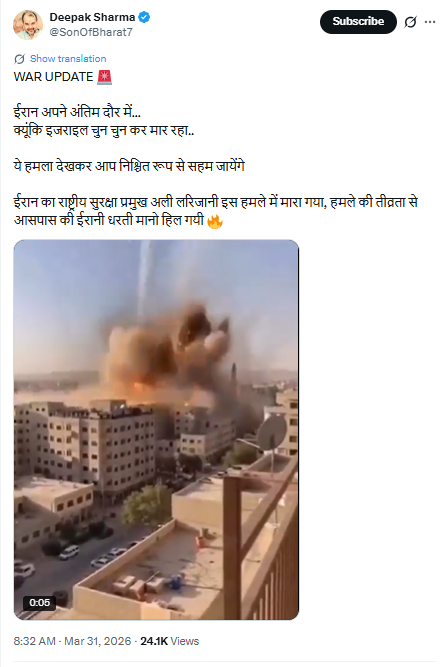
A video is rapidly circulating on social media following claims that Iran’s national security chief Ali Larijani was killed in an Israeli airstrike. The viral clip is being shared with the assertion that it shows the moment Israel launched a powerful attack on Iran to eliminate Larijani, allegedly shaking the ground due to the intensity of the strike However, research by CyberPeace has found the claim to be misleading. The viral video is AI-generated and has no connection to real-world events.
Claim:
Social media users have shared the video with alarming captions. One such post by Deepak Sharma reads:
“WAR UPDATE… Iran is in its final phase… Israel is striking selectively… This attack will leave you shocked… Iran’s national security chief Ali Larijani has been killed in this attack… The intensity of the strike shook the Iranian الأرض.
Post links:
Similar videos were also shared by other users:
- urabh_raj3026/status/2038834832869032026
- https://x.com/ibmindia20/status/2038938020154597447
- https://x.com/Saurabh_raj3026/status/2038834832869032026
Fact Check
To verify the claim, we extracted keyframes from the viral video and conducted a reverse image search. During this process, we found the same video on Instagram, uploaded on March 9, 2026, by the account “_iranwar_2026” without any descriptive caption.
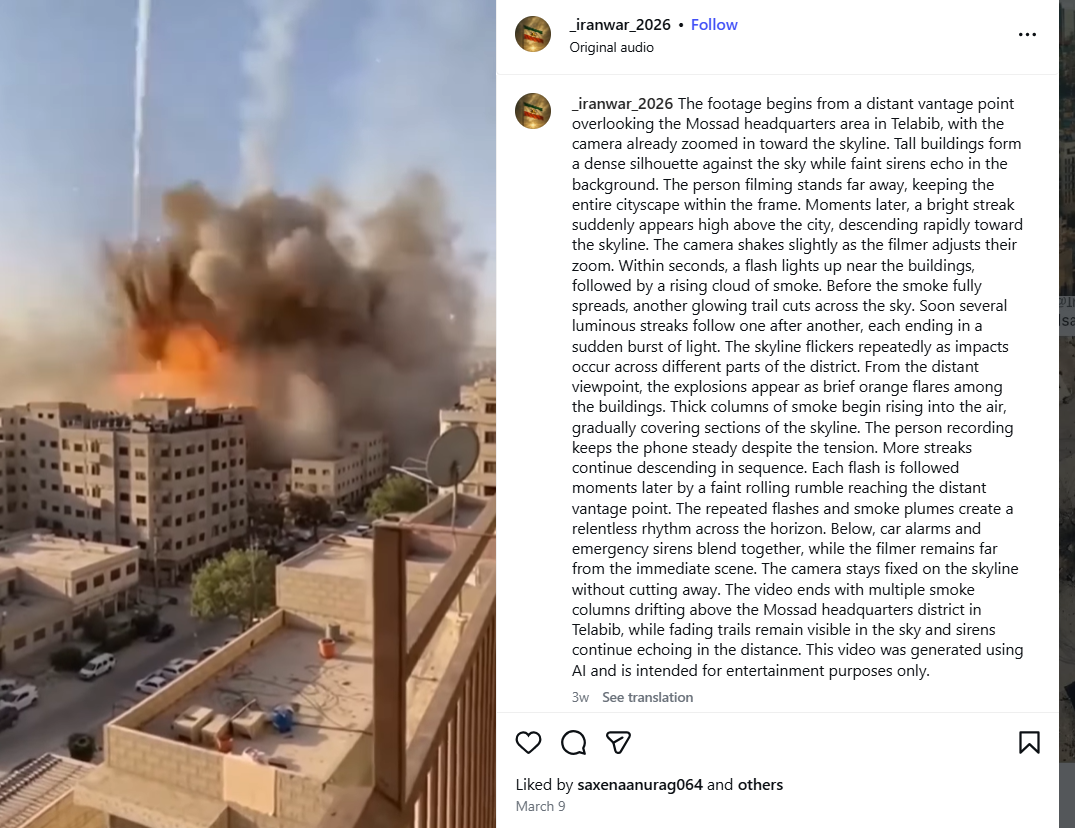
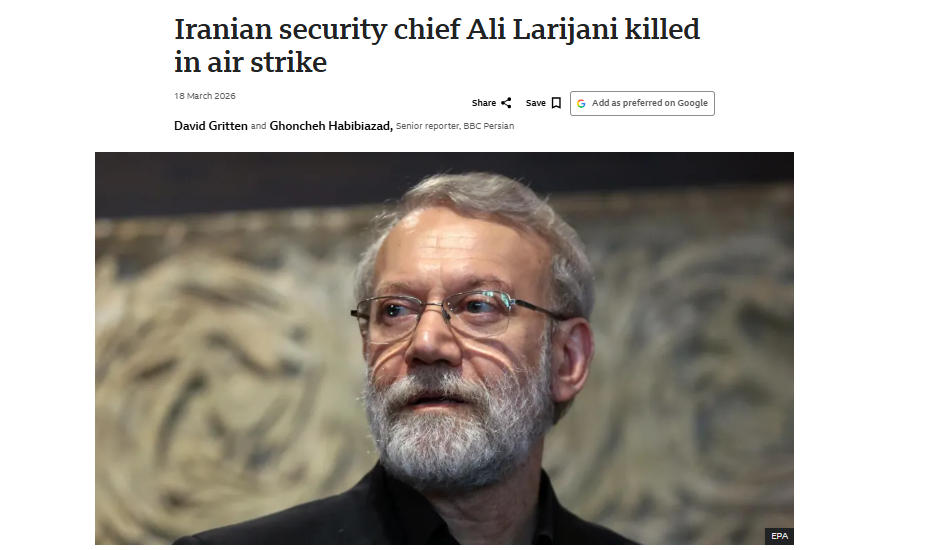
According to a BBC report, Ali Larijani died on March 17 in an Israeli strike. This establishes that the viral video predates the reported incident, making the claim factually inconsistent. Further examination of the Instagram account revealed that it frequently shares pro-Iran content, including gaming visuals and AI-generated clips, raising doubts about the authenticity of the video.
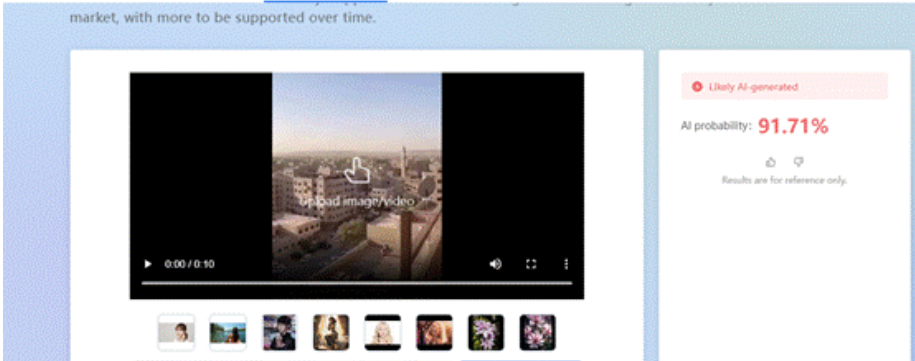
To strengthen the verification, we analyzed the viral clip using the AI detection tool “Zhuque AI Detection Assistant.” The results indicated a 91.71% probability that the video is AI-generated, confirming that it is not real footage.
Conclusion
The viral claim linking the video to an Israeli airstrike that allegedly killed Ali Larijani is misleading and factually incorrect. Multiple layers of verification show that the video existed online before the reported incident, ruling out any direct connection. Additionally, AI detection analysis strongly suggests that the video is artificially generated. The source account’s pattern of sharing AI and gaming-related content further weakens the credibility of the claim. There is no verified evidence to support that the viral clip depicts a real attack or any event related to Larijani’s death. Instead, the video appears to be a digitally created visual circulated without context to amplify misinformation.

Related Blogs

Amid the popularity of OpenAI’s ChatGPT and Google’s announcement of introducing its own Artificial Intelligence chatbot called Bard, there has been much discussion over how such tools can impact India at a time when the country is aiming for an AI revolution.
During the Budget Session, Finance Minister Nirmala Sitharaman talked about AI, while her colleague, Minister of State (MoS) for Electronics and Information Technology Rajeev Chandrasekhar discussed it at the India Stack Developer Conference.
While Sitharaman stated that the government will establish three centres of excellence in AI in the country, Chandrashekhar at the event mentioned that India Stack, which includes digital solutions like Aadhaar, Digilocker and others, will become more sophisticated over time with the inclusion of AI.
As AI chatbots become the buzzword, News18 discusses with experts how such tech tools will impact India.
AI IN INDIA
Many experts believe that in a country like India, which is extremely diverse in nature and has a sizeable population, the introduction of technologies and their right adoption can bring a massive digital revolution.
For example, Manoj Gupta, Cofounder of Plotch.ai, a full-stack AI-enabled SaaS product, told News18 that Bard is still experimental and not open to everyone to use while ChatGPT is available and can be used to build applications on top of it.
He said: “Conversational chatbots are interesting since they have the potential to automate customer support and assisted buying in e-commerce. Even simple banking applications can be built that can use ChatGPT AI models to answer queries like bank balance, service requests etc.”
According to him, such tools could be extremely useful for people who are currently excluded from the digital economy due to language barriers.
Ashwini Vaishnaw, Union Minister for Communications, Electronics & IT, has also talked about using such tools to reduce communication issues. At World Economic Forum in Davos, he said: “We integrated our Bhashini language AI tool, which translates from one Indian language to another Indian language in real-time, spoken and text everything. We integrated that with ChatGPT and are seeing very good results.”
‘DOUBLE-EDGED SWORD’
Sundar Balasubramanian, Managing Director, India & SAARC, at Check Point Software, told News18 that generative AI like ChatGPT is a “double-edged sword”.
According to him, used in the right way, it can help developers write and fix code quicker, enable better chat services for companies, or even be a replacement for search engines, revolutionising the way people search for information.
“On the flip side, hackers are also leveraging ChatGPT to accelerate their bad acts and we have already seen examples of such exploitations. ChatGPT has lowered the bar for novice hackers to enter the field as they are able to learn quicker and hack better through asking the AI tool for answers,” he added.
Balasubramanian also stated that CPR has seen the quality of phishing emails improve tremendously over the past 3 months, making it increasingly difficult to discern between legitimate sources and a targeted phishing scam.
“Despite the emergence of the use of generative AI impacting cybercrime, Check Point is continually reminding organisations and individuals of the significance of being vigilant as ChatGPT and Codex become more mature, it can affect the threat landscape, for both good and bad,” he added.
While the real-life applications of ChatGPT include several things ranging from language translation to explaining tricky math problems, Balasubramanian said it can also be used for making the work of cyber researchers and developers more efficient.
“Generative AI or tools like ChatGPT can be used to detect potential threats by analysing large amounts of data and identifying patterns that may indicate malicious activity. This can help enterprises quickly identify and respond to a potential threat before it escalates to something more,” he added.
POSITIVE FACTORS
Major Vineet Kumar, Founder and Global President of CyberPeace Foundation, believes that the deployment of AI chatbots has proven to be highly beneficial in India, where a booming economy and increasing demand for efficient customer service have led to a surge in their use. According to him, both ChatGPT and Bard have the potential to bring significant positive change to various industries and individuals in India.
“ChatGPT has already made an impact by revolutionising customer service, providing instant and accurate support, and reducing wait time. It has automated tedious and complicated tasks for businesses and educational institutions, freeing up valuable time for more significant activities. In the education sector, ChatGPT has also improved learning experiences by providing quick and reliable information to students and educators,” he added.
He also said there are several possible positive impacts that the AI chatbots, ChatGPT and Bard, could have in India and these include improved customer experience, increased productivity, better access to information, improved healthcare, improved access to education and better financial services.
Reference Link : https://www.news18.com/news/explainers/confused-about-chatgpt-bard-experts-tell-news18-how-openai-googles-ai-chatbots-may-impact-india-7026277.html

Executive Summary:
A fake photo claiming to show the cricketer Virat Kohli watching a press conference by Rahul Gandhi before a match, has been widely shared on social media. The original photo shows Kohli on his phone with no trace of Gandhi. The incident is claimed to have happened on March 21, 2024, before Kohli's team, Royal Challengers Bangalore (RCB), played Chennai Super Kings (CSK) in the Indian Premier League (IPL). Many Social Media accounts spread the false image and made it viral.

Claims:
The viral photo falsely claims Indian cricketer Virat Kohli was watching a press conference by Congress leader Rahul Gandhi on his phone before an IPL match. Many Social media handlers shared it to suggest Kohli's interest in politics. The photo was shared on various platforms including some online news websites.


Fact Check:
After we came across the viral image posted by social media users, we ran a reverse image search of the viral image. Then we landed on the original image posted by an Instagram account named virat__.forever_ on 21 March.

The caption of the Instagram post reads, “VIRAT KOHLI CHILLING BEFORE THE SHOOT FOR JIO ADVERTISEMENT COMMENCE.❤️”

Evidently, there is no image of Congress Leader Rahul Gandhi on the Phone of Virat Kohli. Moreover, the viral image was published after the original image, which was posted on March 21.

Therefore, it’s apparent that the viral image has been altered, borrowing the original image which was shared on March 21.
Conclusion:
To sum up, the Viral Image is altered from the original image, the original image caption tells Cricketer Virat Kohli chilling Before the Jio Advertisement commences but not watching any politician Interview. This shows that in the age of social media, where false information can spread quickly, critical thinking and fact-checking are more important than ever. It is crucial to check if something is real before sharing it, to avoid spreading false stories.

Introduction
In today’s time, everything is online, and the world is interconnected. Cases of data breaches and cyberattacks have been a reality for various organisations and industries, In the recent case (of SAS), Scandinavian Airlines experienced a cyberattack that resulted in the exposure of customer details, highlighting the critical importance of preventing customer privacy. The incident is a wake-up call for Airlines and businesses to evaluate their cyber security measures and learn valuable lessons to safeguard customers’ data. In this blog, we will explore the incident and discuss the strategies for protecting customers’ privacy in this age of digitalisation.
Analysing the backdrop
The incident has been a shocker for the aviation industry, SAS Scandinavian Airlines has been a victim of a cyberattack that compromised consumer data. Let’s understand the motive of cyber crooks and the technique they used :
Motive Behind the Attack: Understanding the reasons that may have driven the criminals is critical to comprehending the context of the Scandinavian Airlines cyber assault. Financial gain, geopolitical conflicts, activism, or personal vendettas are common motivators for cybercriminals. Identifying the purpose of the assault can provide insight into the attacker’s aims and the possible impact on both the targeted organisation and its consumers. Understanding the attack vector and strategies used by cyber attackers reveals the amount of complexity and possible weaknesses in an organisation’s cybersecurity defences. Scandinavian Airlines’ cyber assault might have included phishing, spyware, ransomware, or exploiting software weaknesses. Analysing these tactics allows organisations to strengthen their security against similar assaults.
Impact on Victims: The Scandinavian Airlines (SAS) cyber attack victims, including customers and individuals related to the company, have suffered substantial consequences. Data breaches and cyber-attack have serious consequences due to the leak of personal information.
1)Financial Losses and Fraudulent Activities: One of the most immediate and upsetting consequences of a cyber assault is the possibility of financial loss. Exposed personal information, such as credit card numbers, can be used by hackers to carry out illegal activities such as unauthorised transactions and identity theft. Victims may experience financial difficulties and the need to spend time and money resolving these concerns.
2)Concerns about privacy and personal security: A breach of personal data can significantly impact the privacy and personal security of victims. The disclosed information, including names, addresses, and contact information, might be exploited for nefarious reasons, such as targeted phishing or physical harassment. Victims may have increased anxiety about their safety and privacy, which can interrupt their everyday life and create mental pain.
3) Reputational Damage and Trust Issues: The cyber attack may cause reputational harm to persons linked with Scandinavian Airlines, such as workers or partners. The breach may diminish consumers’ and stakeholders’ faith in the organisation, leading to a bad view of its capacity to protect personal information. This lack of trust might have long-term consequences for the impacted people’s professional and personal relationships.
4) Emotional Stress and Psychological Impact: The psychological impact of a cyber assault can be severe. Fear, worry, and a sense of violation induced by having personal information exposed can create emotional stress and psychological suffering. Victims may experience emotions of vulnerability, loss of control, and distrust toward digital platforms, potentially harming their overall quality of life.
5) Time and Effort Required for Remediation: Addressing the repercussions of a cyber assault demands significant time and effort from the victims. They may need to call financial institutions, reset passwords, monitor accounts for unusual activity, and use credit monitoring services. Resolving the consequences of a data breach may be a difficult and time-consuming process, adding stress and inconvenience to the victims’ lives.
6) Secondary Impacts: The impacts of an online attack could continue beyond the immediate implications. Future repercussions for victims may include trouble acquiring credit or insurance, difficulties finding future work, and continuous worry about exploiting their personal information. These secondary effects can seriously affect victims’ financial and general well-being.
Apart from this, the trust lost would take time to rebuild.

Takeaways from this attack
The cyber-attack on Scandinavian Airlines (SAS) is a sharp reminder of cybercrime’s ever-present and increasing menace. This event provides crucial insights that businesses and people may use to strengthen cybersecurity defences. In the lessons that were learned from the Scandinavian Airlines cyber assault and examine the steps that may be taken to improve cybersecurity and reduce future risks. Some of the key points that can be considered are as follows:
Proactive Risk Assessment and Vulnerability Management: The cyber assault on Scandinavian Airlines emphasises the significance of regular risk assessments and vulnerability management. Organisations must proactively identify and fix possible system and network vulnerabilities. Regular security audits, penetration testing, and vulnerability assessments can help identify flaws before bad actors exploit them.
Strong security measures and best practices: To guard against cyber attacks, it is necessary to implement effective security measures and follow cybersecurity best practices. Lessons from the Scandinavian Airlines cyber assault emphasise the importance of effective firewalls, up-to-date antivirus software, secure setups, frequent software patching, and strong password rules. Using multi-factor authentication and encryption technologies for sensitive data can also considerably improve security.
Employee Training and Awareness: Human mistake is frequently a big component in cyber assaults. Organisations should prioritise employee training and awareness programs to educate employees about phishing schemes, social engineering methods, and safe internet practices. Employees may become the first line of defence against possible attacks by cultivating a culture of cybersecurity awareness.
Data Protection and Privacy Measures: Protecting consumer data should be a key priority for businesses. Lessons from the Scandinavian Airlines cyber assault emphasise the significance of having effective data protection measures, such as encryption and access limits. Adhering to data privacy standards and maintaining safe data storage and transfer can reduce the risks connected with data breaches.
Collaboration and Information Sharing: The Scandinavian Airlines cyber assault emphasises the need for collaboration and information sharing among the cybersecurity community. Organisations should actively share threat intelligence, cooperate with industry partners, and stay current on developing cyber threats. Sharing information and experiences can help to build the collective defence against cybercrime.
Conclusion
The Scandinavian Airlines cyber assault is a reminder that cybersecurity must be a key concern for organisations and people. Organisations may improve their cybersecurity safeguards, proactively discover vulnerabilities, and respond effectively to prospective attacks by learning from this occurrence and adopting the lessons learned. Building a strong cybersecurity culture, frequently upgrading security practices, and encouraging cooperation within the cybersecurity community are all critical steps toward a more robust digital world. We may aim to keep one step ahead of thieves and preserve our important information assets by constantly monitoring and taking proactive actions.
