
#FactCheck - Viral Video Claiming Iran’s Attack on US Airbase Debunked as 9/11 Footage
Executive Summary
A video showing thick smoke rising from a building and people running in panic is being shared on social media. The video is being circulated with the claim that it shows Iran launching a missile attack on the United States.CyberPeace’s research found the claim to be misleading. Our probe revealed that the video is not related to any recent incident. The viral clip is actually from the September 11, 2001 terrorist attacks on the World Trade Center in the United States and is being falsely shared as footage of an alleged Iranian missile strike on the US.
Claim:
An Instagram user shared the video claiming, “Iran has attacked a US airbase in Qatar. Iran has fired six ballistic missiles at the Al Udeid Airbase in Qatar. Al Udeid Airbase is the largest US military base in West Asia.”
Links to the post and its archived version are provided below.

Fact Check:
To verify the claim, we extracted key frames from the viral video and ran a reverse image search using Google Lens. During the search, we found visuals matching the viral clip in a report published by Wion on September 11, 2021. The report, titled “In pics | A look back at the scenes from the 9/11 attacks,” included an image that closely resembled the visuals seen in the viral video. The caption of the image stated that it was a file photo from September 11, 2001, showing pedestrians running as one of the World Trade Center towers collapsed in New York City.

Further research led us to the same footage on the YouTube channel CBS 8 San Diego. At the 01:11 timestamp of the video, visuals matching the viral clip can be clearly seen.

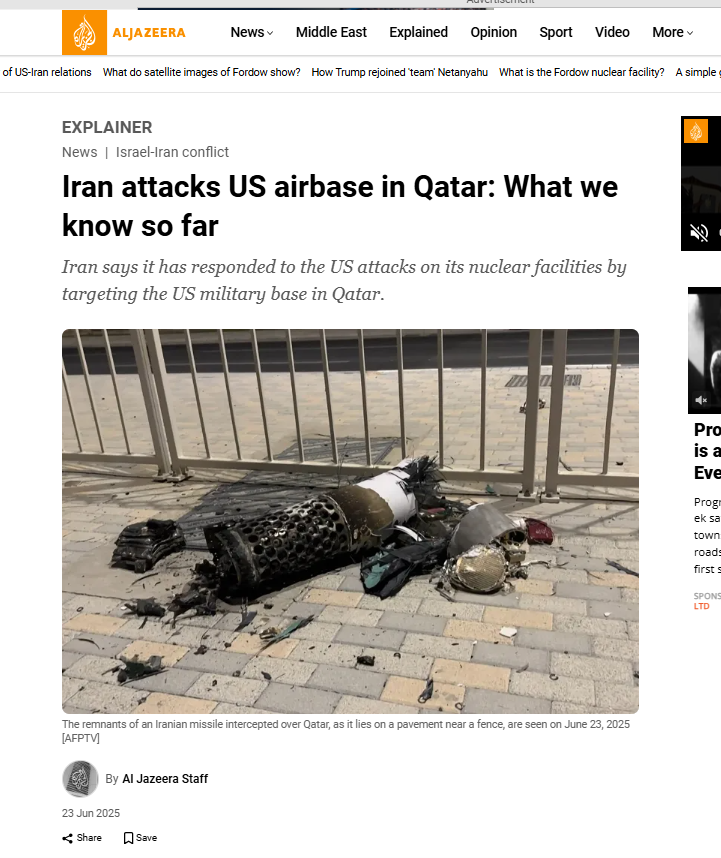
We also found an Al Jazeera report dated June 23, 2025, which confirmed that Iran had attacked US forces stationed at the Al Udeid airbase in Qatar in retaliation for US strikes on Iran’s uclear facilities. However, the visuals used in the viral video do not correspond to this incident.
Conclusion
The viral video does not show a recent Iranian attack on a US airbase in Qatar. The clip actually dates back to the September 11, 2001 terrorist attacks on the World Trade Center in the United States. Old 9/11 footage has been falsely shared with a misleading claim linking it to Iran’s alleged missile strike on the US.

Related Blogs
The Expanding Governance Challenge of Artificial Intelligence
Artificial intelligence (AI) systems are increasingly embedded in economic and social infrastructure. They are being adopted in financial services, healthcare diagnostics, hiring systems, and public administration. But while these systems improve efficiency and decision-making, they also introduce new forms of technological risk.
Unlike conventional software, AI systems learn patterns from data and continue to evolve as they run. This poses governance issues since risks can arise throughout the AI life cycle, whether at the coding level or in their implementation.
The latest regulatory frameworks, such as the European Union’s AI Act (EU AI Act) and the UNESCO Recommendation on the Ethics of Artificial Intelligence, note that responsible AI governance depends on the realisation of where risks emerge across the development process.
This article maps the AI system lifecycle, identifies the risks that emerge at each stage and evaluates the policy tools used to mitigate them using the lifecycle framework developed by the Organisation of Economic Co-operation and Development (OECD).
The Lifecycle of an AI System
AI systems are developed through a structured process that includes problem definition, dataset collection and preparation, model development, testing and validation, deployment, and monitoring.
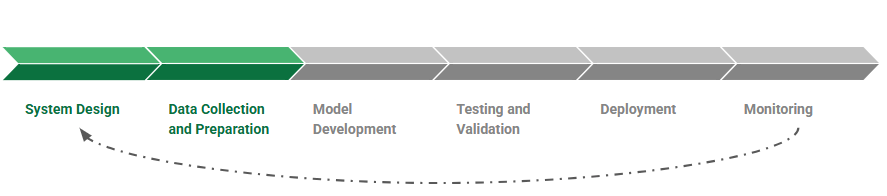
The OECD conceptualises this development process as the AI system lifecycle. Each stage entails various technical and administrative procedures, since choices made during these stages will dictate the goals and limits of an AI system. Further, the quality and representativeness of training sets will have a strong effect on the behaviour of models after implementation.
Since this is an iterative and not a linear procedure, risks can be introduced at each stage of the AI lifecycle. New data can be retrained into different models, and systems are regularly updated once they have been deployed, to address performance degradation, model errors, or unintended outputs. This iterative process means governance must address risks across the entire lifecycle, not just at deployment.
Where AI Risks Emerge
AI risks usually emerge earlier in the development process, especially in the phases when system objectives are formulated and training data are chosen. The EU AI Act and the UNESCO Recommendation on the Ethics of AI outline the following risks: bias and discrimination, privacy and data security violations, the absence of transparency in automated decision-making, and risks to fundamental rights.
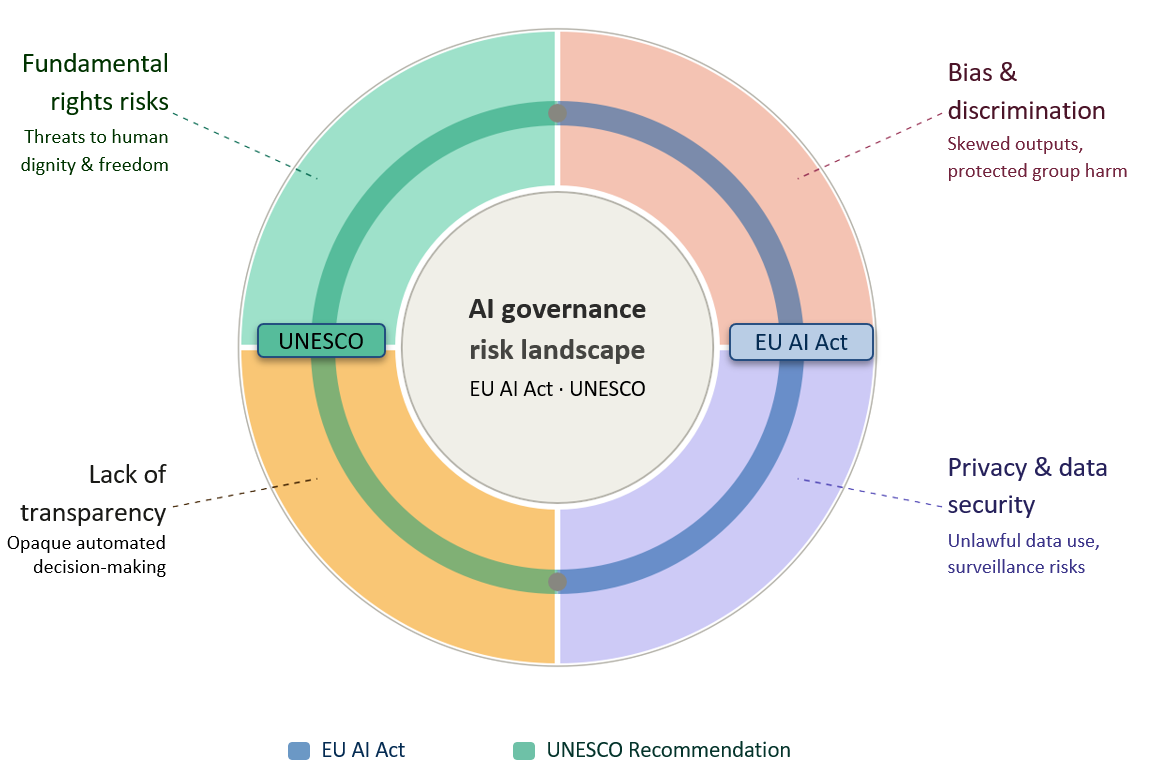
AI Governance Risk Landscape: Core Risk Categories Under International Frameworks
Risk categories jointly identified by the EU AI Act and UNESCO Recommendation on the Ethics of Artificial Intelligence
Outlining the risks throughout the AI lifecycle helps understand the areas where governance interventions are most necessary. For example, discriminatory outcomes often result from biased or unrepresentative training data, while safety failures are typically linked to inadequate testing before deployment. Risks such as misinformation arise post the development process, when generative AI systems are deployed at scale on digital platforms.
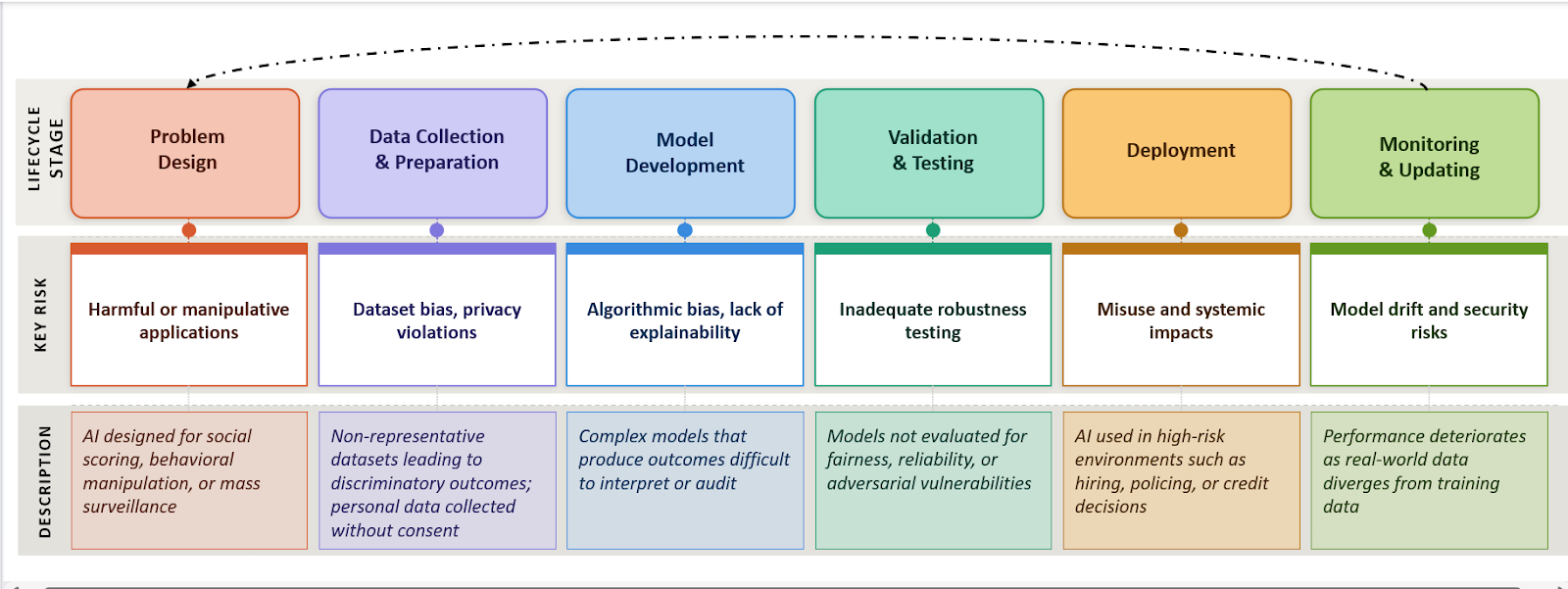
AI System Lifecycle: Key Risks at Each Stage
Risks identified per the EU AI Act and UNESCO Recommendation on the Ethics of AI
Understanding where risks emerge across the lifecycle explains why governance frameworks classify AI systems by risk and apply oversight at multiple stages.
Policy Tools for Mitigating AI Risks
Governments and international organisations have developed regulatory tools to help mitigate AI risks in the lifecycle. These tools are meant to make sure that AI technologies are identified as up to standard in safety, accountability and fairness prior to and after deployment.
For example, the OECD AI Policy Observatory recommends that governments adopt policy instruments such as risk evaluations, algorithmic auditing necessities, regulatory sandboxes, and transparency necessities of AI systems. The European Union’s Artificial Intelligence Act (AI Act) is one of the most comprehensive systems of governance that introduces a risk-oriented regulation strategy. It mandates adherence to requirements concerning data governance, documentation, human oversight, and robustness, and cybersecurity. Such requirements bring regulatory checkpoints to the lifecycle of AI systems.
Mapping these policy tools across the lifecycle illustrates how governance mechanisms can intervene at different stages of AI development.
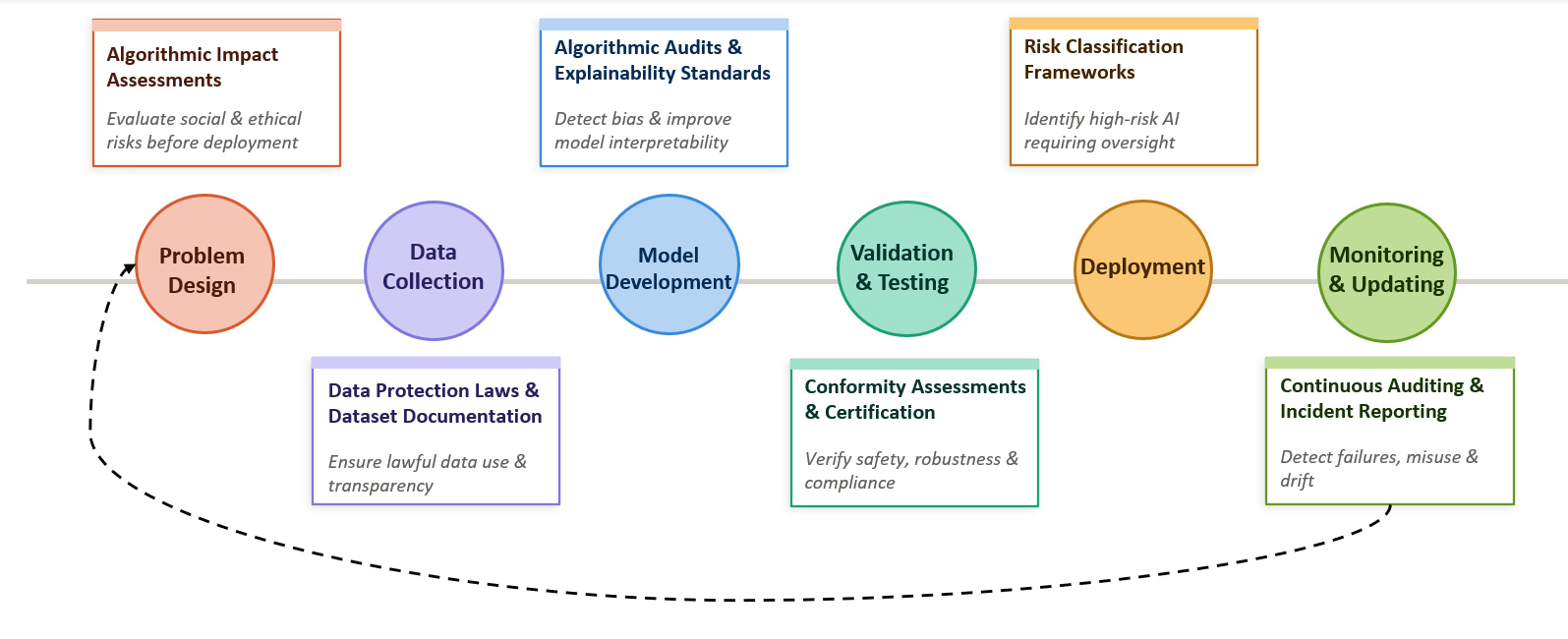
Governance Overlay: Policy Interventions Across the AI Lifecycle
Regulatory tools mapped at each stage of AI development per the EU AI Act and UNESCO Recommendation on the Ethics of AI
Several policy tools are directed at the risks that occur in the pre-developmental stages. In one example, algorithmic impact assessment has been applied in various jurisdictions to measure the possible consequences of automated decision systems on society before implementation. On the same note, the requirements of dataset documentation, including dataset transparency requirements and model cards, are aimed at enhancing accountability during the training and development stages of the AI systems. Therefore, lifecycle-based policy design allows regulators to intervene before harmful outcomes occur, rather than responding only after AI systems have caused damage in real-world environments.
The Policy Gap in AI Governance
The misalignment between risks and governance tools across the AI lifecycle indicates a critical structural gap in existing regulations. Numerous governance processes become activated after AI systems are classified as “high risk” or after they are implemented in the real world. But the most serious sources of damage have their roots in earlier stages of the development procedure.
An example is that prejudiced or unbalanced training data is almost inevitably a source of discriminative results in automated decision systems. When these types of models are applied in areas like staffing, credit rating, or in providing services to the public, such biases can quickly spread to large populations and undermine democratic rights. In the same way, the lack of transparency in model design might result in the fact that the regulator or individuals are affected by the decision-making process. This reflects a broader timing gap in AI governance, where risks originate during design and development, but regulatory intervention typically occurs only after deployment.
Analysis
1. Key risks originate before deployment: As depicted in the lifecycle mapping, the data collection and model development phase presents several significant governance risks as opposed to the deployment phase. Structural issues can be entrenched within AI systems even before they are deployed in practice due to bias in data sets, incomplete reporting of training sets, and obscured network designs.
2. Data governance is a primary point of vulnerability: Most of the instances of algorithmic discrimination listed above are associated with training material that is not representative of some population groups or is historical. Since machine learning models are optimisations of patterns that exist in datasets, these biases can be carried through the whole lifecycle and reproduced after deployment.
3. Regulatory approaches remain mismatched across jurisdictions: Different countries adopt varying approaches to AI governance, ranging from risk-based frameworks such as the EU AI Act to more sector-specific or voluntary guidelines in other regions. This divergence creates inconsistencies in safety, accountability, and enforcement standards, allowing risks to persist across borders and potentially undermining the protection of users in globally deployed AI systems.
4. Governance interventions remain uneven across the lifecycle: Whereas the various regulatory instruments aim at deployment and monitoring, fewer instruments systematically tackle the risks that are posed by the previous design and development phases.
Recommendations
1. Introduce mandatory lifecycle risk assessments: The regulatory systems need to demand systemic risk evaluation at the beginning of AI development, especially at the problem design and dataset selection phases. This would assist in detecting possible harmful applications in advance, before systems are constructed and installed.
2. Strengthen dataset governance standards: Training datasets must be supplemented with documentation as to their provenance, composition and limitations. Standardised documentation frameworks of data sets can assist in the discovery by regulators and auditors of the potential sources of bias or privacy threats.
3. Expand independent algorithmic auditing: AI systems can be assessed by regular third-party audits based on fairness, strength, and security weaknesses. The auditing mechanisms especially apply to high-risk systems employed in employment, finance or the public services.
4. Integrate continuous monitoring requirements: AI systems may be monitored regularly after implementation to identify model drift, unforeseen consequences, or abuse. Reporting systems can facilitate the process where the regulators can see the emerging risks and modify the governance systems.
Conclusion - The Need for Global AI Governance
Despite growing regulatory attention, global air governance remains fragmented. Different jurisdictions adopt varying approaches to risk classification, oversight, and enforcement, leading to inconsistencies in safety and accountability standards. Given that AI systems are often developed, deployed, and used across borders, this lack of coordination allows risks to persist beyond national regulatory frameworks.
Addressing these challenges requires a shift towards greater international cooperation and lifecycle-based governance. Developing shared standards, improving cross-border regulatory alignment, and embedding oversight across all stages of AI development will be essential to ensuring that AI systems are safe, transparent, and accountable in a globally interconnected environment.
References
- OECD AI lifecycle
- OECD AI system lifecycle description
- OECD AI governance lifecycle framework
- EU AI Act overview
- EU AI Act risk categories
- UNESCO Recommendation on the Ethics of AI
- AI governance lifecycle analysis
- OECD AI policy tools database

Introduction
In a world where social media dictates public perception and content created by AI dilutes the difference between fact and fiction, mis/disinformation has become a national cybersecurity threat. Today, disinformation campaigns are designed for their effect, with political manipulation, interference in public health, financial fraud, and even community violence. India, with its 900+ million internet users, is especially susceptible to this distortion online. The advent of deep fakes, AI-text, and hyper-personalised propaganda has made disinformation more plausible and more difficult to identify than ever.
What is Misinformation?
Misinformation is false or inaccurate information provided without intent to deceive. Disinformation, on the other hand, is content intentionally designed to mislead and created and disseminated to harm or manipulate. Both are responsible for what experts have termed an "infodemic", overwhelming people with a deluge of false information that hinders their ability to make decisions.
Examples of impactful mis/disinformation are:
- COVID-19 vaccine conspiracy theories (e.g., infertility or microchips)
- Election-related false news (e.g., EVM hacking so-called)
- Social disinformation (e.g., manipulated videos of riots)
- Financial scams (e.g., bogus UPI cashbacks or RBI refund plans)
How Misinformation Spreads
Misinformation goes viral because of both technology design and human psychology. Social media sites such as Facebook, X (formerly Twitter), Instagram, and WhatsApp are designed to amplify messages that elicit high levels of emotional reactions are usually polarising, sensationalistic, or fear-mongering posts. This causes falsehoods or misinformation to get much more attention and activity than authentic facts, and therefore prioritises virality over truth.
Another major consideration is the misuse of generative AI and deep fakes. Applications like ChatGPT, Midjourney, and ElevenLabs can be used to generate highly convincing fake news stories, audio recordings, or videos imitating public figures. These synthetic media assets are increasingly being misused by bad actors for political impersonation, propagating fabricated news reports, and even carrying out voice-based scams.
To this danger are added coordinated disinformation efforts that are commonly operated by foreign or domestic players with certain political or ideological objectives. These efforts employ networks of bot networks on social media, deceptive hashtags, and fabricated images to sway public opinion, especially during politically sensitive events such as elections, protests, or foreign wars. Such efforts are usually automated with the help of bots and meme-driven propaganda, which makes them scalable and traceless.
Why Misinformation is Dangerous
Mis/disinformation is a significant threat to democratic stability, public health, and personal security. Perhaps one of the most pernicious threats is that it undermines public trust. If it goes unchecked, then it destroys trust in core institutions like the media, judiciary, and electoral system. This erosion of public trust has the potential to destabilise democracies and heighten political polarisation.
In India, false information has had terrible real-world outcomes, especially in terms of creating violence. Misleading messages regarding child kidnappers on WhatsApp have resulted in rural mob lynching. As well, communal riots have been sparked due to manipulated religious videos, and false terrorist warnings have created public panic.
The pandemic of COVID-19 also showed us how misinformation can be lethal. Misinformation regarding vaccine safety, miracle cures, and the source of viruses resulted in mass vaccine hesitancy, utilisation of dangerous treatments, and even avoidable deaths.
Aside from health and safety, mis/disinformation has also been used in financial scams. Cybercriminals take advantage of the fear and curiosity of the people by promoting false investment opportunities, phishing URLs, and impersonation cons. Victims get tricked into sharing confidential information or remitting money using seemingly official government or bank websites, leading to losses in crypto Ponzi schemes, UPI scams, and others.
India’s Response to Misinformation
- PIB Fact Check Unit
The Press Information Bureau (PIB) operates a fact-checking service to debunk viral false information, particularly on government policies. In 3 years, the unit identified more than 1,500 misinformation posts across media.
- Indian Cybercrime Coordination Centre (I4C)
Working under MHA, I4C has collaborated with social media platforms to identify sources of viral misinformation. Through the Cyber Tipline, citizens can report misleading content through 1930 or cybercrime.gov.in.
- IT Rules (The Information Technology (Intermediary Guidelines and Digital Media Ethics Code) Rules, 2021 [updated as on 6.4.2023]
The Information Technology (Intermediary Guidelines) Rules were updated to enable the government to following aspects:
- Removal of unlawful content
- Platform accountability
- Detection Tools
There are certain detection tool that works as shields in assisting fact-checkers and enforcement bodies to:
- Identify synthetic voice and video scams through technical measures.
- Track misinformation networks.
- Label manipulated media in real-time.
CyberPeace View: Solutions for a Misinformation-Resilient Bharat
- Scale Digital Literacy
"Think Before You Share" programs for rural schools to teach students to check sources, identify clickbait, and not reshare fake news.
- Platform Accountability
Technology platforms need to:
- Flag manipulated media.
- Offer algorithmic transparency.
- Mark AI-created media.
- Provide localised fact-checking across diverse Indian languages.
- Community-Led Verification
Establish WhatsApp and Telegram "Fact Check Hubs" headed by expert organisations, industry experts, journalists, and digital volunteers who can report at the grassroots level fake content.
- Legal Framework for Deepfakes
Formulate targeted legislation under the Bhartiya Nyaya Sanhita (BNS) and other relevant laws to make malicious deepfake and synthetic media use a criminal offense for:
- Electoral manipulation.
- Defamation.
- Financial scams.
- AI Counter-Misinformation Infrastructure
Invest in public sector AI models trained specifically to identify:
- Coordinated disinformation patterns.
- Botnet-driven hashtag campaigns.
- Real-time viral fake news bursts.
Conclusion
Mis/disinformation is more than just a content issue, it's a public health, cybersecurity, and democratic stability challenge. As India enters the digitally empowered world, making a secure, informed, and resilient information ecosystem is no longer a choice; now, it's imperative. Fighting misinformation demands a whole-of-society effort with AI innovation, public education, regulatory overhaul, and tech responsibility. The danger is there, but so is the opportunity to guide the world toward a fact-first, trust-based digital age. It's time to act.
References
- https://www.pib.gov.in/factcheck.aspx
- https://www.meity.gov.in/static/uploads/2024/02/Information-Technology-Intermediary-Guidelines-and-Digital-Media-Ethics-Code-Rules-2021-updated-06.04.2023-.pdf
- https://www.cyberpeace.org
- https://www.bbc.com/news/topics/cezwr3d2085t
- https://www.logically.ai
- https://www.altnews.in

Executive Summary:
A misleading video of a child covered in ash allegedly circulating as the evidence for attacks against Hindu minorities in Bangladesh. However, the investigation revealed that the video is actually from Gaza, Palestine, and was filmed following an Israeli airstrike in July 2024. The claim linking the video to Bangladesh is false and misleading.

Claims:
A viral video claims to show a child in Bangladesh covered in ash as evidence of attacks on Hindu minorities.

Fact Check:
Upon receiving the viral posts, we conducted a Google Lens search on keyframes of the video, which led us to a X post posted by Quds News Network. The report identified the video as footage from Gaza, Palestine, specifically capturing the aftermath of an Israeli airstrike on the Nuseirat refugee camp in July 2024.
The caption of the post reads, “Journalist Hani Mahmoud reports on the deadly Israeli attack yesterday which targeted a UN school in Nuseirat, killing at least 17 people who were sheltering inside and injuring many more.”

To further verify, we examined the video footage where the watermark of Al Jazeera News media could be seen, We found the same post posted on the Instagram account on 14 July, 2024 where we confirmed that the child in the video had survived a massacre caused by the Israeli airstrike on a school shelter in Gaza.

Additionally, we found the same video uploaded to CBS News' YouTube channel, where it was clearly captioned as "Video captures aftermath of Israeli airstrike in Gaza", further confirming its true origin.

We found no credible reports or evidence were found linking this video to any incidents in Bangladesh. This clearly implies that the viral video was falsely attributed to Bangladesh.
Conclusion:
The video circulating on social media which shows a child covered in ash as the evidence of attack against Hindu minorities is false and misleading. The investigation leads that the video originally originated from Gaza, Palestine and documents the aftermath of an Israeli air strike in July 2024.
- Claims: A video shows a child in Bangladesh covered in ash as evidence of attacks on Hindu minorities.
- Claimed by: Facebook
- Fact Check: False & Misleading
