
#FactCheck -Old Karnataka Video Falsely Linked to Holi Celebrations on Eid in Delhi
Executive Summary
A video is being shared on social media showing a group of people dancing on a road while carrying saffron flags. A mosque can also be seen nearby in the video Sharing this clip, some users are claiming that it is from Uttam Nagar in Delhi, where members of the Hindu community celebrated Holi on the occasion of Eid on March 21. Research by the CyberPeace found the viral claim to be misleading. Our probe revealed that the video is not related to Holi celebrations on Eid in Uttam Nagar, Delhi. In fact, the video has been available on the internet since 2024 and is said to be from Raichur district in Karnataka. Several users have shared it claiming that it was recorded during Ganesh Chaturthi celebrations.
Claim:
A social media user shared the viral video on March 21, 2026, with a misleading claim. The link and archive link of the post are given below.

Fact Check:
To verify the viral claim, we first conducted a keyword search on Google. However, we did not find any credible media report supporting the claim. In the next step, we extracted keyframes from the video and performed a reverse search using Google Lens. During this process, we found the same video on an Instagram account, which was posted on September 23, 2024.

The user had captioned the video as “Ganesh Chaturthi 2024,” suggesting that the clip is related to the festival. Further, upon closely analyzing the video, we noticed that the mosque visible in the background had “Usmania Masjid” written on it. We then searched for this location on Google Maps and found that the mosque is located on Teen Khandil Road in Raichur, Karnataka, which matches the visuals seen in the viral clip.

Conclusion:
Our research found that the video is not from Uttam Nagar, Delhi, nor is it related to Holi celebrations on Eid. The clip has been available online since 2024 and is from Raichur, Karnataka. It has been shared with a misleading claim and is actually linked to Ganesh Chaturthi celebrations.

Related Blogs
Introduction
A policy, no matter how artfully conceived, is like a timeless idiom, its truth self-evident, its purpose undeniable, standing in silent witness before those it vows to protect, yet trapped in the stillness of inaction, where every moment of delay erodes the very justice it was meant to serve. This is the case of the Digital Personal Data Protection Act, 2023, which holds in its promise a resolution to all the issues related to data protection and a protection framework at par with GDPR and Global Best Practices. While debates on its substantive efficacy are inevitable, its execution has emerged as a site of acute contention. The roll-out and the decision-making have been making headlines since late July on various fronts. The government is being questioned by industry stakeholders, media and independent analysts on certain grounds, be it “slow policy execution”, “centralisation of power” or “arbitrary amendments”. The act is now entrenched in a never-ending dilemma of competing interests under the DPDP Act.
The change to the Right to Information Act (RTI), 2005, made possible by Section 44(3) of the DPDP Act, has become a focal point of debate. This amendment is viewed by some as an attack on weakening the hard-won transparency architecture of Indian democracy by substituting an absolute exemption for personal information for the “public interest override” in Section 8(1)(j) of the RTI Act.
The Lag Ledger: Tracking the Delays in DPDP Enforcement
As per a news report of July 28, 2025, the Parliamentary Standing Committee on Information and Communications Technology has expressed its concern over the delayed implementation and has urged the Ministry of Electronics and Information Technology (MeitY) to ensure that data privacy is adequately ensured in the nation. In the report submitted to the Lok Sabha on July 24, the committee reviewed the government’s reaction to the previous recommendations and concluded that MeitY had only been able to hold nine consultations and twenty awareness workshops about the Draft DPDP Rules, 2025. In addition, four brainstorming sessions with academic specialists were conducted to examine the needs for research and development. The ministry acknowledges that this is a specialised field that urgently needs industrial involvement. Another news report dated 30th July, 2025, of a day-long consultation held where representatives from civil society groups, campaigns, social movements, senior lawyers, retired judges, journalists, and lawmakers participated on the contentious and chilling effects of the Draft Rules that were notified in January this year. The organisers said in a press statement the DPDP Act may have a negative impact on the freedom of the press and people’s right to information and the activists, journalists, attorneys, political parties, groups and organisations “who collect, analyse, and disseminate critical information as they become ‘data fiduciaries’ under the law.”
The DPDP Act has thus been caught up in an uncomfortable paradox: praised as a significant legislative achievement for India’s digital future, but caught in a transitional phase between enactment and enforcement, where every day not only postpones protection but also feeds worries about the dwindling amount of room for accountability and transparency.
The Muzzling Effect: Diluting Whistleblower Protections
The DPDP framework raises a number of subtle but significant issues, one of which is the possibility that it would weaken safeguards for whistleblowers. Critics argue that the Act runs the risk of trapping journalists, activists, and public interest actors who handle sensitive material while exposing wrongdoing because it expands the definition of “personal data” and places strict compliance requirements on “data fiduciaries.”One of the most important checks on state overreach may be silenced if those who speak truth to power are subject to legal retaliation in the absence of clear exclusions of robust public-interest protections.
Noted lawyer Prashant Bhushan has criticised the law for failing to protect whistleblowers, warning that “If someone exposes corruption and names officials, they could now be prosecuted for violating the DPDP Act.”
Consent Management under the DPDP Act
In June 2025, the National e-Governance Division (NeGD) under MeitY released a Business Requirement Document (BRD) for developing consent management systems under the DPDP Act, 2023. The document supports the idea of “Consent Manager”, which acts as a single point of contact between Data Principals and Data Fiduciaries. This idea is fundamental to the Act, which is now being operationalised with the help of MeitY’s “Code for Consent: The DPDP Innovation Challenge.” The government has established a collaborative ecosystem to construct consent management systems (CMS) that can serve as a single, standardised interface between Data Principals and Data Fiduciaries by choosing six distinct entities, such as Jio Platforms, IDfy, and Zoop. Such a framework could enable people to have meaningful control over their personal data, lessen consent fatigue, and move India’s consent architecture closer to international standards if it is implemented precisely and transparently.
There is no debate to the importance of this development however, there are various concerns associated with this advancement that must be considered. Although effective, a centralised consent management system may end up being a single point of failure in terms of political overreach and technical cybersecurity flaws. Concerns are raised over the concentration of power over the framing, seeking, and recording of consent when big corporate entities like Jio are chosen as key innovators. Critics contend that the organisations responsible for generating revenue from user data should not be given the responsibility for designing the gatekeeping systems. Furthermore, the CMS can create opaque channels for data access, compromising user autonomy and whistleblower protections, in the absence of strong safeguards, transparency mechanisms and independent oversight.
Conclusion
Despite being hailed as a turning point in India’s digital governance, the DPDP Act is still stuck in a delayed and unequal transition from promise to reality. Its goals are indisputable, but so are the conundrum it poses to accountability, openness, and civil liberties. Every delay increases public mistrust, and every safeguard that remains unsolved. The true test of a policy intended to safeguard the digital rights of millions lies not in how it was drafted, but in the integrity, pace, and transparency with which it is to be implemented. In the digital age, the true cost of delay is measured not in time, but in trust. CyberPeace calls for transparent, inclusive, and timely execution that balances innovation with the protection of digital rights.
References
- https://www.storyboard18.com/how-it-works/parliamentary-committee-raises-concern-with-meity-over-dpdp-act-implementation-lag-77105.htm
- https://thewire.in/law/excessive-centralisation-of-power-lawyers-activists-journalists-mps-express-fear-on-dpdp-act
- https://www.medianama.com/2025/08/223-jio-idfy-meity-consent-management-systems-dpdpa/
- https://www.downtoearth.org.in/governance/centre-refuses-to-amend-dpdp-act-to-protect-journalists-whistleblowers-and-rti-activists

Introduction
The digital expanse of the metaverse has recently come under scrutiny following a gruesome incident. In a digital realm crafted for connection and exploration, a 16-year-old girl’s avatar falls victim to an agonising assault that kindled the fire of ethno-legal and societal discourse. The incident is a stark reminder that the cyberverse, offering endless possibilities and experiences, also has glaring challenges that require serious consideration. The incident involves a sixteen-year-old teen girl being raped through her digital avatar by a few members of Metaverse.
This incident has sparked a critical question of genuine psychological trauma inflicted by virtual experiences. The incident with a 16-year-old girl highlights the strong emotional repercussions caused by illicit virtual actions. While the physical realm remains unharmed, the digital assault can leave permanent scars on the psyche of the girl. This issue raises a critical question about the ethical implications of virtual interactions and the responsibilities of service providers to protect users' well-being on their platforms.
The Judicial Quagmire
The digital nature of these assaults gives impetus to complex jurisdictions which are profound in cyber offences. We are still novices in navigating the digital labyrinth where avatars have the ability to transcend borders with just a click of a mouse. The current legal structure is not equipped to tackle virtual crimes, calling for urgent reforms in critical legal structure. The Policymakers and legal Professionals must define virtual offenses first with clear and defined jurisdictional boundaries ensuring justice isn’t hampered due to geographical restrictions.
Meta’s Accountability
Meta, a platform where this gruesome incident occurred, finds itself at the crossroads of ethical dilemma. The company implemented plenty of safeguards that proved futile in preventing such harrowing acts. The incident has raised several questions about the broader role and responsibilities of tech juggernauts. Some of the questions demanding immediate answers as how a company can strike a balance between innovation and the protection of its users.
The Tightrope of Ethics
Metaverse is the epitome of innovation, yet this harrowing incident highlights a fundamental ethical contention. The real challenge is to harness the power of virtual reality while addressing the risks of digital hostilities. Society is still facing this conundrum, stakeholders must work in tandem to formulate robust and effective legal structures to protect the rights and well-being of users. This also includes balancing technological development and ethical challenges which require collective effort.
Reflections of Society
Beyond legal and ethical considerations, this act calls for wider societal reflections. It emphasises the pressing need for a cultural shift fostering empathy, digital civility and respect. As we tread deeper into the virtual realm, we must strive to cultivate ethos upholding dignity in both the digital and real world. This shift is only possible through awareness campaigns, educational initiatives and strong community engagement to foster a culture of respect and responsibility.
Safer and Ethical Way Forward
A multidimensional approach is essential to address the complicated challenges cyber violence poses. Several measures can pave the way for safer cyberspace for netizens.
- Legislative Reforms - There’s an urgent need to revamp legislative frameworks to mitigate and effectively address the complexities of these new and emerging virtual offences. The tech companies must collaborate with the government on formulating best practices and help develop standard security measures prioritising user protection.
- Public Awareness and Engagement - Initiating public awareness campaigns to educate users on crucial issues such as cyber resilience, ethics, digital detox and responsible online behaviour play a critical role in making netizens vigilant to avoid cyber hostilities and help fellow netizens in distress. Civil society organisations and think tanks such as CyberPeace Foundation are the pioneers of cyber safety campaigns in the country, working in tandem with governments across the globe to curb the evil of cyber hostilities.
- Interdisciplinary Research: The policymakers should delve deeper into the ethical, psychological and societal ramifications of digital interactions. The multidisciplinary approach in research is crucial for formulating policy based on evidence.
Conclusion
The digital Gang Rape is a wake-up call, demanding the bold measure to confront the intricate legal, societal and ethical pitfalls of the metaverse. As we navigate digital labyrinth, our collective decisions will help shape the metaverse's future. By nurturing the culture of empathy, responsibility and innovation, we can forge a path honouring the dignity of netizens, upholding ethical principles and fostering a vibrant and safe cyberverse. In this significant movement, ethical vigilance, diligence and active collaboration are indispensable.
References:
- https://www.thehindu.com/sci-tech/technology/virtual-gang-rape-reported-in-the-metaverse-probe-underway/article67705164.ece
- https://thesouthfirst.com/news/teen-uk-girl-virtually-gang-raped-in-metaverse-are-indian-laws-equipped-to-handle-similar-cases/

Executive Summary
The film ‘Yadav Ji Ki Love Story’, scheduled to release on February 27, has become embroiled in controversy over its title. Several organizations have expressed objections, registering their displeasure regarding the name of the film. Amid the row, a video is being widely circulated on social media. The footage shows a large crowd holding banners and posters while staging a protest. Users sharing the clip claim that it is from South India, where members of the Yadav community have allegedly launched a large-scale agitation against the film. However, research conducted by the CyberPeace found the viral claim to be false. Our research revealed that the video is not authentic but AI-generated, and is being shared with a misleading narrative.
Claim
On February 22, 2026, a Facebook user shared the viral video claiming it depicts protests by the Yadav community in South India against the film. The original and archived links to the post are provided below

Fact Check:
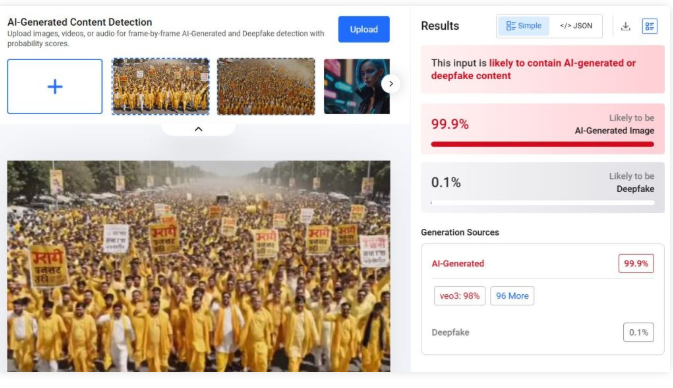
Upon closely examining the viral video, we noticed several anomalies in the visuals, crowd movements, and certain frames. The unnatural patterns and inconsistencies raised suspicions that the footage may have been generated using artificial intelligence. To verify this, we analyzed the video using the AI detection tool Aurigin AI, which indicated that the footage was AI-generated.

We further scanned the clip using another AI detection platform, Hive Moderation. The results showed a 99 percent probability that the video was AI-generated.
Conclusion
Our findings confirm that the viral video is not real. It has been artificially created using AI technology and is being circulated with a false and misleading claim.
