
#FactCheck -Old Chhattisgarh ACB Bribery Case Misrepresented as ‘Cockroach Janta Party’ Action in Viral Video
Executive Summary
A video is being widely shared on social media claiming that members of the so-called ‘Cockroach Janta Party (CJP)’ caught a police officer in Chhattisgarh red-handed while accepting a bribe of ₹30,000. The viral posts also claim that the group has intensified its so-called campaign to “clean the rotten system.” However, CyberPeace Research Wing research found the claim to be misleading.The research revealed that the video has no connection with the ‘Cockroach Janta Party (CJP)’. The original footage dates back to February 2026 and shows Chhattisgarh Police sub-inspector Abdul Munaf being caught by the Anti-Corruption Bureau (ACB) in an alleged ₹25,000 bribery case.
Claim
A Facebook user shared the viral video on May 23, 2026, claiming that members of the “Cockroach Janta Party” caught a police officer red-handed taking a ₹30,000 bribe. The post further stated that the group had intensified its campaign against corruption. The link and archived post are provided.

Fact Check
To verify the claim, we extracted key frames from the viral video and conducted a reverse image search. During the research, we found a report published on the Navbharat Times website dated February 26, 2026, which contained visuals matching the viral vi
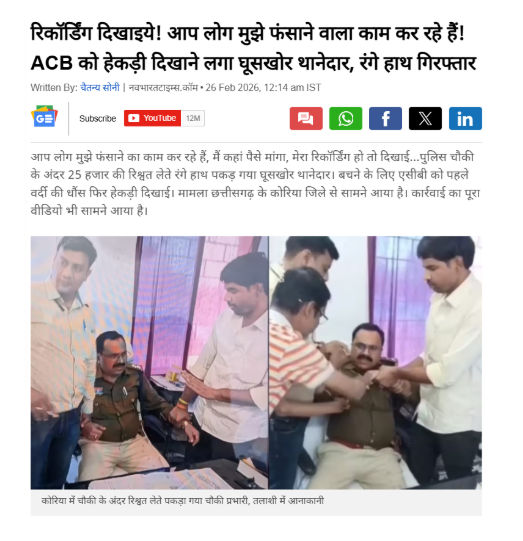
According to the report, the Anti-Corruption Bureau (ACB) in Korea district, Chhattisgarh, arrested a corrupt police station in-charge while accepting a bribe of ₹25,000. After being caught, the officer attempted to assert authority using his uniform and resisted the search procedure, but soon gave up. Further verification using keywords from the Navbharat Times report led to a similar story published by Dainik Bhaskar, which also contained the same visuals.

Additionally, a related context about the satirical “Cockroach Janta Party (CJP)” trend was found in a Times Now Hindi report, which explains that the term emerged as an online satire following a controversial remark attributed to the Chief Justice of India regarding unemployed youth. The statement was later clarified.

Conclusion
The research confirms that the viral video has no connection with the ‘Cockroach Janta Party (CJP)’. The original footage is from a February 2026 incident in which Chhattisgarh Police sub-inspector Abdul Munaf was arrested by the ACB in a bribery case involving ₹25,000. The video has been falsely linked to a misleading narrative on social media.

Related Blogs

Introduction
You must have heard of several techniques of cybercrime up to this point. Many of which we could never have anticipated. Some of these reports are coming from different parts of the country. Where video calls are being utilised to cheat. Through video calls, cybercriminals are making individuals victims of fraud. During this incident, fraudsters film pornographic recordings of both the victims using a screen recorder, then blackmail them by emailing these videos and demanding money. However, cybercriminals are improving their strategies to defraud more people. In this blog post, we will explore the tactics involved in this case, the psychological impact, and ways to combat it. Before we know more about the case, let’s have a look at deep fake, AI, and Sextortion and how fraudsters use technology to commit crimes.
Understanding Deepfake
Deepfake technology is the manipulation or fabrication of multimedia information such as videos, photos, or audio recordings using artificial intelligence (AI) algorithms, and profound learning models. These algorithms process massive quantities of data to learn and imitate human-like behaviour, allowing for very realistic synthetic media development.
Individuals with malicious intent may change facial expressions, bodily movements, and even voices in recordings using deepfake technology, basically replacing a person’s appearance with someone else’s. The produced film can be practically indistinguishable from authentic footage, making it difficult for viewers to distinguish between the two.
Sextortion and technology
Sextortion is a sort of internet blackmail in which offenders use graphic or compromising content to compel others into offering money, sexual favours, or other concessions. This information is usually gained by hacking, social engineering, or tricking people into providing sensitive information.
Deepfake technology combined with sextortion techniques has increased the impact on victims. Deepfakes may now be used by perpetrators to make and distribute pornographic or compromising movies or photographs that seem genuine but are completely fake. As the prospect of discovery grows increasingly credible and tougher to rebut, the stakes for victims rise.
Cyber crooks Deceive
In this present case, cyber thugs first make video calls to people and capture the footage. They then twist the footage and merge it with a distorted naked video. As a result, the victim is obliged to conceal the case. Following that, “they demand money as a ransom to stop releasing the doctored video on the victim’s contacts and social media platforms.” In this case, a video has emerged in which a lady who was supposedly featured in the first film is depicted committing herself because of the shame caused by the video’s release. These extra threats are merely intended to inflict psychological pressure and coercion on the victims.
Sextortionists have reached a new low by profiting from the misfortunes of others, notably targeting deceased victims. The offenders want to maximise emotional pain and persuade the victim into acquiescence by generating deep fake films depicting these persons. They use the inherent compassion and emotion connected with tragedy to exact bigger ransoms from their victims.
This distressing exploitation not only adds urgency to the extortion demands but also preys on the victim’s sensitivity and emotional instability. They even pressurize the victim by impersonating them, and if the demands are fulfilled, the victims may land up in jail.
Tactics used
The morphed death videos are precisely constructed to heighten emotional discomfort and instil terror in the targeted individual. By editing photographs or videos of the deceased, the offenders create unsettling circumstances that heighten the victim’s emotional response.
The psychological manipulation seeks to instil guilt, regret, and a sense of responsibility in the victim. The notion that they are somehow linked to the catastrophe increases their emotional weakness, making them more vulnerable to the demands of sextortionists. The offenders take use of these emotions, coercing victims into cooperation out of fear of being involved in the apparent tragedy.
The impact on the victim’s mental well-being cannot be overstated. They may experience intense psychological trauma, including anxiety, depression, and post-traumatic stress disorder (PTSD). The guilt and shame associated with the false belief of being linked to someone’s death can have long-lasting effects on their emotional health and overall quality of life, others may have trust issues.
Law enforcement agencies advised
Law enforcement organisations were concerned about the growing annoyance of these illegal acts. The use of deep fake methods or other AI technologies to make convincing morphing films demonstrates scammers’ improved ability. These tools are fully capable of modifying digital information in ways that are radically different from the genuine film, making it difficult for victims to detect the fake nature of the video.
Defence strategies to fight back: To combat sextortion, a proactive approach that empowers individuals and utilizes resources is required. This section delves into crucial anti-sextortion techniques such as reporting events, preserving evidence, raising awareness, and implementing digital security measures.
- Report the Incident: Sextortion victims should immediately notify law enforcement. Contact your local police or cybercrime department and supply them with any important information, including specifics of the extortion attempt, communication logs, and any other evidence that can assist in the investigation. Reporting the occurrence is critical for keeping criminals responsible and averting additional harm to others.
- Preserve Evidence: Preserving evidence is critical in creating a solid case against sextortionists. Save and document any types of contact connected to the extortion, including text messages, emails, and social media conversations. Take screenshots, record phone calls (if legal), and save any other digital material or papers that might be used as evidence. This evidence can be useful in investigations and judicial processes.
Digital security: Implementing comprehensive digital security measures can considerably lower the vulnerability to sextortion assaults. Some important measures that one can use:
- Use unique, complicated passwords for all online accounts, and avoid reusing passwords across platforms. Consider utilising password managers to securely store and create strong passwords.
- Enable two-factor authentication (2FA) whenever possible, which adds an extra layer of protection by requiring a second verification step, such as a code delivered to your phone or email, in addition to the password.
- Regular software updates: Keep your operating system, antivirus software, and programmes up to date. Security patches are frequently included in software upgrades to defend against known vulnerabilities.
- Adjust your privacy settings on social networking platforms and other online accounts to limit the availability of personal information and restrict access to your content.
- Be cautious when clicking on links or downloading files from unfamiliar or suspect sources. When exchanging personal information online, only use trusted websites.
Conclusion:
Combating sextortion demands a collaborative effort that combines proactive tactics and resources to confront this damaging practice. Individuals may actively fight back against sextortion by reporting incidences, preserving evidence, raising awareness, and implementing digital security measures. It is critical to empower victims, encourage their rehabilitation, and collaborate to build a safer online environment where sextortionists are held accountable and everyone can navigate the digital environment with confidence.

Executive Summary
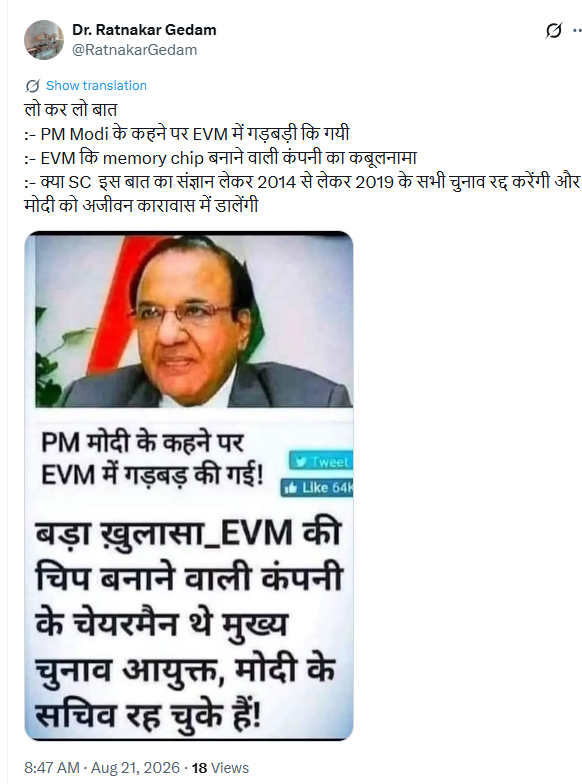
A viral social media post featuring a picture of former Chief Election Commissioner Achal Kumar Jyoti claims he served as the chairman of the company manufacturing EVM microchips and altered EVM settings at the behest of PM Modi. According to a research done by CyberPeace's research wing, the claim that former Chief Election Commissioner Achal Kumar Jyoti was the chairman of an EVM chip manufacturing company and altered EVMs at the behest of PM Modi is completely false.
Claim
Social media posts circulated statements claiming: "PM Modi ordered EVM tampering; the company manufacturing EVM memory chips confessed. Will the SC take note, cancel all elections from 2014 to 2019, and send Modi to life imprisonment?"
https://x.com/RatnakarGedam/status/2090639442411470936?s=20
Fact-Check
Relevant keyword searches yield no credible news reports, official statements, or legal documentation supporting claims that Achal Kumar Jyoti tampered with EVMs or issued any such confession. Achal Kumar Jyoti served as the Chief Election Commissioner of India from July 6, 2017, to January 22, 2018. Prior to this, he was a 1975-batch IAS officer of the Gujarat cadre who served in various administrative roles, including Chief Secretary of Gujarat.
https://www.eci.gov.in/former-cec-ec?utm_source

According to official information, Electronic Voting Machines (EVMs) used in Indian elections are manufactured exclusively by two Public Sector Undertakings (PSUs): Bharat Electronics Limited (BEL) and Electronics Corporation of India Limited (ECIL). Official records confirm that Achal Kumar Jyoti was never appointed as the Chairman or Director of BEL, ECIL, or any entity manufacturing microchips for EVMs.
https://www.eci.gov.in/evm-faqs/?utm_source

Conclusion
The claim that former Chief Election Commissioner Achal Kumar Jyoti headed an EVM chip manufacturing company and tampered with voting machines is completely fabricated and baseless.

Executive Summary
Amid the ongoing war between the United States–Israel alliance and Iran since February 28, 2026, two videos are going viral across social media platforms. The clips show people running in panic, with visuals suggesting a large-scale attack. Users are sharing these videos with the claim that they depict Iran’s recent strikes on Israel. However, a research by the CyberPeace has found both claims to be false. The viral posts are misleading, as the videos are actually from the 9/11 terrorist attacks on the World Trade Center in New York, United States. They have no connection to the current conflict involving Iran or Israel.
Claim
A Facebook page titled ‘Bihar Ko Nihar’ shared one of the videos on March 25, 2026, with the caption: “Iran has launched its most powerful attack on Israel so far. Thousands of soldiers are reported dead, triggering massive protests within the country, and Israel appears completely helpless.” Similarly, another video is being circulated with the false claim that Iran has launched a missile attack on the United States.
The above claims are being widely shared by multiple users across different social media platforms. Archived versions of these posts are also available.
- https://www.facebook.com/reel/4317571078525937
- https://www.facebook.com/reel/1485000739860984
- https://perma.cc/E98R-A4CT

Fact Check
To verify the authenticity of the videos, keyframes were extracted and analyzed using Google Lens. The first viral clip was traced back to a YouTube video uploaded on September 11, 2007, by a channel named ‘Jumperwtc’, which clearly identifies the footage as being from the World Trade Center attacks in the United States. This confirms that the viral video is a segment from that older footage.

For the second video, reverse image searches led to a report published on CBS8.com on September 10, 2021, where the same visuals were found. Further reesearch revealed that the footage also appears in a video uploaded on September 11, 2021, by the YouTube channel ‘CBS 8 San Diego’. The viral segment can be seen around the 1:11 timestamp in that video.

Conclusion
Both viral videos being shared as recent attacks by Iran on Israel or the United States are actually old clips from the 9/11 attacks on the World Trade Center in New York. The claims are false, and the videos are unrelated to the ongoing conflict in West Asia.
