
#FactCheck -Edited Newspaper Clipping Falsely Linked to Indira Gandhi’s Appeal Against Buying Gold
Executive Summary
A purported front page of The Hindu dated June 6, 1967, is being widely circulated on social media with the claim that then Prime Minister Indira Gandhi had urged Indians not to buy gold in any form and to follow “national discipline” by restricting gold consumption. The viral claim suggests that the appeal was part of the government’s efforts to conserve foreign exchange reserves, which were allegedly under severe pressure at the time. However, research conducted by CyberPeace Research Wing found the claim to be false. Our research revealed that the front page being circulated online is not authentic and has been digitally edited.
Claim
An X (formerly Twitter) user shared the viral newspaper clipping on May 12, 2026, and wrote:“In 1967, during a severe foreign exchange crisis, Indira Gandhi appealed to Indians not to buy gold.From ‘skip one meal’ to ‘don’t buy gold,’ Congress-era governance normalized shortages, restrictions, and sacrifice, while ordinary citizens paid the price for failed economic policies.”

Research
To verify the claim, we examined the official social media accounts of The Hindu. During the research, we found a post published on the publication’s official X account on May 12, 2026, clarifying that the viral image claiming to be the June 6, 1967 front page of The Hindu was digitally altered and not part of its official archives. The newspaper also urged readers to verify information carefully before sharing it online.

We also found an X post by B Kolappan, a journalist with The Hindu, who shared the original front page of the newspaper dated June 6, 1967, further exposing the viral image as fake.
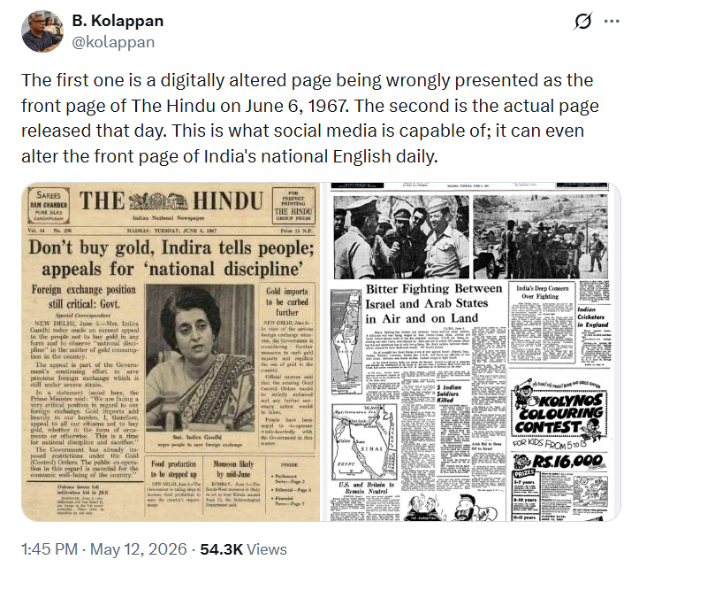
For context, Prime Minister Narendra Modi, while addressing a public gathering on May 10, 2026, spoke about the possible economic impact of the ongoing conflict in the Middle East and advised people to avoid buying gold for a year, even during weddings or family functions. The viral claim appears to have resurfaced in this backdrop.

Conclusion
Our research found that the alleged 1967 front page of The Hindu circulating on social media is digitally edited and fake. There is no evidence that the viral newspaper page is authentic or part of The Hindu’s archival records.

Related Blogs
.webp)
The Equitable Growth Approach of AI and Digital Twins
Digital Twins can be simply described as virtual replicas of physical assets or systems, powered by real-time data and advanced simulations. When this technology is combined with AI, the impact it has on enabling real-time monitoring, predictive maintenance, optimised operations, and improved design processes through the creation of virtual replicas of physical assets becomes even greater. The greatest value of AI is its ability to make data actionable. And when combined with digital twins, these data can be collated, analysed, inefficiencies removed, and better decisions can be taken to improve efficiency and quality.
This intersection between AI and Digital Twins holds immense potential for addressing key challenges, particularly in countries like India, which is rapidly embracing digital adoption to achieve its economic ambitions and sustainability goals. According to Salesforce’s most recent survey on generative AI use among the general population within the U.S., UK, Australia and India, 75% of generative AI users are looking to automate repetitive tasks and use generative AI for work communications. India is particularly looking towards a rapid digital adoption, economic ambitions, and sustainable developments to be achieved through AI adoption. This blog discuss the intersection of equitable growth, sustainability, and AI-driven policies in India.
Sustainability and the Path Ahead: Digital Twin and AI-Driven Solutions
India faces sustainability challenges which are mainly associated with issues such as urban congestion, the rising demand for energy along with climate change and environmental degradation. AI and Digital Twins provide solutions for real-time simulations and predictive analysis. Some of the examples are its applications in sustainable urban planning such as smart cities like the Indore Smart City Initiative and traffic optimisation, energy efficiency/optimisation through AI-driven renewable energy projects and power grid optimisation and even water resource management through leak detection, equitable distribution and conservation.
The need is to balance innovation with regulation, particularly, underscoring the importance of ethical and sustainable deployment of AI and digital twins and addressing data privacy with AI ethics with recent developments such as the India’s evolving AI policy landscape, including the National Strategy for Artificial Intelligence and its focus on AI for All, regulatory frameworks such as DPDP Act and the manner in which they address AI ethics, data privacy, and digital governance.
The need is to initiate targeted policies that promote research and development in AI and digital twin technologies, skill development and partnerships with the private sector, think tanks, nonprofits and others. Also, collaborations at the global level would include aligning our domestic policies with global AI and sustainability initiatives and leveraging the international frameworks for climate tech and smart infrastructure.
Cyberpeace Outlook
As part of specific actions, policymakers need to engage in proactive governance to ensure the responsible use and development of AI. This includes enacting incentive schemes for sustainable AI projects and strengthening the enforcement of data privacy laws. Industry leaders must support equitable access to AI and digital twin technologies and develop tailored AI tools for resource-constrained settings, particularly in India. Finally, researchers need to drive innovation in alignment with sustainability goals, such as those related to agriculture and groundwater management.
References
- https://economictimes.indiatimes.com/tech/artificial-intelligence/technologies-like-ai-and-digital-twins-can-tackle-challenges-like-equitable-growth-to-sustainability-wef/articleshow/117121897.cms
- https://www.salesforce.com/news/stories/generative-ai-statistics/
- https://www.mdpi.com/2673-2688/4/3/38
- https://www.ibm.com/think/topics/generative-ai-for-digital-twin-energy-utilities
Executive Summary
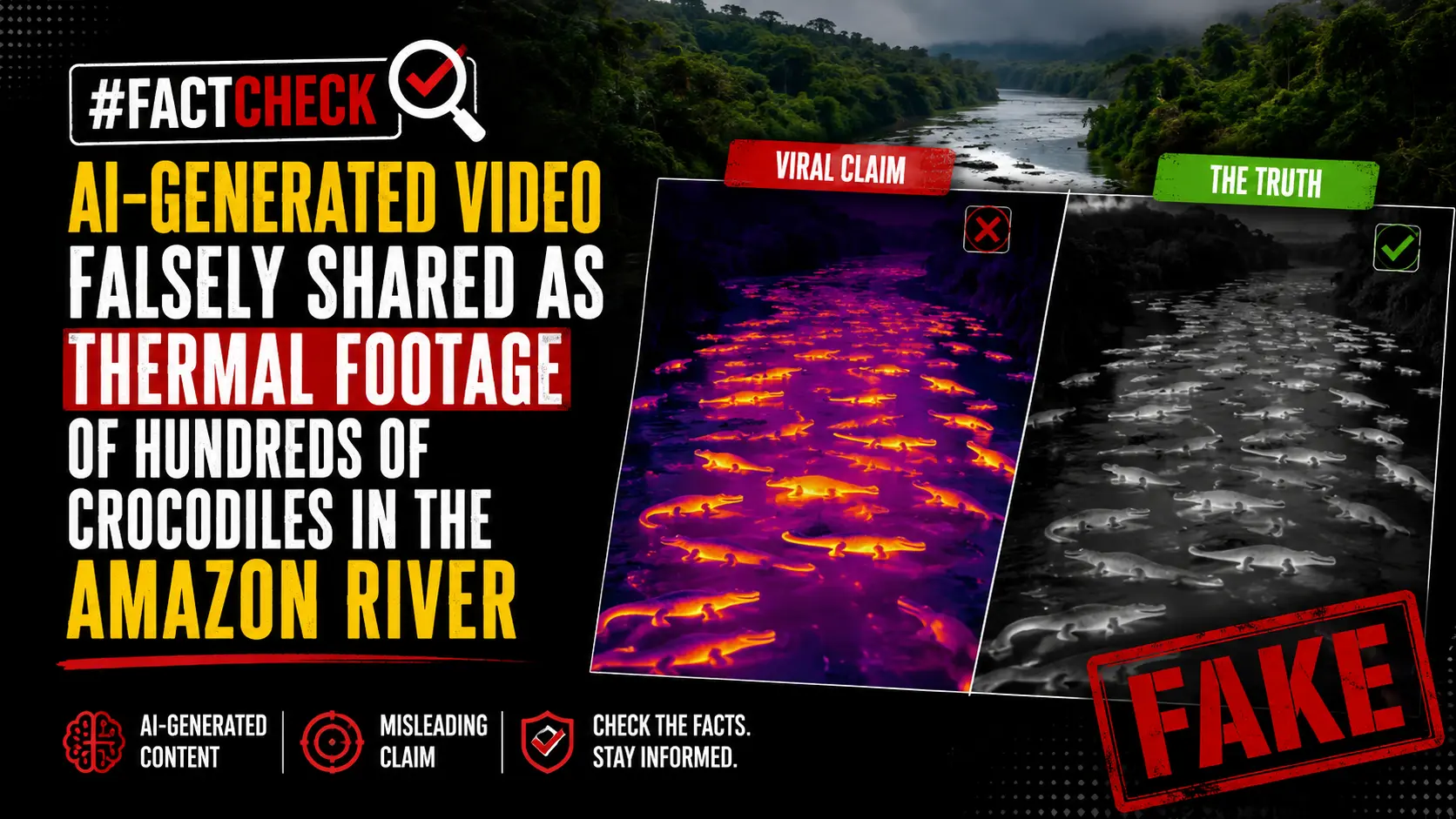
A video is being widely shared on social media claiming to show a helicopter's thermal camera capturing hundreds of crocodiles hidden along the Amazon River at night. The footage appears to show a thermal imaging view of a river and its banks, where hundreds of crocodiles can allegedly be seen. Users claim the video was recorded using night-vision/thermal imaging technology over the Amazon River. CyberPeace Research Wing’s research found the claim to be false. The research revealed that the viral video is not authentic but has been generated using artificial intelligence (AI) and is being circulated with a fabricated claim.
Claim
Social media users are sharing the video claiming that it shows a thermal camera recording of hundreds of crocodiles in and around the Amazon River at night. The post link and screenshot are provided below.
https://www.instagram.com/reel/DalJ41bIezV/?utm_source=ig_web_button_share_sheet
https://www.instagram.com/reel/DalJ41bIezV/?utm_source=ig_web_button_share_sheet

Fact Check
To verify the claim, we extracted several keyframes from the viral video and conducted a reverse image search using Google Lens. However, we found no credible news reports, authentic videos, or reliable sources confirming that the footage was recorded over the Amazon River.
We then conducted a detailed visual analysis of the video. The footage exclusively shows crocodile-like figures spread across the river and its banks, while no other aquatic animals or natural environmental activity—normally expected in a river ecosystem of that scale—are visible. These inconsistencies raised further doubts about the video's authenticity.
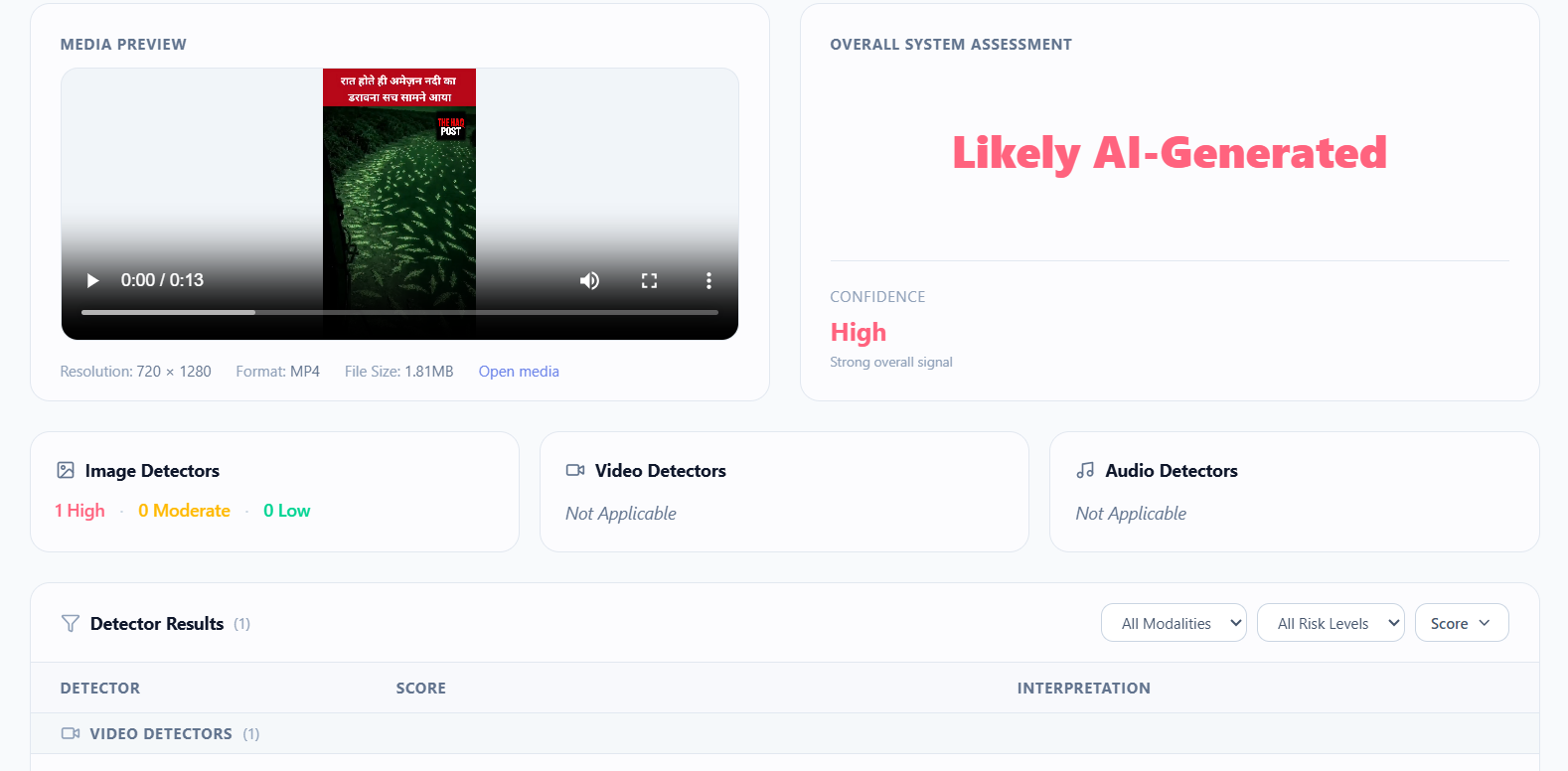
As part of our verification, we analysed the video using the AI detection tool Hive Moderation. The analysis indicated a 95.7% probability that the video was AI-generated.
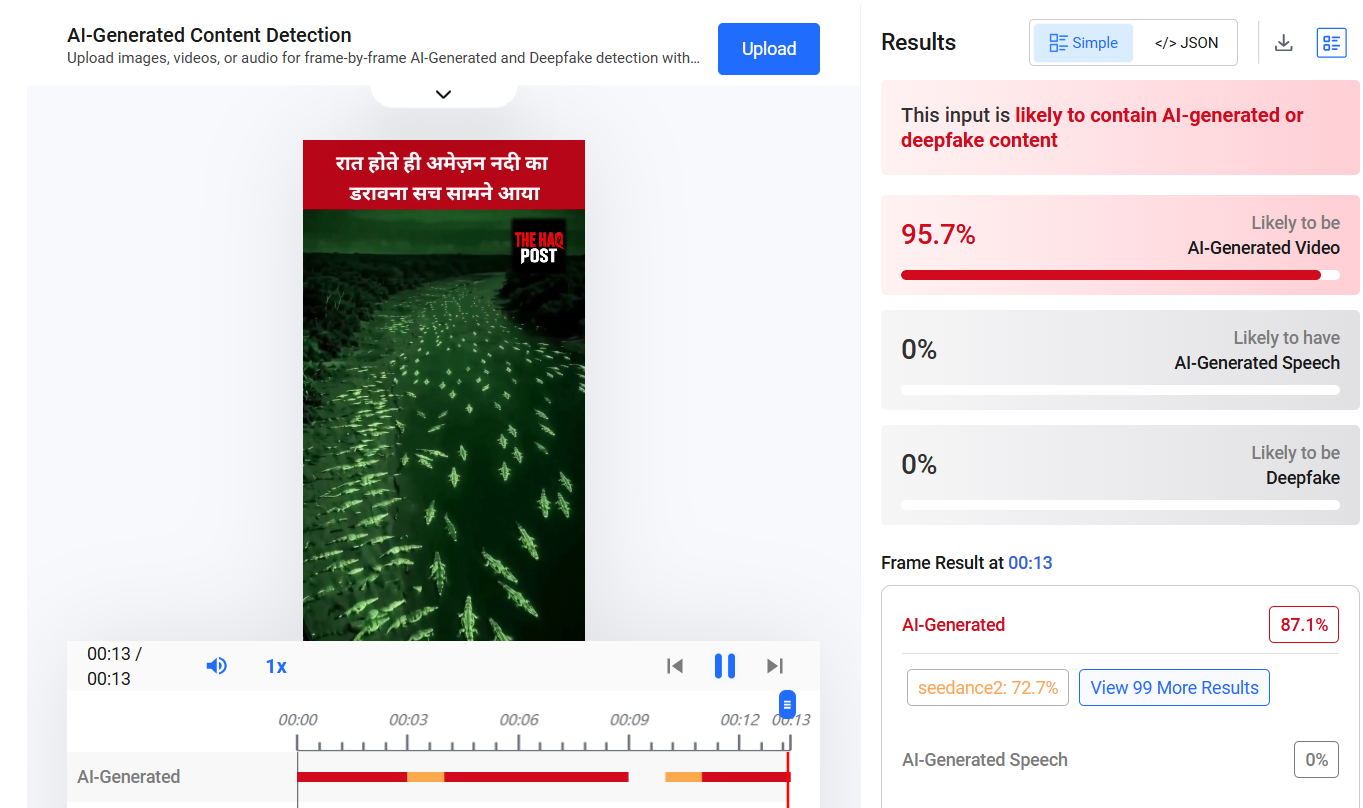
As part of our verification, we analysed the video using the AI detection tool Hive Moderation. The analysis indicated a 95.7% probability that the video was AI-generated.
Conclusion
Our research found that the viral video does not show a genuine thermal-camera recording of the Amazon River. The footage was created using artificial intelligence and is being circulated online with a false and misleading claim.
.webp)
Introduction:
The Federal Bureau of Investigation (FBI) focuses on threats and is an intelligence-driven agency with both law enforcement and intelligence responsibilities. The FBI has the power and duty to look into certain offences that are entrusted to it and to offer other law enforcement agencies cooperation services including fingerprint identification, lab tests, and training. In order to support its own investigations as well as those of its collaborators and to better comprehend and address the security dangers facing the United States, the FBI also gathers, disseminates, and analyzes intelligence.
The FBI’s Internet Crime Complaint Center (IC3) Functions combating cybercrime:
- Collection: Internet crime victims can report incidents and notify the relevant authorities of potential illicit Internet behavior using the IC3. Law enforcement frequently advises and directs victims to use www.ic3.gov to submit a complaint.
- Analysis: To find new dangers and trends, the IC3 examines and examines data that users submit via its website.
- Public Awareness: The website posts public service announcements, business alerts, and other publications outlining specific frauds. Helps to raise awareness and make people become aware of Internet crimes and how to stay protected.
- Referrals: The IC3 compiles relevant complaints to create referrals, which are sent to national, international, local, and state law enforcement agencies for possible investigation. If law enforcement conducts an investigation and finds evidence of a crime, the offender may face legal repercussions.
Alarming increase in cyber crime cases:
In the recently released 2022 Internet Crime Report by the FBI's Internet Crime Complaint Center (IC3), the statistics paint a concerning picture of cybercrime in the United States. FBI’s Internet Crime Complaint Center (IC3) received 39,416 cases of extortion in 2022. The number of cases in 2021 stood at 39,360.
FBI officials emphasize the growing scope and sophistication of cyber-enabled crimes, which come from around the world. They highlight the importance of reporting incidents to IC3 and stress the role of law enforcement and private-sector partnerships.
About Internet Crime Complaint Center IC3:
IC3 was established in May 2000 by the FBI to receive complaints related to internet crimes.
It has received over 7.3 million complaints since its inception, averaging around 651,800 complaints per year over the last five years. IC3's mission is to provide the public with a reliable reporting mechanism for suspected cyber-enabled criminal activity and to collaborate with law enforcement and industry partners.
The FBI encourages the public to regularly review consumer and industry alerts published by IC3. An victim of an internet crime are urged to submit a complaint to IC3, and can also file a complaint on behalf of another person. These statistics underscore the ever-evolving and expanding threat of cybercrime and the importance of vigilance and reporting to combat this growing challenge.
What is sextortion?
The use or threatened use of a sexual image or video of another person without that person’s consent, derived from online encounters or social media websites or applications, primarily to extort money from that person or asking for sexual favours and giving warning to distribute that picture or video to that person’s friends, acquaintances, spouse, partner, or co-workers or in public domain.
Sextortion is an online crime that can be understood as, when an bad actor coerces a young person into creating or sharing a sexual image or video of themselves and then uses it to get something from such young person, such as other sexual images, money, or even sexual favours. Reports highlights that more and more kids are being blackmailed in this way. Sextortion can also happen to adults. Sextortion can also take place by taking your pictures from social media account and converting those pictures into sexually explicit content by morphing such images or creating deepfake by miusing deepfake technologies.
Sextortion in the age of AI and advanced technologies:
AI and deep fake technology make sextortion even more dangerous and pernicious. A perpetrator can now produce a high-quality deep fake that convincingly shows a victim engaged in explicit acts — even if the person has not done any such thing.
Legal Measures available in cases of sextortion:
In India, cybersecurity is governed primarily by the Indian Penal Code (IPC) and the Information Technology Act, 2000 (IT Act). Addressing cyber crimes such as hacking, identity theft, and the publication of obscene material online, sextortion and other cyber crimes. The IT Act covers various aspects of electronic governance and e-commerce, with providing provisions for defining such offences and providing punishment for such offences.
Recently Digital Personal Data Protection Act, 2023 has been enacted by the Indian Government to protect the digital personal data of the Individuals. These laws collectively establish the legal framework for cybersecurity and cybercrime prevention in India. Victims are urged to report the crime to local law enforcement and its cybercrime divisions. Law enforcement will investigate sextortion cases reports and will undertake appropriate legal action.
How to stay protected from evolving cases of sextortion: Best Practices:
- Report the Crime to law enforcement agency and social media platform or Internet service provider.
- Enable Two-step verification as an extra layer of protection.
- Keep your laptop Webcams covered when not in use.
- Stay protected from malware and phishing Attacks.
- Protect your personal information on your social media account, and also monitor your social media accounts in order to identify any suspicious activity. You can also set and review privacy settings of your social media accounts.
Conclusion:
Sextortion cases has been increased in recent time. Knowing the risk, being aware of rules and regulations, and by following best practices will help in preventing such crime and help you to stay safe and also avoid the chance of being victimized. It is important to spreading awareness about such growing cyber crimes and empowering the people to report it and it is also significant to provide support to victims. Let’s all unite in order to fight against such cyber crimes and also to make life a safer place on the internet or digital space.
References:
- https://www.ic3.gov/Media/PDF/AnnualReport/2022_IC3ElderFraudReport.pdf
- https://octillolaw.com/insights/fbi-ic3-releases-2022-internet-crime-report/
- https://www.iafci.org/app_themes/docs/Federal%20Agency/2022_IC3Report.pdf
