
#FactCheck -Digitally Altered MEA Briefing Video Falsely Attributes AI-Generated Remarks on Quad and India–US Relations
Executive Summary
A video of an Additional Secretary in the Ministry of External Affairs (MEA), handling the Americas & Canada Division, is being widely circulated on social media. The clip is being shared with the claim that he said:“Even if the Quad ends, India will partner only with Israel, and since Israel controls the US, India also controls the US.”The viral post attempts to link this alleged statement to India’s foreign policy. Many users are sharing it as authentic. However, CyberPeace Research Wing research found the claim to be false. The video has been digitally altered, and no such statement was made by the official in the original briefing.
Claim
On social media platform X (formerly Twitter), the viral video is being shared with the claim that the MEA Additional Secretary said Israel controls the United States, and therefore India also controls the US.
- https://www.facebook.com/61562281661615/videos/1518036689691723/
- https://archive.ph/xGJHa#selection-967.0-978.0

Fact Check
To verify the claim, we extracted key frames from the viral video and conducted a reverse image search. During the research, we found the original video, which was streamed live on May 26, 2026, on the verified YouTube channel of the Ministry of External Affairs (MEA), titled: “Special Briefing by MEA on Quad Foreign Ministers’ Meeting”
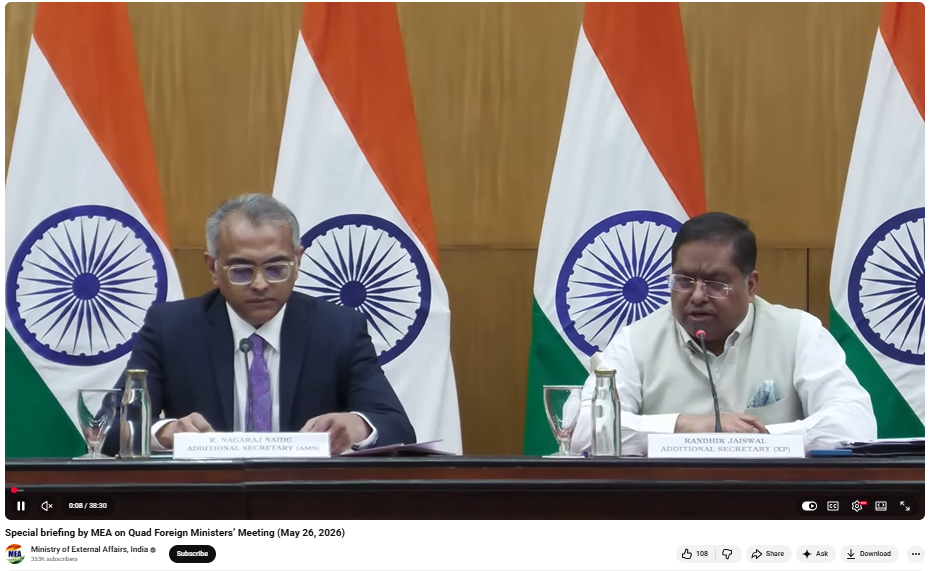
During the briefing, Naidu highlighted India’s commitment to a free and open Indo-Pacific region, mentioning new initiatives in maritime surveillance, critical minerals, and 6G development. He also noted the continued momentum of the Quad, stating that frequent ministerial meetings reflect strong and ongoing cooperation among member countries despite challenges in holding formal leaders’ summits.
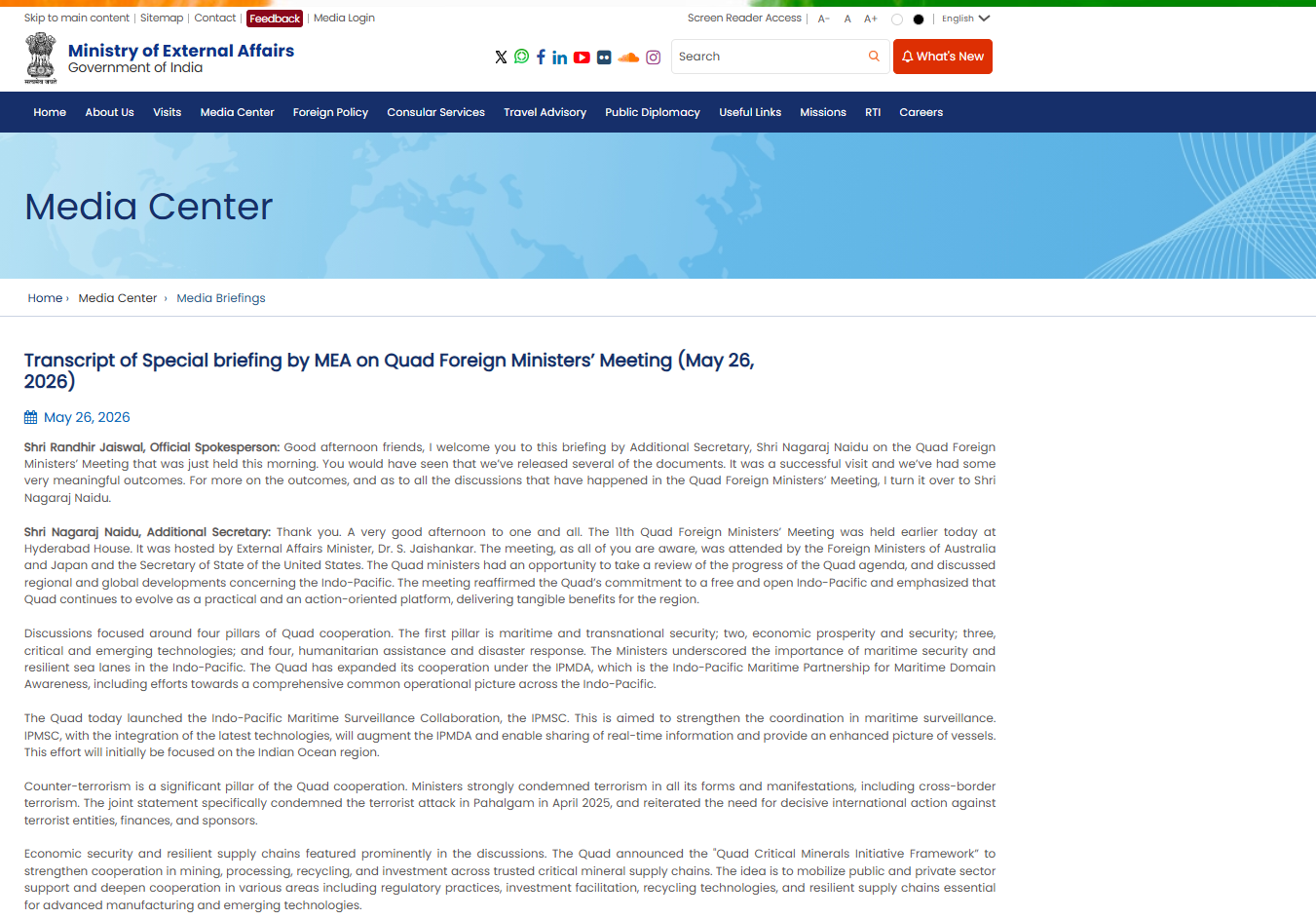
The official transcript of the briefing is also available on the MEA website:
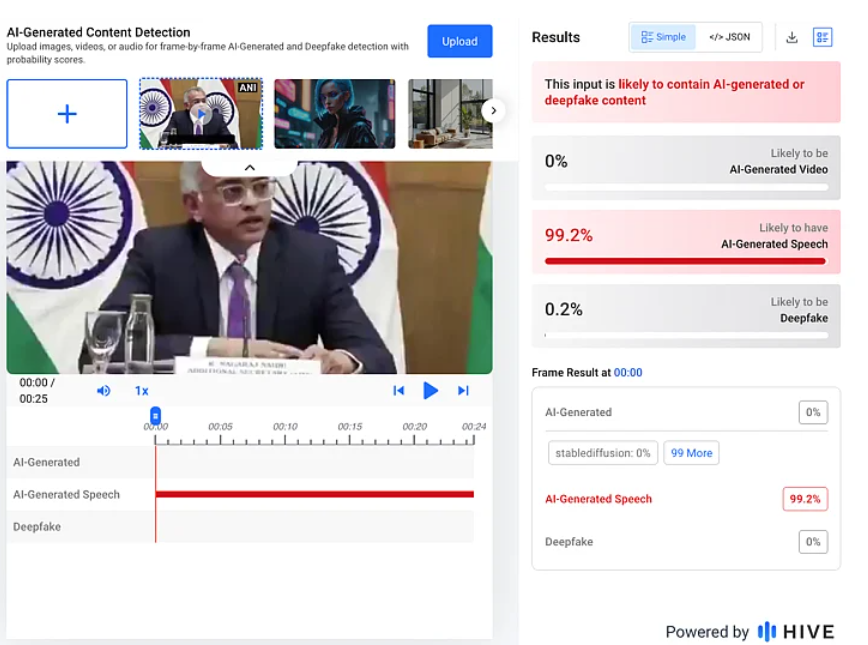
Since the viral statement was never made during the event, we further analysed the video using Deepfake Voice Detector and Hive Moderation’s AI-generated content detection tool. Hive moderation analysis indicated a 99.2% probability that the audio in the viral video is AI-generated.
Conclusion
CyberPeace Research Wing research found that the viral video is digitally altered. The Additional Secretary did not make any such statement during the official briefing. The audio in the clip has been manipulated and is being circulated with a misleading narrative.

Related Blogs

Introduction
Sexual Offences against children have recently come under scrutiny after the decision of the Madras High Court which has ruled that watching and downloading child sexual porn is an inchoate crime. In response, the Supreme Court, on 23 September 2024, ruled that Section 15 of the POCSO and Section 67B of the IT Act penalise any form of use of child pornography, including storing and watching such pornographic content. Along with this, the Supreme Court has further recommended replacing the term “Child Pornography” which it said acts as a misnomer and does not capture the full extent of the crime, with a more inclusive term “Child Sexual Exploitative and Abuse Material” (CESAM). This term would more accurately reflect the reality that these images and videos are not merely pornographic but are records of incidents, where a child has either been sexually exploited and abused or where any abuse of children has been portrayed through any self-generated visual depiction.
Intermediaries cannot claim exemption from Liability U/S 79
Previously, intermediaries claimed safe harbour by only complying with the requirements stipulated under the MOU. As per the decision of the SC, now, an intermediary cannot claim exemption from the liability under Section 79 of the IT Act for any third-party information, data, or communication link made available or hosted by it unless due diligence is conducted by it and compliance is made of these provisions of the POCSO Act. This is as per the provisions of Sections 19 and 20 of the POCSO read with Rule 11 of the POCSO Rules which have a mandatory nature.
The due diligence under section 79 of the IT Act includes the removal of child pornographic content and immediate reporting of such content to the concerned police units in the manner specified under the POCSO Act and the Rules. In this way, the Supreme Court has broadened the Interpretation and scope of the ‘Due Diligence’ obligation under section 79 of the IT Act. It was also stated that is to be duly noted that merely because an intermediary complies with the IT Act, will not absolve it of any liability under the POCSO. This is unless it duly complies with the requirements and procedure set out under it, particularly Section 20 of the POCSO Act and Rule 11 of the POCSO Rules.
Bar on Judicial Use of the term ‘Child Porn’
Supreme Court found that the term child pornography can be trivialised as pornography is often seen as a consensual act between adults. Supreme Court emphasised using the term Child Sexual Exploitative and Abuse Material (CESAM) as it would emphasise the exploitation of children highlight the criminality of the act and shift the focus to a more robust framework to counter these crimes. The Supreme Court also stated that the Union of India should consider amending the POCSO Act to replace the "child pornography" term with "child sexual exploitative and abuse material" (CSEAM). This would reflect more accurately on the reality of such offences. Supreme Court also directed that the term "child pornography" shall not be used in any judicial order or judgment, and instead, the term "CSEAM" should be endorsed.
Curbing CSEAM Content on Social Media Platforms
Social Media Intermediaries and Expert Organisations play an important role in curbing CESAM content. Per the directions of the Apex Court, a need to impart positive age-appropriate sex education to prevent youth from engaging in harmful sexual behaviours, including the distribution, and viewing of CSEAM is important and all stakeholders must engage in proactive measures to counter these offences which are under the umbrella of CSEAM. This should entail promoting age-appropriated and lawful content on social media platforms and social media platforms to ensure compliance with applicable provisions.
Conclusion
In light of the Supreme Court’s landmark ruling, it is imperative to acknowledge the pressing necessity of establishing a safer online environment that shields children from exploitation. The shift towards using "Child Sexual Exploitative and Abuse Material" (CSEAM) emphasizes the severity of the crime and the need for a vigilant response. The social media intermediaries must respect their commitment to report and remove exploitive content and must ensure compliance with POCSO and IT regulations. Furthermore, comprehensive, age-appropriate sex education can also be used as a preventive measure, educating young people about the moral and legal ramifications of sexual offences, encouraging respect and awareness and ensuring safer cyberspace.
References
- https://www.scconline.com/blog/post/2024/09/23/storing-watching-child-pornography-crime-supreme-court-pocso-it-act/#:~:text=Supreme%20Court%3A%20The%20bench%20of,watching%20of%20such%20pornographic%20content
- https://timesofindia.indiatimes.com/india/supreme-court-viewing-child-porn-is-offence-under-pocso-it-acts/articleshow/113613572.cms
- https://bwlegalworld.com/article/dont-use-term-child-pornography-says-sc-urges-parliament-to-amend-pocso-act-534053
- https://indianexpress.com/article/india/child-pornography-law-pocso-it-supreme-court-9583376/
Introduction
With the increasing reliance on digital technologies in the banking industry, cyber threats have become a significant concern. Cyberlaw plays a crucial role in safeguarding the banking sector from cybercrimes and ensuring the security and integrity of financial systems.
The banking industry has witnessed a rapid digital transformation, enabling convenient services and greater access to financial resources. However, this digitalisation also exposes the industry to cyber threats, necessitating the formulation and implementation of effective cyber law frameworks.
Recent Trends in the Banking Industry
Digital Transformation: The banking industry has embraced digital technologies, such as mobile banking, internet banking, and financial apps, to enhance customer experience and operational efficiency.
Open Banking: The concept of open banking has gained prominence, enabling data sharing between banks and third-party service providers, which introduces new cyber risks.
How Cyber Law Helps the Banking Sector
The banking sector and cyber crime share an unspoken synergy due to the mass digitisation of banking services. Thanks to QR codes, UPI and online banking payments, India is now home to 40% of global online banking transactions. Some critical aspects of the cyber law and banking sector are as follows:
Data Protection: Cyberlaw mandates banks to implement robust data protection measures, including encryption, access controls, and regular security audits, to safeguard customer data.
Incident Response and Reporting: Cyberlaw requires banks to establish incident response plans, promptly report cyber incidents to regulatory authorities, and cooperate in investigations.
Customer Protection: Cyberlaw enforces regulations related to online banking fraud, identity theft, and unauthorised transactions, ensuring that customers are protected from cybercrimes.
Legal Framework: Cyberlaw provides a legal foundation for digitalisation in the banking sector, assuring customers that regulations protect their digital transactions and data.
Cybersecurity Training and Awareness: Cyberlaw encourages banks to conduct regular training programs and create awareness among employees and customers about cyber threats, safe digital practices, and reporting procedures.

RBI Guidelines
The RBI, as India’s central banking institution, has issued comprehensive guidelines to enhance cyber resilience in the banking industry. These guidelines address various aspects, including:
Technology Risk Management
Cyber Security Framework
IT Governance
Cyber Crisis Management Plan
Incident Reporting and Response
Recent Trends in Banking Sector Frauds and the Role of Cyber Law
Phishing Attacks: Cyberlaw helps banks combat phishing attacks by imposing penalties on perpetrators and mandating preventive measures like two-factor authentication.
Insider Threats: Cyberlaw regulations emphasise the need for stringent access controls, employee background checks, and legal consequences for insiders involved in fraudulent activities.
Ransomware Attacks: Cyberlaw frameworks assist banks in dealing with ransomware attacks by enabling legal actions against hackers and promoting preventive measures, such as regular software updates and data backups.
Master Directions on Cyber Resilience and Digital Payment Security Controls for Payment System Operators (PSOs)
Draft of Master Directions on Cyber Resilience and Digital Payment Security Controls for Payment System Operators (PSOs) issued by the Reserve Bank of India (RBI). The directions provide guidelines and requirements for PSOs to improve the safety and security of their payment systems, with a focus on cyber resilience. These guidelines for PSOs include mobile payment service providers like Paytm or digital wallet payment platforms.
Here are the highlights-
The Directions aim to improve the safety and security of payment systems operated by PSOs by providing a framework for overall information security preparedness, with an emphasis on cyber resilience.
The Directions apply to all authorised non-bank PSOs.
PSOs must ensure adherence to these Directions by unregulated entities in their digital payments ecosystem, such as payment gateways, third-party service providers, vendors, and merchants.
The PSO’s Board of Directors is responsible for ensuring adequate oversight over information security risks, including cyber risk and cyber resilience. A sub-committee of the Board may be delegated with primary oversight responsibilities.
PSOs must formulate a Board-approved Information Security (IS) policy that covers roles and responsibilities, measures to identify and manage cyber security risks, training and awareness programs, and more.
PSOs should have a distinct Board-approved Cyber Crisis Management Plan (CCMP) to detect, contain, respond, and recover from cyber threats and attacks.
A senior-level executive, such as a Chief Information Security Officer (CISO), should be responsible for implementing the IS policy and the cyber resilience framework and assessing the overall information security posture of the PSO.
PSOs need to define Key Risk Indicators (KRIs) and Key Performance Indicators (KPIs) to identify potential risk events and assess the effectiveness of security controls. The sub-committee of the Board is responsible for monitoring these indicators.
PSOs should conduct a cyber risk assessment when launching new products, services, technologies, or significant changes to existing infrastructure or processes.
PSOs, including inventory management, identity and access management, network security, application security life cycle, security testing, vendor risk management, data security, patch and change management life cycle, incident response, business continuity planning, API security, employee awareness and training, and other security measures should implement various baseline information security measures and controls.
PSOs should ensure that payment transactions involving debit to accounts conducted electronically are permitted only through multi-factor authentication, except where explicitly permitted/relaxed.

Conclusion
The relationship between cyber law and the banking industry is crucial in ensuring a secure and trusted digital environment. Recent trends indicate that cyber threats are evolving and becoming more sophisticated. Compliance with cyber law provisions and adherence to guidelines such as those provided by the RBI is essential for banks to protect themselves and their customers from cybercrimes. By embracing robust cyber law frameworks, the banking industry can foster a resilient ecosystem that enables innovation while safeguarding the interests of all stakeholders or users.
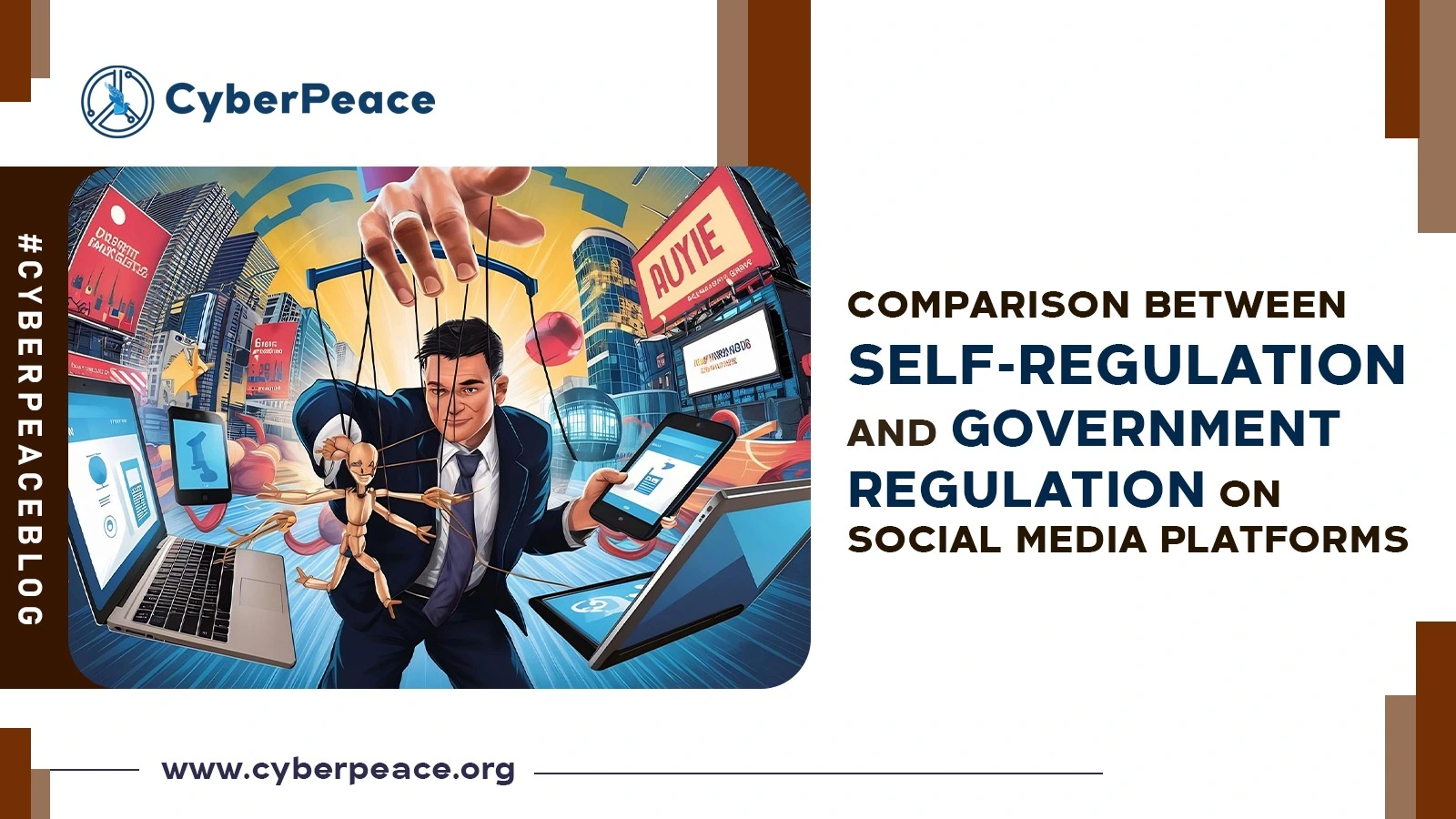
Social media has become far more than a tool of communication, engagement and entertainment. It shapes politics, community identity, and even shapes agendas. When misused, the consequences can be grave: communal disharmony, riots, false rumours, harassment or worse. Emphasising the need for digital Atmanirbhar, Prime Minister Narendra Modi recently urged India’s youth to develop the country’s own social media platforms, like Facebook, Instagram and X, to ensure that the nation’s technological ecosystems remain secure and independent, reinforcing digital autonomy. This growing influence of platforms has sharpened the tussle between government regulation, the independence of social media companies, and the protection of freedom of expression in most countries.
Why Government Regulation Is Especially Needed
While self-regulation has its advantages, ‘real-world harms’ show why state oversight cannot be optional:
- Incitement to violence and communal unrest: Misinformation and hate speech can inflame tensions. In Manipur (May 2023), false posts, including unverified sexual-violence claims, spread online, worsening clashes. Authorities shut down mobile internet on 3 May 2023 to curb “disinformation and false rumours,” showing how quickly harmful content can escalate and why enforceable moderation rules matter.
- Fake news and misinformation: False content about health, elections or individuals spreads far faster than corrections. During COVID-19, an “infodemic” of fake cures, conspiracy theories and religious discrimination went viral on WhatsApp and Facebook, starting with false claims that the virus came from eating bats. The WHO warned of serious knock-on effects, and a Reuters Institute study found that although such claims by public figures were fewer, they gained the highest engagement, showing why self-regulation alone often fails to stop it.
Nepal’s Example:
Nepal provides a clear example of the tension between government regulation and the self-regulation tussle of social media. In 2023, the government issued rules requiring all social media platforms, whether local or foreign, to register with the Ministry of Communication and Information Technology, appoint a local contact person, and comply with Nepali law. By 2025, major platforms such as Facebook, Instagram, and YouTube had not met the registration deadline. In response, the Nepal Telecommunications Authority began blocking unregistered platforms until they complied. While journalists, civil-rights groups and Gen Z criticised the move as potentially limiting free speech and exposing corruption against the government. The government argued it was necessary to stop harmful content and misinformation. The case shows that without enforceable obligations, self-regulation can leave platforms unaccountable, but it must also balance with protecting free speech.
Self-Regulation: Strengths and Challenges
Most social-media companies prefer to self-regulate. They write community rules, trust & safety guidelines, and give users ways to flag harmful posts, and lean on a mix of staff, outside boards and AI filters to handle content that crosses the line. The big advantage here is speed: when something dangerous appears, a platform can react within minutes, far quicker than a court or lawmaker. Because they know their systems inside out, from user habits to algorithmic quirks, they can adapt fast.
But there’s a downside. These platforms thrive on engagement, hence sensational or hateful posts often keep people scrolling longer. That means the very content that makes money can also be the content that most needs moderating , a built-in conflict of interest.
Government Regulation: Strengths and Risks
Public rules make platforms answerable. Laws can require illegal content to be removed, force transparency and protect user rights. They can also stop serious harms such as fake news that might spark violence, and they often feel more legitimate when made through open, democratic processes.
Yet regulation can lag behind technology. Vague or heavy-handed rules may be misused to silence critics or curb free speech. Global enforcement is messy, and compliance can be costly for smaller firms.
Practical Implications & Hybrid Governance
For users, regulation brings clearer rights and safer spaces, but it must be carefully drafted to protect legitimate speech. For platforms, self-regulation gives flexibility but less certainty; government rules provide a level playing field but add compliance costs. For governments, regulation helps protect public safety, reduce communal disharmony, and fight misinformation, but it requires transparency and safeguards to avoid misuse.
Hybrid Approach
A combined model of self-regulation plus government regulation is likely to be most effective. Laws should establish baseline obligations: registration, local grievance officers, timely removal of illegal content, and transparency reporting. Platforms should retain flexibility in how they implement these obligations and innovate with tools for user safety. Independent audits, civil society oversight, and simple user appeals can help keep both governments and platforms accountable.
Conclusion
Social media has great power. It can bring people together, but it can also spread false stories, deepen divides and even stir violence. Acting on their own, platforms can move fast and try new ideas, but that alone rarely stops harmful content. Good government rules can fill the gap by holding companies to account and protecting people’s rights.
The best way forward is to mix both approaches, clear laws, outside checks, open reporting, easy complaint systems and support for local platforms, so the digital space stays safer and more trustworthy.
References
- https://timesofindia.indiatimes.com/india/need-desi-social-media-platforms-to-secure-digital-sovereignty-pm/articleshow/123327780.cms#
- https://www.bbc.com/news/world-asia-india-66255989
- https://nepallawsunshine.com/social-media-registration-in-nepal/ https://www.newsonair.gov.in/nepal-bans-26-unregistered-social-media-sites-including-facebook-whatsapp-instagram/
- https://hbr.org/2021/01/social-media-companies-should-self-regulate-now
- https://www.drishtiias.com/daily-updates/daily-news-analysis/social-media-regulation-in-india
