
#FactCheck- AI-Generated Video Falsely Claims Iran Shot Down US F-35 Fighter Jet
Executive Summary:
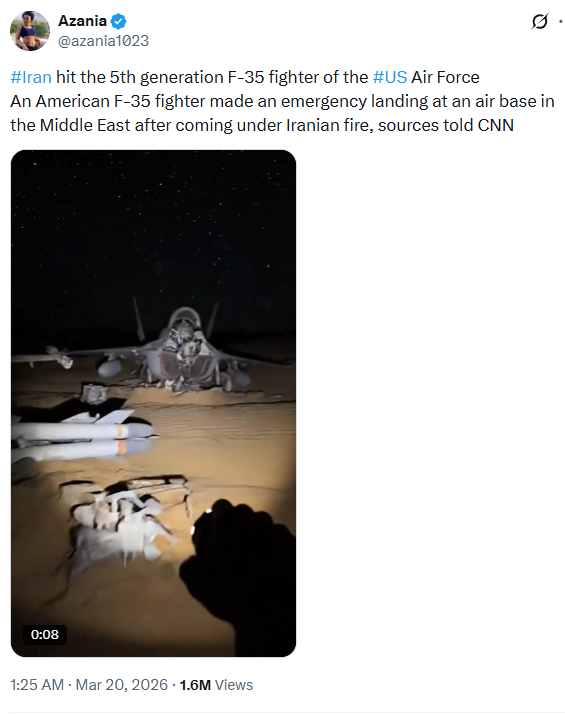
Amid the ongoing conflict involving the US-Israel and Iran, Tehran has claimed that it shot down a US F-35 fighter jet. In this context, a video is going viral on social media showing a crashed American fighter aircraft on the ground. It is being claimed that the footage shows Iran downing a US F-35 jet. However, an research by the CyberPeace found that the viral video is a deepfake and not real. The clip appears to have been created using Google AI tools.
Claim:
A social media user “Azania” shared the viral video on March 20, 2026, with the caption,“#Iran hit the 5th generation F-35 fighter of the #US Air Force… An American F-35 fighter made an emergency landing at an air base in the Middle East after coming under Iranian fire, sources told CNN.”
Fact Check:
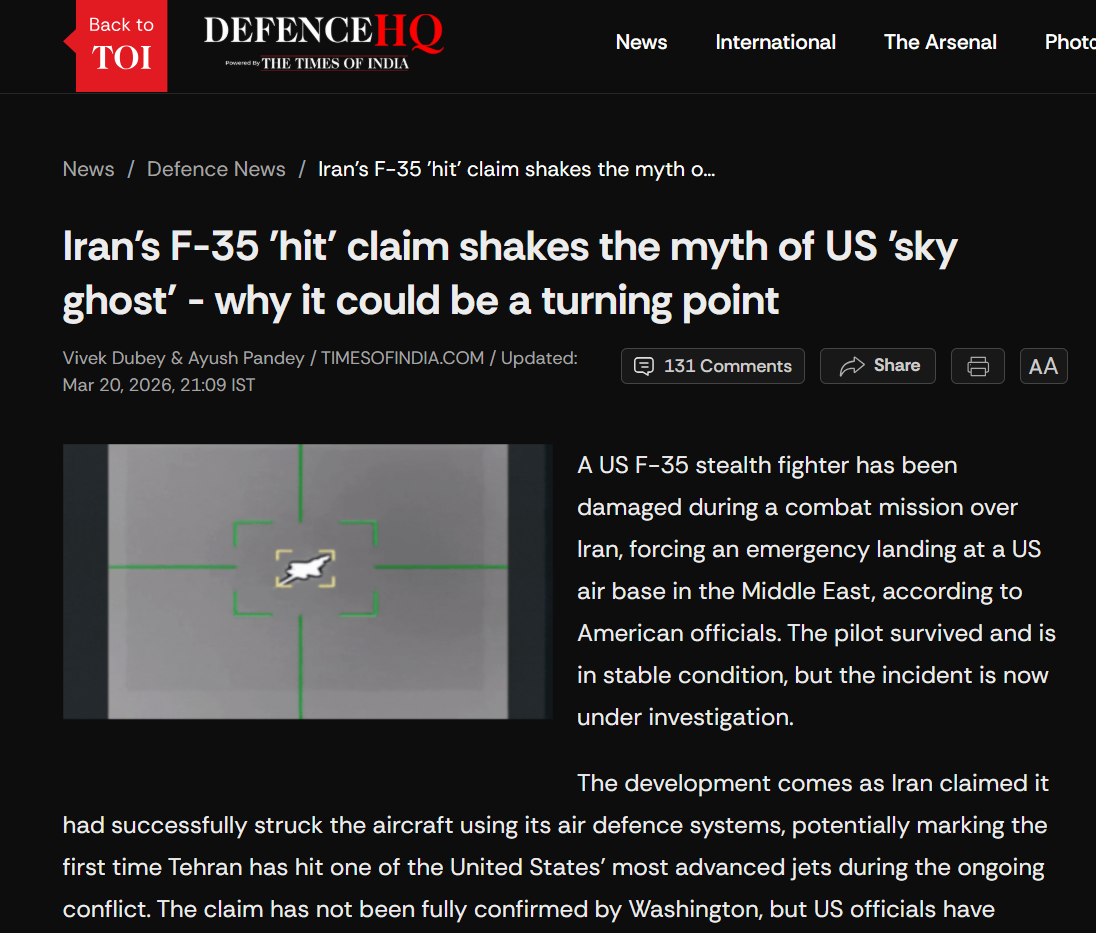
We began our research with a news search and found multiple reports stating that a US F-35 fighter jet was damaged during a combat mission over Iran. According to reports, Iran’s Islamic Revolutionary Guard Corps (IRGC) claimed to have damaged a US F-35 jet and also released a video. As per a CNN report, US officials confirmed that an American F-35 was damaged during a mission over Iran, forcing it to make an emergency landing at a US airbase in the Middle East. The pilot was safe and in stable condition, and the incident is currently under research .
A spokesperson for the US Central Command, Captain Tim Hawkins, also acknowledged that an F-35 made an emergency landing during the mission. However, the US has not officially confirmed that the damage was caused by an Iranian attack.Reports by Fox News and The Times of India also mention the emergency landing of the aircraft.
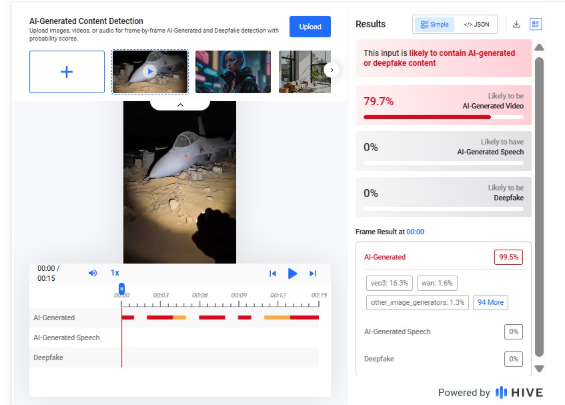
Upon closely examining the viral video, we noticed several inconsistencies indicating possible AI manipulation. We then analyzed the clip using Hive Moderation, which indicated nearly a 79 percent probability that the video is AI-generated. The analysis also suggests that it was likely created using Google’s AI video generation tools (Veo).
Conclusion:
The viral video claiming to show Iran shooting down a US F-35 fighter jet is AI-generated and not real. While Iran has claimed to have targeted a US F-35, and the US has confirmed an emergency landing during a mission, there is no official confirmation that the aircraft was shot down by Iran.

Related Blogs

Introduction
In the age of digital advancement, where technology continually grows, so does the method of crime. The rise of cybercrime has created various threats to individuals and organizations, businesses, and government agencies. To combat such crimes law enforcement agencies are looking out for innovative solutions against these challenges. One such innovative solution is taken by the Surat Police in Gujarat, who have embraced the power of Artificial Intelligence (AI) to bolster their efforts in reducing cybercrimes.
Key Highlights
Surat, India, has launched an AI-based WhatsApp chatbot called "Surat Police Cyber Mitra Chatbot" to tackle growing cybercrime. The chatbot provides quick assistance to individuals dealing with various cyber issues, ranging from reporting cyber crimes to receiving safety tips. The initiative is the first of its kind in the country, showcasing Surat Police's dedication to using advanced technology for public safety. Surat Police Commissioner-in-Charge commended the use of AI in crime control as a positive step forward, while also stressing the need for continuous improvements in various areas, including technological advancements, data acquisition related to cybercrime, and training for police personnel.
The Surat Cyber Mitra Chatbot, available on WhatsApp number 9328523417, offers round-the-clock assistance to citizens, allowing them to access crucial information on cyber fraud and legal matters.
Surat Police's AI Chatbot: Cyber Mitra
- Surat Police in Gujarat, India, has launched an AI-based WhatsApp chatbot, "Surat Police Cyber Mitra Chatbot," to combat growing cybercrime.
- The chatbot provides assistance to individuals dealing with various cyber issues, from reporting cyber crimes to receiving safety tips.
- The initiative is the first of its kind in the country, showcasing Surat Police's dedication to using advanced technology for public safety.
- The Surat Cyber Mitra Chatbot, available on WhatsApp number 9328523417, offers round-the-clock assistance to citizens, providing crucial information on cyber fraud.
The Growing Cybercrime Threat
With the advancement of technology, cybercrime has become more complex due to the interconnectivity of digital devices and the internet. The criminals exploit vulnerabilities in software, networks, and human behavior to perpetrate a wide range of malicious activities to fulfill their illicit gains. Individuals and organizations face a wide range of cyber risks that can cause significant financial, reputational, and emotional harm.
Surat Police’s Strategic Initiative
Surat Police Cyber Mitra Chatbot is an AI-powered tool for instant problem resolution. This innovative approach allows citizens to address any issue or query at their doorstep, providing immediate and accurate responses to concerns. The chatbot is accessible 24/7, 24 hours a day, and serves as a reliable resource for obtaining legal information related to cyber fraud.
The use of AI in police initiatives has been a topic of discussion for some time, and the Surat City Police has taken this step to leverage technology for the betterment of society. The chatbot promises to boost public trust towards law enforcement and improve the legal system by addressing citizen issues within seconds, ranging from financial disputes to cyber fraud incidents.
This accessibility extends to inquiries such as how to report financial crimes or cyber-fraud incidents and understand legal procedures. The availability of accurate information will not only enhance citizens' trust in the police but also contribute to the efficiency of law enforcement operations. The availability of accurate information will lead to more informed interactions between citizens and the police, fostering a stronger sense of community security and collaboration.
The utilisation of this chatbot will facilitate access to information and empower citizens to engage more actively with the legal system. As trust in the police grows and legal processes become more transparent and accessible, the overall integrity and effectiveness of the legal system are expected to improve significantly.
Conclusion
The Surat Police Cyber Mitra Chatbot is an AI-powered tool that provides round-the-clock assistance to citizens, enhancing public trust in law enforcement and streamlining access to legal information. This initiative bridges the gap between law enforcement and the community, fostering a stronger sense of security and collaboration, and driving improvements in the efficiency and integrity of the legal process.
References:
- https://www.ahmedabadmirror.com/surat-first-city-in-india-to-launch-ai-chatbot-to-tackle-cybercrime/81861788.html
- https://government.economictimes.indiatimes.com/news/secure-india/gujarat-surat-police-adopts-ai-to-check-cyber-crimes/107410981
- https://www.timesnownews.com/india/chatbot-and-advanced-analytics-surat-police-utilising-ai-technology-to-reduce-cybercrime-article-107397157
- https://www.grownxtdigital.in/technology/surat-police-ai-cyber-mitra-chatbot-gujarat/

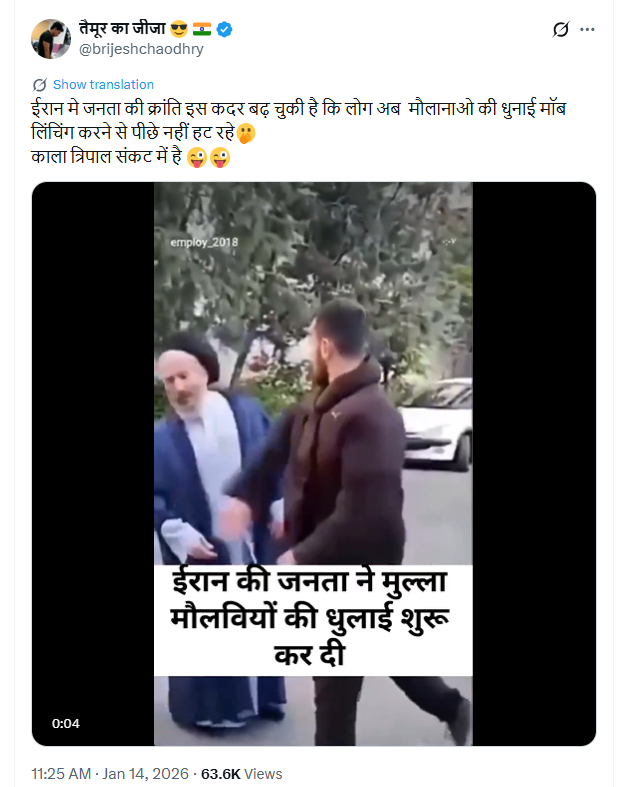
Amid reports that the death toll in Iran’s ongoing protests has risen to 2,571, a video has been widely circulated on social media showing a man slapping a person dressed in clerical attire after an argument. Users sharing the clip claim that public anger in Iran has escalated to the point where people are now physically attacking religious clerics. However, research by the Cyber Peace Foundation has found this claim to be misleading. The research established that the video is not recent and has no connection to the current protests in Iran. In fact, the clip dates back to 2021 and was entirely scripted.
Claim
On January 14, 2026, users on X (formerly Twitter) shared the viral video with captions suggesting that Iranian citizens are openly assaulting clerics amid the ongoing unrest. One such post stated that the situation in Iran had deteriorated so badly that people were now beating religious leaders.
The link, archived version, and screenshot of the post are available below:
Factcheck:
To verify the authenticity of the claim, the Cyber Peace Foundation extracted keyframes from the viral video and conducted a Google reverse image search. This led investigators to a report published on April 19, 2021, on the Persian-language website of Deutsche Welle (DW). The visuals matched the viral clip exactly, confirming that the footage is nearly five years old, not recent. Here is the link to the original video, along with a screenshot:
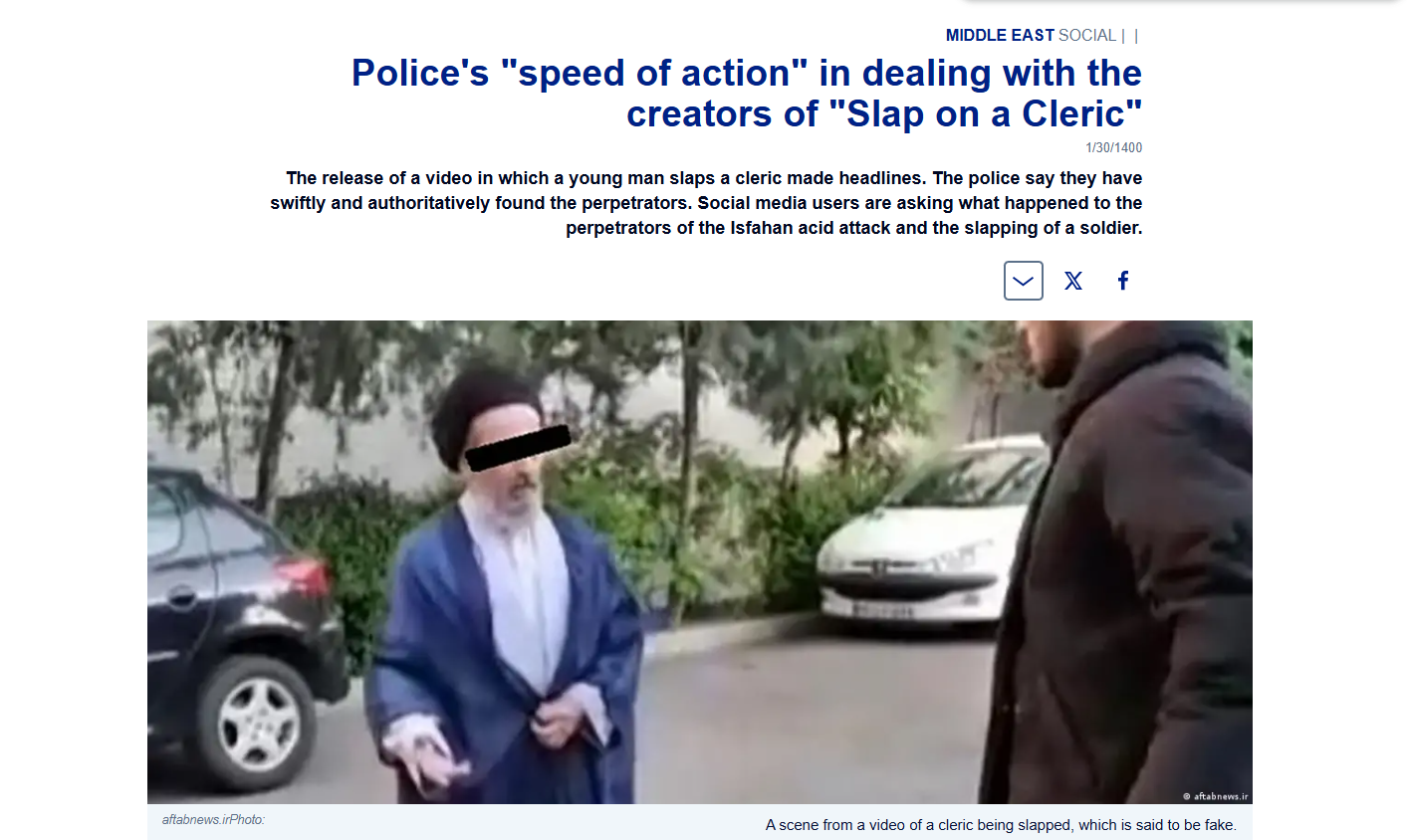
Further examination of reports by Fars News Agency revealed that Tehran police had conducted a detailed probe into the video at the time and declared it fake and pre-scripted. According to Tehran Police Chief Hossein Rahimi, the individual seen wearing religious attire was not a cleric. Here is the link to the original video, along with a screenshot: He was actually employed at a carpet cleaning shop in Tehran, while the man seen slapping him was his own son.
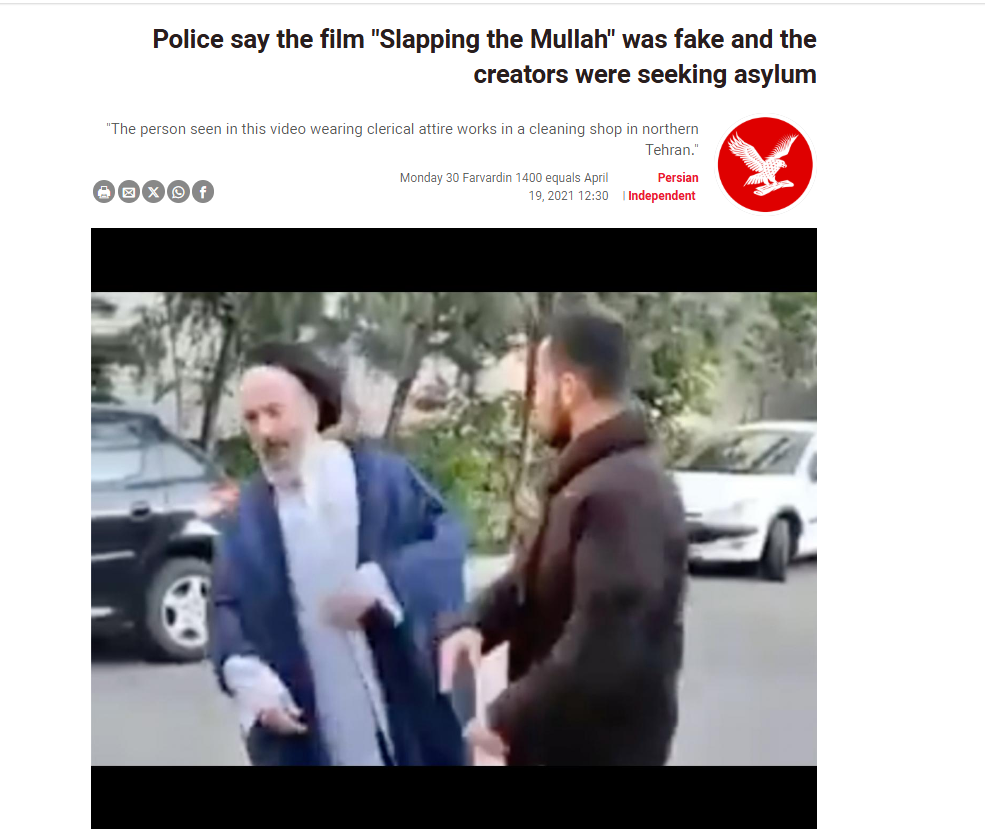
Police stated that the video was deliberately staged and circulated to provoke public sentiment and create unrest by falsely linking it to religious tensions. Both the father and son were arrested, and images of them in police custody were published in contemporaneous reports. Additional confirmation was found on the Independent Persian website, which had also reported on the incident on April 19, 2021, reiterating that the video was fabricated and unrelated to any protest movement. Here is the link to the original video, along with a screenshot:
Conclusion
The claim that the viral video shows an Iranian protester slapping a cleric during the current wave of protests is false. The video is from 2021, was scripted, and has no link to the ongoing demonstrations in Iran. It is being reshared with a misleading narrative to spread disinformation and inflame public sentiment.c
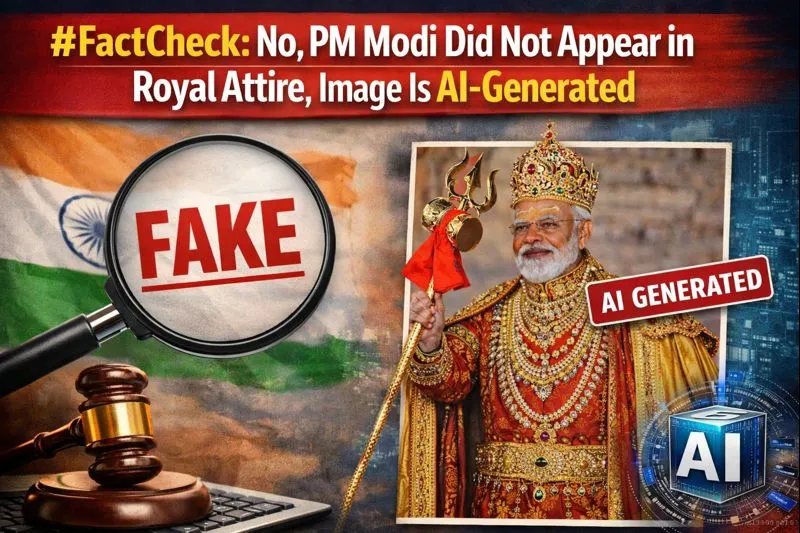
A photograph showing Prime Minister Narendra Modi holding a trident and dressed in royal attire is being widely shared on social media. Users circulating the image are claiming that it shows PM Modi in a regal outfit.
However, a verification by the Cyber Peace Foundation’s Research Desk has found that the claim is false. The investigation established that the viral image is not authentic and has been generated using Artificial Intelligence (AI).
Claim:
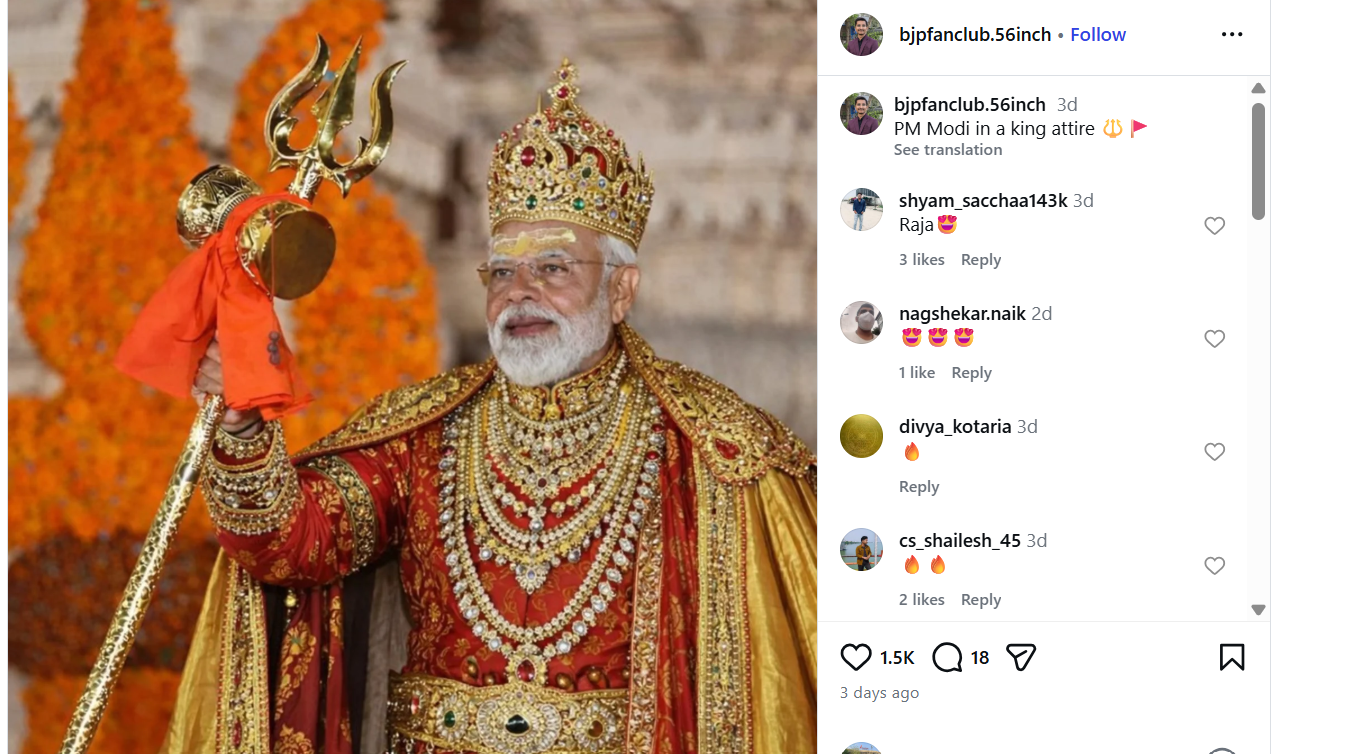
On January 11, 2026, several Instagram users shared the image with captions describing it as a photograph of Prime Minister Modi in royal attire.
Links and archived versions of the posts, along with screenshots, are provided below.
Fact Check:
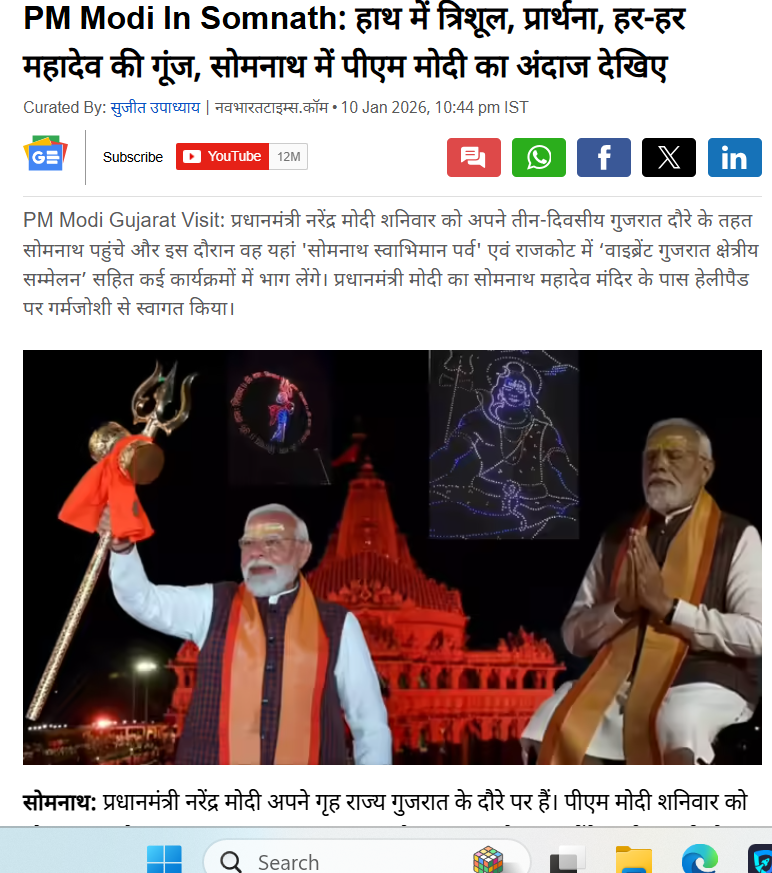
To verify the claim, relevant keywords such as “PM Modi holding trishul” were searched on Google. This led to a report published by Navbharat Times on January 10, 2025. The report features photographs of Prime Minister Modi holding a trident during his visit to the Somnath Temple. However, in the original images, he is seen wearing normal attire, not royal clothing as shown in the viral image. Link and screenshot
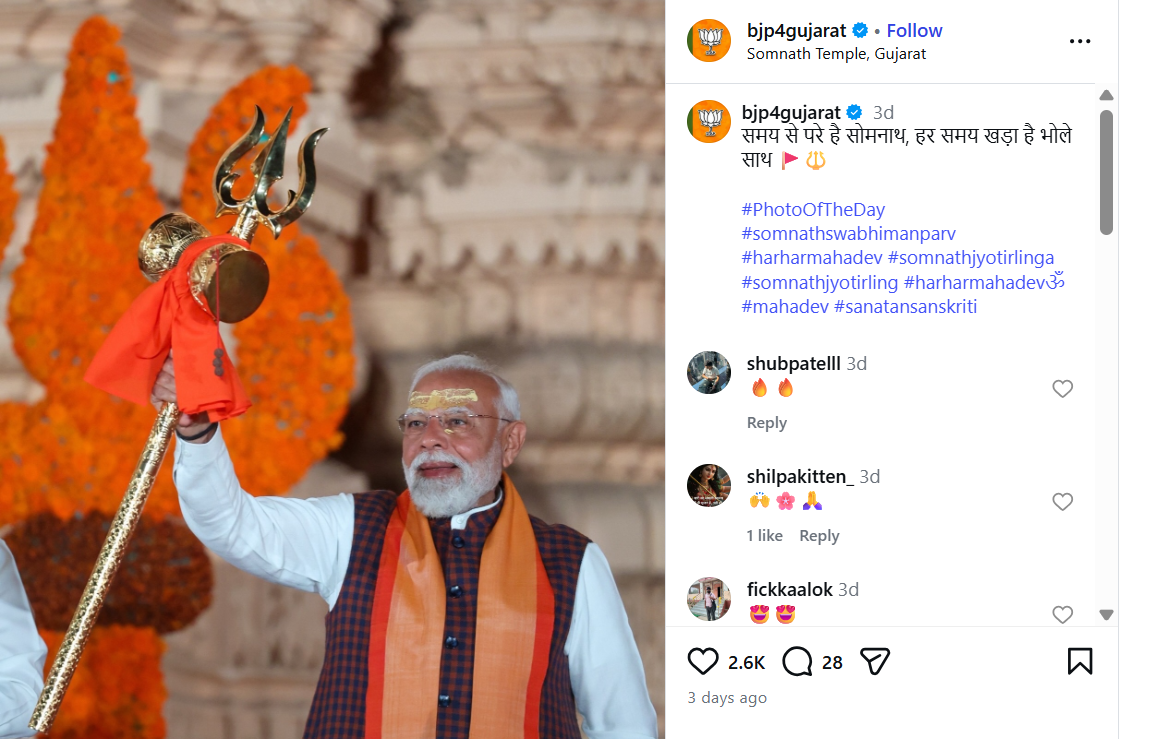
In the next step of the investigation, the original photograph was traced to the official Instagram account of BJP Gujarat, where it was posted on January 11, 2026. The post clearly identifies the image as being from Somnath Temple. Link and screenshot: https://www.instagram.com/p/DTVlb-9Da1V
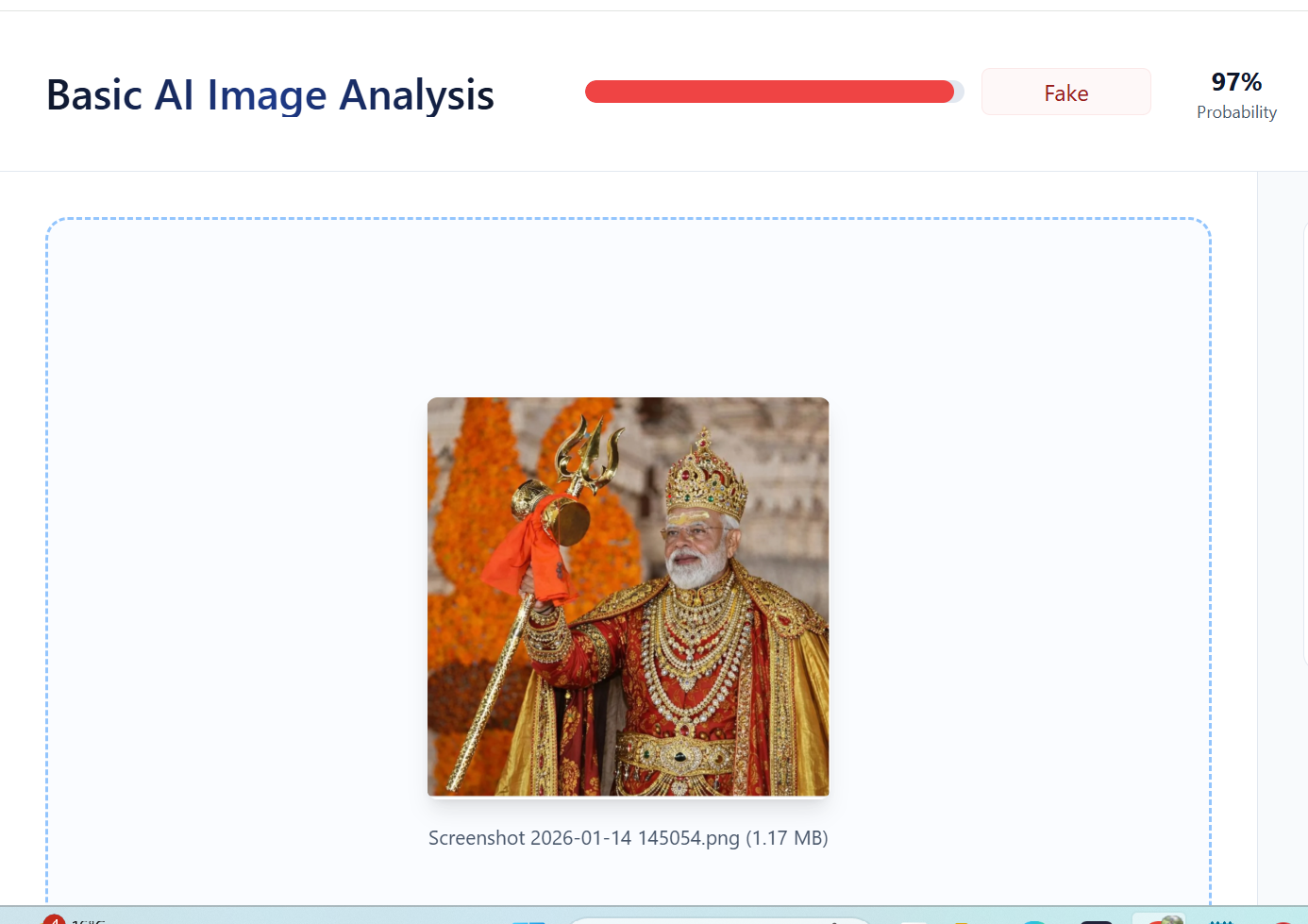
A close examination of the viral image raised suspicion about digital manipulation. The image was then analysed using the AI detection tool TruthScan. The tool’s assessment indicated a 97 percent likelihood that the image was AI-generated.
Further comparison between the viral image and the original photograph revealed that all visual elements match except the clothing, confirming that the attire was digitally altered using AI tools.
Conclusion
The claim that Prime Minister Narendra Modi appeared in royal attire is false. The Cyber Peace Foundation’s research confirms that the viral image was created using AI by altering the clothing in an original photograph taken during PM Modi’s visit to Somnath Temple. The manipulated image was shared online to mislead users.
