
#FactCheck -AI-Generated Letter Falsely Claims Prime Minister Narendra Modi Has Resigned
Executive Summary
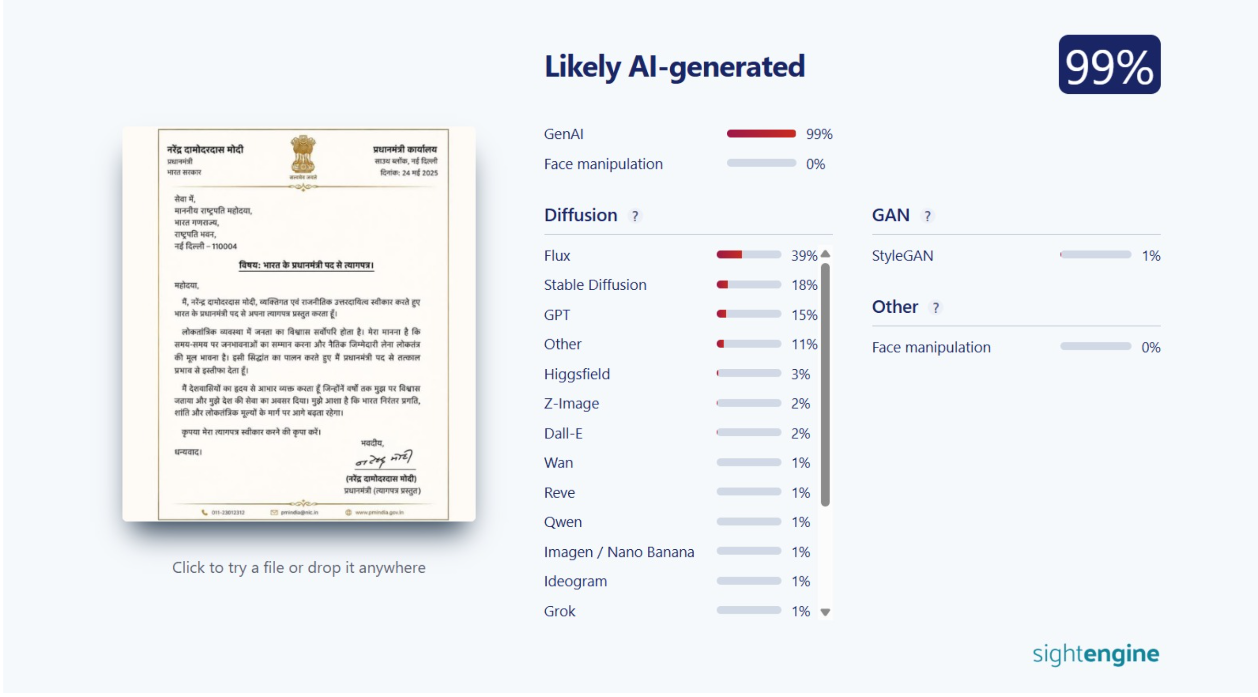
A letter circulating on social media falsely claims that Prime Minister Narendra Modi has resigned from his post. CyberPeace Research Wing's research found the claim to be false. Our research confirmed that the viral letter is fabricated and is being shared with a misleading claim. AI detection tools also indicate that the document is highly likely to have been generated using artificial intelligence.
Claim
An Instagram user shared the viral letter on July 29, 2026, claiming that Prime Minister Narendra Modi had resigned from office.
The post link, archived link, and screenshot are provided below:
https://www.facebook.com/photo/?fbid=2108984893363522&set=a.785246212404070
https://ghostarchive.org/archive/aHXTq

Fact Check
To verify the claim, we conducted a keyword search on Google. However, we found no credible media reports supporting the claim that Prime Minister Modi had resigned.
We then visited the official website of the Prime Minister's Office (PMO India). The website contained no announcement, press release, or official information confirming the purported resignation.
https://www.pmindia.gov.in/en/

As part of our research , we also reviewed the official X (formerly Twitter) account of PMO India. We found no post or statement related to the viral claim.

Finally, we analyzed the viral letter using the AI detection tool Sightengine AI. The analysis indicated that the document is 99% likely to be AI-generated.
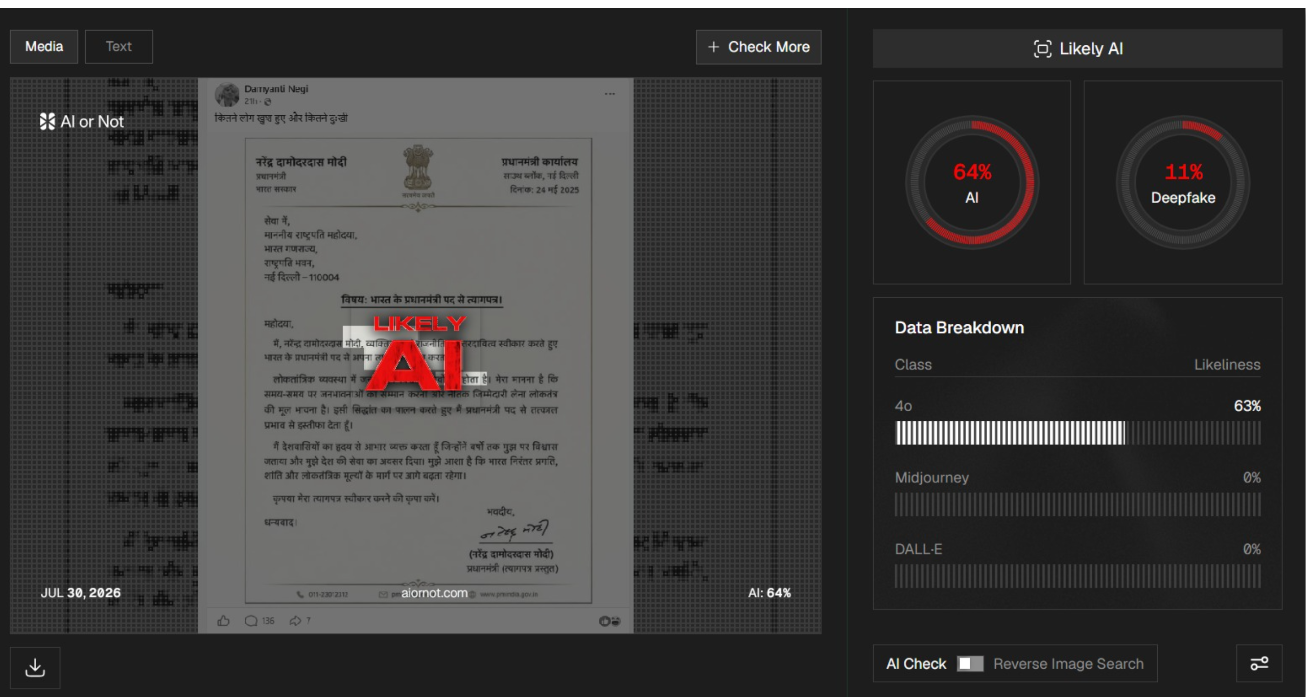
To further verify the findings, we also scanned the letter using AI or Not. According to the tool's analysis, the document is 64% likely to be AI-generated.
Conclusion
The claim that Prime Minister Narendra Modi has resigned is false. No credible media organization or official government source has reported such a development. Furthermore, AI detection tools strongly suggest that the viral resignation letter was generated using artificial intelligence and is being circulated with a false claim.

Related Blogs

Executive Summary
A social media post about the shooting incident during a dinner event for journalists covering the White House is going viral with the claim that the attacker was a Muslim man who was shot dead by security personnel. The accompanying video shows panic inside a hall and alert security officials responding to the situation. wHowever, research by the CyberPeace Research Wing found that the claim is false and misleading. The video is being shared with incorrect information about the identity and fate of the suspect.
Claim:
An Instagram user shared the video on April 26, 2026, claiming that the attacker who targeted Donald Trump was a “jihadi” named Mohammad Ibrahim and that he was killed after being shot multiple times.

Fact Check:
To verify the claim, relevant keyword searches were conducted online.
A report published by BBC on April 28, 2026, stated that the suspect accused of attempting to assassinate President Donald Trump during the Washington dinner event was identified as Cole Thomas Allen. The report said Allen lived with his parents in Los Angeles and was produced in court on April 28.
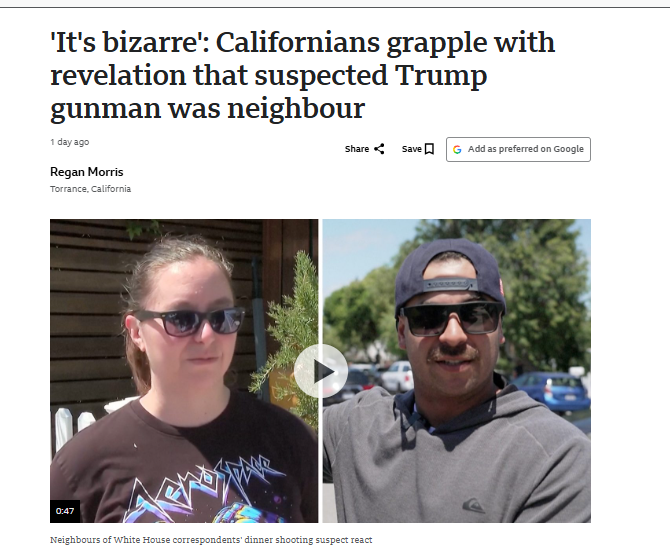
According to court documents cited in the report, Allen rushed past a security checkpoint carrying a semi-automatic handgun, a pump-action shotgun, and three knives. Authorities said one Secret Service agent was injured during the incident before Allen was subdued and taken into custody. A separate report published by NBC News on April 26, 2026, also identified the accused as Cole Thomas Allen and included visuals from the incident, showing the suspect after his arrest.

Conclusion:
The claim that the White House dinner party attacker was a Muslim man named Mohammad Ibrahim is false. The accused has been identified as Cole Thomas Allen, and he was arrested after the incident. Claims that he was killed are also incorrect.

Executive Summary
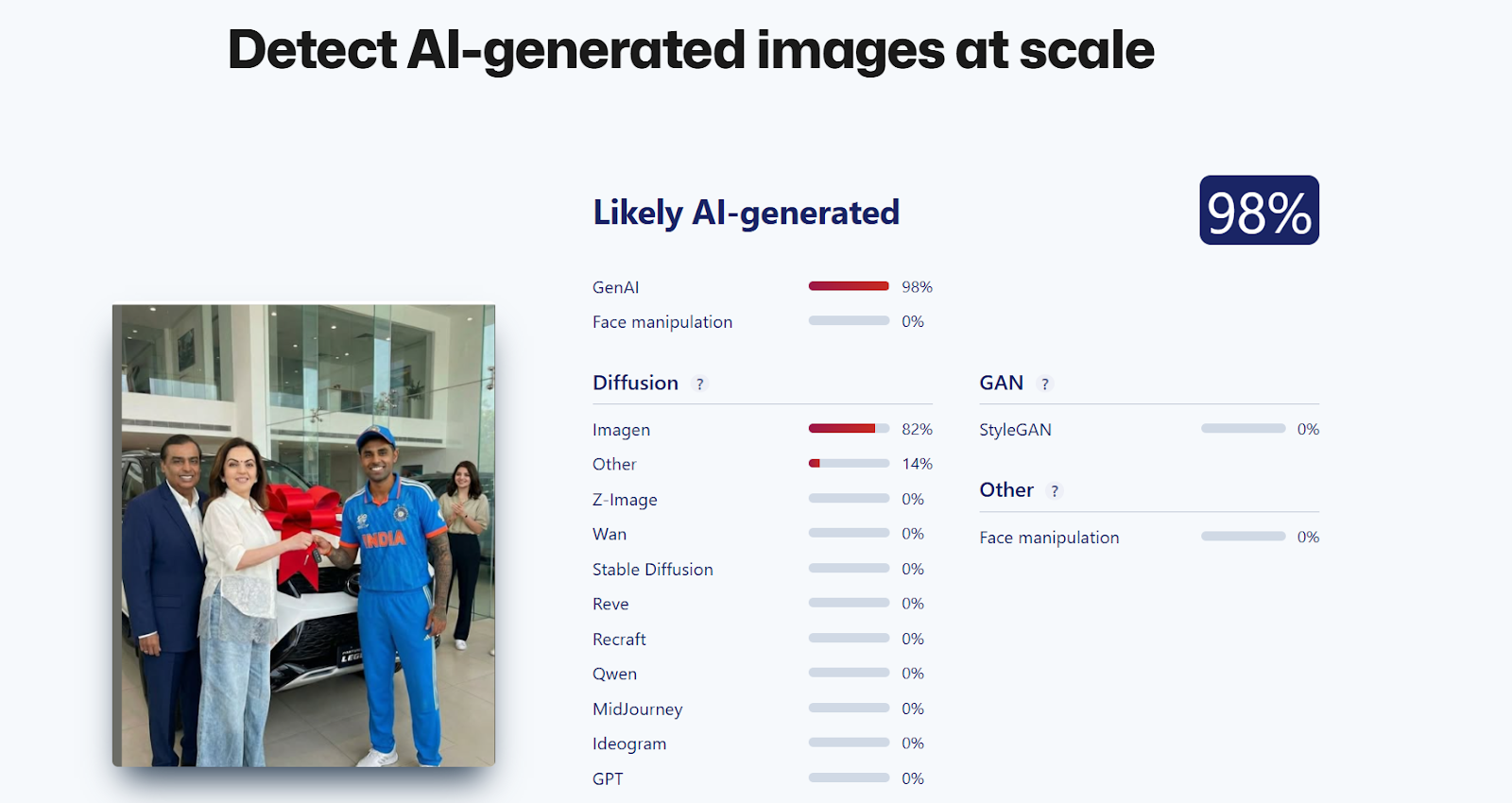
A picture circulating on social media allegedly shows Reliance Industries chairman Mukesh Ambani and Nita Ambani presenting a luxury car to India’s T20 team captain Suryakumar Yadav. The image is being widely shared with the claim that the Ambani family gifted the cricketer a luxury car in recognition of his outstanding performance. However, research conducted by the CyberPeace found the viral claim to be false. The research revealed that the image being circulated online is not authentic but generated using artificial intelligence (AI).
Claim
On February 8, 2025, a Facebook user shared the viral image claiming that Mukesh Ambani and Nita Ambani gifted a luxury car to Suryakumar Yadav following his brilliant innings. The post has been widely circulated across social media platforms. In another instance, a user shared a collage in which one image shows Suryakumar Yadav receiving an award, while another depicts him with Nita Ambani, further amplifying the claim.
- https://www.facebook.com/61559815349585/posts/122207061746327178/?rdid=0MukeT6c7WK1uB8m#
- https://archive.ph/wip/UH9Xh

Fact Check:
Upon closely examining the viral image, certain visual inconsistencies raised suspicion that it might be AI-generated. To verify its authenticity, the image was analysed using the AI detection tool Hive Moderation, which indicated a 99 percent probability that the image was AI-generated.

In the next step of the research, the image was also analysed using another AI detection tool, Sightengine, which found a 98 percent likelihood that the image was created using artificial intelligence.
Conclusion
The research clearly establishes that the viral image claiming Mukesh Ambani and Nita Ambani gifted a luxury car to Suryakumar Yadav is misleading. The picture is not real and has been generated using AI.

Introduction
For years, Indian companies could get away with vague privacy promises. That window closed on 13 November 2025, when the government notified the Digital Personal Data Protection Rules, giving teeth to the broad principles Parliament had passed back in 2023 under the DPDP Act. The Rules turned soft commitments into specific, auditable duties, and a lot of organisations are only now realising how much that actually changes.
Start with Section 8(4). It requires every Data Fiduciary to put "appropriate technical and organisational measures" in place. Most readers skim past "organisational" and focus on the technical half, but that's a mistake, because the word is doing real work. It's asking for defined roles, written policies, staff training, and someone actually watching whether any of it holds up over time, not just firewalls and encryption keys. Section 8(5) goes further, demanding reasonable security safeguards against breaches, and Rule 6 spells out exactly what that phrase means in practice: encrypt data at rest and in transit, restrict access on a need to know basis, require multi factor authentication, log and monitor activity, run regular vulnerability checks, bind your data processors contractually to the same standard, and keep relevant logs for at least a year.
Then there's Rule 7, and this is where the clock starts running. Once a Data Fiduciary becomes aware of a breach, the Data Protection Board must be told without delay, and a full report has to follow within 72 hours covering what happened, when, why, what's being done about it, and confirmation that affected individuals were notified. Unlike GDPR, there's no minimum severity threshold here. A breach affecting ten people triggers the same obligation as one affecting ten million. And CERT-In's existing six hour reporting window under its 2022 Directions still applies separately, which means a serious incident can trigger two overlapping regulatory clocks running side by side.
Put all of this together and a pattern emerges. The law assumes an organisation already knows what it's protecting, has actually protected it, kept usable records the whole way through, and can explain clearly what happened the moment something breaks. That coordination job belongs to Governance, Risk and Compliance, or GRC for short. GRC decides who's accountable, which risks actually matter, which controls address them, and how anyone checks whether compliance is real rather than assumed. Skip that structure and security work tends to splinter into a pile of disconnected tasks nobody truly owns.
GRC gives a legal duty somewhere to live. Forensic readiness is what lets an organisation prove, months or years later, that the duty was actually being met.
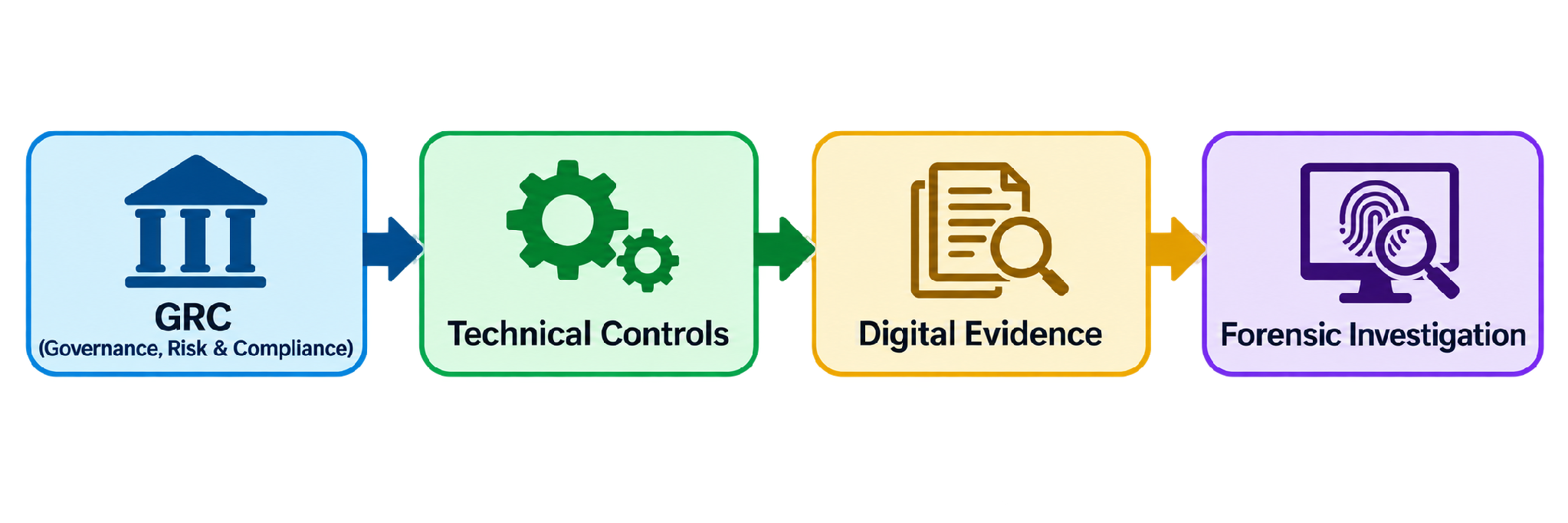
The Role of Governance, Risk and Compliance
On paper, most cybersecurity programmes look fine. There's an incident response plan somewhere, access control rules exist, logging is "in place," and someone has a title that says they're responsible for security. None of that gets tested until something actually breaks. A phishing compromise, a ransomware infection, a leaked database, a hijacked admin account, whatever the trigger, the questions that follow are always the same, and they're not comfortable ones. What happened, exactly, and when did it start? Which systems, which data, were actually touched? Were the controls the organisation claims to run genuinely functioning at that moment, or just described in a slide deck somewhere? And can anyone produce records solid enough to answer those questions with confidence rather than a shrug?
This is the exact seam where GRC and digital forensics meet. GRC lays out what's expected, who's responsible, and what evidence a control should be generating in the background. Digital forensics is the craft of taking whatever technical traces actually exist and turning them into an account of events that will hold up to scrutiny. Passing an audit was never really the point. Being able to stand in front of a regulator, mid incident, and show that the processes described on paper were real, active, and generating trustworthy evidence, that's the actual bar.
Why Compliance Alone Falls Short
Compliance, in the narrow sense, just means meeting whatever legal, contractual, or internal requirement applies. But a policy sitting in a document repository proves nothing about what actually happens on a Tuesday afternoon when someone requests admin access. A written incident response plan says nothing about whether the team can actually execute it under real pressure, at 2am, with a ransomware note on every screen. A logging policy is close to worthless if the logs it promises were switched off somewhere along the way, or overwritten, or scattered across systems that were never synchronised to the same clock.
NIST's Cybersecurity Framework 2.0 essentially built this concern into its core structure, placing "Govern" alongside Identify, Protect, Detect, Respond, and Recover as one of five equal functions rather than background paperwork sitting off to the side. India's own regulatory posture pushes in the same direction. CERT-In's 2022 Directions require certain incidents to be reported within six hours of discovery, and its guidance for government entities leans heavily on documented incident handling and disciplined evidence practices. The underlying message from both is identical: figure out, before anything goes wrong, whether the evidence you'll eventually need is actually going to exist when someone asks for it.
Where GRC and Forensics Actually Connect
A good GRC programme spells out what's supposed to happen. Forensic readiness is what lets you later prove what actually did.
Access control is a useful example here. On the GRC side, an organisation might require least privilege access, multi factor authentication, periodic reviews of who holds privileged accounts, and prompt removal of access once someone leaves or changes roles. On the forensic side, none of that means anything without the underlying records that let investigators actually test it, authentication logs, MFA usage history, privilege change records, and account activity trails. The table below lines up a few common GRC controls against the specific evidence needed to show they were genuinely operating.
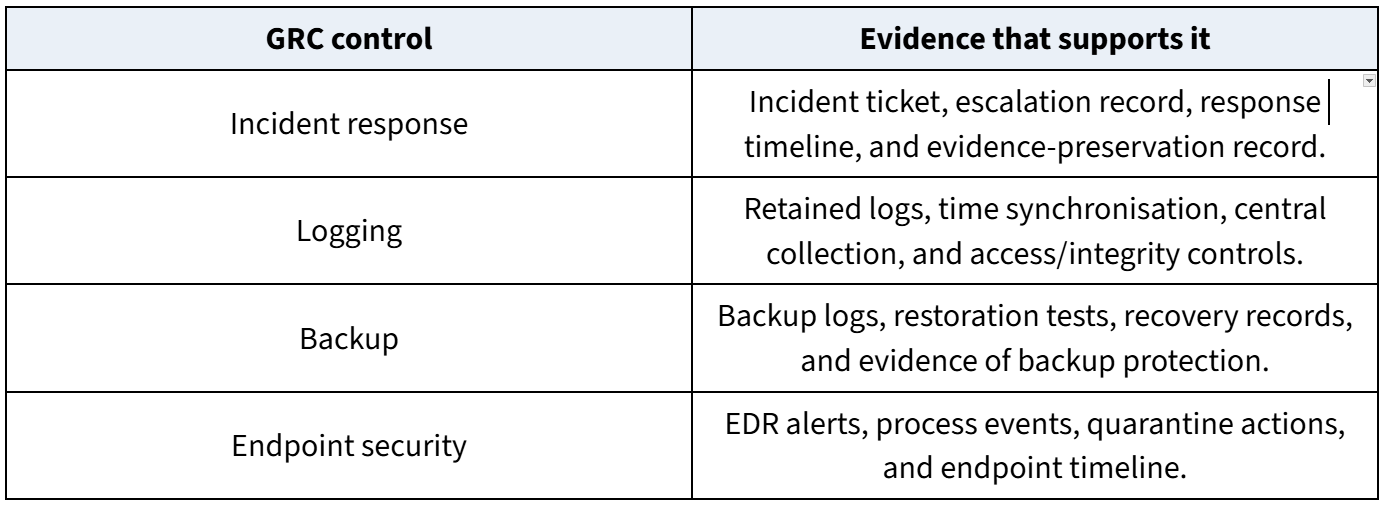
A Practical Scenario: After a Ransomware Incident
Picture a mid-sized company waking up to find half its file servers encrypted. There's an incident response plan somewhere in the shared drive, technically, but nobody's actually run through it in over a year. The security team isolates the obviously compromised endpoint and starts escalating. Now the forensic side of the house has to reconstruct what happened, working backward through endpoint telemetry, authentication logs, firewall events, email traffic, and file activity, hunting for the original point of entry, how the attacker escalated privileges, how they moved sideways through the network, what data they actually touched, and finally how the ransomware got deployed.
This is where the quality of everything collected beforehand suddenly matters a great deal. If server clocks were never properly synchronised, the timeline investigators build might not line up cleanly enough to trust. If logs only ever lived locally on individual machines rather than being pulled centrally, some of them are probably gone by now. If nobody ever bothered logging administrator actions, there are going to be real, unexplained gaps in the story. And if whatever evidence does exist wasn't collected the right way, its integrity can be challenged later, sometimes fatally, in a legal or regulatory proceeding. CERT-In actually ran a programme on exactly this in July 2026, "Inside the Breach," covering system artefacts, investigative technique, and chain of custody requirements, precisely because this is where real investigations tend to succeed or quietly fall apart.
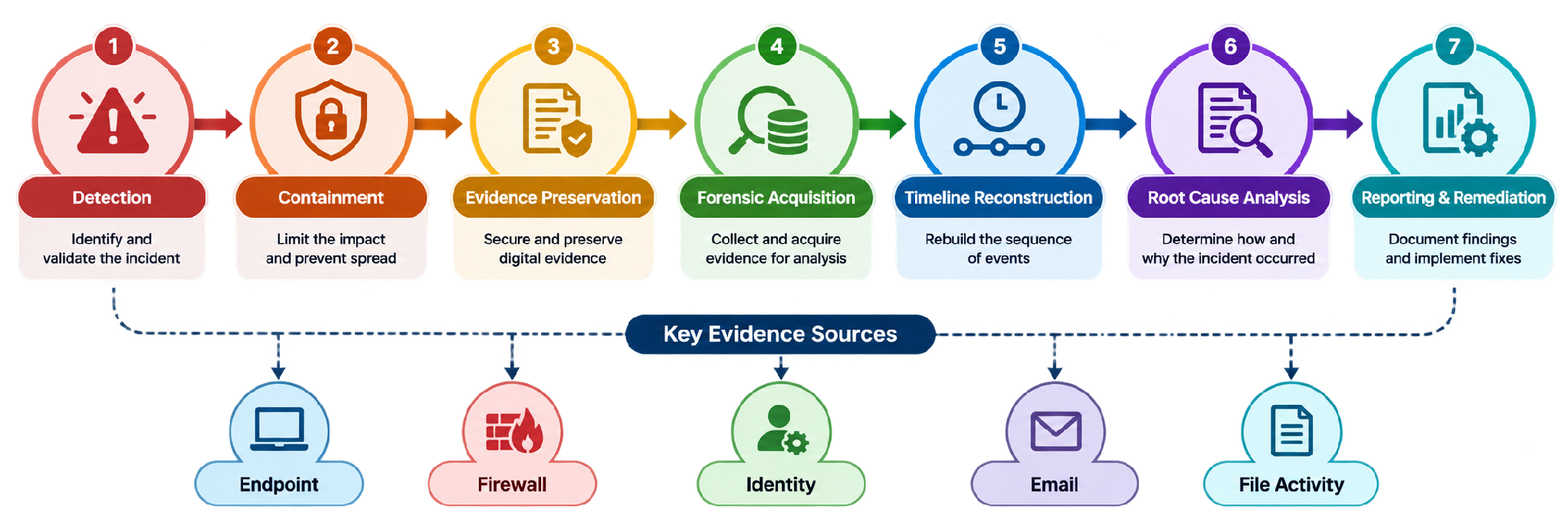
Building a Forensic Ready GRC Programme
For an organisation starting more or less from scratch, forensic readiness doesn't need to be bolted on as some separate initiative. It can be built straight into the GRC programme that already exists. Start by identifying the systems, applications, cloud services, and privileged accounts that actually matter. Map the real risks and regulatory requirements onto the controls meant to address them. Then get specific about what evidence each control should be generating, and how that evidence gets protected and kept over time. Time synchronisation, centralised logging, tightly controlled access to security records, and clear ownership of preservation, escalation, and investigation all need to exist well before an incident, not be improvised during one. And none of it means much until it's actually been tested, through tabletop exercises and simulated incidents rather than assumed to work because it's written down somewhere. NIST SP 800-61 Revision 3 frames incident response as one continuous loop of preparation, detection, response, recovery, and improvement, rather than a series of separate boxes to check.
There's one question worth asking of every important control an organisation runs: could you actually prove this was working at the moment an incident happened? If the honest answer is no, what you have is a compliance process on paper, and a forensic readiness gap sitting quietly underneath it.
Conclusion
Cyber readiness was never really about how many policies sit in a binder or how many boxes get ticked in an audit. It shows up, or doesn't, in the hours right after something breaks, when an organisation has to move fast, preserve evidence that can actually stand up to scrutiny, explain clearly what happened, and prove that governance and technical controls were genuinely working together rather than just coexisting on paper. GRC sets the direction, the accountability, the risk priorities, and the compliance expectations. Digital forensics does the work of preserving and interpreting the technical evidence once something actually happens. Forensic readiness sits in between the two, making sure they're actually talking to each other long before an incident forces the conversation. The practical task for most organisations comes down to something simple to say, if not always simple to build: design controls that hold up under real incident response, not just an auditor's checklist. The strongest compliance posture was never the one with the thickest binder. It's the one that can back every document up with evidence, on the day it actually matters.
References
- Digital Personal Data Protection Act, 2023, Sections 8(4), 8(5), 8(6). https://www.meity.gov.in/writereaddata/files/Digital%20Personal%20Data%20Protection%20Act%202023.pdf
- Digital Personal Data Protection Rules, 2025, Rules 6 and 7, notified 13 November 2025. https://www.meity.gov.in
- National Institute of Standards and Technology, The NIST Cybersecurity Framework (CSF) 2.0, CSWP 29, 2024. https://csrc.nist.gov/pubs/cswp/29/the-nist-cybersecurity-framework-csf-20/final
- Indian Computer Emergency Response Team (CERT-In), Directions under Section 70B of the Information Technology Act, 2000, dated 28 April 2022. https://www.cert-in.org.in/Directions70B.jsp
- Indian Computer Emergency Response Team (CERT-In), Guidelines on Information Security Practices for Government Entities. https://www.cert-in.org.in/Downloader?fileName=CIPS-2026-0014.pdf&pageid=5&type=2
- National Institute of Standards and Technology, SP 800-86: Guide to Integrating Forensic Techniques into Incident Response, 2006. https://csrc.nist.gov/pubs/sp/800/86/final
- International Organization for Standardization, ISO/IEC 27037:2012, Guidelines for identification, collection, acquisition and preservation of digital evidence. CERT-In, "Inside the Breach: Advanced Cyber Forensics & Incident Investigation," 31 July 2026. https://www.cert-in.org.in/s2cMainServlet?pageid=PRSTNVIEW03&reCode=CIWS-2026-3569
- National Institute of Standards and Technology, SP 800-61 Rev. 3: Incident Response Recommendations and Considerations for Cybersecurity Risk Management, 2025. https://csrc.nist.gov/pubs/sp/800/61/r3/final
- Matters.ai, "DPDP Breach Notification: 72-Hour Rule & ₹200 Cr Penalty." https://www.matters.ai/article/dpdp-breach-notification MediaNama, "Data Breach Reporting Timeline of DPDP Rules 2025 Explained." https://www.medianama.com/2025/11/223-data-breach-reporting-timeline-of-dpdp-rules-2025-explained/
