
#FactCheck - 2013 Aircraft Video Misleadingly Shared as Ajit Pawar’s Plane Accident
Executive Summary:
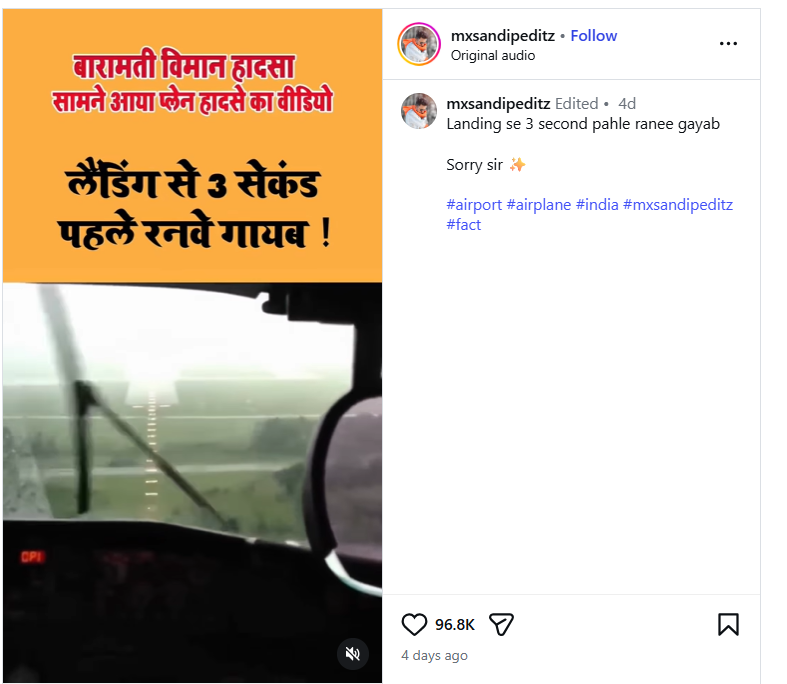
A video showing poor runway visibility from inside an aircraft cockpit is being widely shared on social media, linking it to an alleged aircraft accident involving Maharashtra Deputy Chief Minister Ajit Pawar in Baramati on January 28, 2025. Users claim that the footage captured the final moments before the crash, suggesting that the runway visibility disappeared just seconds before landing. However, research conducted by the CyberPeace found the viral claim to be misleading. The research revealed that the video has no connection to any aircraft accident involving Deputy Chief Minister Ajit Pawar. In reality, the video dates back to 2013 and shows a pilot attempting to land an aircraft amid heavy rain. During the approach, the runway briefly disappears from the pilot’s view, prompting the pilot to abort the landing and execute a go-around. The aircraft later lands safely after weather conditions improve.
Claim
An Instagram user shared the viral video on January 29, 2026, claiming:“Baramati plane crash: video of the aircraft accident surfaces. Runway disappears just three seconds before landing.” (The link to the post, its archived version, and screenshots are provided below.)
Fact Check
To verify the claim, we extracted keyframes from the viral video and conducted a reverse image search using Google Lens. The search led us to the same video uploaded on a YouTube channel named douglesso, which was published on June 12, 2013. (Footage link and screenshot available below.)

Further research led us to a report published by the American media website CNET, which featured the same visual. According to the report, the video shows a Boeing Business Jet attempting to land during heavy rainfall. The aircraft was conducting a CAT I Instrument Landing System (ILS) approach when a sudden downpour drastically reduced visibility at decision height. As the runway briefly disappeared from view, the pilots aborted the landing and carried out a go-around. The aircraft later landed safely once weather conditions improved. (The link to the CNET report and its screenshot are provided below.)
- https://www.cnet.com/culture/this-is-what-happens-when-a-plane-is-landing-and-the-runway-disappears/

Conclusion
Our research confirms that the video circulating on social media is unrelated to any recent aircraft accident involving Maharashtra Deputy Chief Minister Ajit Pawar. The clip is an old video from 2013, which is now being shared with a false and misleading claim.

Related Blogs

Introduction
The Telecom Regulatory Authority of India (TRAI) on 20th August 2024 issued directives requiring Access Service Providers to adhere to the specific guidelines to protect consumer interests and prevent fraudulent activities. TRAI has mandated all Access Service Providers to abide by the directives. These steps advance TRAI's efforts to promote a secure messaging ecosystem, protecting consumer interests and eliminating fraudulent conduct.
Key Highlights of the TRAI’s Directives
- For improved monitoring and control, TRAI has directed that Access Service Providers move telemarketing calls, beginning with the 140 series, to an online DLT (Digital Ledger Technology) platform by September 30, 2024, at the latest.
- All Access Service Providers will be forbidden from sending messages that contain URLs, APKs, OTT links, or callback numbers that the sender has not whitelisted, the rule is to be effective from September 1st, 2024.
- In an effort to improve message traceability, TRAI has made it mandatory for all messages, starting on November 1, 2024, to include a traceable trail from sender to receiver. Any message with an undefined or mismatched telemarketer chain will be rejected.
- To discourage the exploitation or misuse of templates for promotional content, TRAI has introduced punitive actions in case of non-compliance. Content Templates registered in the wrong category will be banned, and subsequent offences will result in a one-month suspension of the Sender's services.
- To assure compliance with rules, all Headers and Content Templates registered on DLT must follow the requirements. Furthermore, a single Content Template cannot be connected to numerous headers.
- If any misuse of headers or content templates by a sender is discovered, TRAI has instructed an immediate ‘suspension of traffic’ from all of that sender's headers and content templates for their verification. Such suspension can only be revoked only after the Sender has taken legal action against such usage. Furthermore, Delivery-Telemarketers must identify and disclose companies guilty of such misuse within two business days, or else risk comparable repercussions.
CyberPeace Policy Outlook
TRAI’s measures are aimed at curbing the misuse of messaging services including spam. TRAI has mandated that headers and content templates follow defined requirements. Punitive actions are introduced in case of non-compliance with the directives, such as blacklisting and service suspension. TRAI’s measures will surely curb the increasing rate of scams such as phishing, spamming, and other fraudulent activities and ultimately protect consumer's interests and establish a true cyber-safe environment in messaging services ecosystem.
The official text of TRAI directives is available on the official website of TRAI or you can access the link here.
References
- https://www.trai.gov.in/sites/default/files/Direction_20082024.pdf
- https://www.trai.gov.in/sites/default/files/PR_No.53of2024.pdf
- https://pib.gov.in/PressReleaseIframePage.aspx?PRID=2046872
- https://legal.economictimes.indiatimes.com/news/regulators/trai-issues-directives-to-access-providers-to-curb-misuse-fraud-through-messaging/112669368

Introduction
The Pahalgam terror attack, which took place on April 22, 2025, was a tragic incident that shook the nation. The National Investigation Agency (NIA) formally took over the Pahalgam terrorist attack case on Sunday, April 27, 2025. Following India's strikes on Pakistan, tensions between the two countries have heightened, leading to concerns about potential escalation, including the risk of cyber attacks and the spread of misinformation that could further complicate the situation. It is crucial for corporations, critical sectors, and all netizens in India to stay proactive and vigilant against cyber attacks, while also being cautious of the risks of misinformation. This includes protecting themselves from being affected and avoiding the inadvertent or deliberate spread of false information.
Be Careful with the Information You Consume and Share
It is crucial to note that the Press Information Bureau (PIB) has alerted citizens to stay cautious of fake narratives being circulated by Pakistani handles. Through an official fact check, PIB debunked several misleading claims aimed at undermining India’s internal stability and security forces. Citizens are urged to verify any suspicious content via PIB Fact Check before sharing it further. As social media becomes a hub for viral content, netizens must be cautious about the information they consume and share. Misleading information, old videos, false claims, and misinformation flood the platform, making it essential to be mindful of the content you consume and share, as spreading unverified content can have severe consequences.
CyberPeace Recommends Following Crucial Cyber Safety Tips to Stay Vigilant Against Potential Digital Threats:
- Do not open/download any video file you receive in social media groups or from unknown sources.
- As per several media reports, a video file named "Dance of the Hilary" is being circulated, which may be intended for a cyber attack on India. Please refrain from clicking, downloading, or sharing any such file. Additionally, there are reports of suspicious files circulating on WhatsApp, including tasksche.exe, OperationSindoor.ppt, and OperationSindhu.pptx. Do not download or open any of these files, as they may pose a serious cyber threat.
- To receive accurate alerts, you can enable government notifications on your iPhone. Go to Settings > Notifications and scroll down to Government Alerts. Make sure all the toggles under Government Alerts are turned on. This will allow you to receive timely information and important alerts from government agencies, and your device will display critical notifications to keep you informed and safe.
- Turn off automatic media download in WhatsApp to reduce the risk of downloading potentially harmful files.
- To protect your privacy, disable location services on apps like WhatsApp, Instagram, Snapchat, and X unless absolutely necessary.
- Refrain from sharing sensitive information like government data, confidential details, or personal records on unsecured devices or networks.
- To avoid misinformation and manipulation during conflict, verifying and cross-checking the news before sharing it with anyone is crucial. Stay updated with official news updates, and be cautious while sharing information.
Conclusion
In times of heightened tensions, all of us need to stay vigilant, protect our digital spaces, and verify the information we encounter. Together, we can safeguard ourselves from cyber threats and misinformation, ensuring the safety, stability, and digital security of our nation. As proud citizens, let us unite to protect both our physical and digital well-being.
References
- https://www.thehindu.com/news/national/pakistan-has-unleashed-propaganda-machine-in-response-to-successful-operation-sindoor-ib-ministry/article69549084.ece
- https://sambadenglish.com/national-international-news/india/centre-asks-people-to-stay-alert-against-misinformation-in-social-media-9048169
- https://www.youtube.com/watch?v=gLHo_Vd1_H0&t=19s

Introduction
Who would have predicted that the crime of slavery would haunt our lives through the digital world? In a recent unfolding of events, the cyber wing of Maharashtra has saved 60 Indian nationals from a cyber slavery racket run by armed rebel groups operating in Myanmar and arrested five suspects who acted as recruiting agents, including a foreign national. As per the reports, the racketeers made contact with various individuals, enticing them with offers of high-paying jobs in East Asian countries. The operation unfolds a carefully designed crime network that operates through bordering states, Myanmar, Thailand, and Malaysia, targeting vulnerable individuals through deceptive means and forcing them to commit cyber fraud and financial crimes, operating as an authentic industrial setup. The disturbing set of events makes up only one of many such cyber-slavery incidents that are uncovered and various other rackets that operate in the shadows of cyberspace. Another similar event was reported in March 2025, where the disturbing ordeal of a 52-year-old father from Bihar’s Gopalganj, whose son was lured into working in a scam call centre under the pretence of a data entry job in Thailand.
Counting the Unseen: The Dark Metrics of Cyber Slavery
As per the United Nations report from October 2024, a large number of young individuals are enslaved, acting under the impression they will be employed in high-paying jobs, often on social media platforms, and what follows is an intricate web of cybercriminals operating from illegal scam compounds. According to the UN Office on Drugs and Crime (UNODC), financial losses from scams in Southeast Asia reached between $18 billion (Rs 1.6 lakh crore) and $37 billion (Rs 3.2 lakh crore) in 2023, much of it linked to organised crime in these three countries. Also, acting on a similar premise, the Indian Cyber Crime Coordination Centre (I4C), a division under the Ministry of Home Affairs (MHA), organised an inter-ministerial committee to address a significant rise in cybercrime in Southeast Asian countries, which includes Cambodia, Myanmar, and Laos.
The data from the Bureau of Immigration in the Union Ministry of Home Affairs, which included around 29,466 Indians who travelled on visitor visas to Thailand, Vietnam, Myanmar, and Cambodia between January 2022 and May 2024, has gone missing.
From Rescue to Reform: How India is Tackling Cyber Slavery
The recent events that unfolded have agitated the government to undertake vigilant rescue operations for the missing individuals who became victims of this modern-day trafficking and coordinate with foreign ministries in Myanmar, Thailand and Cambodia for extradition and repatriation. It is notable that in the year 2015, India along with seven other countries in South Asia, including Afghanistan, Bangladesh, Bhutan, Maldives, Nepal, Pakistan and Sri Lanka, came together to address transnational threats that transcend geographical and cultural borders in cooperation with the United Nations Office on Drugs and Crimes (UNODC). The collaboration brought together a Compendium of Bilateral and Regional Instruments for South Asia providing for International Cooperation in Criminal Matters. Further, in January 2025, UNODC and the European Union launched a €9 million regional project titled "Preventing and Addressing Trafficking in Human Beings and the Smuggling of Migrants in South Asia." The Government of India, through its various agencies, also lays down various guidelines and advisories on the National Cyber Crime Reporting Portal. Additionally, law enforcement agencies are actively involved, and cybersecurity NGOs are proactively spreading awareness about identifying red flags associated with threats such as cyber slavery.
Recommendations: A Call to Action
- The various advisories released by the Gov. of India emphasise the need for Indian nationals to verify the credentials of the employer through the Indian Embassy located in that country.
- The authorities and various agencies also stress the need for individuals to refrain from sharing personal information such as location details, contact information or any information pertaining to personal relationships that can be exploited by such criminals.
- The fundamental manner of tackling the crime of cyber slavery is to ensure digital literacy and increase awareness through public campaigns and educational programmes
- The need of the hour is international cooperation and collaboration to undertake a concerted effort to bring back the victims and penalise all those who facilitate such criminal activities.
References
- https://www.thehindu.com/news/national/more-than-60-indians-forced-into-cyber-slavery-rescued-from-myanmar-5-arrested/article69438991.ece
- https://www.indiatoday.in/india-today-insight/story/cyber-slavery-the-new-job-con-trapping-indian-youth-abroad-2637157-2024-11-21
- https://indianexpress.com/article/india/mha-high-powered-committee-cybercrimes-from-se-asia-9345843/
- https://www.unodc.org/documents/terrorism/Publications/SAARC%20compendium/SA_Compendium_Volume-2.pdf
