
#FactCheck -AI-Generated Image Falsely Linked to Kotdwar Shop Controversy
Executive Summary
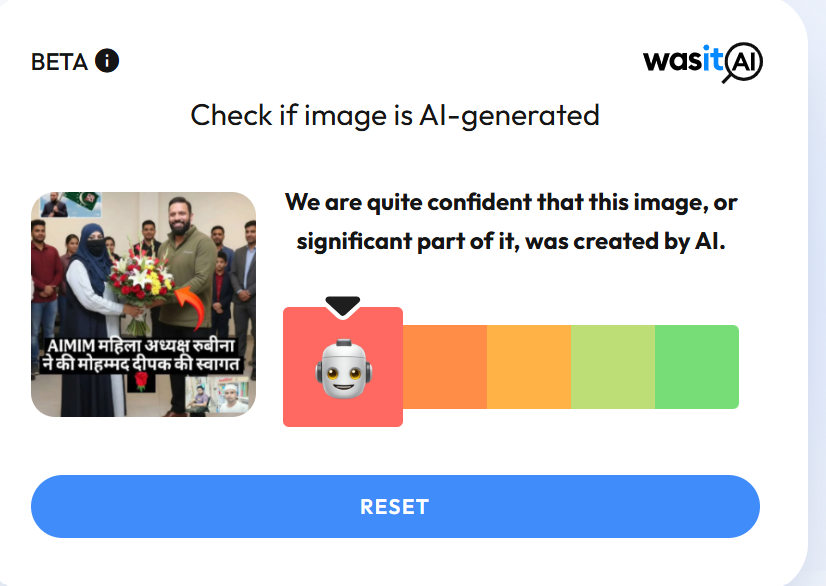
A dispute had recently emerged in Kotdwar, Uttarakhand, over the name of a shop. During the controversy, a local youth, Deepak Kumar, came forward in support of the shopkeeper. The incident subsequently became a subject of discussion on social media, with users expressing varied reactions. Meanwhile, a photo began circulating on social media showing a burqa-clad woman presenting a bouquet to Deepak Kumar. The image is being shared with the claim that All India Majlis-e-Ittehadul Muslimeen (AIMIM)’s women’s president, Rubina, welcomed “Mohammad Deepak Kumar” by presenting him with a bouquet. However, research conducted by the CyberPeace found the viral claim to be false. The research revealed that users are sharing an AI-generated image with a misleading claim.
Claim:
On social media platform Instagram, a user shared the viral image claiming that AIMIM’s women’s president Rubina welcomed “Mohammad Deepak Kumar” by presenting him with a bouquet. The link to the post, its archived version, and a screenshot are provided below.

Fact Check:
Upon closely examining the viral image, certain inconsistencies raised suspicion that it could be AI-generated. To verify its authenticity, the image was analysed using the AI detection tool Hive Moderation, which indicated a 96 percent probability that the image was AI-generated.

In the next stage of the research , the image was also analysed using another AI detection tool, Wasit AI, which likewise identified the image as AI-generated.
Conclusion
The research establishes that users are circulating an AI-generated image with a misleading claim linking it to the Kotdwar controversy.

Related Blogs

Introduction
In the age of social media, the news can spread like wildfire. A recent viral claim contained that police have started a nationwide scheme of free travel service for women at night. It stated that any woman who is alone and cannot find a vehicle to go home between 10 PM and 06 AM can contact the provided numbers and request a free vehicle. The viral message further contained the request to share and forward this information to everyone to get the women to know about the free vehicle service offered by police at night. However, upon fact check the claim was found to be misleading.
Social Impact of Misleading Information
The fact that such misleading information gets viral at a fast speed is because of its ability to impact and influence people through emotional resonance. Especially during a time when women's safety is a topic discussed in media sensationalism due to recently highlighted rape or sexual violence incidents, such fake viral claims often spark widespread public concern, causing emotional resonance to people and they unknowingly share or forward such messages in the spike of emotional and sensational appeal contained in such messages. The emotional nature of these viral texts often overrides scepticism, leading to immediate sharing without verification.
Such nature of viral messages often tends to bring people to protest, raise awareness and create support networks, but in spite of emotional resonance people get targeted by misinformation and become the unintended superspreaders of fake news fueled by emotional and social media-driven reactions. Women’s safety in society is a sensitive topic and when people discover such viral claims to be misleading and fake, it often hurts the sentiments of society leading to significant social impacts, including distrust in social media, unnecessary panic and confusion.
CyberPeace Policy Vertical Advisory for Social Media Users
- Think before Sharing: All netizens must practice caution while sharing anything and double-check its authenticity before sharing/forwarding or reposting it on your social media stories.
- Don't be unintended superspreaders of Misinformation: Misinformation with emotional resonance and widespread sharing by netizens can lead to them becoming "superspreaders of misinformation" and making it viral quickly. Hence you must avoid such unintended consequences by following the best practices of being vigilant and informed by reliable sources.
- Exercise vigilance and scepticism: It is important that netizens exercise vigilance and they build cognitive abilities to recognise the red flags of misleading information. You can do so by following the official communication channels, looking for any discrepancy in the content of susceptible information and double-checking its authenticity before sharing it with anyone.
- Verify the information from official sources: Follow the official communication channels of concerned authorities for any kind of information, circulars, notifications etc. In case of finding any piece of information to be susceptible or misleading, intimate it to the relevant authority and the fact-checking organizations.
- Stay in touch with expert organizations: Cybersecurity experts and civil society organisations possess the unique blend of large-scale impact potential and technical expertise. Netizens can stay updated about recent developments in the tech-policy sphere and learn about internet best practices, and measures to counter misinformation through methods such as prebunking, debunking and more.
Connect with CyberPeace
As an expert organisation, we have the ability to educate and empower huge numbers, along with the skills and policy acumen needed to be able to not just make people aware of the problem but also teach them how to solve it for themselves. At CyberPeace we regularly produce fact-check reports, blogs & advisories, and insights on prebunking & debunking measures and capacity-building programs with the aim of empowering netizens at the heart of our initiatives. CyberPeace has established the largest network of CyberPeace Corps volunteers globally. These volunteers play a crucial role in assisting victims, raising awareness, and promoting proactive measures.
References:

Introduction
The appeal is to be heard by the TDSAT (telecommunication dispute settlement & appellate tribunal) regarding several changes under Digital personal data protection. The Changes should be a removal of the deemed consent, a change in appellate mechanism, No change in delegation legislation, and under data breach. And there are some following other changes in the bill, and the digital personal data protection bill 2023 will now provide a negative list of countries that cannot transfer the data.
New Version of the DPDP Bill
The Digital Personal Data Protection Bill has a new version. There are three major changes in the 2022 draft of the digital personal data protection bill. The changes are as follows: The new version proposes changes that there shall be no deemed consent under the bill and that the personal data processing should be for limited uses only. By giving the deemed consent, there shall be consent for the processing of data for any purposes. That is why there shall be no deemed consent.
- In the interest of the sovereignty
- The integrity of India and the National Security
- For the issue of subsidies, benefits, services, certificates, licenses, permits, etc
- To comply with any judgment or order under the law
- To protect, assist, or provide service in a medical or health emergency, a disaster situation, or to maintain public order
- In relation to an employee and his/her rights
The 2023 version now includes an appeals mechanism
It states that the Board will have the authority to issue directives for data breach remediation or mitigation, investigate data breaches and complaints, and levy financial penalties. It would be authorised to submit complaints to alternative dispute resolution, accept voluntary undertakings from data fiduciaries, and advise the government to prohibit a data fiduciary’s website, app, or other online presence if the terms of the law were regularly violated. The Telecom Disputes Settlement and Appellate Tribunal will hear any appeals.
The other change is in delegated legislation, as one of the criticisms of the 2022 version bill was that it gave the government extensive rule-making powers. The committee also raised the same concern with the ministry. The committed wants that the provisions that cannot be fully defined within the scope of the bill can be addressed.
The other major change raised in the new version bill is regarding the data breach; there will be no compensation for the data breach. This raises a significant concern for the victims, If the victims suffer a data breach and he approaches the relevant court or authority, he will not be awarded compensation for the loss he has suffered due to the data breach.
Need of changes under DPDP
There is a need for changes in digital personal data protection as we talk about the deemed consent so simply speaking, by ‘deeming’ consent for subsequent uses, your data may be used for purposes other than what it has been provided for and, as there is no provision for to be informed of this through mandatory notice, there may never even come to know about it.
Conclusion
The bill requires changes to meet the need of evolving digital landscape in the digital personal data protection 2022 draft. The removal of deemed consent will ultimately protect the data of the data principal. And the data of the data principal will be used or processed only for the purpose for which the consent is given. The change in the appellate mechanism is also crucial as it meets the requirements of addressing appeals. However, the no compensation for a data breach is derogatory to the interest of the victim who has suffered a data breach.

Executive Summary:
Given that AI technologies are evolving at a fast pace in 2024, an AI-oriented phishing attack on a large Indian financial institution illustrated the threats. The documentation of the attack specifics involves the identification of attack techniques, ramifications to the institution, intervention conducted, and resultant effects. The case study also turns to the challenges connected with the development of better protection and sensibilisation of automatized threats.
Introduction
Due to the advancement in AI technology, its uses in cybercrimes across the world have emerged significant in financial institutions. In this report a serious incident that happened in early 2024 is analysed, according to which a leading Indian bank was hit by a highly complex, highly intelligent AI-supported phishing operation. Attack made use of AI’s innate characteristic of data analysis and data persuasion which led into a severe compromise of the bank’s internal structures.
Background
The chosen financial institution, one of the largest banks in India, had a good background regarding the extremity of its cybersecurity policies. However, these global cyberattacks opened up new threats that AI-based methods posed that earlier forms of security could not entirely counter efficiently. The attackers concentrated on the top managers of the bank because it is evident that controlling such persons gives the option of entering the inner systems as well as financial information.
Attack Execution
The attackers utilised AI in sending the messages that were an exact look alike of internal messages sent between employees. From Facebook and Twitter content, blog entries, and lastly, LinkedIn connection history and email tenor of the bank’s executives, the AI used to create these emails was highly specific. Some of these emails possessed official formatting, specific internal language, and the CEO’s writing; this made them very realistic.
It also used that link in phishing emails that led the users to a pseudo internal portal in an attempt to obtain the login credentials. Due to sophistication, the targeted individuals thought the received emails were genuine, and entered their log in details easily to the bank’s network, thus allowing the attackers access.
Impact
It caused quite an impact to the bank in every aspect. Numerous executives of the company lost their passwords to the fake emails and compromised several financial databases with information from customer accounts and transactions. The break-in permitted the criminals to cease a number of the financial’s internet services hence disrupting its functions and those of its customers for a number of days.
They also suffered a devastating blow to their customer trust because the breach revealed the bank’s weakness against contemporary cyber threats. Apart from managing the immediate operations which dealt with mitigating the breach, the financial institution was also toppling a long-term reputational hit.
Technical Analysis and Findings
1. The AI techniques that are used in generation of the phishing emails are as follows:
- The attack used powerful NLP technology, which was most probably developed using the large-scaled transformer, such as GPT (Generative Pre-trained Transformer). Since these models are learned from large data samples they used the examples of the conversation pieces from social networks, emails and PC language to create quite credible emails.
Key Technical Features:
- Contextual Understanding: The AI was able to take into account the nature of prior interactions and thus write follow up emails that were perfectly in line with prior discourse.
- Style Mimicry: The AI replicated the writing of the CEO given the emails of the CEO and then extrapolated from the data given such elements as the tone, the language, and the format of the signature line.
- Adaptive Learning: The AI actively adapted from the mistakes, and feedback to tweak the generated emails for other tries and this made it difficult to detect.
2. Sophisticated Spear-Phishing Techniques
Unlike ordinary phishing scams, this attack was phishing using spear-phishing where the attackers would directly target specific people using emails. The AI used social engineering techniques that significantly increased the chances of certain individuals replying to certain emails based on algorithms which machine learning furnished.
Key Technical Features:
- Targeted Data Harvesting: Cyborgs found out the employees of the organisation and targeted messages via the public profiles and messengers were scraped.
- Behavioural Analysis: The latest behaviour pattern concerning the users of the social networking sites and other online platforms were used by the AI to forecast the courses of action expected to be taken by the end users such as clicking on the links or opening of the attachments.
- Real-Time Adjustments: These are times when it was determined that the response to the phishing email was necessary and the use of AI adjusted the consequent emails’ timing and content.
3. Advanced Evasion Techniques
The attackers were able to pull off this attack by leveraging AI in their evasion from the normal filters placed in emails. These techniques therefore entailed a modification of the contents of the emails in a manner that would not be easily detected by the spam filters while at the same time preserving the content of the message.
Key Technical Features:
- Dynamic Content Alteration: The AI merely changed the different aspects of the email message slightly to develop several versions of the phishing email that would compromise different algorithms.
- Polymorphic Attacks: In this case, polymorphic code was used in the phishing attack which implies that the actual payloads of the links changed frequently, which means that it was difficult for the AV tools to block them as they were perceived as threats.
- Phantom Domains: Another tactic employed was that of using AI in generating and disseminating phantom domains, that are actual web sites that appear to be legitimate but are in fact short lived specially created for this phishing attack, adding to the difficulty of detection.
4. Exploitation of Human Vulnerabilities
This kind of attack’s success was not only in AI but also in the vulnerability of people, trust in familiar language and the tendency to obey authorities.
Key Technical Features:
- Social Engineering: As for the second factor, AI determined specific psychological principles that should be used in order to maximise the chance of the targeted recipients opening the phishing emails, namely the principles of urgency and familiarity.
- Multi-Layered Deception: The AI was successfully able to have a two tiered approach of the emails being sent as once the targeted individuals opened the first mail, later the second one by pretext of being a follow up by a genuine company/personality.
Response
On sighting the breach, the bank’s cybersecurity personnel spring into action to try and limit the fallout. They reported the matter to the Indian Computer Emergency Response Team (CERT-In) to find who originated the attack and how to block any other intrusion. The bank also immediately started taking measures to strengthen its security a bit further, for instance, in filtering emails, and increasing the authentication procedures.
Knowing the risks, the bank realised that actions should be taken in order to enhance the cybersecurity level and implement a new wide-scale cybersecurity awareness program. This programme consisted of increasing the awareness of employees about possible AI-phishing in the organisation’s info space and the necessity of checking the sender’s identity beforehand.
Outcome
Despite the fact and evidence that this bank was able to regain its functionality after the attack without critical impacts with regards to its operations, the following issues were raised. Some of the losses that the financial institution reported include losses in form of compensation of the affected customers and costs of implementing measures to enhance the financial institution’s cybersecurity. However, the principle of the incident was significantly critical of the bank as customers and shareholders began to doubt the organisation’s capacity to safeguard information in the modern digital era of advanced artificial intelligence cyber threats.
This case depicts the importance for the financial firms to align their security plan in a way that fights the new security threats. The attack is also a message to other organisations in that they are not immune from such analysis attacks with AI and should take proper measures against such threats.
Conclusion
The recent AI-phishing attack on an Indian bank in 2024 is one of the indicators of potential modern attackers’ capabilities. Since the AI technology is still progressing, so are the advances of the cyberattacks. Financial institutions and several other organisations can only go as far as adopting adequate AI-aware cybersecurity solutions for their systems and data.
Moreover, this case raises awareness of how important it is to train the employees to be properly prepared to avoid the successful cyberattacks. The organisation’s cybersecurity awareness and secure employee behaviours, as well as practices that enable them to understand and report any likely artificial intelligence offences, helps the organisation to minimise risks from any AI attack.
Recommendations
- Enhanced AI-Based Defences: Financial institutions should employ AI-driven detection and response products that are capable of mitigating AI-operation-based cyber threats in real-time.
- Employee Training Programs: CYBER SECURITY: All employees should undergo frequent cybersecurity awareness training; here they should be trained on how to identify AI-populated phishing.
- Stricter Authentication Protocols: For more specific accounts, ID and other security procedures should be tight in order to get into sensitive ones.
- Collaboration with CERT-In: Continued engagement and coordination with authorities such as the Indian Computer Emergency Response Team (CERT-In) and other equivalents to constantly monitor new threats and valid recommendations.
- Public Communication Strategies: It is also important to establish effective communication plans to address the customers of the organisations and ensure that they remain trusted even when an organisation is facing a cyber threat.
Through implementing these, financial institutions have an opportunity for being ready with new threats that come with AI and cyber terrorism on essential financial assets in today’s complex IT environments.
