
#FactCheck - Viral video attributed to the Australian Prime Minister is AI-generated; claim of cancelling Pakistani visas is false
A video is being shared on social media, falsely attributing it to Australian Prime Minister Anthony Albanese. The video claims that following the Bondi Beach attack, he decided to cancel the visas of Pakistani citizens.
An investigation by the Cyber Peace Foundation revealed that the viral video was created using AI. In the original video, Anthony Albanese was answering questions related to the Climate Change Bill during a press conference. It is important to note that in the attack that took place last Sunday (14 December) at Bondi Beach in Sydney, New South Wales, Australia, 15 people were killed. According to Australian police, the attack targeted the Jewish community. New South Wales Police Commissioner Mal Lanyon stated that the two accused involved in the attack were father and son—one aged 50 and the other 24. Media reports identified them as Sajid and Naved Akram.
Claim:
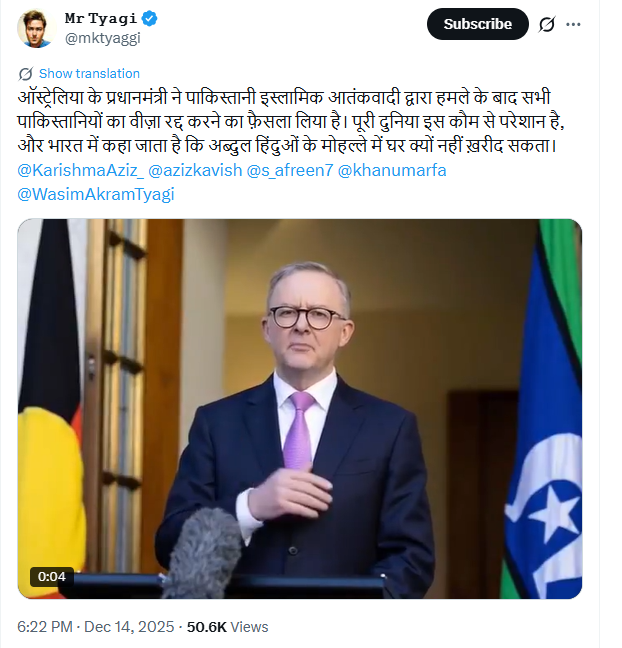
On 14 December 2025, a user on the social media platform X shared a video claiming, “After the attack by a Pakistani Islamic terrorist, the Australian Prime Minister has decided to cancel the visas of all Pakistanis. The whole world is troubled by this community, and in India it is said that Abdul cannot buy a house in a Hindu neighbourhood.”
The link to the related post, its archived version, and screenshots can be seen below:
Investigation:Upon closely examining the viral video, we suspected it to be AI-generated. Subsequently, we scanned the video using the AI detection tool aurigin.ai. According to the results provided by the tool, the video was found to be AI-generated.

Related Blogs

Introduction
The enactment of the Online Gaming (Promotion and Regulation) Act, 2025 has a significant impact, resulting in considerable changes to the structure of the Indian gaming industry. The ban on Real-Money Games (RMG), including fantasy sports, rummy, and poker, aims to curb addiction, illegal betting and most importantly, financial exploitation.
However, this decision sent ripples throughout the industry, resulting in players, companies and their investors re-strategising their plans to move forward. This approach, however, is a sharp contrast to how other nations, including the UK, Singapore and others, regulate online gaming. This, as a result, has also raised doubts about the ban and calls into question whether this is the right move.
Industry in Flux - The resultant Fallout
- MPL’s Layoffs: The Mobile Premiere League has so far laid off nearly 60 per cent of its workforce, with the CEO of the company openly admitting that the company is no longer able to make money in India.
- Dream11’s Lost Revenue: Having seen a position of being a market leader, the company has now witnessed its 95 per cent revenue wiped out, resulting in raised alarms among investors.
- A23’s Legal Move: The company chose to move the Karnataka High Court under the argument that the ban also ends up unfairly criminalising skill-based games that were earlier classified differently from gambling by the courts.
The new face of eSports: With RMGs outlawed, the focus is now on esports, including casual mobile gaming, console/PC gaming, and creating new opportunities and also leaving a void for RMG revenue companies.
Regulations Around the World - & India
India has adopted a prohibition model, whereas many other countries have developed regulatory frameworks that allow sectoral expansion under monitoring.
United Kingdom:
- Online gaming is regulated by the UK Gambling Commission.
- RMGs are legal but subject to strict licensing, age verification and advertising rules.
- Self-exclusion schemes are a must, offered by operators along with tools to prevent gambling addictions.
United States
- State-driven regulations that vary from state to state.
- States including Nevada and New Jersey allow casinos both online and offline, while other states prohibit them completely.
- Regulation for skill-based fantasy games is fragmented but generally legal.
China
- Great focus on controlling and restricting gaming addictions among minors.
- Time limits are enforced for players under 18 (usually as little as 3 hours per week).
- Gambling has been deemed illegal; however, esports and casual gaming operate within China’s regulated gaming ecosystem, subject to certain compliance.
Singapore
- The Remote Gambling Act regulates chance-based games, while other eSports and skill-based games operate out of its jurisdiction and are regulated separately.
- Online gambling isn't completely banned, but is operated under restrictions.
- Only Licensed operators under strict controls are allowed by the government to operate to avoid and prevent black-market alternatives.
Australia
- Regulates under the Interactive Gambling Act.
- Sports betting and certain licensed operators are allowed, while most of the other online gambling services are prohibited.
- Restrictions on advertising and real-time interventions allow emphasis on harm minimisation.
India’s Approach - Comparison
The Online Gaming (Promotion and Regulation) Act, 2025 introduces a prohibition model for real money games. This differs from jurisdictions such as the UK and US, which have implemented regulatory frameworks to oversee the sector. In India, earlier legal interpretations distinguished between games of skill and games of chance. The new legislation provides a single treatment for both categories, which marks a departure from previous judicial pronouncements.
Conclusion
At present, India’s gaming sector is navigating layoffs, court cases, and a pivot towards esports post the RMG ban. Keeping in mind that the intent of said ban is the protection of citizens, the industry also argues that regulation, instead of prohibition, offers a sustainable approach to the issues. On the other hand, on the global scale, most nations prefer controlled and licensed models that ensure consumer safety and work on preserving both jobs and revenues. However, India’s step is diverging from such a model. The lack of safeguards and engagement in the real money gaming industry led to a prohibition model, underscoring that in sensitive digital sectors, early regulatory alignment is essential.
References
- India online gaming ban: Global rules & regulation bill 2025
- Level up or game over? Decoding India’s gaming industry post RMG ban
- MPL lays off 350 employees after GST rules, RMG crackdown
- India’s Dream11 hit by online gaming ban, revenue slumps
- Online gaming ban: A23 moves Karnataka HC against government decision
- UK Gambling Commission – Licensing and Regulations
- Fantasy Sports & Gambling Law – State by State
- China’s gaming restrictions for minors
- Singapore Remote Gambling Act – Ministry of Home Affairs
- Australian Communications and Media Authority – Interactive Gambling Act

Executive Summary
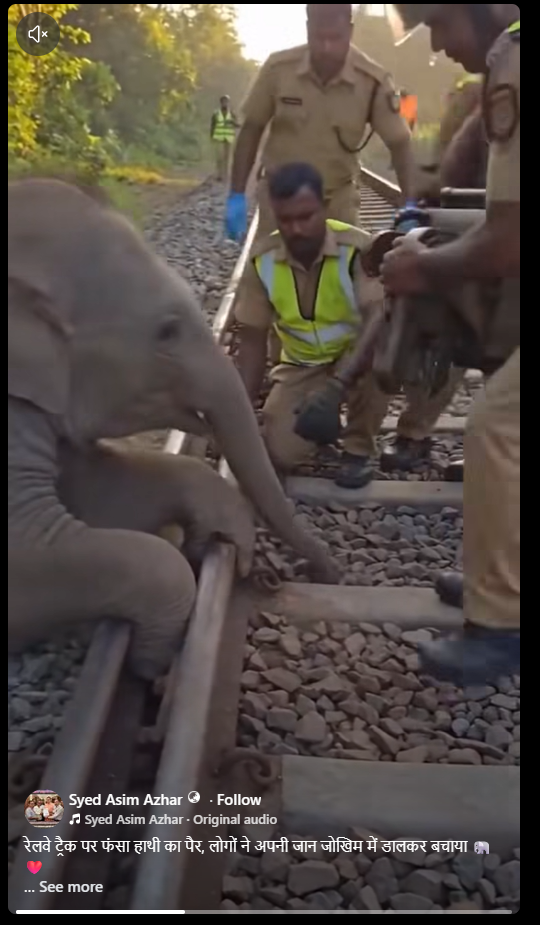
A video is being shared on social media showing a baby elephant apparently trapped in a railway track. In the video, its leg can be seen stuck between the tracks, while a train appears to be approaching. The video further shows rescuers using a hydraulic machine to remove part of the railway track and safely free the baby elephant. CyberPeace Research found that the viral claim is false. Our research found that the video is AI-generated and is being shared on social media with a false and misleading claim.
Claim:
A user on Facebook shared the video claiming that an elephant’s leg got stuck in a railway track, following which people risked their lives to safely rescue the animal. The post link, archive link and screenshot are provided below.
https://www.facebook.com/reel/992948767150505
Fact Check
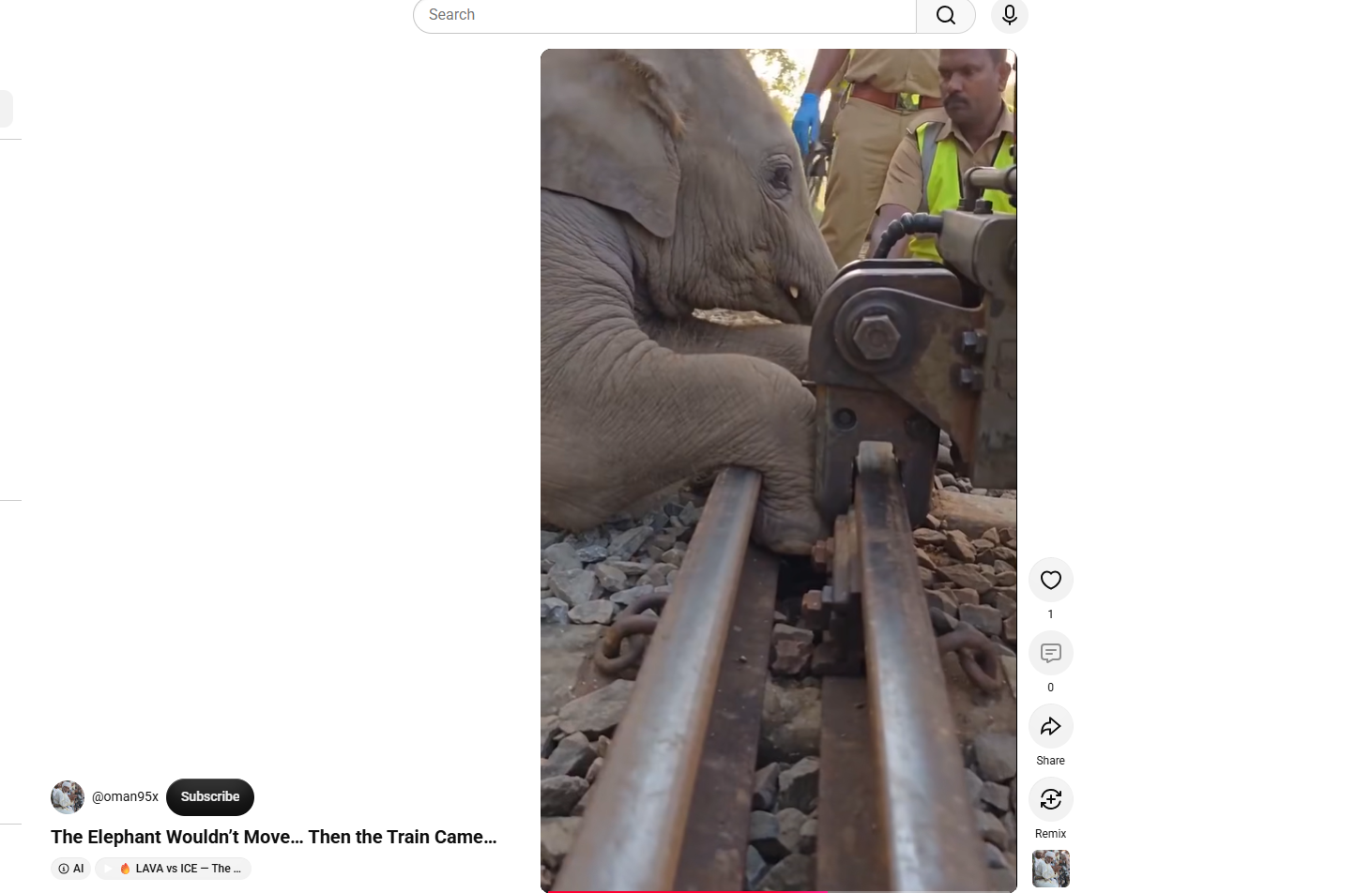
During our research, we conducted a reverse image search of different keyframes from the viral video. However, we did not find any credible media report or other authentic source related to the incident. However, during our research, we found some social media posts featuring the same video. These posts have labelled the video as AI-generated content.
https://www.youtube.com/shorts/TCQ2n6LDr_Q
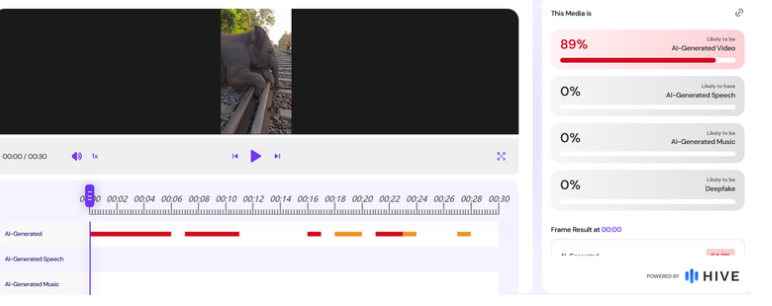
We then scanned the viral video using the Hive Detect tool. According to the tool’s analysis, the video was identified as potentially AI-generated with an 89% score.
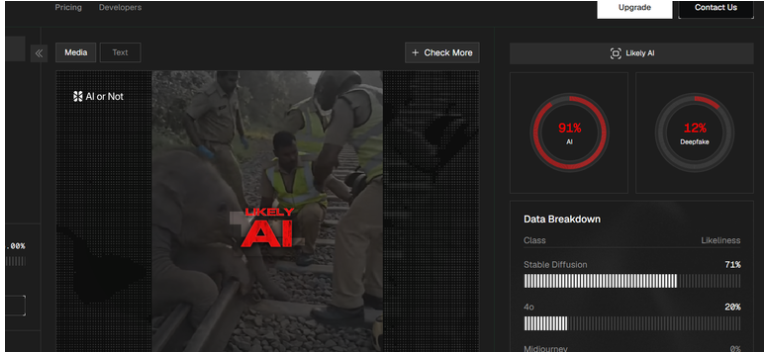
At the end of our research, we also examined the video using the AIorNot tool. According to its analysis, the visuals in the video were identified as AI-generated with a 91% probability.
Conclusion
Our research found that the video being shared on social media does not depict a real incident. During our research into the source and context of the video, we found no credible information supporting the claim. Furthermore, an analysis of the video using AI detection tools also confirmed that it is AI-generated.
Executive Summary
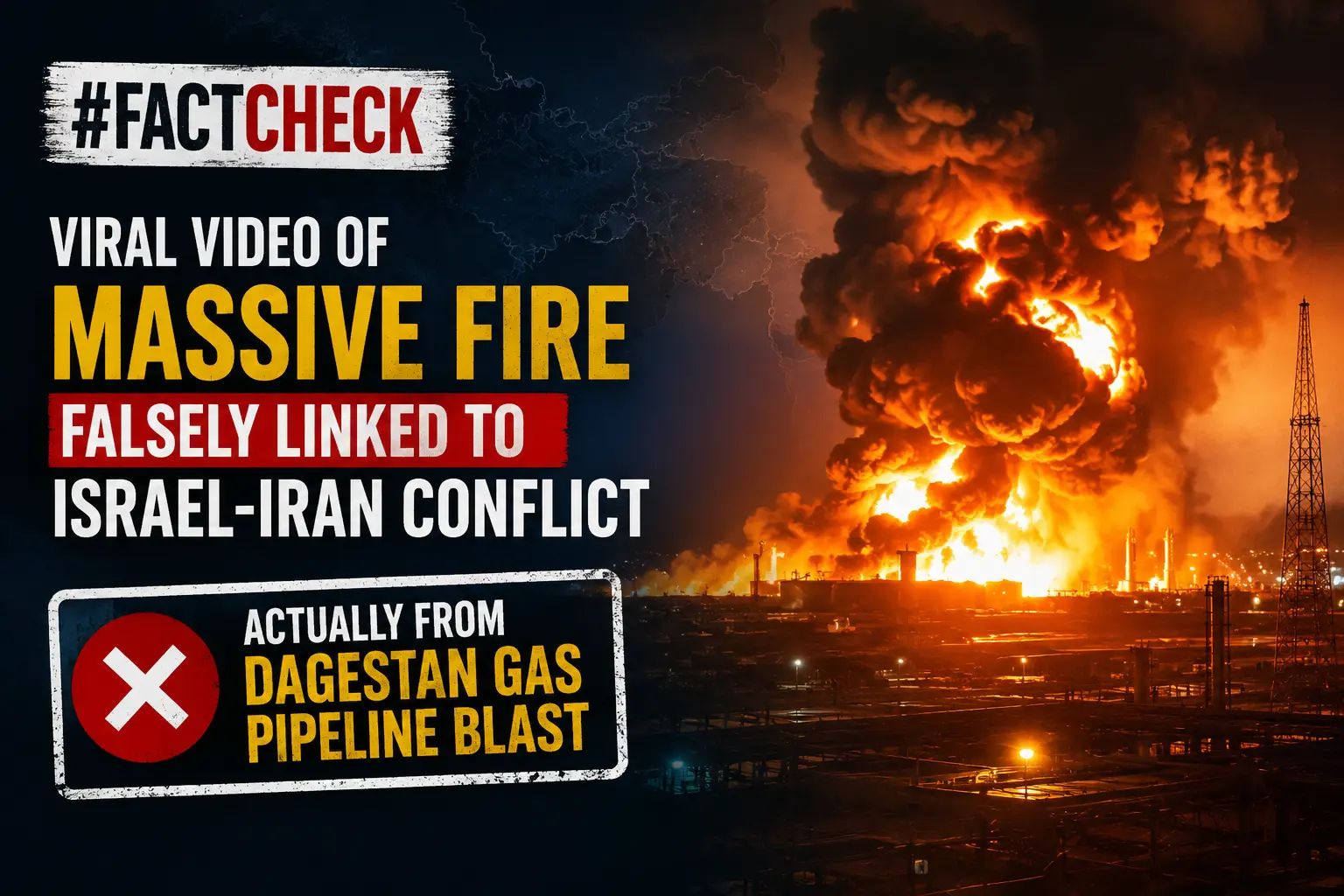
A video showing a massive fire with thick black smoke is being widely shared on social media with the claim that it depicts a recent Israeli attack on Iran. CyberPeace Research Wing research found that the claim is false. The viral video is not related to Iran or any Israel-Iran conflict. It actually shows a gas pipeline fire in Kizilyurt city of Russia’s Dagestan region.
Claim:
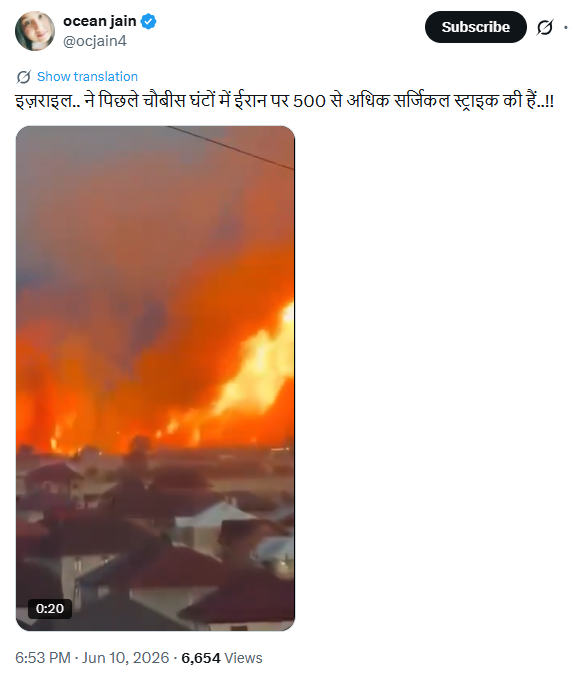
A video circulating on X shows a large fire breaking out at a location with thick black smoke rising. The clip is being shared with a caption claiming, “Israel has carried out more than 500 surgical strikes on Iran in the last 24 hours.” Post link: https://x.com/ocjain4/status/2064700017361985702, https://x.com/ocjain4/status/2064700017361985702
Fact Check:
A reverse image search using keyframes from the viral video led to visuals published in a report on a Dagestan-based media outlet dated June 9. The report stated that the Russian Emergency Situations Ministry’s Dagestan department received reports of three explosions at a methane gas station.
https://riadagestan.ru/news/incidents/v_dagestane_vzorvalas_azs
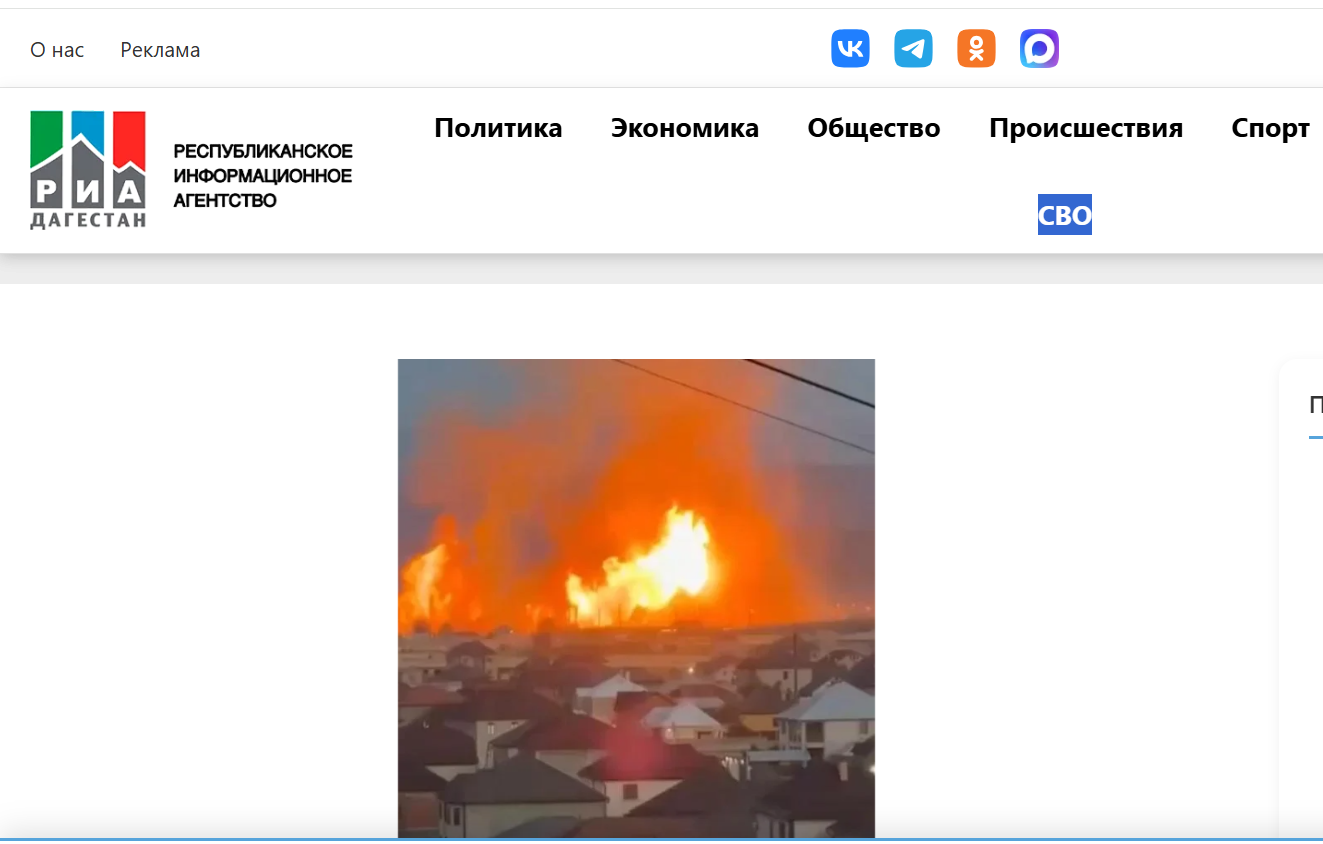
Further research found that several Russian media outlets also published the same visuals on June 9, describing them as a pipeline explosion and fire in Kizilyurt, Dagestan
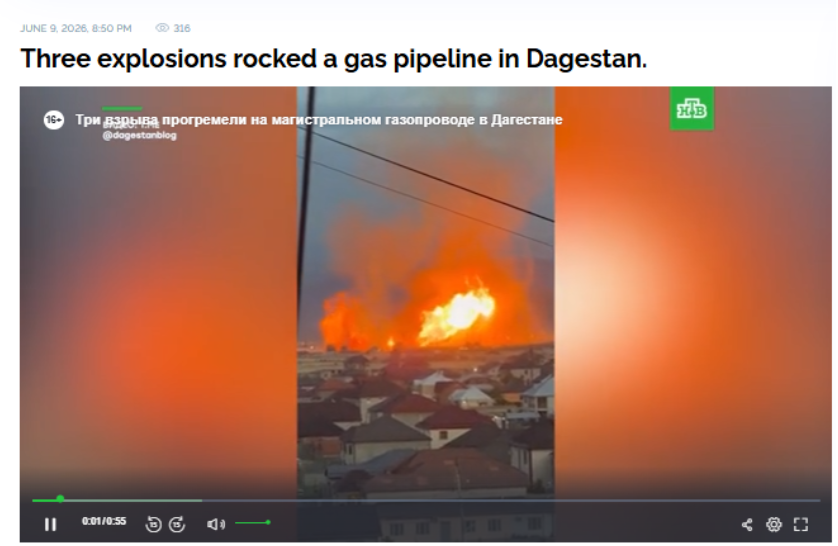
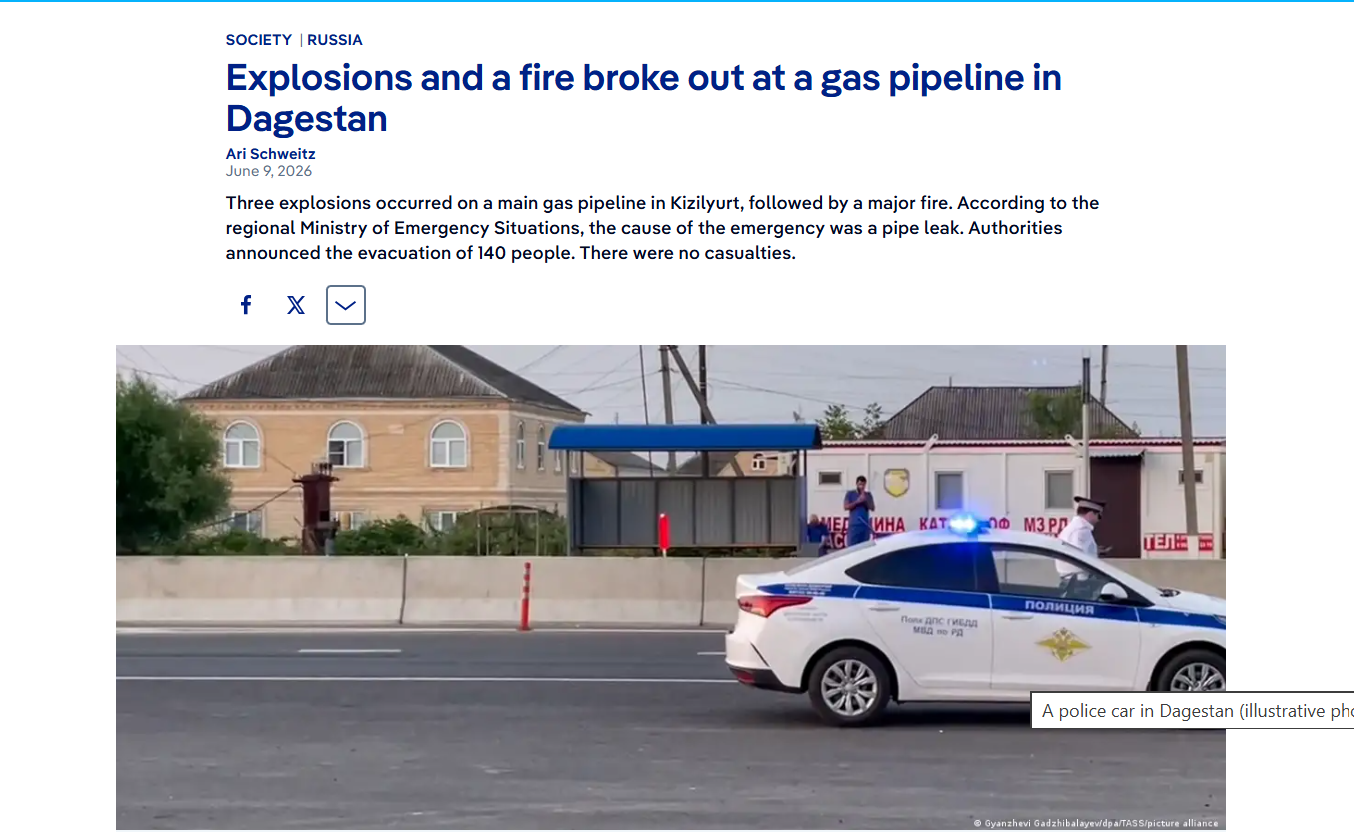
We also found a report published by DW on June 9, 2026, which stated that three explosions occurred on the Mozdok–Kazimagomed gas pipeline in Kizilyurt, Dagestan, resulting in a massive fire with flames rising up to 15 meters. According to local authorities, no casualties or injuries were reported..
https://www.dw.com/ru/na-gazoprovode-v-dagestane-progremeli-tri-vzryva-voznik-pozar/a-77481599
Conclusion:
The research clearly shows that the viral video is unrelated to the Israel-Iran conflict. It actually depicts a gas pipeline fire in Russia’s Dagestan region, which has been falsely shared as a recent Israeli strike on Iran.
