
Cyber Resolutions for 2025: Because Hackers Won't Take a Day Off
Introduction
So it's that time of year when you feel bright and excited to start the year with new resolutions; your goals could be anything from going to the gym to learning new skills and being productive this year, but with cybercrime on the rise, you must also be smart and take your New Year Cyber Resolutions seriously. Yes, you heard it right: it's a new year, a new you, but the same hackers with advanced dangers. It's time to make a cyber resolution this year to be secure, smart, and follow the best cyber safety tips for 2K25 and beyond.
Best Cyber Security Tips For You
So while taking your cyber resolutions this 2k25, remember that hackers have resolutions too; so you have to make yours better! CyberPeace has curated a list of great tips and cyber hygiene practices you must practice in 2025:
- Be Aware Of Your Digital Rights: Netizens should be aware of their rights in the digital space. It's important to know where to report issues, how to raise concerns with platforms, and what rights are available to you under applicable IT and Data Protection laws. And as we often say, sharing is caring, so make sure to discuss and share your knowledge of digital rights with your family, peers, and circle. Not only will this help raise awareness, but you’ll also learn from their experiences, collectively empowering yourselves. After all, a well-informed online community is a happy one.
- Awareness Is Your First Line Of Defence: Awareness serves as the first line of defence, especially in light of the lessons learned from 2024, where new forms of cybercrimes have emerged with serious consequences. Scams like digital arrests, romance frauds, lottery scams, and investment scams have become more prevalent. As we move into 2025, remember that sophisticated cyber scams require equally advanced strategies to stay protected. As cybercrimes evolve and become more complex, it's crucial to stay updated with specific strategies and hygiene tips to defend yourself. Build your first line of defence by being aware of these growing scams, and say goodbye to the manipulative tactics used by cyber crooks.
- Customise Social Media Media Profile And Privacy Settings: With the rising misuse of advanced technologies such as deepfake, it’s crucial to share access to your profile only with people you trust and know. Customize your social media profile settings based on your convenience, such as who can add you, who can see your uploaded pictures and stories, and who can comment on your posts. Tailor these settings to suit your needs and preferences, ensuring a safer digital environment for yourself.
- Be Cautious: Choose wisely, just because an online deal seems exciting doesn’t mean it’s legitimate. A single click could have devastating consequences. Not every link leads to a secure website; it could be a malware or phishing attempt. Be cautious and follow basic cyber hygiene tips, such as only visiting websites with a padlock symbol, a secure connection, and the 'HTTPS' status in the URL.
- Don’t Let Fake News Fake You Out: Online misinformation and disinformation have sparked serious concern due to their widespread proliferation. That’s why it’s crucial to 'Spot The Lies Before They Spot You.' Exercise due care and caution when consuming, sharing, or forwarding any online information. Always verify it from trusted sources, recognize the red flags of misleading claims, and contribute to creating a truthful online information landscape.
- Turn the Tables on Cybercriminals: It is crucial to know the proper reporting channels for cybercrimes, including specific reporting methods based on the type of issue. For example, ‘unsolicited commercial communications’ can be reported on the Chakshu portal by the government. Unauthorized electronic transactions can be reported to the RBI toll-free number at 14440, while women can report incidents to the National Commission for Women. If you encounter issues on a platform, you can reach out to the platform's grievance officer. All types of cybercrimes can be reported through the National Cyber Crime Reporting Portal (cybercrime.gov.in) and the helpline at 1930. It’s essential to be aware of the right authorities and reporting mechanisms, so if something goes wrong in your digital experience, you can take action, turn the tables on cybercrooks, and stay informed about official grievances and reporting channels.
- Log Out, Chill Out: The increased use of technology can have far-reaching consequences that are often overlooked, such as procrastination, stress, anxiety, and eye strain (also known as digital eye strain or computer vision syndrome). Sometimes, it’s essential to switch off the digital curtains. This is where a ‘Digital Detox’ comes in, offering a chance to recharge and reset. We’re all aware of how our devices and phones influence our daily lives, shaping our behaviours, decisions, and lifestyles from morning until night, even impacting our sleep. Taking time to unplug can provide a much-needed psychological and physical boost. Practicing a digital detox at regular suitable intervals, such as twice a month, can help restore balance, reduce stress, and improve overall well-being.
Final Words & the Idea of ‘Tech for Good’
Remember that we are in the technological era, and these technologies are created for our ease and convenience. There are certain challenges that bad actors pose, but to counter this, the change starts from you. Remember that technology, while having its risks, also brings tremendous benefits to society. We encourage you to take a step and encourage the responsible and ethical use of the technology. The vision for ‘Tech for Good’ will have to be expanded to a larger picture. Do not engage in a behaviour that you would not ordinarily do in an offline environment, the online environment is also the same and has far-reaching effects. Use technology for good, and follow and encourage ethical and responsible behaviour in online communities. The emphasis should be on using technology in a safer environment for everyone and combatting dishonest practices.
The effective strategies for preventing cybercrime and dishonest practices requires cooperation , efforts by citizens, government agencies, and technology businesses. We intend to employ technology's good aspects to build a digital environment that values security, honesty, and moral behaviour while promoting innovation and connectedness. In 2025, together we can make a cyber safe resilient society.

Related Blogs
.webp)
Introduction
AI-generated fake videos are proliferating on the Internet indeed becoming more common by the day. There is a use of sophisticated AI algorithms that help manipulate or generate multimedia content such as videos, audio, and images. As a result, it has become increasingly difficult to differentiate between genuine, altered, or fake content, and these AI-manipulated videos look realistic. A recent study has shown that 98% of deepfake-generated videos have adult content featuring young girls, women, and children, with India ranking 6th among the nations that suffer from misuse of deepfake technology. This practice has dangerous consequences and could harm an individual's reputation, and criminals could use this technology to create a false narrative about a candidate or a political party during elections.
The working of deepfake videos is based on algorithms that refine the fake content, and the generators are built and trained in such a way as to get the desired output. The process is repeated several times, allowing the generator to improve the content until it seems realistic, making it more flawless. Deepfake videos are created by specific approaches some of them are: -
- Lip syncing: This is the most common technique used in deepfake. Here, the voice recordings of the video, make it appear as to what was originally said by the person appearing in the video.
- Audio deepfake: For Audio-generated deepfake, a generative adversarial network (GAN) is used to colon a person’s voice, based on the vocal patterns and refine it till the desired output is generated.
- Deepfake has become so serious that the technology could be used by bad actors or by cyber-terrorist squads to set their Geo-political agendas. Looking at the present situation in the past few the number of cases has just doubled, targeting children, women and popular faces.
- Greater Risk: in the last few years the cases of deep fake have risen. by the end of the year 2022, the number of cases has risen to 96% against women and children according to a survey.
- Every 60 seconds, a deepfake pornographic video is created, now quicker and more affordable than ever, it takes less than 25 minutes and costs using just one clean face image.
- The connection to deepfakes is that people can become targets of "revenge porn" without the publisher having sexually explicit photographs or films of the victim. They may be made using any number of random pictures or images collected from the internet to obtain the same result. This means that almost everyone who has taken a selfie or shared a photograph of oneself online faces the possibility of a deepfake being constructed in their image.
Deepfake-related security concerns
As deepfakes proliferate, more people are realising that they can be used not only to create non-consensual porn but also as part of disinformation and fake news campaigns with the potential to sway elections and rekindle frozen or low-intensity conflicts.
Deepfakes have three security implications: at the international level, strategic deepfakes have the potential to destroy precarious peace; at the national level, deepfakes may be used to unduly influence elections, and the political process, or discredit opposition, which is a national security concern, and at the personal level, the scope for using Women suffer disproportionately from exposure to sexually explicit content as compared to males, and they are more frequently threatened.
Policy Consideration
Looking at the present situation where the cases of deepfake are on the rise against women and children, the policymakers need to be aware that deepfakes are utilized for a variety of valid objectives, including artistic and satirical works, which policymakers should be aware of. Therefore, simply banning deepfakes is not a way consistent with fundamental liberties. One conceivable legislative option is to require a content warning or disclaimer. Deepfake is an advanced technology and misuse of deepfake technology is a crime.
What are the existing rules to combat deepfakes?
It's worth noting that both the IT Act of 2000 and the IT Rules of 2021 require social media intermediaries to remove deep-fake videos or images as soon as feasible. Failure to follow these guidelines can result in up to three years in jail and a Rs 1 lakh fine. Rule 3(1)(b)(vii) requires social media intermediaries to guarantee that its users do not host content that impersonates another person, and Rule 3(2)(b) requires such content to be withdrawn within 24 hours of receiving a complaint. Furthermore, the government has stipulated that any post must be removed within 36 hours of being published online. Recently government has also issued an advisory to social media intermediaries to identify misinformation and deepfakes.
Conclusion
It is important to foster ethical and responsible consumption of technology. This can only be achieved by creating standards for both the creators and users, educating individuals about content limits, and providing information. Internet-based platforms should also devise techniques to deter the uploading of inappropriate information. We can reduce the negative and misleading impacts of deepfakes by collaborating and ensuring technology can be used in a better manner.
References
- https://timesofindia.indiatimes.com/life-style/parenting/moments/how-social-media-scandals-like-deepfake-impact-minors-and-students-mental-health/articleshow/105168380.cms?from=mdr
- https://www.aa.com.tr/en/science-technology/deepfake-technology-putting-children-at-risk-say-experts/2980880
- https://wiisglobal.org/deepfakes-as-a-security-issue-why-gender-matters/

Executive Summary
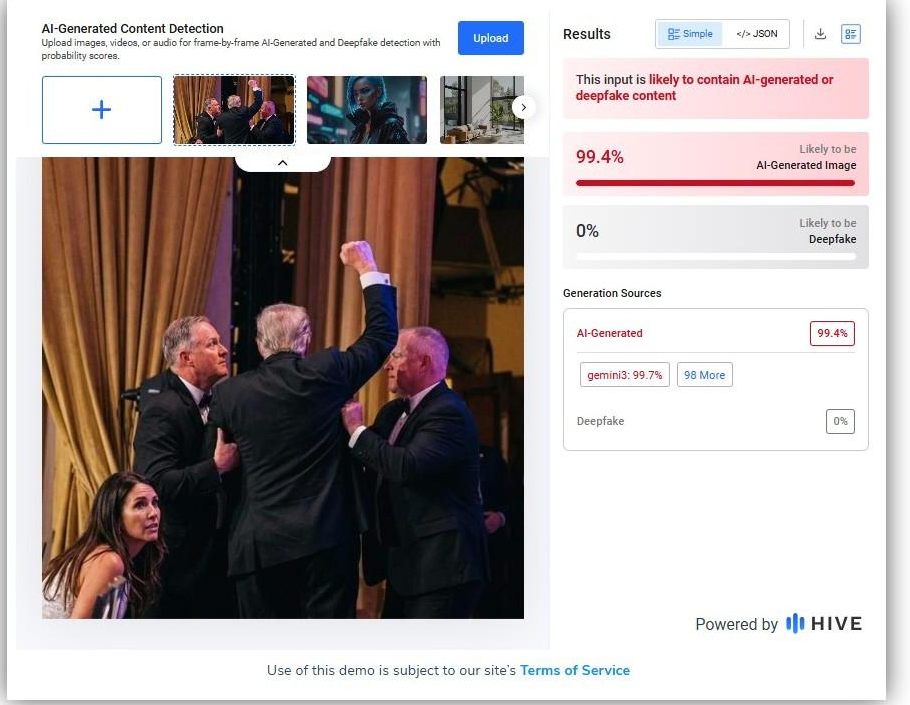
A photo of Donald Trump is going viral on social media, showing him raising his fist. Users claim the image was taken during a press event in Washington, when security personnel were escorting him out amid reports of gunfire. Research by CyberPeace Research Wing found that the viral image is AI-generated and is being shared with misleading claims.
Claim
On April 26, 2026, an X user shared the image with the caption: “Thank You, Lord our God, for protecting our President.” The post suggests that Trump made the gesture during a chaotic evacuation at a Washington event.

Fact Check
Reports confirm that Trump and senior officials were hurried away from the White House Correspondents’ Association dinner on April 25 after gunshots were reportedly heard from a floor above the ballroom. However, no authentic visuals show Trump raising his fist during the evacuation.
- https://www.nytimes.com/2024/07/14/arts/design/trump-photo-raised-fist.html
- https://edition.cnn.com/2025/04/11/politics/trump-obama-portrait-white-house


Further analysis of the viral image indicates signs of digital manipulation. Google’s SynthID detection tool flagged the file as containing SynthID—an invisible watermark embedded in content generated using Google’s AI tools.

Additionally, AI detection platform Hive Moderation assessed that the image is likely AI-generated or a deepfake.
Conclusion
The research confirms that the viral image of Donald Trump raising his fist during a Washington incident is not real. It was created using AI and is being circulated with a misleading narrative.
Introduction
" सर्वे भवन्तु सुखिनः, सर्वे सन्तु निरामयाः " May all be happy, may all be free from suffering. This timeless invocation reflects a vision of collective well-being, where progress is meaningful only when shared, and protection extends to every individual in society. This very philosophy lies at the heart of Corporate Social Responsibility, which seeks to ensure that growth is not isolated or unequal, but inclusive, ethical, and mindful of the broader social good.
At its core, Corporate Social Responsibility is not merely a statutory obligation, it is a reflection of a deeper ethical commitment, an acknowledgement that growth must carry with it a sense of duty towards society. In many ways, CSR embodies the idea that progress without responsibility is incomplete, and that corporations, as key actors shaping modern life, must help safeguard the very communities they engage with.
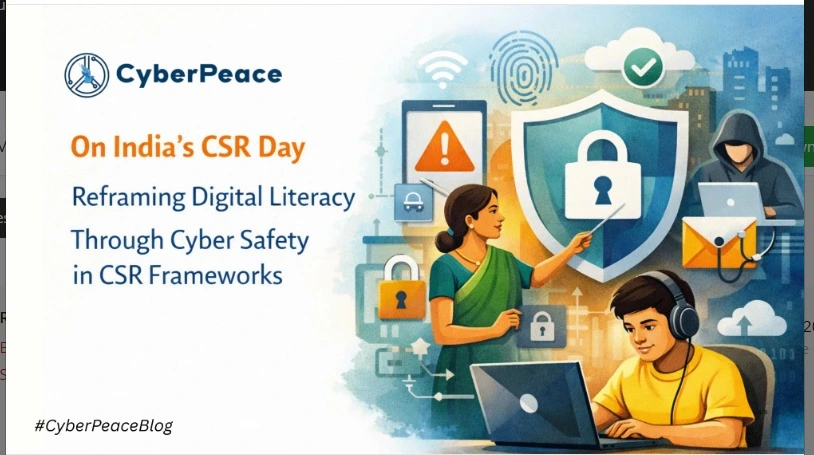
Reframing Digital Literacy Through Cyber Safety in CSR Frameworks
In India, this moral vision has been given a legal structure under the Companies Act, 2013, CSR Schedule VII, which mandates certain classes of companies to allocate a portion of their profits towards socially beneficial activities. Section 135 of the Act requires companies meeting specified financial thresholds to undertake CSR initiatives, guided by principles of inclusivity, sustainability, and social welfare. The underlying values are clear, CSR is intended not as charity, but as a strategic and accountable contribution to societal development.
Schedule VII of the Act further outlines the broad areas that qualify as CSR, including “Education and Digital Literacy”, gender equality, rural development, and measures for reducing inequalities. Within this framework, promoting “digital literacy” has increasingly been recognised as a legitimate and necessary CSR activity, especially in the context of a rapidly digitising society like India.
However, the current understanding of digital literacy within CSR remains incomplete. It often emphasises access and usage, teaching individuals how to navigate digital platforms, use devices, and engage with online services. What remains insufficiently addressed is the question of safety. In an environment where cyber fraud, data breaches, online harassment, and identity theft are becoming increasingly common, digital literacy without cyber awareness risks becoming a partial and potentially harmful intervention.
Embedding cyber awareness and capacity building within ‘digital literacy’ in explicit form is therefore not optional, it is essential. This includes equipping individuals with the ability to recognise online threats, protect personal data, understand digital consent, and respond effectively to cyber risks. It also requires recognising that vulnerable populations, including first-time internet users, women, and marginalised communities, often face disproportionate exposure to cyber harm.
“It is pertinent to note that Cybersecurity awareness training is relevant to CSR but is not yet consistently implemented as an explicit CSR activity. It is often included indirectly within digital literacy programs, highlighting the need for a more structured, progressive and integrated approach.”
Given this reality, there is a strong case for explicitly recognising cyber awareness as a distinct and integral component of CSR activities, rather than treating it as an implicit subset of digital literacy. Doing so would not only align CSR with contemporary societal risks but also ensure that corporate interventions move beyond enabling access to actively ensuring safety.
In a digital society, empowerment without protection is incomplete. If CSR is to truly reflect its foundational values, it must evolve to address not just the opportunities of the digital age, but also its risks.
Why Cyber Safety Must Be Central to CSR
The current state of digital ecosystems, which used to operate as secondary systems, now functions as essential systems that support government operations, banking systems, educational institutions, and social communication. The digital environment has its vulnerabilities, which create direct dangers for people in society. The elderly, first-time internet users, and rural communities face higher cyber threat risks because they often lack knowledge and protective resources on responsible use. The implementation of CSR initiatives that provide digital access to these groups, along with how to handle risks, will create greater benefit for their safety. Organisations must encourage the implementation of cyber safety training in their CSR programs because doing so will create value while fulfilling their ethical obligations. The empowerment process needs to achieve complete success, which protects people from any potential dangers according to the "do no harm" principle.
Key Components of CyberPeace-Aligned Digital Literacy
To make CSR initiatives more effective and future-ready, organisations should incorporate the following elements into their digital literacy programs:
- Cyber Awareness and Risk Recognition: The training program teaches participants how to recognise typical security threats, which include phishing attacks and scams, deepfake technology and misinformation.
- Data Protection and Privacy Literacy: The program teaches users how to protect their personal information, together with the process of giving consent and the methods used to handle their online presence.
- Responsible Digital Behaviour: The program teaches people how to use the internet responsibly by showing them how to make ethical decisions that require both respect and accountability while understanding the legal consequences of their actions.
- Incident Response and Reporting Mechanisms: The program teaches users about cyber incident response, which includes all reporting methods and available support resources.
- Inclusion-Focused Design: The program develops specific solutions which protect various demographic groups from their particular vulnerabilities while maintaining accessibility and essential programmatic relevance.
Policy and Institutional Alignment
The integration of cyber safety into corporate social responsibility lets organisations achieve their national objectives, which include:
- Strengthening digital trust and resilience
- Supporting safe digital inclusion initiatives
- Complementing the efforts of institutions working on cybersecurity awareness and capacity building
The structured approach requires organisations to execute three specific steps, which include:
- Partnering with cybersecurity organisations and civil society
- Developing standardised cyber awareness modules
- The organisation will use behavioural change indicators to evaluate its impact instead of relying on access metrics.
The Way Forward
Digital-era Corporate Social Responsibility needs to transition from its present state of providing access to digital resources toward establishing secure online platforms for users. The understanding of digital literacy needs to shift from its current status as a technical ability toward its new definition as a social competency that encompasses safety, responsibility and resilience training.
Companies need to understand their digital transformation obligations because their digital transformation efforts require them to handle all associated risks. The implementation of cyber safety within corporate social responsibility frameworks will enable organisations to develop a secure and trustworthy digital environment that includes all users.
Conclusion
The implementation of corporate social responsibility needs to fulfil its core mission of creating societal benefits through inclusive practices that span all current digital possibilities and their associated security threats. The field of digital literacy requires a new framework that combines digital safety practices with its existing educational materials.
The digital safety practice ensures that people obtain essential knowledge and skills that enable them to use digital resources securely when they access online content. The process of accomplishing shared community prosperity needs to establish a framework that benefits every person through social advancement and the protection of their rights.
References
- https://upload.indiacode.nic.in/schedulefile?aid=AC_CEN_22_29_00008_201318_1517807327856&rid=79
- https://www.allresearchjournal.com/archives/2025/vol11issue4/PartF/11-5-60-511.pdf
- https://www.unesco.org/en/dtc-finance-toolkit-factsheets/corporate-social-responsibility-csr
- https://www.investopedia.com/terms/c/corp-social-responsibility.asp
- https://digitalmarketinginstitute.com/blog/corporate-16-brands-doing-corporate-social-responsibility-successfully
- https://www.imd.org/blog/sustainability/csr-strategy/
