
#FactCheck - AI-Generated Visuals Falsely Shared as Government Subsidy for Free Electricity and Air Conditioners in the Philippines
Executive Summary
In the Philippines, social media users have been sharing a video and an image following complaints over sharp increases in electricity bills. The posts claim that, in exchange for higher electricity charges, low-income households are being provided free electricity and air conditioning units. However, a fact-check by CyberPeace Research Wing found no evidence to support these claims. A closer examination of the visuals revealed several inconsistencies and visual indicators suggesting that the content is likely AI-generated.
Claim
An image was also shared on Instagram on April 29, showing purported beneficiaries holding new air conditioning units allegedly provided “free by the government.”

Fact Check
However, the video and image circulating on social media do not actually show beneficiaries receiving any subsidy. A closer analysis of the visuals indicates that the content is AI-generated. In the initial frames of the misrepresented video, a diamond-shaped icon can be seen in the bottom-right corner, which is the watermark associated with Google’s Gemini AI model.
Further analysis using Google’s SynthID Detector, a tool designed to identify AI-generated content, indicated with a “very high” level of confidence that the material was created using the company’s AI technology.

The country’s social welfare agency also issued a statement on Facebook on April 30, rejecting the claim and saying it is “not true” and intended only to “propagate wrong information.” Social welfare agency statement on Facebook
- https://www.facebook.com/photo?fbid=1373756198132587&set=a.665386155636265

Conclusion
However, the video and image circulating on social media do not actually show beneficiaries receiving any subsidy. A closer analysis of the visuals indicates that the content is AI-generated. In the initial frames of the misrepresented video, a diamond-shaped icon can be seen in the bottom-right corner, which is the watermark associated with Google’s Gemini AI model. The viral video and image are misleading. Multiple inconsistencies and visual cues suggest that the content is likely AI-generated, and the claim that low-income households are receiving free electricity and air conditioners is false.

Related Blogs

Executive Summary
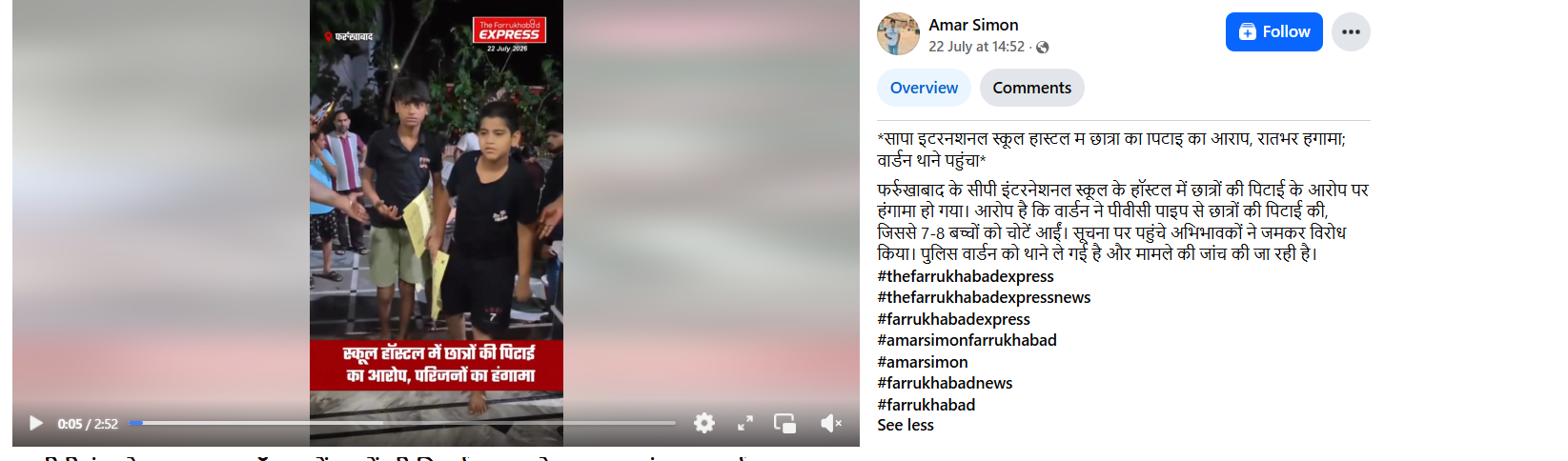
A video showing several children in an injured condition is being widely shared on social media with the claim that the footage is from the ‘Sansad March’ protest organised by the Cockroach Janata Party (CJP) on July 20, 2026. The video is being circulated with the allegation that Delhi Police lathi-charged children during the protest in Delhi. CyberPeace Research Wing’s research found the claim to be false. The viral video is not related to the CJP protest in Delhi. The footage is from an old incident at a private school hostel in Farrukhabad, Uttar Pradesh, where a warden was accused of assaulting students. The old video has been falsely linked to the recent protest with a misleading claim.
Claim:
A Facebook user named ‘The sociopolitics’ shared the video on July 23, 2026, claiming that children were beaten by Delhi Police during the protest.The post stated, “What had the children done wrong? Were they beaten with their eyes covered, or was the anger of their bosses taken out on the public?” The viral post was shared widely on social media by users who believed the claim to be true. The archived version of the post can be accessed here:
https://www.instagram.com/reels/DbKiqy8lOu5/

Fact Check:
To verify the authenticity of the viral video, the Desk first analysed the footage carefully and examined its audio. The conversation of the children in the video made it clear that the visuals were not connected to the student protest at Delhi’s Jantar Mantar or any police lathi-charge. In the video, the children can be heard mentioning the name of their school and speaking about the warden who allegedly assaulted them. The video also displayed the Instagram username ‘parulpatel4618’, which provided a lead for further research.
https://www.instagram.com/p/DbFcdAjxvG5

In the next stage of the research, the Desk found a Facebook post dated July 22, 2026, related to the incident. According to the post, students at CP International School hostel in Farrukhabad, Uttar Pradesh, were allegedly beaten, following which a protest was reported. The post stated that the hostel warden was accused of assaulting students with a PVC pipe, leaving several children injured. After receiving information about the incident, parents reached the spot and protested. Police took the warden to the police station and initiated an research.
https://www.facebook.com/watch/?v=992060370500487
Conclusion:
The research established that the viral video is not from the CJP ‘Sansad March’ protest in Delhi. The footage is from an old incident at a private school hostel in Farrukhabad, Uttar Pradesh, where a warden was accused of assaulting students. The video is being circulated with a false claim by linking it to a recent protest.
.webp)
Introduction
The automobile business is fast expanding, with vehicles becoming sophisticated, interconnected gadgets equipped with cutting-edge digital technology. This integration improves convenience, safety, and efficiency while also exposing automobiles to a new set of cyber risks. Electric vehicles (EVs) are equipped with sophisticated computer systems that manage various functions, such as acceleration, braking, and steering. If these systems are compromised, it could result in hazardous situations, including the remote control of the vehicle or unauthorized access to sensitive data. The automotive sector is evolving with the rise of connected car stakeholders, exposing new vulnerabilities for hackers to exploit.
Why Automotive Cybersecurity is required
Cybersecurity threats to automotives result from hardware, software and overall systems redundancy. Additional concerns include general privacy clauses that justify collecting and transferring data to “third-party vendors”, without explicitly disclosing who such third parties are and the manner of processing personal data. For example, infotainment platform data may show popular music and the user’s preferences, which may be used by the music industry to improve marketing strategies. Similarly, it is lesser known that any data relating to behavioural tracking data, such as driving patterns etc., are also logged by the original equipment manufacturer.
Hacking is not limited to attackers gaining control of an electronic automobile; it includes malicious actors hacking charging stations to manipulate the systems. In Russia, EV charging stations were hacked in Moscow to display pro-Ukraine and anti-Putin messages such as “Glory to Ukraine” and “Death to the enemy” in the backdrop of the Russia-Ukraine war. Other examples include instances from the Isle of Wight, where hackers controlled the EV monitor to show inappropriate content and display high voltage fault codes to EV owners, preventing them from charging their vehicles with empty batteries.
UN Economic Commission for Europe releases Regulation 155 for Automobiles
UN Economic Commission for Europe Regulation 155 lays down uniform provisions concerning the approval of vehicles with regard to cybersecurity and cybersecurity management systems (CSMS). This was originally a part of the Commission.s Work Paper (W.P.) 29 that aimed to harmonise vehicular regulations for vehicles and vehicle equipment. Regulation 155 has a two-prong objective; first, to ensure cybersecurity at the organisational level and second, to ensure adequate designs of the vehicle architecture. A critical aspect in this context is the implementation of a certified CSMS by all companies that bring vehicles to market. Notably, this requirement alters the perspective of manufacturers; their responsibilities no longer conclude with the start of production (SOP). Instead, manufacturers are now required to continuously monitor and assess the safety systems throughout the entire life cycle of a vehicle, including making any necessary improvements.
This Regulation reflects the highly dynamic nature of software development and assurance. Moreover, the management system is designed to ensure compliance with safety requirements across the entire supply chain. This is a significant challenge, considering that suppliers currently account for over 70 per cent of the software volume.
The Regulation, which is binding in nature for 64 member countries, came into force in 2021. UNECE countries were required to be compliant with the Regulations by July 2022 for all new vehicles and by July 2024, the Regulation was set to apply to all vehicles. It is believed that the Regulation will become a de facto global standard, since vehicles authorised in a particular country may not be brought into the global market or the market of any UNECE member country based on any other authorisation. In such a scenario, OEMs of non-member countries may be required to give a “self-declaration”, declaring the equipment’s conformity with cybersecurity standards.
Conclusion
To compete and ensure trust, global car makers must deliver a robust cybersecurity framework that meets evolving regulations. The UNECE regulations in this regard are driving this direction by requiring automotive original equipment manufacturers (OEMs) to integrate vehicle cybersecurity throughout the entire value chain. The ‘security by design' approach aims to build a connected car that is trusted by all. Automotive cybersecurity involves measures and technologies to protect connected vehicles and their onboard systems from growing digital threats.
References:
- “Electric vehicle cyber security risks and best practices (2023)”, Cyber Talk, 1 August 2023. https://www.cybertalk.org/2023/08/01/electric-vehicle-cyber-security-risks-and-best-practices-2023/#:~:text=EVs%20are%20equipped%20with%20complex,unauthorized%20access%20to%20sensitive%20data.
- Gordon, Aaron, “Russian Electric Vehicle Chargers Hacked, Tell Users “PUTIN IS A D*******D”, Vice, 28 February 2022. https://www.vice.com/en/article/russian-electric-vehicle-chargers-hacked-tell-users-putin-is-a-dickhead/
- “Isle of Wight: Council’s electric vehicle chargers hacked to show porn site”, BBC, 6 April 2022. https://www.bbc.com/news/uk-england-hampshire-61006816
- Sandler, Manuel, “UN Regulation No. 155: What You Need to Know about UN R155”, Cyres Consulting, 1 June 2022. https://www.cyres-consulting.com/un-regulation-no-155-requirements-what-you-need-to-know/?srsltid=AfmBOopV1pH1mg6M2Nn439N1-EyiU-gPwH2L4vq5tmP0Y2vUpQR-yfP7#A_short_overview_Background_knowledge_on_UN_Regulation_No_155
- https://unece.org/wp29-introduction?__cf_chl_tk=ZYt.Sq4MrXvTwSiYURi_essxUCGCysfPq7eSCg1oXLA-1724839918-0.0.1.1-13972
Executive Summary
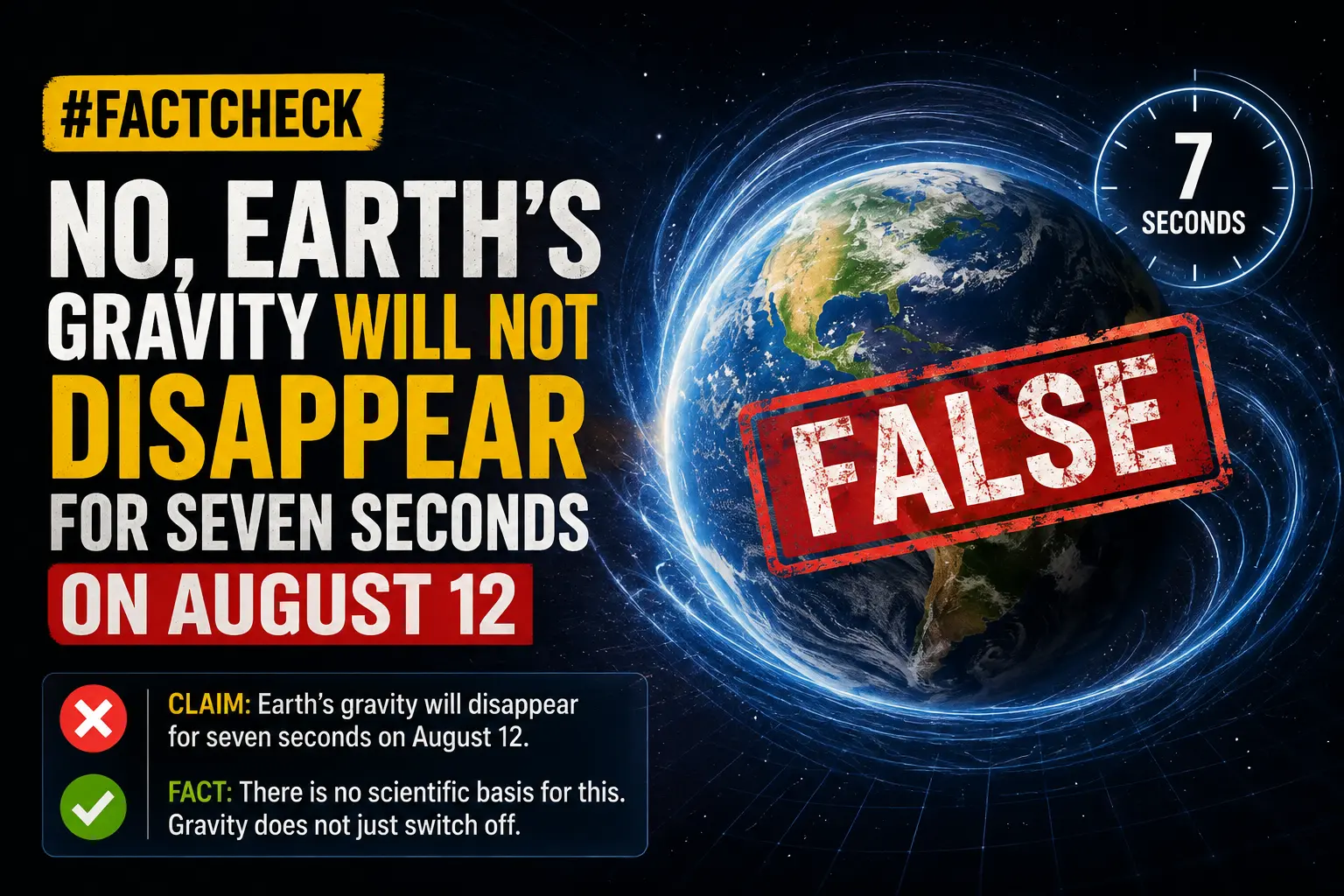
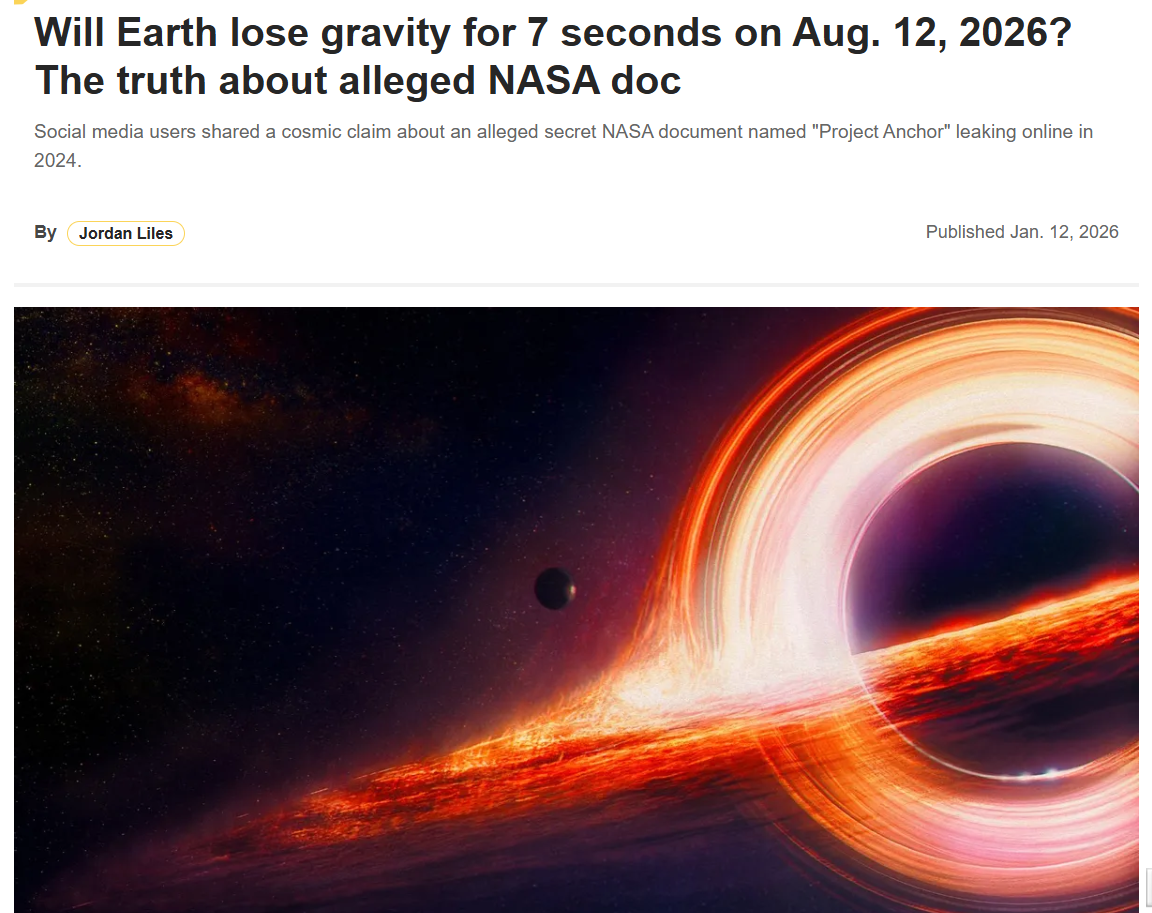
A claim is going viral across social media platforms stating that Earth’s gravity will disappear for seven seconds on the night of August 12, 2026, causing people to feel as if they are floating in the air. According to the viral posts, the phenomenon will occur due to a leaked confidential document related to the US space agency NASA’s alleged “Project Anchor.” The CyberPeace Research Wing found the claim to be false. The National Aeronautics and Space Administration (NASA) has denied that Earth’s gravity will disappear for seven seconds on August 12. According to NASA, the astronomical event taking place on August 12 is a total solar eclipse visible from parts of the Northern Hemisphere, which will not cause any unusual change in Earth’s gravity.
Claim
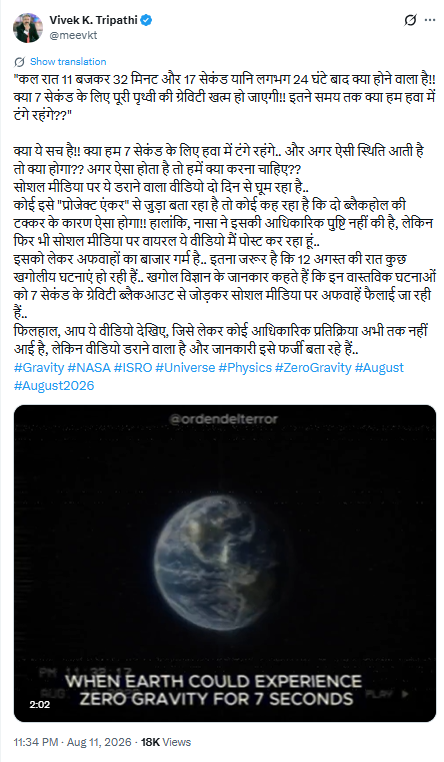
X user ‘Vivek K. Tripathi’ shared a post on August 11, 2026, asking whether Earth’s gravity would disappear for seven seconds at 11:32:17 p.m. the following night, causing people to remain suspended in the air.
The post also claimed that some social media users were linking the alleged phenomenon to “Project Anchor” or the collision of two black holes, while acknowledging that NASA had not officially confirmed the claim.
https://x.com/meevkt/status/2087238637687869773?s=20
FactCheck
To verify the claim, we conducted both basic and advanced searches for information related to NASA’s alleged “Project Anchor” and the supposed leaked document. However, we could not find any credible source confirming the existence of such a project or document. Information about NASA’s projects is available through its official database.
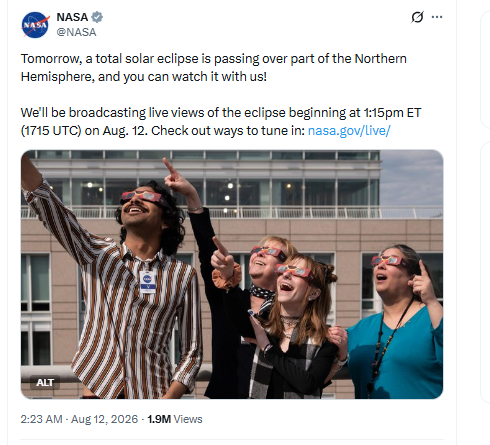
We then checked NASA’s official website and social media accounts for any announcement regarding Earth’s gravity disappearing on August 12. We found no such information. Instead, an August 12, 2026 post by NASA discussed the astronomical event of a total solar eclipse visible from parts of the Northern Hemisphere.
According to a NASA spokesperson quoted by Snopes, Earth’s gravity will not disappear on August 12, 2026. The spokesperson explained that Earth’s gravity is determined by its mass. It could only disappear if the total mass of Earth—including its core, mantle, crust, oceans, surface water and atmosphere—were to disappear. A total solar eclipse does not cause any unusual effect on Earth’s gravity. The gravitational pull of the Sun and Moon does not affect Eart
https://www.snopes.com/fact-check/nasa-project-anchor-earth-gravity/
Conclusion
The claim that Earth’s gravity will disappear for seven seconds on the night of August 12, 2026, is false. The claim is based on an unfounded online conspiracy theory involving the fictitious “Project Anchor.” NASA has also rejected the alleged “gravity blackout” claim. The actual astronomical event taking place on August 12 is a total solar eclipse visible from parts of the Northern Hemisphere, which will not cause any unusual change in Earth’s gravity. While the Sun and Moon exert gravitational forces that influence tides, they do not cause Earth’s overall gravity to disappear.
