
When Convenience Meets Surveillance - Inside the Privacy Backlash Over Meta's Smart Glasses
Introduction
Meta's bet that smart glasses will succeed the smartphone as the dominant personal computing device is, commercially, already paying off. EssilorLuxottica, the eyewear manufacturer that builds the Ray-Ban and Oakley Meta product lines, reported selling more than seven million pairs of AI-enabled glasses in 2025 alone, more than tripling the previous year's sales. Chief Executive Mark Zuckerberg has framed the shift as inevitable, comparing it in a recent interview to the transition from flip phones to smartphones and predicting that within a few years, eyewear without embedded AI will put its wearer at a disadvantage.
Yet as adoption accelerates, two features in various stages of internal testing have pulled Meta back into a familiar and uncomfortable position: at the centre of a privacy controversy over exactly how much a camera- and microphone-equipped wearable can quietly learn about the people around it.
NameTag and the return of facial recognition
In June 2026, the technology publication Wired reported that it had found dormant code for a facial-recognition system, internally called NameTag, embedded inside the Meta AI companion app that pairs with the company's smart glasses – an app that had by then been downloaded more than 50 million times. According to that reporting, the system relies on a pipeline of on-device AI models that detect a face, store it locally on the wearer's phone, and match it against previously saved "faceprints", alerting the wearer when it recognises someone they met before. Meta's Chief Technology Officer, Andrew Bosworth, has described the intended design as privacy-conscious: identification data would be encrypted locally, accessible only while the glasses are being worn, and would not populate a centralised company database. He has pitched the feature as a solution to the everyday difficulty of recalling names and past conversations.
Privacy researchers and advocacy groups have been considerably less reassured. One technologist with the Electronic Frontier Foundation’s Threat Lab who analysed the code concluded that despite having been deactivated, it appeared to be near-complete, and more recent reporting connected a portion of Meta’s facial recognition software licensing to Rank One Computing, a vendor that has also licensed similar tech to both U.S. law enforcement and military groups. Meta took the code down immediately after the story’s publication and claims no decision has been made regarding a public rollout.
"Super sensing" and always-on capture
A second, less publicised effort has drawn similar concern. The Financial Times reported in July 2026 that Meta is internally prototyping glasses, under the working concept "super-sensing", designed to capture ambient audio continuously and take still images every few seconds throughout the day, building a searchable log that a wearer's AI assistant could later query to recall where an item was left or what was discussed earlier. Notably, that reporting indicated Meta had discussed shipping the feature without activating the small LED indicator that currently signals when the glasses' camera is capturing photos or video the very light Meta had just reinforced against tampering on its existing hardware. Critics point out that the indicator is already a limited safeguard, since it is easily missed and unfamiliar to most bystanders; removing it during continuous, always-on capture would eliminate the one visible cue currently available to people nearby.
A pattern regulators are watching closely
Both features have emerged against a backdrop of substantial legal exposure. Meta has previously paid roughly two billion dollars combined in biometric-privacy settlements tied to earlier facial-recognition systems on Facebook, including $650 million under Illinois's Biometric Information Privacy Act and $1.4 billion to the state of Texas.
A separate class action filed in early 2026 alleges that footage captured by smart-glasses users, including intimate recordings from inside private homes, was reviewed by outside contractors in Kenya for AI-training purposes, a claim that prompted an inquiry from the United Kingdom's Information Commissioner's Office. The Texas Attorney General has opened its own civil investigation into the glasses' data practices. Because U.S. federal privacy law remains fragmented, enforcement of claims like these is likely to continue playing out state by state through statutes such as BIPA, which allow individuals to sue directly, even as the European Union's AI Act imposes separate restrictions on biometric processing within Europe.
Why this matters beyond Meta
For readers focused on cybersecurity and digital privacy, the common thread running through NameTag and super sensing is consent architecture. The smart glasses take in not just what you’re up to but also the location, face, clothes and conversation patterns of anyone within the glasses’ field of vision – all without their consent. Where raising a smartphone to take a photo leaves no ambiguity to nearby observers, glasses made to look like normal eyewear leaves fewer visual and verbal tells of what is actually occurring behind a set of seemingly average lenses. According to security experts and law professors, wiretap laws and the patchwork of existing statutes addressing biometric data aren't prepared for the kind of invisible monitoring that AI-enabled eyeglasses from Meta, and eventually others, are capable of. It's that imbalance between a technology’s unseen power and the limitations of the average person’s awareness that is sure to be the main source of conflict.
CyberPeace Insights
Wearable AI holds real promise for accessibility and everyday convenience, and Meta's continued investment reflects where personal computing is headed. At the same time, features like NameTag and "super-sensing" show why privacy-by-design must stay foundational, not incidental, as this space matures. The core issue isn't innovation itself but consent — ensuring bystanders retain visible, reliable cues when a device is active. Meta's stated moves toward on-device processing and encryption are worth acknowledging as steps in the right direction. CyberPeace believes continued dialogue between industry, regulators, and researchers, rather than adversarial scrutiny alone, is the surest path to public trust.
Conclusion
Meta maintains that both NameTag and Super Sensing remain unreleased and unconfirmed for commercial launch and are subject to further internal review. Executives have publicly disputed characterisations suggesting either feature is further along than the company has described. Even so, the recurring pattern of infrastructure for sensitive capabilities surfacing through independent reporting rather than company disclosure is what has kept privacy advocates, journalists, and regulators paying close attention. It suggests that as smart glasses move from novelty item to mass-market device, the terms of that transition will be shaped as much by courts, regulators, and public pressure as by Meta's own product roadmap.
References
- https://www.magzter.com/stories/newspaper/Mint-Mumbai/METAS-FLOOD-OF-SMARTGLASSES-HAS-PRIVACY-ADVOCATES-UP-IN-ARMS
- Engadget — Wired found code for an unreleased facial recognition feature in Meta's AI app
- Malwarebytes Labs — Meta's face-recognition code raises new concerns about smart glasses
- Kaspersky Daily — What's wrong with Meta's NameTag feature and why you should be wary of it
- Biometric Update — AI glasses reveal widening gap between Meta's privacy safeguards and AI ambitions
- Fortune — Meta added a privacy-safety feature to its AI glasses but is reportedly testing a 'super-sensing' prototype
- MacRumors — Meta's 'Super Sensing' Prototype Glasses Quietly Record Everything
- TechCrunch — Meta sued over AI smart glasses' privacy concerns, after workers reviewed nudity, sex, and other footage

Related Blogs
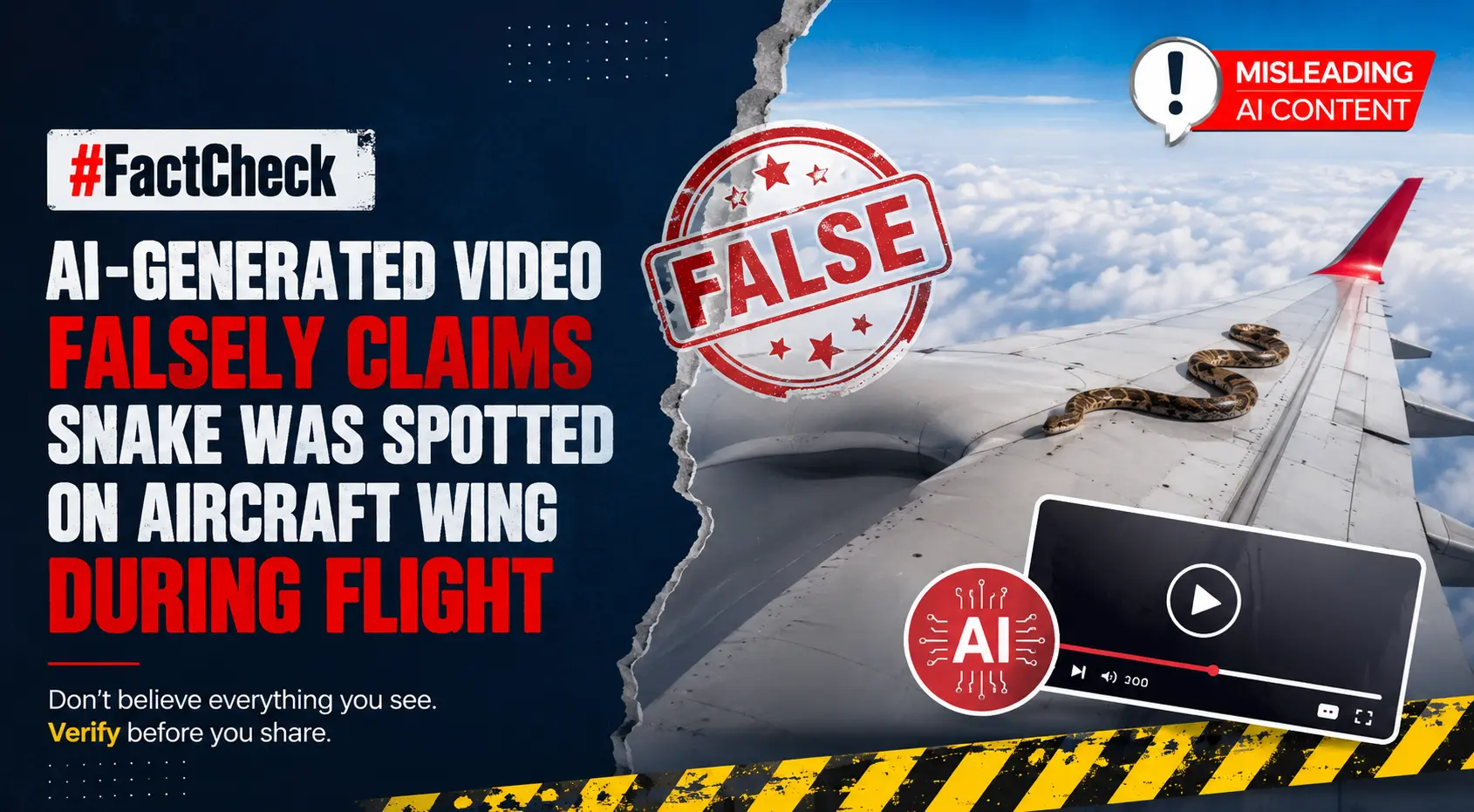
Executive Summary
A video showing a snake crawling on the wing of an aircraft during a flight is being widely circulated on social media. The video is being shared with the claim that the sighting of a snake on the aircraft wing caused panic among passengers and crew members during the flight. Several users are sharing the video as a genuine incident. CyberPeace Research Wing ’s research found the viral claim to be misleading. The research revealed that the video does not show a real incident and was created using artificial intelligence (AI).
Claim:
A Facebook user shared the viral video on July 26, 2026, claiming that a snake was spotted on an aircraft during a flight, causing panic. The post stated, “Snake spotted on aircraft during flight, video goes viral!”
The link to the post, archive link and screenshot are provided below:
https://www.facebook.com/reel/2845827375780035

Factcheck
To verify the authenticity of the viral video, the Desk analysed several key frames from the footage and conducted a reverse image search.
However, no credible news report, official information, or reliable source was found linking the video to any real incident involving a snake on an aircraft during a flight.
Upon closely examining the video, the Desk suspected that it may have been generated using AI. To verify this, the video was analysed using the AI detection tool HIVE Moderation. The tool’s analysis also indicated that the video was likely AI-generated, suggesting that it does not depict an actual incident.

As part of further verification, the key frames of the video were also examined using another AI detection tool, Sightengine. The tool’s analysis indicated a 99 per cent probability that the visuals were AI-generated.

Conclusion:
The research established that the viral video does not show a real incident of a snake crawling on an aircraft wing during a flight. The video was created using artificial intelligence (AI) and is being circulated on social media with a misleading claim.

Executive Summary
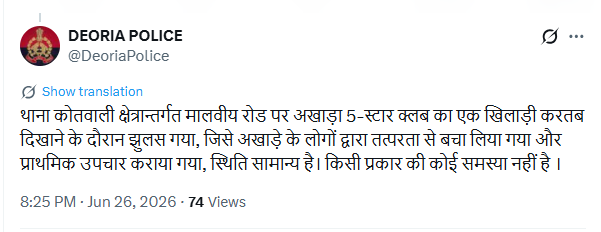
A video is being widely shared on social media linking it to a Muharram procession in India. The video shows a person engulfed in flames, with users claiming that an individual was deliberately set on fire during a Muharram procession in India. Several social media users are circulating the clip with communal claims. CyberPeace Research Wing research found that the viral claim is misleading. The video does not show any incident of a person being deliberately burned during a Muharram procession. In reality, it is from Deoria, Uttar Pradesh, where a performer sustained burn injuries while performing stunts during a Muharram procession.
Claim:
On X (formerly Twitter), a user posted the viral video on 3 June 2026, claiming: “Not Bangladesh, this is India where a person is being burned alive during a Muharram procession.” The post link, archive link, and screenshots are provided below. https://x.com/singh_kikki/status/2070753631167541586 , https://archive.ph/vP3bZ
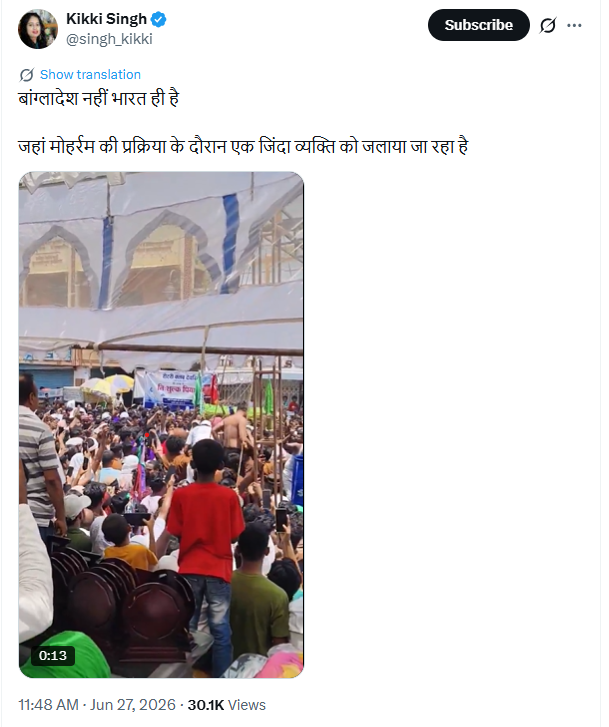
Fact Check:
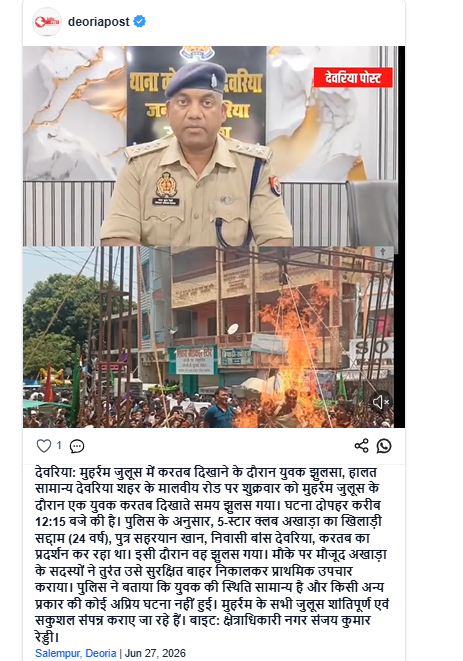
For verification, we extracted multiple keyframes from the video and conducted a reverse image search using Google Lens. During the search, we found the same video published on the Public app on 27 June 2026. According to the report, the incident took place on Malviya Road in Deoria city, Uttar Pradesh, during a Muharram procession, where a member of the 5-Star Club akhara, Saddam (24), a resident of Bans Deoria, suffered burn injuries while performing stunts involving fire. The report further stated that members of the akhara immediately rescued him and arranged first aid. Police confirmed that his condition is stable and that the incident was accidental. No other untoward incident was reported, and all Muharram processions were conducted peacefully. A statement by Circle Officer (City), Sanjay Kumar Reddy, was also included in the report. https://public.app/video/sp_zh7dywam0a2pb
In our subsequent research, we found a report published on Dainik Bhaskar's website with the same claim. A link and screenshot of the post are provided below. https://www.bhaskar.com/amp/local/uttar-pradesh/deoria/news/deoria-youth-burns-muharram-procession-stunt-138296624.html
Finally, we also found an official post from the Deoria Police X handle confirming the incident. The police stated that a performer from the 5-Star Club akhara was injured while performing stunts on Malviya Road and was immediately given first aid. His condition is stable, and no other incident occurred. https://x.com/DeoriaPolice/status/2070521290864377982
Conclusion:
The research clearly found that the viral video does not show a person being deliberately burned during a Muharram procession. The footage is from Deoria, Uttar Pradesh, where a performer was accidentally injured during a fire stunt.

Executive Summary:
The viral image in the social media which depicts fake injuries on the face of the MP(Member of Parliament, Lok Sabha) Kangana Ranaut alleged to have been beaten by a CISF officer at the Chandigarh airport. The reverse search of the viral image taken back to 2006, was part of an anti-mosquito commercial and does not feature the MP, Kangana Ranaut. The findings contradict the claim that the photos are evidence of injuries resulting from the incident involving the MP, Kangana Ranaut. It is always important to verify the truthfulness of visual content before sharing it, to prevent misinformation.

Claims:
The images circulating on social media platforms claiming the injuries on the MP, Kangana Ranaut’s face were because of an assault incident by a female CISF officer at Chandigarh airport. This claim hinted that the photos are evidence of the physical quarrel and resulting injuries suffered by the MP, Kangana Ranaut.


Fact Check:
When we received the posts, we reverse-searched the image and found another photo that looked similar to the viral one. We could verify through the earring in the viral image with the new image.

The reverse image search revealed that the photo was originally uploaded in 2006 and is unrelated to the MP, Kangana Ranaut. It depicts a model in an advertisement for an anti-mosquito spray campaign.
We can validate this from the earrings in the photo after the comparison between the two photos.

Hence, we can confirm that the viral image of the injury mark of the MP, Kangana Ranaut has been debunked as fake and misleading, instead it has been cropped out from the original photo to misrepresent the context.
Conclusion:
Therefore, the viral photos on social media which claimed to be the results of injuries on the MP, Kangana Ranaut’s face after being assaulted allegedly by a CISF officer at the airport in Chandigarh were fake. Detailed analysis of the pictures provided the fact that the pictures have no connection with Ranaut; the picture was a 2006 anti-mosquito spray advertisement; therefore, the allegations that show these images as that of Ranaut’s injury are fake and misleading.
- Claim: photos circulating on social media claiming to show injuries on the MP, Kangana Ranaut's face following an assault incident by a female CISF officer at Chandigarh airport.
- Claimed on: X (Formerly known as Twitter), thread, Facebook
- Fact Check: Fake & Misleading
