
#FactCheck - AI-Generated Image Falsely Shows Tamil Nadu CM Vijay Touching Rahul Gandhi’s Feet
Executive Summary
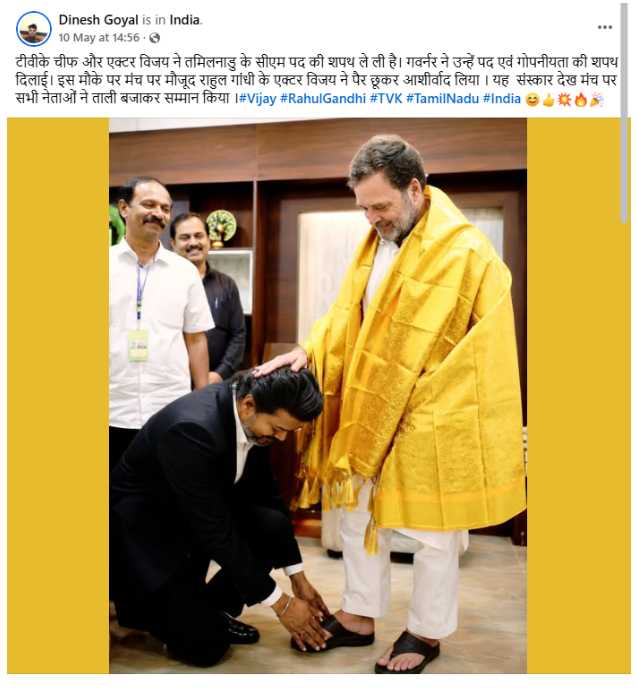
A viral image circulating on social media claims that Tamil Nadu Chief Minister C. Joseph Vijay touched the feet of Congress leader Rahul Gandhi during his swearing-in ceremony, while Congress and several other parties extended support to his government. The image is being widely shared with captions suggesting it captures a real political moment. However, CyberPeace Research Wing research has found the claim to be false. The image is AI-generated and does not depict any real event.
Claim
A Facebook user shared the viral image on May 10, 2026, claiming that TVK chief and actor Vijay had taken oath as the Chief Minister of Tamil Nadu. The post further claimed that during the ceremony, Vijay touched Rahul Gandhi’s feet to seek blessings, and the gesture was applauded by leaders present on stage. The post, along with archived links and screenshots, is being circulated as authentic evidence of the alleged incident.
- https://www.facebook.com/100057774695228/posts/1389222123013598/?rdid=FEzRYpVvSIieeUbj#
- https://archive.ph/kv4e1
Fact Check
A keyword-based search on Google did not return any credible news reports supporting the claim or confirming such an event. A closer visual examination of the image raised strong suspicions of AI manipulation, prompting verification through AI detection tools. When the image was analyzed using the SIGHTENGINE detection tool, the results indicated that the image is 99% likely to be AI-generated.

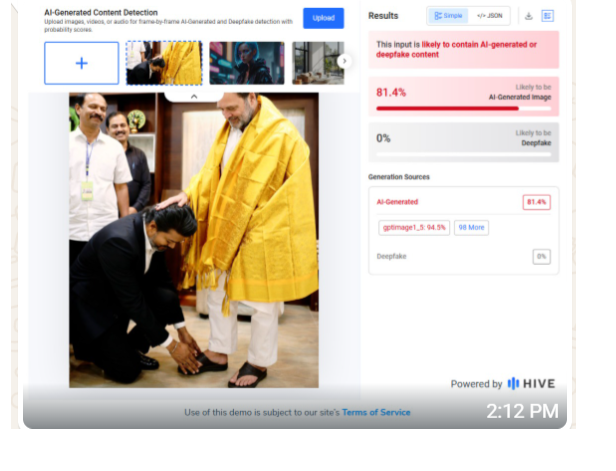
Further verification using another AI detection platform, HIVE MODERATION, also flagged the image as synthetic, showing an 81% probability of being AI-generated.
Conclusion
The research clearly shows that the viral image is not real. It has been generated using artificial intelligence and is being falsely shared as a real political event.

Related Blogs

Introduction
Two videos are being widely circulated on social media with the claim that Chinese troops have entered Arunachal Pradesh, India. The first video shows a large group of soldiers marching in formation, while the second shows armed personnel disembarking from military trucks. Social media users claim that the footage shows Chinese soldiers advancing into Indian territory. CyberPeace Research Wing’s research found the claim to be false. The two viral videos are unrelated to India and actually show Thai Army personnel during military training exercises. Both the Government of India and the Indian Army have also dismissed the claim of any recent Chinese intrusion into Indian territory.
Claim
An Instagram user, "mtkv.ideo," shared the viral videos on July 7, 2026, with the caption,"Chinese army has entered 60 km inside India."
https://www.instagram.com/reels/DaehrgExzUl/

Fact Check
To verify the claim, we extracted several keyframes from the viral videos and conducted a reverse image search using Google Lens.
During the research, we found one of the videos posted on June 16, 2026, on the Facebook page "Liangpha Kha Khaeng."
https://www.facebook.com/reel/992963226961409
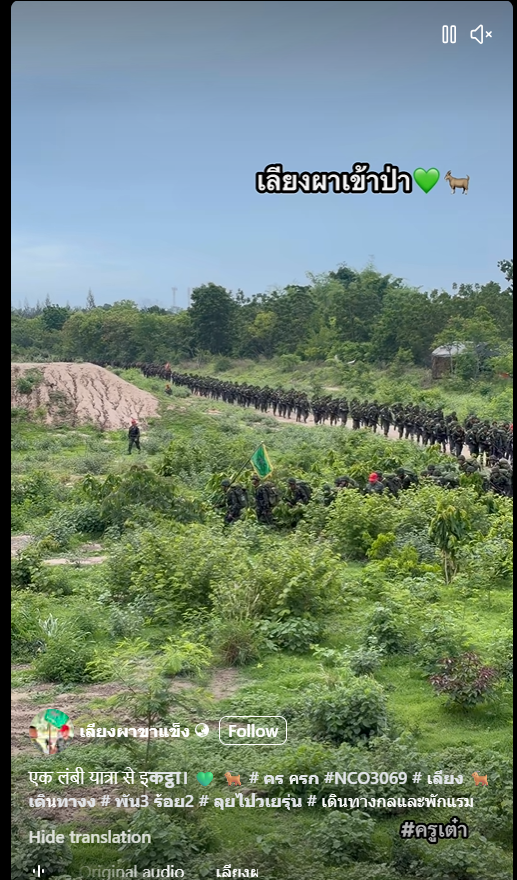
According to the information provided with the post, the video shows a training exercise of Non-Commissioned Officers (NCOs) from the 3rd Battalion, 2nd Regiment of the Royal Thai Army. The page also contains several other posts featuring Thai military drills and training activities. We further reviewed the Facebook page and found multiple training videos featuring the same flag carried by soldiers in the viral footage, confirming that the personnel shown belong to the Thai Army, not the Chinese military.
https://www.facebook.com/profile.php?id=61588894033585&locale=hi_IN

We also found a report published by The Times of India, quoting Union Minister Kiren Rijiju, who dismissed claims of any Chinese intrusion into Arunachal Pradesh. Rijiju clarified that no intrusion had taken place, adding that occasional movement across undemarcated areas occurs because the boundary has not been fully delineated. https://timesofindia.indiatimes.com/india/no-intrusion-transgression-in-absence-of-demarcation-kiran-rijiju/articleshow/132101410.cms

Conclusion
Our research found that the viral claim is false. The videos being shared as evidence of Chinese troops entering Arunachal Pradesh actually show Royal Thai Army personnel participating in military training exercises in Thailand. There is no evidence that the footage is related to India or that it depicts any recent Chinese military intrusion into Indian territory. Government officials have also rejected the viral claim.
.webp)
Overview:
WazirX is the platform for cryptocurrencies, based in India that has been hacked, and it made a loss of more than $230 million in cryptocurrency. This case concerned an unauthorized transaction with a multisignature or multisig, wallet controlled through Liminal’a digital asset management platform. These attacking incidents have thereafter raised more questions on the security of the Cryptocurrency exchanges and efficiency of the existing policies and laws.
Wallet Configuration and Security Measures
This wallet was breached and had a multisig setting meaning that more than one signature was needed to authorize a transaction. Specifically, it had six signatories: five are funded by WazirX and one is funded by Liminal. Every transaction needed the approval of at least three signatories of WazirX, all of whom had addressed security concerns by using Ledger’s hardware wallets; while the Liminal, too, had a signatory, for approval.
To further increase the level of security of the transactions, a whitelisting policy was introduced, only limited addresses were authorized to receive funds. This system was rather vulnerable, and the attackers managed to grasp the discrepancy between the information available through Liminal’s interface and the content of the transaction to seize unauthorized control over the wallet and implement the theft.
Modus Operandi: Attack Mechanics
The cyber attack appears to have been carefully carried out, with preliminary investigations suggesting the following tactics:
- Payload Manipulation: The attackers apparently substituted the transaction’s payload during signing; hence, they can reroute the collected funds into an unrelated wallet.
- Chain Hopping: To make it much harder to track their movements, the attackers split large amounts of money across multiple blockchains and broke tens of thousands of dollars into thousands of transactions involving different cryptocurrencies. This technique makes it difficult to trace people and things.
- Zero Balance Transactions: There were also some instances where it ended up with no Ethereum (ETH) in the balance and such wallets also in use for the purpose of further anonymization of the transactions.
- Analysis of the blockchain data suggested the enemy might have been making the preparations for this attack for several days prior to their attack and involved a high amount of planning.
Actions taken by WazirX:
Following the attack, WazirX implemented a series of immediate actions:
- User Notifications: The users were immediately notified of the occurrence of the breach and the possible risk it posed to them.
- Law Enforcement Engagement: The matters were reported to the National Cyber Crime Reporting Portal and specific authorities of which the Financial Intelligence Unit (FIU) and the Computer Emergency Response Team (CERT-In).
- Service Suspension: WazirX had suspended all its trading operations and user deposits’ and withdrawals’ to minimize further cases and investigate.
- Global Outreach: The exchange contacted more than 500 cryptocurrency exchanges and requested to blacklist the wallet’s addresses linked to the theft.
- Bounty Program: A bounty program was announced to encourage people to share information that can enable the authorities to retrieve the stolen money. A maximum of 23 million dollars was placed on the bounty.
Further Investigations
WazirX stated that it has contracted the services of cybersecurity professionals to help in the prosecution process of identifying and compensating for the losses. The exchange is still investigating the forensic data and working with the police for tracking the stolen assets. Nevertheless, the prospects of full recovery may be quite questionable primarily because of complexity of the attack and the methods used by the attackers.
Precautionary measures:
The WazirX cyber attack clearly implies that there is the necessity to improve the security and the regulation of the cryptocurrency industry. As exchanges become increasingly targeted by hackers, there is a pressing need for:
- Stricter Security Protocols: The commitment to technical innovations, such as integration of MFA, as well as constant monitoring of the users’ wallets’ activities.
- Regulatory Oversight: Formalization of the laws that require proper security for the cryptocurrency exchange platforms to safeguard their users as well as their investments.
- Community Awareness: To bypass such predicaments, there is a need to study on emergent techniques in spreading awareness, particularly in cases of scams or phishing attempts that are likely to follow such breaches.
Conclusion:
The cyber attack on WazirX in the field of cryptocurrency market, shows weaknesses and provides valuable lessons for enhancing the security. This attack highlights critical vulnerabilities in cryptocurrency exchanges, even though employing advanced security measures like multisignature wallets and whitelisting policies. The attack's complexity, involving payload manipulation, chain hopping, and zero balance transactions, underscores the attackers' meticulous planning and the challenges in tracing stolen assets. This case brings a strong message regarding the necessity of solid security measures, and constant attention to security in the rapidly growing world of digital assets. Furthermore, the incident highlights the importance of community awareness and education on emerging threats like scams and phishing attempts, which usually follow such breaches. By fostering a culture of vigilance and knowledge, the cryptocurrency community can better defend against future attacks.
Reference:
https://wazirx.com/blog/important-update-cyber-attack-incident-and-measures-to-protect-your-assets/
https://www.linkedin.com/pulse/wazirx-cyberattack-in-depth-analysis-jyqxf

Executive Summary
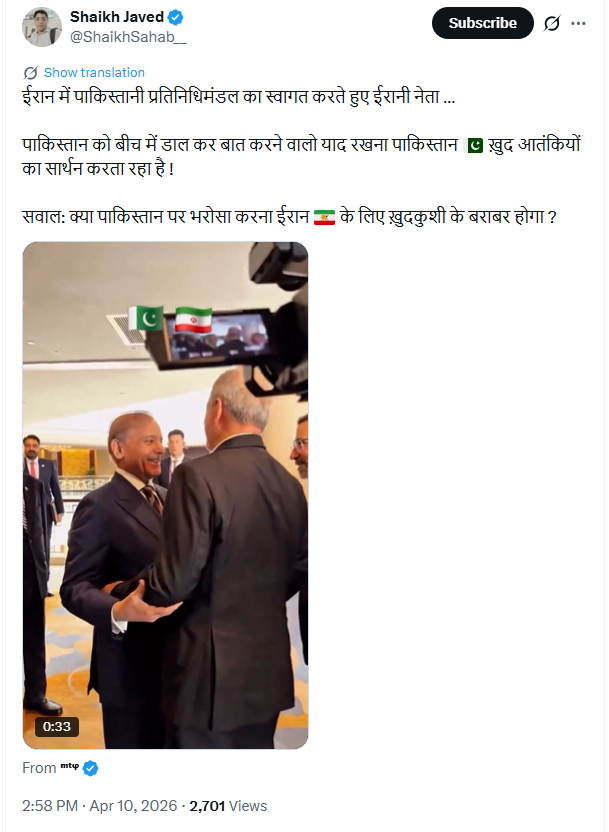
Amid reports of a two-week ceasefire announced on April 8, 2026, between the United States and Iran, and claims that Pakistan is facilitating peace talks between the two nations, a video showing leaders of Pakistan and Iran meeting has gone viral on social media. The video is being shared with the claim that Pakistani leaders received a grand welcome upon arriving in Iran for the April 11, 2026 talks. However, an research by the CyberPeace found the claim to be misleading. The viral video is not recent but dates back to September 2025.
Claim
An X (formerly Twitter) user shared the video on April 10, 2026, claiming that it shows Pakistani leaders being warmly welcomed in Iran.
Post link:
Fact Check
To verify the claim, we extracted keyframes from the viral video and conducted a reverse image search. This led us to the same video posted on a Facebook account named “Bhurgri Siddique” on September 1, 2025.

According to the available information, the video shows a meeting between a Pakistani delegation and Iranian leaders. Further keyword searches helped us locate a longer version of the same video on the official YouTube channel “HT Videos,” also uploaded on September 1, 2025. The video was from the Shanghai Cooperation Organisation Summit 2025 held in China, where leaders from various member countries, including Pakistan and Iran, had met.

Conclusion
The viral claim is misleading. The video does not show any recent meeting or welcome ceremony in Iran linked to the ongoing ceasefire talks. Instead, it is an old clip from September 2025, recorded during the SCO Summit in China. There is no evidence to suggest that the footage is related to current developments between the United States, Iran, and Pakistan. The video has been taken out of context and is being reshared with a false narrative to mislead users.
