
#FactCheck -Old Video of Benjamin Netanyahu Running in Knesset Falsely Linked to Iran-Israel Tensions
Executive Summary
Amid the ongoing tensions between the United States, Israel, and Iran, a video circulating on social media claims that Israeli Prime Minister Benjamin Netanyahu was seen running after Iran launched an attack on Israel. However, research by the CyberPeace found the viral claim to be misleading. Our research revealed that the video has no connection with the current tensions between the United States, Israel, and Iran. In reality, the clip dates back to 2021, when Netanyahu was rushing inside Israel’s parliament to cast his vote after arriving late.
Claim:
On the social media platform X (formerly Twitter), a user shared the video on March 5, 2026, claiming that Netanyahu had fled and gone into hiding due to fear of Iran. The post included inflammatory remarks suggesting that Iran had demonstrated its power and that Netanyahu had abandoned his country out of fear.

Fact Check
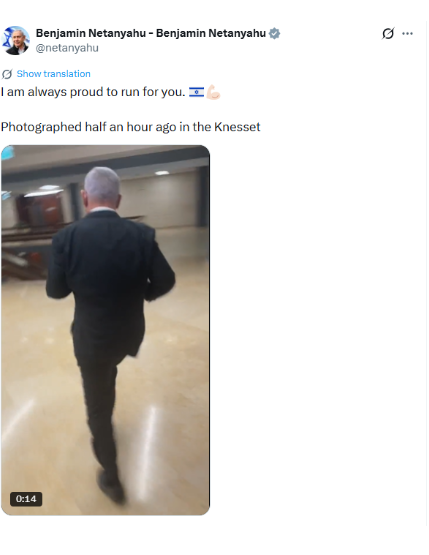
To verify the authenticity of the video, we extracted several keyframes and conducted a reverse image search on Google. During the research, we found the same video on the official X account of Benjamin Netanyahu, posted on December 14, 2021. In the post, Netanyahu wrote in Hebrew, which translates to,“I am always proud to run for you. Photographed half an hour ago in the Knesset.”
Further research also led us to a Hebrew news website where the same video was published.
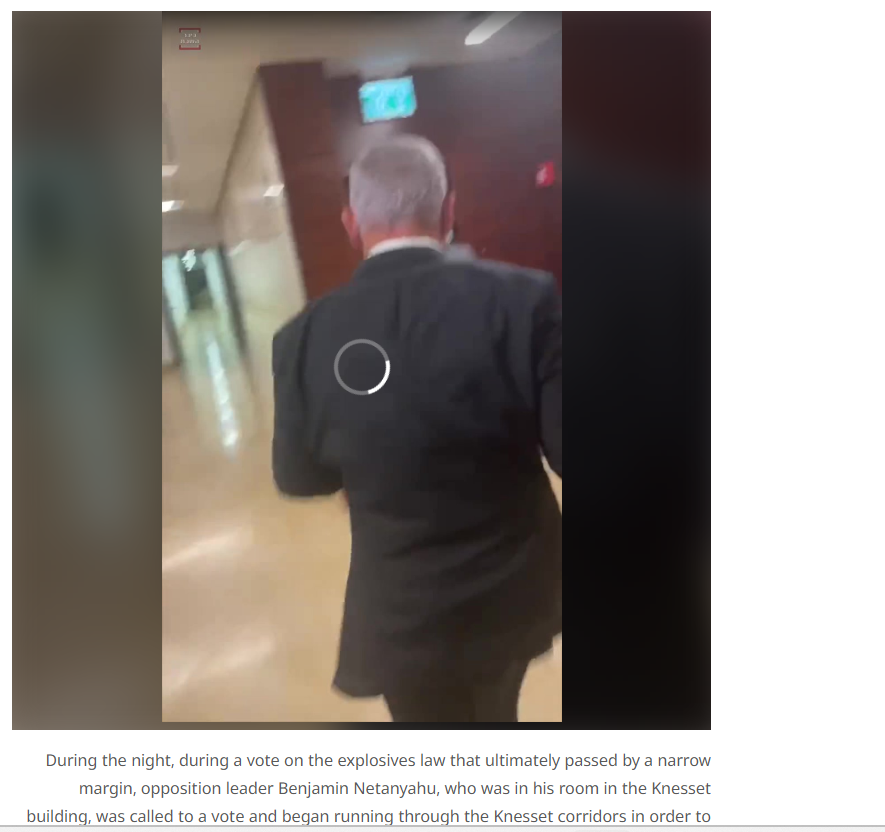
According to the report, voting in the Knesset (Israel’s parliament) continued throughout the night, and an explosives-related bill was passed by a very narrow margin. At the time, opposition leader Benjamin Netanyahu was in his room inside the Knesset building. When he was called for the vote, he hurried through the parliament corridors to reach the chamber in time to cast his vote.
Conclusion:
Our research found that the viral video is unrelated to the ongoing tensions involving the United States, Israel, and Iran. The footage is from 2021 and shows Benjamin Netanyahu rushing inside the Knesset to participate in a parliamentary vote after being called in at the last moment.

Related Blogs

Executive Summary:
A photo allegedly shows an Israeli Army dog attacking an elderly Palestinian woman has been circulating online on social media. However, the image is misleading as it was created using Artificial Intelligence (AI), as indicated by its graphical elements, watermark ("IN.VISUALART"), and basic anomalies. Although there are certain reports regarding the real incident in several news channels, the viral image was not taken during the actual event. This emphasizes the need to verify photos and information shared on social media carefully.

Claims:
A photo circulating in the media depicts an Israeli Army dog attacking an elderly Palestinian woman.


Fact Check:
Upon receiving the posts, we closely analyzed the image and found certain discrepancies that are commonly seen in AI-generated images. We can clearly see the watermark “IN.VISUALART” and also the hand of the old lady looks odd.

We then checked in AI-Image detection tools named, True Media and contentatscale AI detector. Both found potential AI Manipulation in the image.


Both tools found it to be AI Manipulated. We then keyword searched for relevant news regarding the viral photo. Though we found relevant news, we didn’t get any credible source for the image.

The photograph that was shared around the internet has no credible source. Hence the viral image is AI-generated and fake.
Conclusion:
The circulating photo of an Israeli Army dog attacking an elderly Palestinian woman is misleading. The incident did occur as per the several news channels, but the photo depicting the incident is AI-generated and not real.
- Claim: A photo being shared online shows an elderly Palestinian woman being attacked by an Israeli Army dog.
- Claimed on: X, Facebook, LinkedIn
- Fact Check: Fake & Misleading

Introduction:
Welcome to the third edition of our blog on digital forensics series. In our previous blog we discussed the difference between copying, cloning, and imaging in the context of Digital Forensics, and found out why imaging is a better process. Today we will discuss the process of evidence collection in Digital Forensics. The whole process starts with making sure the evidence collection team has all necessary tools required for the task.
Investigating Tools and Equipment:
Below are some mentioned tools that the team should carry with them for a successful evidence collection:
- Anti-static bags
- Faraday bags
- Toolkit having screwdrivers(nonmagnetic), scissors, pins, cutters, forceps, clips etc.
- Rubber gloves
- Incident response toolkit (Software)
- Converter/Adapter: USB, SATA, IDE, SCSI
- Imaging software
- Volatile data collection tools (FTK Imager, Magnet Forensics RAM Capture)
- Pens, permanent markers
- Storage containers
- Batteries
- Video cameras
- Note/sketch pads
- Blank storage media
- Write-Blocker device
- Labels
- Crime scene security tapes
- Camera
What sources of Data are necessary for Digital Evidence?
- Hard-Drive (Desktop, Laptop, External, Server)
- Flash Drive
- SD Cards
- Floppy Disks
- Optical Media (CD, DVD)
- CCTV/DVR
- Internal Storage of Mobile Device
- GPS (Mobile/Car)
- Call Site Track (Towers)
- RAM

Evidence Collection
The investigators encounter two primary types of evidence during the course of gathering evidence: non-electronic and electronic evidence.
The following approaches could be used to gather non-electronic evidence:
- In the course of looking into electronic crimes, recovering non-electronic evidence can be extremely important. Be cautious to make sure that this kind of evidence is retrieved and kept safe. Items that may be relevant to a later review of electronic evidence include passwords, papers or printouts, calendars, literature, hardware and software manuals, text or graphical computer printouts, and photos. These items should be secured and kept for further examination.
- They are frequently found close to the computer or other related hardware. Locating, securing, and preserving all evidence is required by departmental procedures.
Three scenarios arise for the collection of digital evidence from computers:
Situation 1: The desktop is visible, and the monitor is on.
- Take a picture of the screen and note the data that is visible.
- Utilize tools for memory capturing to gather volatile data.
- Look for virtual disks. If so, gather mounted data's logical copies.
- Give each port and connection a label.
- Take a picture of them.
- Turn off network access to stop remote access.
- Cut off the power or turn it off.
- Locate and disconnect the hard drive by opening the CPU chassis.
- Take all evidence and place it in anti-magnetic (Faraday) bags.
- Deliver the evidence to the forensic lab.
- Keep the chain of custody intact.
Situation 2: The monitor is turned on, but it either has a blank screen (sleep mode) or an image for the screensaver.
- Make a small mouse movement (without pressing buttons). The work product should appear on the screen, or it should ask for a password.
- If moving the mouse does not result in a change to the screen, stop using the mouse and stop all keystrokes.
- Take a picture of the screen and note the data that is visible.
- Use memory capturing tools to gather volatile data (always use a write blocker to prevent manipulation during data collection).
- Proceed further in accordance with Situation 1.
Situation 3: The Monitor Is Off
- Write down the "off" status.
- After turning on the monitor, check to see if its status matches that of situations 1 or 2 above, and then take the appropriate action.
- Using a phone modem, cable, confirm that you are connected to the outside world. Try to find the phone number if there is a connection to the phone.
- To protect evidence, take out the floppy disks that might be there, package each disk separately, and label the evidence. Put in a blank floppy disk or a seizure disk, if one is available. Avoid touching the CD drive or taking out CDs.
- Cover the power connector and every drive slot with tape.
- Note the serial number, make, and model.
- Take a picture of the computer's connections and make a diagram with the relevant cables.
- To enable precise reassembly at a later date, label all connectors and cable ends, including connections to peripheral devices. Put "unused" on any connection ports that are not in use. Recognize docking stations for laptop computers in an attempt to locate additional storage media.
- All evidence should be seized and placed in anti-magnetic (Faraday) bags.
- All evidence should be seized and placed in anti-magnetic (Faraday) bags.
- Put a tag or label on every bag.
- Deliver the evidence to the forensic lab.
- Keep the chain of custody intact.
Following the effective gathering of data, the following steps in the process are crucial: data packaging, data transportation, and data storage.
The following are the steps involved in data packaging, transportation, and storage:
Packaging:
- Label every computer system that is gathered so that it can be put back together exactly as it was found
When gathering evidence at a scene of crime,
- Before packing, make sure that every piece of evidence has been appropriately labeled and documented.
- Latent or trace evidence requires particular attention, and steps should be taken to preserve it.
- Use paper or antistatic plastic bags for packing magnetic media to prevent static electricity. Do not use materials like regular plastic bags (instead use faraday bags) that can cause static electricity.
- Be careful not to bend, fold, computer media like tapes, or CD-ROM.
- Make sure that the labels on every container used to store evidence are correct.
Transporting
- Make sure devices are not packed in containers and are safely fastened inside the car to avoid shock and excessive vibrations. Computers could be positioned on the floor of the car,and monitors could be mounted on the seat with the screen down .
When transporting evidence—
- Any electronic evidence should be kept away from magnetic sources. Radiation transmitters, speaker magnets, and heated seats are a few examples of items that can contaminate electronic evidence.
- Avoid leaving electronic evidence in your car for longer than necessary. Electronic devices can be harmed by extremes in temperature, humidity.
- Maintain the integrity of the chain of custody while transporting any evidence.
Storing
- Evidence should be kept safe and away from extremes in humidity and temperature. Keep it away from dust, moisture, magnetic devices, and other dangerous impurities. Be advised that extended storage may cause important evidence—like dates, times, and system configurations—to disappear. Because batteries have a finite lifespan, data loss may occur if they malfunction. Whenever the battery operated device needs immediate attention, it should be informed to the relevant authority (eg., the chief of laboratory, the forensic examiner, and the custodian of the evidence).
CONCLUSION:
Thus, securing the crime scene to packaging, transportation and storage of data are the important steps in the process of collecting digital evidence in forensic investigations. Keeping the authenticity during the process along with their provenance is critical during this phase. It is also important to ensure the admissibility of evidence in legal proceedings. This systematic approach is essential for effectively investigating and prosecuting digital crimes.

Introduction
Prebunking is a technique that shifts the focus from directly challenging falsehoods or telling people what they need to believe to understanding how people are manipulated and misled online to begin with. It is a growing field of research that aims to help people resist persuasion by misinformation. Prebunking, or "attitudinal inoculation," is a way to teach people to spot and resist manipulative messages before they happen. The crux of the approach is rooted in taking a step backwards and nipping the problem in the bud by deepening our understanding of it, instead of designing redressal mechanisms to tackle it after the fact. It has been proven effective in helping a wide range of people build resilience to misleading information.
Prebunking is a psychological strategy for countering the effect of misinformation with the goal of assisting individuals in identifying and resisting deceptive content, hence increasing resilience against future misinformation. Online manipulation is a complex issue, and multiple approaches are needed to curb its worst effects. Prebunking provides an opportunity to get ahead of online manipulation, providing a layer of protection before individuals encounter malicious content. Prebunking aids individuals in discerning and refuting misleading arguments, thus enabling them to resist a variety of online manipulations.
Prebunking builds mental defenses for misinformation by providing warnings and counterarguments before people encounter malicious content. Inoculating people against false or misleading information is a powerful and effective method for building trust and understanding along with a personal capacity for discernment and fact-checking. Prebunking teaches people how to separate facts from myths by teaching them the importance of thinking in terms of ‘how you know what you know’ and consensus-building. Prebunking uses examples and case studies to explain the types and risks of misinformation so that individuals can apply these learnings to reject false claims and manipulation in the future as well.
How Prebunking Helps Individuals Spot Manipulative Messages
Prebunking helps individuals identify manipulative messages by providing them with the necessary tools and knowledge to recognize common techniques used to spread misinformation. Successful prebunking strategies include;
- Warnings;
- Preemptive Refutation: It explains the narrative/technique and how particular information is manipulative in structure. The Inoculation treatment messages typically include 2-3 counterarguments and their refutations. An effective rebuttal provides the viewer with skills to fight any erroneous or misleading information they may encounter in the future.
- Micro-dosing: A weakened or practical example of misinformation that is innocuous.
All these alert individuals to potential manipulation attempts. Prebunking also offers weakened examples of misinformation, allowing individuals to practice identifying deceptive content. It activates mental defenses, preparing individuals to resist persuasion attempts. Misinformation can exploit cognitive biases: people tend to put a lot of faith in things they’ve heard repeatedly - a fact that malicious actors manipulate by flooding the Internet with their claims to help legitimise them by creating familiarity. The ‘prebunking’ technique helps to create resilience against misinformation and protects our minds from the harmful effects of misinformation.
Prebunking essentially helps people control the information they consume by teaching them how to discern between accurate and deceptive content. It enables one to develop critical thinking skills, evaluate sources adequately and identify red flags. By incorporating these components and strategies, prebunking enhances the ability to spot manipulative messages, resist deceptive narratives, and make informed decisions when navigating the very dynamic and complex information landscape online.
CyberPeace Policy Recommendations
- Preventing and fighting misinformation necessitates joint efforts between different stakeholders. The government and policymakers should sponsor prebunking initiatives and information literacy programmes to counter misinformation and adopt systematic approaches. Regulatory frameworks should encourage accountability in the dissemination of online information on various platforms. Collaboration with educational institutions, technological companies and civil society organisations can assist in the implementation of prebunking techniques in a variety of areas.
- Higher educational institutions should support prebunking and media literacy and offer professional development opportunities for educators, and scholars by working with academics and professionals on the subject of misinformation by producing research studies on the grey areas and challenges associated with misinformation.
- Technological companies and social media platforms should improve algorithm transparency, create user-friendly tools and resources, and work with fact-checking organisations to incorporate fact-check labels and tools.
- Civil society organisations and NGOs should promote digital literacy campaigns to spread awareness on misinformation and teach prebunking strategies and critical information evaluation. Training programmes should be available to help people recognise and resist deceptive information using prebunking tactics. Advocacy efforts should support legislation or guidelines that support and encourage prebunking efforts and promote media literacy as a basic skill in the digital landscape.
- Media outlets and journalists including print & social media should follow high journalistic standards and engage in fact-checking activities to ensure information accuracy before release. Collaboration with prebunking professionals, cyber security experts, researchers and advocacy analysts can result in instructional content and initiatives that promote media literacy, prebunking strategies and misinformation awareness.
Final Words
The World Economic Forum's Global Risks Report 2024 identifies misinformation and disinformation as the top most significant risks for the next two years. Misinformation and disinformation are rampant in today’s digital-first reality, and the ever-growing popularity of social media is only going to see the challenges compound further. It is absolutely imperative for all netizens and stakeholders to adopt proactive approaches to counter the growing problem of misinformation. Prebunking is a powerful problem-solving tool in this regard because it aims at ‘protection through prevention’ instead of limiting the strategy to harm reduction and redressal. We can draw parallels with the concept of vaccination or inoculation, reducing the probability of a misinformation infection. Prebunking exposes us to a weakened form of misinformation and provides ways to identify it, reducing the chance false information takes root in our psyches.
The most compelling attribute of this approach is that the focus is not only on preventing damage but also creating widespread ownership and citizen participation in the problem-solving process. Every empowered individual creates an additional layer of protection against the scourge of misinformation, not only making safer choices for themselves but also lowering the risk of spreading false claims to others.
References
- [1] https://www3.weforum.org/docs/WEF_The_Global_Risks_Report_2024.pdf
- [2] https://prebunking.withgoogle.com/docs/A_Practical_Guide_to_Prebunking_Misinformation.pdf
- [3] https://ijoc.org/index.php/ijoc/article/viewFile/17634/3565

