
#Fact Check: Viral video of fighter pilot repairing aircraft mid-air is AI-generated
Executive Summary
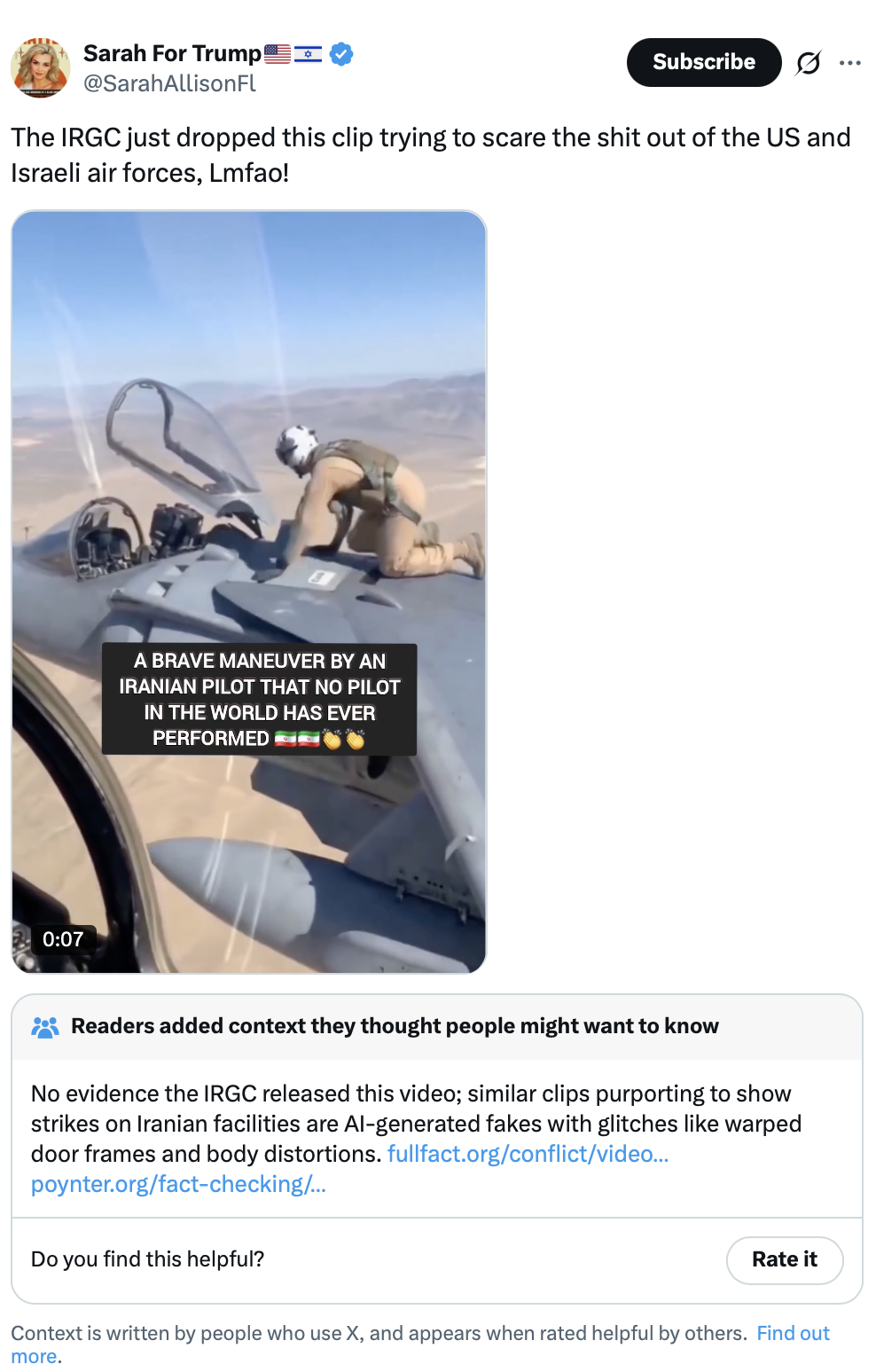
A video has gone viral on social media claiming to show a fighter pilot climbing out of his aircraft mid-flight to repair its engine before crawling back into the cockpit and resuming the mission. The footage shows the pilot closing a compartment on the aircraft's fuselage, making his way back to the cockpit, and the canopy shutting as the aircraft continues flying. According to a study by the CyberPeace Research Wing , the viral video is not authentic but AI-generated.
Claim
On August 1, an X user named "Sarah for Trump" shared the clip, claiming it showed an Iranian fighter pilot repairing his aircraft in mid-air. The post alleged that the video had been released by Iran's Revolutionary Guards to intimidate the United States and Israel. Text overlaid on the video read: "A brave maneuver by an Iranian pilot that no pilot in the world has ever performed." (At the time of publishing this story, the video had garnered 2.6 million views)
At the time this story was published, the video had received more than 2.6 million views.
https://x.com/SarahAllisonFl/status/2083589225912402201
https://archive.ph/fkW32
FactCheck
To verify the claim, we first analysed the viral video using the InVid verification tool and extracted several keyframes. A reverse image search of these frames through Google Lens led us to multiple social media posts carrying the same video with similar claims. The search also led us to an Instagram account named "viralism.ai", where the identical video had been uploaded on June 14. A comparison confirmed that the visuals matched the viral clip exactly, indicating that the Instagram upload was the original source from which the video was later circulated with a false narrative.
https://www.instagram.com/reel/DZkIrEijc89/
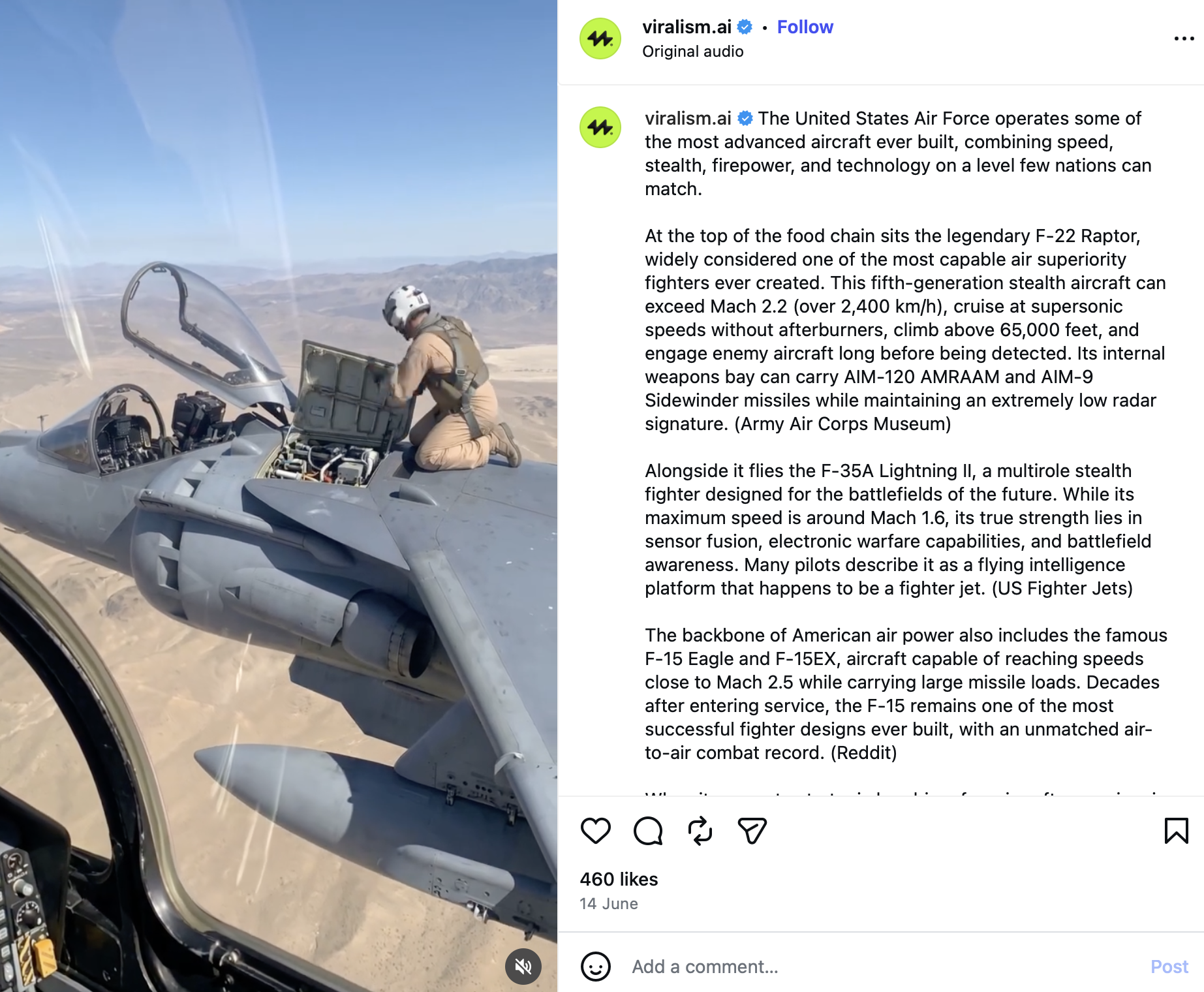
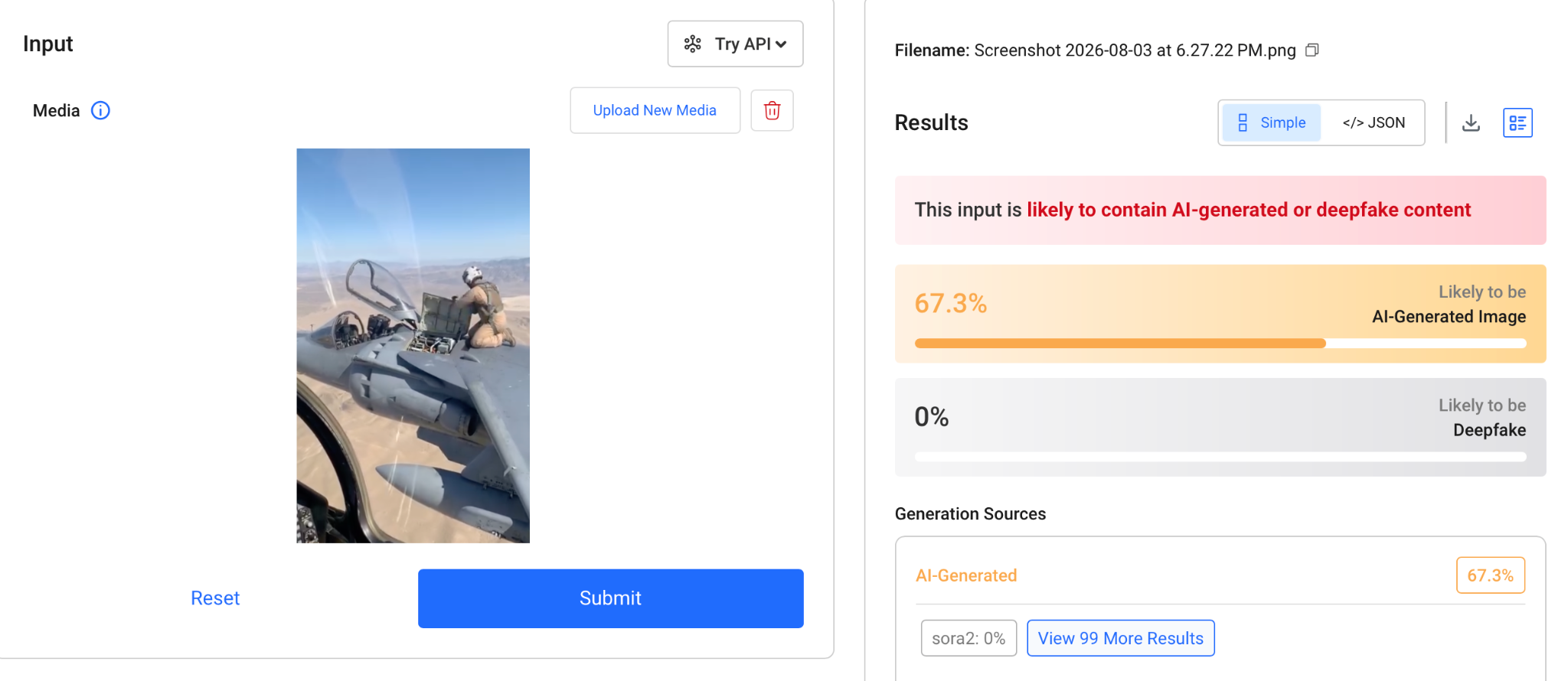
A review of the Instagram account further revealed that it primarily publishes AI-generated content. The account's description clearly states "AI Viral Videos and Trends," indicating that the video was created using artificial intelligence rather than depicting a real event. To further confirm our findings, we analysed the clip using the AI detection tool Hive Moderation. The results showed a high probability that the video was AI-generated, with several portions of the footage being flagged as synthetic
Conclusion
The research found that the viral video does not depict a real-life incident. The footage showing a fighter pilot allegedly repairing an aircraft engine during flight was generated using artificial intelligence and later circulated online as genuine. The accompanying claim that the video was released by Iran's Revolutionary Guards to threaten the United States and Israel is also false.

Related Blogs

Executive Summary:
A viral online image claims to show Arvind Kejriwal, Chief Minister of Delhi, welcoming Elon Musk during his visit to India to discuss Delhi’s administrative policies. However, the CyberPeace Research Team has confirmed that the image is a deep fake, created using AI technology. The assertion that Elon Musk visited India to discuss Delhi’s administrative policies is false and misleading.


Claim
A viral image claims that Arvind Kejriwal welcomed Elon Musk during his visit to India to discuss Delhi’s administrative policies.


Fact Check:
Upon receiving the viral posts, we conducted a reverse image search using InVid Reverse Image searching tool. The search traced the image back to different unrelated sources featuring both Arvind Kejriwal and Elon Musk, but none of the sources depicted them together or involved any such event. The viral image displayed visible inconsistencies, such as lighting disparities and unnatural blending, which prompted further investigation.
Using advanced AI detection tools like TrueMedia.org and Hive AI Detection tool, we analyzed the image. The analysis confirmed with 97.5% confidence that the image was a deepfake. The tools identified “substantial evidence of manipulation,” particularly in the merging of facial features and the alignment of clothes and background, which were artificially generated.


Moreover, a review of official statements and credible reports revealed no record of Elon Musk visiting India to discuss Delhi’s administrative policies. Neither Arvind Kejriwal’s office nor Tesla or SpaceX made any announcement regarding such an event, further debunking the viral claim.
Conclusion:
The viral image claiming that Arvind Kejriwal welcomed Elon Musk during his visit to India to discuss Delhi’s administrative policies is a deep fake. Tools like Reverse Image search and AI detection confirm the image’s manipulation through AI technology. Additionally, there is no supporting evidence from any credible sources. The CyberPeace Research Team confirms the claim is false and misleading.
- Claim: Arvind Kejriwal welcomed Elon Musk to India to discuss Delhi’s administrative policies, viral on social media.
- Claimed on: Facebook and X(Formerly Twitter)
- Fact Check: False & Misleading

Introduction
As the world is being "Digitally Interlaced", cyber security has become a continuous wrangle. The “Gambling industry” is considered an incredibly lucrative mark for cybercriminals, principally due to the enormous quantities of cash on hand and the sensitive details it processes day to day. Cybercriminals may use susceptibilities in gambling scaffolds to achieve financial scams or launder unlawful funds. An analysis by Security Scorecard discovered that the online gambling industry was ranked third in the possibility of encountering a cyber attack, following the energy and financial services sectors. Similarly, Online gambling is a bending matter that demands meticulous contemplation by policymakers and nationals. The incredible rise of online gambling has led to a terse acclivity in unlawful activities such as online scams, fraud, etc. Also, online sports gambling has become a thriving endeavour in contemporary years as millions of people are putting stakes and gambles on their electronic devices.
The Challenges
Online gambling has thus become a widespread frolicking for numerous youngsters, with the industry tossed to be worth billions of dollars in the forthcoming decades. The prominent cyber security challenges in the gambling industry are money laundering, financial laundering, ransomware, personal information theft, data breaches, distributed Denial of Service (DDoS), system disruptions and Insider perils and employee malfeasance. Challenges of online gambling also include being properly not regulated and a lack of social interaction with near and dear ones. The spread of Internet gambling has presented many problems affecting consumer behaviour online, motivations to gamble, problem gambling, security of websites, and the righteousness and virtue of the games. The rise of online gambling among young people due to the lack of clear regulations has likewise produced an abundant backdrop for financial ruination.
Web games and betting are among the fastest-evolving areas of the Internet. Over the past several years, there has been an international flare-up in online gambling, permitting customers to play from the convenience of home, work, and public locations. Numerous offshore betting websites and apps usually permit parties to win in the start with sound returns, whereas after the user gets addicted and invests considerable sums, they either keep failing or have the website refuse to cash out the winnings. Also, the information demonstrates that online games have been employed to commit wrongdoings (Child sexual exploitive material, religious conversion, cyberbullying, fraud, betting in virtual online casinos, etc.)
India's laws and regulations surrounding online gambling are complex and constantly evolving. While the legal framework is not entirely clear, a few state in India have their own set of rules.
Recently In April 2023, the Union Ministry of Electronics and Information Technology (“MeitY”), by virtue of the rule-making powers available to the central government under the Information Technology Act, 2000 (“IT Act 2000”), implemented a new central legal framework for online gaming through amendments to the Information Technology (Intermediary Guidelines and Digital Media Ethics Code) Rules, 2021 (“IT Rules 2021”). These amendments (“Online Gaming Rules”) propose a light-touch, co-regulatory regime whereby MeitY-recognised, independent self-regulatory bodies (“SRB”) will verify whether an “online real-money game” is to be made available to the general public or not – in accordance with the baseline criteria prescribed by the Online Gaming Rules.
The Online Gaming Rules attempt to regulate online gaming platforms by treating them as an “online gaming intermediary” (“OGI”) and prescribing intermediary due diligence obligations for them under the IT Rules 2021. An OGI has been defined in the Online Gaming Rules as “any intermediary that enables the users of its computer resource to access one or more online games”. Under the Online Gaming Rules, an online game can be a “permissible online game” if (i) it is not an online real-money game, or (ii) it is an online real-money game but is “verified” by an SRB in accordance with the baseline criteria prescribed by the Online Gaming Rules and any additional criteria prescribed by the SRB itself.
Global Perspective
The global gaming industry worth over US$227 billion in 2022 is further projected to grow to US$312 billion by 2027. Several countries have set regulatory frameworks about online gaming, though these are skewed, concentrating mainly on gambling and circumventing numerous of the more typical cyber threats. The US spends about $60 billion annually on online gambling and sports betting. In Europe, gambling is an even larger moneymaker. Also, numerous countries in Europe, like the UK, have legalised gambling. Nevertheless, it is prohibited for a US based company to operate an online gambling site. Yet, sports betting online is permitted in some states.
Today, though the gaming market has been overpowered by China and the US, future growth in the sector is anticipated to come from emerging economies like India with increasing populations. The permitted status of online gambling in India is nonetheless imprecise, vamoosing space for exploitation by cyber criminals and disarray for players involved. One of the climactic points that ought to be addressed is the sudden upsurge of online games, which increases gambling. Skill-based games such as poker, rummy etc., have additionally been developed to circumvent the legal definition of gambling in India. The recent instances of the online gaming industry not being properly regulated have also come to light in India. For instance, the Enforcement Directorate (ED) is still investigating the vast Mahadev Online Betting scandal, exposing an unknown money laundering method using Unified Payment Interface (UPI) IDs. Also, the Cyber Cell in Agra has taken proactive action against copyright violations, illegal online gambling and betting activities, shutting down 27 Illegal cricket betting sites in major operations, safeguarding several lakhs of Indians with thousands of crores from being transferred to overseas shores principally China.
Consequently, though India has announced new regulations on online gaming, its contemporary policy framework cannot contend with the problems endangering this sector. The Public Gambling Act of 1867 makes it unlawful to use a public gambling house or to be seen in one. Nevertheless, the act does not explicitly cite online gambling, leading to further interpretation. The Ministry of Home Affairs (MHA) has released a further awareness campaign for offshore illegal gambling apps, notifying users to be mindful of foreign apps as they may be fraudulent and might induce monetary damage to the user. Also, state laws control gambling in India with each state having its own directive on the subject. Yet, the Supreme Court of India has maintained that skilled games are not gambling and are thus legal. Furthermore, the Information Technology (IT) Act, of 2000 does not precisely handle online gambling or games that enable gambling.
Today, developers have strived for new ways to monetise the growing popularity of online gaming, which oversaw the creation of in-game currencies that can be bought using actual money, usually through credit cards. Several nations have prohibited the usage of in-game currency and loot boxes, considering them a kind of online gambling. The in-game currency has thus caused much disagreement about becoming a state of hunting monetisation by developers, especially targeting minor or newbie players. The gambling industry, therefore, faces unique cybersecurity challenges that require a comprehensive and proactive approach to cybersecurity.
Conclusion
Presently, there are approximately 3.09 billion active video game players worldwide, and the number is expected to reach 3.32 billion by 2024 as of 2023. In the contemporary digital era, information is priceless, and encryption acts as a necessary means to safeguard it. Thus, Regulators are working to maintain the swiftness of shift in the industry, as the dearth of transparency in the law has made it challenging to implement regulations. There is also less awareness about cyber security in India due to the following grounds such as the lack of ethical hackers in the country, companies in India lacking focus on cyber security and hiring a team of ethical hackers and cyber security experts. Furthermore, there has been a lack of knowledge among the citizens as well.
It is essential to realise the conceivable social and economic consequences and take measures to handle the online gambling industry. The industry has thus been undersized in the mode of research following online crime and Internet gambling, even though it is an acute emphasis. There is also a pressing necessity to rebuild these regulations to tackle the more unbridled cyber security hazards swarming the gaming industry. Similarly, there is an urgent need for governments and policymakers around the world to start paying more attention to the gaming industry as cyber security threats continue to rise. There should be a further need to strengthen the regulatory framework, establish Self Regulatory Organizations (SROs), create ethical gaming designs and increase awareness among gamers. The Government of India should consider devising its own rating system to rate games so that players under 18 cannot access them.
Eventually, cyber security is a shared commitment, and everyone in the online gambling ecosystem must function jointly to provide a secure and safe setting for all.
References:
- https://truefort.com/gambling-industry-cybersecurity/
- https://www.orfonline.org/research/cybersecurity-threats-in-online-gaming-learnings-for-india
- https://www.hackread.com/chinese-scammers-cloned-websites-gambling-network/
- https://www.civilsdaily.com/news/cybersecurity-threats-from-online-gaming/
- https://www.linkedin.com/pulse/legal-considerations-online-gambling-india-sudden-increase-mathur/
- https://www.jsheld.com/insights/articles/the-importance-of-cybersecurity-in-the-online-sports-betting-industry
- https://www.the420.in/agra-cyber-cell-takes-down-27-illegal-betting-sites/
- https://g2g.news/gaming/ministry-of-home-affairs-releases-new-awareness-campaign-for-online-gaming-in-india/
- https://smestreet.in/technology/kaspersky-warns-of-increased-phishing-scams-and-data-breaches-in-apac-for-2024-2381601
- https://economictimes.indiatimes.com/tech/newsletters/morning-dispatch/govt-bans-mahadev-other-illegal-betting-apps-cyber-attacks-against-india-spike/articleshow/104996017.cms?from=mdr
- https://cipher.com/cybersecurity-for-gambling/
- https://www.mangalorean.com/tightening-the-reins-indian-government-blocks-over-550-illegal-betting-and-gambling-apps/
- https://cybersecurityasean.com/news-press-releases/kaspersky-predicts-rise-cyber-threats-across-apac-2024
- https://www.cnbctv18.com/technology/mahadev-betting-app-scam-ed-money-laundering-upi-celebrities-under-scanner-17815661.htm
- https://iclg.com/practice-areas/gambling-laws-and-regulations/india
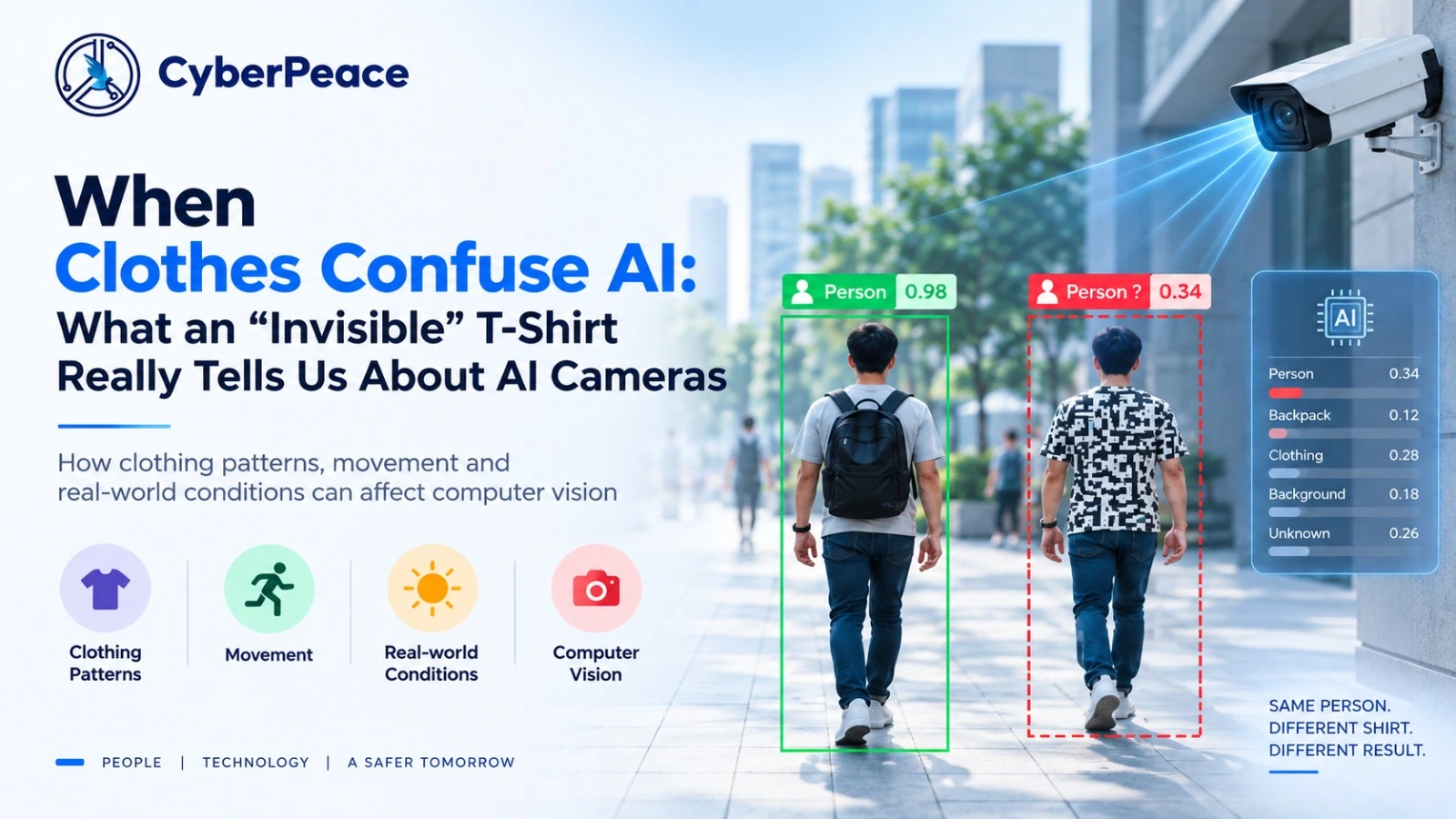
How clothing patterns, movement and real-world conditions can affect computer vision
Introduction
A person walks in front of an AI camera. The person is clearly visible to us, yet the system may not always identify the person with the same confidence. This sounds strange until we understand one basic fact: a camera records an image, while an AI model interprets that image through patterns learned during training.
This idea became popular through demonstrations such as “The T-Shirt Invisibility Cloak,” where specially designed clothing was shown as a way to interfere with person-detection systems. The wearer does not become physically invisible. The camera still captures the person. Instead, the visual pattern can make a particular AI model less confident or cause an incorrect prediction.
So, how can a piece of clothing affect machine vision? And what does this tell us about the strengths and limitations of AI surveillance?
How Does an AI Camera See?
A normal CCTV camera mainly captures and records video. An AI camera adds software that analyses the video for a specific task, such as detecting a person, vehicle, face or event.
A simple way to understand the process is:
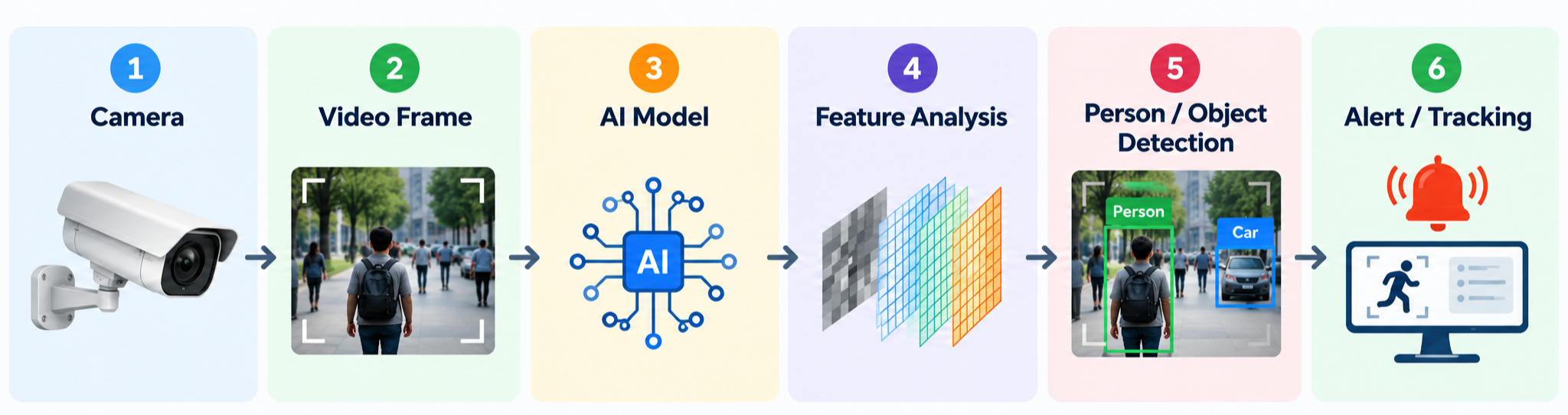
The model does not understand a person exactly as a human does. It processes numerical representations learned from training data. For a person detector, the question is closer to “Do these visual patterns match the class ‘person’?” than “I know this is a human.”
Think About It
A human sees a person wearing a complex shirt and easily separates the shirt design from the person. An AI model must decide what the visual patterns in the image mean for its particular task.
When Clothing Becomes Difficult
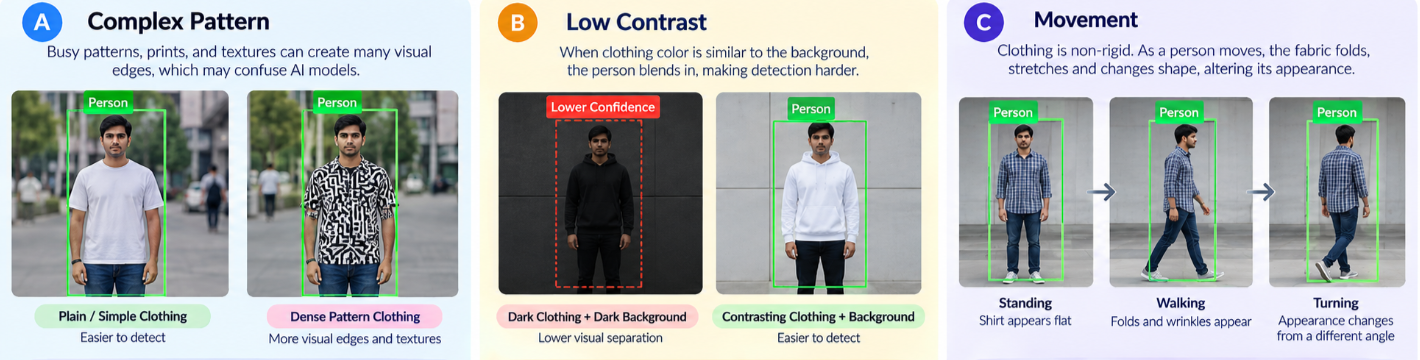
Clothing can become challenging when it changes the visual information available to a model.
Complex patterns can add many edges, repeated shapes and textures to an image. These do not automatically confuse an AI camera, but they can influence the features a detector uses.
Low contrast can create another problem. If clothing is close in colour or brightness to the background, the boundary between the person and the environment may be harder to separate, especially in poor lighting or low-resolution footage.
Movement creates another challenge. A loose jacket, flowing fabric or layered clothing changes shape as the person walks or turns. Researchers designing adversarial T-shirts have had to account for these non-rigid changes because a printed pattern does not stay flat on a moving body.
The T-Shirt Invisibility Cloak
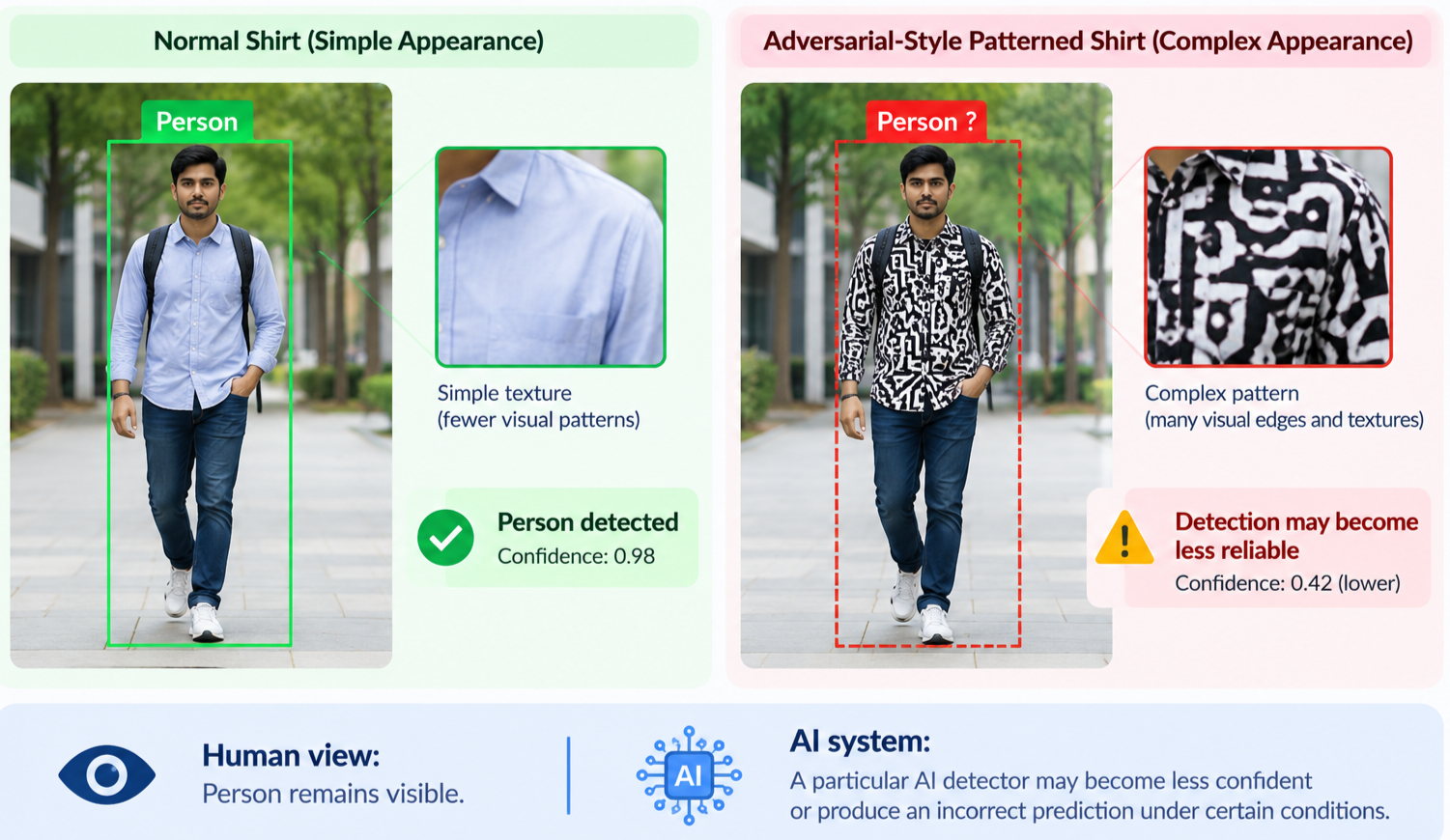
The video “The T-Shirt Invisibility Cloak” is a simple introduction to a larger research area called physical adversarial examples.
In adversarial machine learning, researchers study inputs deliberately designed to make a model produce an incorrect prediction. With clothing, the visual pattern is physically printed on a garment and then captured by a camera.
A 2019 study by Xu and colleagues demonstrated an adversarial T-shirt designed to interfere with person detectors in the physical world. Under their test conditions, the reported physical attack success rate against YOLOv2 was 57%. The work also modelled cloth deformation caused by movement.
A 2022 CVPR study on adversarial texture extended the idea to different viewing angles and tested physical clothing such as T-shirts, skirts and dresses.
But there is an important limitation: an adversarial garment is not a universal invisibility cloak. Different cameras and AI systems use different models, training data and processing pipelines. A pattern that affects one detector may have little effect on another.
Why Does the AI Get It Wrong?
Clothing may be only one part of the problem. A model can receive features different from what it learned during training. Camera angle, distance, movement, lighting, motion blur, compression and occlusion can also change the image.
Imagine the same person in four situations:
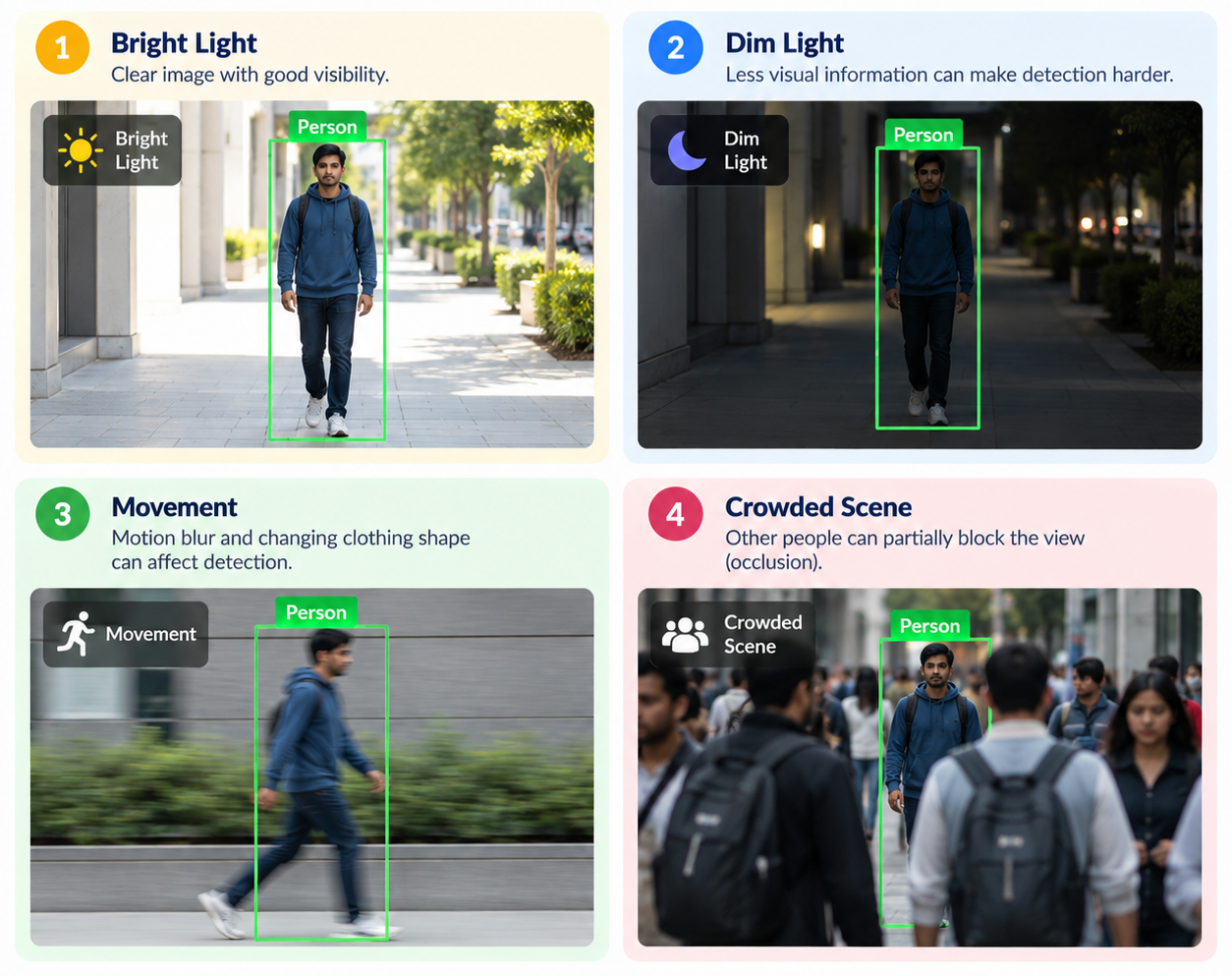
There may not be one fixed answer. AI performance depends on the combination of conditions.
AI Camera vs Human Vision
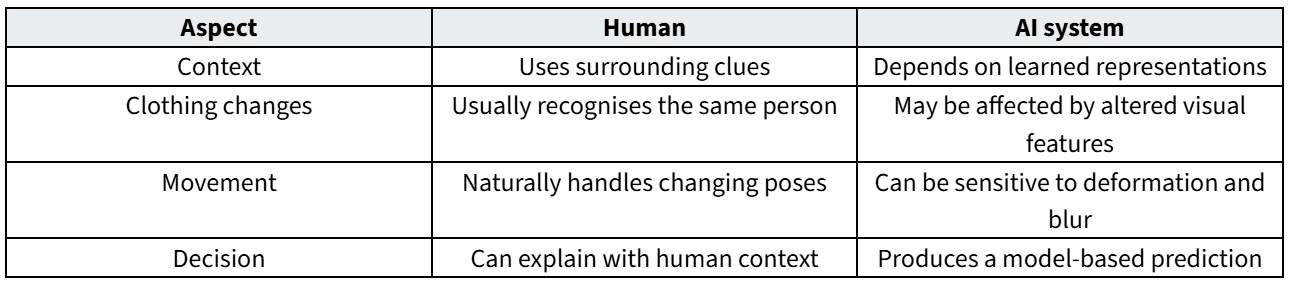
Humans use context. We understand that clothes wrinkle, people turn, shadows change and objects may temporarily block part of a body. An AI detector is more task-specific and can become less reliable when input conditions differ from the data used to train or evaluate it.
This does not make AI useless. It makes realistic testing important.
Building More Reliable AI Surveillance
The lesson is not that AI cameras should be abandoned. They should be tested under difficult, realistic conditions.
Testing can include different clothing patterns, colours, body positions, distances, camera angles, lighting conditions and crowded scenes. Security teams should also distinguish between person detection, facial recognition, tracking and behaviour analysis because these are different tasks. [6]
Most importantly, an automated alert should be treated as a prediction, not unquestionable truth. Important decisions should include appropriate human review.
A New Research Direction
Research is also moving beyond ordinary visible-light cameras. A 2026 CVPR paper explored adversarial clothing designed to affect both visible and infrared surveillance systems. At the same time, researchers continue to study ways of making models more robust against physical adversarial attacks.
This creates a continuing security cycle:
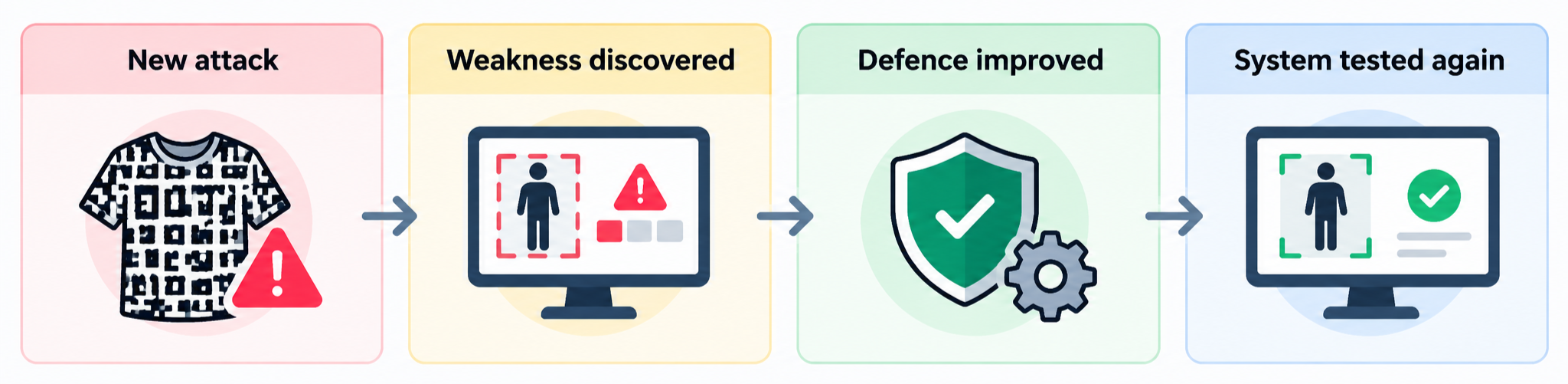
That cycle is a normal part of security research.

At a Glance: Human Vision vs AI Detection
Conclusion
The idea of an “invisible T-shirt” is fascinating because it challenges a common assumption about AI: if a machine can see an image, we expect it to understand that image correctly.
A person can remain completely visible while a particular AI detector becomes less confident or makes a wrong prediction. Clothing patterns, texture, folds, movement, lighting, camera angle and other factors can interact with a model in unexpected ways. Research has demonstrated physical adversarial clothing against person detectors, while newer work is exploring more complex surveillance conditions.
The real lesson is not that a shirt can make someone invisible. AI vision is a prediction system with strengths and weaknesses. Understanding those weaknesses helps researchers build better defences, helps security teams evaluate systems realistically, and reminds us that automated surveillance should be deployed with technical care, human oversight and respect for privacy.
References
- The T-Shirt Invisibility Cloak
- YouTube video referenced for the article’s introductory example: https://www.youtube.com/watch?v=NyofHyRm5CQ
- Xu, K., Zhang, G., Liu, S., Fan, Q., Sun, M., Chen, H., Chen, P.-Y., Wang, Y., & Lin, X. (2020). Adversarial T-shirt! Evading Person Detectors in a Physical World. Computer Vision – ECCV 2020, 665–681. https://doi.org/10.1007/978-3-030-58558-7_39
- Study demonstrating a physical adversarial T-shirt against person detection and modelling non-rigid cloth deformation during movement. https://arxiv.org/abs/1910.11099
- Thys, S., Van Ranst, W., & Goedemé, T. (2019). Fooling Automated Surveillance Cameras: Adversarial Patches to Attack Person Detection. CVPR Workshops.
- Earlier work showing physical adversarial patches can reduce the accuracy of person detectors. https://openaccess.thecvf.com/content_CVPRW_2019/html/CV-COPS/Thys_Fooling_Automated_Surveillance_Cameras_Adversarial_Patches_to_Attack_Person_Detection_CVPRW_2019_paper.html
- Hu, Z., Huang, S., Zhu, X., Sun, F., Zhang, B., & Hu, X. (2022). Adversarial Texture for Fooling Person Detectors in the Physical World. Proceedings of the IEEE/CVF Conference on Computer Vision and Pattern Recognition (CVPR), 13307–13316.
- Study extending physical adversarial clothing to multiple viewing angles and garments including T-shirts, skirts and dresses. https://openaccess.thecvf.com/content/CVPR2022/html/Hu_Adversarial_Texture_for_Fooling_Person_Detectors_in_the_Physical_World_CVPR_2022_paper.html
- Long, J., Jiang, T., Liu, H., Ma, C., Zhou, W., Yang, Y., & Yao, W. (2026). Thermally Activated Dual-Modal Adversarial Clothing against AI Surveillance Systems. CVPR 2026.
- Recent work exploring adversarial clothing against visible and infrared surveillance systems. https://openaccess.thecvf.com/content/CVPR2026/html/Long_Thermally_Activated_Dual-Modal_Adversarial_Clothing_against_AI_Surveillance_Systems_CVPR_2026_paper.html
- Li, S., Zhang, S., Chen, G., Wang, D., Feng, P., Wang, J., Liu, A., Yi, X., & Liu, X. (2023). Towards Benchmarking and Assessing Visual Naturalness of Physical World Adversarial Attacks. Proceedings of the IEEE/CVF Conference on Computer Vision and Pattern Recognition (CVPR), 12324–12333.
- Useful context on physical adversarial attacks and the challenge of making them visually natural. https://openaccess.thecvf.com/content/CVPR2023/papers/Li_Towards_Benchmarking_and_Assessing_Visual_Naturalness_of_Physical_World_Adversarial_CVPR_2023_paper.pdf [6]

