
#FactCheck - AI-Generated Image Falsely Linked to US Court Appearance of Venezuelan First Lady
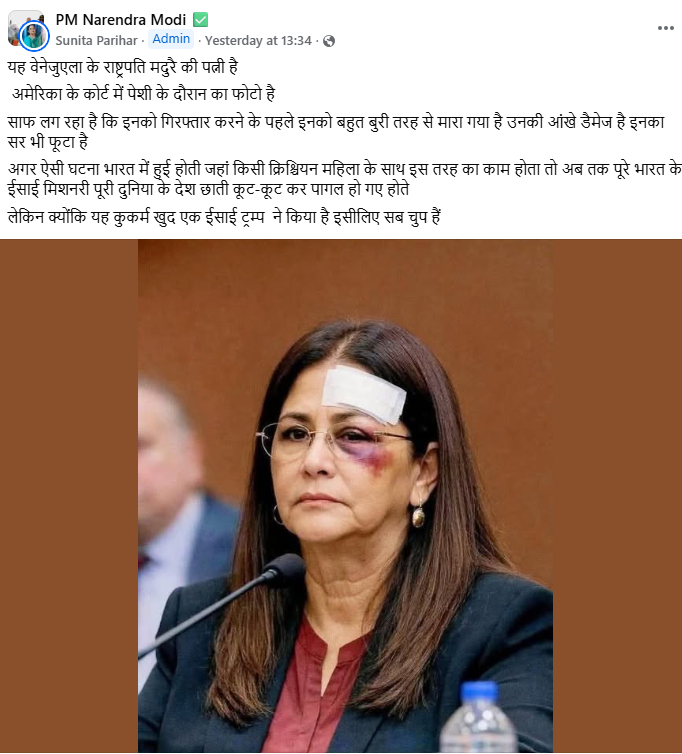
A photo showing Cilia Flores, wife of Venezuelan President Nicolás Maduro, with visible injuries on her face is being widely shared on social media. Users claim the image was taken during her court appearance in the United States on January 5, alleging that she was beaten before being produced before a judge. Cyber Peace Foundation’s research found that the viral image was created using AI tools and is not real.
Claim:
A Facebook user shared the image claiming it shows Venezuelan President Maduro’s wife during her US court appearance, alleging physical assault prior to her arrest. The post also makes political and religious allegations in connection with the incident.Link, archive link and screenshot
Fact Check:
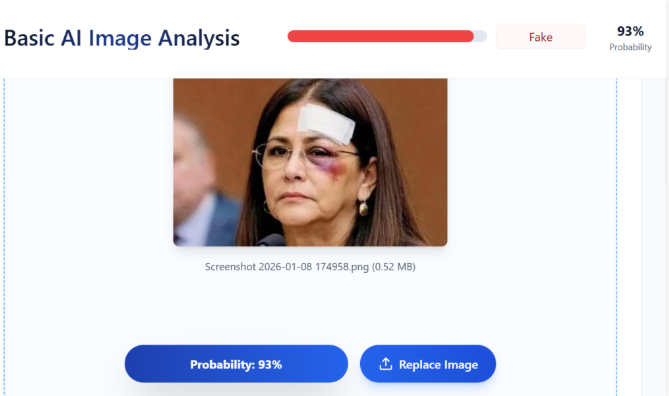
The viral image appeared suspicious due to unnatural facial details and injury patterns. Given the increasing use of artificial intelligence to generate fake visuals, Vishvas News analysed the image using AI image detection tools.TruthScan assessed the image as 93% likely to be AI-generated.
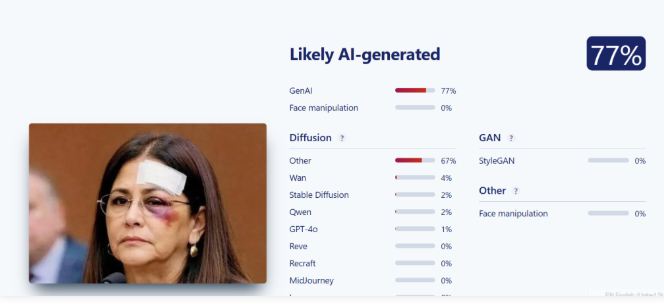
Sightengine flagged the image as 77% likely to be AI-generated.
The results indicate that the image is not authentic and has been created using AI tools.
What Official Reports Say
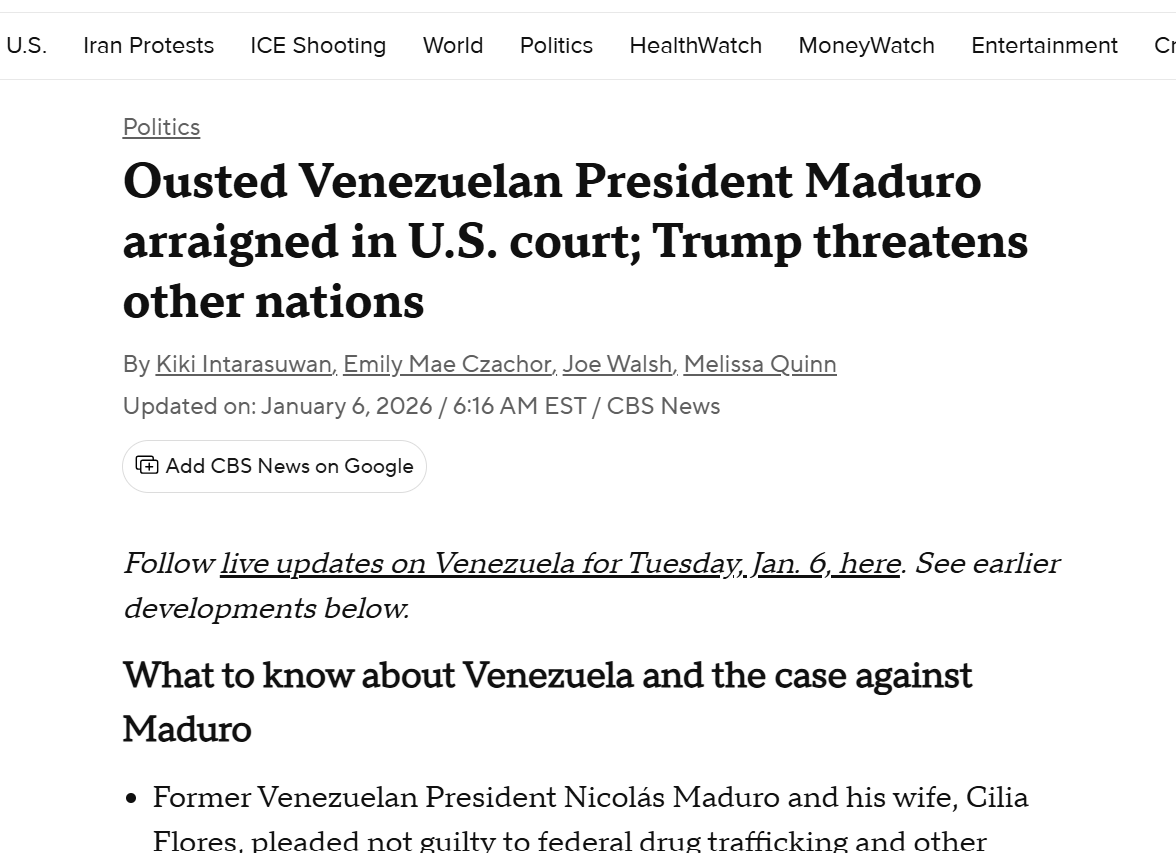
According to a CBS News report published on January 6, Nicolás Maduro and his wife Cilia Flores were produced before a federal court in Lower Manhattan, where they pleaded not guilty to drug trafficking and other charges. They are currently lodged at the Metropolitan Detention Center in Brooklyn The report states that the couple was detained during a US military operation. Following this, Venezuela’s Vice President Delcy Rodríguez was sworn in as the acting president. While Cilia Flores did appear before a Manhattan court, there is no authentic image showing her with injuries during the court proceedings. Link and Screenshot
https://www.cbsnews.com/live-updates/venezuela-trump-maduro-charges/
Conclusion:
The image being circulated as a photo of Cilia Flores during her US court appearance is AI-generated and fake. The claim that it shows injuries inflicted on her before being produced in court is false and misleading. The viral image has no connection with real court visuals.

Related Blogs

Introduction
The increase in consumer demands has resulted in a sharp increase in digital financing in India. As a result, the reputation of the digital lending sector has been impacted, as bad actors increasingly deploy illicit lending platforms such as fraudulent loans and trading apps. As millions of Indians download fast loan applications to help them meet their financial ends, the fraudulent apps result in cyber crimes including financial fraud. Consumers need to be vigilant of dubious trading or loan applications as bad actors frequently use illegitimate apps to trick victims by advertising limited-period offers and applying pressure.
Recently the Indian Cyber Crime Coordination Centre (I4C) led handel CyberDost has issued a cybercrime alert against the ‘CashExpand-U’ finance assistant app, which has been now removed from the Google Play Store. The app was found to be associated with hostile foreign entities, and the app had made it easier to raise small loans. However, such loan apps are seldom credible and may compromise financial information.
Raising cases of Fraudulent Loan Apps
The finance minister had stated that the government is constantly engaged with the Reserve Bank of India and other regulators and stakeholders to control fraudulent loan apps. In FY23, there were 1,062 complaints against such apps, the Finance Minister shared during a Lok Sabha session. Google removed almost 134 fake apps from the Play Store in a single week in September 2023 after multiple complaints were registered against such apps. The Reserve Bank of India (RBI) had also issued regulatory guidelines on digital lending in April 2023 to bring transparency in the digital loan space.
CyberPeace Policy Wing Advisory for Users
- Be cautious of App Permissions
Fake lending apps collect data by fraudulently taking numerous app permissions from consumers and misusing them later. The users must effectively manage their app permissions to avoid denying any extra permissions such as access to contacts, location, and photos. This is because fraudulent digital lenders access users' personal data to extort additional money even after loan repayment.
- Practice Due Diligence
Consumers must exercise care & caution before applying for a loan from digital lending platforms. Before applying for a loan or downloading any such apps, consumers must conduct due diligence by verifying the app's name, rating, reviews, physical address, and contact information. Always double-verify the paperwork before signing any agreement or contract. Always apply for loans from RBI-approved and compliant banking and financial services providers.
- Download from Official Sources
To avoid downloading counterfeit apps, only download lending apps from official stores like Google Play Store or Apple App Store, and avoid downloading apps from web links sent via SMS, email, or social media, even if shared by your known persons.
- Be sceptical of too-good-to-be-true offerings
Be cautious of deals that seem too good to be true, like hassle-free easy loans as they can be fraudulent. If an offer seems too good to be true, it might be a red flag. Hence always conduct your own research to verify the lender and avoid making hasty decisions.
- Reporting Mechanism
In case of facing a scam by such fraudulent apps, victims can file a complaint with the ‘National Cyber Crime Reporting Portal’ or Cyber Crime Helpline ‘1930’, or they can also contact us at CyberPeace Helpline +919570000066 and helpline@cyberpeace.net to get assistance in reporting their cases.
Final Words
Illegitimate loan/trading apps have been raising concerns by defrauding innocent consumers who seek financial assistance. The Center has recently warned against the CashExpand-U app, which has been now removed from the Google Play Store. Users are advised to exercise due care and caution while downloading loan apps and applying for loans to prevent any potential scams. keep up to date with news from concerned authorities about common scams and fraudulent practices in the lending space and stay safe in the online world.
References:
- https://www.livemint.com/news/beware-govt-issues-cybercrime-alert-against-loan-app-cashexpand-u-finance-assistant-11720338996430.html
- https://timesofindia.indiatimes.com/technology/tech-news/government-has-issued-an-important-warning-for-this-loan-app/articleshow/111541577.cms

Executive Summary:
The viral video circulating on social media about the Indian men’s 4x400m relay team recently broke the Asian record and qualified for the finals of the world Athletics championship. The fact check reveals that this is not a recent event but it is from the World World Athletics Championships, August 2023 that happened in Budapest, Hungary. The Indian team comprising Muhammed Anas Yahiya, Amoj Jacob, Muhammed Ajmal Variyathodi, and Rajesh Ramesh, clocked a time of 2 minutes 59.05 seconds, finishing second behind the USA and breaking the Asian record. Although they performed very well in the heats, they only got fifth place in the finals. The video is being reuploaded with false claims stating its a recent record.

Claims:
A recent claim that the Indian men’s 4x400m relay team set the Asian record and qualified to the world finals.


Fact Check:
In the recent past, a video of the Indian Men’s 4x400m relay team which set a new Asian record is viral on different Social Media. Many believe that this is a video of the recent achievement of the Indian team. Upon receiving the posts, we did keyword searches based on the input and we found related posts from various social media. We found an article published by ‘The Hindu’ on August 27, 2023.

According to the article, the Indian team competed in the World Athletics Championship held in Budapest, Hungary. During that time, the team had a very good performance. The Indian team, which consisted of Muhammed Anas Yahiya, Amoj Jacob, Muhammed Ajmal Variyathodi, and Rajesh Ramesh, completed the race in 2:58.47 seconds, coming second after the USA in the event.
The earlier record was 3.00.25 which was set in 2021.

This was a new record in Asia, so it was a historic moment for India. Despite their great success, this video is being reshared with captions that implies this is a recent event, which has raised confusion. We also found various social media posts posted on Aug 26, 2023. We also found the same video posted on the official X account of Prime Minister Narendra Modi, the caption of the post reads, “Incredible teamwork at the World Athletics Championships!
Anas, Amoj, Rajesh Ramesh, and Muhammed Ajmal sprinted into the finals, setting a new Asian Record in the M 4X400m Relay.
This will be remembered as a triumphant comeback, truly historical for Indian athletics.”

This reveals that this is not a recent event but it is from the World World Athletics Championships, August 2023 that happened in Budapest, Hungary.
Conclusion:
The viral video of the recent news about the Indian men’s 4x400m relay team breaking the Asian record is not true. The video was from August 2023 that happened at the World Athletics Championships, Budapest. The Indian team broke the Asian record with 2 minutes 59.05 seconds in second position while the US team obtained first position with a timing of 2 minutes 58.47 seconds. However, the video circulated projecting as a recent event is misleading and false.
- Claim: Recent achievement of the Indian men's 4x400m relay team broke the Asian record and qualified for the World finals.
- Claimed on: X, LinkedIn, Instagram
- Fact Check: Fake & Misleading

Executive Summary
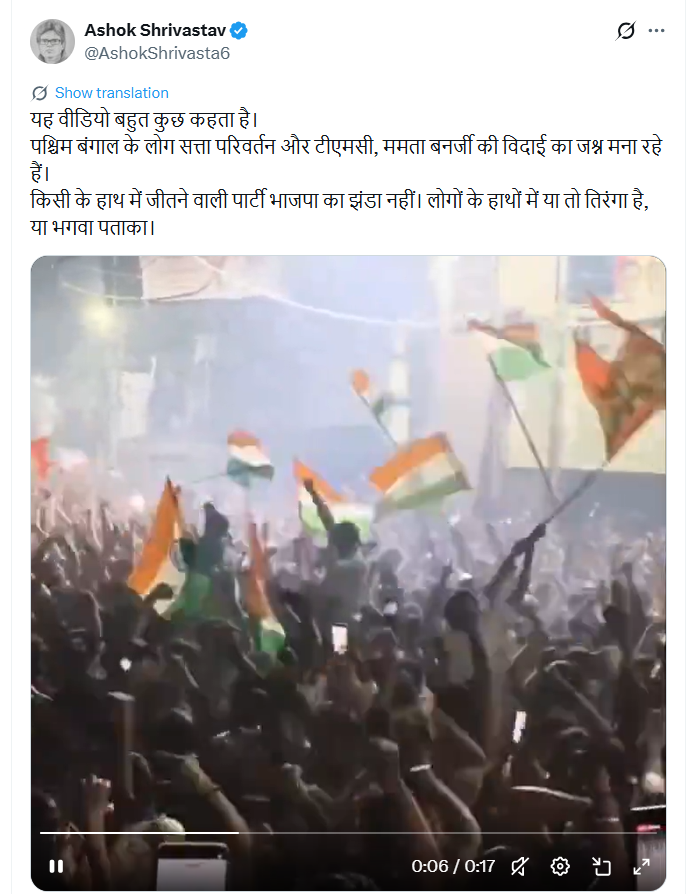
Assembly election results for West Bengal, Assam, Kerala, Tamil Nadu and the Union Territory of Puducherry have been declared, with the Bharatiya Janata Party (BJP) set to form the government in West Bengal after defeating the Trinamool Congress (TMC). Amid celebrations and reports of violence in the state, several misleading videos and images are also circulating on social media. One such viral clip shows people waving the Indian tricolour and saffron flags during a street celebration. Social media users are claiming that the video captures people celebrating a political change and BJP’s victory in West Bengal. Research by CyberPeace Research Wing found that the claim is false. The viral video is not from West Bengal but from Prayagraj and actually shows celebrations after India’s victory in the ICC Men's T20 World Cup 2026.
Claim
An X user named “Ashok Shrivastav” shared the video on May 6, 2026, claiming that people in West Bengal were celebrating the departure of Mamata Banerjee and the TMC government. The user further claimed that people were waving only the national flag and saffron flags, not BJP flags.
Fact Check
To verify the claim, we extracted several keyframes from the viral video and conducted a reverse image search using Google Lens. The clip was found on multiple social media handles falsely linked to West Bengal.
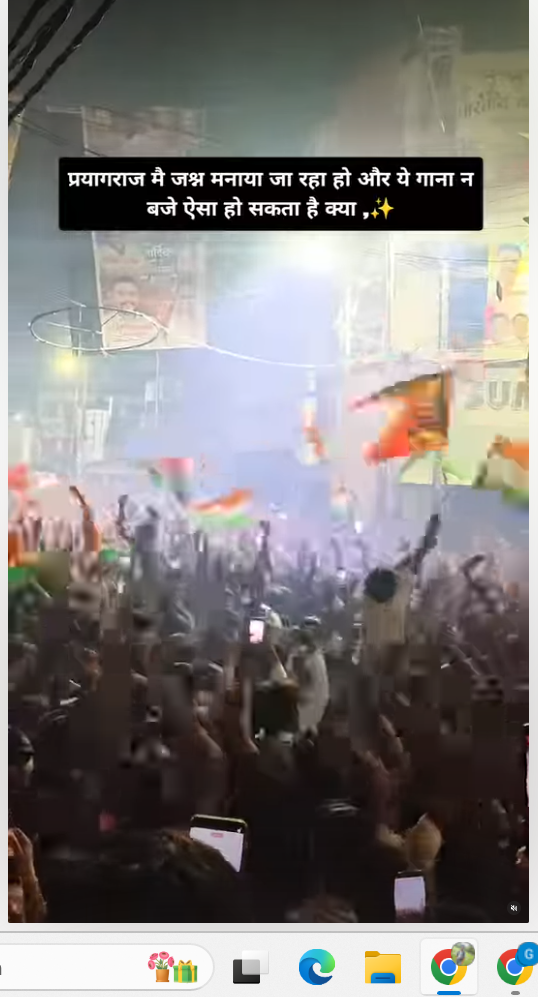
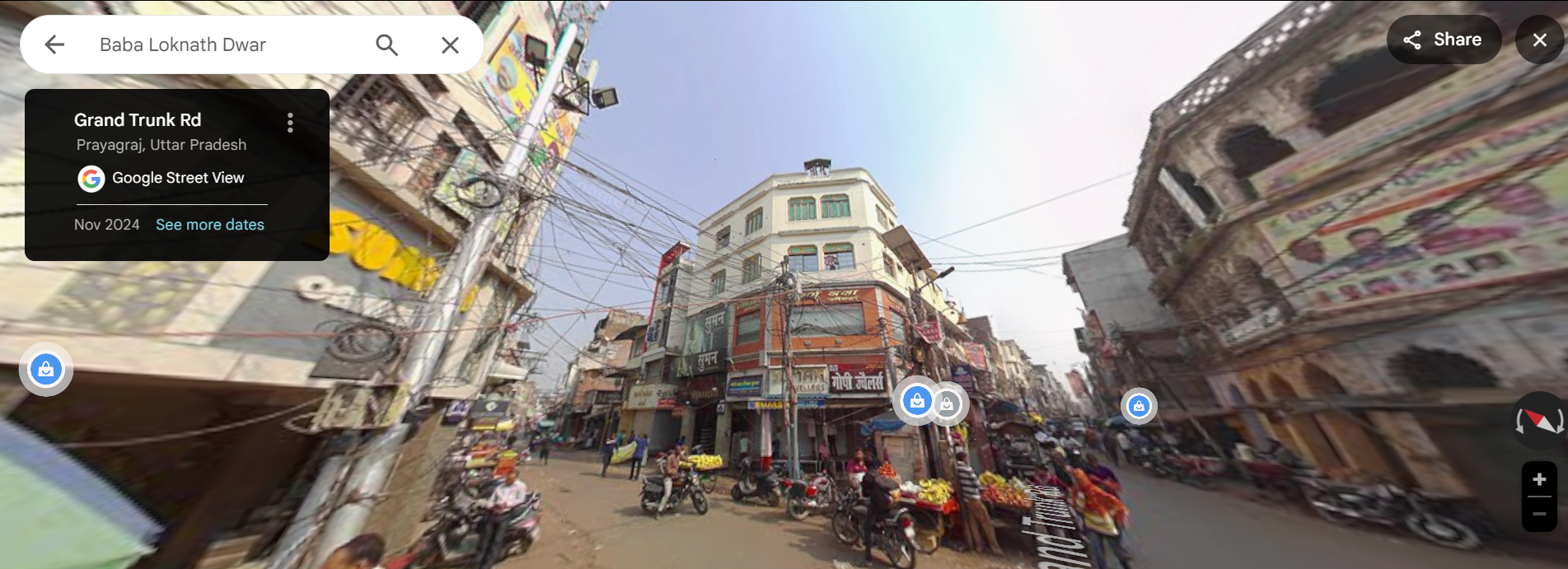
However, the oldest version of the video was uploaded on March 8, 2026, by an Instagram page named “Streets of Sangam.” The caption identified the location as Prayagraj and included hashtags related to the World Cup and Loknath. During the comparison of the viral and original videos, we noticed a shop sign reading “Suman Ornaments.” Using Google Street View, we traced the location to Baba Loknath area in Prayagraj, where the same shop could be identified near Loknath Gate.
Conclusion
Our research confirms that the viral claim is fake. The video being shared as BJP victory celebrations in West Bengal is actually from Prayagraj, Uttar Pradesh, and dates back to March 2026, when locals celebrated Team India’s T20 World Cup victory. The old clip is now being misleadingly circulated with a false political narrative.
