
India’s Quantum Leap Startups Selected for Support Under the NQM and the NMIC-PS
Introduction
Quantum technology involves the study of matter and energy at the sub-atomic level. This technology uses superposition and entanglement to provide new capabilities in computing, cryptography and communication and solves problems at speeds not possible with classical computers. Unlike classical bits, qubits can exist in a superposition of states, representing 0, 1, or any combination of these states simultaneously. The Union Cabinet approved the National Quantum Mission on 19 April 2023, with a budget allocation of Rs 6000 Crore. The mission will seed, nourish, and scale up scientific and industrial R&D in the domain of quantum technology so that India emerges as one of the leaders in developing quantum technologies and their applications.
The Union Minister for Science and Technology and Minister of Earth Sciences, Dr. Jitendra Singh announced the selection of 8 start-ups for support under India’s National Quantum Mission and the National Mission on Interdisciplinary Cyber-Physical Systems (NM-ICPS). The selected start-ups represent diverse quantum tech domains and were chosen via a rigorous evaluation process. These startups are poised to be critical enablers in translating quantum research into practical applications. This start-up selection aligns with India’s broader vision for technological self-reliance and innovation by 2047.
Policy Landscape and Vision
The National Quantum Mission’s main goal is to develop intermediate-scale quantum computers with 50-1000 physical qubits in 8 years, across diverse platforms such as superconducting and photonic technology. The mission deliverables include the development of satellite-based secure quantum communications between ground stations over a range of 2000 km within India, long-distance secure quantum communications with other countries, inter-city quantum key distribution over 2000 km, and multi-node quantum networks with quantum memories.
The National Mission on Interdisciplinary Cyber-Physical Systems aims to promote translational research in Cyber-Physical Systems and associated technologies and prototypes and demonstrates applications for national priorities. The other expectations are enhancing the top-of-the-line research base, human resource development and skill sets in these emerging areas. These missions align with India’s broader ideals such as the Digital India and Make in India campaigns to strengthen India’s technological ecosystem.
Selected Startups and Their Innovations
The startups selected reflect alignment with India’s National Quantum Mission, oriented towards fostering cutting-edge research and innovation and have industrial applications aiming at placing India as the global leader in quantum technology. The selections are:
- QNu Labs (Bengaluru): is advancing quantum communication by developing end-to-end quantum-safe heterogeneous networks.
- QPiAI India Pvt. Ltd. (Bengaluru): is building a superconducting quantum computer.
- Dimira Technologies Pvt. Ltd. (IIT Mumbai): is creating indigenous cryogenic cables, essential for quantum computing.
- Prenishq Pvt. Ltd. (IIT Delhi): developing precision diode-laser systems.
- QuPrayog Pvt. Ltd. (Pune): is working on creating optical atomic clocks and related technologies.
- Quanastra Pvt. Ltd. (Delhi): is developing advanced cryogenics and superconducting detectors.
- Pristine Diamonds Pvt. Ltd. (Ahmedabad): is creating diamond materials for quantum sensing.
- Quan2D Technologies Pvt. Ltd. (Bengaluru): is making advancements in superconducting Nanowire Single-photon Detectors.
References

Related Blogs
.webp)
Introduction
According to Statista, the global artificial intelligence software market is forecast to grow by around 126 billion US dollars by 2025. This will include a 270% increase in enterprise adoption over the past four years. The top three verticals in the Al market are BFSI (Banking, Financial Services, and Insurance), Healthcare & Life Sciences, and Retail & e-commerce. These sectors benefit from vast data generation and the critical need for advanced analytics. Al is used for fraud detection, customer service, and risk management in BFSI; diagnostics and personalised treatment plans in healthcare; and retail marketing and inventory management.
The Chairperson of the Competition Commission of India’s Chief, Smt. Ravneet Kaur raised a concern that Artificial Intelligence has the potential to aid cartelisation by automating collusive behaviour through predictive algorithms. She explained that the mere use of algorithms cannot be anti-competitive but in case the algorithms are manipulated, then that is a valid concern about competition in markets.
This blog focuses on how policymakers can balance fostering innovation and ensuring fair competition in an AI-driven economy.
What is the Risk Created by AI-driven Collusion?
AI uses predictive algorithms, and therefore, they could lead to aiding cartelisation by automating collusive behaviour. AI-driven collusion could be through:
- The use of predictive analytics to coordinate pricing strategies among competitors.
- The lack of human oversight in algorithm-induced decision-making leads to tacit collusion (competitors coordinate their actions without explicitly communicating or agreeing to do so).
AI has been raising antitrust concerns and the most recent example is the partnership between Microsoft and OpenAI, which has raised concerns among other national competition authorities regarding potential competition law issues. While it is expected that the partnership will potentially accelerate innovation, it also raises concerns about potential anticompetitive effects such as market foreclosure or the creation of barriers to entry for competitors and, therefore, has been under consideration in the German and UK courts. The problem here is in detecting and proving whether collusion is taking place.
The Role of Policy and Regulation
The uncertainties induced by AI regarding its effects on competition create the need for algorithmic transparency and accountability in mitigating the risks of AI-driven collusion. It leads to the need to build and create regulatory frameworks that mandate the disclosure of algorithmic methodologies and establish a set of clear guidelines for the development of AI and its deployment. These frameworks or guidelines should encourage an environment of collaboration between competition watchdogs and AI experts.
The global best practices and emerging trends in AI regulation already include respect for human rights, sustainability, transparency and strong risk management. The EU AI Act could serve as a model for other jurisdictions, as it outlines measures to ensure accountability and mitigate risks. The key goal is to tailor AI regulations to address perceived risks while incorporating core values such as privacy, non-discrimination, transparency, and security.
Promoting Innovation Without Stifling Competition
Policymakers need to ensure that they balance regulatory measures with innovation scope and that the two priorities do not hinder each other.
- Create adaptive and forward-thinking regulatory approaches to keep pace with technological advancements that take place at the pace of development and allow for quick adjustments in response to new AI capabilities and market behaviours.n
- Competition watchdogs need to recruit domain experts to assess competition amid rapid changes in the technology landscape. Create a multi-stakeholder approach that involves regulators, industry leaders, technologists and academia who can create inclusive and ethical AI policies.
- Businesses can be provided incentives such as recognition through certifications, grants or benefits in acknowledgement of adopting ethical AI practices.
- Launch studies such as the CCI’s market study to study the impact of AI on competition. This can lead to the creation of a driving force for sustainable growth with technological advancements.
Conclusion: AI and the Future of Competition
We must promote a multi-stakeholder approach that enhances regulatory oversight, and incentivising ethical AI practices. This is needed to strike a delicate balance that safeguards competition and drives sustainable growth. As AI continues to redefine industries, embracing collaborative, inclusive, and forward-thinking policies will be critical to building an equitable and innovative digital future.
The lawmakers and policymakers engaged in the drafting of the frameworks need to ensure that they are adaptive to change and foster innovation. It is necessary to note that fair competition and innovation are not mutually exclusive goals, they are complementary to each other. Therefore, a regulatory framework that promotes transparency, accountability, and fairness in AI deployment must be established.
References
- https://www.thehindu.com/sci-tech/technology/ai-has-potential-to-aid-cartelisation-fair-competition-integral-for-sustainable-growth-cci-chief/article69041922.ece
- https://www.marketsandmarkets.com/Market-Reports/artificial-intelligence-market-74851580.html
- https://www.ey.com/en_in/insights/ai/how-to-navigate-global-trends-in-artificial-intelligence-regulation#:~:text=Six%20regulatory%20trends%20in%20Artificial%20Intelligence&text=These%20include%20respect%20for%20human,based%20approach%20to%20AI%20regulation.
- https://www.business-standard.com/industry/news/ai-has-potential-to-aid-fair-competition-for-sustainable-growth-cci-chief-124122900221_1.html

Introduction
India currently faces a crucial moment because its digital system experiences rapid growth while cyber criminals take advantage of this development to increase their fraudulent activities. The Department of Telecommunications (DoT) has implemented a new regulatory requirement that mandates all messaging and communication platforms to use SIM-binding technology as their primary security measure. The new rule, which starts on 1st March 2026, requires WhatsApp, Telegram, Signal and other similar applications to operate only when users have their registered SIM card present in their device. The telecom identifier restriction aims to prevent unauthorised access, but it creates significant privacy concerns, together with issues of proportionality and platform governance.
Understanding the SIM-Binding Directive
SIM-binding establishes direct links between communication platform accounts and the SIM cards used for registration. The application will stop working when users take out their SIM card, turn it off, or get a new SIM card. Users must re-authenticate their sessions through the main device because web-based sessions, including WhatsApp Web, will automatically log out after six hours of use.
The Telecommunications Act, 2023 and Telecom Cyber Security Rules serve as the base legal authority for this directive. The regulation requires Telecommunication Identity User Entities (TIUEs), which identify users through mobile numbers, to maintain service access based on verified telecommunications credentials.
Rationale: Addressing Cyber Fraud and Misuse
The policy exists because cyber fraud activities have reached a point where they require a more powerful response. Authorities have stated that messaging applications maintain their operational capacity even after users remove their SIM cards, which allows international scammers to use Indian phone numbers for their fraudulent activities. SIM-binding aims to:
- Restore traceability by linking active accounts to verified SIM-based identities.
- Reduce remote access abuse, which includes both account takeovers and impersonation scams.
- Stop fraudulent activities that require physical device access through the creation of permanent sessions.
- Build a system of accountability that extends throughout the telecommunications industry.
The government introduced this measure as an appropriate solution to deal with systemic vulnerabilities because reported cyber fraud losses in 2024 reached more than ₹22,800 crore.
Security with Responsibility
The system requires digital trust to be established through secure identity verification systems, which include official systems for verification and operational systems that enable governmental agencies to work together.
CyberPeace principles require security measures to maintain three essential conditions, which are:
- They must respond to existing dangers
- Their execution process must be open to public observation
- They need to protect user rights, which include their right to privacy and personal independence
- They must provide equal access while safeguarding against negative impacts on at-risk user groups.
Industry Response and Governance Challenges
The directive has received diverse responses from people who work in different fields. Some platforms are testing SIM presence verification features for their upcoming changes, according to reports, while industry groups representing major technology companies have raised legal issues. They argue that the mandate may exceed the regulatory scope of the DoT and potentially conflict with constitutional protections. The existing tension demonstrates how governments face difficulties because they must protect national security while managing international platform operations and legal systems. The situation requires multiple stakeholders to work together because governments, industry, and civil society need to design policies through their collective input.
Policy Insights and Recommendations
The successful balanced execution of this initiative depends on these two essential elements:
- Clear Implementation Guidelines: Organizations need to establish detailed technical standards together with compliance frameworks, which must be followed during their implementation process across various platforms.
- Privacy Safeguards: The telecom service provider must implement strong data protection measures that protect customer data from unauthorised access through SIM-binding technology.
- User Awareness and Transparency: Users should receive information about SIM-binding effects on their access rights, together with security controls, which will help them build trust and provide informed consent.
- Flexibility for Edge Cases: Provisions should exist for legitimate use cases such as device changes, international travel, and accessibility needs.
- Global Interoperability Dialogue: India should engage with global stakeholders to ensure that such measures do not fragment the digital ecosystem.
Conclusion
The SIM-binding directive establishes India’s defence against cyber threats by solving a specific problem that exists in digital identity verification. The system establishes CyberPeace as its fundamental base through its shift from reactive cybersecurity practices toward preventive digital governance methods.
The system will achieve its desired results only if it effectively manages the three elements of security protection, privacy maintenance, and user convenience. SIM-binding and similar policies require ongoing assessment because their implementation affects both national security and the fundamental principles of trustworthiness, inclusiveness, and ethical digital governance.
References
- https://www.opindia.com/2026/02/sim-binding-to-be-implemented-from-1st-march-what-it-means-and-how-it-will-impact-users/
- https://www.ndtv.com/india-news/sim-binding-rule-set-to-change-how-whatsapp-telegram-work-in-india-from-march-1-11148903#:~:text=Under%20the%20new%20framework%2C%20messaging,is%20re%2Dinserted%20and%20authenticated.
- https://timesofindia.indiatimes.com/technology/tech-news/telecom-departments-sim-binding-rule-to-come-into-effect-from-tomorrow-march-1-what-is-sim-binding-how-it-works-and-what-it-means-for-whatsapp-users/articleshow/128879561.cms
- https://www.deccanherald.com/technology/whatsapp-begins-testing-sim-binding-in-india-3913963

Executive Summary
A video of Indian cricketer Rohit Sharma is being widely shared on social media, purportedly showing him saying, “If you want me to play in the next World Cup and you are with me, then share and like this video.” However, CyberPeace Research Wing found the viral claim to be false. Our research found that the viral video is not authentic but AI-generated and is being circulated with a misleading claim.
Claim:
A Facebook user shared the viral video on September 28 with the caption, “If you want me to play in the next World Cup and you are with me, then share and like this video.” The post link, archived link and screenshot are provided below.
https://www.facebook.com/reel/27349791221308658

Fact check
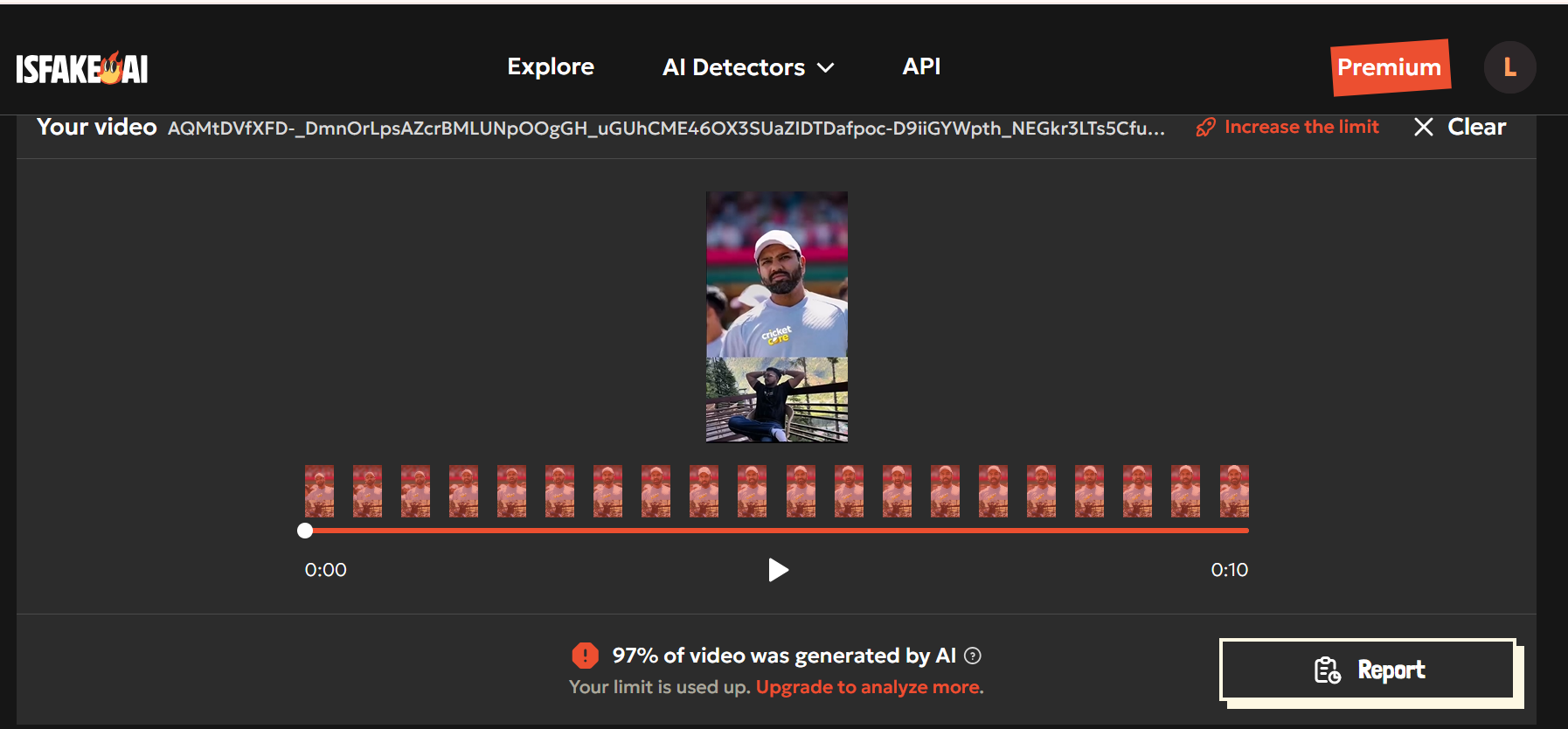
To verify the viral claim, we conducted a Google search using relevant keywords. During the search, we did not find any credible media reports corroborating the claim. As part of our research, we scanned the viral video using the AI detection tool ISFAKEAI. According to the tool’s results, the video was 97 per cent AI-generated.
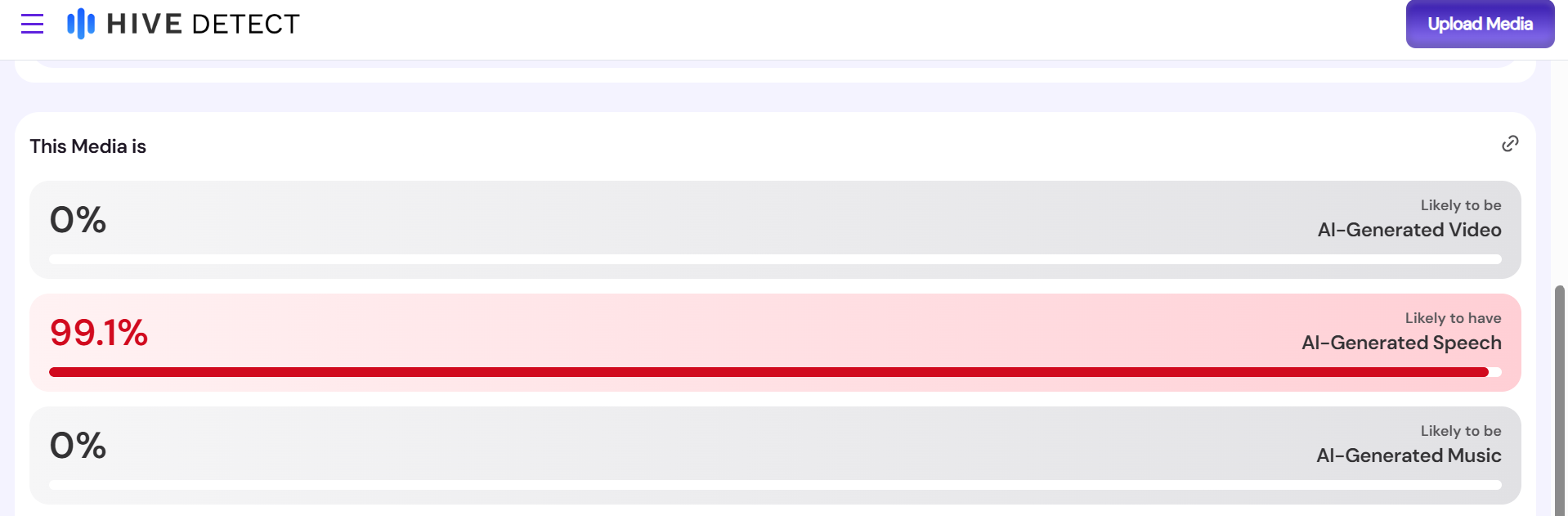
We further analysed the video using Hive Detect, which found that the speech in the viral video was 99 per cent AI-generated.
Conclusion:
Our research found that the viral video is not authentic but AI-generated. The video is being circulated on social media with a misleading claim that it shows an aeroplane being affected by the alleged ‘Arnab’ cyclone in Ahmedabad.
