
The Tiny Chip That Runs the Entire World, and Why Everyone's Fighting Over It
Introduction
Microchips are the invisible foundation of the modern economy. From consumer electronics and automotive manufacturing to military defense and artificial intelligence, virtually every critical industry relies on semiconductor supply chains. Yet, despite their ubiquity, chip manufacturing remains one of the most complex and concentrated supply networks on the planet. This explainer breaks down the global semiconductor ecosystem: how chips are produced, where the primary vulnerabilities lie, and why control over silicon has become the defining geopolitical battleground of our time.
A Chip Crosses More Borders Than Most People Do
Chipmaking is a relay race across continents. Engineers design the layout, then factories carve it onto silicon wafers so precisely that a particle of dust can ruin a batch. A single chip may be designed in the United States, made in Taiwan on Dutch equipment, assembled in Malaysia or Vietnam, and soldered in China or India. Thus, the entire link in the chain is vulnerable, and the failure of one weak element will lead to the stoppage of the entire chain. The forecast for the industry in 2021 was complicated by pandemic-related constraints and record demand, resulting in the disruption of automakers’ production costs by $210 billion and the loss of 7.7 million vehicles, according to AlixPartners
The Geography of Silicon Power
Manufacturing clusters in East Asia: Taiwan is focused on advanced manufacturing, South Korea – on memory (Samsung, SK Hynix), Japan – on chemicals and equipment. South Korea is ready to double its DRAM production in 2026 by increasing it 5 times than 2025. China is seeking to reduce its dependence on imports, but it is not as far along in advanced manufacturing as many analysts believe. The US holds much of the underlying IP but manufactures a smaller share of it — TSMC's Arizona campus shows the shift, growing from $12 billion to over $165 billion, with a further $100 billion expansion announced in mid-2026 that could push the total to $265 billion, potentially the largest foreign direct investment in US history.
Foundry, Fabless, or Both?
The semiconductor industry runs on three primary business models:
- Fabless (Design-Only): Companies like NVIDIA, AMD, and Qualcomm focus exclusively on architecture, intellectual property, and circuit design. They outsource all physical fabrication to specialised manufacturers, which helps them stay agile.
- Pure-Play Foundries (Manufacturing-Only): Dedicated contract manufacturers, most prominently TSMC (Taiwan Semiconductor Manufacturing Company), take designs from fabless firms and produce the physical wafers. They invest billions annually in advanced lithography and don’t compete in product design.
- Integrated Device Manufacturers (IDMs): Legacy companies like Intel and Samsung manage the entire lifecycle, from designing and fabricating to packaging their own chips. However, maintaining both cutting-edge design and manufacturing capabilities has become more and more difficult, leading IDMs to adopt hybrid foundry strategies.
Advanced Packaging: The New Frontier
For decades, the primary driver of semiconductor performance was Moore’s Law: shrinking transistor dimensions on a single silicon die. But physical limitations are making traditional scaling prohibitively expensive, making the industry shift its focus to Advanced Packaging. Techniques like 2.5D and 3D stacking combine multiple chips with short, dense wiring, boosting speed and efficiency without shrinking transistors, which are crucial for AI hardware. TSMC's CoWoS platform is now considered as critical as fabrication itself, with demand regularly outpacing supply. Because packaging needs far less capital than a leading-edge fab, more countries are racing to build local packaging capacity.
Who Actually Runs This Industry
A few companies dominate the market. TSMC is the biggest contract manufacturer of chips, while Samsung is both a designer and a manufacturer. Intel is re-establishing its foundry business, while Nvidia has taken over the market for AI and graphics processing units. Qualcomm and MediaTek dominate the market for mobile phone chips, and AMD competes in the personal computer market. Finally, there is one tiny Dutch company, ASML, which has a monopoly on the most advanced lithography tools, called extreme ultraviolet, or EUV. Each such machine costs more than $15 billion, so there is no real competition for now. Broadcom, Micron, and SK Hynix are other important players, as they are major suppliers of memory chips for computers and cars, as well as AI chips.
Where Things Are Headed
AI remains central, pushing advanced packaging and high-bandwidth memory to the top of every strategy; SEMI projects 300mm memory equipment investment will exceed $50 billion in 2026. Trade policy now matters as much as technology. In January 2026, the U.S. imposed a 25 per cent tariff on advanced semiconductors and began applying case-by-case reviews to previously near-automatic rejections of requests for Chinese firms to buy state-of-the-art chips for use in artificial intelligence computers. The U.S. is incentivizing Taiwanese manufacturers to make semiconductors in America while South Korea, Japan, and the European Union have made efforts to encourage investment in their own display technology. According to an article from Bloomberg published in July 2026, new fabrication plants face a danger of being delayed for years due to a shortage of skilled workers, resulting in billions of dollars wasted on investments.
Conclusion
Ultimately, semiconductors represent the ultimate convergence of technology, commerce, and geopolitics. A single speck of silicon now carries the weight of global GDP, national security, and the future of artificial intelligence. As trade barriers rise and supply chains re-align, control over these micro-foundations will decide which economies lead and which get left behind. The next decade will be won by mastering advanced packaging, talent management, and forging strategic alliances.
References
AlixPartners. "Semiconductor Shortages to Cost the Auto Industry Billions." September 2021
TSMC. "TSMC Arizona." Company overview
World Semiconductor Trade Statistics (WSTS). "Global Semiconductor Market Surges Beyond $1.5T 2026."

Related Blogs

Executive Summary:
A viral online video claims of an attack on Prime Minister Benjamin Netanyahu in the Israeli Senate. However, the CyberPeace Research Team has confirmed that the video is fake, created using video editing tools to manipulate the true essence of the original footage by merging two very different videos as one and making false claims. The original footage has no connection to an attack on Mr. Netanyahu. The claim that endorses the same is therefore false and misleading.

Claims:
A viral video claims an attack on Prime Minister Benjamin Netanyahu in the Israeli Senate.


Fact Check:
Upon receiving the viral posts, we conducted a Reverse Image search on the keyframes of the video. The search led us to various legitimate sources featuring an attack on an ethnic Turkish leader of Bulgaria but not on the Prime Minister Benjamin Netanyahu, none of which included any attacks on him.

We used AI detection tools, such as TrueMedia.org, to analyze the video. The analysis confirmed with 68.0% confidence that the video was an editing. The tools identified "substantial evidence of manipulation," particularly in the change of graphics quality of the footage and the breakage of the flow in footage with the change in overall background environment.


Additionally, an extensive review of official statements from the Knesset revealed no mention of any such incident taking place. No credible reports were found linking the Israeli PM to the same, further confirming the video’s inauthenticity.
Conclusion:
The viral video claiming of an attack on Prime Minister Netanyahu is an old video that has been edited. The research using various AI detection tools confirms that the video is manipulated using edited footage. Additionally, there is no information in any official sources. Thus, the CyberPeace Research Team confirms that the video was manipulated using video editing technology, making the claim false and misleading.
- Claim: Attack on the Prime Minister Netanyahu Israeli Senate
- Claimed on: Facebook, Instagram and X(Formerly Twitter)
- Fact Check: False & Misleading

Executive Summary
Amid the ongoing conflict involving the US-Israel and Iran in West Asia, a video showing destroyed aircraft at an airport is going viral on social media. The clip is being shared with the claim that it shows an Israeli military base destroyed in an Iranian attack. However, an research by the CyberPeacen found that the viral video is not real but AI-generated.
Claim:
An Instagram user “sakirali8064” shared the video on March 22, 2026, claiming that Iran had demonstrated its military strength by deploying advanced missiles capable of long-range precision strikes.The video also carries a “Breaking News” overlay stating:“Iran attack Israel military base… the entire base destroyed.
Post link and archive link:

Fact Check:
To verify the claim, we extracted keyframes from the viral clip and conducted a reverse image search using Google Lens. We found a longer version of the same video posted on March 5, 2026, by a Facebook user named “With INC,” where it was also falsely linked to an Iranian attack on Israel’s Ben Gurion Airport.

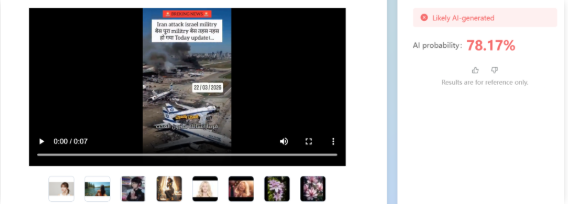
Upon closely examining the video, we observed inconsistencies such as fire changing positions unnaturally, which raised suspicion of AI manipulation. We then analyzed the video using Hive Moderation, which indicated a probability of over 99% that the content is AI-generated.

Additionally, analysis using Tencent’s “Zhuque AI” detection tool suggested more than 78% likelihood of the video being AI-generated.
Conclusion:
The viral video claiming that an Iranian attack destroyed an Israeli military base is AI-generated and misleading. While Iran has claimed to have targeted Israel’s Ben Gurion International Airport using drones, the viral footage does not depict a real event.

Executive Summary
A picture allegedly showing Sunrisers Hyderabad (SRH) owner Kavya Maran emotionally hugging young cricketer Vaibhav Suryavanshi has gone viral on social media. The image is being shared as a genuine photograph from a cricket-related event, with users claiming that Kavya Maran was seen embracing Vaibhav Suryavanshi. However, CyberPeace Research Wing research found the claim to be false. No credible news reports, official statements, or authentic photographs support the incident depicted in the viral image.
Claim
A Facebook user shared the viral image with the caption: “Kavya Maran Hug Vaibhav Suryavanshi 🥰🔥 #cricketnews #RRvsSRH” The link to the post and its screenshot are provided below.

Fact Check
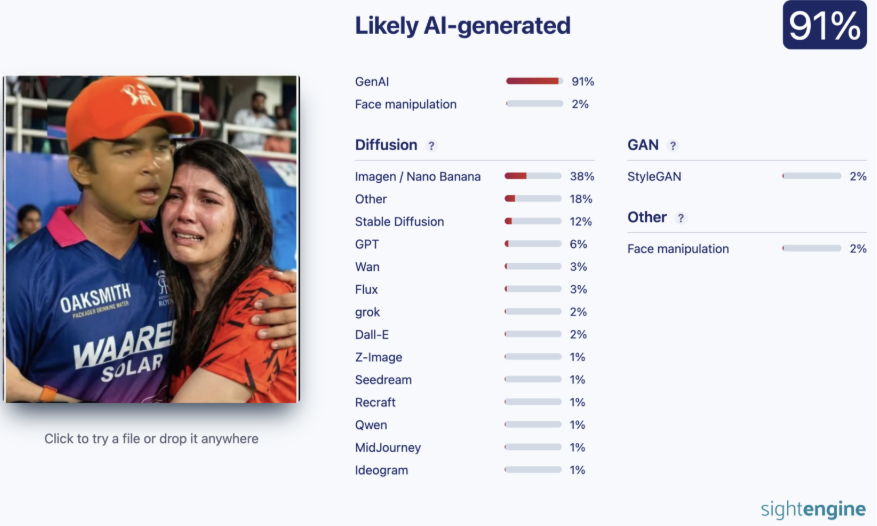
During the research, we found no credible news reports, official statements, or authentic images confirming that Kavya Maran hugged Vaibhav Suryavanshi as shown in the viral picture. To further verify the image, it was analysed using AI detection tools, including Sightengine and Hive Moderation. Both tools indicated a high probability that the image was generated using Artificial Intelligence. The findings suggest that the viral photograph is not a genuine image captured at a real event but a digitally created visual.

Conclusion
Our research found that the viral image showing Kavya Maran emotionally hugging Vaibhav Suryavanshi is not authentic. The picture was generated using AI and does not depict a real incident.
