
Strengthening of IT Protocols at the Apex of India's Economic Sphere
Introduction
Against the dynamic backdrop of Mumbai, where the intersection of age-old markets and cutting-edge innovation is a daily reality, an initiative of paramount importance has begun to take shape within the hallowed walls of the Reserve Bank of India (RBI). This is not just a tweak, a nudge in policy, or a subtle refinement of protocols. What we're observing is nothing short of a paradigmatic shift, a recalibration of systemic magnitude, that aims to recalibrate the way India's financial monoliths oversee, manage, and secure their informational bedrock – their treasured IT systems.
On the 7th of November, 2023, the Reserve Bank of India, that bastion of monetary oversight and national fiscal stability, unfurled a new doctrine – the 'Master Direction on Information Technology Governance, Risk, Controls, and Assurance Practices.' A document comprehensive in its reach, it presents not merely an update but a consolidation of all previously issued guidelines, instructions, and circulars relevant to IT governance, plaited into a seamless narrative that extols virtues of structured control and unimpeachable assurance practices. Moreover, it grasps the future potential of Business Continuity and Disaster Recovery Management, testaments to RBI's forward-thinking vision.
This novel edict has been crafted with a target audience that spans the varied gamut of financial entities – from Scheduled Commercial Banks to Non-Banking Financial Companies, from Credit Information Companies to All India Financial Institutions. These are the juggernauts that keep the economic wheels of the nation churning, and RBI's precision-guided document is an unambiguous acknowledgment of the vital role IT holds in maintaining the heartbeat of these financial bodies. Here lies a riveting declaration that robust governance structures aren't merely preferred but essential to manage the landscape of IT-related risks that balloon in an era of ever-proliferating digital complexity.
Directive Structure
The directive's structure is a combination of informed precision and intuitive foresight. Its seven chapters are not simply a grouping of topics; they are the seven pillars upon which the temple of IT governance is to be erected. The introductory chapter does more than set the stage – it defines the very reality, the scope, and the applicability of the directive, binding the reader in an inextricable covenant of engagement and anticipation. It's followed by a deep dive into the cradle of IT governance in the second chapter, drawing back the curtain to reveal the nuanced roles and defiant responsibilities bestowed upon the Board of Directors, the IT Strategy Committee, the clairvoyant Senior Management, the IT Steering Committee, and the pivotal Head of IT Function.
As we move along to the third chapter, we encounter the nuts and bolts of IT Infrastructure & Services Management. This is not just a checklist; it is an orchestration of the management of IT services, third-party liaisons, the calculus of capacity management, and the nuances of project management. Here terms like change and patch management, cryptographic controls, and physical and environmental safeguards leap from the page – alive with earnest practicality, demanding not just attention but action.
Transparency deepens as we glide into the fourth chapter with its robust exploration of IT and Information Security Risk Management. Here, the demand for periodic dissection of IT-related perils is made clear, along with the edifice of an IT and Information Security Risk Management Framework, buttressed by the imperatives of Vulnerability Assessment and Penetration Testing.
The fifth chapter presents a tableau of circumspection and preparedness, as it waxes eloquent on the necessity and architecture of a well-honed Business Continuity Plan and a disaster-ready DR Policy. It is a paean to the anticipatory stance financial institutions must employ in a world fraught with uncertainty.
Continuing the narrative, the sixth chapter places the spotlight on Information Systems Audit, delineating the precise role played by the Audit Committee of the Board in ushering in accountability through an exhaustive IS Audit of the institution's virtual expanse.
And as we perch on the final chapter, we're privy to the 'repeal and other provisions' of the directive, underscoring the interplay of other applicable laws and the interpretation a reader may yield from the directive's breadth.
Conclusion
To proclaim that this directive is a mere step forward in the RBI's exhaustive and assiduous efforts to propel India's financial institutions onto the digital frontier would be a grave understatement. What we are witnessing is the inception of a more adept, more secure, and more resilient financial sector. This directive is nothing less than a beacon, shepherding in an epoch of IT governance marked by impervious governance structures, proactive risk management, and an unyielding commitment to the pursuit of excellence and continuous improvement. This is no ephemeral shift - this is, indisputably, a revolutionary stride into a future where confidence and competence stand as the watchwords in navigating the digital terra incognita.
References:

Related Blogs
Introduction
Cyberspace is the new and the fifth dimension of warfare as recognised by the UN. In recent times we have seen a significant rise in cyber attacks on nations’ strategic interests and critical infrastructure. The scope of cyberwarfare is increasing rapidly in contemporary times. Nations across the globe are struggling with this issue. The Ministry of Defence of the Government of India has been fundamental to take preventive measures towards all attacks on the Republic of India. The ministry is the junction for all three forces: Airforce, Navy and Army and creates coordination between the forces and deploys the force at strategic locations in terms of enemy threats.
The new OS
Governments across the world have developed various cyber security measures and mechanisms to keep data and information safe and secure. Similarly, the Indian Government has been very critical in deploying cybersecurity strategies, policies, measures, and bills to safeguard the Indian cyber-ecosystem. The Ministry of Defence has recently made a transition in terms of the Operating System used in the daily functions of the ministry. Earlier, the ministry was using an OS from Microsoft, which has now been replaced with the indigenous OS named “Maya” based on open-source Ubuntu. This is the first time the ministry will be deploying indigenous operating software. This step comes at a time of global rise in cyber attacks, and the aspect of indigenous OS will prevent malware and spyware attacks.
What is Maya?
Users will not notice many differences while switching to Maya because it has a similar interface and functionality to Windows. The first instruction is to install Maya on all South Block PCs with Internet access before August 15. In these systems, a Chakravyuh “endpoint detection and protection system” is also being installed. Maya isn’t yet installed on any computers connected to the networks of the three Services; instead, it is solely used in Defence Ministry systems. It had also been reviewed by the three Services and would shortly be adopted on service networks. The Army and Air Force were currently reviewing it after the Navy had already given its approval.
OS Maya was created by government development organisations in less than six months. An official from the ministry has informed that Maya would stop malware attacks and other cyberattacks, which have sharply increased. The nation has recently experienced a number of malware and extortion attacks, some of which targeted vital infrastructure. The Defence Ministry has made repeated attempts in the past to switch from Windows to an Indian operating system.
How will the new OS help?
The OS Maya is a critically developed OS and is expected to cater to the needs of all cybersecurity and safety issues of contemporary threats and vulnerabilities.
The following aspects need to be kept in mind in regard to safety and security issues:
- Better and improved security and safety
- Reduced chances of cyberattacks
- Promotion of Inidegenous talent and innovation
- Global standard OS
- Preventing and precautionary measures
- Safety by Design for overall resilience
- Improved Inter forces coordination
- Upskilling and capacity building for Serving personnel
Conclusion
Finally, the emergence of cyberspace as the fifth dimension of warfare has compelled countries all over the world to adopt a proactive stance, and India’s Ministry of Defence has made a significant move in this area. The significance of strengthened cybersecurity measures has been highlighted by the rising frequency and level of complexity of cyberattacks against key assets and vital infrastructure. The Ministry’s choice to use the local Maya operating system is a key step in protecting the country’s cyber-ecosystem. Maya’s debut represents a fundamental shift in the cybersecurity approach as well as a technology transition. This change not only improves the security and protection of confidential data but also demonstrates India’s dedication to supporting innovation and developing homegrown talent. Government development organisations have shown their commitment to solving the changing difficulties of the digital age by producing cutting-edge operating systems like Maya in a relatively short amount of time.
Executive Summary
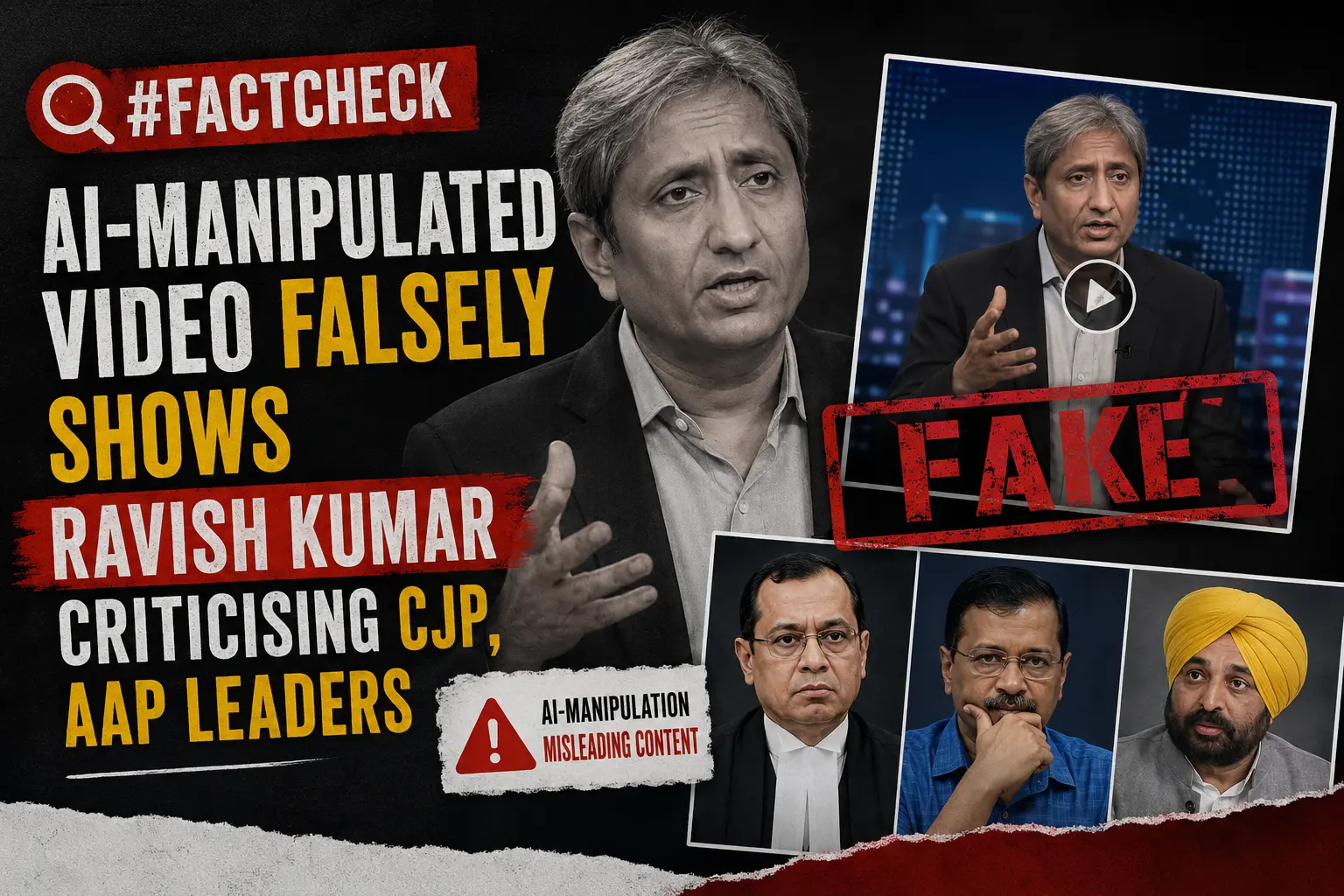
A video of journalist Ravish Kumar is being widely shared on social media. The video is being circulated with the claim that Kumar criticised Abhijeet Deepak, the CJP and Aam Aadmi Party (AAP) leaders over the CJP’s alleged absence from the ongoing student protest in Jharkhand. The CyberPeace Research Wing found the claim to be false. The research established that the original video of Ravish Kumar was digitally manipulated using artificial intelligence (AI), and altered audio was added before it was shared with a misleading claim.
Claim
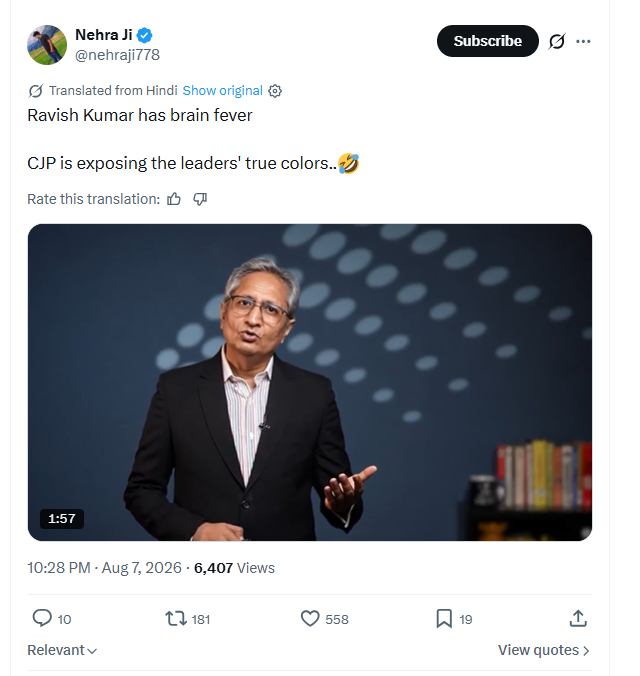
A user on X (formerly Twitter) shared the viral video on August 7, 2026, with the caption: “Ravish Kumar has brain fever. CJP is exposing the leaders’ true colors.”
https://x.com/nehraji778/status/2085772474915164506
Factcheck
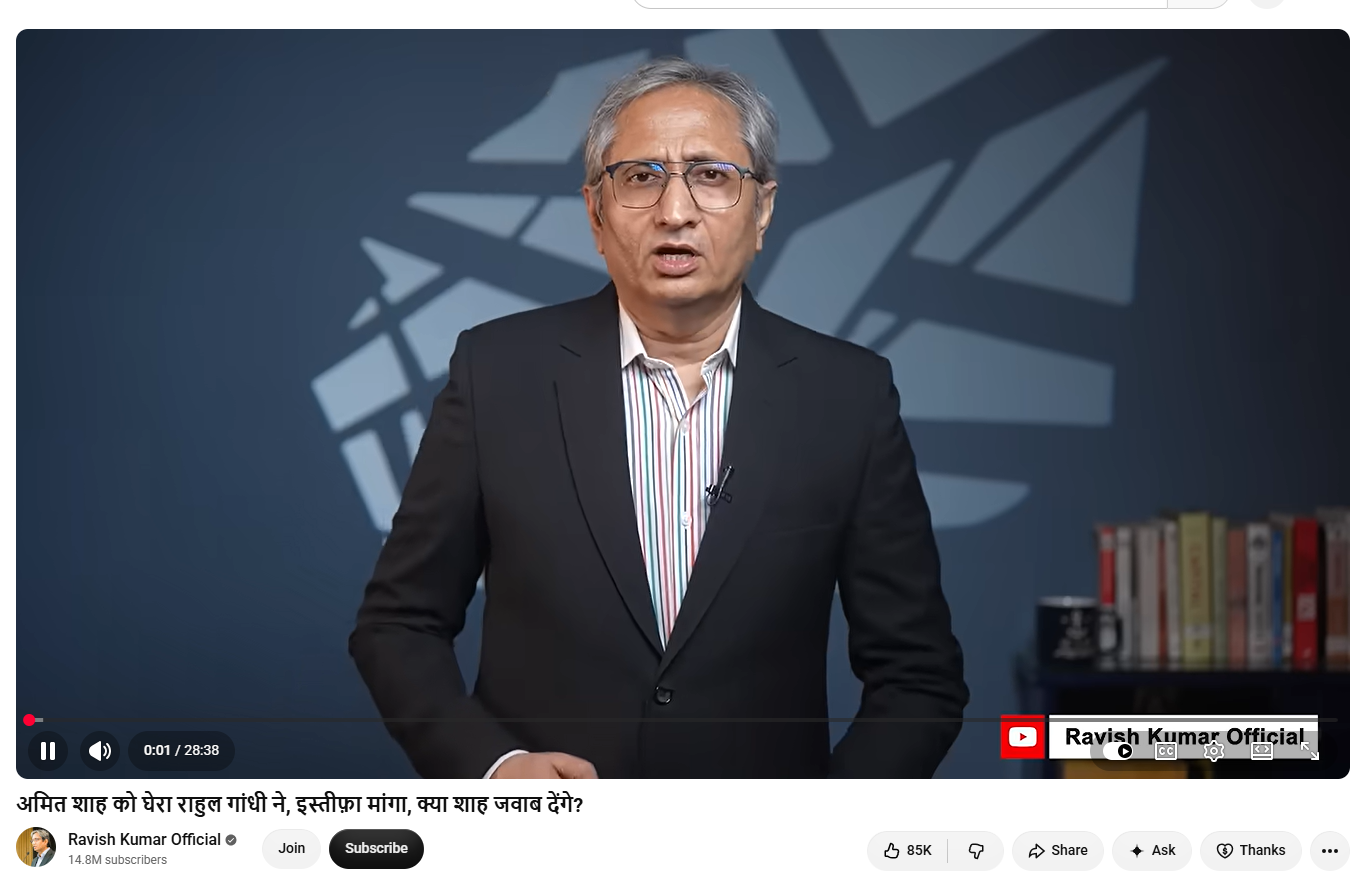
To verify the claim, we extracted several keyframes from the viral video and conducted a reverse image search using Google Lens. During the search, we found a video uploaded on Ravish Kumar’s official YouTube channel on July 29, 2026.
The visuals in the original video match those seen in the viral clip. Ravish Kumar can be seen wearing the same clothes and appearing in almost the same frame as in the viral video.
https://www.youtube.com/watch?v=Rdn_hfyZVRM
In the next step, we analysed the viral video using Hive Moderation. The tool indicated a 97 per cent probability that the video was AI-generated.
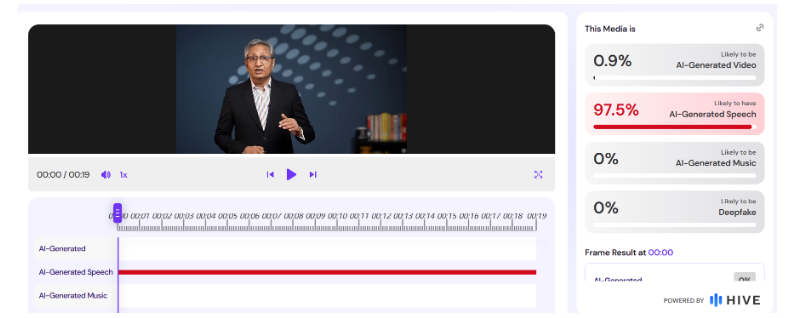
Conclusion
The research found that the viral claim is false. The visuals are taken from a genuine video of Ravish Kumar, but the original footage has been digitally manipulated and altered audio has been added using AI. The modified video is being circulated with a misleading claim that Kumar criticised Abhijeet Deepak, CJP and AAP leaders over the Jharkhand student protest.

Executive Summary
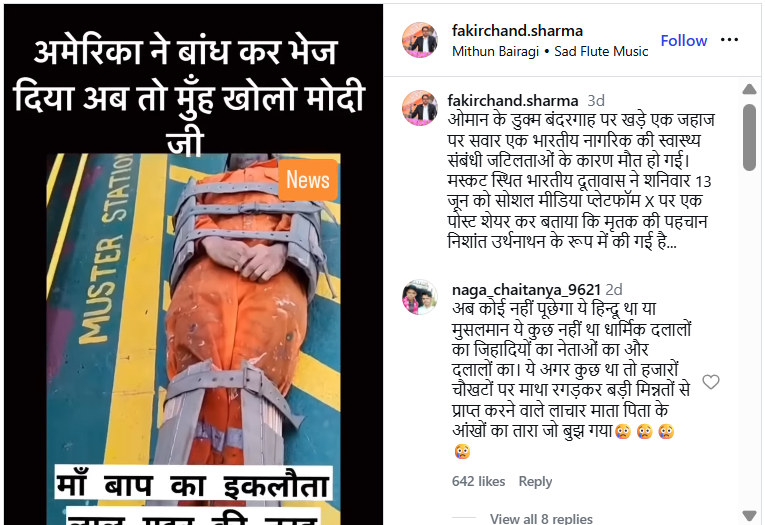
Amid reports of attacks on ships in the Gulf of Oman that led to the death of three Indian nationals, a video showing a person lying injured on a ship is being widely circulated on social media. The clip is being shared with the claim that the United States sent the body of a deceased Indian sailor to India in a “wrapped” condition. CyberPeace Research Wing research found the claim to be misleading. The viral video is unrelated to any recent incident involving Indian nationals and is, in fact, from a mock drill conducted on board a ship.
Claim:
An Instagram user ‘fakirchand.sharma’ shared the video on June 15, 2026, claiming that an Indian sailor, identified as Nishant Urthnathan, died due to health complications on a vessel anchored at Duqm port, Oman. The post further alleged that the United States returned the body in a “wrapped” condition, sparking outrage on social media. https://www.instagram.com/fakirchand.sharma/reel/DZlsxj9TIaS , https://perma.cc/C9SF-J8ZR
Fact Check:
A reverse image search of keyframes from the viral video led to an Instagram account ‘bipul_raja_vlogs’, where the same video was posted on June 10, 2026. The original caption clearly stated that the visuals were from a fire drill conducted on board a ship. https://www.instagram.com/p/DZbnZlGPAlL

Further posts from the same account on June 15 and June 17, 2026, also show similar mock drill visuals and clarify that the content is being misused online. The account features multiple posts related to routine ship operations and training exercises. https://www.instagram.com/p/DZnEXOzCc2X


The profile also contains several other photos and videos of crew members working on the ship. We also checked the YouTube channel linked in this profile, “Sunnybabu,” where a mock drill video was uploaded on January 21, 2026. https://www.instagram.com/bipul_raja_vlogs

Conclusion:
The research confirms that the viral video is unrelated to the death of any Indian sailor in the Gulf of Oman. The clip actually shows a mock drill conducted on a ship and is being falsely shared with a misleading narrative.
