
Regulating Speech or Controlling It? A Critical Analysis of the 2026 IT Second Amendment Rules
Introduction
The Ministry of Electronics and Information Technology (MEITy) released the Draft Information Technology (Intermediary Guidelines and Digital Media Ethics Code) Second Amendment Rules, 2026 on March 30, 2026, inviting public comments with a response window closing on April 14. This is a limited 15-day period for public input on proposed rules that will have major constitutional impacts. The brevity and timing of this opportunity demonstrate debatable commitment to stakeholder engagement and meaningful consultation by the drafting agency.
While MEITY describes the proposed amendments as "clarificatory and procedural nature," an analysis shows they will have substantive effects. Collectively, the amended language changes significantly how online speech will be regulated in India by providing the executive with more concentrated regulatory authority, limiting the required transparency of content enforcement, mandating greater retention of data without proportionality-based safeguards, and placing excessive compliance burden on intermediaries. Each of these changes has consequences beyond just changes in process and together, these changes collectively raise substantial concerns regarding compliance with Articles 14, 19, and 21 of the Constitution of India.
The Constitutional Baseline: Shreya Singhal and the Limits of Intermediary Liability
India’s Supreme Court decision in Shreya Singhal v Union of India (2015) 5 SCC 1 provides the foundation for intermediary liability, wherein the Court read down Section 79(3)(b) of the IT Act, 2000, holding that intermediaries are required to act upon receiving actual knowledge only through a court order or a valid notification by the appropriate government authority. The Supreme Court’s decision intended to provide a constitutional protection to intermediaries from being subjected to informal, unverified executive pressure to take down content by requiring that any such order be subject to some level of legal objective credibility or threshold.
Rule 3(4) of the proposed amendments places that balance under significant strain. By requiring intermediaries to comply with advisories, directions, standard operating procedures, codes of practice, and guidelines issued by the Ministry — and tying non-compliance to the loss of safe harbour — the draft effectively lowers the constitutional threshold that Shreya Singhal was designed to maintain. Compliance obligations now potentially arise from instruments that carry no judicial sanction and no mandatory public disclosure.
Rule 3(4): Delegated Legislation or Executive Overreach
The rule-making power conferred on the Central Government under Section 87 of the IT Act is limited to carrying out the provisions of the Act. It does not authorise the creation of new substantive obligations. This principle has been consistently affirmed in Indian Express Newspapers v. Union of India (1985) 1 SCC 641 and Confederation of Ex-Servicemen Associations v. Union of India (2006) 8 SCC 399, where the Court held that delegated legislation must remain within the four corners of the parent statute.
Rule 3(4) tests those limits. It converts executive advisories into binding compliance instruments without a clear statutory foundation in either Section 79 or Section 87. Although the proposed rule requires that such instruments specify their legal basis, there is no requirement that they be published or made publicly accessible. This creates a framework in which legality risks becoming circular — instruments claimed to be lawful solely by reference to a provision that does not clearly authorise them, shielded from scrutiny by their own opacity. Justice Chandurkar’s judgment in Kunal Kamra v. Union of India identified precisely this defect in the Fact Check Unit amendment. Rule 3(4) replicates the structural problem in a broader form.
Compliance Pressure and the Logic of Over-Censorship
The practical consequence of Rule 3(4) lies not only in its legality but in how it reshapes incentive structures for platforms. An intermediary facing the permanent threat of safe harbour loss will not wait to assess the legal merit of each advisory. The rational calculation is to comply early, broadly, and without friction. Lawful content — particularly satire, political commentary, and journalism — becomes vulnerable not because it is unlawful, but because it presents regulatory risk.
This dynamic was visible on 18 March 2026, when stand-up comedian Pulkit Mani (@hunnywhoisfunny) found his satirical Instagram reel being restricted across India. The video had accumulated over 16.5 million views. Users encountered a notice citing Section 79(3)(b) of the IT Act. No reasons were publicly provided. No prior hearing was offered. The same night, several political parody and satire accounts were withheld on X.
Data Retention, Privacy, and the Proportionality Test
The amendments to Rules 3(1)(g) and 3(1)(h) extend data retention obligations by making them additional to requirements under any other law. The existing 180-day floor for retained user data — covering removed content, registration information, and associated records — becomes a minimum rather than a ceiling. No maximum is specified, and no proportionality requirement accompanies the extension.
This raises direct concerns under Article 21 as interpreted in Justice K.S. Puttaswamy v. Union of India (2017) 10 SCC 1, which held that any state intrusion into privacy must satisfy the triple test of legality, necessity, and proportionality. Undefined retention periods, with no statutory ceiling and no requirement of purpose limitation, risk failing all three. The longer user data is held, including metadata, device information, and records of removed content, the greater the exposure to surveillance, unauthorised access, and use beyond the original justification.
Circumventing Judicial Scrutiny Through Procedural Redesign
The Bombay High Court, in its August 2021 order, stayed provisions of the IT Rules’ oversight mechanism as prima facie violative of Article 19(1)(a). The Madras High Court in T.M. Krishna v. Union of India affirmed that stay, cautioning that government-controlled media oversight risked undermining press independence. Both matters remain pending before the Delhi High Court.
The amendments to Rules 8(1) and 14 restructure the same oversight machinery through a modified procedural design. By extending the Inter-Departmental Committee’s jurisdiction to cover “matters” referred by the Ministry with no requirement of a complainant, no defined subject matter, and no guaranteed prior hearing, the proposed rules effectively reconstitute what courts found constitutionally suspect. Individual users posting news and current affairs content are now brought within reach of blocking mechanisms originally designed for institutional publishers.
Conclusion
As seen above, the Draft IT Rules 2026 are unable to meet the constitutional and judicial requirements to regulate free speech. What the proposed amendments construct is a durable system in which platforms self-censor under liability pressure, data is retained without proportionate justification, and content oversight expands through procedural adjustment rather than parliamentary legislation. Regulation of the digital public sphere is both legitimate and necessary. But it must be anchored in law, not in the quiet authority of executive advisories. The law must ultimately remain anchored in constitutional values, guided by the enduring principles of justice, equity, and good conscience.
The comment period closes on 14 April 2026.
Submissions may be sent to itrules.consultation@meity.gov.in.
References
- https://www.meity.gov.in/static/uploads/2026/03/30591fc6e322dcbcc9dae84a0f02e9e7.pdf
- https://www.meity.gov.in/static/uploads/2026/03/a71a21d35c107f2e528363d3eb17646a.pdf
- https://www.meity.gov.in/static/uploads/2026/02/550681ab908f8afb135b0ad42816a1c9.pdf
- https://neopolitico.com/india/government-blocks-viral-satirical-reel-impersonating-pm-modi-raising-fresh-questions-on-free-speech-and-digital-regulation/
- https://internetfreedom.in/sound-the-alarm-iffs-first-read-on-meitys-draft-it-rules-second-amendment-2026/

Related Blogs

The more ease and dependency the internet slithers into our lives, the more obscure parasites linger on with it, menacing our privacy and data. Among these digital parasites, cyber espionage, hacking, and ransom have never failed to grab the headlines. These hostilities carried out by cyber criminals, corporate juggernauts and several state and non-state actors lend them unlimited access to the customers’ data damaging the digital fabric and wellbeing of netizens.
As technology continues to evolve, so does the need for robust safety measures. To tackle these emerging challenges, Korea based Samsung Electronics has introduced a cutting-edge security tool called Auto Blocker. Introduced in the One UI 6 Update, Auto Blocker boasts an array of additional security features, granting users the ability to customize their device's security as per their requirements Also known as ‘advanced sandbox’ or ‘Virtual Quarantine’. Sandboxing is a safety measure for separating running programs to prevent spread of digital vulnerabilities. It prohibits automatic execution of malicious code embedded in images. This shield now extends to third-party apps like WhatsApp and Facebook messenger, providing better resilience against cyber-attacks in all Samsung devices.
Matter of Choice
Dr. Seungwon Shin, EVP & Head of Security Team, Mobile eXperience Business at Samsung Electronics, emphasizes the significance of user safety. He stated “At Samsung, we constantly strive to keep our users safe from security attacks, and with the introduction of Auto Blocker, users can continue to enjoy the benefits of our open ecosystem, knowing that their mobile experience is secured.”
Auto Blocker is a matter of choice. It's not a cookie cutter solution; instead, its USP is the ability to customize security measures of your device. The Auto Blocker can be accessed through device’s setting, and is activated via toggle.
Your personal Digital Armor
One of Auto Blocker's salient features is its ability to prevent bloatware (unnecessary apps) from installing in the devices from unknown sources which is called sideloading. While sideloading provides greater scope of control and better customization, it also exposes users to potential threats, such as malicious file downloads. The proactive approach of Auto Blocker disables sideloading by default. Auto Blocker serves as an extra line of defense, especially against gruesome social engineering attacks such as voice Phishing (Vhishing). The app has an essential tool called ‘Message Guard’, engineered to combat Zero Click attacks. These complicated attacks are executed when a message containing an image is viewed.
The Auto Blocker also offers a wide variety of new controls to enhance device’s safety, including security scans to detect malwares. Additionally, Auto Blocker prevents the installation of malwares via USB cable. This ensures the device's security even when someone gains physical access to it, such as when the device is being charged in a public place.
Raising the Bar for Cyber Security
Auto Blocker testifies Samsung's unwavering commitment to the safety and privacy of its users. It acts an essential part of Samsung's security suite and privacy innovations, improving overall mobile experience within the Galaxy’s ecosystem. It provides a safer mobile experience while allowing user superior control over their device's protection. In comparison. Apple offers a more standardized approach to privacy and security with emphasis on user friendly design and closed ecosystem. Samsung disables sideloading to combat threats, while Apple is more flexible in this regard on macOS.
In this dynamic digital space, the Auto Blocker offers a tool to maintain cyber peace and resilience. It protects from a broad spectrum of digital hostilities while allowing us to embrace the new digital ecosystem crafted by Galaxy. It's a security feature that puts you in control, allowing you to determine how you fortify your digital fort to safeguard your device against digital specters like zero clicks, voice phishing (Vishing) and malware downloads
Samsung’s new product emerges as impenetrable armor shielding users against cyber hostilities. With its new customizable security feature with Galaxy Ecosystem, it allows users to exercise greater control over their digital space, promoting more secure and peaceful cyberspace.
Reference:
HT News Desk. (2023, November 1). Samsung unveils new Auto Blocker feature to protect devices. How does it work? Hindustan Times. https://www.hindustantimes.com/technology/samsung-unveils-new auto-blocker-feature to-protect-devices-how-does-it-work 101698805574773.html
Introduction
The ongoing debate on whether AI scaling has hit a wall has been rehashed by the underwhelming response to OpenAI’s ChatGPT v5. AI scaling laws, which describe that machine learning models perform better with increased training data, model parameters and computational resources, have guided the rapid progress of Large Language Models (LLMs) so far. But many AI researchers suggest that further improvements in LLMs will have to be effected through large computational costs by orders of magnitude, which does not justify the returns. The question, then, is whether scaling remains a viable path or whether the field must explore new approaches. This is not just a tech issue but a profound innovation challenge for countries like India, charting their own AI course.
The Scaling Wall: Gaps and Innovation Opportunities
Escalating costs, data scarcity, and diminishing gains mean that simply building larger AI models may no longer guarantee breakthroughs. In such a scenario, LLM developers will have to refine new approaches to training these models, for example, by diversifying data types and redefining training techniques.
This global challenge has a bearing on India’s AI ambitions. For India, where compute and data resources are relatively scarce, this scaling slowdown poses both a challenge and an opportunity. While the India AI Mission embodies smart priorities such as democratising compute resources and developing local datasets, looming scaling challenges could prove a roadblock. Realising these ambitions requires strong input from research and academia, and improved coordination between policymakers and startups. The scaling wall highlights systemic innovation gaps where sustained support is needed, not only in hardware but also in talent development, safety research, and efficient model design.
Way Forward
To truly harness AI’s transformative power, India must prioritise policy actions and ecosystem shifts that support smarter, safer, and context-rich research through the following measures:
- Driving Efficiency and Compute Innovation: Instead of relying on brute-force scaling, India should invest in research and startups working on efficient architectures, energy-conscious training methods, and compute optimisation.
- Investing in Multimodal and Diverse Data: While indigenous datasets are being developed under the India AI Mission through AI Kosha, they must be ethically sourced from speech, images, video, sensor data, and regional content, apart from text, to enable context-rich AI models truly tailored to Indian needs.
- Addressing Core Problems for Trustworthy AI: LLMs offered by all major companies, like OpenAI, Grok, and Deepseek, have the problem of unreliability, hallucinations, and biases, since they are primarily built on scaling large datasets and parameters, which have inherent limitations. India should invest in capabilities to solve these issues and design more trustworthy LLMs.
- Supporting Talent Development and Training: Despite its substantial AI talent pool, India faces an impending demand-supply gap. It will need to launch national programs and incentives to upskill engineers, researchers, and students in advanced AI skills such as model efficiency, safety, interpretability, and new training paradigms
Conclusion
The AI scaling wall debate is a reminder that the future of LLMs will depend not on ever-larger models but on smarter, safer, and more sustainable innovation. A new generation of AI is approaching us, and India can help shape its future. The country’s AI Mission and startup ecosystem are well-positioned to lead this shift by focusing on localised needs, efficient technologies, and inclusive growth, if implemented effectively. How India approaches this new set of challenges and translates its ambitions into action, however, remains to be seen.
References
- https://blogs.nvidia.com/blog/ai-scaling-laws/
- https://www.marketingaiinstitute.com/blog/scaling-laws-ai-wall
- https://fortune.com/2025/02/19/generative-ai-scaling-agi-deep-learning/
- https://indiaai.gov.in/
- https://www.deloitte.com/in/en/about/press-room/bridging-the-ai-talent-gap-to-boost-indias-tech-and-economic-impact-deloitte-nasscom-report.html
Executive Summary
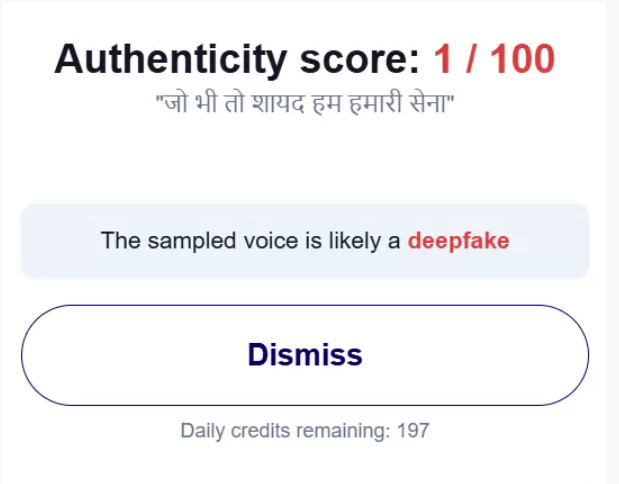
A deepfake video is being widely circulated on social media with a false claim that External Affairs Minister S. Jaishankar admitted in a podcast interview that India was surprised by Pakistan’s counter-response during “Operation Sindoor” and suffered some losses. However, a fact-check by CyberPeace Research Wing has found the claim to be fake. The research shows that AI-generated audio has been used to misrepresent the External Affairs Minister’s remarks.
Claim
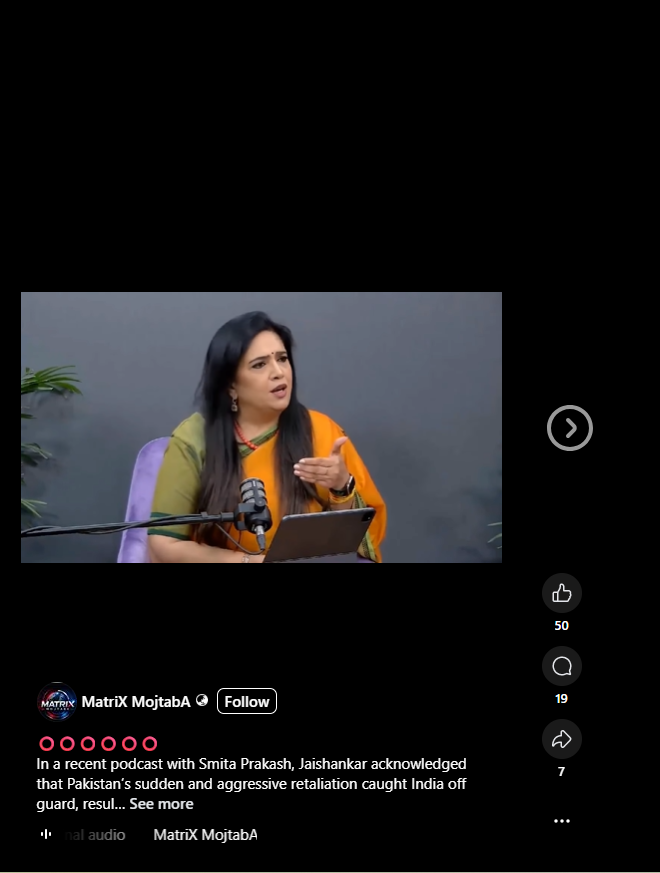
A Facebook user shared the viral video claiming that in a recent podcast with journalist Smita Prakash, Jaishankar admitted that Pakistan’s aggressive response during Operation Sindoor had caught India off guard.
Fact Check
A review of the original interview on ANI’s YouTube channel shows that the conversation between Smita Prakash and S. Jaishankar was uploaded on May 24, 2024—well before Operation Sindoor.
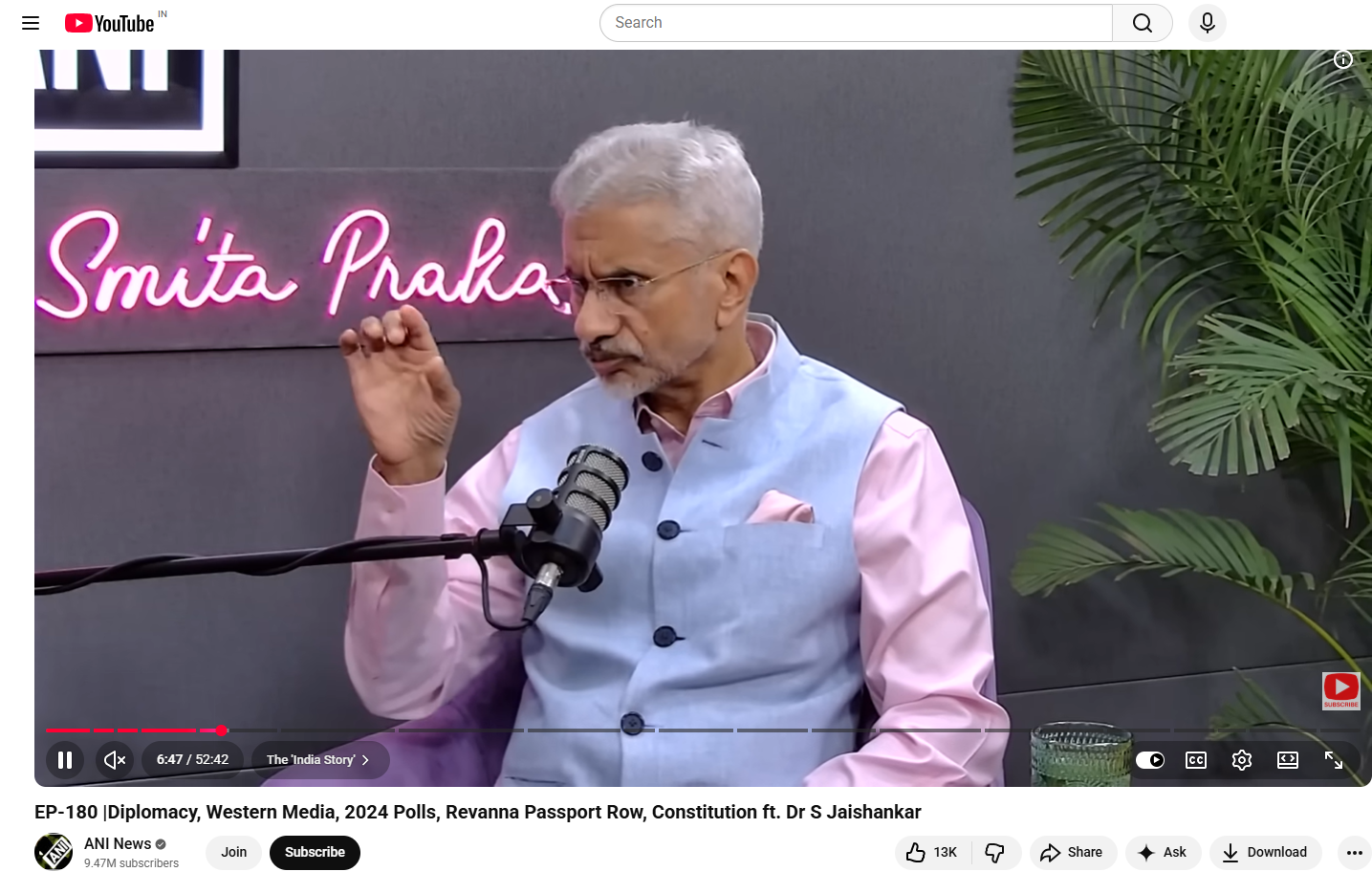
Operation Sindoor reportedly began on May 7, 2025. In the original video, there is no mention of Operation Sindoor or any Pakistani counter-response, making the viral claim baseless. Further analysis using AI detection tools such as Hive Moderation and Hiya indicated that the audio in the viral clip is likely AI-generated, suggesting manipulation of the original content.
Conclusion
The viral video is fake. AI-generated audio has been used to alter an old interview and falsely attribute statements to External Affairs Minister S. Jaishankar.
