
#FactCheck - Fake Video Uses AI Voice to Falsely Attribute Remarks on Prasidh Krishna to Virat Kohli
A video circulating widely on social media claims that Indian cricketer Virat Kohli made a sarcastic remark about fast bowler Prasidh Krishna ahead of the New Zealand series. In the clip, Kohli is allegedly heard saying that he expected to be the top scorer of the series, but lost all hope after seeing Prasidh Krishna’s name in the squad.
Users sharing the video claim that Kohli publicly commented on Prasidh Krishna in this manner.
Research by the CyberPeace Foundation has found the viral claim to be false. Our probe revealed that the viral clip has been digitally manipulated. The video is originally from a 2024 advertisement featuring Virat Kohli, in which his voice has been altered using deepfake (AI-generated) technology and falsely presented with a misleading narrative.
Claim
The video was shared on Instagram on January 6, 2025, with users claiming that Kohli made the remark after the New Zealand squad was announced. The post included the altered audio suggesting Kohli’s disappointment over Prasidh Krishna’s selection. Link, archive link

Fact Check:
To verify the claim, we extracted key frames from the viral video and conducted a Google Reverse Image Search. This led us to the original video posted by Virat Kohli himself on X (formerly Twitter) on April 15, 2024. The original clip was part of a brand advertisement, and no such statement about the New Zealand series or Prasidh Krishna was made in it. Link and Screenshot

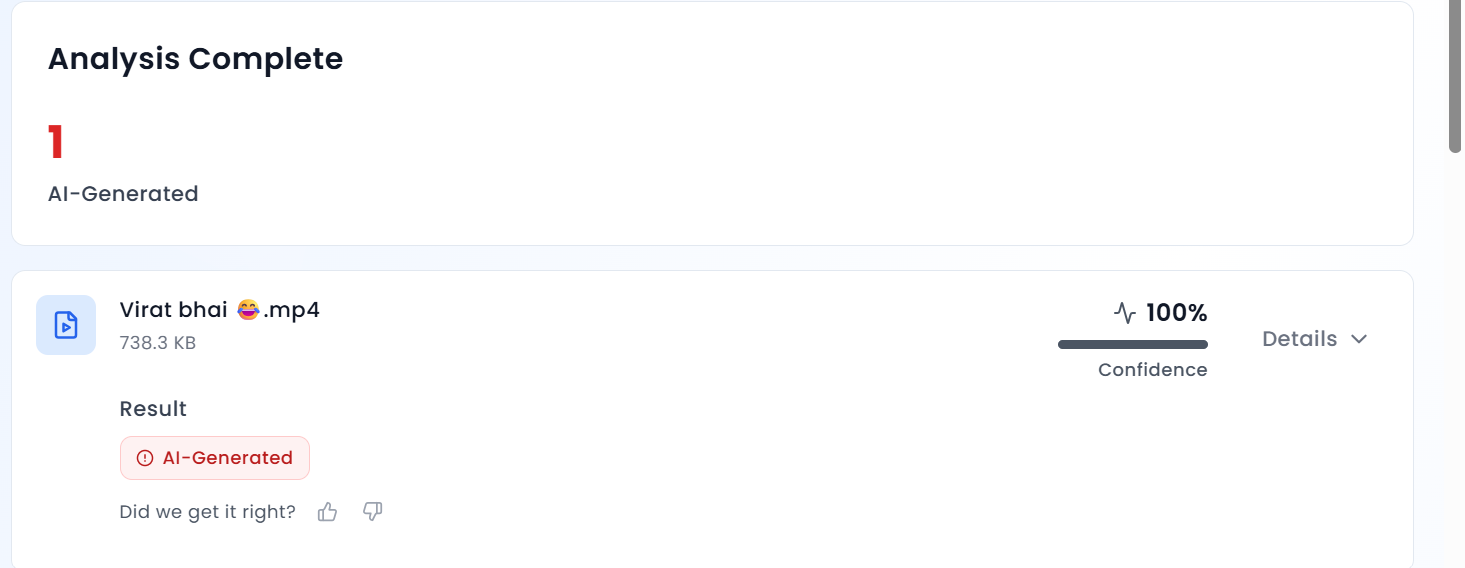
A close review of the viral clip raised suspicions due to the unnatural tone and inconsistencies in Kohli’s voice. To confirm this, we analysed the video using the AI detection tool Aurigin AI. The tool’s results showed that the audio in the viral clip is 100 percent AI-generated, confirming that Kohli’s voice was artificially manipulated.
Conclusion
The CyberPeace Foundation’s research confirms that the viral video claiming Virat Kohli mocked Prasidh Krishna is fake and misleading. The clip is taken from an old advertisement and has been doctored using deepfake technology to alter Kohli’s voice. The video is being circulated on social media with a false claim, and Virat Kohli has made no such statement regarding the New Zealand series or Prasidh Krishna.

Related Blogs
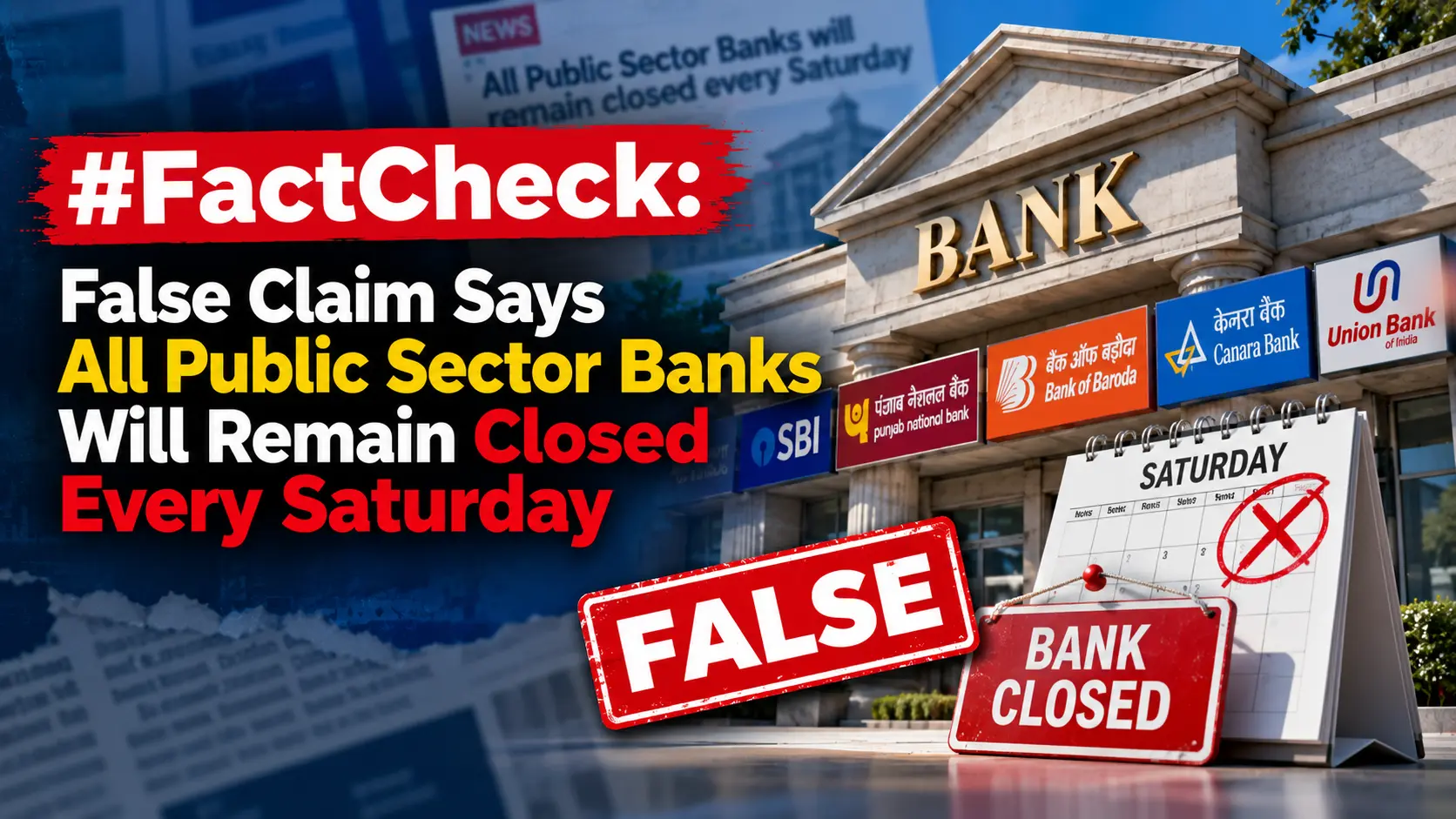
Executive Summary
Employees’ organisations of public sector banks had recently announced a nationwide strike, with one of their key demands being a five-day work week, including holidays on all Saturdays. Against this backdrop, a claim is being circulated on social media that the bank unions’ demand has been accepted and that all public sector banks will now remain closed every Saturday.
However, CyberPeace Research found that the claim that banks will observe holidays on all Saturdays is false. Neither the government nor bank employees’ unions have made any official announcement regarding the implementation of a five-day work week or holidays on all Saturdays.
Claim:
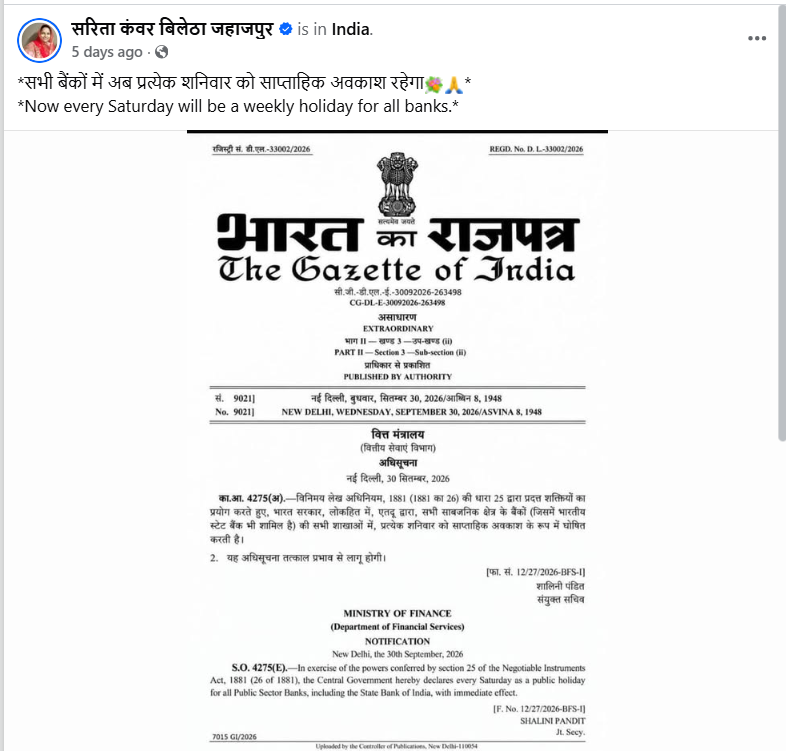
A user on the social media platform Facebook shared what was purportedly an Indian Gazette document, claiming that all banks will now observe a weekly holiday on every Saturday.
https://www.facebook.com/photo/?fbid=122234792282534138&set=a.122114627672534138
Fact Check
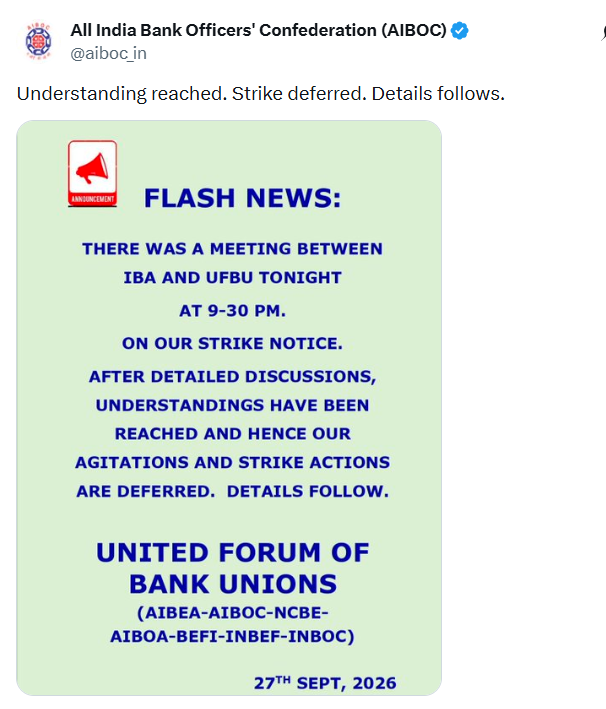
We reviewed all the announcements issued by the organisations that had called for the bank strike. None of these organisations issued any statement confirming that their demands had been accepted. We found a statement from the All India Bank Officers’ Confederation (AIBOC), in which the organisation stated in an X post that the strike scheduled for September 28–30, 2026, had been postponed following discussions. However, the organisation did not state anywhere that the demand for holidays on all Saturdays had been accepted.
https://x.com/aiboc_in/status/2104262645507612777?s=20
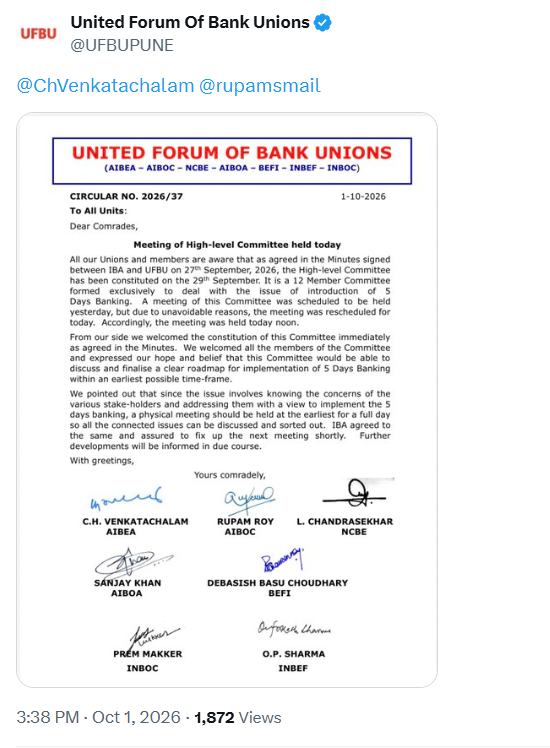
The United Forum of Bank Unions (UFBU), a joint platform of seven bank employees’ unions, issued a statement on October 1, making it clear that there has been no confirmation so far that the unions’ demands have been accepted. The statement said that a five-member committee has been constituted to consider the demand for holidays on all Saturdays, and the committee will soon prepare a roadmap for taking the matter forward.
https://x.com/UFBUPUNE/status/2105600756795707456
Conclusion:
The claim circulating on social media that all public sector banks will remain closed every Saturday from now on is false. CyberPeace Research found that neither the government nor bank employees’ unions have made any official announcement regarding the declaration of holidays on all Saturdays. Therefore, the claim being circulated on social media is misleading.

Introduction:
This report examines ongoing phishing scams targeting "State Bank of India (SBI)" customers, India's biggest public bank using fake SelfKYC APKs to trick people. The image plays a part in a phishing plan to get users to download bogus APK files by claiming they need to update or confirm their "Know Your Customer (KYC)" info.
Fake Claim:
A picture making the rounds on social media comes with an APK file. It shows a phishing message that says the user's SBI YONO account will stop working because of their "Old PAN card." It then tells the user to install the "WBI APK" APK (Android Application Package) to check documents and keep their account open. This message is fake and aims to get people to download a harmful app.
Key Characteristics of the Scam:
- The messages "URGENTLY REQUIRED" and "Your account will be blocked today" show how scammers try to scare people into acting fast without thinking.
- PAN Card Reference: Crooks often use PAN card verification and KYC updates as a trick because these are normal for Indian bank customers.
- Risky APK Downloads: The message pushes people to get APK files, which can be dangerous. APKs from places other than the Google Play Store often have harmful software.
- Copying the Brand: The message looks a lot like SBI's real words and logos to seem legit.
- Shady Source: You can't find the APK they mention on Google Play or SBI's website, which means you should ignore the app right away.
Modus Operandi:
- Delivery Mechanism: Typically, users of messaging services like "WhatsApp," "SMS," or "email" receive identical messages with an APK link, which is how the scam is distributed.
- APK Installation: The phony APK frequently asks for a lot of rights once it is installed, including access to "SMS," "contacts," "calls," and "banking apps."
- Data Theft: Once installed, the program may have the ability to steal card numbers, personal information, OTPs, and banking credentials.
- Remote Access: These APKs may occasionally allow cybercriminals to remotely take control of the victim's device in order to carry out fraudulent financial activities.
While the user installs the application on their device the following interface opens:


It asks the user to allow the following:
- SMS is used to send and receive info from the bank.
- User details such as Username, Password, Mobile Number, and Captcha.
Technical Findings of the Application:
Static Analysis:
- File Name: SBI SELF KYC_015850.apk
- Package Name: com.mark.dot.comsbione.krishn
- Scan Date: Sept. 25, 2024, 6:45 a.m.
- App Security Score: 52/100 (MEDIUM RISK)
- Grade: B
File Information:
- File Name: SBI SELF KYC_015850.apk
- Size: 2.88MB
- MD5: 55fdb5ff999656ddbfa0284d0707d9ef
- SHA1: 8821ee6475576beb86d271bc15882247f1e83630
- SHA256: 54bab6a7a0b111763c726e161aa8a6eb43d10b76bb1c19728ace50e5afa40448
App Information:
- App Name: SBl Bank
- Package Name:: com.mark.dot.comsbione.krishn
- Main Activity: com.mark.dot.comsbione.krishn.MainActivity
- Target SDK: 34
- Min SDK: 24
- Max SDK:
- Android Version Name:: 1.0
- Android Version Code:: 1
App Components:
- Activities: 8
- Services: 2
- Receivers: 2
- Providers: 1
- Exported Activities: 0
- Exported Services: 1
- Exported Receivers: 2
- Exported Providers:: 0
Certificate Information:
- Binary is signed
- v1 signature: False
- v2 signature: True
- v3 signature: False
- v4 signature: False
- X.509 Subject: CN=PANDEY, OU=PANDEY, O=PANDEY, L=NK, ST=NK, C=91
- Signature Algorithm: rsassa_pkcs1v15
- Valid From: 20240904 07:38:35+00:00
- Valid To: 20490829 07:38:35+00:00
- Issuer: CN=PANDEY, OU=PANDEY, O=PANDEY, L=NK, ST=NK, C=91
- Serial Number: 0x1
- Hash Algorithm: sha256
- md5: 4536ca31b69fb68a34c6440072fca8b5
- sha1: 6f8825341186f39cfb864ba0044c034efb7cb8f4
- sha256: 6bc865a3f1371978e512fa4545850826bc29fa1d79cdedf69723b1e44bf3e23f
- sha512:05254668e1c12a2455c3224ef49a585b599d00796fab91b6f94d0b85ab48ae4b14868dabf16aa609c3b6a4b7ac14c7c8f753111b4291c4f3efa49f4edf41123d
- PublicKey Algorithm: RSA
- Bit Size: 2048
- Fingerprint: a84f890d7dfbf1514fc69313bf99aa8a826bade3927236f447af63fbb18a8ea6
- Found 1 unique certificate
App Permission

1. Normal Permissions
- Access_network_state: Allows the App to View the Network Status of All Networks.
- Foreground_service: Enables Regular Apps to Use Foreground Services.
- Foreground_service_data_sync: Allows Data Synchronization With Foreground Services.
- Internet: Grants Full Internet Access.
2. Signature Permission:
- Broadcast_sms: Sends Sms Received Broadcasts. It Can Be Abused by Malicious Apps to Forge Incoming Sms Messages.
3. Dangerous Permissions:
- Read_phone_numbers: Grants Access to the Device’s Phone Number(S).
- Read_phone_state: Reads the Phone’s State and Identity, Including Phone Features and Data.
- Read_sms: Allows the App to Read Sms or Mms Messages Stored on the Device or Sim Card. Malicious Apps Could Use This to Read Confidential Messages.
- Receive_sms: Enables the App to Receive and Process Sms Messages. Malicious Apps Could Monitor or Delete Messages Without Showing Them to the User.
- Send_sms: Allows the App to Send Sms Messages. Malicious Apps Could Send Messages Without the User’s Confirmation, Potentially Leading to Financial Costs.
On further analysis on virustotal platform using md5 hash file, the following results were retrieved where there are 24 security vendors out of 68, marked this apk file as malicious and the graph represents the distribution of malicious file in the environment.


Key Takeaways:
- Normal Permissions: Generally Safe for Accessing Basic Functionalities (Network State, Internet).
- Signature Permissions: May Pose Risks When Misused, Especially Related to Sms Broadcasts.
- Dangerous Permissions: Provide Sensitive Data Access, Such as Phone Numbers and Device Identity, Which Can Be Exploited by Malicious Apps.
- The Dangerous Permissions Pose Risks Regarding the Reading, Receiving, and Sending of Sms, Which Can Lead to Privacy Breaches or Financial Consequences.
How to Identify the Scam:
- Official Statement: SBI never asks clients to download unauthorized APKs for upgrades related to KYC or other services. All formal correspondence takes place via the SBI YONO app, which may be found in reputable app shops.
- No Immediate Threats: Bank correspondence never employs menacing language or issues harsh deadlines, such as "your account will be blocked today."
- Email Domain and SMS Number: Verified email addresses or phone numbers are used for official SBI correspondence. Generic, unauthorized numbers or addresses are frequently used in scams.
- Links and APK Files: Steer clear of downloading APK files from unreliable sources at all times. For app downloads, visit the Apple App Store or Google Play Store instead.
CyberPeace Advisory:
- The Research team recommends that people should avoid opening such messages sent via social platforms. One must always think before clicking on such links, or downloading any attachments from unauthorised sources.
- Downloading any application from any third party sources instead of the official app store should be avoided. This will greatly reduce the risk of downloading a malicious app, as official app stores have strict guidelines for app developers and review each app before it gets published on the store.
- Even if you download the application from an authorised source, check the app's permissions before you install it. Some malicious apps may request access to sensitive information or resources on your device. If an app is asking for too many permissions, it's best to avoid it.
- Keep your device and the app-store app up to date. This will ensure that you have the latest security updates and bug fixes.
- Falling into such a trap could result in a complete compromise of the system, including access to sensitive information such as microphone recordings, camera footage, text messages, contacts, pictures, videos, and even banking applications and could lead users to financial loss.
- Do not share confidential details like credentials, banking information with such types of Phishing scams.
- Never share or forward fake messages containing links on any social platform without proper verification.
Conclusion:
Fake APK phishing scams target financial institutions more often. This report outlines safety steps for SBI customers and ways to spot and steer clear of these cons. Keep in mind that legitimate banks never ask you to get an APK from shady websites or threaten to close your account right away. To stay safe, use SBI's official YONO app on both systems and get apps from trusted places like Google Play or the Apple App Store. Check if the info is true before you do anything turn on 2FA for all your bank and money accounts, and tell SBI or your local cyber police about any scams you see.

Executive Summary:
A viral post on X (formerly Twitter) gained much attention, creating a false narrative of recent damage caused by the earthquake in Tibet. Our findings confirmed that the clip was not filmed in Tibet, instead it came from an earthquake that occurred in Japan in the past. The origin of the claim is traced in this report. More to this, analysis and verified findings regarding the evidence have been put in place for further clarification of the misinformation around the video.

Claim:
The viral video shows collapsed infrastructure and significant destruction, with the caption or claims suggesting it is evidence of a recent earthquake in Tibet. Similar claims can be found here and here

Fact Check:
The widely circulated clip, initially claimed to depict the aftermath of the most recent earthquake in Tibet, has been rigorously analyzed and proven to be misattributed. A reverse image search based on the Keyframes of the claimed video revealed that the footage originated from a devastating earthquake in Japan in the past. According to an article published by a Japanese news website, the incident occurred in February 2024. The video was authenticated by news agencies, as it accurately depicted the scenes of destruction reported during that event.

Moreover, the same video was already uploaded on a YouTube channel, which proves that the video was not recent. The architecture, the signboards written in Japanese script, and the vehicles appearing in the video also prove that the footage belongs to Japan, not Tibet. The video shows news from Japan that occurred in the past, proving the video was shared with different context to spread false information.

The video was uploaded on February 2nd, 2024.
Snap from viral video

Snap from Youtube video

Conclusion:
The video viral about the earthquake recently experienced by Tibet is, therefore, wrong as it appears to be old footage from Japan, a previous earthquake experienced by this nation. Thus, the need for information verification, such that doing this helps the spreading of true information to avoid giving false data.
- Claim: A viral video claims to show recent earthquake destruction in Tibet.
- Claimed On: X (Formerly Known As Twitter)
- Fact Check: False and Misleading
