
Protect, Prevent and Respond - Building Strong Cybersecurity Defences for Senior Citizens
Introduction
The way we interact, go about our daily lives and manage our financial resources has completely changed in this digital age. Tasks that were earlier done manually (and were extremely time-consuming) now happen in just minutes and seconds. As this convenience expands, so do the risks that come with it. The proliferation of digital technology has opened up a wide arena where we, as users, are getting exposed to a complex environment of emerging cyber threats at every step. This has become especially true for our senior citizens, who face heightened vulnerabilities owing to their age and situational factors. Therefore, getting an understanding of these risks and knowing how to respond to them is no longer optional.
Cybercrime against senior citizens is rising every year. The elderly today are using and depending on smartphones, net banking, UPI (Unified Payments Interface) and social media more than ever. Scammers are preying on this circumstance and perpetrating well-planned cyber attacks on the senior population. A 2024 report from the United States Federal Trade Commission (FTC) that analysed cybercrime data for the year 2023 found that older adults lost more money per incident as opposed to the younger population.
This blog aims at providing practical and easy-to-follow cyber safety tips for senior citizens and a clear action plan on how to respond if they ever fall victim to a scam.
Safe and Smart Browsing for the Elderly: Essential Cybersecurity Tips
- Device safety: Cybersecurity can be ensured with one simple rule, which is securing your device first. This is the first line of defence against cybercrime and can go a long way in preventing online attacks and scams. This device security can be established by using screen locks such as setting up a PIN, lock patterns, fingerprints, or even applying the face lock feature on smartphones and tablets.
The next step is to install a reputable antivirus on your device (such as laptops and desktops) and keep updating it from time to time. Enabling additional security features in your devices, such as ‘automatic updates’, further ensures that the phone’s Operating System (OS) and the Applications (apps) remain up to date. This guarantees that the device’s OS and the apps are fully upgraded to catch and fix any new security threats. Users should also beware of any unauthorised software. Suspicious links or messages that offer free software or updates should be avoided at all costs.
The Government of India’s 2024 cyber safety booklet also stresses the importance of keeping devices and apps equipped with the latest security patches to prevent exploitation of any known vulnerabilities.
- Robust Passwords and 2FA: Weak passwords are one of the easiest entry points for cybercriminals. This is why it is crucial to have strong and robust passwords to keep accounts and devices absolutely secure. It is also important to make sure to avoid using very basic PINs, such as date of birth or predictable ascending digits such as ‘12345’. Also, similar passwords should not be used across various bank, email or social media accounts. While creating a strong password, ideally, one should use a combination of upper case and lower case letters along with mixed digits and special characters. If need be, one can jot down these complex passwords in a separate physical diary to keep a record and refer to it in case of forgetfulness.
Enabling two-factor authentication adds an extra layer of protection. Whenever and wherever possible, users should enable OTP (one-time password) based verification or app-based authentication codes. In case someone does end up stealing the user’s password, they would still need the second factor to log in.
The Government of India supported the Information Security Education and Awareness (ISEA) initiative, which also provides guidelines that recommend the use of passwords and secure authentication as key cyber safety practices for senior citizens.
- Handle messages with caution: Most cybercrime instances against senior citizens are initiated with a phone call, an SMS or a WhatsApp message. Personal details such as OTPs, CVV (3-digit number on the back of a debit/credit card), ATM or UPI PIN, full debit/credit card number, net banking ID and password, etc., should never be shared over a call or a chat. Also, people need to be aware of the fact that genuine officials will never make any demands for such details over calls or messages. ISEA has specifically warned about frauds like phishing, where fraudsters call or message their victims pretending to be from banks, courier companies, telecom operators or from the government to trick seniors into revealing their personal details.
A caller might say ‘Your KYC can get blocked, give OTP now’ or ‘Your card will get deactivated, click this link’. Hang up immediately! Do not click any links, do not share any number and do not install any app that they suggest (eg. remote access apps).
- Banking without worries: Online banking is truly a boon, especially for senior citizens. It eliminates the need to visit the bank in person for every small requirement. But this comfort and ease can serve us well only if we use it with a certain sense of vigilance and responsibility.
Users are advised to use only official banking apps that are downloaded from Google Play Store or the Apple App Store. It is also prudent to activate SMS or email alerts for all online transactions so that the user receives timely notifications of any withdrawal or transfer. Users should also avoid using public Wi-Fi connections for banking or UPI payments. It is better to use your own mobile data or a home Wi-Fi with a strong password. This safeguards your financial transactions. India has a system in place called the Citizen Financial Cyber Fraud Reporting and Management System (CFCFRMS) that quickly responds to online financial fraud, especially with regards to UPI and net banking frauds.
- Think before you share: Beyond online banking and other essential activities on the web, lies the world of social media which has seamlessly woven itself into our daily routines. Therefore, gaining awareness about the safe usage of social media is extremely important. For starters, users should keep the privacy settings of their social media accounts as ‘Private’. They should also be mindful of accepting friend requests from strangers or unknown profiles, even if they claim that they know the user. Users must also avoid ‘oversharing’ on public platforms and social media accounts. It is always best to refrain from posting about personal details on social media such as finances, travel schedules or addresses. If a user receives urgent messages from a close friend or a relative asking for money, then it is better to first call them up directly to verify that the request is genuine.
The older generation should also be wary of fraudsters who, under false identities, build emotional relationships online and then start demanding money, gifts or even private photos from their victims.
- Stay a step ahead: Lastly, senior users can stay a step ahead in this game by familiarising themselves with the typical scams that are targeted towards their age group. This know-how will prepare them to identify scam patterns and early warning signs. Discussing experiences or sharing knowledge with family members or peers can also help seniors bridge the gap between awareness and action.
Fallen for a scam? Don’t panic! Here’s what seniors should do next: An action plan for recovery and protection
We are all human at the end of the day. Anyone can fall for a scam, even the most careful people. The important thing is how to ‘respond’ after getting scammed. As per the 2023 Internet Crime Complaint Center (IC3) Elder Fraud Report, prompt reporting after a scam can improve the chances of either freezing or retrieving the stolen money. If you have fallen for a scam, here is what you should do:
- Keep calm and disconnect: Though it may feel challenging, but the first instinct that victims should display is to keep their calm and hang up the phone. The victim should then block the number and refrain from responding to any further emails or messages. Any remote access app, screen sharing app or a support tool that were installed at the request of the caller, should be instantly uninstalled.
- Alert your bank right away: Time is of the essence when it comes to online financial frauds. If a user has been scammed and he is aware of it, then he should immediately call the official customer care number of his bank. It is to be noted here that this number should be verified from the bank’s website or from the user’s credit/debit card. Once the user is connected to the bank’s support staff, he should inform them clearly that he has been a victim of an online fraud. The support staff may guide the user regarding the options that he can undertake. These can be: blocking the cards, freezing the account or an attempt from the bank’s interface to try and stop or recall the recent transaction.
The Reserve Bank of India (RBI) has laid down certain guidelines on unauthorised electronic banking transactions that encourage quick reporting and provide a steady framework for customer liability. Also, if in case a victim feels that the bank’s response has been unsatisfactory, the complaints can be further escalated to the RBI Ombudsman.
- Reset online credentials: Once the victim has spoken to the bank and taken all necessary steps in that regard, the next step is to reset the passwords. Passwords for netbanking, UPI apps, email accounts, social media, shopping platforms, etc., should all be changed. The victim can also turn on two factor authentication for all important accounts. Incase some critical information like PAN (Permanent Account Number) or Aadhar or SSN (Social Security Number ) has been shared, the victim should be on the lookout for any identity theft in the form of unknown loans, new cards or credit enquiries.
- Notify official cybercrime portals or authorities: The next step is to inform the relevant cybercrime authorities in your region. In India there is a government backed National Cyber Crime Helpline which is a part of the Financial Cyber Fraud Reporting and Management System. The aim of the helpline is to prevent further losses in digital payment frauds. Victims can also file a complaint on the National Cyber Crime Reporting portal. Other than these options, the victim can visit the nearest police station along with copies of their online complaint, bank statements, transaction receipts and ID proofs.
In the US, such complaints can be lodged with the IC3 which runs a specialised elder fraud program. The IC3 also publishes the annual Elder Fraud Report and lays down latest guidelines and trends regarding cybercrime.
- Preserve proofs of the scam: The IC3’s 2023 report notes that detailed and prompt reporting by the victim enables law enforcement and financial institutions to deploy ‘Financial Fraud Kill Chain’ procedures that help in tracing or freezing stolen funds. This is why it is very important to preserve the evidence of a cyber scam. Proper documentation can help banks and law enforcement agencies to properly investigate a case. If possible, the victim should save all messages, WhatsApp chats, emails, screenshots and voice recordings. Establishing a clear timeline of the events also helps. Minute details such as: when the first call was received, what was said and when the money exited the victim’s account, significantly help in piecing together the full picture. Victims should also keep a record of all bank statements and transaction alert messages related to the fraudulent activity.
- Helping seniors heal: Apart from monetary damage, the emotional impact of a scam should also be acknowledged. Getting scammed can be deeply humiliating for senior citizens, especially at their age where everyday life may already feel quite overwhelming. Also, when it comes to their lifelong savings, the ramifications of becoming a victim of an online financial scam can be quite distressing for seniors. The US Department of Justice’s elder fraud content emphasises on the fact that senior victims need ample emotional support and should not be blamed or shamed for their predicament.
Families and caregivers can guide the elderly victims step by step through the recovery process which includes taking the necessary technical steps, filling out forms and following up with banks or authorities. For large value frauds, repeated targeting or cases that involve identity theft, getting a legal consult for the victim is highly advisable. This kind of support and reassurance can help seniors reduce their anxiety and regain their inner strength.
Secure today, safe tomorrow
The rate of cybercrime against senior citizens isn’t showing any signs of slowing down. Scammers are refining their techniques every day. Therefore, the best long standing defence against cybercrime is to make cyber safety a regular habit. This can be achieved with the support of families, caregivers and communities. Beyond the practical steps, spreading awareness and maintaining an open dialogue is equally important. Senior citizens should feel comfortable asking questions, sharing concerns and continue learning from experiences, be it theirs or of others. Reinforcement of safe online practices should become ingrained at the core of every society. When cybersecurity practices merge with everyday life, seniors gain both protection and confidence. Simple and steady digital safety practices that come with guidance and reassurance empower the seniors to enjoy the benefits of technology without fear.
Simply put, the habits that are adopted today will lay the foundation for a secure and safer digital tomorrow.
References
- https://bankingjournal.aba.com/2024/11/ftc-older-adults-lost-up-to-61-5b-to-fraud-in-2023/
- https://www.cert-in.org.in/PDF/CSH_Booklet.pdf
- https://infosecawareness.in/concept/cyber-security-tips-for-senior-citizens
- https://cybercrime.gov.in/UploadMedia/instructions_citizenreportingcyberfrauds.pdf
- https://www.ic3.gov/annualreport/reports/2023_ic3elderfraudreport.pdf
- https://www.arklegal.in/post/how-to-report-cyber-crime-in-india
- https://www.pib.gov.in/Pressreleaseshare.aspx?PRID=1814120
- https://cybercrime.gov.in/Webform/crmcondi.aspx
- https://www.justice.gov/archives/stopfraud-archive/elder-fraud-and-financial-exploitation
- https://www.ftc.gov/system/files/ftc_gov/pdf/federal-trade-commission-protecting-older-adults-report_102024.pdf
- https://www.unionbankofindia.bank.in/pdf/cyber-security-customer-awareness-guide-vol-v.pdf
- https://cdnbbsr.s3waas.gov.in/s371e09b16e21f7b6919bbfc43f6a5b2f0/uploads/2024/11/20241111752149945.pdf
- https://www.dsci.in/files/content/documents/2024/CSAM24-Infographic_Cyber-Safety-Essentials-for-Senior-Citizens-v1.pdf

Related Blogs
Executive Summary
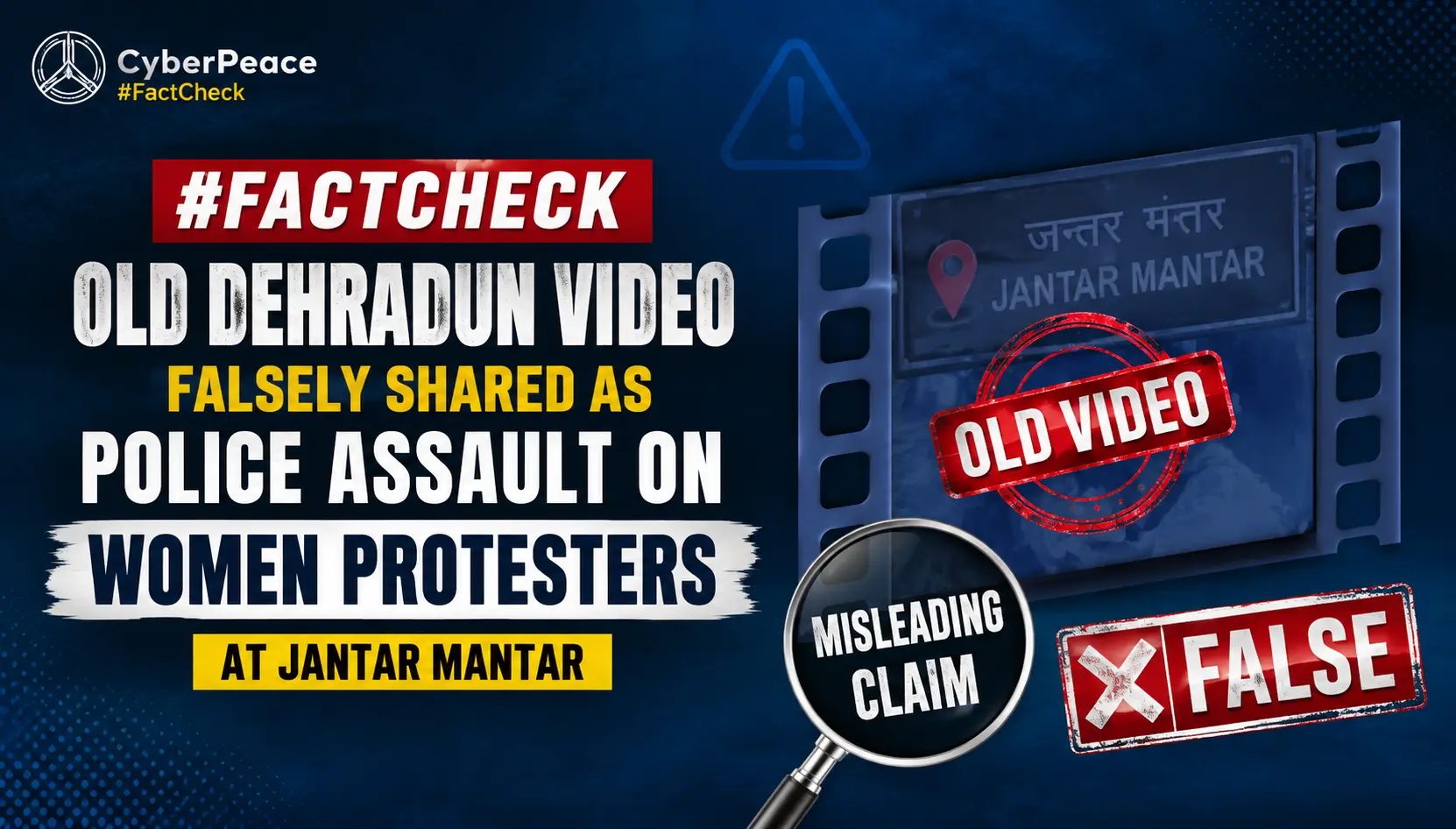
A video showing a scuffle between a group of women and police personnel is being widely shared on social media with the claim that it shows Delhi Police assaulting women protesters at Jantar Mantar. CyberPeace Research Wing ’s research found the claim to be misleading. The viral video is not from Jantar Mantar in Delhi but from an unrelated incident in Dehradun, Uttarakhand. The old footage is being falsely circulated as a recent video from the ongoing protests.
Claim:
A Facebook user shared the viral video claiming that Delhi Police personnel were assaulting women and girls during the protest at Jantar Mantar.
The post link, archive link and screenshot are provided below.
https://www.facebook.com/reel/2864826433884333

Fact Check:
To verify the claim, we extracted keyframes from the viral video and conducted a reverse image search using Google Lens. This led us to the same video uploaded on the Instagram account iamvikasbaliyan on October 15, 2025.
https://www.instagram.com/reels/DP0H_SSE625/

According to the information shared with the post, the incident took place in Mohabbewala, Dehradun, Uttarakhand, after a truck crashed into a house, damaging the property. The homeowner allegedly demanded compensation and, when the issue remained unresolved, attempted to set the truck on fire. When police personnel intervened to stop her, a scuffle broke out between the woman and the police. The viral video captures this incident. In the next stage of the research, we found an ABP News report published on October 15, 2025, carrying the same visuals as the viral video. The report also identified the incident as having occurred in Mohabbewala, Dehradun.

Conclusion:
CyberPeace Research Wing ’s research found the viral claim to be misleading. The video does not show Delhi Police assaulting women protesters at Jantar Mantar. It is an old video from Dehradun, Uttarakhand, showing an unrelated incident that has been falsely linked to the ongoing protests in Delhi.

Introduction
The Indian Ministry of Information and Broadcasting has proposed a new legislation. On the 10th of November, 2023, a draft bill emerged, a parchment of governance seeking to sculpt the contours of the nation's broadcasting landscape. The Broadcasting Services (Regulation) Bill, 2023, is not merely a legislative doctrine; it is a harbinger of change, an attestation to the storm of technology and the diversification of media in the age of the internet.
The bill, slated to replace the Cable Television Networks (Regulation) Act of 1995, acknowledges the paradigm shifts that have occurred in the media ecosystem. The emergence of Internet Protocol Television (IPTV), over-the-top (OTT) platforms and other digital broadcasting services has rendered the previous legislation a relic, ill-suited to the dynamism of the current milieu. The draft bill, therefore, stands at the precipice of the future, inviting stakeholders and the vox populi to weigh in on its provisions, to shape the edifice of regulation that will govern the airwaves and the digital streams.
Defining the certain Clauses of the bill
Clause 1 (dd) - The Programme
In the intricate tapestry of the bill's clauses, certain threads stand out, demanding scrutiny and careful consideration. Clause 1(dd), for instance, grapples with the definition of 'Programme,' a term that, in its current breadth, could ensnare the vast expanse of audio, visual, and written content transmitted through broadcasting networks. The implications are profound: content disseminated via YouTube or any website could fall within the ambit of this regulation, a prospect that raises questions about the scope of governmental oversight in the digital realm.
Clause 2(v) - The news and current affairs
Clause 2(v) delves into the murky waters of 'news and current affairs programmes,' a definition that, as it stands, is a maelstrom of ambiguity. The phrases 'newly-received or noteworthy audio, visual or audio-visual programmes' and 'about recent events primarily of socio-political, economic or cultural nature' are a siren's call, luring the unwary into a vortex of subjective interpretation. The threat of potential abuse looms larger, threatening the right to freedom of expression enshrined in Article 19 of the Indian Constitution. It is a clarion call for stakeholders to forge a definition that is objective and clear, one that is in accordance with the Supreme Court's decision in Shreya Singhal v. Union of India, which upheld the sanctity of digital expression while advocating for responsible content creation.
Clause 2(y) Over the Top Broadcasting Services
Clause 2(y) casts its gaze upon OTT broadcasting services, entities that operate in a realm distinct from traditional broadcasting. The one-to-many paradigm of broadcast media justifies a degree of governmental control, but OTT streaming is a more intimate affair, a one-on-one engagement with content on personal devices. The draft bill's attempt to umbrella OTT services under the broadcasting moniker is a conflation that could stifle the diversity and personalised nature of these platforms. It is a conundrum that other nations, such as Australia and Singapore, have approached with nuanced regulatory frameworks that recognise the unique characteristics of OTT services.
Clause 4(4) - Requirements for Broadcasters and Network Operators
The bill's journey through the labyrinth of regulation is fraught with other challenges. The definition of 'Person' in Clause 2(z), the registration exemptions in Clause 4(4), the prohibition on state governments and political parties from engaging in broadcasting in Clause 6, and the powers of inspection and seizure in Clauses 30(2) and 31, all present a complex puzzle. Each clause, each sub-section, is a cog in the machinery of governance that must be calibrated with precision to balance the imperatives of regulation with the freedoms of expression and innovation.
Clause 27 - Advisory Council
The Broadcast Advisory Council, envisioned in Clause 27, is yet another crucible where the principles of impartiality and independence must be tempered. The composition of this council, the public consultations that inform its establishment, and the alignment with constitutional principles are all vital to its legitimacy and efficacy.
A Way Forward
It is up to us, as participants in the democratic process and citizens, to interact with the bill's provisions as it makes its way through the halls of public discourse and legislative examination. To guarantee that the ultimate version of the Broadcasting Services (Regulation) Bill, 2023, is a symbol of advancement and a charter that upholds our most valued liberties while welcoming the opportunities presented by the digital era, we must employ the instruments of study and discussion.
The draft bill is more than just a document in this turbulent time of transition; it is a story of India's dreams, a testament to its dedication to democracy, and a roadmap for its digital future. Therefore, let us take this duty with the seriousness it merits, as the choices we make today will have a lasting impact on the history of our country and the media environment for future generations.
References
- https://scroll.in/article/1059881/why-indias-new-draft-broadcast-bill-has-raised-fears-of-censorship-and-press-suppression#:~:text=The%20bill%20extends%20the%20regulatory,regulation%20through%20content%20evaluation%20committees.
- https://pib.gov.in/PressReleasePage.aspx?PRID=1976200
- https://www.hindustantimes.com/india-news/new-broadcast-bill-may-also-cover-those-who-put-up-news-content-online-101701023054502.html

A photo featuring Bollywood actor Abhishek Bachchan and actress Aishwarya Rai is being widely shared on social media. In the image, the Kedarnath Temple is clearly visible in the background. Users are claiming that the couple recently visited the Kedarnath shrine for darshan.
Cyber Peace Foundation’s research found the viral claim to be false. Our research revealed that the image of Abhishek Bachchan and Aishwarya Rai is not real, but AI-generated, and is being misleadingly shared as a genuine photograph.
Claim
On January 14, 2026, a user on X (formerly Twitter) shared the viral image with a caption suggesting that all rumours had ended and that the couple had restarted their life together. The post further claimed that both actors were seen smiling after a long time, implying that the image was taken during their visit to Kedarnath Temple.
The post has since been widely circulated on social media platforms

Fact Check:
To verify the claim, we first conducted a keyword search on Google related to Abhishek Bachchan, Aishwarya Rai, and a Kedarnath visit. However, we did not find any credible media reports confirming such a visit.
On closely examining the viral image, several visual inconsistencies raised suspicion about it being artificially generated. To confirm this, we scanned the image using the AI detection tool Sightengine. According to the tool’s analysis, the image was found to be 84 percent AI-generated.
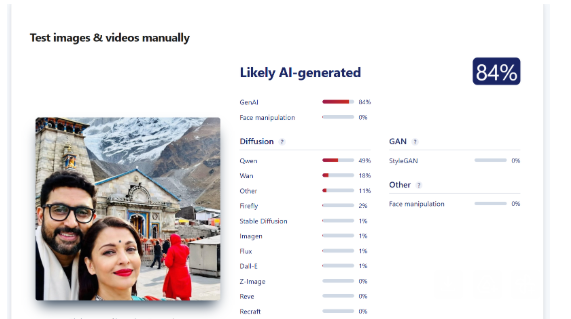
Additionally, we scanned the same image using another AI detection tool, HIVE Moderation. The results showed an even stronger indication, classifying the image as 99 percent AI-generated.

Conclusion
Our research confirms that the viral image showing Abhishek Bachchan and Aishwarya Rai at Kedarnath Temple is not authentic. The picture is AI-generated and is being falsely shared on social media to mislead users.
