
Perception vs Reality, The LPG Panic and the Effects of Misinformation
In recent months, conversations around the possible shortage of liquefied petroleum gas (LPG), a basic cooking fuel in Indian households, have quietly resurfaced across the country. From whispers in local markets to viral messages circulating on social media, concerns about LPG availability began to take hold in the public imagination. Though the immediacy of the situation has since faded, its echoes remain, reminding us how quickly uncertainty can spread. Like a ripple across still water, a single rumour can travel far, gathering force as it moves and blurring the line between perception and reality.
Against this backdrop, in April 2026, reports began circulating about a potential LPG shortage. The Union Government moved quickly to counter what it identified as misinformation, emphasising that supply remained stable and urging citizens not to engage in panic buying. A noticeable disconnect emerged between official communication and public perception. Across different regions, signs of anxiety-driven behaviour became evident. Instances of panic buying and hoarding increased, law enforcement agencies conducted raids to address such actions, and opportunistic thefts were reported, often exploiting widespread concern. These incidents highlight how misinformation, even when addressed promptly, can continue to shape public behaviour.
It is worth noting that rising prices also played a role in shaping public response, as increases in LPG rates contributed to a sense of urgency among consumers. Therefore, the surge in panic buying cannot be attributed solely to misinformation, but rather to a combination of economic pressures and perceived scarcity.
Misinformation Ecosystem - From Rumours to Behaviour
The spread of misinformation is occurring at an unprecedented pace and is, in large part, driven by the viral nature of social media. Digital platforms not only enable the rapid dissemination of information but also allow it to be amplified in ways that would not be possible through traditional media outlets. Often, the drive for virality outweighs any concern for accuracy, meaning that many individuals who spread misinformation are motivated more by the pursuit of attention than by any ideological agenda. Recent arrests of individuals involved in spreading misinformation about LPG and petrol shortages, much of which went viral, suggest that misinformation today is frequently driven by the desire for visibility rather than ideological motives. The information being circulated has largely followed a similar pattern, focusing on fears of an LPG shortage, expectations of price increases, and concerns about supply disruptions. Even though this information has not been verified, it has triggered behavioural responses among individuals. In several areas, including parts of Uttar Pradesh and Goa, the spread of misinformation through social media has led to panic buying, despite official assurances that there would be sufficient LPG supply to meet demand.
The impact of panic buying, and its associated misinformation, has already been seen in multiple sectors; these increased demands have placed pressure on the distribution network, leading to disruptions in access, as well as being out of stock of certain products. In many cases, commercial users of products (especially restaurants) have experienced significant disruption, threatening their continued operations, and industry representatives have alerted others about the inconsistent supply of commercial cylinders; likewise, consumers (households) are beginning to switch to alternative products (e.g., induction cooking) as a reflection of the anticipatory mindset to address the uncertainty created through perceptions of Product Scarcity.
State Response: Managing Misinformation or Behaviour?

The government has taken a variety of approaches, from advisories and enforcement actions to communicating with citizens indirectly. For example, State Governments have been directed to combat misinformation, monitor supply chains and take action against hoarding and black market activity. There has been a significant increase in the level of large- scale enforcement activity, with over 3,700 raids carried out to crack down on hoarding and black marketing related to LPG, in addition to confiscating cylinders and issuing penalties to those who break the law. In addition, the authorities have also focused on maintaining regular communication with the public in order to reassure them about the supply of LPG and fuel stability.
Geopolitical Context: Why Rumours Are Believable
Understanding today’s panic requires an understanding of the global environment: i.e., due to the ongoing conflict in West Asia, the energy markets are unstable, and energy supply is uncertain not only in West Asia but across a large part of the world. Even if domestic supply remains stable, public perception is affected by global instability. A clear example of this can be seen in neighbouring countries to India; Pakistan has seen significant increases in the cost of fuel, implemented measures such as reducing the number of days individuals work each week, and has created public support mechanisms; Bangladesh has imposed restrictions on the use of energy, has shortened the number of hours individuals can operate businesses each day, and has restricted the total amount of energy used; Sri Lanka has begun to ration fuel, and to increase the price of petrol; and Nepal has reduced the numbers of days individuals may work each week, and has adjusted supply.
All of these examples are not isolated instances, but are markers of a common regional environment. As we live in a global community that is connected in many ways, these developments will quickly affect public expectations everywhere. Therefore, for consumers in India, seeing evidence of rationing of fuel and shortages of fuel in neighbouring countries increases their belief that these types of problems could occur in their country.
Critical Perspective: Between Panic and Precaution
The LPG incident has brought about questions surrounding the nature of misinformation in terms of its definition & regulation. One of the main concerns is whether or not "misinformation" is being cast too widely. To be sure, false claims need to be addressed; however, not everything that is responded to publicly is based on untrue facts, as many times public responses are based on perceived risk via global and/or local incidents that occur. Perhaps the greatest challenge is the difficulty in differentiating precaution and panic. People’s memories of the COVID-19 pandemic are fresh in their minds and will serve to influence their behaviours moving onward, in that many people are stockpiling or preparing for uncertainty not out of irrational fear, but as an anticipatory response to their prior experiences.
Conclusion
The Indian LPG "crisis" is not so much a problem with actual supply chain breakdown as it is a result of how information and behaviour are connected through perception. This cohabitating environment of panic buying, law enforcement, and government assurance demonstrates an evident disconnect and gap between how governments present a narrative and how the public responds. While there is some role of misinformation within this discourse, the misinformation itself extends beyond any or all false claims about LPG supply and operates within a greater ecosystem of global uncertainty and personal experience. As such, and because of this, perception becomes an incredibly strong force in itself that produces true economic consequences.
Reference
- https://www.pib.gov.in/PressReleasePage.aspx?PRID=2248640&utm_source®=3&lang=2
- https://www.pmindia.gov.in/en/news_updates/pm-addresses-the-lok-sabha-on-the-ongoing-conflict-in-west-asia/
- https://www.ndtv.com/delhi-news/iran-war-middle-east-conflict-why-the-lpg-crisis-is-forcing-migrants-to-quietly-leave-delhi-11313629
- https://timesofindia.indiatimes.com/city/bareilly/thieves-steal-108-lpg-cylinders-from-godown-in-up/articleshow/130035518.cms
- https://indianexpress.com/article/india/arrested-rumours-lpg-petrol-shortage-police-chasing-views-10614193/
- https://www.hindustantimes.com/cities/lucknow-news/social-media-rumours-fuel-panic-buying-in-some-up-districts-situation-normal-in-lucknow-101774465353107.html
- https://timesofindia.indiatimes.com/city/goa/fear-of-shortage-price-rise-fuels-panic-buying-across-goa/articleshow/129810144.cms
- https://www.news18.com/cities/new-delhi-news/online-rumours-offline-rush-panic-buying-sweeps-petrol-pumps-across-cities-whats-the-truth-ws-ln-9995684.html
- https://m.economictimes.com/news/india/3700-raids-conducted-across-country-to-wipe-out-lpg-black-marketing-says-centre/articleshow/130025232.cms
- https://www.reuters.com/business/energy/induction-stoves-fly-off-shelves-india-gas-shortage-fears-spark-panic-buying-2026-03-12/
- https://www.ndtv.com/india-news/restaurant-body-warns-of-closures-over-commercial-lpg-supply-concerns-writes-to-minister-11194418
- https://www.freepressjournal.in/mumbai/fpj-dialogue-we-are-getting-only-1-cylinder-instead-of-10-says-ahar-president-vijay-shetty-on-mumbai-lpg-crisis
- https://www.hindustantimes.com/world-news/fuel-cuts-wfh-and-more-how-indias-neighbours-are-dealing-with-global-energy-crisis-triggered-by-us-iran-war-101775397199941.html
- https://www.abc.net.au/news/2026-03-30/four-step-fuel-supply-plan-national-cabinet-fuel-crisis/106512706
- https://tribune.net.ph/2026/04/07/philippines-scrambles-as-regional-oil-crisis-hits

Related Blogs

In an era defined by perpetual technological advancement, the hitherto uncharted territories of the human experience are progressively being illuminated by the luminous glow of innovation. The construct of privacy, once a straightforward concept involving personal secrets and solitude, has evolved into a complex web of data protection, consent, and digital rights. This notion of privacy, which often feels as though it elusively ebbs and flows like the ghost of a bygone epoch, is now confronted with a novel intruder – neurotechnology – which promises to redefine the very essence of individual sanctity.
Why Neuro Rights
At the forefront of this existential conversation lie ventures like Elon Musk's Neuralink. This company, which finds itself at the confluence of fantastical dreams and tangible reality, teases a future where the contents of our thoughts could be rendered as accessible as the words we speak. An existence where machines not only decipher our mental whispers but hold the potential to echo back, reshaping our cognitive landscapes. This startling innovation sets the stage for the emergence of 'neurorights' – a paradigm aimed at erecting a metaphorical firewall around the synapses and neurons that compose our innermost selves.
At institutions such as the University of California, Berkeley, researchers, under the aegis of cognitive scientists like Jack Gallant, are already drawing the map of once-inaccessible territories within the mind. Gallant's landmark study, which involved decoding the brain activity of volunteers as they absorbed visual stimuli, opened Pandora's box regarding the implications of mind-reading. The paper published a decade ago, was an inchoate step toward understanding the narrative woven within the cerebral cortex. Although his work yielded only a rough sketch of the observed video content, it heralded an era where thought could be translated into observable media.
The Growth
This rapid acceleration of neuro-technological prowess has not gone unnoticed on the sociopolitical stage. In a pioneering spirit reminiscent of the robust legislative eagerness of early democracies, Chile boldly stepped into the global spotlight in 2021 by legislating neurorights. The Chilean senate's decision to constitutionalize these rights sent ripples the world over, signalling an acknowledgement that the evolution of brain-computer interfaces was advancing at a daunting pace. The initiative was spearheaded by visionaries like Guido Girardi, a former senator whose legislative foresight drew clear parallels between the disruptive advent of social media and the potential upheaval posed by emergent neurotechnology.
Pursuit of Regulation
Yet the pursuit of regulation in such an embryonic field is riddled with intellectual quandaries and ethical mazes. Advocates like Allan McCay articulate the delicate tightrope that policy-makers must traverse. The perils of premature regulation are as formidable as the risks of a delayed response – the former potentially stifling innovation, the latter risking a landscape where technological advances could outpace societal control, engendering a future fraught with unforeseen backlashes.
Such is the dichotomy embodied in the story of Ian Burkhart, whose life was irrevocably altered by the intervention of neurotechnology. Burkhart's experience, transitioning from quadriplegia to digital dexterity through sheer force of thought, epitomizes the utopic potential of neuronal interfaces. Yet, McCay issues a solemn reminder that with great power comes great potential for misuse, highlighting contentious ethical issues such as the potential for the criminal justice system to over extend its reach into the neural recesses of the human psyche.
Firmly ensconced within this brave new world, the quest for prudence is of paramount importance. McCay advocates for a dyadic approach, where privacy is vehemently protected and the workings of technology proffered with crystal-clear transparency. The clandestine machinations of AI and the danger of algorithmic bias necessitate a vigorous, ethical architecture to govern this new frontier.
As legal frameworks around the globe wrestle with the implications of neurotechnology, countries like India, with their burgeoning jurisprudence regarding privacy, offer a vantage point into the potential shape of forthcoming legislation. Jurists and technology lawyers, including Jaideep Reddy, acknowledge ongoing protections yet underscore the imperativeness of continued discourse to gauge the adequacy of current laws in this nascent arena.
Conclusion
The dialogue surrounding neurorights emerges, not merely as another thread in our social fabric, but as a tapestry unto itself – intricately woven with the threads of autonomy, liberty, and privacy. As we hover at the edge of tomorrow, these conversations crystallize into an imperative collective undertaking, promising to define the sanctity of cognitive liberty. The issue at hand is nothing less than a societal reckoning with the final frontier – the safeguarding of the privacy of our thoughts.
References:

A video circulating on social media claims to show former Indian cricketer Sachin Tendulkar commenting on England batter Joe Root’s batting feats. In the clip, Tendulkar is allegedly heard saying that if Joe Root continues scoring centuries, even his (Tendulkar’s) record would be broken. The video further claims that Tendulkar says if Root scores another century, he would give up the bat’s grip, after which the clip abruptly ends.
Users sharing the video are claiming that Sachin Tendulkar has taken a dig at Joe Root through this remark.
Cyber Peace Foundation’s research found the claim to be misleading. Our research clearly establishes that the viral video is not authentic but has been created using Artificial Intelligence (AI) tools and is being shared online with a false narrative.
CLAIM
On January 5, 2025, several users shared the viral video on Instagram, claiming it shows Sachin Tendulkar making remarks about Joe Root’s century-scoring spree.
(Post link and archive link available.)

FACT CHECK
To verify the claim, we extracted keyframes from the viral video and conducted a Google Reverse Image Search. This led us to an interview of Sachin Tendulkar published on the official BBC News YouTube channel on November 18, 2013. The visuals from that interview match exactly with those seen in the viral clip.
This establishes that the visuals used in the viral video are old and have been repurposed with manipulated audio to create a misleading narrative.
Further, Joe Root made his Test debut in 2012. At that time, he had not scored multiple Test centuries and was nowhere close to Sachin Tendulkar’s record tally of hundreds. This timeline itself makes the viral claim factually incorrect.
(Link to the original BBC interview available.)
https://www.youtube.com/watch?v=v6Rz4pgR9UQ

Upon closely examining the viral clip, we noticed that Sachin Tendulkar’s voice sounded unnatural and inconsistent. This raised suspicion of audio manipulation.
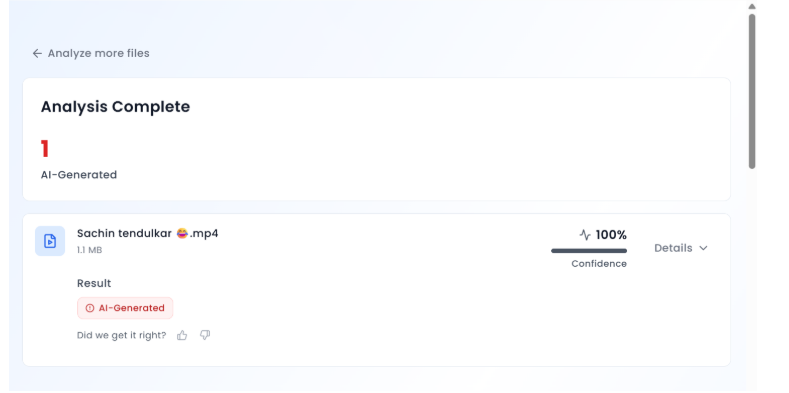
We then ran the viral video through an AI detection tool, Aurigin AI. According to the results, the audio in the video was found to be 100 percent AI-generated, confirming that Tendulkar never made the statements attributed to him in the clip.
Conclusion
Our research confirms that the viral video claiming Sachin Tendulkar commented on Joe Root’s centuries is fake. The video has been created using AI-generated audio and misleadingly combined with visuals from a 2013 interview. Users are sharing this manipulated clip on social media with a false claim.

Executive Summary
A shocking video claiming to show snakes raining down from the sky is going viral on social media. The clip shows what appear to be cobras and pythons falling in large numbers instead of rain, while people are seen running in panic through a marketplace. The video is being shared with the claim that it is the result of “tampering with nature” and that sudden snake rainfall occurred in an unidentified country. (Links and archived versions provided)
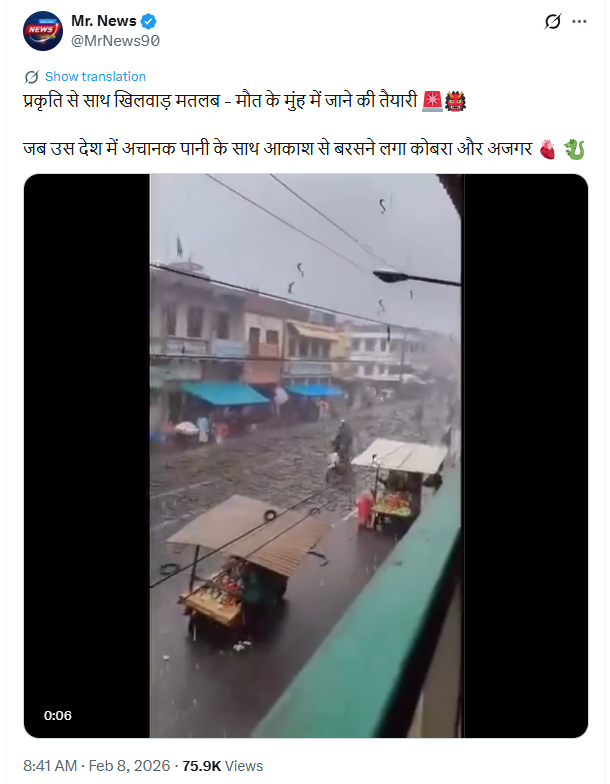
CyberPeace researched the viral claim and found it to be false. The video does not depict a real incident. Instead, it has been generated using artificial intelligence (AI).
Fact Check
To verify the authenticity of the video, we extracted keyframes and conducted a reverse image search using Google Lens. However, we did not find any credible media report linked to the viral footage. We also searched relevant keywords on Google but found no reliable national or international news coverage supporting the claim. If snakes had genuinely rained from the sky in any country, the incident would have received widespread media attention globally. A frame-by-frame analysis of the video revealed multiple inconsistencies and visual anomalies:
In the first two seconds, a massive snake appears to fall onto electric wires, yet its body passes unrealistically through the wires — something that is physically impossible. The snakes falling from the sky and crawling on the ground move in an unnatural manner. Instead of falling under gravity, they appear to float mid-air. Around the 9–10 second mark, a person lying on the ground has a visibly distorted hand structure, a common artifact seen in AI-generated videos.
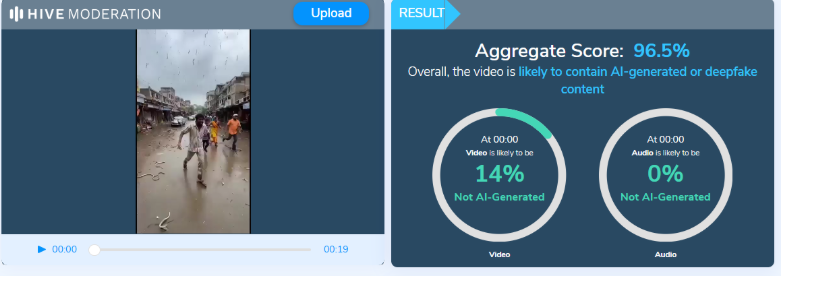
Such irregularities are typical indicators of AI-generated content. The viral video was further analyzed using the AI detection tool Hive Moderation, which indicated a 96.5% probability that the video was AI-generated.
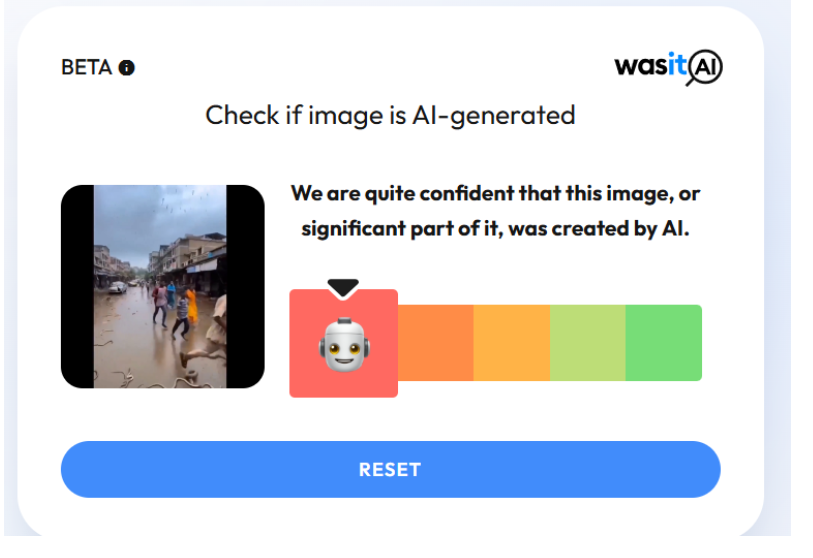
Additionally, image detection tool WasitAI also classified the visuals in the viral clip as highly likely to be AI-generated.
Conclusion
CyberPeace ’s research confirms that the viral video claiming to show snakes raining from the sky is not authentic. The footage has been created using artificial intelligence and does not depict a real event.
