
India Just Signed the World's First Global Cybercrime Treaty: A Global Rulebook for a Borderless Crime
On 25 September 2026, at UN Headquarters in New York, External Affairs Minister S. Jaishankar signed the United Nations Convention against Cybercrime on the sidelines of the 81st session of the UN General Assembly, calling it a step that "strengthens international cooperation for a safer digital future."
The signature places India among the growing list of nations joining what is officially the first comprehensive global treaty dedicated to cybercrime. What Jaishankar's brief statement did not mention is that this same treaty has spent the better part of three years drawing sustained, detailed criticism from human rights organisations, technology companies, and digital rights groups, who argue it risks becoming a tool for surveillance rather than a tool against crime.
A Conversation CyberPeace Has Been Having for Years
For CyberPeace, India’s signature is not an isolated development but the latest chapter in a conversation the organisation has been following since the Convention was still being negotiated.
In December 2024, CyberPeace published its analysis of the emerging UN Convention against Cybercrime, examining its objectives, proposed offences, mechanisms for international cooperation, electronic evidence and its relationship with the Budapest Convention. The analysis also highlighted an important principle embedded in the emerging framework: that stronger cybercrime enforcement must operate alongside due process, privacy and human-rights safeguards.
That conversation continued in October 2025, when CyberPeace published The Digital Leviathan: The UN Cybercrime Treaty and the Future of Global Governance. The piece examined the Convention not merely as a cybercrime instrument, but as part of a larger evolution in global digital governance, particularly around cross-border evidence, international cooperation and the changing architecture of cyber sovereignty.
And in August 2026, CyberPeace returned to the question from the operational side in The World Is Rewriting the Rules Against Cyber-Enabled Transnational Crime. The analysis placed the Convention alongside the wider international response to transnational cyber-enabled crime, including scam networks, financial fraud and increasingly sophisticated criminal ecosystems that operate across multiple jurisdictions.
What the Convention actually is
The treaty's full, formal title is unusually descriptive for a UN instrument: the United Nations Convention against Cybercrime, Strengthening International Cooperation for Combating Certain Crimes Committed by Means of Information and Communications Technology Systems and for the Sharing of Evidence in Electronic Form of Serious Crimes. The UN General Assembly adopted it unanimously on 24 December 2024, following three years of negotiation, and it opened for signature at a ceremony in Hanoi, Vietnam, in October 2025. It will remain open for signature at UN Headquarters through 31 December 2026, and comes into force ninety days after the fortieth country ratifies it.
At its core, the Convention gives signatory states a shared legal framework for two things: preventing and prosecuting offences committed through digital systems, and cooperating across borders when evidence, offenders, or victims of a crime are scattered across multiple jurisdictions, a structural problem that has long frustrated cybercrime investigations. It also includes provisions specifically addressing the recovery of criminal proceeds, adding a financial dimension that lets states cooperate not just on prosecuting offenders but on tracing and reclaiming stolen money that has moved across borders, often through mule accounts and shell transactions designed to outrun any single country's jurisdiction.
Why India signed, in its own words
Jaishankar's public reasoning was concise. Cybercrime, in the government's framing, does not respect national boundaries, and India's own cybercrime caseload, spanning cross-border financial fraud, romance scams, and organised online extortion networks often operating from outside India's borders, has repeatedly run into exactly the jurisdictional walls this Convention is designed to lower. Prof. Triveni Singh, a well known cybercrime expert and former IPS officer, put the practical case plainly: "Cybercrime does not stop at national borders. Criminals can operate from one country and target victims in another. This convention can help countries share evidence and work together faster. For India, stronger international cooperation can make it easier to investigate cross-border cyber fraud and trace stolen money."
The part the announcement leaves out
Here is where the story gets considerably more complicated than a signing ceremony photo suggests. Since before the Convention's text was even finalised, a wide coalition of digital rights organisations, including the Electronic Frontier Foundation, Human Rights Watch, the Global Network Initiative, and Privacy International, has warned that the treaty's language is dangerously broad, and that its safeguards against misuse are considerably weaker than they need to be.
Cisco, one of the few major technology companies to comment publicly, stated the Convention does not do enough to "sufficiently protect basic human rights." UN Secretary-General António Guterres, notably, has himself urged countries to sign and ratify the Convention while simultaneously calling for its implementation to be "rooted in human rights," a somewhat unusual dual message from the very institution that produced the text, and one that implicitly acknowledges the concerns raised against it.
Where this leaves India
None of this means India's signature was unwarranted. The jurisdictional friction Prof. Triveni Singh described is real and well documented, and a shared international framework for evidence sharing genuinely could accelerate investigations that currently stall for months while agencies wait on slow, bilateral mutual legal assistance requests. India's existing domestic cybercrime coordination architecture is already substantial, spanning I4C, the National Cybercrime Reporting Portal, and newer mechanisms like the Citizen Financial Cyber Fraud Reporting and Management System and the Sahyog platform, and a global treaty that maps onto this existing infrastructure could genuinely close gaps that purely domestic tools cannot reach, particularly in cases where the perpetrator, the server, and the victim all sit in different countries, a pattern that has become close to the default in organised online financial fraud rather than the exception.
But the criticisms levelled at the Convention are not fringe objections; they come from some of the most established digital rights organisations in the world, and they focus specifically on the treaty's most powerful surveillance and cross-border cooperation provisions, the very mechanisms India will now need to operationalise domestically. Signing the Convention is also only the first procedural step; India's obligations under it will not take practical effect until the instrument is ratified domestically, a process that typically allows room for a signatory state to clarify how broadly or narrowly it intends to apply the treaty's more expansive provisions. How India chooses to implement those provisions, whether through the kind of judicial oversight and narrow, offence-specific application human rights groups have called for, or through the broader interpretation the treaty's text technically permits, will likely determine whether this Convention becomes a genuine tool against fraud and organised cybercrime, or a broader instrument whose reach eventually extends well past the digital offences it was signed to address.
References
- The420.in, "India Signs UN Cybercrime Convention to Strengthen Global Fight Against Digital Crime." ANI, "EAM Jaishankar signs UN Convention against Cybercrime on UNGA sidelines." https://aninews.in/news/world/us/eam-jaishankar-signs-un-convention-against-cybercrime-on-unga-sidelines20260926063207/
- Ministry of Cyber Affairs, "India signs UN Convention against Cybercrime at UNGA 81." https://ministryofcyberaffairs.com/news/india-signs-un-convention-against-cybercrime-at-unga-81-95b7e43b-7e29-4722-a4a7-304bca55b71c
- Electronic Frontier Foundation, "UN Cybercrime Convention Negotiations Enter Final Phase With Troubling Surveillance Powers Still on the Table." https://www.eff.org/deeplinks/2023/08/un-cybercrime-convention-negotiations-enter-final-phase-troubling-surveillance
- Electronic Frontier Foundation, "First Draft of UN Cybercrime Convention Drops Troubling Provisions, But Dangerous And Open-Ended Cross Border Surveillance Powers Are Still on the Table."
- https://www.eff.org/deeplinks/2023/07/first-draft-un-cybercrime-treaty-drops-troubling-provisions-dangerous-and-open
- Global Network Initiative, "GNI Calls on Member States Not to Support the UN Cybercrime Convention." https://globalnetworkinitiative.org/gni-statement-on-uncc/
- Just Security, "The UN Cybercrime Convention: Analyzing the Risks to Human Rights and Global Privacy." https://www.justsecurity.org/98738/cybercrime-convention-human-rights/
- TechRadar Pro, "UN cybercrime convention inadequate, says Human Rights Watch." https://techradar.com/pro/un-cybercrime-convention-inadequate-says-human-rights-watch
- Digital Watch Observatory, "Comparative analysis: the Budapest Convention vs the UN Convention Against Cybercrime." https://dig.watch/updates/comparative-analysis-the-budapest-convention-vs-the-un-convention-against-cybercrime
- epicenter.works, "Cybercrime Convention: Cross-Border Human Rights Violations." https://epicenter.works/en/content/cybercrime-convention-cross-border-human-rights-violations
- UN Press, "Secretary-General Urges All Countries to Sign, Ratify New UN Convention against Cybercrime, Calls for Solutions Rooted in Human Rights." https://press.un.org/en/2025/sgsm22961.doc.htm
- https://cyberpeace.org/resources/blogs/the-digital-leviathan-the-un-cybercrime-treaty-and-the-future-of-global-governance
- https://cyberpeace.org/resources/blogs/the-world-is-rewriting-the-rules-against-cyber-enabled-transnational-crime

Related Blogs
Executive Summary:
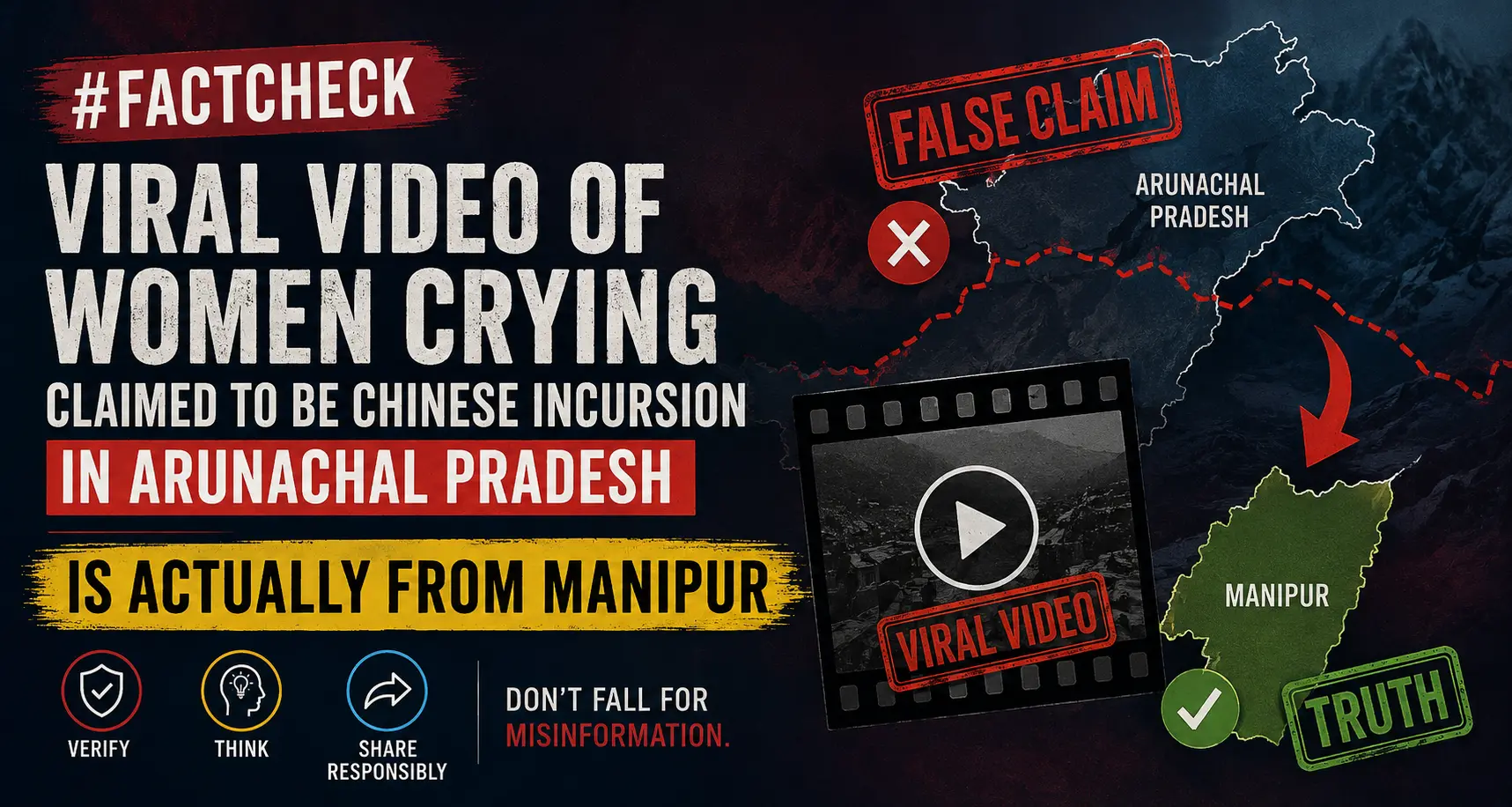
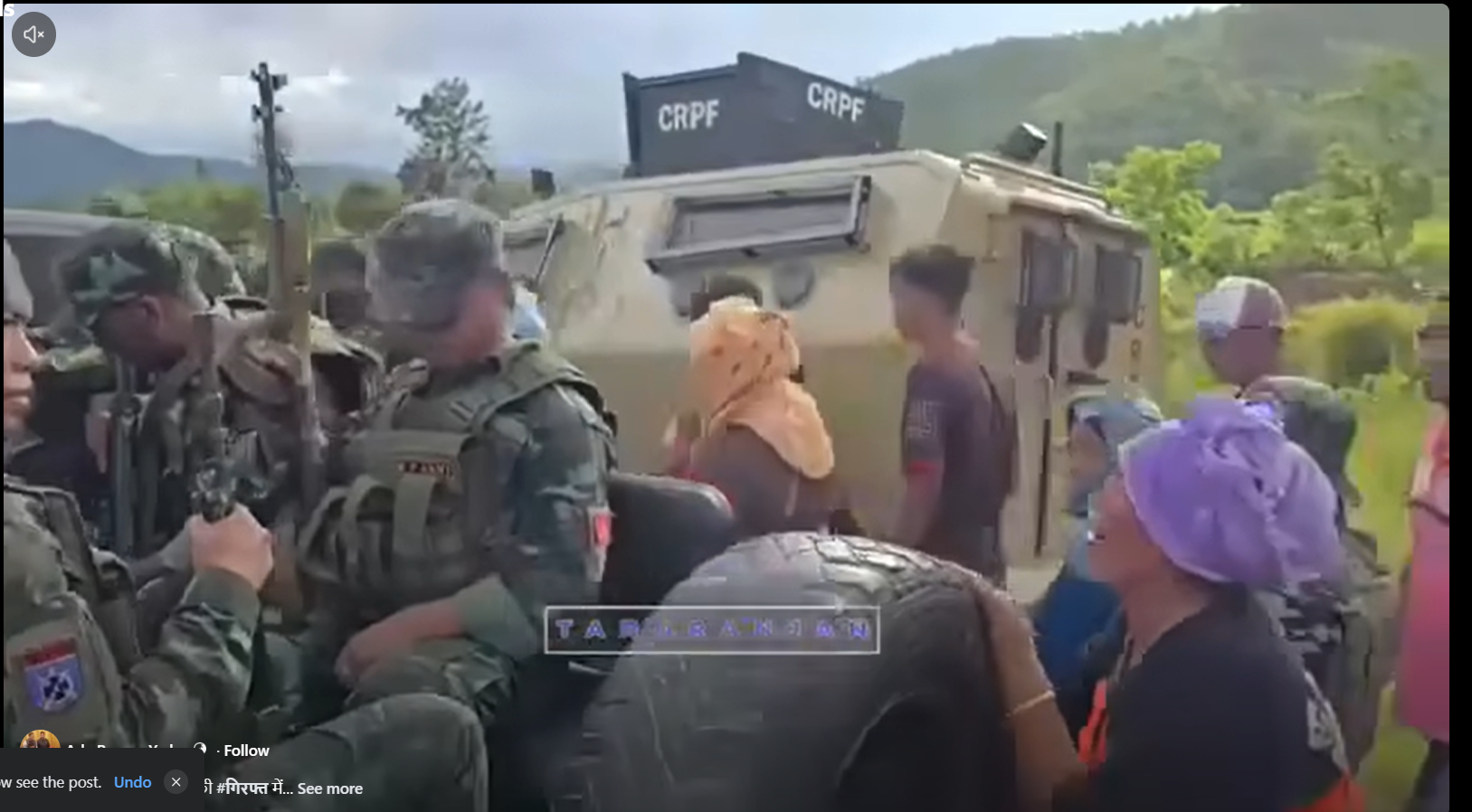
On August 13, 2026, Leader of Opposition in the Lok Sabha and MP Rahul Gandhi, speaking at a Rashtriya Congress program, alleged that in several places in Arunachal Pradesh, China has stopped our army from patrolling. Following this, a video went viral on social media showing weeping women standing behind uniformed personnel in a vehicle. Some users shared this video targeting the central government with claims of Chinese army infiltration in Arunachal Pradesh. The research by the CyberPeace's research wing revealed that the viral video is actually from Manipur. The video was captured when the United National Liberation Front (UNLF) was vacating its 'Nongshum Camp' in the Nongshum area of Manipur.
Claim:
On August 15, 2026, Facebook user ‘Adv Raman Yadav’ posted a video (archive link) writing, "Arunachal_Pradesh.. in China's grip, citizens will hoist the Tiranga at home themselves, but who will hoist it on the country's border? Neither the lion's courage is working, nor is the strategy of the so-called Chanakya working... The creator of the dialogue 'if Pakistan raises an eye, the world will see the consequences' and 'strongly condemn' is unable to say anything! And those famous for absurd statements... Giriraj Singh, Nishikant Dubey, Manoj Tiwari, someone named Negi, or any other BJP leader's conscience is not awakening. Today Arunachal Pradesh is slipping into China's grip, the people there are constantly pleading to save them from becoming slaves, but Narendra Damodardas Modi is busy making reels and giving instructions to his MPs..."
https://www.facebook.com/reel/2081742402422160
Fact Check:
To investigate the viral claim, we first extracted keyframes from the video and searched them using Google Lens. The Facebook user 'Manipur Assam' had posted this video on June 30, 2026.
https://www.facebook.com/reel/2565715717192123

According to a report published on the 'Manipur Update' website on June 30, 2026, "People from villages near the Nongshum area willingly bid a tearful farewell to UNLF's 'Nongshum Camp'. This step was taken after lengthy negotiations and the assurance that personnel from the 10th India Reserve Battalion (IRB) would immediately assume security responsibilities for the camp. Following their departure, 10th IRB personnel reached the Nongshum camp and replaced them."
https://manipur-update.com/people-in-nongshum-unwillingly-bid-tearful-adieus-to-unlfs-nongshum-camp/

According to information provided on the 'India Today NE' website on June 27, 2026, "The Pambei-led faction of the UNLF signed a tripartite peace agreement with the Central Government and the Manipur Government in November 2023. Recently, on June 19, talks took place in New Delhi between representatives of the Government of India and UNLF leaders. During this, the proposal to relocate the camp under a designated administrative and security framework was also discussed."

Conclusion:
Our research revealed that a video from Nongshum village in Manipur is being shared with false claims of Chinese military infiltration in Arunachal Pradesh
Executive Summary
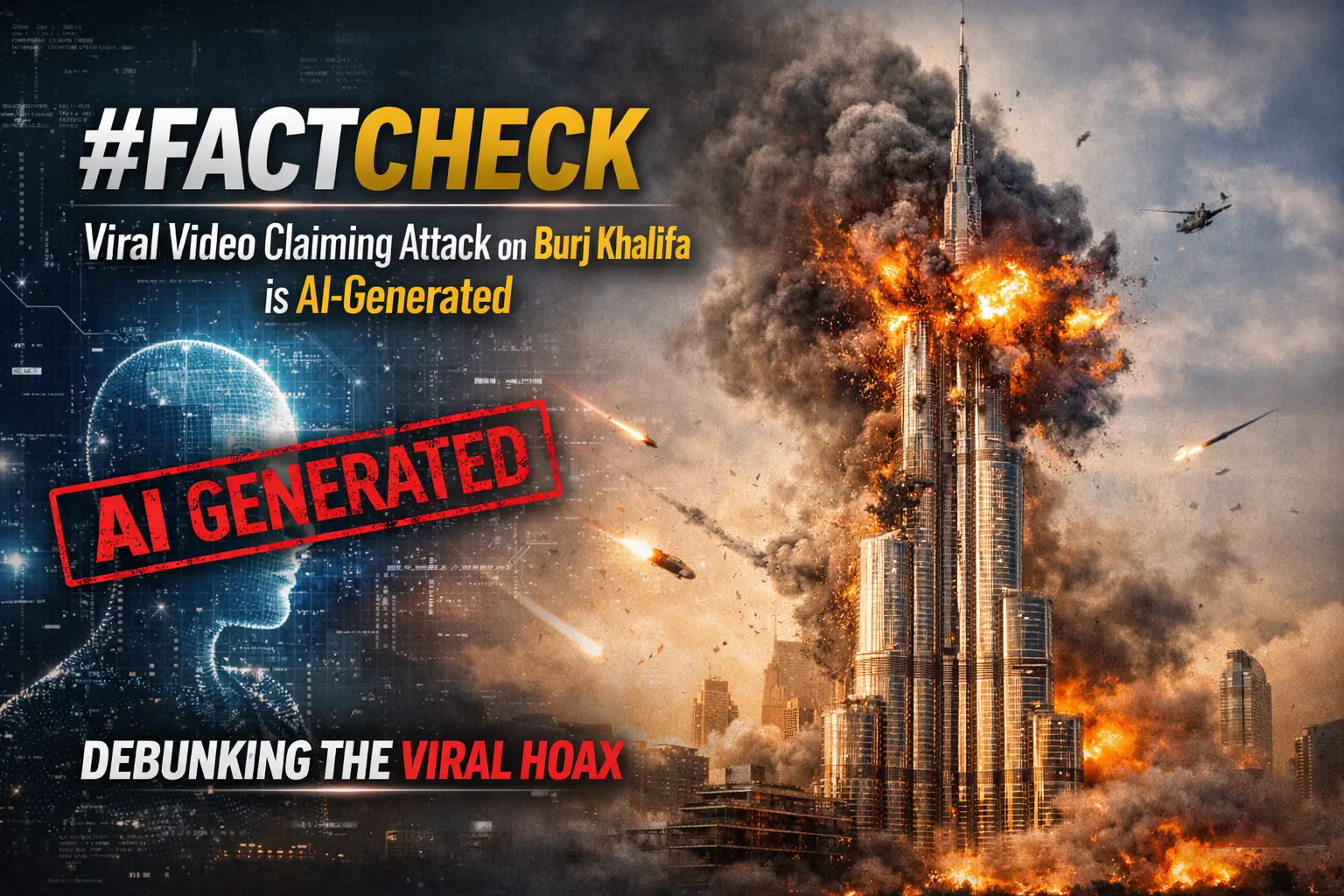
Amid rising tensions between the United States, Israel, and Iran, a video is circulating on social media claiming that Burj Khalifa in Dubai has been attacked. The clip is being widely shared with users alleging that a strike took place near the iconic skyscraper. However, research by CyberPeace found the claim to be misleading. Our research revealed that the viral video is not real and was generated using artificial intelligence.
Claim
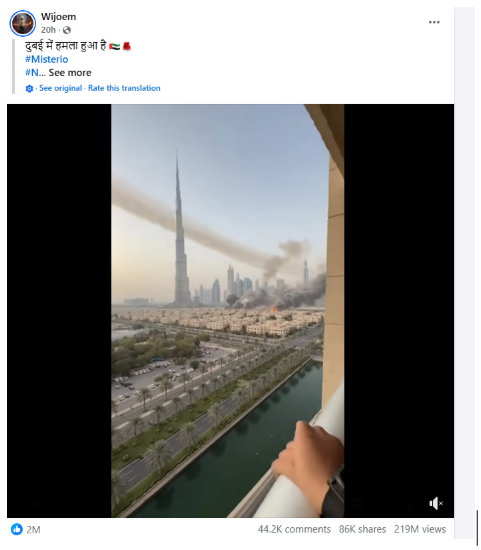
On March 1, 2026, a Facebook user shared the viral clip claiming that an attack had taken place in Dubai. The post was shared with the caption: “Dubai has been attacked.” The link to the post and its archive is provided below along with a screenshot.
Fact Check
To verify the claim, we first searched Google using relevant keywords. During this process, we found a report published on March 1, 2026, by the Indian news outlet Dainik Bhaskar.

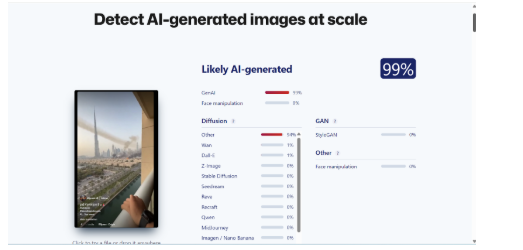
According to the report, tensions in the Middle East escalated amid the Israel–Iran conflict, impacting several countries in the region. A drone incident reportedly occurred near Burj Khalifa, prompting authorities to evacuate the building as a precautionary measure and temporarily switch off its lights. However, the visuals seen in the viral video do not match the details or imagery described in the report. Upon closely examining the viral clip, we noticed several technical inconsistencies and unusual visual elements, raising suspicions that the video might have been generated using artificial intelligence. To verify this, we analyzed the video using the AI detection tool Sightengine. The results indicated a 99% probability that the video was AI-generated.
Conclusion
Our research found that the viral video circulating on social media is not authentic. The footage was created using artificial intelligence and does not depict a real attack on Burj Khalifa.
.webp)
Introduction
AI-generated fake videos are proliferating on the Internet indeed becoming more common by the day. There is a use of sophisticated AI algorithms that help manipulate or generate multimedia content such as videos, audio, and images. As a result, it has become increasingly difficult to differentiate between genuine, altered, or fake content, and these AI-manipulated videos look realistic. A recent study has shown that 98% of deepfake-generated videos have adult content featuring young girls, women, and children, with India ranking 6th among the nations that suffer from misuse of deepfake technology. This practice has dangerous consequences and could harm an individual's reputation, and criminals could use this technology to create a false narrative about a candidate or a political party during elections.
The working of deepfake videos is based on algorithms that refine the fake content, and the generators are built and trained in such a way as to get the desired output. The process is repeated several times, allowing the generator to improve the content until it seems realistic, making it more flawless. Deepfake videos are created by specific approaches some of them are: -
- Lip syncing: This is the most common technique used in deepfake. Here, the voice recordings of the video, make it appear as to what was originally said by the person appearing in the video.
- Audio deepfake: For Audio-generated deepfake, a generative adversarial network (GAN) is used to colon a person’s voice, based on the vocal patterns and refine it till the desired output is generated.
- Deepfake has become so serious that the technology could be used by bad actors or by cyber-terrorist squads to set their Geo-political agendas. Looking at the present situation in the past few the number of cases has just doubled, targeting children, women and popular faces.
- Greater Risk: in the last few years the cases of deep fake have risen. by the end of the year 2022, the number of cases has risen to 96% against women and children according to a survey.
- Every 60 seconds, a deepfake pornographic video is created, now quicker and more affordable than ever, it takes less than 25 minutes and costs using just one clean face image.
- The connection to deepfakes is that people can become targets of "revenge porn" without the publisher having sexually explicit photographs or films of the victim. They may be made using any number of random pictures or images collected from the internet to obtain the same result. This means that almost everyone who has taken a selfie or shared a photograph of oneself online faces the possibility of a deepfake being constructed in their image.
Deepfake-related security concerns
As deepfakes proliferate, more people are realising that they can be used not only to create non-consensual porn but also as part of disinformation and fake news campaigns with the potential to sway elections and rekindle frozen or low-intensity conflicts.
Deepfakes have three security implications: at the international level, strategic deepfakes have the potential to destroy precarious peace; at the national level, deepfakes may be used to unduly influence elections, and the political process, or discredit opposition, which is a national security concern, and at the personal level, the scope for using Women suffer disproportionately from exposure to sexually explicit content as compared to males, and they are more frequently threatened.
Policy Consideration
Looking at the present situation where the cases of deepfake are on the rise against women and children, the policymakers need to be aware that deepfakes are utilized for a variety of valid objectives, including artistic and satirical works, which policymakers should be aware of. Therefore, simply banning deepfakes is not a way consistent with fundamental liberties. One conceivable legislative option is to require a content warning or disclaimer. Deepfake is an advanced technology and misuse of deepfake technology is a crime.
What are the existing rules to combat deepfakes?
It's worth noting that both the IT Act of 2000 and the IT Rules of 2021 require social media intermediaries to remove deep-fake videos or images as soon as feasible. Failure to follow these guidelines can result in up to three years in jail and a Rs 1 lakh fine. Rule 3(1)(b)(vii) requires social media intermediaries to guarantee that its users do not host content that impersonates another person, and Rule 3(2)(b) requires such content to be withdrawn within 24 hours of receiving a complaint. Furthermore, the government has stipulated that any post must be removed within 36 hours of being published online. Recently government has also issued an advisory to social media intermediaries to identify misinformation and deepfakes.
Conclusion
It is important to foster ethical and responsible consumption of technology. This can only be achieved by creating standards for both the creators and users, educating individuals about content limits, and providing information. Internet-based platforms should also devise techniques to deter the uploading of inappropriate information. We can reduce the negative and misleading impacts of deepfakes by collaborating and ensuring technology can be used in a better manner.
References
- https://timesofindia.indiatimes.com/life-style/parenting/moments/how-social-media-scandals-like-deepfake-impact-minors-and-students-mental-health/articleshow/105168380.cms?from=mdr
- https://www.aa.com.tr/en/science-technology/deepfake-technology-putting-children-at-risk-say-experts/2980880
- https://wiisglobal.org/deepfakes-as-a-security-issue-why-gender-matters/
