
#FactCheck: Viral letter allegedly issued by PMO on reservation is fake, AI-generated document
Executive Summary
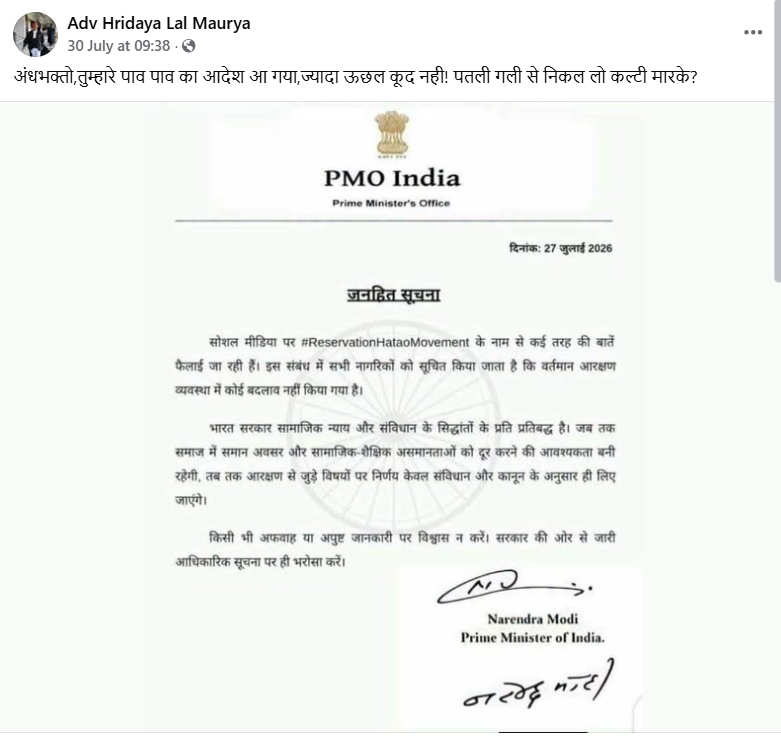
A purported letter issued in the name of the Prime Minister’s Office (PMO) is being widely shared on social media. The letter claims that the government has not made any changes to the reservation system regarding the “Remove Reservation Movement” and appeals to people not to pay attention to rumours. The viral letter is dated July 27, 2026, and also carries what appear to be Prime Minister Narendra Modi’s signatures in both Hindi and English.
CyberPeace Research Wing’s research found the viral claim to be false. The research revealed that the Prime Minister’s Office (PMO) has neither issued any official statement regarding reservation nor released any such letter. No credible media reports related to the alleged letter were found. The research further revealed that the purported reservation-related letter circulating on social media was a fake document created with the help of AI.
Claim:
A Facebook user shared the alleged letter issued in the name of the Prime Minister’s Office on July 30, 2026, claiming that the government has not made any changes to the reservation system in connection with the “Remove Reservation Movement” and appealed to citizens not to believe rumours. The viral letter bears the date July 27, 2026, and displays signatures of Prime Minister Narendra Modi in both Hindi and English. The archived link and screenshot of the post are provided below:
https://www.facebook.com/share/p/1b9nD5k3As/
Factcheck
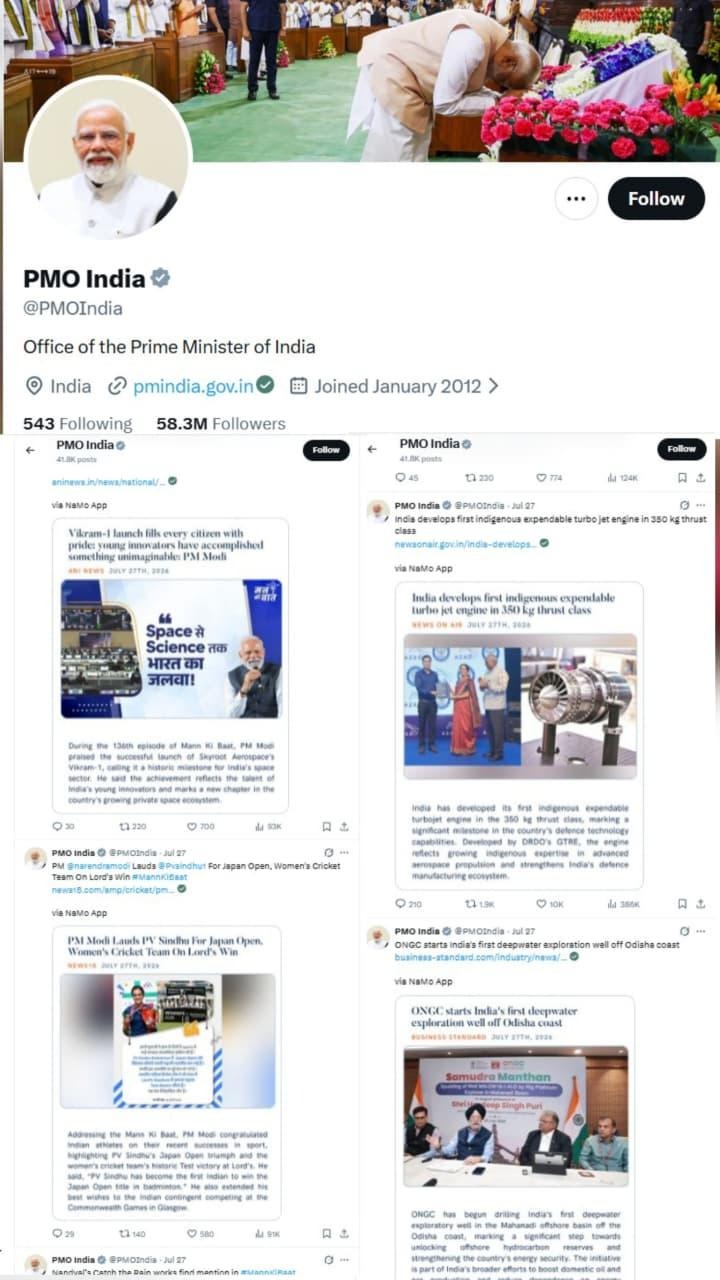
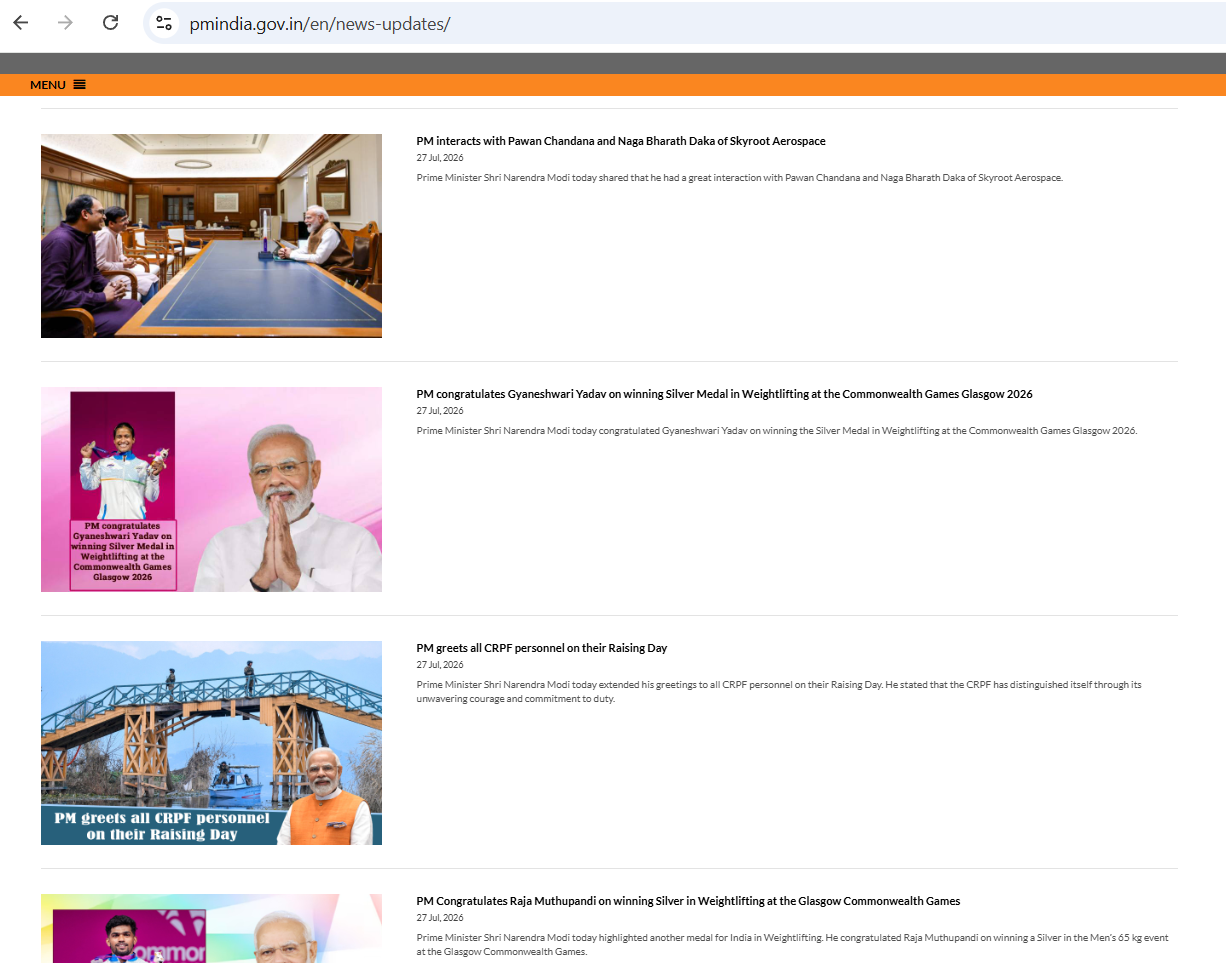
To verify the authenticity of the viral claim, we conducted a Google search using relevant keywords. However, no credible media reports related to the alleged letter were found. During the next stage of the research, we scanned the official X account (formerly Twitter) of PMO India. We did not find any such letter posted on July 27 or around that date. Continuing the research, we checked the official website of PMO India. No such letter was found in the news updates section or anywhere else on the website that could confirm the viral claim.
Further, we reviewed the press releases issued by the Prime Minister’s Office on July 27 available on the official website of the Press Information Bureau (PIB). We found no press release or official communication related to reservation or matching the viral letter.
https://www.pmindia.gov.in/en/
As part of the research, we scanned the viral letter using the AI detection tool Image Detector. The results indicated that the document was 93 percent likely to be AI-generated.

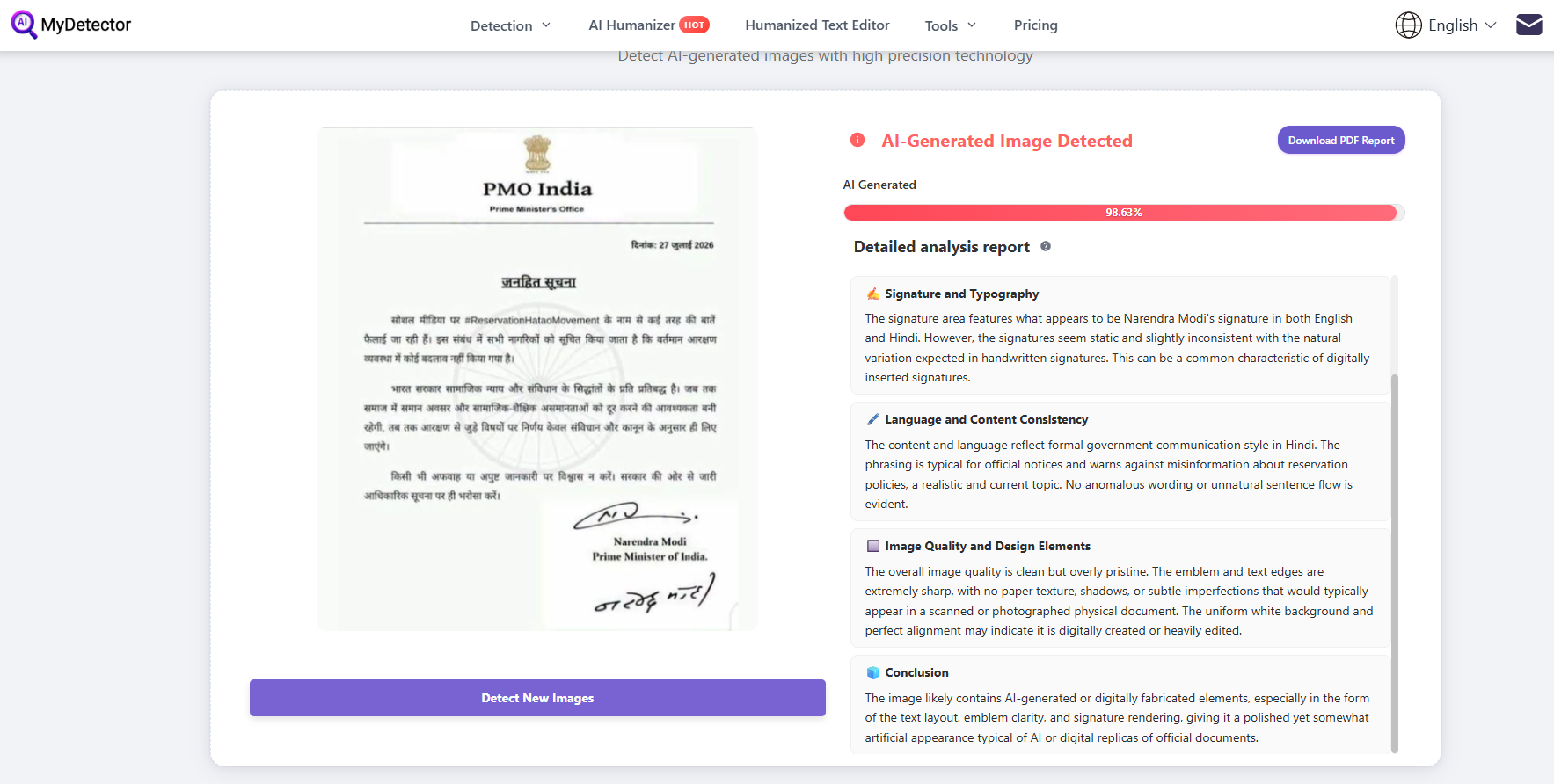
We also analysed the viral letter using another AI detection tool, My Detector. The results showed a 98 percent probability that the letter was created using AI.
Conclusion:
Our research found no official evidence confirming that the Prime Minister’s Office issued the viral letter. The purported PMO letter regarding reservation was found to be fake and AI-generated.

Related Blogs
WhatsApp messages masquerading as an offer from Maruti Suzuki with links luring unsuspecting users with the promise of Maruti Suzuki 40th Anniversary Celebration presents, have been making the rounds on the app. If you receive such messages try to stay away from it, as it can be a scam.
The Research Wing of CyberPeace Foundation along with Autobot Infosec Private Limited have conducted a study based on a WhatsApp message that contained a link pretending to be a free gift offer from Maruti Suzuki which asks users to participate in a survey in order to get a chance to win a Maruti Baleno Sigma MT car.
Warning SignsThe campaign pretends to be an offer from Maruti Suzuki but is hosted on a third party domain instead of the official Maruti Suzuki website which makes it more suspicious.
The domain names associated with the campaign have been registered in very recent times.
Multiple redirections have been noticed between the links.
No reputed site would ask its users to share the campaign on WhatsApp.
The prize is kept really attractive to lure the laymen.
Grammatical mistakes have been noticed.
A congratulations message appears on the landing page with an attractive photo of Maruti Suzuki cars that asks users to participate in a quick survey in order to get a “Maruti Suzuki BALENO Sigma MT”. Also, the bottom of the page seems to appear like a comment section with public comments establishing the truthfulness of the offer.
The survey starts with some basic questions like Do you know Maruti Suzuki?, How old are you?, How do you think of Maruti Suzuki?, Are you male or female? Etc. Once the user answers the questions a “congratulatory message” is displayed.
On clicking the OK button users are given three attempts to win the prize. After completing all the attempts a message pops up that the user has won “Maruti Suzuki BALENO Sigma MT”. It then prompts the user to share the message on WhatsApp.
Strangely enough the user has to keep clicking the WhatsApp button until the progress bar completes. After clicking on the green ‘WhatsApp’ button multiple times it shows a section where an instruction has been given to complete registration in order to get the prize.
After clicking on the green ‘Complete registration’ button, it redirects the user to multiple advertisements web pages varying each time the user clicks on the button.
During the analysis the research team found a javascript code called hm.js was being executed in the background from the host hm[.]baidu[.]com which is a subdomain of Baidu and is used for Baidu Analytics, also known as Baidu Tongji. The important part is that Baidu is a Chinese multinational technology company specializing in Internet-related services, products and artificial intelligence, headquartered in Beijing’s Haidian district, China.To read the full report, please click (https://www.cyberpeace.org/CyberPeace/Repository/20210828Research-report-on-Maruti-Suzuki-40th-Anniversary-Celebration-free-gift-scam.pdf) here:
Conclusive Summary
1. The whole research activity was performed in a secured sandbox environment where the WhatsApp application was not installed. If any user opens the link from a device like smartphones where the WhatsApp application is installed, the sharing features on the site will open the Whatsapp application on the device to share the link.
2. The campaign collects browser and system information from the users.
3. Most of the domain names associated with the campaign have the registrant country as China.
4. Cybercriminals used Cloudflare technologies to mask the real IP addresses of the front-end domain names used in this Maruti Suzuki 40th Anniversary Celebration free gift campaign. But during the phases of investigation, the research team has identified a domain name that was requested in the background and has been traced as belonging to China.
CyberPeace Advisory
1. CyberPeace Foundation and Autobot Infosec recommend that people should avoid opening such messages sent via social platforms.
2. If at all, the user gets into this trap, it could lead to whole system compromise such as access to the microphone, Camera, Text Messages, Contacts, Pictures, Videos, Banking Applications, etc as well as financial losses.
3. Do not share confidential details like login credentials, banking information with such a type of scam.
4. Do not share or forward fake messages containing links without proper verification.
5. There is a need for International Cyber Cooperation between countries to bust the cybercriminal gangs running the fraud campaigns affecting individuals and organizations, to make Cyberspace resilient and peaceful.
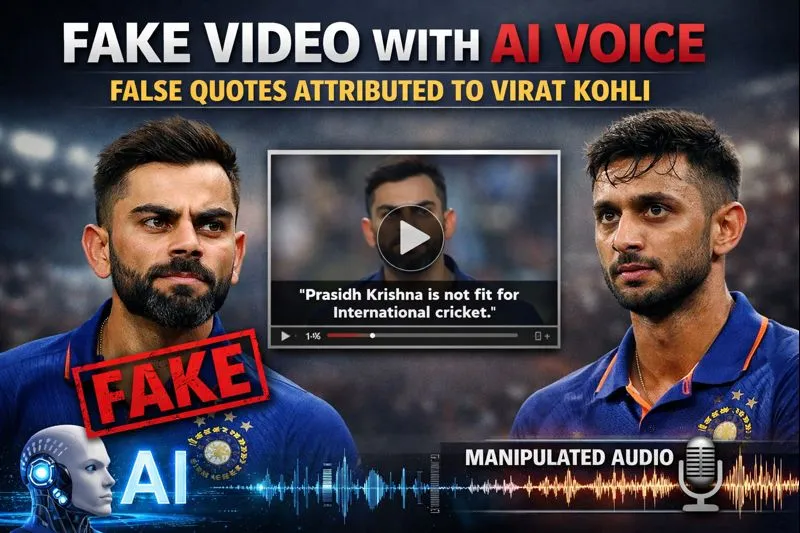
A video circulating widely on social media claims that Indian cricketer Virat Kohli made a sarcastic remark about fast bowler Prasidh Krishna ahead of the New Zealand series. In the clip, Kohli is allegedly heard saying that he expected to be the top scorer of the series, but lost all hope after seeing Prasidh Krishna’s name in the squad.
Users sharing the video claim that Kohli publicly commented on Prasidh Krishna in this manner.
Research by the CyberPeace Foundation has found the viral claim to be false. Our probe revealed that the viral clip has been digitally manipulated. The video is originally from a 2024 advertisement featuring Virat Kohli, in which his voice has been altered using deepfake (AI-generated) technology and falsely presented with a misleading narrative.
Claim
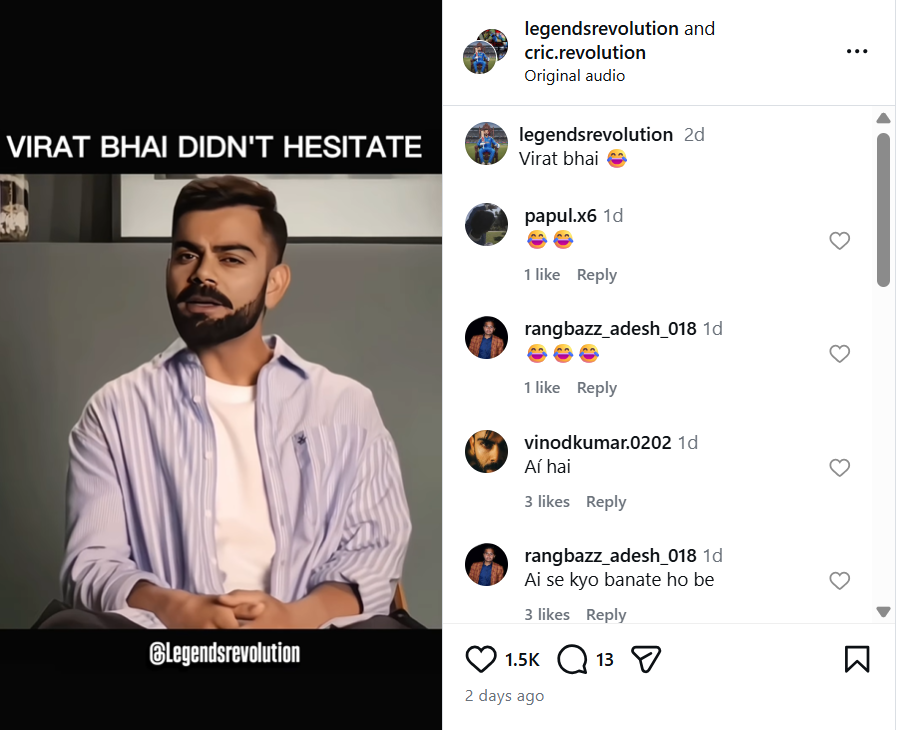
The video was shared on Instagram on January 6, 2025, with users claiming that Kohli made the remark after the New Zealand squad was announced. The post included the altered audio suggesting Kohli’s disappointment over Prasidh Krishna’s selection. Link, archive link
Fact Check:
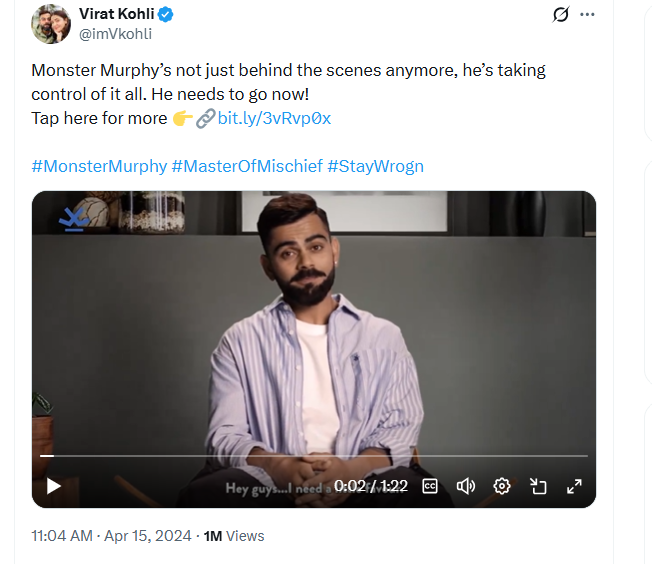
To verify the claim, we extracted key frames from the viral video and conducted a Google Reverse Image Search. This led us to the original video posted by Virat Kohli himself on X (formerly Twitter) on April 15, 2024. The original clip was part of a brand advertisement, and no such statement about the New Zealand series or Prasidh Krishna was made in it. Link and Screenshot
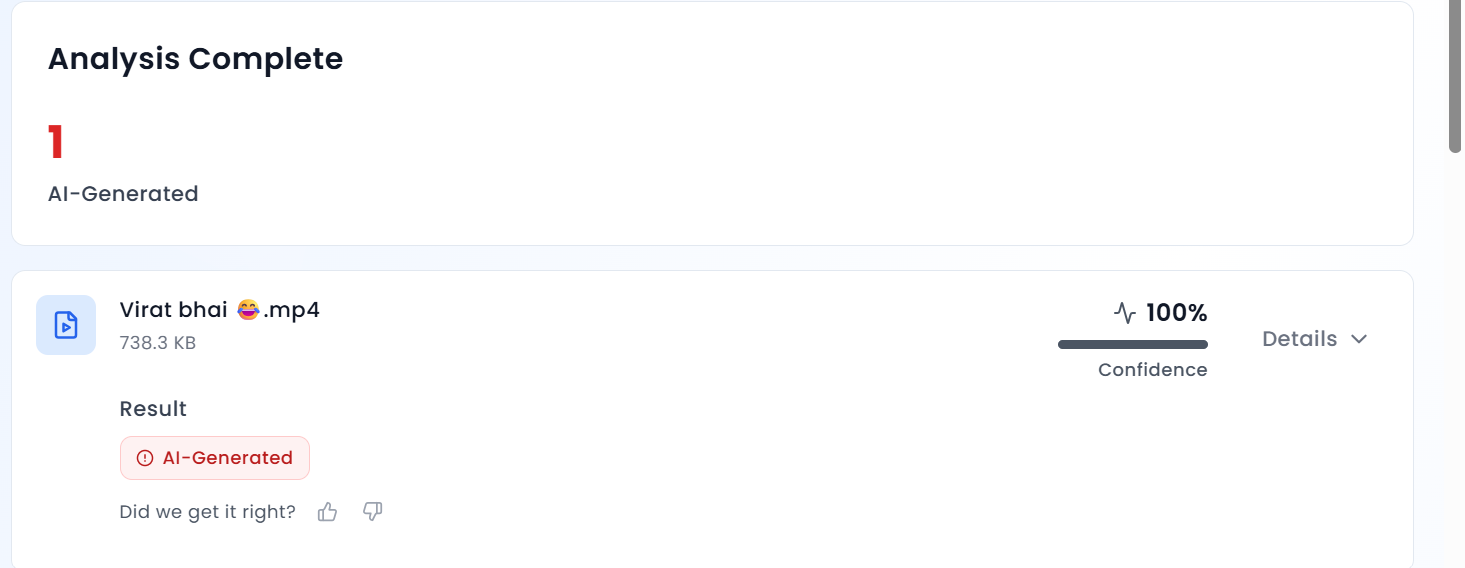
A close review of the viral clip raised suspicions due to the unnatural tone and inconsistencies in Kohli’s voice. To confirm this, we analysed the video using the AI detection tool Aurigin AI. The tool’s results showed that the audio in the viral clip is 100 percent AI-generated, confirming that Kohli’s voice was artificially manipulated.
Conclusion
The CyberPeace Foundation’s research confirms that the viral video claiming Virat Kohli mocked Prasidh Krishna is fake and misleading. The clip is taken from an old advertisement and has been doctored using deepfake technology to alter Kohli’s voice. The video is being circulated on social media with a false claim, and Virat Kohli has made no such statement regarding the New Zealand series or Prasidh Krishna.
Executive Summary
A video of US Secretary of State Marco Rubio is rapidly going viral on social media, in which he can allegedly be heard making a statement regarding the 2025 India-Pakistan conflict. Along with the video, it is being claimed that the US played a crucial role in ending the conflict between the two countries, but India was the first to initiate a ceasefire with Pakistan. Users are sharing this video believing it to be true.
Research by the CyberPeace Research Wing revealed that the video has been digitally manipulated. Rubio did state that the United States played a role in ending the conflict, but he never said that India was the first to request a ceasefire from Pakistan. This alleged statement was not part of the original video and was added later to alter the clip.
Claim
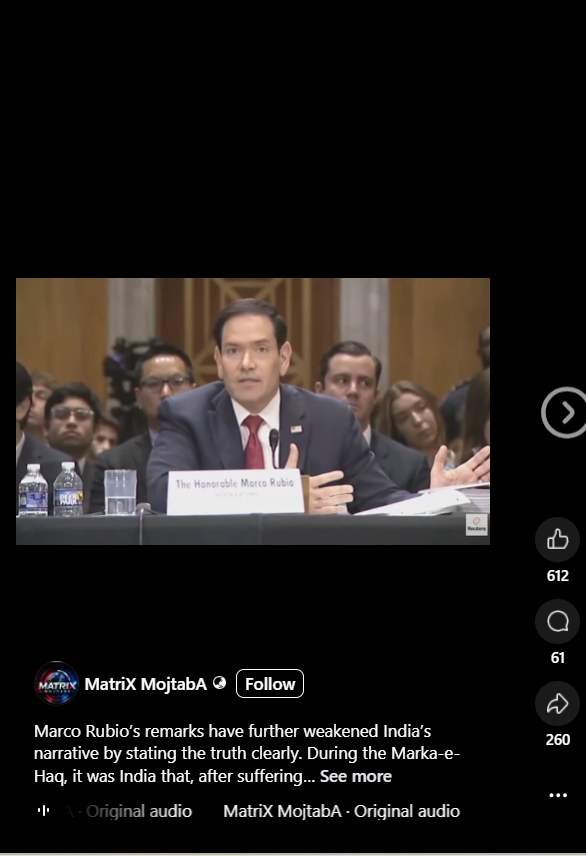
A user on a Facebook page shared the viral video and wrote, "Marco Rubio's statement has clearly brought out the truth, weakening India's claim. During 'Maarka-e-Haq', after suffering heavy losses, India was the first party to request a ceasefire from Pakistan. This highlights the gap between India's public claims and the ground reality, where the military..." The post link, archive link, and screenshot can be seen below. https://www.facebook.com/reel/1015648544746728
https://www.facebook.com/reel/1015648544746728
Fact Check
We investigated the viral video using the InVid tool and extracted several of its keyframes. These keyframes were then subjected to a reverse image search via Google Lens. The investigation revealed that the exact same video had been shared on social media previously, showing the same background and setting. The post link and screenshot can be seen below.
https://www.facebook.com/reel/1015648544746728
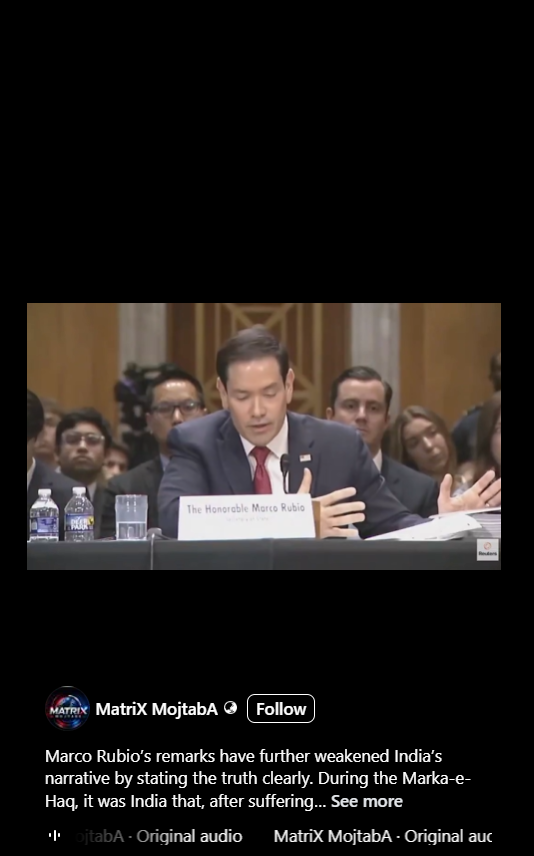
In the next step of our investigation, we found a video published on Reuters' official YouTube channel on June 2, 2026, whose background matches the viral video. However, nowhere in this original video is Marco Rubio heard saying that India was the first to request a ceasefire from Pakistan. The post link and screenshot can be seen below.
https://www.youtube.com/watch?v=qSpp5IYO6Cs
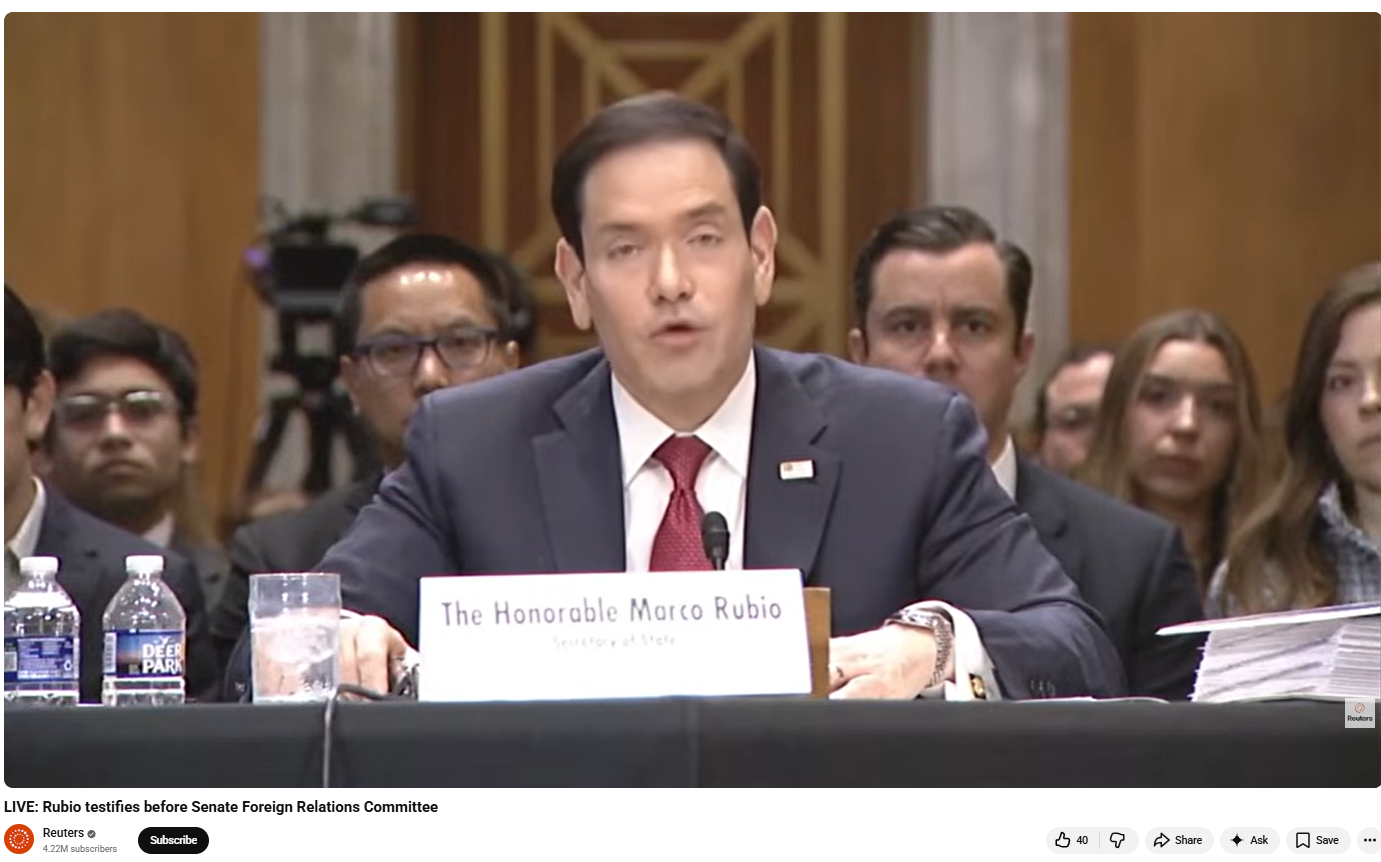
At the 2-hour 8-minute 55-second mark of the Reuters video, Rubio only states that the US played a role in ending the India-Pakistan conflict. Following this, he discusses the Thailand-Cambodia conflict. This makes it clear that the alleged statement in the viral video was digitally added or edited in, and is not part of the original footage.
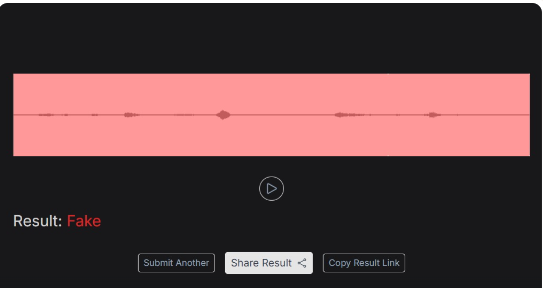
Taking the investigation further, we scanned the suspicious audio portion of the viral video using the AI detection tool 'Resemble AI'. According to the analysis results, clear signs of audio manipulation were detected.
Conclusion:
Our investigation revealed that the video has been digitally manipulated. Rubio did state that the United States played a role in ending the conflict, but he never said that India was the first to request a ceasefire from Pakistan. This alleged statement was not part of the original video and was altered by adding it later.
