
#FactCheck-AI-Generated Video Falsely Shared as Attack on Iran’s South Pars Gas Field
Executive Summary
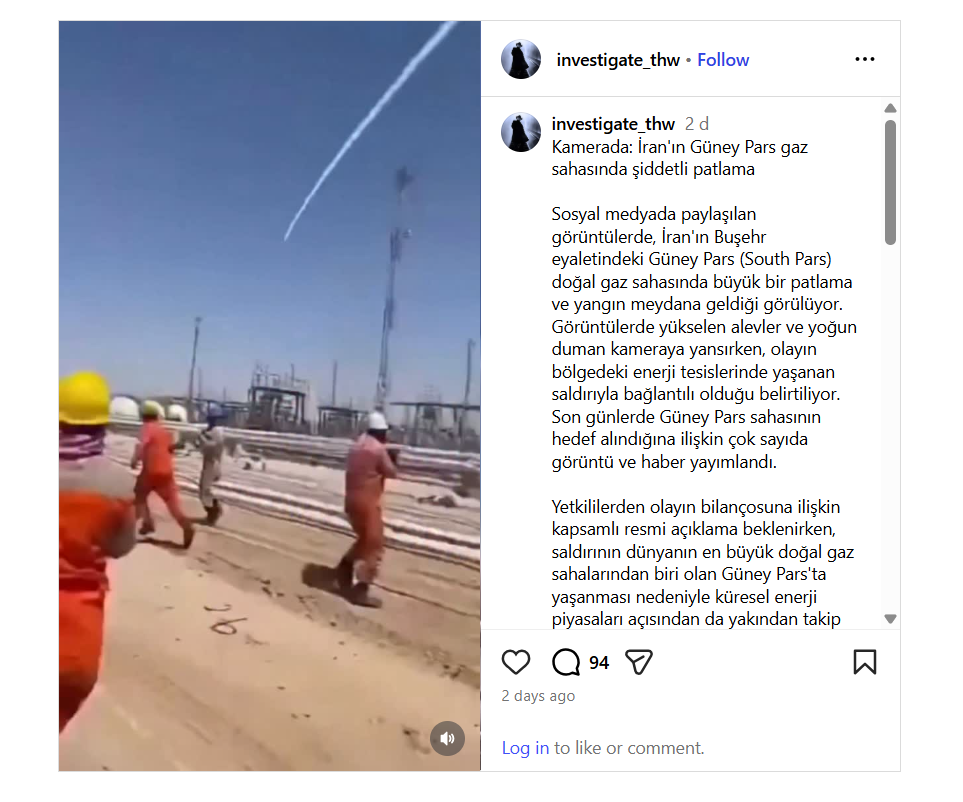
A video showing a massive explosion and fire at what appears to be a gas facility is being widely circulated on social media. In the footage, huge flames and thick smoke can be seen rising from the site, while workers and security personnel are seen running around in panic.
The video is being shared with the claim that it shows an attack on the South Pars natural gas field in Iran’s Bushehr province.
CyberPeace Research Wing’s research found the viral claim to be false. The research revealed that the video is not from a real incident but was created using Artificial Intelligence (AI) and is being circulated with a false narrative.
Claim
The viral video is being shared on social media with the claim that it shows an attack on energy facilities at the South Pars natural gas field in Iran’s Bushehr province.
Post Link:
https://www.instagram.com/reel/DanX_iJIfTu/?utm_source=ig_web_button_share_sheet
Fact Check
To verify the claim, we extracted multiple keyframes from the viral video and conducted a reverse image search using Google Lens. During the search, we did not find any credible news report or reliable source confirming that the video was related to any attack on Iran’s South Pars gas field.
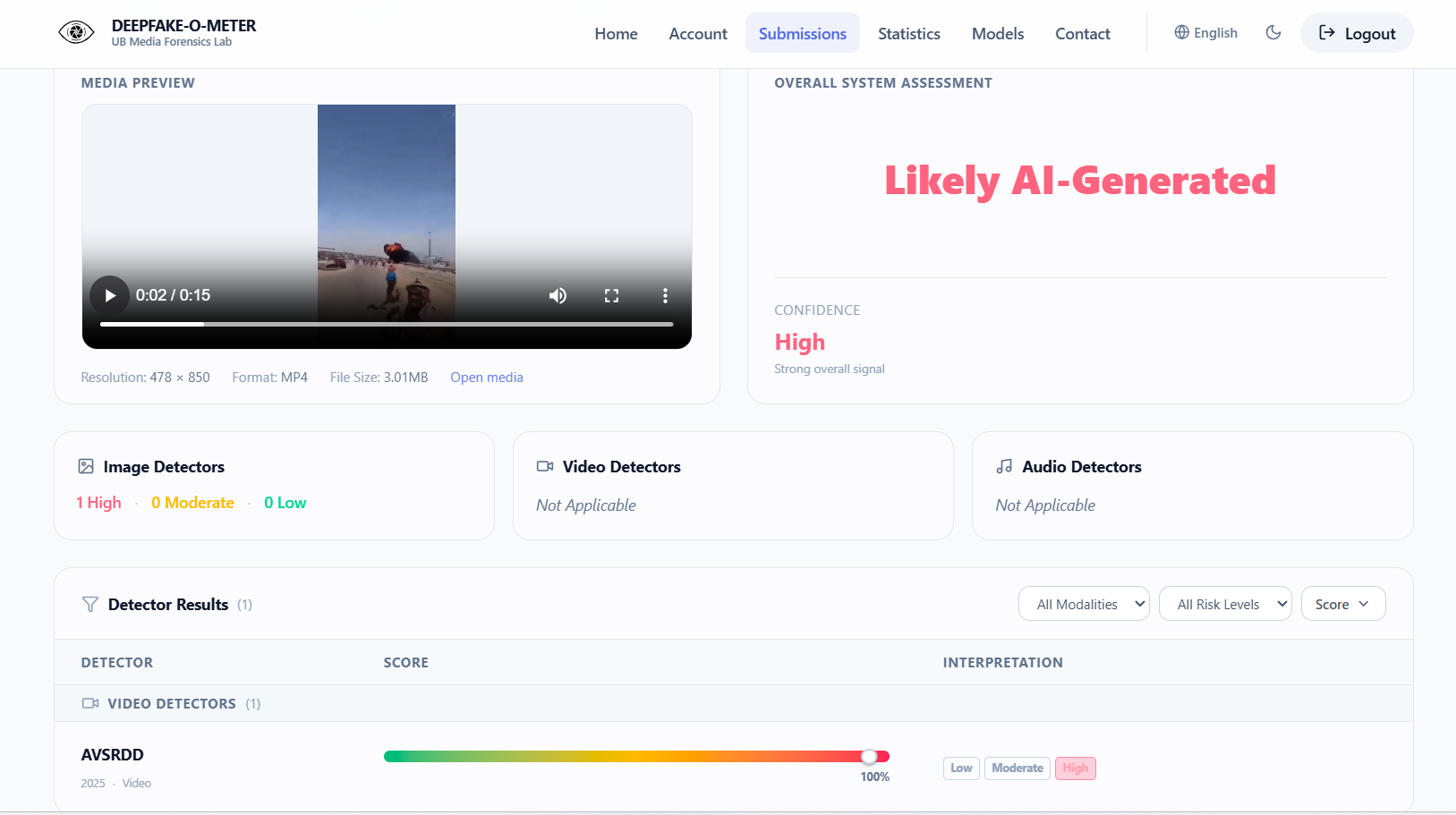
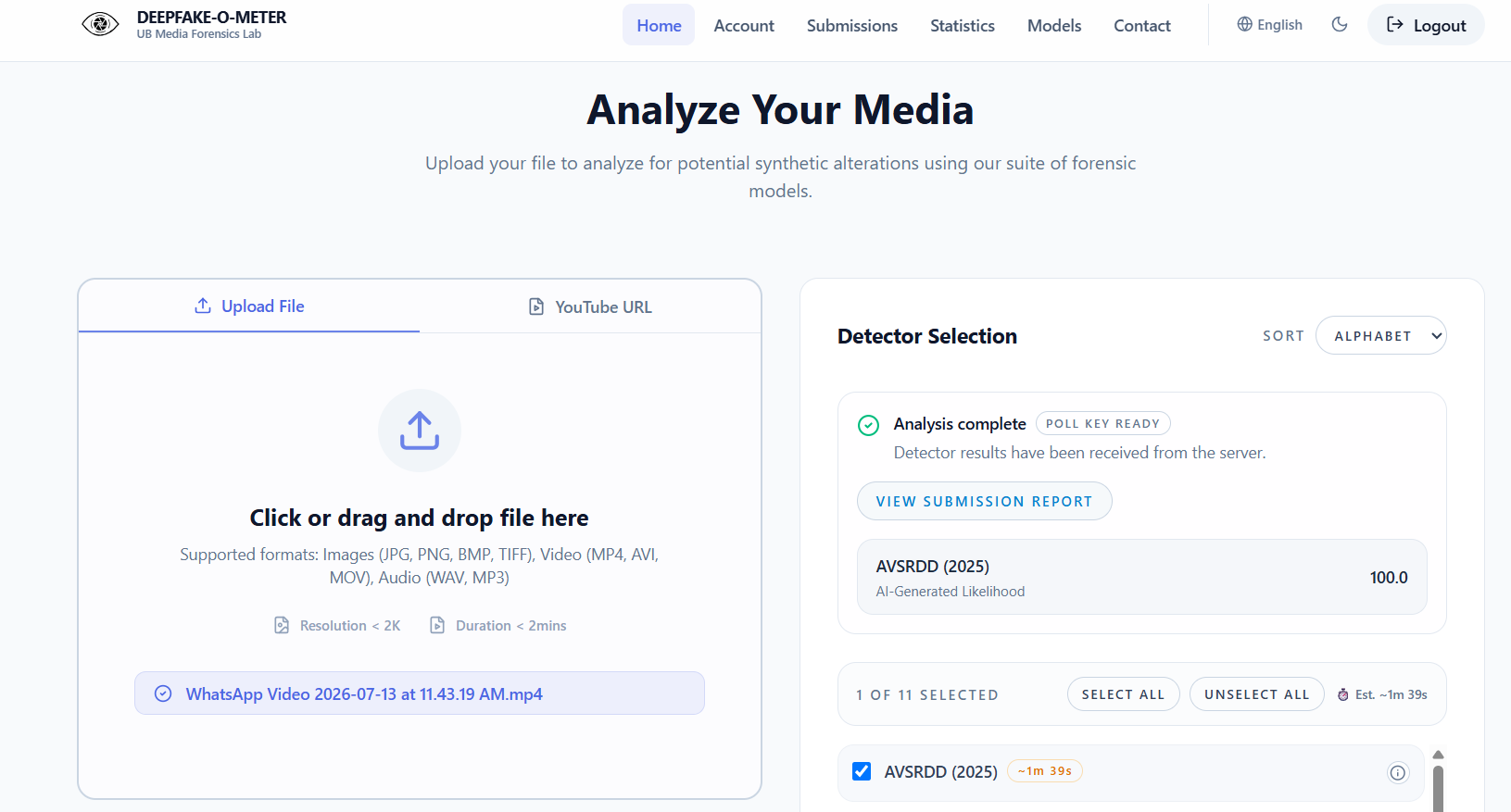
In the next step of the research, we analysed the video using the AI detection tool Deepfake-O-Meter. The tool’s results indicated that the viral video was approximately 100% likely to be AI-generated.
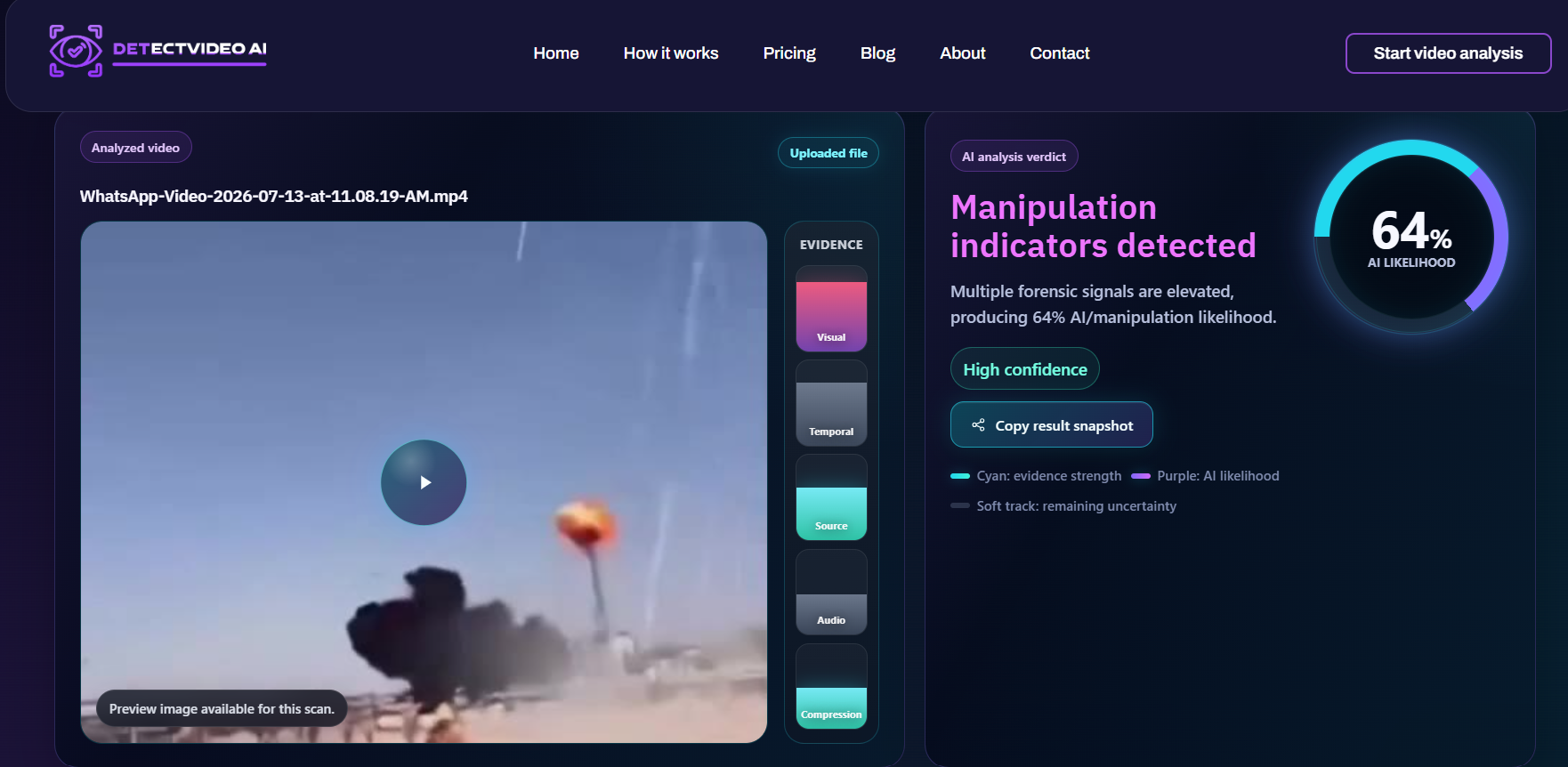
For further verification, we also checked the video using another AI detection tool, DetectVideo AI. The analysis showed that the video had a 64% probability of being AI-generated.
Conclusion
Our research found that the viral claim is false. The video does not show any real attack on Iran’s South Pars natural gas field. The footage was found to be AI-generated and is being shared on social media with a misleading claim.

Related Blogs
Introduction
The use of AI in content production, especially images and videos, is changing the foundations of evidence. AI-generated videos and images can mirror a person’s facial features, voice, or actions with a level of fidelity to which the average individual may not be able to distinguish real from fake. The ability to provide creative solutions is indeed a beneficial aspect of this technology. However, its misuse has been rapidly escalating over recent years. This creates threats to privacy and dignity, and facilitates the creation of dis/misinformation. Its real-world consequences are the manipulation of elections, national security threats, and the erosion of trust in society.
Why India Needs Deepfake Regulation
Deepfake regulation is urgently needed in India, evidenced by the recent Rashmika Mandanna incident, where a hoax deepfake of an actress created a scandal throughout the country. This was the first time that an individual's image was superimposed on the body of another woman in a viral deepfake video that fooled many viewers and created outrage among those who were deceived by the video. The incident even led to law enforcement agencies issuing warnings to the public about the dangers of manipulated media.
This was not an isolated incident; many influencers, actors, leaders and common people have fallen victim to deepfake pornography, deepfake speech scams, defraudations, and other malicious uses of deepfake technology. The rapid proliferation of deepfake technology is outpacing any efforts by lawmakers to regulate its widespread use. In this regard, a Private Member’s Bill was introduced in the Lok Sabha in its Winter Session. This proposal was presented to the Lok Sabha as an individual MP's Private Member's Bill. Even though these have had a low rate of success in being passed into law historically, they do provide an opportunity for the government to take notice of and respond to emerging issues. In fact, Private Member's Bills have been the catalyst for government action on many important matters and have also provided an avenue for parliamentary discussion and future policy creation. The introduction of this Bill demonstrates the importance of addressing the public concern surrounding digital impersonation and demonstrates that the Parliament acknowledges digital deepfakes to be a significant concern and, therefore, in need of a legislative framework to combat them.
Key Features Proposed by the New Deepfake Regulation Bill
The proposed legislation aims to create a strong legal structure around the creation, distribution and use of deepfake content in India. Its five core proposals are:
1. Prior Consent Requirement: individuals must give their written approval before producing or distributing deepfake media, including digital representations of themselves, as well as their faces, images, likenesses and voices. This aims to protect women, celebrities, minors, and everyday citizens against the use of their identities with the intent to harm them or their reputations or to harass them through the production of deepfakes.
2. Penalties for Malicious Deepfakes: Serious criminal consequences should be placed for creating or sharing deepfake media, particularly when it is intended to cause harm (defame, harass, impersonate, deceive or manipulate another person). The Bill also addresses financially fraudulent use of deepfakes, political misinformation, interfering with elections and other types of explicit AI-generated media.
3. Establishment of a Deepfake Task Force: To look at the potential impact of deepfakes on national security, elections and public order, as well as on public safety and privacy. This group will work with academic institutions, AI research labs and technology companies to create advanced tools for the detection of deepfakes and establish best practices for the safe and responsible use of generative AI.
4. Creation of a Deepfake Detection and Awareness Fund: To assist with the development of tools for detecting deepfakes, increasing the capacity of law enforcement agencies to investigate cybercrime, promoting public awareness of deepfakes through national campaigns, and funding research on artificial intelligence safety and misinformation.
How Other Countries Are Handling Deepfakes
1. United States
Many States in the United States, including California and Texas, have enacted laws to prohibit the use of politically deceptive deepfakes during elections. Additionally, the Federal Government is currently developing regulations requiring that AI-generated content be clearly labelled. Social Media Platforms are also being encouraged to implement a requirement for users to disclose deepfakes.
2. United Kingdom
In the United Kingdom, it is illegal to create or distribute intimate deepfake images without consent; violators face jail time. The Online Safety Act emphasises the accountability of digital media providers by requiring them to identify, eliminate, and avert harmful synthetic content, which makes their role in curating safe environments all the more important.
3. European Union:
The EU has enacted the EU AI Act, which governs the use of deepfakes by requiring an explicit label to be affixed to any AI-generated content. The absence of a label would subject an offending party to potentially severe regulatory consequences; therefore, any platform wishing to do business in the EU should evaluate the risks associated with deepfakes and adhere strictly to the EU's guidelines for transparency regarding manipulated media.
4. China:
China has among the most rigorous regulations regarding deepfakes anywhere on the planet. All AI-manipulated media will have to be marked with a visible watermark, users will have to authenticate their identities prior to being allowed to use advanced AI tools, and online platforms have a legal requirement to take proactive measures to identify and remove synthetic materials from circulation.
Conclusion
Deepfake technology has the potential to be one of the greatest (and most dangerous) innovations of AI technology. There is much to learn from incidents such as that involving Rashmika Mandanna, as well as the proliferation of deepfake technology that abuses globally, demonstrating how easily truth can be altered in the digital realm. The new Private Member's Bill created by India seeks to provide for a comprehensive framework to address these abuses based on prior consent, penalties that actually work, technical preparedness, and public education/awareness. With other nations of the world moving towards increased regulation of AI technology, proposals such as this provide a direction for India to become a leader in the field of responsible digital governance.
References
- https://www.ndtv.com/india-news/lok-sabha-introduces-bill-to-regulate-deepfake-content-with-consent-rules-9761943
- https://m.economictimes.com/news/india/shiv-sena-mp-introduces-private-members-bill-to-regulate-deepfakes/articleshow/125802794.cms
- https://www.bbc.com/news/world-asia-india-67305557
- https://www.akingump.com/en/insights/blogs/ag-data-dive/california-deepfake-laws-first-in-country-to-take-effect
- https://codes.findlaw.com/tx/penal-code/penal-sect-21-165/
- https://www.mishcon.com/news/when-ai-impersonates-taking-action-against-deepfakes-in-the-uk#:~:text=As%20of%2031%20January%202024,of%20intimate%20deepfakes%20without%20consent.
- https://www.politico.eu/article/eu-tech-ai-deepfakes-labeling-rules-images-elections-iti-c2pa/
- https://www.reuters.com/article/technology/china-seeks-to-root-out-fake-news-and-deepfakes-with-new-online-content-rules-idUSKBN1Y30VT/

Introduction
In the dynamic realm of online gaming, where virtual worlds and competitive landscapes converge, ensuring the safety of players has become an imperative task. As the digital gaming community expands, so do the challenges of navigating potential risks and threats. There is a need for crucial strategies and measures aimed at safeguarding players and fostering a secure environment where gamers can fully immerse themselves in their passion without compromising their well-being. Online gaming, a thriving industry, makes gamers attractive targets for cyber theft, including account takeovers (ATO). ATO involves stealing characters, inventory, in-game currencies, achievements, and skins, with high-level accounts as prime targets. Gamers face real-life consequences as fraud within games can compromise personal information, including location, credentials, credit card details, and more. Protecting oneself involves maintaining privacy in sharing information, enabling two-factor authentication, and employing strong, unique passwords with security solutions that provide additional safeguards for an uninterrupted gaming experience.
Online Gaming Carries The Following Major Risks
Viruses and malware: Searching for less expensive or free downloads of your preferred games puts you in danger of accidentally downloading malware and viruses.
Theft of identity: Hackers gather information that is personally identifiable to create victimised identities. The chat feature is one of the possible risks of playing video games online with random people.
Invasion of a profile: It's not advisable to use an identical password and username across all of your preferred video game platforms since if hackers manage to obtain your login information, they may hack all of your player accounts and perhaps take control of them.
Swatting and doxing: Doxxing is the practice of hackers publishing your residential location or telephone number online after obtaining your private data. Swatting is a dangerous harassment tactic originating from online gaming, involving false emergency reports to provoke an excessive police response at the unsuspecting victim's location.
How Hacking Poses Serious Risks to Online Gaming Security
The video game industry has experienced rapid growth in recent times, catering to millions of players throughout the globe who relish an extensive array of engaging adventures. But because of its widespread use, hackers are now more likely to target it in an attempt to take advantage of its weaknesses.
Hackers are drawn to the gaming business for a number of reasons.
Due to its enormous income potential, this sector is an appealing option for investment. Players' large audience offers a treasure trove of private data that can be used for fraudulent transactions and other nefarious activities. Because of its high exposure, the sector is a tempting target for attackers looking to achieve recognition or make an impression. Customers wish to add modifications, cheats, or other external software to their contest, which increases the threat. In this sector, there is fierce competition, and winners take home large cash awards. This encourages players to use DDoS attacks to their advantage in order to outperform their rivals.
Importance of Secure Servers
Upgrade server applications and Modifications
Maintaining the most recent versions of all server software is a basic step in gaming server security. Updates and patches are regularly released by developers to address security flaws, therefore it's imperative to install them right away. If you ignore updates, your server becomes vulnerable to known vulnerabilities and a prime target for cybercriminals.
Put Strict Access Controls in Place
It is essential to manage who has permission to access your gaming system to avoid violations and unwanted access. Use strong password regulations and mandate complicated passwords for administrators on the system.
Two-factor authentication (2FA) into place
Restrict access rights to those who need them for administrative tasks to lessen the possibility of unlicensed individuals taking over a server.Safety Measures Players should be urged to adhere to best practices, which include:
Using secure passwords.
Avoid clicking on dubious links.
Updating software & apps regularly.
Upgrading antivirus software regularlyImproving cybersecurity practices and bringing attention to possible risks can greatly improve the general population's safety in gaming.
Conclusion
The internet gaming industry's rapid expansion has resulted in increased security threats in addition to recreation. Players confront various threats, including growing hacking attempts, sensitive information leaks, malware, identity theft, and doxing. To reduce these dangers, secure servers are essential. They emphasise the importance of frequent upgrades, restricting access, and user training. It becomes essential to enable security measures to keep ahead of emerging dangers. Enhancing safety measures guarantees a more secure gaming environment, safeguarding the large population that participates in this quickly changing digital space.
References
https://www.kaspersky.com/resource-center/threats/top-10-online-gaming-risks
https://www.imperva.com/blog/cyber-attacks-gaming-industry/
https://www.techslang.com/securing-gaming-servers-cybersecurity-best-practices-for-online-gaming-communities/
https://www.vox.com/policy-and-politics/2018/1/13/16888710/barris-swatting-death-charges

Executive Summary
Amid the ongoing tensions between the United States, Israel, and Iran, a video circulating on social media claims that Israeli Prime Minister Benjamin Netanyahu was seen running after Iran launched an attack on Israel. However, research by the CyberPeace found the viral claim to be misleading. Our research revealed that the video has no connection with the current tensions between the United States, Israel, and Iran. In reality, the clip dates back to 2021, when Netanyahu was rushing inside Israel’s parliament to cast his vote after arriving late.
Claim:
On the social media platform X (formerly Twitter), a user shared the video on March 5, 2026, claiming that Netanyahu had fled and gone into hiding due to fear of Iran. The post included inflammatory remarks suggesting that Iran had demonstrated its power and that Netanyahu had abandoned his country out of fear.

Fact Check
To verify the authenticity of the video, we extracted several keyframes and conducted a reverse image search on Google. During the research, we found the same video on the official X account of Benjamin Netanyahu, posted on December 14, 2021. In the post, Netanyahu wrote in Hebrew, which translates to,“I am always proud to run for you. Photographed half an hour ago in the Knesset.”
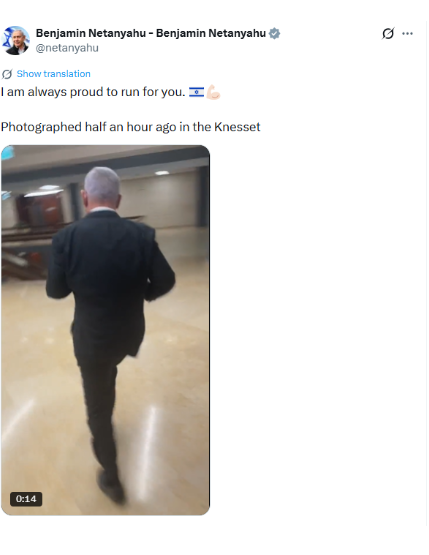
Further research also led us to a Hebrew news website where the same video was published.
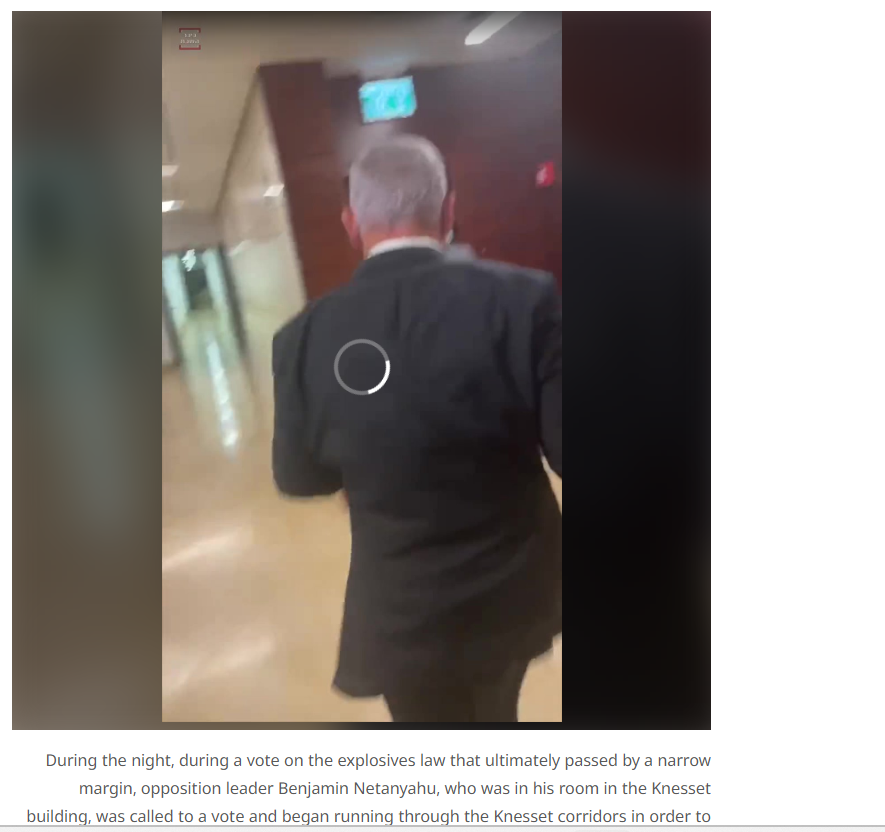
According to the report, voting in the Knesset (Israel’s parliament) continued throughout the night, and an explosives-related bill was passed by a very narrow margin. At the time, opposition leader Benjamin Netanyahu was in his room inside the Knesset building. When he was called for the vote, he hurried through the parliament corridors to reach the chamber in time to cast his vote.
Conclusion:
Our research found that the viral video is unrelated to the ongoing tensions involving the United States, Israel, and Iran. The footage is from 2021 and shows Benjamin Netanyahu rushing inside the Knesset to participate in a parliamentary vote after being called in at the last moment.
