
#FactCheck- Old SCO Summit Video Misrepresented as Pakistan-Iran Meeting
Executive Summary
Amid reports of a two-week ceasefire announced on April 8, 2026, between the United States and Iran, and claims that Pakistan is facilitating peace talks between the two nations, a video showing leaders of Pakistan and Iran meeting has gone viral on social media. The video is being shared with the claim that Pakistani leaders received a grand welcome upon arriving in Iran for the April 11, 2026 talks. However, an research by the CyberPeace found the claim to be misleading. The viral video is not recent but dates back to September 2025.
Claim
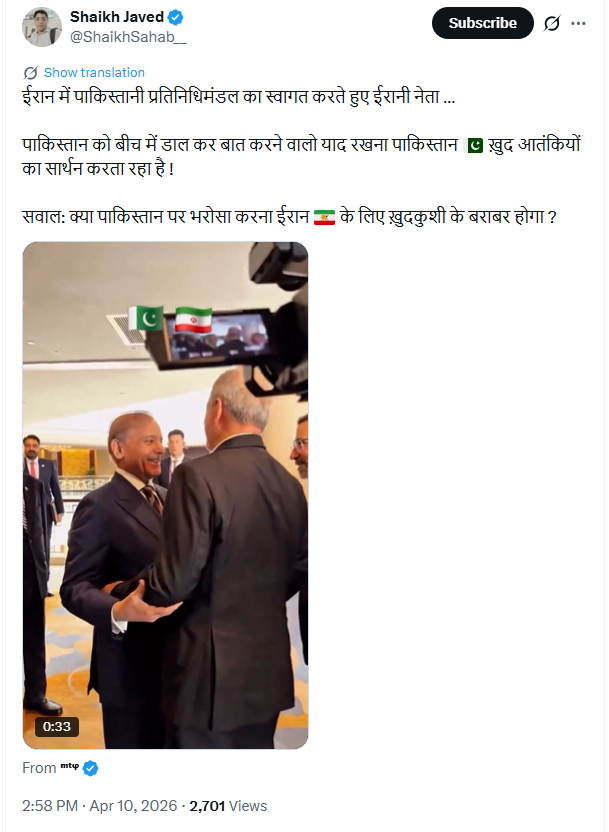
An X (formerly Twitter) user shared the video on April 10, 2026, claiming that it shows Pakistani leaders being warmly welcomed in Iran.
Post link:
Fact Check
To verify the claim, we extracted keyframes from the viral video and conducted a reverse image search. This led us to the same video posted on a Facebook account named “Bhurgri Siddique” on September 1, 2025.

According to the available information, the video shows a meeting between a Pakistani delegation and Iranian leaders. Further keyword searches helped us locate a longer version of the same video on the official YouTube channel “HT Videos,” also uploaded on September 1, 2025. The video was from the Shanghai Cooperation Organisation Summit 2025 held in China, where leaders from various member countries, including Pakistan and Iran, had met.

Conclusion
The viral claim is misleading. The video does not show any recent meeting or welcome ceremony in Iran linked to the ongoing ceasefire talks. Instead, it is an old clip from September 2025, recorded during the SCO Summit in China. There is no evidence to suggest that the footage is related to current developments between the United States, Iran, and Pakistan. The video has been taken out of context and is being reshared with a false narrative to mislead users.

Related Blogs

Executive Summary
A video circulating on social media allegedly shows an Indian Army Air Defence JCO, identified as “Anurag Thakur,” criticising the Central government and announcing his resignation. In the clip, the individual is purportedly heard expressing disappointment with the government’s support for soldiers and claiming heavy casualties within his unit. However, an investigation by the CyberPeace Research Wing has found the claim to be false and the video manipulated.
Claim:
The viral post alleges that an Indian Army Air Defence JCO criticised the Centre and resigned, citing lack of support for soldiers and unacknowledged casualties.

Fact Check:
A keyword search using terms such as “Indian Army Air Defence JCO,” “Anurag Thakur,” and “resignation” did not yield any credible news reports supporting the claim. A reverse image search of the viral clip led to an original video posted by ANI on April 22, 2026. The ANI watermark is also visible in the viral footage, confirming that the clip has been sourced from this original video.
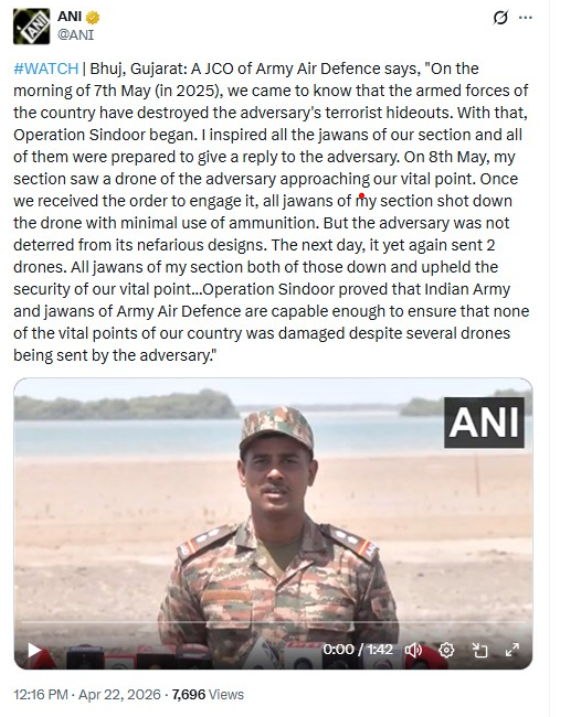
In the authentic version, the same personnel appears in the same setting, but he is speaking in Hindi about operations against adversary drones during “Operation Sindoor” in May 2025. He explains how his unit detected and neutralised multiple drones, successfully safeguarding a critical installation. Importantly, the original video does not identify the individual as Anurag Thakur, nor does it contain any reference to resignation, casualties, or criticism of the government.
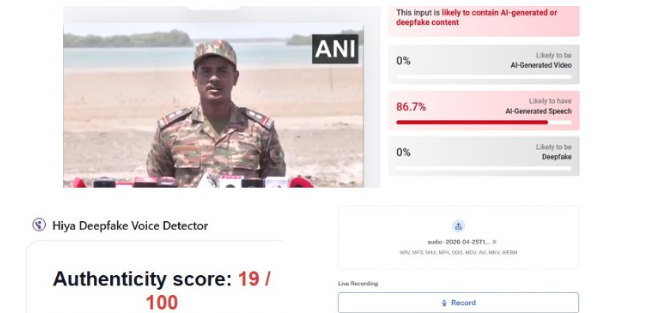
Further technical analysis using the AI detection tool Hive Moderation indicated that the audio in the viral clip has an 86 percent likelihood of being artificially generated.
Conclusion:
The viral video has been altered with fabricated audio to falsely claim that an Indian Army officer criticised the government and resigned. The claim is baseless and the clip is a clear case of a deepfake created to mislead viewers.
.webp)
Introduction
India has always been celebrated as the land of abundance, once known as the ‘golden bird’ that attracted the world with its prosperity and wisdom. In the current century, as the world moves deeper into the age where every nation is redefining its strength through advancements in every sector, including technology, India is preparing for a powerful transformation. “Viksit Bharat 2047” is an initiative aimed at achieving India's aspiration of becoming a developed nation by its centennial year of independence. India’s growth story is shifting as it takes a step towards development in every field and advances progress both in terms of generating economic growth and breakthroughs in technologies across industries.
Today, when technology touches every aspect of our lives, ‘Cyber Security’ becomes a key area that will significantly drive progress and hold strong importance under the Viksit Bharat vision, especially with the rise of emerging technologies such as AI, quantum computing, cryptography, 5G & 6G, robotics and automation, Internet of Things (IoT), augmented reality (AR) & virtual reality (VR) etc.
Key Initiatives Taken by the Centre
Indian Cyber Crime Coordination Centre:
The Indian Cybercrime Coordination Centre (I4C) was established by the Ministry of Home Affairs (MHA) to provide a framework for law enforcement agencies (LEAs) to deal with cybercrime in a coordinated and comprehensive manner. I4C is actively working on initiatives to combat emerging threats in cyberspace, and it has become a strong pillar of India’s cybersecurity and cybercrime prevention. The ‘National Cyber Crime Reporting Portal’, equipped with a 24x7 cybercrime helpline number 1930, is one of the key components of the I4C.
Recently under I4C, key initiatives were launched to strengthen cybersecurity. The Cyber Fraud Mitigation Centre (CFMC) has been incorporated to bring together banks, financial institutions, telecom companies, Internet Service Providers, and law enforcement agencies on a single platform to tackle online financial crimes efficiently. The Cyber Commandos Program will establish a specialised wing of trained Cyber Commandos in states, Union Territories, and Central Police Organisations to counter rising cyber threats. The Samanvay platform, a web-based Joint Cybercrime Investigation Facility System, has been introduced as a one-stop data repository for cybercrime to foster data sharing and collaboration. The Suspect Registry Portal, connected to the National Cybercrime Reporting Portal (NCRP), has been designed to track cybercriminals and strengthen fraud risk management.
India’s AI Mission:-
The Indian Cabinet has approved a comprehensive national-level IndiaAI Mission. The mission aims to strengthen the Indian AI innovation ecosystem by democratizing computing access, improving data quality, developing indigenous AI capabilities, attracting top AI talent, enabling industry collaboration, providing startup risk capital, ensuring socially impactful AI projects, and bolstering ethical AI. Through India AI Mission, the government is facilitating the development of India’s own foundational models, including Large Language Models (LLMs) and problem-specific AI solutions tailored to Indian needs.
The mission is implemented by the 'IndiaAI' Independent Business Division (IBD) under the Digital India Corporation (DIC) and consists of several components, such as IndiaAI Compute Capacity, IndiaAI Innovation Centre (IAIC), IndiaAI Datasets Platform, IndiaAI Application Development Initiative, IndiaAI Future Skills, IndiaAI Startup Financing, and Safe & Trusted AI. The main objective is to create and nurture an ecosystem for India’s AI innovation.
Startup India:-
With more than 1.59 lakh startups recognised by the Department for Promotion of Industry and Internal Trade (DPIIT) as of January 15, 2025, India has firmly established itself as the third-largest startup ecosystem in the world. Startup India is a flagship initiative launched by the Government of India on 16th January 2016 to build a strong ecosystem for nurturing innovation and startups in the country, which will drive economic growth and generate large-scale employment opportunities.
Key Regulations:-
The Centre, in order to better regulate the cyber domain, has come up with significant regulations. To protect the personal data of citizens, the Digital Personal Data Protection Act, 2023 has been enacted. The Intermediary Guidelines 2021 lay down obligations on social media platforms and intermediaries to ensure accountability and user safety. The Telecommunications Act 2023 has also been enacted. Further, the Promotion and Regulation of Online Gaming Bill 2025, passed by Parliament on 21st August 2025, aims to address related concerns. In addition, Cert-In issues guidelines & advisories from time to time, in order to strengthen cybersecurity.
CyberPeace Outlook
CyberPeace has been at the forefront in transforming policy, technology, and ethical growth in the cyber landscape through its key initiatives. In 2023, CyberPeace hosted the Global CyberPeace Summit in collaboration with Civil 20 and G20 India, with knowledge support from the United Service Institution of India and participation from MeitY, NCIIPC, CERT-In, Zoom, Meta, InMobi, ICANN, Internet Society, MANRS, APNIC, and leading universities, which helped shape critical global conversations on trust, safety, and collaboration in cyberspace.
Viksit Bharat 2047 is more than just a vision for economic success; it is a pledge to create a nation that is technologically secure, resilient, and globally competitive. In this journey, cybersecurity will be at the heart of India's digital reboot, securing its innovation, empowering its citizens, and ensuring its future.
References
- https://www.cyberpeace.org/resources/blogs/i4c-foundation-day-celebration-shri-amit-shah-launches-key-initiatives-to-tackle-cybercrime
- https://www.cyberpeace.org/resources/blogs/indiaai-mission
- https://bharatarticles.com/viksit-bharat-2047-vision-challenges-and-roadmap-to-a-developed-india/
- https://www.pib.gov.in/PressReleasePage.aspx?PRID=2012355
- https://www.pib.gov.in/PressReleasePage.aspx?PRID=2093125

Executive Summary
A video is being widely shared on social media showing an Indian cargo vessel engulfed in flames. It is being claimed that the ship was carrying chemical weapons to Israel and was hit by a drone near the Strait of Hormuz off the coast of Oman, after which it caught fire. CyberPeace Research Wing research found the claim to be misleading. The viral video does not show any such incident. Instead, it shows an Indian cargo vessel on fire, but in a completely different context unrelated to any drone strike or weapons shipment allegation.
Claim
The video circulating online is being shared with the claim that it shows an Indian cargo ship carrying chemical weapons to Israel, which was struck by a drone near the Strait of Hormuz off the coast of Oman and subsequently caught fire. https://x.com/ThokaReturns/status/2070224570792251728 , https://x.com/ThokaReturns/status/2070224570792251728

FactCheck
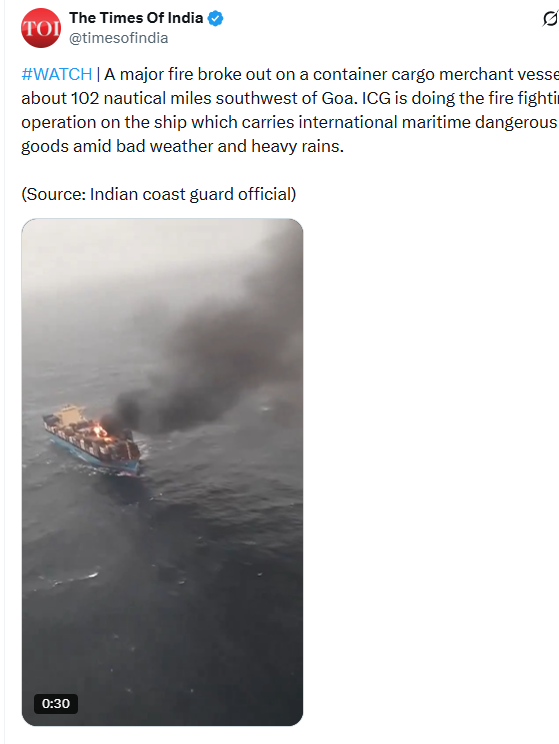
A reverse image search of keyframes from the viral video led us to a Times of India post dated July 19, 2024, on X (formerly Twitter), which contained the same visuals. The report stated that a major fire broke out on a container cargo vessel approximately 102 nautical miles southwest of Goa, following which the Indian Coast Guard launched firefighting operations. A comparison between the news footage and the viral video confirmed that both refer to the same incident. https://x.com/timesofindia/status/1814352708473856175
We also found an India Today report on the incident, which stated that the vessel was travelling from Mundra to Colombo, Sri Lanka, when the fire broke out. The Indian Coast Guard immediately diverted one of its ships to respond to the distress call. https://www.indiatoday.in/india/story/fire-breaks-out-container-cargo-merchant-vessel-off-goa-coast-rescue-ops-2569320-2024-07-19

Conclusion
Our research confirms that an old and unrelated video has been shared on social media as visuals of an Indian cargo vessel allegedly hit by a drone off the coast of Oman
