
Can a Screenshot Be Evidence? | Understanding the Reliability of Digital Evidence
Forensic Reality Check
A screenshot shows what appeared on a screen. It does not automatically prove who created the content, whether it was altered, or what happened outside the frame.
Introduction
In today's period of time ,we observe that a screenshot seems like evidence. A screenshot can feel like proof. The screenshot comes with a name, a timestamp, a profile picture and a message all neatly placed inside an app we know well. In cases involving fraud, harassment, workplace conflicts or cybercrime individuals often send a screenshot first to the police, a company or a lawyer. This makes sense. When something troubling shows up on a phone or computer taking a screenshot feels like the thing to do. The screenshot captures the moment like a photo.
There is another side to evidence. A screenshot only shows what was on the screen at that moment. The screenshot does not tell us where the content came from. The screenshot does not show who had control of the account. The screenshot does not say if the image was edited. The screenshot does not reveal what happened before or after the screenshot was taken. The Bharatiya Sakshya Adhiniyam 2023 recognizes records. The Bharatiya Sakshya Adhiniyam also sets out rules for proving them. That means the real question is not just "Is this screenshot real?" The bigger question is, "Can we explain and verify the story behind it?”
A screenshot is evidence - but not automatically the whole story
Think of a common situation. A person receives a screenshot of a chat in which someone appears to demand money and threaten to publish private documents. The image looks genuine. Yet an investigator would still ask: Was the message actually sent? From which account or device? Does the date and time match the service records? Is the conversation complete?
Those questions do not make the screenshot useless. They make the investigation stronger.
Digital information can be copied, compressed, cropped, forwarded, or edited with little visible sign. NIST describes digital evidence as information of probative value stored or transmitted in binary form and emphasises preservation because digital files are easy to change. [3][4] The forensic mindset is simple: ask whether an image’s origin, context and integrity can be explained.
What makes a screenshot more reliable?
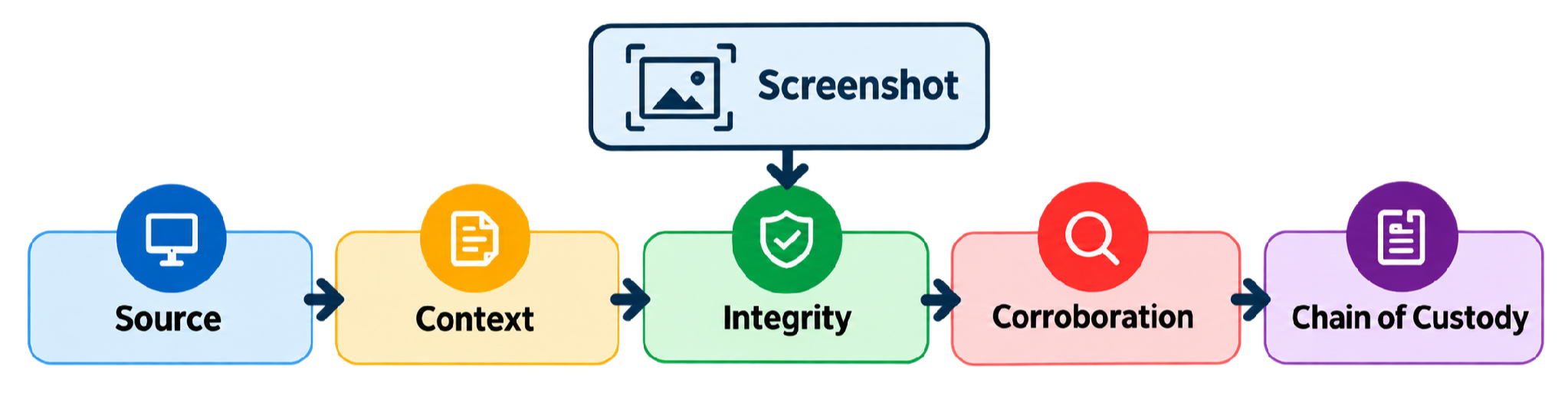
A stronger evidence package normally answers five practical questions:
• Source - Where did the image come from: a phone, laptop, messaging application, email client, cloud account, or another person?
• Context - Does it preserve the relevant username, number, URL, date, time, surrounding messages, and sequence?
• Integrity - Has the original file been retained, and can later changes be detected?
• Corroboration - Do other records support the same event, such as device artifacts, email headers, transaction data, or witness accounts?
• Chain of custody - Who collected it, when, how was it transferred, and where was it stored?
Hashing helps with integrity. A cryptographic hash acts like a digital fingerprint for a file. If the file changes, its hash value changes. NIST recommends hashing digital images and other evidence objects and securely preserving the resulting hash values. [4][5] A hash does not prove the content is truthful; it helps show that the file examined is the file that was preserved.
The Indian legal angle: admissibility is not the same as authenticity
India’s current evidence framework is equally important. The Bharatiya Sakshya Adhiniyam, 2023 came into force on 1 July 2024. Section 61 says an electronic or digital record cannot be denied admissibility merely because it is electronic, subject to the Act. Section 62 directs that electronic records are proved in accordance with Section 63. [1]
Section 63 sets out conditions for admissibility and, where it applies, requires a certificate to accompany the electronic record when submitted for admission. The Schedule includes device details and fields for the relevant hash value and algorithm. [2]
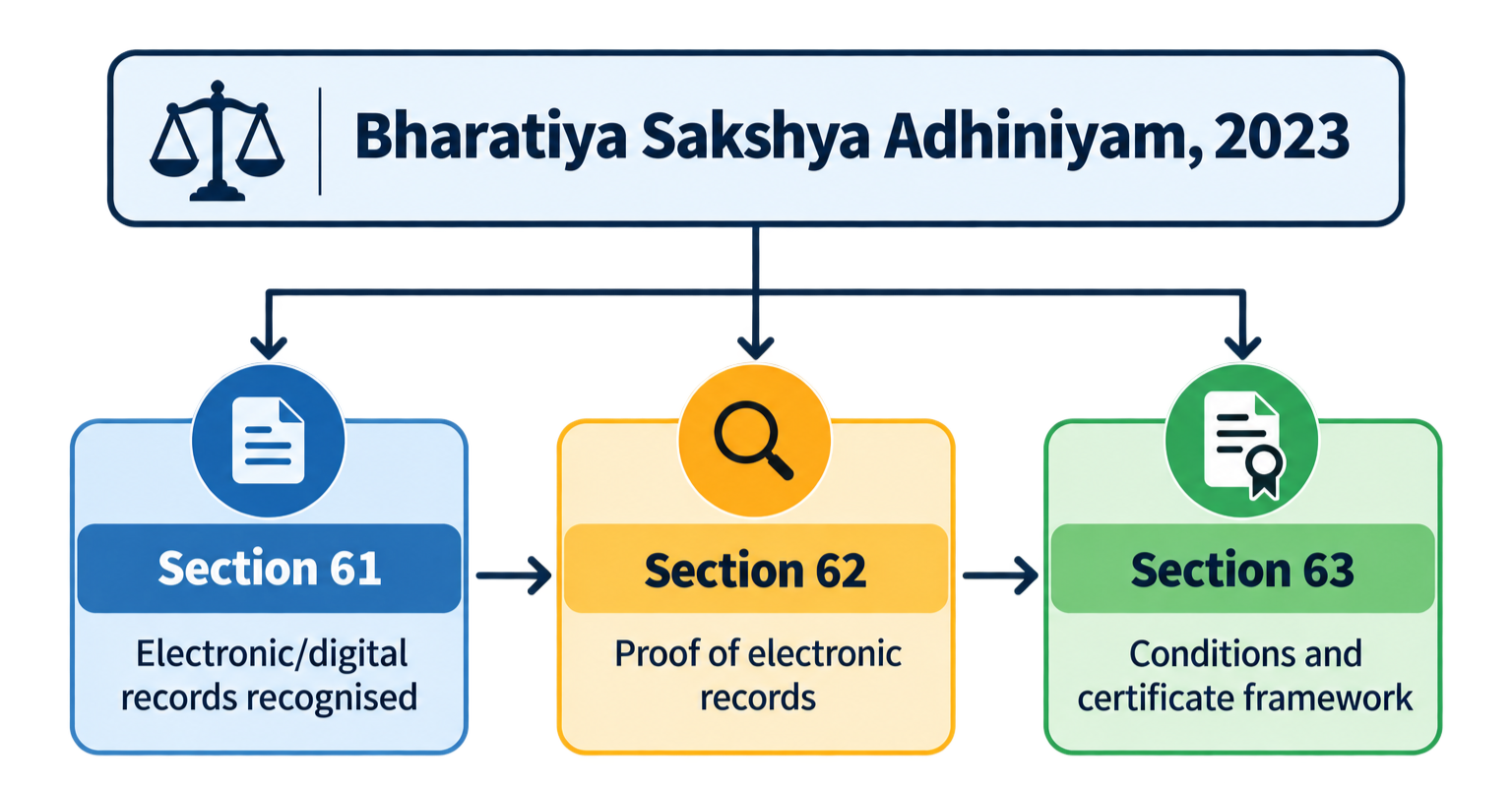
There is an important practical nuance: not every screenshot automatically requires the same proof route. Treatment can depend on what is produced, how it was obtained, and how it is tendered. Investigators should preserve the underlying source wherever lawfully possible rather than treat a screenshot as a self-proving substitute for the original record.
In Pooranmal v. State of Rajasthan, decided on 10 March 2026, the Supreme Court considered call detail records rather than screenshots and held, in that case, that the certificate requirement under Section 63 was mandatory for the electronic record relied upon there. [6] The broader lesson is that digital evidence must be presented through the legal proof framework that applies to it.
REALISTIC EXAMPLE A screenshot arrives. The investigation starts.
Consider a realistic cyber-fraud complaint. A victim receives a screenshot showing what appears to be a message from a senior company executive asking an employee to transfer money urgently. The safest response is not to decide immediately whether it “looks genuine.” The investigator can preserve the original image, record its source, calculate a hash, and look for supporting material: the actual chat or email, device data, account identifiers, timestamps, transaction records, or login history.
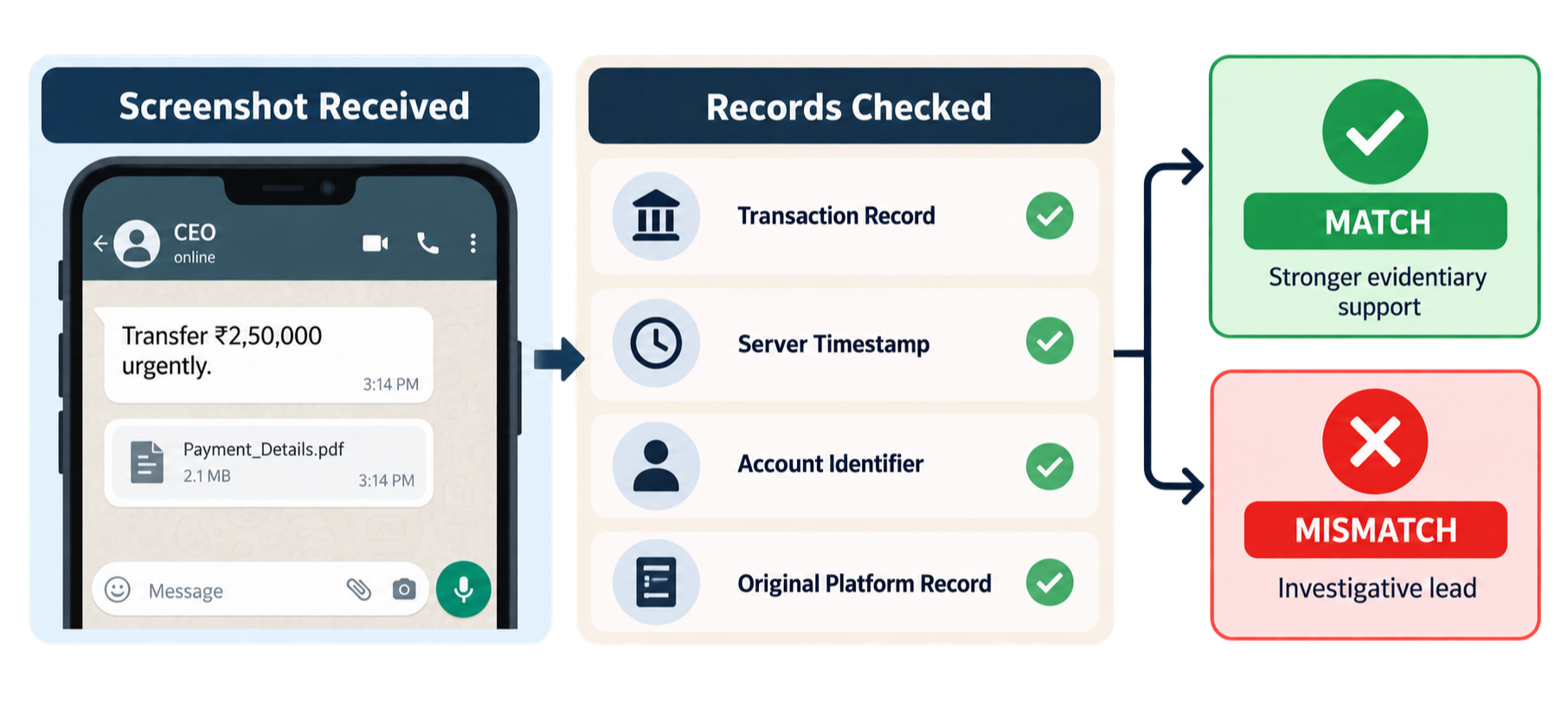
Suppose the screenshot says 3:14 p.m., but the underlying account record shows the message was never sent. That contradiction becomes an investigative lead. If the screenshot matches the original device data and independent records, its evidentiary value becomes stronger.
The human side matters too. A victim should not be criticised for taking a screenshot. In many incidents, it is the quickest way to show another person what happened. The forensic response is simply to go one step further: preserve first, verify next, interpret last.
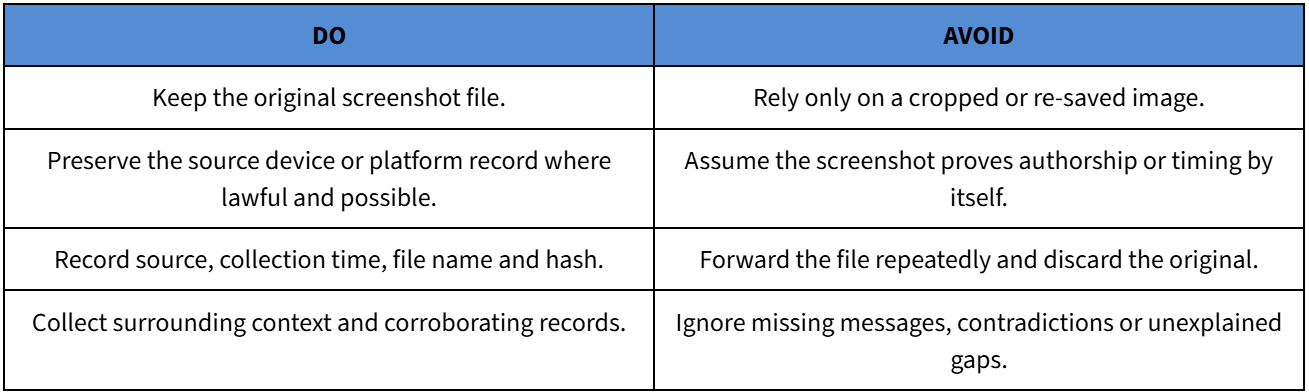
A small checklist can prevent a big evidentiary problem
The bigger lesson
Screenshots are valuable because they can preserve a moment that may later disappear: a threat, a suspicious payment instruction, a spoofed webpage, or a social-media post. But a convincing image is not the same thing as a complete digital record.
Good digital forensics connects the artifact to a source, a timeline, a method of collection, and independent facts. NIST’s work on digital evidence emphasises preservation, controlled handling, and awareness of the limits of forensic conclusions. [3][4] Confidence should follow the evidence, not replace it.
Conclusion
So, can a screenshot be evidence? The important question is whether the screenshot can be verified, put into context and backed up by evidence when the case needs it. For citizens the practical advice is clear: keep the screenshot, do not delete the screenshot, keep the screenshot and do not rely only on a forwarded copy. Preserving the source device or original platform record were lawful and possible.
For investigators and organisations, the standard is higher. Record the source and collection details preserve the screenshot, calculate and document hashes, maintain chain of custody and seek corroboration. A screenshot can open the door to an investigation. Good forensic practice is what helps establish what happened on the side of that door.
References
[1] India Code, The Bharatiya Sakshya Adhiniyam, 2023, Sections 61-62; commencement from 1 July 2024. Source
[2] India Code, The Bharatiya Sakshya Adhiniyam, 2023, Section 63 and Schedule - certificate for electronic records, including device particulars and hash value fields. Source
[3] NIST, Digital Evidence, overview of digital evidence and forensic challenges. Source
[4] NIST, Digital Evidence Preservation: Considerations for Evidence Handlers, NISTIR 8387, 2022. Source
[5] NIST / OSAC Lexicon, “Hash, Hash Value,” 2025. Source
[6] Supreme Court of India, Pooranmal v. State of Rajasthan & Anr., 2026 INSC 217, judgment dated 10 March 2026. Source
[7] NIST, ANSI/ASTM E3016-18 Standard Guide for Establishing Confidence in Digital and Multimedia Evidence Forensic Results by Error Mitigation Analysis. Source

Related Blogs

About Global Commission on Internet Governance
The Global Commission on Internet Governance was established in January 2014 with the goal of formulating and advancing a strategic vision for Internet governance going forward. Independent research on Internet-related issues of international public policy is carried out and supported over the two-year initiative. An official commission report with particular policy recommendations for the future of Internet governance will be made available as a result of this initiative.
There are two goals for the Global Commission on Internet Governance. First, it will encourage a broad and inclusive public discussion on how Internet governance will develop globally. Second, through its comprehensive policy-oriented report and the subsequent marketing of this final report, the Global Commission on Internet Governance will present its findings to key stakeholders at major Internet governance events.
The Internet: exploring the world wide web and the deep web
The Internet can be thought of as a vast networking infrastructure, or network of networks. By linking millions of computers worldwide, it creates a network that allows any two computers, provided they are both online, to speak with one another.
The Hypertext Transfer Protocol is the only language spoken over the Internet and is used by the Web to transfer data. Email, which depends on File Transfer Protocol, Usenet newsgroups, Simple Mail Transfer Protocol, and instant messaging, is also used on the Internet—not the Web. Thus, even though it's a sizable chunk, the Web is only a part of the Internet [1]. In summary, the deep Web is the portion of the Internet that is not visible to the naked eye. It is stuff from the World Wide Web that isn't available on the main Web. Standard search engines cannot reach it. More than 500 times larger than the visible Web is this enormous subset of the Internet [1-2].
The Global Commission on Internet Governance will concentrate on four principal themes:
• Improving the legitimacy of government, including standards and methods for regulation;
• Promoting economic innovation and expansion, including the development of infrastructure, competition laws, and vital Internet resources;
• Safeguarding online human rights, including establishing the idea of technological neutrality for rights to privacy, human rights, and freedom of expression;
• Preventing systemic risk includes setting standards for state behaviour, cooperating with law enforcement to combat cybercrime, preventing its spread, fostering confidence, and addressing disarmament-related issues.
Dark Web
The part of the deep Web that has been purposefully concealed and is unreachable using conventional Web browsers is known as the "dark Web." Dark Web sites are a platform for Internet users who value their anonymity since they shield users from prying eyes and typically utilize encryption to thwart monitoring. The Tor network is a well-known source for content that may be discovered on the dark web. Only a unique Web browser known as the Tor browser is required to access the anonymous Tor network (Tor 2014). It was a technique for anonymous online communication that the US Naval Research Laboratory first introduced as The Onion Routing (Tor) project in 2002. Many of the functionality offered by Tor are also available on I2P, another network. On the other hand, I2P was intended to function as a network inside the Internet, with traffic contained within its boundaries. Better anonymous access to the open Internet is offered by Tor, while a more dependable and stable "network within the network" is provided by I2P [3].
Cybersecurity in the dark web
Cyber crime is not any different than crime in the real world — it is just executed in a new medium: “Virtual criminality’ is basically the same as the terrestrial crime with which we are familiar. To be sure, some of the manifestations are new. But a great deal of crime committed with or against computers differs only in terms of the medium. While the technology of implementation, and particularly its efficiency, may be without precedent, the crime is fundamentally familiar. It is less a question of something completely different than a recognizable crime committed in a completely different way [4].”
Dark web monitoring
The dark Web, in general, and the Tor network, in particular, offer a secure platform for cybercriminals to support a vast amount of illegal activities — from anonymous marketplaces to secure means of communication, to an untraceable and difficult to shut down infrastructure for deploying malware and botnets.
As such, it has become increasingly important for security agencies to track and monitor the activities in the dark Web, focusing today on Tor networks, but possibly extending to other technologies in the near future. Due to its intricate webbing and design, monitoring the dark Web will continue to pose significant challenges. Efforts to address it should be focused on the areas discussed below [5].
Hidden service directory of dark web
A domain database used by both Tor and I2P is based on a distributed system called a "distributed hash table," or DHT. In order for a DHT to function, its nodes must cooperate to store and manage a portion of the database, which takes the shape of a key-value store. Owing to the distributed character of the domain resolution process for hidden services, nodes inside the DHT can be positioned to track requests originating from a certain domain [6].
Conclusion
The deep Web, and especially dark Web networks like Tor (2004), offer bad actors a practical means of transacting in products anonymously and lawfully.
The absence of discernible activity in non-traditional dark web networks is not evidence of their nonexistence. As per the guiding philosophy of the dark web, the actions are actually harder to identify and monitor. Critical mass is one of the market's driving forces. It seems unlikely that operators on the black Web will require a great degree of stealth until the repercussions are severe enough, should they be caught. It is possible that certain websites might go down, have a short trading window, and then reappear, which would make it harder to look into them.
References
- Ciancaglini, Vincenzo, Marco Balduzzi, Max Goncharov and Robert McArdle. 2013. “Deepweb and Cybercrime: It’s Not All About TOR.” Trend Micro Research Paper. October.
- Coughlin, Con. 2014. “How Social Media Is Helping Islamic State to Spread Its Poison.” The Telegraph, November 5.
- Dahl, Julia. 2014. “Identity Theft Ensnares Millions while the Law Plays Catch Up.” CBS News, July 14.
- Dean, Matt. 2014. “Digital Currencies Fueling Crime on the Dark Side of the Internet.” Fox Business, December 18.
- Falconer, Joel. 2012. “A Journey into the Dark Corners of the Deep Web.” The Next Web, October 8.
- Gehl, Robert W. 2014. “Power/Freedom on the Dark Web: A Digital Ethnography of the Dark Web Social Network.” New Media & Society, October 15. http://nms.sagepub.com/content/early/2014/ 10/16/1461444814554900.full#ref-38.

Introduction
The Kumbh Mela is known worldwide as India's most significant pilgrimage and has earned a place on the UNESCO Intangible Cultural Heritage of Humanity list in 2017. This year, the Maha Kumbh will be held in Prayagraj, Uttar Pradesh, with 40 crore devotees from all over the world expected to attend this momentous event from January 13th to 26th February 2025. As the world embraces the blessings of digitalisation, people are increasingly relying on the Internet for arranging their travel, booking rooms, and securing accommodations for this grand spiritual journey.
However, amidst this digital age, where the conveniences offered are manifold, there also lurks the shadow of deceit. Cybercriminals are finding innovative ways to entrap innocent individuals. Fraudulent activities are on the rise, with wrongdoers operating fake websites that promise secure bookings for cottages, tents, and other accommodations for the Mahakumbh event. Like the deceptive mirage that the desert traveller may mistakenly believe to be an oasis, these malicious sites lure pilgrims with the false hope of easy arrangements, only to exploit their trust and commit malicious cyber fraudulent activities.
Policy and Preventive Measures Taken by Government
This year, the government has taken steps to utilise digitalisation services to enhance the experience of devotees, blending innovation with tradition. However, considering the rise in cyber scams, a dedicated cyber police station has also been established at Maha Kumbh 2025 to address threats such as the misuse of AI, the dark web, and social media platforms. This initiative aims to protect devotees from potential scams.
To strengthen safety measures, a special team of selected officers from across the state has been deployed in Mahakumbh Nagar, Prayagraj, to provide cybersecurity and ensure the safety of pilgrims. A dedicated cyber police station or digital police station will ensure round-the-clock monitoring of cyberspace.
The cybersecurity team has already identified 44 suspicious websites and initiated action against them. To further safeguard devotees attending Maha Kumbh 2025, a large-scale awareness campaign is being conducted to educate users about potential cyber threats.
The Role of Digital Discipline in Navigating the Uncharted Waters of the Internet
As the Yajurveda (ancient Vedic scriptures of Hinduism) reminds us ‘सत्यं चानृतं च सत्यं अभवत्, यदेतत् तपसा तप्यताम्।’. This learning translates into English as "Truth and falsehood are both present, yet truth is purified through intense discipline”. The Mahakumbh is a confluence not just of rivers but of faith and humanity's eternal quest for truth (Satyam). In the digital age, this vigilance extends to protecting ourselves from cyber frauds and scams that exploit the sanctity of occasions like the Mahakumbh. Just as devotees seek purity through holy rituals, we must also embrace Digital Discipline to navigate the confluence of tradition and technology safely.
Here are some Digital Discipline best practices you must follow:
- Be cautious of fake websites, fraudulent travel agencies, and scam bookings. Always verify legitimacy before engaging in any transactions.
- Stay alert for fake donation requests and only contribute to verified organizations.
- Be aware of any mis/disinformation and implausible claims surrounding the Mahakumbh event and verify it from authenticated sources. The official website of Mahakumbh is https://kumbh.gov.in.
- To report any cybercrime or issue, you can report it on the National Cyber Crime Reporting Portal at https://cybercrime.gov.in/, equipped with a 24x7 helpline 1930 that serves as a powerful resource available to the victims of cybercrimes to report their cases.
Conclusion
Netizens worldwide must prioritise Digital Discipline to ensure they are safeguarded from the snares of these cyber miscreants, so that they may safely and joyfully embark on their journey to the Maha Kumbh and receive divine blessings and purity of purpose through the experience.
References
- https://www.deccanherald.com/india/uttar-pradesh/up-police-gets-on-its-toes-to-ensure-cyber-safe-maha-kumbh-3335911
- https://www.hindustantimes.com/cities/others/four-cyber-crooks-held-for-operating-fake-booking-websites-101735326388201.html
- https://www.indiatvnews.com/uttar-pradesh/maha-kumbh-2025-cyber-police-station-set-up-in-prayagraj-to-safeguard-devotees-from-online-frauds-in-city-preparation-security-other-details-2024-12-11-965745
- https://organiser.org/2024/12/12/268915/bharat/mahakumbh-2025-cyber-police-station-set-up-to-protect-devotees-from-ai-and-social-media-scammers/
- https://www.ptinews.com/story/national/maha-kumbh-56-cyber-warriors-deployed-to-safeguard-devotees-against-online-scams/2135062

Executive Summary
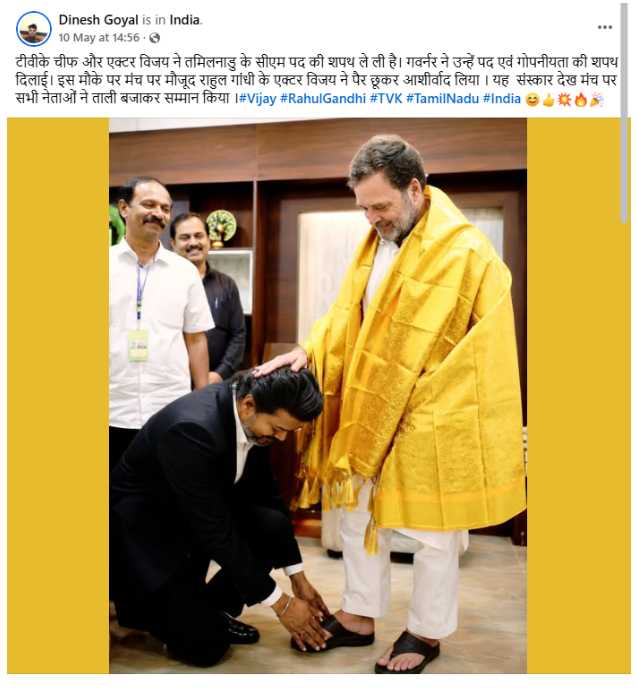
A viral image circulating on social media claims that Tamil Nadu Chief Minister C. Joseph Vijay touched the feet of Congress leader Rahul Gandhi during his swearing-in ceremony, while Congress and several other parties extended support to his government. The image is being widely shared with captions suggesting it captures a real political moment. However, CyberPeace Research Wing research has found the claim to be false. The image is AI-generated and does not depict any real event.
Claim
A Facebook user shared the viral image on May 10, 2026, claiming that TVK chief and actor Vijay had taken oath as the Chief Minister of Tamil Nadu. The post further claimed that during the ceremony, Vijay touched Rahul Gandhi’s feet to seek blessings, and the gesture was applauded by leaders present on stage. The post, along with archived links and screenshots, is being circulated as authentic evidence of the alleged incident.
- https://www.facebook.com/100057774695228/posts/1389222123013598/?rdid=FEzRYpVvSIieeUbj#
- https://archive.ph/kv4e1
Fact Check
A keyword-based search on Google did not return any credible news reports supporting the claim or confirming such an event. A closer visual examination of the image raised strong suspicions of AI manipulation, prompting verification through AI detection tools. When the image was analyzed using the SIGHTENGINE detection tool, the results indicated that the image is 99% likely to be AI-generated.

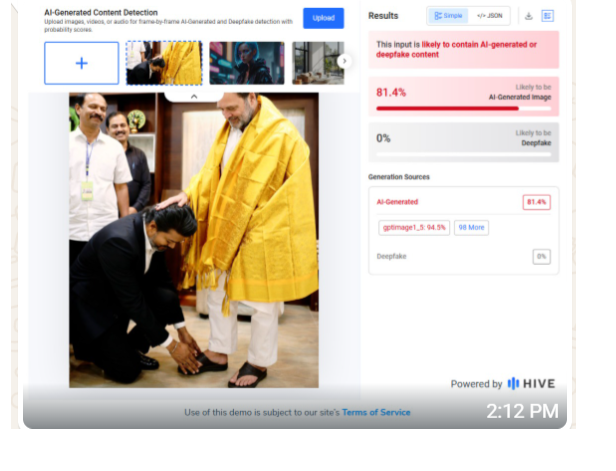
Further verification using another AI detection platform, HIVE MODERATION, also flagged the image as synthetic, showing an 81% probability of being AI-generated.
Conclusion
The research clearly shows that the viral image is not real. It has been generated using artificial intelligence and is being falsely shared as a real political event.
