
Unravelling AI-Generated Misinformation in the 'Delhi Chalo' Farmers' Protest
Introduction
A photo circulating on social media depicting modified tractors is being misrepresented as part of the 'Delhi Chalo' farmers' protest narrative. In the recent swirl of misinformation surrounding the 'Delhi Chalo' farmers' protest. A photo, ostensibly showing a phalanx of modified tractors, has been making the rounds on social media platforms, falsely tethered to the ongoing protests. This image, accompanied by a headline suggesting a mechanical metamorphosis to resist police barricades, was allegedly published by a news agency. However, beneath the surface of this viral phenomenon lies a more complex and fabricated reality.
The Movement
The 'Delhi Chalo' movement, a clarion call that resonated with thousands of farmers from the fertile plains of Punjab, the verdant fields of Haryana, and the sprawling expanses of Uttar Pradesh, has been a testament to the agrarian community's demand for assured crop prices and legal guarantees for the Minimum Support Price (MSP). The protest, which has seen the fortification of borders and the chaos at the Punjab-Haryana border on February 13, 2024, has become a crucible for the farmers' unyielding spirit.
Yet, amidst this backdrop of civil demonstration and discourse, a nefarious narrative of misinformation has taken root. The viral image, which has been shared with the fervour of wildfire, was accompanied by a screenshot of an article allegedly published by the news agency. This article, dated February 11, 2024, quoted an anonymous official who claimed that intelligence agencies had alerted the police to the protesters' plans to outfit tractors with hydraulic tools. The implication was clear: these machines had been transformed into battering rams against the bulwark of law enforcement.
The Pursuit of Truth
However, the India TV Fact Check team, in their relentless pursuit of truth, unearthed that the viral photo of these so-called modified tractors is nothing but a chimerical creation, a figment of artificial intelligence. Visual discrepancies betrayed its AI-generated nature.
This is not the first time that the misinformation has loomed over the farmers' protest. Previous instances, including a viral video of a modified tractor, have been debunked by the same fact-checking team. These efforts are a bulwark against the tide of false narratives that seek to muddy the waters of public understanding.
The claim that the photo depicted modified tractors intended for use in the ‘Delhi Chalo’ farmers' protest rally in Delhi on February 13, 2024, was a mirage.
The Fact Check
OpIndia, in their article, clarified that the photo used was a representative image created by AI and not a real photograph. To further scrutinize this viral photo, the HIVE AI detector tool was employed, indicating a 99.4% likelihood of the image being AI-generated. Thus, the claim made in the post was misleading.
The viral photo claiming that farmers had modified their tractors to avoid tear gas shells and remove barricades put up by the police during the rally was a digital illusion. The internet has become a fertile ground for the rapid spread of misinformation, reaching millions in an instant. Social media, with its complex algorithms, amplifies this spread, as any interaction, even those intended to debunk false information, inadvertently increases its reach. This phenomenon is exacerbated by 'echo chambers,' where users are exposed to a homogenous stream of content that reinforces their pre-existing beliefs, making it difficult to encounter and consider alternative perspectives.
Conclusion
The viral image depicting modified tractors for the ‘Delhi Chalo’ farmers' protest rally was a digital fabrication, a testament to the power of AI in creating convincing yet false narratives. As we navigate the labyrinth of information in the digital era, it is imperative to remain vigilant, to question the veracity of what we see and hear, and to rely on the diligent work of fact-checkers in discerning the truth. The mirage of modified machines serves as a stark reminder of the potency of misinformation and the importance of critical thinking in the age of artificial intelligence.
References
- https://www.indiatvnews.com/fact-check/fact-check-ai-generated-tractor-photo-misrepresented-delhi-chalo-farmers-protest-narrative-msp-police-barricades-punjab-haryana-uttar-pradesh-2024-02-15-917010
- https://factly.in/this-viral-image-depicting-modified-tractors-for-the-delhi-chalo-farmers-protest-rally-is-created-using-ai/

Related Blogs

Artificial Intelligence (AI) continues to grow in importance in today’s world not just as technological advancement but also becoming the backbone of economic growth, national security, scientific research, and digital governance. However, AI innovations of such a sophisticated kind require significant computing power that is currently only within the reach of a few countries. Against this backdrop, India and the United Arab Emirates (UAE) have taken a significant step by partnering to build one of India's most powerful AI supercomputing infrastructures. What began as a discussion about digital infrastructure under the ambit of the new found India-UAE tech relationship, has come to a stage that is likely to usher in new AI-centric developments in the country, while bolstering the partnership between India and UAE.
From Vision to Concrete Action
This collaboration stemmed from the strengthening relationship between India and the UAE. The goal is to focus more on digital cooperation after the 2023 G20 Summit held in India. During this period, Artificial Intelligence, digital public infrastructure, and strong digital ecosystems became key topics of discussion between the two countries. This partnership received formal recognition with the India-UAE Digital Infrastructure Memorandum of Understanding (MoU) signed in 2024. This agreement identified Artificial Intelligence, high-performance computing (HPC), cloud infrastructure, and digital innovation as priority areas for cooperation.
The initiative has now moved from policy talks to actual implementation. In February 2026, the UAE announced plans to deploy an 8-exaflop AI Super Computing Cluster in partnership between CDAC and in May 2026, when our Hon’ble Prime Minister visited UAE, both governments formalized the commercial framework for establishing the system, marking one of the largest AI infrastructure collaborations between the two countries. It was one the significant agendas discussed between the two countries among others.
What Does the Agreement Include?
The agreement between the countries is for the deployment of ‘Condor Galaxy India supercomputer’, which is an AI supercomputing cluster designed specifically for complex and advanced artificial intelligence workloads. Some of the major points of agreement include:
- Deployment of an 8 Exaflop Super Computing Cluster, meaning it can perform up to eight quintillion (8 × 10¹⁸) AI-related calculations per second. This would place it among the world's most powerful AI supercomputing systems.
- This project will be implemented by G42, which is an Abu Dhabi-based AI technology company, in partnership with India's Centre for Development of Advanced Computing (C-DAC).
- The computing infrastructure will utilise 64 Cerebras CS-3 AI systems, built using wafer-scale processor technology designed for large AI models.
- G42 and C-DAC will jointly oversee installation, deployment, operation, and maintenance of the infrastructure.
- The supercomputer will support India's IndiaAI Mission, strengthening domestic AI research and innovation. It is also a step in the direction of India’ AI mission through mindful collaboration.
- Notably, the system will be physically located within India and operate under Indian governance frameworks and laws ensuring that sensitive datasets remain under India’s jurisdiction.
While beyond the infrastructure, the partnership also aims for research efforts within fields like healthcare & genomics, climate change modeling & optimization of energy, geointelligence, research studies & government usages, as well as growing startups in AI. It is hoped that the computing infrastructure will be made accessible to researchers, academic bodies, government organizations & startups from both nations to foster collaborative research.
How Are India and the UAE Collaborating?
The partnership involves more than simply sharing the hardware, the two countries are entering into a multiyear technology partnership where each brings different but complementary expertise. On one hand India offers the knowledge and experience of C-DAC, a large number of AI engineers, startups, academics and researchers, and the IndiaAI Mission, a framework to enable access to the advanced computing infrastructure needed to use these researchers.
In return, the UAE offers investment in AI infrastructure and expertise in global AI cloud infrastructure, and sovereign AI platform development, from AI cloud infrastructure company G42, a company that has deployed large AI computing clusters as part of the Condor Galaxy network. Among the biggest names involved in the new initiative is also Cerebras Systems, the artificial intelligence (AI) computing company that will supply the AI chips for the supercomputer. The leading designer of AI compute technology, Cerebras develops the world's fastest AI hardware. In particular, the flagship Wafer Scale Engine (WSE-3), a revolutionary single chip that is the largest AI processor in the world, offers significant gains in speed and computational efficiency. This partnership will spur a joint R&D effort. That allows both India and the UAE to harness their respective knowledge and resources to accelerate better results for all stakeholders in various domains.
This collaboration will enable joint research and development (R&D), allowing both countries to combine their expertise and resources to produce more effective outcomes that are mutually beneficial across multiple sectors.
Cyber and Digital Security Benefits
From a cybersecurity perspective, this partnership is particularly significant.
- Moving towards AI Sovereignty
Possessing the infrastructure within India can ensure that sensitive government, healthcare, research, and enterprise data remains within Indian jurisdiction. This will reduce dependence on foreign cloud infrastructure while improving regulatory control over sensitive and critical datasets.
- Modernising Cyber Defence
Having a high-performance computing system will improve our cyber defence through AI-based threat detection, malware flagging, vulnerability assessment and cyber testing of safeguarding critical infrastructure. These are necessary in current times considering the growing capabilities and mode of cyber attacks.
- Secure AI Development
Countries worldwide are moving toward "Sovereign AI" which is a goal of developing AI systems within nationally governed infrastructure to protect sensitive information. The India-UAE partnership directly supports this objective by combining national governance and world-class computing capability development.
- Economic Benefits for India
The project offers several long-term economic advantages. First, easing the entry barrier for startups and researchers in India as they are often reliant on expensive overseas cloud computing services. Second, enabling availability of more computing power that can accelerate innovation across sectors such as healthcare, agriculture, manufacturing, fintech, education, and logistics. Third, stronger AI computing infrastructure could foster the inflow of global capital into India’s tech ecosystem by provisioning requisite resources to run frontier AI computations. Finally, the initiative supports India's ambition of becoming a global AI innovation hub under the IndiaAI Mission by enabling domestic development of advanced AI models rather than relying solely on imported technologies that will in long-term make India a sought out destination as an AI-hub.
Why the UAE Benefits?
In the case of the UAE, the partnership further helps Abu Dhabi's vision to become a global leader in artificial intelligence by extending the reach of G42's AI capabilities internationally, while strengthening ties with one of the world’s leading digital economies as a trusted strategic technology partner. In harnessing India's extensive talent base, research communities, and growing AI capabilities, the UAE unlocks opportunities for scale and innovation, while also cementing its status as a dependable technological enabler across emerging economies. The project is a part of the UAE’s long-standing agenda to move away from hydrocarbons and towards growth in areas such as AI, digital infrastructure, and technologies of the future.
Conclusion
The India-UAE supercomputer collaboration is a step in the direction of being self-dependent in terms of having a strong computing infrastructure base in India. This also changes the outlook of international technology partnerships from traditional trade relationships to collaborations focused on AI, digital infrastructure, research, and strategic innovation. AI is becoming a defining factor in economic competitiveness and national resilience on a global scale and the access to sovereign computing infrastructure will increasingly shape our influence in world markets. By uniting UAE’s investment capacity and AI infrastructure expertise and India’s advantages. If successfully implemented, the collaboration could serve as a model of what cooperation toward sovereign and trusted AI can entail.
REFERENCES
- https://www.pib.gov.in/PressReleasePage.aspx?PRID=2006207®=48&lang=2
- https://www.pib.gov.in/PressReleaseDetail.aspx?PRID=2261385®=48&lang=1
- https://www.pib.gov.in/PressReleaseDetail.aspx?PRID=2261393®=48&lang=1
Executive Summary:
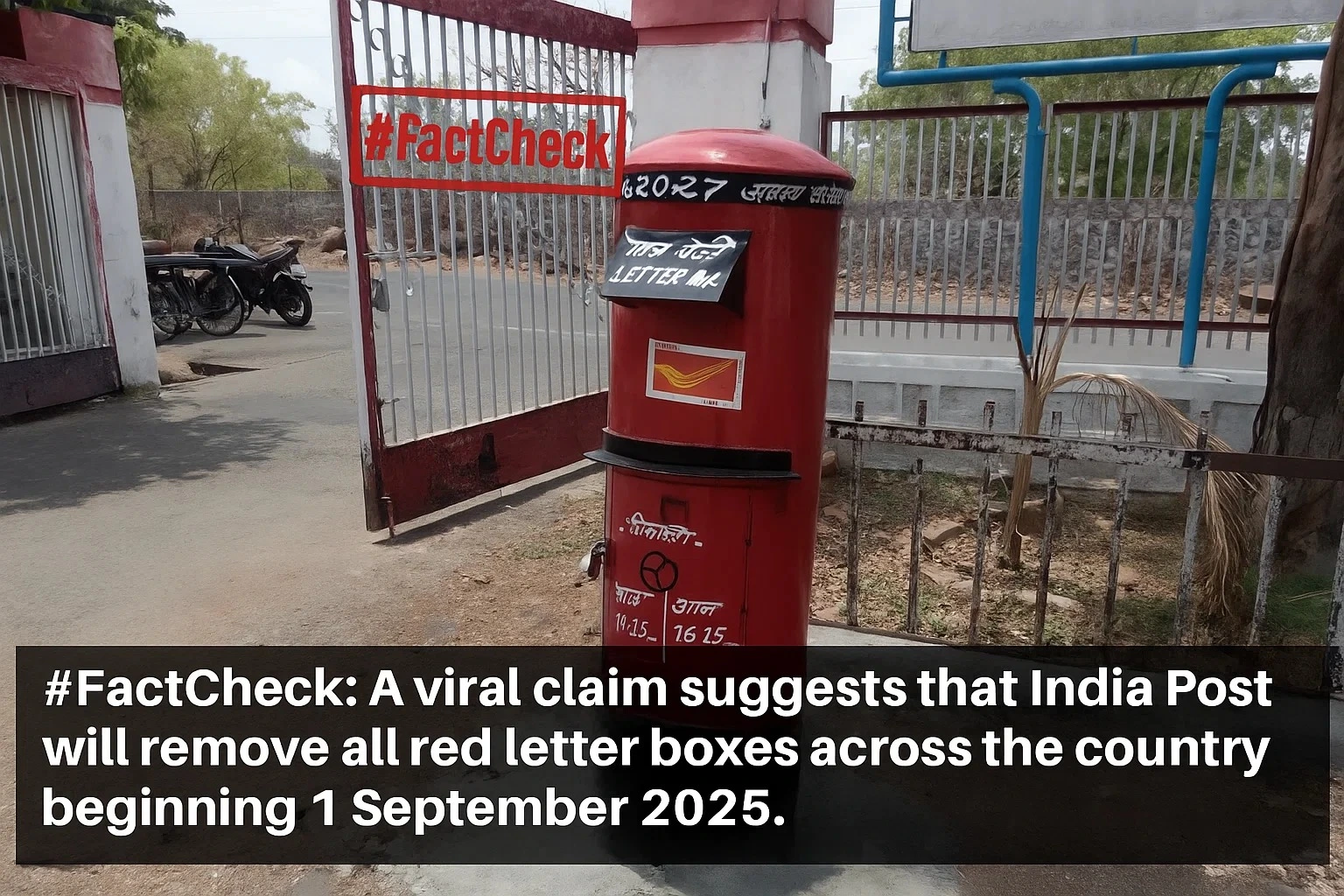
A viral social media claim suggested that India Post would discontinue all red post boxes across the country from 1 September 2025, attributing the move to the government’s Digital India initiative. However, fact-checking revealed this claim to be false. India Post’s official X (formerly Twitter) and Instagram handles clarified on 7 August 2025 that red letterboxes remain operational, calling them timeless symbols of connection and memories. No official notice or notification regarding their discontinuation exists on the Department of Posts’ website. This indicates the viral posts were misleading and aimed at creating confusion among the public.
Claim:
A claim is circulating on social media stating that India Post will discontinue all red post boxes across the country effective 1 September 2025. According to the viral posts,[archived link] the move is being linked to the government’s push towards Digital India, suggesting that traditional post boxes have lost their relevance in the digital era.

Fact Check:
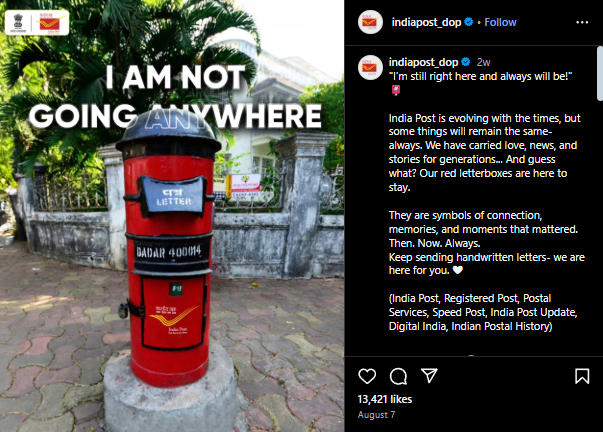
After conducting a reverse image analysis, we found that the official X handle of India Post, in a post dated 7 August 2025, clarified that the viral claim was incorrect and misleading. The post was shared with the caption:
I’m still right here and always will be!"
India Post is evolving with the times, but some things will remain the same- always. We have carried love, news, and stories for generations... And guess what? Our red letterboxes are here to stay.
They are symbols of connection, memories, and moments that mattered. Then. Now. Always.
Keep sending handwritten letters- we are here for you.
This directly refutes the viral claim about the discontinuation of the red post box from 1 September 2025. A similar clarification was also posted on the official Instagram handle @indiapost_dop on the same date.

Furthermore, after thoroughly reviewing the official website of the Department of Posts, Government of India, we found absolutely no trace, notice, or even the slightest mention of any plan to discontinue the iconic red post boxes. This complete absence of official communication strongly reinforces the fact that the viral claim is nothing more than a baseless and misleading rumour.

Conclusion:
The claim about the discontinuation of red post boxes from 1 September 2025 is false and misleading. India Post has officially confirmed that the iconic red letterboxes will continue to function as before and remain an integral part of India’s postal services.
- Claim: A viral claim suggests that India Post will remove all red letter boxes across the country beginning 1 September 2025.
- Claimed On: Social Media
- Fact Check: False and Misleading

Biological data includes biometric information such as fingerprints, facial recognition, DNA sequences, and behavioral traits. Genetic data can be extracted from an individual’s remains long after their death and can continue to identify both that individual and an expanding pool of their living relatives. This persistent identification can significantly reduce privacy over time, revealing genetic characteristics and familial relationships across successive generations.
Key Developments in Privacy Protection for Biological Data:
Legal texts have been created relating to personal data protection and privacy broadly, and can sometimes prove to be poor adaptations specifically for ‘biometric data’ and its safety. Some examples are mentioned below:
- EU and UK- GDPR
GDPR focuses primarily on biometrics in Biological Data while deciphering the technology's immense potential. The EU describes “personal data” under the General Data Protection Regulation (GDPR) including any identifiable information about a particular person. For example, this can include names, identification numbers, location data, and other structured and unstructured data. In addition, the GDPR has more specific requirements around processing sensitive or “special categories of personal data.” These “special categories” include things like genetic and biometric data. For biometric security to work well, citizens' rights must be protected appropriately, and the data collected by private and public concerns must be managed carefully and sensibly.
- USA
California Consumer Privacy Act (CCPA) grants Californian consumers the right to protect their personal information and biometric data including the right to disclosure or access, the right to be forgotten, and data portability. The sale of personal information and the option of opt-out is also given to consumers. Additionally, it contains the right to take legal action, with penalties imposed for violations.
The California Privacy Rights Act was passed on November 3, 2020, and took effect on January 1, 2023, with a lookback period starting January 1, 2022. It introduces sensitive personal information which includes biometric data and other sensitive details.
Virginia's Consumer Data Protection Act, effective from January 1, 2023, designates genetic and biometric data as sensitive data that must be protected.
Illinois' Biometric Information Privacy Act is recognised as the most robust biometric privacy law in the United States. The significance of the Rosenbach v. Six Flags case lies in the Illinois Supreme Court's ruling that a plaintiff does not need to demonstrate additional harm to impose penalties on a BIPA violator. A mere loss of statutory biometric privacy rights is sufficient to warrant penalties.
- India
As per Rule 2(1)(b) of the SPDI Rules, Sensitive Personal Data or Information, including biometric data is included under its meaning. The term ‘biometric data’ has not been defined in the Digital Personal Data Protection Act, 2023. The need for data privacy under the DPDP Act emerges only if such data is subsequently digitised under extraction and manipulation, including notice and consent requirements and penalties.
The Biotech-PRIDE (Promotion of Research and Innovation through Data Exchange) Guidelines of 2021 are aimed at fostering an exchange of information which would thereby enhance research and innovation among various research groups nationwide. These guidelines do not deal with the generation of biological data but are a mechanism to share and exchange information and knowledge generated according to existing laws, rules, regulations and norms of the country. They will ensure data-sharing benefits, maximise use, avoid duplication, maximise integration, ownership of information, better decision-making and equity of access
How is Biological Data vulnerable?
- Biological data is often immutable, meaning it cannot be altered once compromised. Unlike other authentications that can be changed, compromised biometric data poses a permanent risk, making its protection paramount.
- The use of facial recognition technology by law enforcement agencies and the creation of databases by the same also highlights the urgent need for stringent privacy protections.
- Advances in technology, particularly AI and ML, make it easier to collect, analyse, and utilise biometric data by manipulating biometric data. This in turn is leading to new forms of identity theft and fraud that make it necessary to enhance security measures and ethical considerations to prevent abuse.
- Cross-border data transfers raise serious privacy concerns, especially as countries have varying levels and standards of data protection.
- Wearable health-related biometric devices lack the required privacy protections which ends up making the data they collect vulnerable to misuse and breaches.
Future Outlook
With the growing use of biological data, there is likely to be increased pressure on regulatory bodies to strengthen privacy protections. This necessitates a need for enhanced security measures to protect users' identities and further prevent any form of unauthorised access. Future developments should be aimed at including strict consent requirements, and enhanced data security measures, especially for wearable devices. A new legal framework specifically designed to address the challenges posed by biometric data would be welcome. Biological data protection is an emerging need in the digital environment that we live in today.
References
- https://www.cnbc.com/2024/08/17/new-privacy-battle-is-underway-as-tech-gadgets-capture-our-brain-waves.html
- https://www.snrlaw.in/sense-and-sensitivity-sensitive-information-under-indias-new-data-regime/
- https://www.thalesgroup.com/en/markets/digital-identity-and-security/government/biometrics/biometric-data
- https://www.business-standard.com/article/economy-policy/govt-releases-guideline-to-provide-framework-for-sharing-of-biological-data-121073001467_1.html
