
#FactCheck - Viral Video Claiming UK PM Keir Starmer Was Thrown Out of a Pub Is Misleading
A video circulating on social media claims that British Prime Minister Keir Starmer was forcibly thrown out of a pub by its owner. The clip has been widely shared by users, many of whom are drawing political comparisons and questioning democratic norms. However, research conducted by Cyber Peace Foundation has found that the viral claim is misleading. Our research reveals that the video dates back to 2021, a time when Keir Starmer was not the Prime Minister of the United Kingdom, but the leader of the opposition Labour Party.
Claim
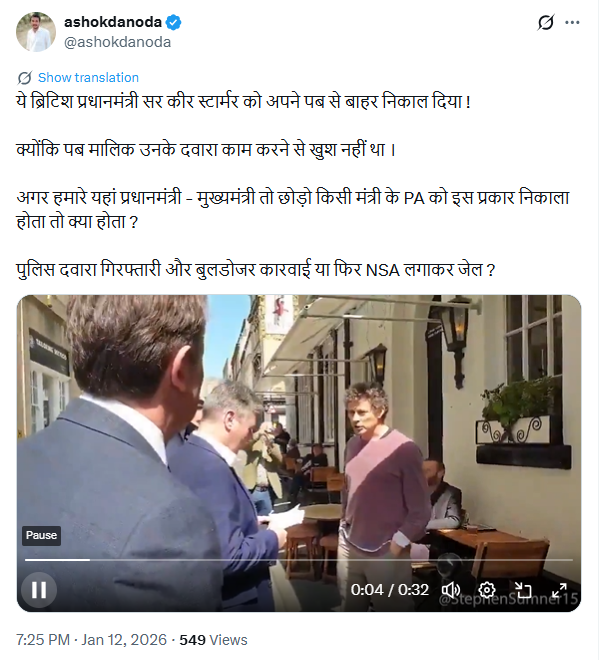
On January 12, 2026, a video was shared on social media platform X (formerly Twitter) with the claim that British Prime Minister Sir Keir Starmer was asked to leave a pub by its owner. The post suggests that the pub owner was unhappy with Starmer’s performance and contrasts the incident with how political dissent is allegedly handled in India. The viral video, approximately 32 seconds long, shows a man angrily confronting Keir Starmer in English, stating that he had supported the Labour Party all his life but was disappointed with Starmer’s leadership. The man is then heard asking Starmer to leave the pub.
Links to the viral post and its archived version were reviewed as part of the research.
Fact Check
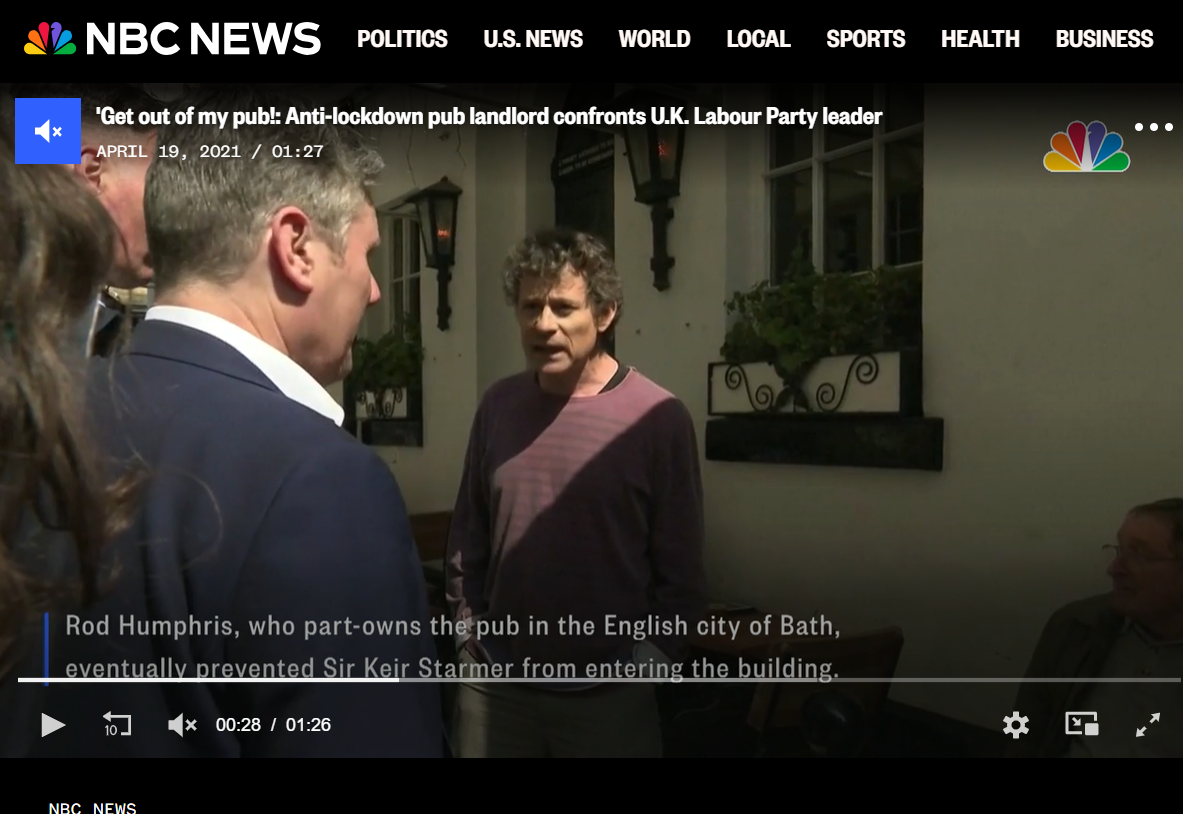
To verify the claim, we extracted key frames from the viral video and conducted a Google reverse image search. During this process, we found the same video posted on an X account on April 19, 2021.The visuals in the 2021 post matched the viral video exactly, clearly indicating that the footage is not recent.The original post described the incident as an event involving Labour Party leader Keir Starmer during his visit to the Raven pub in Bath, and included a warning about strong language used by the pub owner, Rod Humphries. Here is the link to the original video, along with a screenshot:

Further keyword searches led us to a report published by NBC News on April 19, 2021. According to the report, Keir Starmer, then the leader of the UK’s opposition Labour Party, was confronted and asked to leave a pub in the city of Bath. The pub owner reportedly accused Starmer of failing to oppose COVID-19 lockdown measures strongly enough at a time when strict restrictions were in place across the UK.
- https://www.nbcnews.com/video/anti-lockdown-pub-landlord-screams-at-u-k-labour-party-leader-to-get-out-of-his-pub-110466117702
We also verified who held the office of British Prime Minister in 2021. Official UK government records confirm that Boris Johnson was the Prime Minister at that time, while Keir Starmer served as the Leader of the Opposition.

Conclusion
Our research confirms that the viral video is old and misleadingly presented. The footage is from 2021, when Keir Starmer was not the Prime Minister of the United Kingdom, but the opposition Labour Party leader. Sharing the video with the claim that it shows a current British Prime Minister being thrown out of a pub is factually incorrect.

Related Blogs
Executive Summary
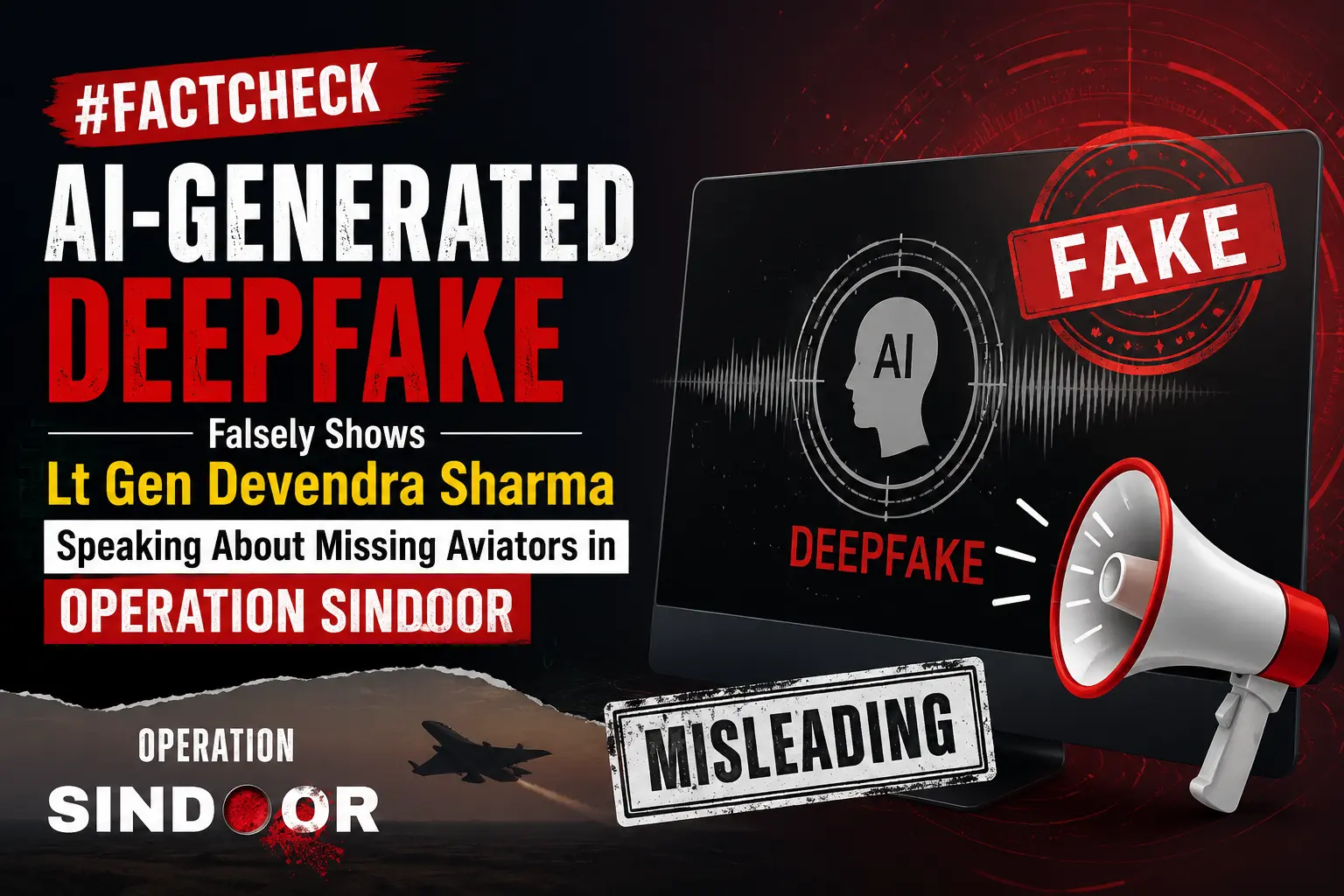
A purported video of Lieutenant General Devendra Sharma is being shared on social media, falsely portraying him as saying that “five aviators who participated in Operation Sindoor are missing from our training list. CyberPeace Research Wingresearch found that the viral video is completely fabricated and generated using artificial intelligence. The Ministry of Defence has also dismissed the clip as an AI-generated deepfake. The investigation found that Lieutenant General Devendra Sharma, Commander of the Army Training Command, never made any such statement. The viral clip has been manipulated by inserting fake audio into footage from his original speech to spread a misleading narrative.
Claim
A user on social media platform X shared the viral video with the caption:“Fifty-nine officers were listed at the Combat Army Aviation Training School, but five officers are missing. They were involved in Operation Sindoor as pilots of four Rafale jets and one Su-30 aircraft…”

Fact Check
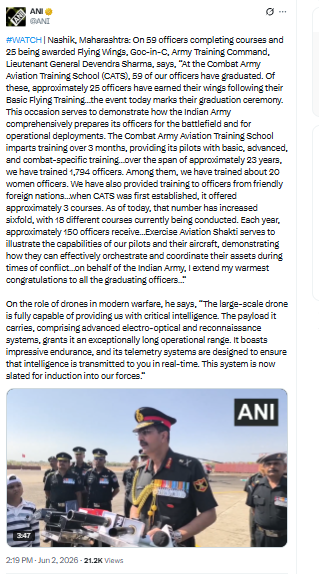
To verify the claim, we extracted several keyframes from the viral video and conducted a reverse-image search. During the investigation, we found the original video on ANI’s official X account. In the authentic footage, Lt Gen Sharma is seen speaking at a routine event at a training institution. His remarks focused on regular training-related matters, and he made no reference to missing pilots, Operation Sindoor, or any alleged losses.
https://x.com/ANI/status/2061731994971881667
In the next stage of the investigation, we found a post by the Ministry of Defence, Government of India, which also identified the viral clip as a deepfake.
https://www.facebook.com/watch/?v=1697698548109000
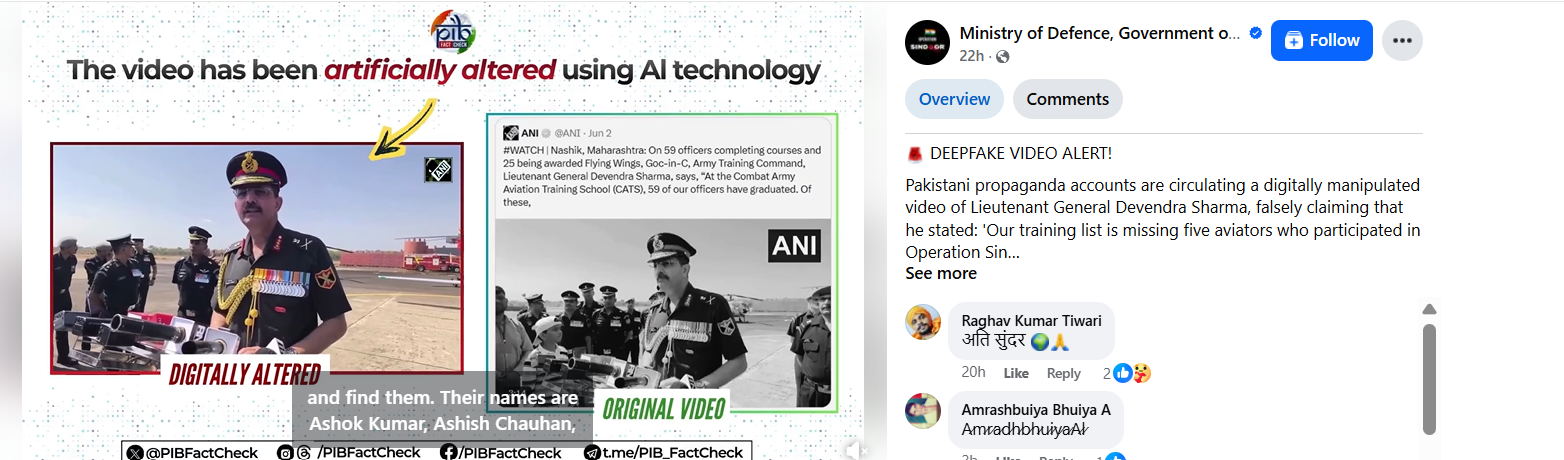
The ministry clarified that the video had been manipulated using AI-generated audio and did not reflect any genuine statement made by Lt Gen Devendra Sharma.
Conclusion
The viral video is a fabricated AI-generated deepfake. Lieutenant General Devendra Sharma never made the statement attributed to him about five missing aviators linked to Operation Sindoor. The original video was altered by inserting fake audio into authentic footage. The manipulated clip is being circulated online to spread misinformation and create confusion regarding the Indian Armed Forces.

Introduction
The European Union has fined the meta $ 1.3 billion for infringing the EU privacy laws by transferring the personal data of Facebook users to the United States. The EU fined Meta’s business in Ireland. As per the European Union, transferring Personal data to the US is a breach of the General data protection Regulation or European Union law on data protection and privacy.
GDPR Compliance
The terms of GDPR promise to gather users’ personal information legally and under strict conditions. And those who collect and manage personal data must protect users’ personal data from exploitation. The GDPR restricts an organisation’s capacity to transfer personal data outside the EU if the transfer is solely based on that body’s evaluation of the sufficiency of the personal data’s protection. Transfers should only be made where European authorities have determined that a third country, a territory within that third country, or an international organisation provides acceptable protection for data protection.
Violation by Meta
The punishment, announced by Ireland’s Data Protection Commission, might be one of the most significant in the five years since the European Union passed the landmark General Data Protection Regulation. According to regulators, Facebook failed to comply with a 2020 judgment by the European Union’s top court that Facebook data transferred over the Atlantic was not sufficiently safeguarded from American espionage agencies. However, whether Meta will ever need to encrypt Facebook users’ data in Europe is still being determined. Meta announced it would appeal the ruling, launching a potentially legal procedure.
Simultaneously, European Union and American officials are negotiating a new data-sharing pact that would provide legal protections for Meta and scores of other companies to continue moving information between the US and Europe. This pact could overturn much of the European Union’s Monday ruling.
Article 46(1) GDPR Has been violated by the meta, And as per the Irish privacy.
What is required by the GDPR before transferring personal information across national boundaries?

Personal data transfers to countries outside the European Economic Area are generally permitted if these nations are regarded to provide a sufficient degree of data protection. According to Article 45 of the GDPR, the European Commission evaluates the degree of personal data protection in third countries.
The European Union judgment demonstrates how government rules are upending the borderless way data has traditionally migrated. Companies are increasingly being pressed to store data within the country where it is acquired rather than allowing it to transfer freely to data centres around the world as a result of data-protection requirements, national security laws, and other regulations.
The US internet giant had previously warned that if forced to stop using SCCs (standard contractual clauses) without a proper alternative data transfer agreement in place, it would be compelled to shut down services such as Facebook and Instagram in Europe.
What will happen next for Facebook in Europe?
The ruling includes a six-month transition period before it must halt data flows, meaning the service will continue to operate in the meantime. (More specifically, Meta has been given a five-month transition period to freeze any future transfer of personal data to the United States and a six-month deadline to terminate the unlawful processing and/or storage of European user data it has previously transferred without a legitimate legal basis. Meta has also stated that it will appeal and appears to seek a stay of execution while it pursues its legal arguments in court.
Conclusion
The GDPR places restrictions on transferring personal data outside the European Union to third-party nations or international bodies to ensure that the GDPR’s level of protection for individuals is not jeopardised. But the meta violated the European Union’s privacy laws by the user’s personal information to the US. Under the compliance of GDPR, transferring and sending personal information to users intentionally is an offence. and presently, the personal data of Facebook users has been breached by the Meta, as they shared the information with the US.
%20(1).webp)
Before you take that next sip of your chai latte at Starbucks, you're about to see Artificial Intelligence (AI) in your tea. Yes you heard it right, but relax, you don't need to put the cup down, because it's not blended in like a new masala and nobody's adding AI as an ingredient. But AI will be deciding how much stock gets ordered, when the machine needs a service call, how the whole backend of your favourite coffee chain runs.
Here's what's actually going on. Starbucks has been quietly building its own AI to replace the systems Oracle, Microsoft, and IBM used to run for it, for the services such as inventory, equipment management, even the point-of-sale software every outlet depends on. In short: Starbucks decided it does not want to outsource its backend anymore. It wants to build the brain itself.
Sounds fascinating on the surface. A coffee company doing its own AI R&D, right? Except dig one layer deeper, and it stops being cool and starts being a conundrum. Here's the actual link: companies like Starbucks are Indian IT's bread and butter. This is literally the business model, global companies pay Indian IT firms like TCS, HCL, Infosys, Wipro to run exactly this kind of backend work: inventory systems, equipment management, point-of-sale software, IT infrastructure. That's what pays the salaries of roughly 6 million people employed by India's outsourcing industry.
However, recently, this workforce has been shrinking rather than growing. TCS, the largest player in the industry, reported just 0.4 percent revenue growth in the quarter after stripping out currency fluctuations, its slowest expansion in a year, while its workforce shrank by around 3 percent over the past year to about 594,000 employees. At smaller rival HCL Technologies, sales actually slipped 0.5 percent quarter on quarter. Company wide, TCS let go of over 23,000 employees in FY26 alone, citing its pivot toward an AI first services model and reduced bench requirements per client engagement, with a steep net decline of over 11,000 employees in the most recent quarter alone.
AI's impact on India's IT industry and workforce
India's IT sector employs close to 6 million people, and a large share of that workforce has built careers around exactly the kind of work now being absorbed by AI: inventory systems, equipment monitoring, point of sale software, and other repetitive backend operations. As more global clients explore building these capabilities in house, the demand for large teams doing routine maintenance work is likely to shrink. This does not mean mass job losses overnight, but it does suggest a shift in what kind of talent gets hired and retained. Entry level, process driven roles may see slower growth, while demand rises for professionals who can design, audit, and govern AI systems rather than simply maintain legacy software. For India's IT workforce, the challenge is less about competing with AI and more about repositioning around it, moving up the value chain before the shift forces the decision.
Beyond One Coffee Chain ~ The Real Shift in Global Outsourcing
Starbucks isn't an isolated case; it's a visible example of a much wider recalibration. For two decades, the operating assumption in enterprise software was that building complex, mission-critical systems in-house was too slow, too risky, and too expensive compared to buying from established vendors. AI-assisted coding is chipping away at that assumption. What used to require large, specialised engineering teams and years of development can now be prototyped and iterated on far faster enough that even a company whose core business is coffee, not code, can seriously consider building its own enterprise software stack.
However it is also worth noting that this transition isn't frictionless. Starbucks itself had to walk back an AI-powered inventory-counting tool earlier this year after it produced inaccurate counts, reverting stores to manual counting. Building in-house AI systems is not automatically smoother or more reliable than buying proven software; it just shifts the risk and the learning curve onto the company doing the building.
Disruption and Opportunity, Side by Side
None of this means Indian IT companies can afford to sit still. The Starbucks example offers a legitimate signal that repetitive, well defined, automatable work, especially when powered by in house built AI, genuinely poses some risk or not. But it cannot be seen only through the lens of the industry's obituary. It would be premature to call this a broader decline in terms of IT professionals, companies, or jobs.
The same earnings season also brought TCS's expanded AI mandate with ABB and HCL's $1.14 billion AI driven contract in Europe. Demand has not disappeared, it appears to be evolving from routine maintenance work toward AI native, higher value engagement.
Whether this becomes a meaningful structural shift or simply another cycle the industry eventually absorbs remains to be seen. What seems clear for now is that the path forward depends less on resisting the shift and more on how quickly the industry chooses to embrace it.
Conclusion
AI is a double-edged sword. While it challenges the old model of outsourcing via a maintenance and staff augmentation play, it also provides new, high-value services opportunities around AI integration, data infrastructure, and governance-areas where the scale, domain expertise, and global delivery experience that Indian IT has amassed over three decades is essential. Whether India's IT majors will move fast enough to upskill, re-skill, and reposition to ride this wave before the opportunity heads somewhere else, is the question to watch, rather than the survival of one vendor or contract.
Sources
- Bloomberg Opinion - Andy Mukherjee, "You Can't Spell Chai Latte Without AI, and That Will Hurt India.” bloomberg.com/opinion/articles/2026-07-14/you-can-t-spell-chai-latte-without-ai-that-will-hurt-india
- Yahoo Finance / Vlad Schepkov, "Starbucks Working on AI Tools to Replace Microsoft and IBM Software – Report," July 9, 2026. finance.yahoo.com/technology/ai/articles/starbucks-working-ai-tools-replace-105954159.html
- Livemint - Andy Mukherjee, "As Starbucks Mixes AI in Chai Latte, What Must IT Players Do?" Mint Curator.
livemint.com/opinion/online-views/andy-mukherjee-india-it-industry-starbucks-ai-tc-hcl-tech-artificial-intelligence-oracle-microsoft-ibm-11784118723454.html - Metaintro, "TCS and Infosys Face an AI Reckoning" https://www.metaintro.com/blog/tcs-infosys-ai-reckoning-millions-it-jobs-2026
- LayoffTrends, "IT Layoffs India 2026 — TCS, Infosys, Wipro, GCC Jobs" https://layofftrends.com/india.html
- NiftyTrader, "Hiring Slows at India's Top IT Firms — Net Headcount Falls in 9MFY26" https://www.niftytrader.in/markets/hiring-slows-at-indias-top-it-firms-net-headcount-falls-in-9mfy26-what-it-signals-for-the-sector/
- TCS official newsroom, "TCS and ABB Sign Multi-Million, Multi-Year Deal to Transform Global Network Operations with AI," tcs.com/who-we-are/newsroom/press-release/tcs-and-abb-sign-multi-million-multi-year-deal-to-transform-global-network-operations-with-ai
