
When Rumours Outrun Facts: Misinformation During Sensitive Public Events
Introduction
A mass of people gathered in public is a common scene. All are eager for the same information, official estimates are delayed, and the space is then filled by whatever is earliest. In Delhi the gap was partially filled by old videos being described as new footage and by reports of injuries and deaths which police and fact-checkers have rejected. This report investigates what was claimed, by whom, and what has been validated. It does not take sides in the protests. It is focused on a small issue: how this false information travelled, why it was effective, and what the reader can do to combat it.
What was reported
India Today claimed that the ISI, the spy agency of Pakistan, posted a false injury report of a senior opposition leader, as well as fake reports of deaths, during the Delhi protests. That is what the publication's own headline says, and the claim of ISI links is based on sources, not an established fact.
Delhi Police has filed at least four FIRs against social media handles for creating fake content and attempts at building an "anti-India narrative", according to a report by The Week, quoting news agency ANI. Police said multiple Pakistani handlers reported deaths in the 10 October protest and shared fake videos while impersonating Indians. India TV reported that around 500 posts and 100 handles had been removed, citing unidentified sources and the police. There is no independent verification of those numbers in the material we reviewed.
What has been verified, and what has not
The strongest piece is from News Meter, a fact-checking organisation. It found two videos posted on X on 12 October. The first was purportedly a video of police firing on a rally and killing five workers. When searching the video for the beginning of its footage, NewsMeter found it on Facebook from 5 March 2020 and in a Times of India report about the February 2020 riots in Delhi's Chand Bagh locality. The second video, which was reportedly of soldiers beating a protester, has been posted on YouTube since 2019 and on news websites reports as early as 2017, according to News Meter. There is no evidence of firing at the rally. Another of the original fact checkers, NewsMeter, traced a video alleging an attack on a politician's residence to December 2019 rallies. The Delhi Police also labelled the claim of firing at the rally as a rumour on 12 October.
A few items still require substantiation. The ISI's direction is unconfirmed, and the accounts' source is police and other sources. News Meter identified the location data of one account as "South Asia" with a slight possibility of VPN use, and it examined its earlier report of Pakistan-based propaganda accounts' pattern, but nothing is definitive. Location tags are weak evidence. The death claims were deemed false by police, but no external investigation of either accusation exists in the information looked at.
How fabricated visuals travel
Recycled footage is effective because it is footage. The crowd, the violence – all of that is real; they just got the date and place wrong. Writer Claire Wardle and researcher Hossein Derakhshan have dubbed this entirely different genre of falsehood as a form of "misinformation" – where the lie is in the caption, but the pixels still tell the truth.
That's where the urgency comes in. The article published by News Meter closed with the plea to 'people to come on the road and block the city'. Short, scary and sensational messages are among the easiest to share. A 2018 Science paper by Soroush Vosoughi, Deb Roy and Sinan Aral found false news stories are about 70 per cent more likely to be retweeted than accurate stories and spread more rapidly, primarily because humans (not bots) retweeted them.
And platform design does, too. Recommendation algorithms tend to incentivise content engagement, and there's a tonne of engagement to be driven from anger. The credibility of accounts using pseudonyms or pretending to be local seems to come from the community they claim.
Why injury and death claims are different
The most powerful piece of rumour is the one in which a person has been killed or injured. It stirs mourning and fury, inflames crowds to violence, and leaves the rumour-monger little room for denial. Even in cases of retraction, the original story is often the one to stay. Delhi Police in its post cautioned that "malicious rumours" are an offence.
If false reports drown out the conversation, true reports of harm are then easier to write off. Official messaging needs the same due care as a viral post for the same reason: Public officials are party to the events they describe. Tone is no guarantee, not even "certainty". Multiple independent tellings can demonstrate it.
The damage extends further than the audience as well. If people are searching for loved ones, they might find a rumour; before they get confirmation from the individual, helplines can become overwhelmed, and reporters have all their time wasted following up claims that were planned to be followed up.
What responsible sharing looks like
But most of it is a run-of-the-mill habit. Put the brakes on before you forward something that fuels your fear or anger. Investigate who created the post, when the account was created. Reverse image search the videos with Google Lens or Tin Eye (that's how the Delhi videos were dated). Find the same report on outlets that credit their sources. Choose fact checkers that follow clear standards, like signatories of the International Fact-Checking Network code of principles.
If you've already posted something false, admit it and include the correction. Even quoting a rumour to ridicule it may publicise it, so if you can, describe the rumour instead.
Headlines that treat an allegation as fact or that post an initial report of a viral claim without verifying it lend the rumour a second platform. Pachyphonus warned against grabbing on to supposed "hedge words" like "alleged", "according to police" and "sources said" just to lighten the blow - they reveal how much a statement is worth.
Conclusion
The Delhi story highlights a trend that defies borders or specific occurrences. Old footage, solicitous captions and unproven reports of damage are constantly propagated because they seem meaningful. The claims of well-planned foreign accounts are "unsubstantiated allegations", and the proven age of the returned content is "old archive footage". The real stickler is maintaining those categories. Before rushing to share the next scary footage, consider who's sharing it, when it was shot and who else has verified it.
Sources
- India Today: Anti-CEC protests, ISI-linked Pakistan accounts and false claims (report this piece is based on)
- The Week: Several Pakistani social media handles under scanner for fake content
- India TV: Delhi Police takes down 500 social media posts
- NewsMeter: Videos are old, unrelated to anti-CEC protests
- NewsMeter: Video of alleged attack on residence is from 2019
- Times of India (2020): How Delhi cops tried to rescue their colleagues
- Delhi Police statement on X, 12 October 2026
- Vosoughi, Roy and Aral (2018), The spread of true and false news online, Science
- Wardle and Derakhshan (2017), Information Disorder, Council of Europe
- International Fact-Checking Network, Code of Principles

Related Blogs

Introduction
As the world is being "Digitally Interlaced", cyber security has become a continuous wrangle. The “Gambling industry” is considered an incredibly lucrative mark for cybercriminals, principally due to the enormous quantities of cash on hand and the sensitive details it processes day to day. Cybercriminals may use susceptibilities in gambling scaffolds to achieve financial scams or launder unlawful funds. An analysis by Security Scorecard discovered that the online gambling industry was ranked third in the possibility of encountering a cyber attack, following the energy and financial services sectors. Similarly, Online gambling is a bending matter that demands meticulous contemplation by policymakers and nationals. The incredible rise of online gambling has led to a terse acclivity in unlawful activities such as online scams, fraud, etc. Also, online sports gambling has become a thriving endeavour in contemporary years as millions of people are putting stakes and gambles on their electronic devices.
The Challenges
Online gambling has thus become a widespread frolicking for numerous youngsters, with the industry tossed to be worth billions of dollars in the forthcoming decades. The prominent cyber security challenges in the gambling industry are money laundering, financial laundering, ransomware, personal information theft, data breaches, distributed Denial of Service (DDoS), system disruptions and Insider perils and employee malfeasance. Challenges of online gambling also include being properly not regulated and a lack of social interaction with near and dear ones. The spread of Internet gambling has presented many problems affecting consumer behaviour online, motivations to gamble, problem gambling, security of websites, and the righteousness and virtue of the games. The rise of online gambling among young people due to the lack of clear regulations has likewise produced an abundant backdrop for financial ruination.
Web games and betting are among the fastest-evolving areas of the Internet. Over the past several years, there has been an international flare-up in online gambling, permitting customers to play from the convenience of home, work, and public locations. Numerous offshore betting websites and apps usually permit parties to win in the start with sound returns, whereas after the user gets addicted and invests considerable sums, they either keep failing or have the website refuse to cash out the winnings. Also, the information demonstrates that online games have been employed to commit wrongdoings (Child sexual exploitive material, religious conversion, cyberbullying, fraud, betting in virtual online casinos, etc.)
India's laws and regulations surrounding online gambling are complex and constantly evolving. While the legal framework is not entirely clear, a few state in India have their own set of rules.
Recently In April 2023, the Union Ministry of Electronics and Information Technology (“MeitY”), by virtue of the rule-making powers available to the central government under the Information Technology Act, 2000 (“IT Act 2000”), implemented a new central legal framework for online gaming through amendments to the Information Technology (Intermediary Guidelines and Digital Media Ethics Code) Rules, 2021 (“IT Rules 2021”). These amendments (“Online Gaming Rules”) propose a light-touch, co-regulatory regime whereby MeitY-recognised, independent self-regulatory bodies (“SRB”) will verify whether an “online real-money game” is to be made available to the general public or not – in accordance with the baseline criteria prescribed by the Online Gaming Rules.
The Online Gaming Rules attempt to regulate online gaming platforms by treating them as an “online gaming intermediary” (“OGI”) and prescribing intermediary due diligence obligations for them under the IT Rules 2021. An OGI has been defined in the Online Gaming Rules as “any intermediary that enables the users of its computer resource to access one or more online games”. Under the Online Gaming Rules, an online game can be a “permissible online game” if (i) it is not an online real-money game, or (ii) it is an online real-money game but is “verified” by an SRB in accordance with the baseline criteria prescribed by the Online Gaming Rules and any additional criteria prescribed by the SRB itself.
Global Perspective
The global gaming industry worth over US$227 billion in 2022 is further projected to grow to US$312 billion by 2027. Several countries have set regulatory frameworks about online gaming, though these are skewed, concentrating mainly on gambling and circumventing numerous of the more typical cyber threats. The US spends about $60 billion annually on online gambling and sports betting. In Europe, gambling is an even larger moneymaker. Also, numerous countries in Europe, like the UK, have legalised gambling. Nevertheless, it is prohibited for a US based company to operate an online gambling site. Yet, sports betting online is permitted in some states.
Today, though the gaming market has been overpowered by China and the US, future growth in the sector is anticipated to come from emerging economies like India with increasing populations. The permitted status of online gambling in India is nonetheless imprecise, vamoosing space for exploitation by cyber criminals and disarray for players involved. One of the climactic points that ought to be addressed is the sudden upsurge of online games, which increases gambling. Skill-based games such as poker, rummy etc., have additionally been developed to circumvent the legal definition of gambling in India. The recent instances of the online gaming industry not being properly regulated have also come to light in India. For instance, the Enforcement Directorate (ED) is still investigating the vast Mahadev Online Betting scandal, exposing an unknown money laundering method using Unified Payment Interface (UPI) IDs. Also, the Cyber Cell in Agra has taken proactive action against copyright violations, illegal online gambling and betting activities, shutting down 27 Illegal cricket betting sites in major operations, safeguarding several lakhs of Indians with thousands of crores from being transferred to overseas shores principally China.
Consequently, though India has announced new regulations on online gaming, its contemporary policy framework cannot contend with the problems endangering this sector. The Public Gambling Act of 1867 makes it unlawful to use a public gambling house or to be seen in one. Nevertheless, the act does not explicitly cite online gambling, leading to further interpretation. The Ministry of Home Affairs (MHA) has released a further awareness campaign for offshore illegal gambling apps, notifying users to be mindful of foreign apps as they may be fraudulent and might induce monetary damage to the user. Also, state laws control gambling in India with each state having its own directive on the subject. Yet, the Supreme Court of India has maintained that skilled games are not gambling and are thus legal. Furthermore, the Information Technology (IT) Act, of 2000 does not precisely handle online gambling or games that enable gambling.
Today, developers have strived for new ways to monetise the growing popularity of online gaming, which oversaw the creation of in-game currencies that can be bought using actual money, usually through credit cards. Several nations have prohibited the usage of in-game currency and loot boxes, considering them a kind of online gambling. The in-game currency has thus caused much disagreement about becoming a state of hunting monetisation by developers, especially targeting minor or newbie players. The gambling industry, therefore, faces unique cybersecurity challenges that require a comprehensive and proactive approach to cybersecurity.
Conclusion
Presently, there are approximately 3.09 billion active video game players worldwide, and the number is expected to reach 3.32 billion by 2024 as of 2023. In the contemporary digital era, information is priceless, and encryption acts as a necessary means to safeguard it. Thus, Regulators are working to maintain the swiftness of shift in the industry, as the dearth of transparency in the law has made it challenging to implement regulations. There is also less awareness about cyber security in India due to the following grounds such as the lack of ethical hackers in the country, companies in India lacking focus on cyber security and hiring a team of ethical hackers and cyber security experts. Furthermore, there has been a lack of knowledge among the citizens as well.
It is essential to realise the conceivable social and economic consequences and take measures to handle the online gambling industry. The industry has thus been undersized in the mode of research following online crime and Internet gambling, even though it is an acute emphasis. There is also a pressing necessity to rebuild these regulations to tackle the more unbridled cyber security hazards swarming the gaming industry. Similarly, there is an urgent need for governments and policymakers around the world to start paying more attention to the gaming industry as cyber security threats continue to rise. There should be a further need to strengthen the regulatory framework, establish Self Regulatory Organizations (SROs), create ethical gaming designs and increase awareness among gamers. The Government of India should consider devising its own rating system to rate games so that players under 18 cannot access them.
Eventually, cyber security is a shared commitment, and everyone in the online gambling ecosystem must function jointly to provide a secure and safe setting for all.
References:
- https://truefort.com/gambling-industry-cybersecurity/
- https://www.orfonline.org/research/cybersecurity-threats-in-online-gaming-learnings-for-india
- https://www.hackread.com/chinese-scammers-cloned-websites-gambling-network/
- https://www.civilsdaily.com/news/cybersecurity-threats-from-online-gaming/
- https://www.linkedin.com/pulse/legal-considerations-online-gambling-india-sudden-increase-mathur/
- https://www.jsheld.com/insights/articles/the-importance-of-cybersecurity-in-the-online-sports-betting-industry
- https://www.the420.in/agra-cyber-cell-takes-down-27-illegal-betting-sites/
- https://g2g.news/gaming/ministry-of-home-affairs-releases-new-awareness-campaign-for-online-gaming-in-india/
- https://smestreet.in/technology/kaspersky-warns-of-increased-phishing-scams-and-data-breaches-in-apac-for-2024-2381601
- https://economictimes.indiatimes.com/tech/newsletters/morning-dispatch/govt-bans-mahadev-other-illegal-betting-apps-cyber-attacks-against-india-spike/articleshow/104996017.cms?from=mdr
- https://cipher.com/cybersecurity-for-gambling/
- https://www.mangalorean.com/tightening-the-reins-indian-government-blocks-over-550-illegal-betting-and-gambling-apps/
- https://cybersecurityasean.com/news-press-releases/kaspersky-predicts-rise-cyber-threats-across-apac-2024
- https://www.cnbctv18.com/technology/mahadev-betting-app-scam-ed-money-laundering-upi-celebrities-under-scanner-17815661.htm
- https://iclg.com/practice-areas/gambling-laws-and-regulations/india

Executive Summary
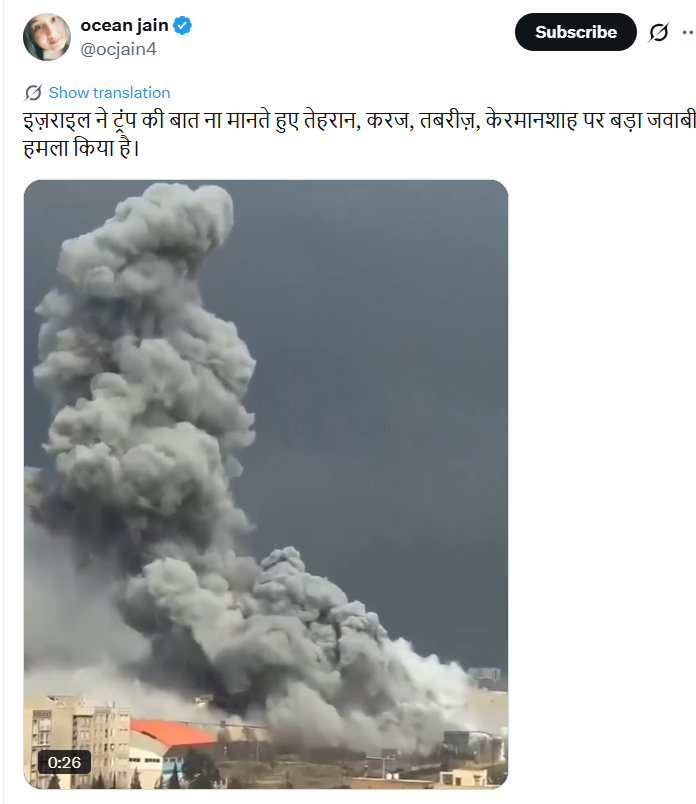
Following recent escalations between Iran and Israel, where both countries reportedly exchanged missile strikes over the weekend, a video is now circulating on social media claiming to show the latest attacks between the two nations. However, CyberPeace Research Wing research found that the viral video is not related to the recent developments. The footage is actually from a March incident involving reported US-Israeli strikes in Tehran’s Jannat Abad area.
Claim
An X (formerly Twitter) user shared the viral video with the caption:“Israel, ignoring Trump’s advice, has carried out a major retaliatory strike on Tehran, Karaj, Tabriz, and Kermanshah.”
https://x.com/ocjain4/status/2063844698138239357?s=20
The video is being widely shared with claims that it shows recent Iran–Israel missile exchanges following Sunday’s reported attacks.
Fact Check
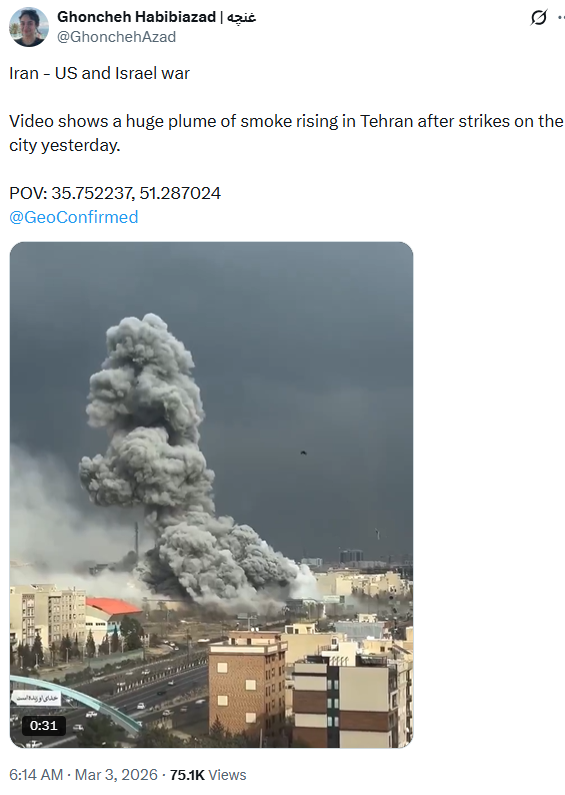
To verify the claim, we extracted keyframes from the viral video and conducted a reverse image search. The research led us to a post from BBC Persian journalist Ghoncheh Habibiazad’s X account dated 3 March. The video was shared with a caption describing it as showing a strike in Tehran attributed to US-Israeli action.
https://x.com/GhonchehAzad/status/2028632595156598874?s=20
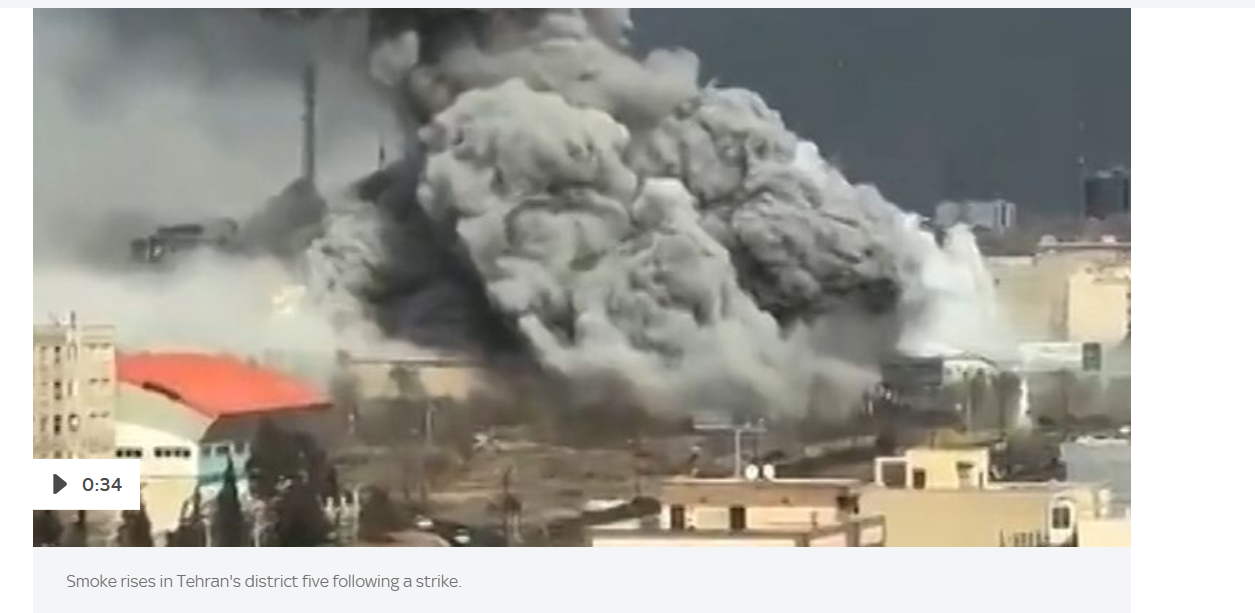
Further verification found the same footage published by Sky News and uploaded on Al Arabiya’s YouTube channel on 3 March 2026. The accompanying descriptions referred to smoke rising from Tehran’s District 5 and near the Hemmat Expressway following the strike.
https://news.sky.com/video/smoke-seen-rising-after-strike-in-tehran-13514731
https://www.youtube.com/shorts/AceFmYiBkuA
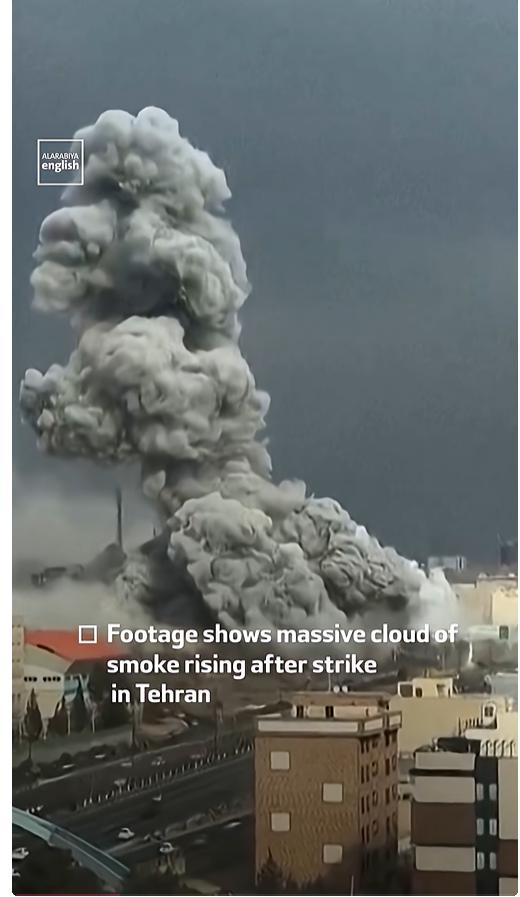
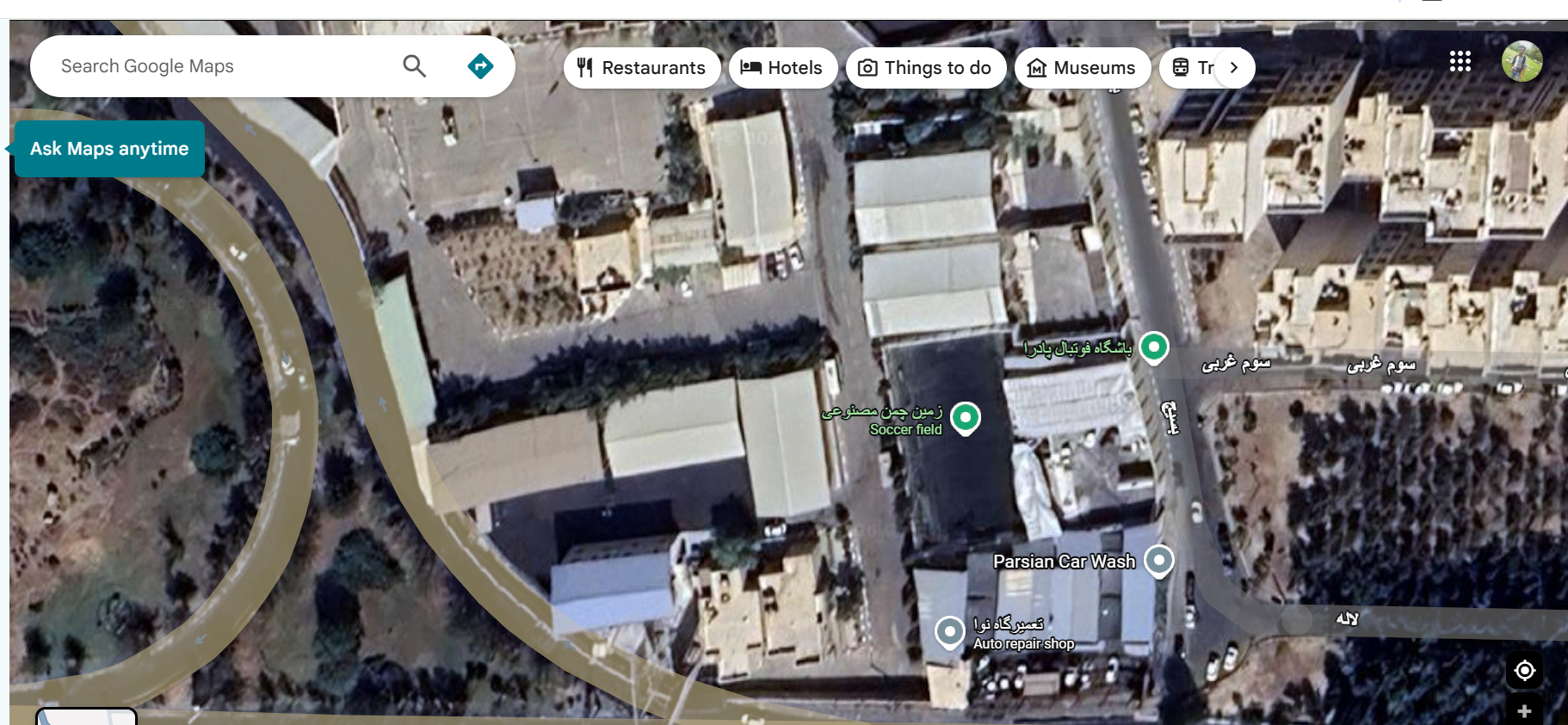
Additionally, a comparison using Google Satellite View confirmed that the location seen in the viral video matches the same area shown in the earlier March footage shared by BBC-affiliated reporting.
Conclusion
Our research confirms that the viral video has no connection to the recent Iran–Israel missile exchanges. The footage is from a March incident showing reported strikes in Tehran’s Jannat Abad area, and is being misleadingly shared as a recent escalation between the two countries.
Executive Summary
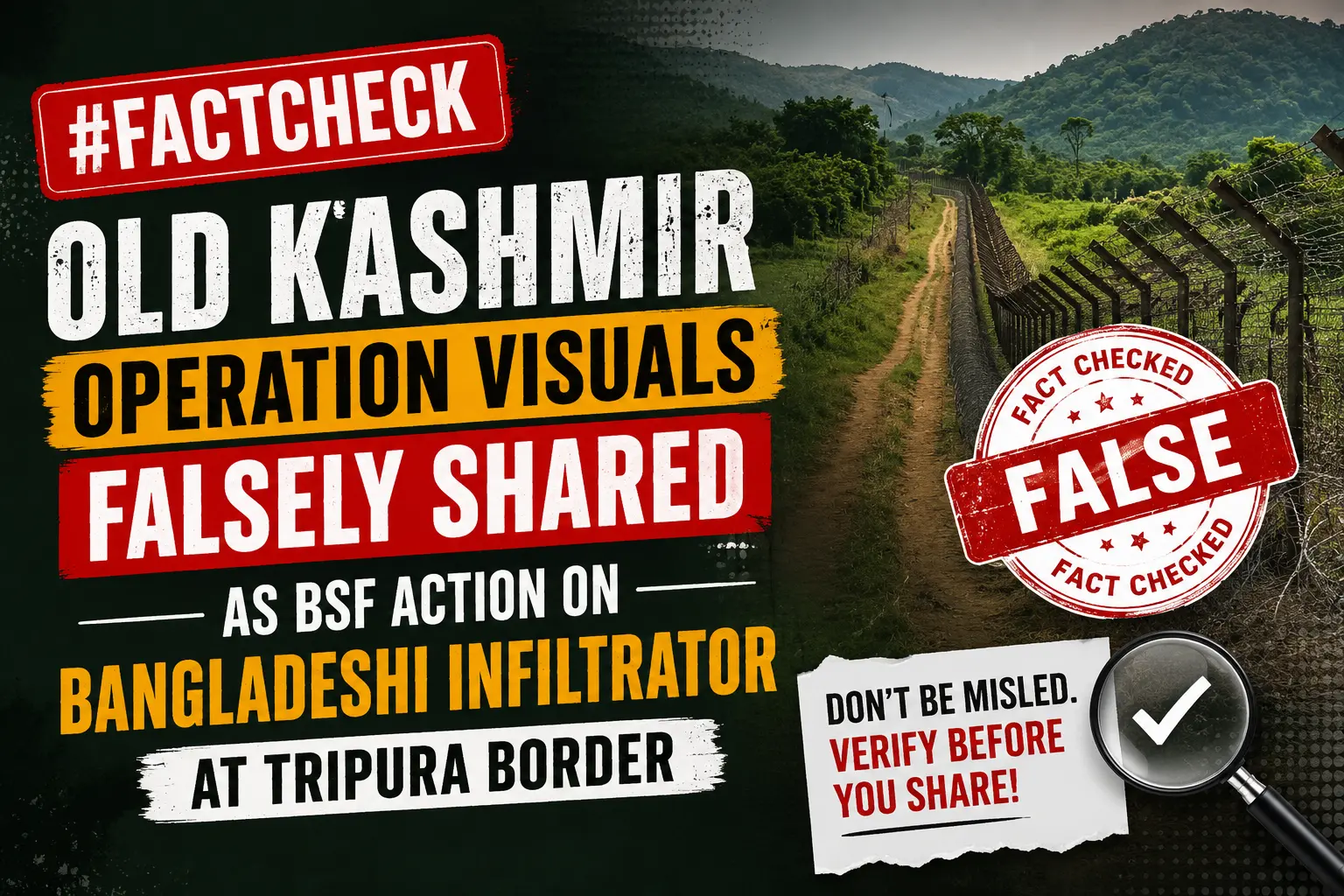
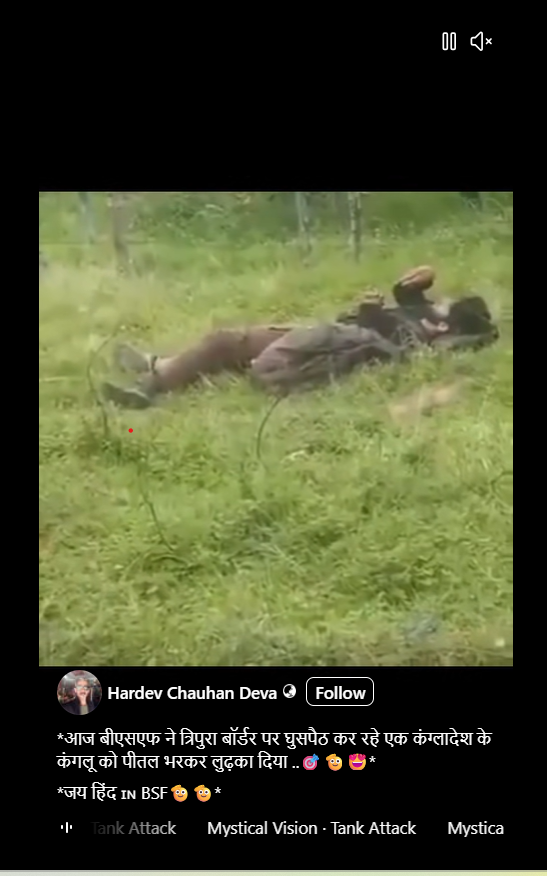
A video showing a body lying on the ground is being widely circulated on social media with the claim that it shows a Bangladeshi infiltrator who was killed by the Border Security Force (BSF) during an infiltration attempt along the Tripura border. CyberPeace Research Wing research found the claim to be misleading. While reports confirm that in June 2026 a Bangladeshi national was killed in BSF firing in Tripura’s Unakoti district, the viral video is unrelated to that incident.
Claim:
A Facebook reel shared the video claiming that BSF recently shot dead a Bangladeshi infiltrator at the Tripura border, and that the visuals depict the same incident. Link: https://www.facebook.com/reel/1561542888951793
Fact Check:
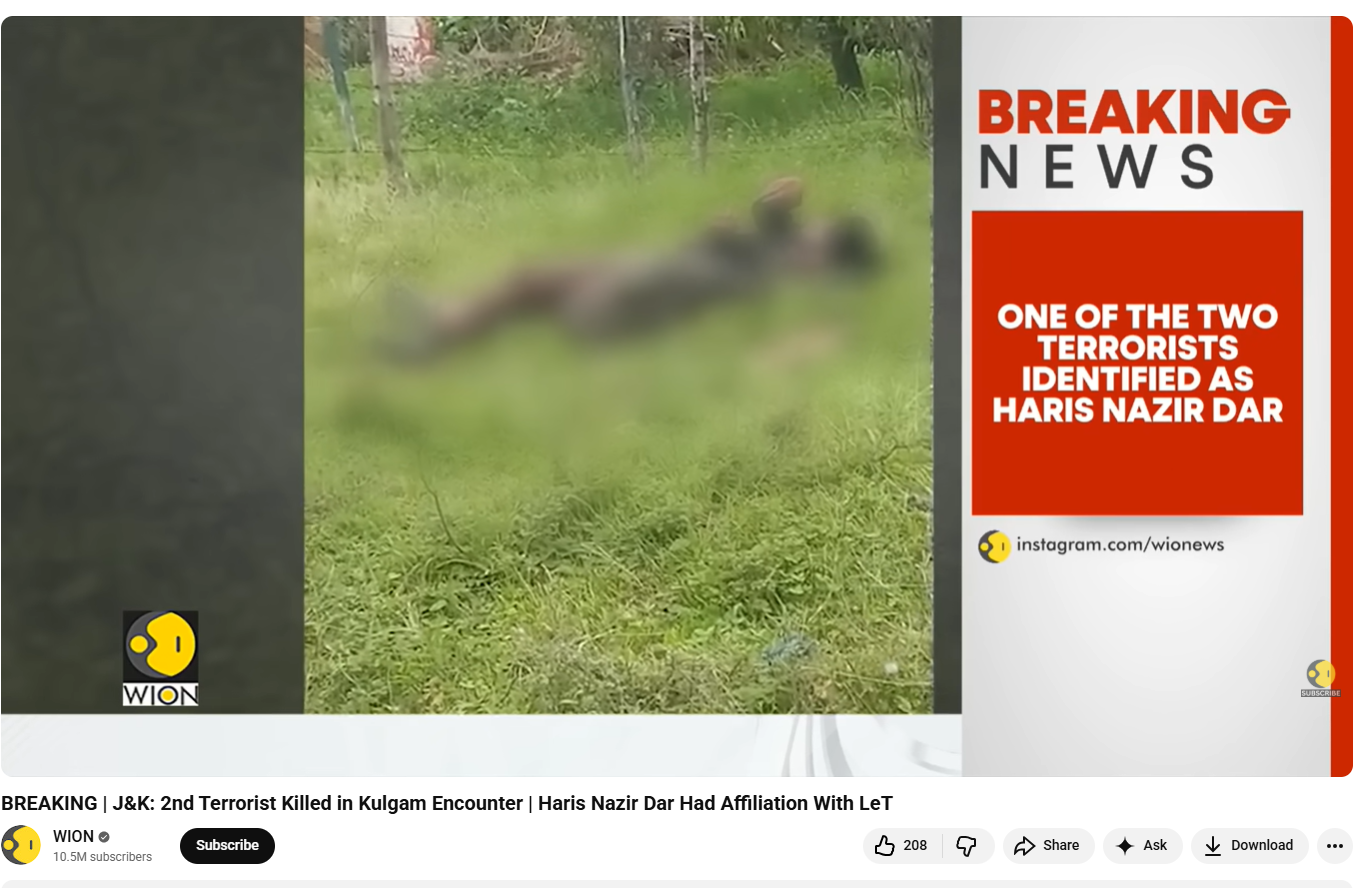
A reverse image search of keyframes from the viral video led to reports published by Bhaskar English, which carried the same visuals. The reports identified the deceased as Haris Nazir Dar, a Lashkar-e-Taiba terrorist, who was killed during Operation Akhal on 2 August 2025 in Jammu and Kashmir. https://www.bhaskarenglish.in/national/news/2-soldiers-martyred-in-jks-kulgam-3-terrorists-killed-135638183.html

Further verification also found similar coverage on WION, confirming the same context of the incident. https://www.youtube.com/watch?v=Uhk-7QjPKK8
Operation Akhal was a major joint counter-terrorism operation conducted in August 2025 in the Akhal forests of Kulgam district, South Kashmir, by the Indian Army’s Chinar Corps, Jammu and Kashmir Police, and the Special Operations Group (SOG). https://newsonair.gov.in/kulgam-encounter-joint-operation-continues-in-akhal-forests-three-terrorists-killed/

Conclusion:
The research confirms that the viral video claiming to show a Bangladeshi infiltrator killed by the BSF at the Tripura border is misleading. The footage is from an August 2025 counter-terrorism operation in Jammu and Kashmir and shows Lashkar-e-Taiba terrorist Haris Nazir Dar killed during Operation Akhal.
