
Unveiling the Resurgence of the Vultur Banking Trojan: A Threat to Android Users
Introduction:
With improved capabilities and evasion strategies, the Vultur banking Trojan has reappeared and is a serious danger to Android users. The virus now employs numerous encrypted payloads, encrypted communication, and poses as legitimate apps. It is transmitted by trojanized dropper programs on the Google Play Store. Vultur targets victims via phone calls and SMS messages. With the help of this updated version of Vultur, attackers may take total control of compromised devices. They can perform a variety of remote control operations like install, remove, upload, and download files, halt the execution of programs, and circumvent the lock screen. The virus is now far more hazardous than it was previously because of its improved capacity to remotely access and manipulate machines.
Overview:
The Android banking malware Vultur is well-known for its ability to record screens. It was first identified by ThreatFabric in March 2021 and targets banking apps for remote control and keylogging.
The malicious apps were hosted on the Google Play Store by the Brunhilda dropper-framework, which was used for its distribution. Initial versions of the program used reputable remote access tools such as ngrok and AlphaVNC.
Hybrid attacks have been used in recent operations to disseminate the Brunhilda dropper via phone calls and SMS. The dropper uses a number of payloads to distribute an upgraded version of Vultur.
41 new Firebase Cloud Messaging (FCM) commands and seven new Command-and-Control (C2) methods are included in the most recent version of Vultur.
With the help of Android's Accessibility Services, these enhancements concentrate on remote access functionality that improves the malware's capacity to communicate with the victim's screen.
Modus operandi of Attack:
Hybrid Attack Method:
- Utilizes a phone call, two SMS messages, and trick users into installing malware.
- First SMS tricks victims into calling a certain number by claiming to have made significant, unlawful transactions, which gives the impression of urgency.
- Although there was no transaction in reality, the urgency motivates victims to act quickly.
Trozonized MacAfee App:
- The victims are told to install a trojanized version of the McAfee Security program from a given link during the phone call.
- This app looks harmless and has features similar to the original McAfee Security app, but it's actually the Brunhilda dropper.
- The victims are misled into assuming that the security software they are installing is authentic.
Execution of Vultur Payloads:
- Three payloads connected to Vultur are decrypted and executed via the Brunhilda dropper.
- Threat actors can carry out a variety of malicious operations, including keylogging and screen recording, on the victim's mobile device thanks to these payloads, which grant them total access over it.
- The infected device of the victim allows the threat actors to launch additional assaults or obtain private data.
Indication of the attack:
The symptoms of a Vultur banking Trojan infection include:
- Remote Access: This malware gives the hacker the ability to remotely use the infected device via clicking, scrolling, and swiping through Android's accessibility services.
- File Management: Through this, the malware is able to copy, share, remove, create, and locate files from devices it has infected.
- App Blocking: For instance; the malicious software can be programmed to stop the victims from opening a certain bunch of apps.
- Custom Notifications: Attackers can embed the malware with the functionality of displaying the customized notifications in the taskbar.
- Keyguard Disabling: The malware may be designed to turn off Screen Lock Guard feature so the lock screen security measure can be easily bypassed.
- Encrypted C2 Communication: The malware chooses AES data encryption, with Base64 text encoding to provide hidden traces for C2 communication.
- Payload Decryption: The malware uses native code, mostly written in C as well as C++, to decode the goods, thus, making a process of reversing more complicated.
- Spying on Financial Apps: The malware uses screen-streaming and keylogging as ways of acquiring facts about the victim’s mobile banking applications.
Indicator of Compromise:
File hash (SHA-256)
- edef007f1ca60fdf75a7d5c5ffe09f1fc3fb560153633ec18c5ddb46cc75ea21
- 89625cf2caed9028b41121c4589d9e35fa7981a2381aa293d4979b36cf5c8ff2
- 1fc81b03703d64339d1417a079720bf0480fece3d017c303d88d18c70c7aabc3
- 4fed4a42aadea8b3e937856318f9fbd056e2f46c19a6316df0660921dd5ba6c5
- 001fd4af41df8883957c515703e9b6b08e36fde3fd1d127b283ee75a32d575fc
- fc8c69bddd40a24d6d28fbf0c0d43a1a57067b19e6c3cc07e2664ef4879c221b
- 7337a79d832a57531b20b09c2fc17b4257a6d4e93fcaeb961eb7c6a95b071a06
- 7f1a344d8141e75c69a3c5cf61197f1d4b5038053fd777a68589ecdb29168e0c
- 26f9e19c2a82d2ed4d940c2ec535ff2aba8583ae3867502899a7790fe3628400
- 2a97ed20f1ae2ea5ef2b162d61279b2f9b68eba7cf27920e2a82a115fd68e31f
- c0f3cb3d837d39aa3abccada0b4ecdb840621a8539519c104b27e2a646d7d50d
- 92af567452ecd02e48a2ebc762a318ce526ab28e192e89407cac9df3c317e78d
- fa6111216966a98561a2af9e4ac97db036bcd551635be5b230995faad40b7607
- dc4f24f07d99e4e34d1f50de0535f88ea52cc62bfb520452bdd730b94d6d8c0e
- 627529bb010b98511cfa1ad1aaa08760b158f4733e2bbccfd54050838c7b7fa3
- f5ce27a49eaf59292f11af07851383e7d721a4d60019f3aceb8ca914259056af
- 5d86c9afd1d33e4affa9ba61225aded26ecaeb01755eeb861bb4db9bbb39191c
- 5724589c46f3e469dc9f048e1e2601b8d7d1bafcc54e3d9460bc0adeeada022d
- 7f1a344d8141e75c69a3c5cf61197f1d4b5038053fd777a68589ecdb29168e0c
- fd3b36455e58ba3531e8cce0326cce782723cc5d1cc0998b775e07e6c2622160
- 819044d01e8726a47fc5970efc80ceddea0ac9bf7c1c5d08b293f0ae571369a9
- 0f2f8adce0f1e1971cba5851e383846b68e5504679d916d7dad10133cc965851
- fb1e68ee3509993d0fe767b0372752d2fec8f5b0bf03d5c10a30b042a830ae1a
- d3dc4e22611ed20d700b6dd292ffddbc595c42453f18879f2ae4693a4d4d925a
- f4d7e9ec4eda034c29b8d73d479084658858f56e67909c2ffedf9223d7ca9bd2
- 7ca6989ccfb0ad0571aef7b263125410a5037976f41e17ee7c022097f827bd74
- c646c8e6a632e23a9c2e60590f012c7b5cb40340194cb0a597161676961b4de0
Command and Control Servers
- safetyfactor[.]online
- cloudmiracle[.]store
- flandria171[.]appspot[.]com (FCM)
- newyan-1e09d[.]appspot[.]com (FCM)
Droppers distribution URL’s
- mcafee[.]960232[.]com
- mcafee[.]353934[.]com
- mcafee[.]908713[.]com
- mcafee[.]784503[.]com
- mcafee[.]053105[.]com
- mcafee[.]092877[.]com
- mcafee[.]582630[.]com
- mcafee[.]581574[.]com
- mcafee[.]582342[.]com
- mcafee[.]593942[.]com
- mcafee[.]930204[.]com
Steps to be taken when your device is compromised?.
- Change the password: Vultur revealed multiple cases where threat actors can gain access to your financial and private information. To safeguard your account, reset passwords on other devices and create secure, unique passwords during the time. Instead of simply storing your password, a reputed password manager is the most secure way of storing information.
- Keep an eye on your transactions and accounts: It is advised that you regularly monitor your online accounts for any unusual or illegal activity. Keep a watch out for any irregularities, and report anything suspicious to the provider or authorities straight immediately.. Also check your credit reports and scores attentively to make sure that your identity or cards are not compromised.
- Make sure you are using identity theft protection: Many pieces of information about your identity are stored in an Android device. Cyber criminals can easily get hold of this data and make major damage to you, including stealing your money and identity. For your own protection, some of the identity theft protection services that monitor all your personal information and notify you on any unusual activity and, as well, helps you to freeze your accounts would be beneficial.
- Immediately get in touch with your banks and credit card companies: Your personal information such as credit card or bank details is of high risk to be exposed to hackers who could use them to make transactions without you knowing. You should inform your credit card and the lending bank about the situation as soon as possible. They would help you if your cards were used for fraudulent charges and your card be either frozen or canceled. Besides, they can get new cards issued.
- Make your contacts alert regarding the fraud you faced: Threat actors may access your social media or email accounts to send phishing messages or spam to people in your contact list, if they gain access to them. Moreover, they may masquerade as you and try to extort cash from you or disclose your personal information. Distributing a message to your contacts stating that they shouldn’t open or reply to any messages that look like they are not from you and look very strange or suspicious, will be a great idea.
- Make a backup and wipe all your device content in factory settings: You can always factory reset your device to ensure it is free of viruses and spyware. In other words, it will refresh Android and leave behind all your data and settings. Back up all the critical data prior to processing it and assure that everything is restored from a trustworthy source only.
Preventive measures to be taken:
- Avoid calling back to the hacker: If a hacker texts you claiming to have approved a sizable bank transaction, refrain from picking up the phone. You can always check by making a call to your own financial intuition. However, never pick up on an unknown number that someone else sends you.
- Avoid sideloading apps and shortened URLs: Try to avoid sideloading apps. That's the moment when you install apps from unofficial sources. Users may be tricked into downloading malware using short URLs.
- Be careful granting permissions: Be cautious when allowing permissions for apps. Think about whether an app really needs access to specific data or device functions.
- Limit the apps you have on your phone: On your phone, having plenty of apps might sometimes make it easier to become infected with malware. Over time, these apps may allow harmful code to enter your system, and the more programs you have to update and monitor, the greater the risk to your Android device. This is how to remove pointless apps from your Android device.
- Download apps from reputable sources: Additionally, make sure the programs you download are from reputable and authorized developers. Do your homework and read reviews before you install.
- Keep your Android device updated: With the help of software and security upgrades, your phone can automatically maintain security. Remember to install them.
- Have good antivirus software on all your devices: The best defense against malware on all of your devices is to install antivirus software. By blocking you from clicking on potentially dangerous links, antivirus software can keep malware off your devices and keep hackers from accessing your personal data.
Conclusion:
Vultur is a terrifying banking Trojan with a great deal of sophistication. It's unsettling that hackers can take complete control of your Android device, which emphasizes how crucial it is that you take precautions. It all starts with a text message in these attacks. You must take the time to independently contact your banking institution to check whether there are any issues. You may prevent having your entire device compromised and your personal information exposed by simply investing an additional few minutes.
Reference:
- https://research.nccgroup.com/2024/03/28/android-malware-vultur-expands-its-wingspan/
- https://www.threatfabric.com/blogs/vultur-v-for-vnc\
- https://www.tomsguide.com/computing/malware-adware/this-nasty-android-banking-trojan-lets-hackers-completely-hijack-your-phone-how-to-stay-safe
- https://thehackernews.com/2024/04/vultur-android-banking-trojan-returns.html?m=1
- https://www.smallbiztechnology.com/archive/2024/04/vultur-trojan-heightens-android-app-security-risks.html/
- https://securityaffairs.com/161320/malware/vultur-banking-trojan-android.html
- https://www.malwarebytes.com/blog/detections/android-trojan-spy-vultur
- https://www.scmagazine.com/brief/updated-vultur-android-banking-trojan-emerges
- https://innovatecybersecurity.com/security-threat-advisory/windows-server-updates-blamed-for-domain-controller-crashes-kb5035855-and-kb5035857/

Related Blogs
Introduction
India is seeing a major change due to the introduction of Artificial Intelligence (AI) across all sectors of government, business, and the digital economy with regard to areas such as governance, healthcare, finance, and the infrastructure. The large scale and rapid pace of AI implementation are expected to lead to efficiency gains, innovations in products and services, and to drive economic growth; however, the growth of AI also creates many serious concerns regarding ethics, legality, and societal ramifications. Issues such as algorithmic bias in the use of algorithms by AI, a lack of transparency in decision-making algorithms, data protection risks resulting from AI employments, and unclear frameworks for determining accountability for AI-related action; bring issues of how we will govern AI in a responsible manner to the forefront of public policy discourse.
India wants to become an AI superpower and leader in technology on the world stage. As such, India has a dual responsibility to fuel innovation without discounting democratic ideals, human rights, and public trust. UNESCO's AI Readiness Assessment Methodology (RAM) is a global tool for AI governance, created to provide concrete policy guidance on how to make ethical AI a reality. The India AI RAM Report is set to be formally released by UNESCO during the India AI Impact Summit 2026, taking place in New Delhi, as a major milestone in India's developing AI governance journey.
What is UNESCO’s AI Readiness Assessment Methodology (RAM)?
UNESCO has created a simple yet effective tool, called the AI Readiness Assessment Methodology (RAM), that can assist governments in determining how well they are prepared to develop, deploy and manage Artificial Intelligence ethically, responsibly and trustworthily. RAM provides a framework for diagnosing and self-assessing the state of a country’s ability to govern AI on the basis of evidence-based decision making rather than serving as a regulatory framework or ranking system.
The most important goal of RAM is to assess a country’s overall state of readiness to govern AI based on four dimensions: institutionally, legally, socially and technologically. In doing so, RAM examines how institutions function, their maturity level and the extent to which various policies align with one another; thereby giving governments an overview of strengths, weaknesses and priorities for reform.
Unlike other frameworks, RAM does not prescribe any one-size-fits-all solutions; instead, it uses a context sensitive approach when implementing the concepts of AI governance due to differing national realities, developmental priorities and social/economic conditions. Using the ethical principles established by UNESCO, RAM converts these principles into practical actions that can guide countries in their transition from abstract commitments to concrete strategies for governing AI.
Key Dimensions Assessed Under RAM
UNESCO's AI Readiness Assessment Methodology (RAM) is a tool used to assess a country's readiness to implement ethical Artificial Intelligence through five interconnected dimensions. These include: the legal and regulatory dimension (which looks at the laws, rules, and safeguards that are currently in place related to AI), the social and cultural dimension (which looks at whether the public is aware of AI, whether it trusts AI, whether AI is an inclusive experience for all people who use AI and whether AI has affected society in various ways), and the economic dimension (which looks at innovation, participation from industry, and readiness of the market for AI).
Also included in the framework/functionality of the RAM are: scientific and educational dimension (which examines a country’s capacity to conduct serious scientific research, including research activities that prepare persons to be employable in AI jobs); and technological and infrastructure dimension (which examines the availability of data, digital infrastructure, and computing capabilities for AI projects in a country).
All five of these dimensions consider the entirety of the scope of an AI readiness evaluation to ensure that AI Governance is more than just a technical issue; rather, it is a condition of a country’s capacity to generate laws, create policy and maintain social equality in relation to all forms of Artificial Intelligence.
Methodology and Nationwide Consultative Process
RAM takes both qualitative and quantitative characteristics together to create an overall understanding of how ready any nation is for AI capabilities. It is designed with flexibility so nations can define their assessments with respect to their own institutional capabilities and development agenda.
Normally, RAM is implemented by an independent expert who is assisted by a national team consisting of various stakeholders. With respect to the RAM process used in India, it was conducted as a national consultation where representatives from across all sectors of society (government, private sector, academia, civil society, and young people) participated in the assessment's creation. This consultation process made sure there were many different viewpoints present, which increased the legitimacy of the assessment results and how relevant they are in each country. The consultation process also yields policy recommendations based on real life governing situations or challenges that are specific to different sectors.
Institutional Partnerships Behind India’s RAM
The India RAM Initiative was developed by the UNESCO South Asia Regional Office (as a partner of IndiaAI Mission and the Indian Ministry of Electronics and Information Technology) and implemented by Ikigai Law with the help of The Patrick J. McGovern Foundation. This demonstrated the need for and importance of partnership in developing governance frameworks for Artificial Intelligence (AI). The result of the RAM process is a collaborative effort that includes evidence-based international norm-setting capabilities from around the world; government policies under the guidance of national political leadership; independent legal-technical implementation; input from civil society; all with the goal of empowering (increasing) India's ability to establish and implement both a consistent (i.e., coherent) and comprehensive (i.e., inclusive) AI Governance Framework.
Significance of the India AI RAM Report and Its Launch
The India AI RAM Report provides a complete initial assessment of India’s AI ecosystem and includes key insights into AI readiness, governance strengths/weaknesses, and potential opportunities across multiple sectors. It identifies priority areas to promote a responsible and trustworthy AI ecosystem in India.
The report will be officially released during the India AI Impact Summit (February 16, 2026 at Bharat Mandapam, New Delhi) where Mr. Abhishek Venkateswaran (National Project Officer-Social and Human Sciences at UNESCO South Asia) offered additional insight into the consultative process and the overall importance of this launch on India's future AI policy path.
Policy Relevance and the Road Ahead
The RAM Framework gives the government a structure and roadmap for developing and implementing AI Governance. In doing this, RAM reinforces the alignment of IndiaAI Mission, which includes safety and trust in AI as one of the pillars. However, the results from this Assessment will not automatically translate to reforming institutions, issuing guidelines specific to sectors, or developing a mechanism for continued evaluation. Implementation will require strong and sustained commitment from political leaders, as well as the commitment of institutions involved in the reforms made possible by RAM's implementation.
Conclusion
UNESCO has developed an AI Readiness Assessment Methodology (AI-RAM) that can greatly advance the way India approaches governance with respect to artificial intelligence (AI). By focusing on "readiness" (doing what needs to be done), "responsibility" (being or having good moral principles) and "inclusivity" (including everyone), the AI-RAM will enable India to become an active participant in discussions around ethical use of AI at a global level. India is now positioned to take on a leadership role in the world by adopting this methodology, which provides a platform for establishing global standards for AI development. The real benefit of the AI-RAM will come from policy measures that will ensure future AI development in India is 'human-centered', 'trustworthy' and 'aligns with democratic values'.
References
- https://icaire.org/files/UNESCORam-en.pdf
- https://www.pib.gov.in/PressReleasePage.aspx?PRID=2134492®=3&lang=2
- https://www.facebook.com/unesconewdelhi/videos/unesco-is-set-to-launch-the-india-ai-readiness-assessment-methodology-ram-report/25955631820699516/
- https://www.unesco.org/ethics-ai/en/ram
- https://www.hindustantimes.com/india-news/unesco-meity-launch-exercise-to-assess-india-s-ai-readiness-101749188341803.html#
- https://www.manoramayearbook.in/current-affairs/india/2025/06/09/unesco-ai-readiness-assessment-methodology-ram.html
.webp)
Introduction
Misinformation is a major issue in the AI age, exacerbated by the broad adoption of AI technologies. The misuse of deepfakes, bots, and content-generating algorithms have made it simpler for bad actors to propagate misinformation on a large scale. These technologies are capable of creating manipulative audio/video content, propagate political propaganda, defame individuals, or incite societal unrest. AI-powered bots may flood internet platforms with false information, swaying public opinion in subtle ways. The spread of misinformation endangers democracy, public health, and social order. It has the potential to affect voter sentiments, erode faith in the election process, and even spark violence. Addressing misinformation includes expanding digital literacy, strengthening platform detection capabilities, incorporating regulatory checks, and removing incorrect information.
AI's Role in Misinformation Creation
AI's growth in its capabilities to generate content have grown exponentially in recent years. Legitimate uses or purposes of AI many-a-times take a backseat and result in the exploitation of content that already exists on the internet. One of the main examples of misinformation flooding the internet is when AI-powered bots flood social media platforms with fake news at a scale and speed that makes it impossible for humans to track and figure out whether the same is true or false.
The netizens in India are greatly influenced by viral content on social media. AI-generated misinformation can have particularly negative consequences. Being literate in the traditional sense of the word does not automatically guarantee one the ability to parse through the nuances of social media content authenticity and impact. Literacy, be it social media literacy or internet literacy, is under attack and one of the main contributors to this is the rampant rise of AI-generated misinformation. Some of the most common examples of misinformation that can be found are related to elections, public health, and communal issues. These issues have one common factor that connects them, which is that they evoke strong emotions in people and as such can go viral very quickly and influence social behaviour, to the extent that they may lead to social unrest, political instability and even violence. Such developments lead to public mistrust in the authorities and institutions, which is dangerous in any economy, but even more so in a country like India which is home to a very large population comprising a diverse range of identity groups.
Misinformation and Gen AI
Generative AI (GAI) is a powerful tool that allows individuals to create massive amounts of realistic-seeming content, including imitating real people's voices and creating photos and videos that are indistinguishable from reality. Advanced deepfake technology blurs the line between authentic and fake. However, when used smartly, GAI is also capable of providing a greater number of content consumers with trustworthy information, counteracting misinformation.
Generative AI (GAI) is a technology that has entered the realm of autonomous content production and language creation, which is linked to the issue of misinformation. It is often difficult to determine if content originates from humans or machines and if we can trust what we read, see, or hear. This has led to media users becoming more confused about their relationship with media platforms and content and highlighted the need for a change in traditional journalistic principles.
We have seen a number of different examples of GAI in action in recent times, from fully AI-generated fake news websites to fake Joe Biden robocalls telling the Democrats in the U.S. not to vote. The consequences of such content and the impact it could have on life as we know it are almost too vast to even comprehend at present. If our ability to identify reality is quickly fading, how will we make critical decisions or navigate the digital landscape safely? As such, the safe and ethical use and applications of this technology needs to be a top global priority.
Challenges for Policymakers
AI's ability to generate anonymous content makes it difficult to hold perpetrators accountable due to the massive amount of data generated. The decentralised nature of the internet further complicates regulation efforts, as misinformation can spread across multiple platforms and jurisdictions. Balancing the need to protect the freedom of speech and expression with the need to combat misinformation is a challenge. Over-regulation could stifle legitimate discourse, while under-regulation could allow misinformation to propagate unchecked. India's multilingual population adds more layers to already-complex issue, as AI-generated misinformation is tailored to different languages and cultural contexts, making it harder to detect and counter. Therefore, developing strategies catering to the multilingual population is necessary.
Potential Solutions
To effectively combat AI-generated misinformation in India, an approach that is multi-faceted and multi-dimensional is essential. Some potential solutions are as follows:
- Developing a framework that is specific in its application to address AI-generated content. It should include stricter penalties for the originator and spreader and dissemination of fake content in proportionality to its consequences. The framework should establish clear and concise guidelines for social media platforms to ensure that proactive measures are taken to detect and remove AI-generated misinformation.
- Investing in tools that are driven by AI for customised detection and flagging of misinformation in real time. This can help in identifying deepfakes, manipulated images, and other forms of AI-generated content.
- The primary aim should be to encourage different collaborations between tech companies, cyber security orgnisations, academic institutions and government agencies to develop solutions for combating misinformation.
- Digital literacy programs will empower individuals by training them to evaluate online content. Educational programs in schools and communities teach critical thinking and media literacy skills, enabling individuals to better discern between real and fake content.
Conclusion
AI-generated misinformation presents a significant threat to India, and it is safe to say that the risks posed are at scale with the rapid rate at which the nation is developing technologically. As the country moves towards greater digital literacy and unprecedented mobile technology adoption, one must be cognizant of the fact that even a single piece of misinformation can quickly and deeply reach and influence a large portion of the population. Indian policymakers need to rise to the challenge of AI-generated misinformation and counteract it by developing comprehensive strategies that not only focus on regulation and technological innovation but also encourage public education. AI technologies are misused by bad actors to create hyper-realistic fake content including deepfakes and fabricated news stories, which can be extremely hard to distinguish from the truth. The battle against misinformation is complex and ongoing, but by developing and deploying the right policies, tools, digital defense frameworks and other mechanisms, we can navigate these challenges and safeguard the online information landscape.
References:
- https://economictimes.indiatimes.com/news/how-to/how-ai-powered-tools-deepfakes-pose-a-misinformation-challenge-for-internet-users/articleshow/98770592.cms?from=mdr
- https://www.dw.com/en/india-ai-driven-political-messaging-raises-ethical-dilemma/a-69172400
- https://pure.rug.nl/ws/portalfiles/portal/975865684/proceedings.pdf#page=62
Executive Summary
A Pakistani propaganda account on social media has claimed that Russian President Vladimir Putin ignored Indian Prime Minister Narendra Modi and stood alongside the Pakistani Prime Minister. Research by CyberPeace’s research wing found that PM Modi and President Putin held a bilateral meeting on the sidelines of the SCO Summit in Bishkek, Kyrgyzstan. During the meeting, the two leaders exchanged warm greetings and discussed several issues, including the India-Russia strategic partnership.
Claim:
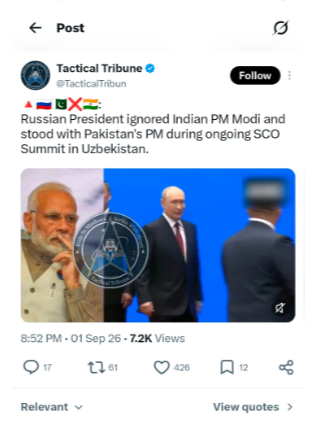
A social media post claims that Russian President Vladimir Putin ignored Prime Minister Narendra Modi and stood alongside the Pakistani Prime Minister.
https://x.com/TacticalTribun/status/2094808040973172786
Fact Check:
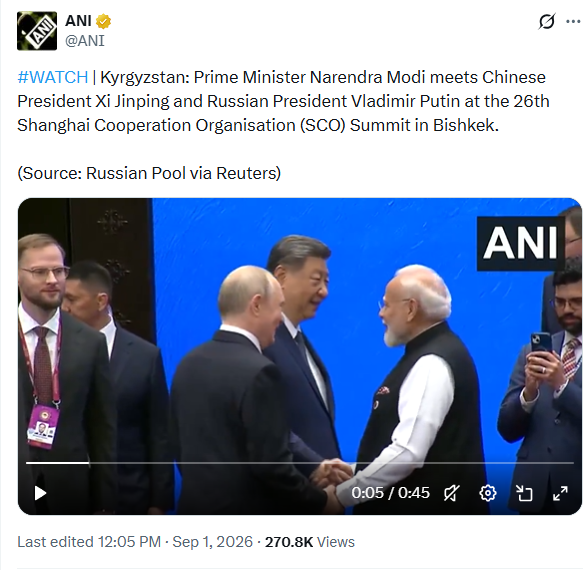
To verify the truth behind the viral claim, we searched Google using relevant keywords related to Prime Minister Narendra Modi’s official visit to Kyrgyzstan. During the search, we found a video posted on ANI’s X handle on September 1, 2026. According to the video, Prime Minister Narendra Modi met Chinese President Xi Jinping and Russian President Vladimir Putin in Bishkek during the 26th Shanghai Cooperation Organisation (SCO) Summit.
https://x.com/ANI/status/2094675518897692896
In the next step of our research, we scanned Prime Minister Narendra Modi’s X account, where we found a post dated August 31, 2026. In the post, PM Modi wrote, “Had extensive discussions with President Putin. Discussed the full range of the India-Russia Special and Privileged Strategic Partnership. It is gladdening to see significant progress across various sectors in recent years. Focus areas for the India-Russia friendship remain energy, innovation, space, fertilisers and people-to-people linkages.”
https://x.com/narendramodi/status/2094433881714032725?s=20

At the end of our research, we found a report published on the Aaj Tak website on September 1, 2026. According to the report, Prime Minister Narendra Modi was in Bishkek, the capital of Kyrgyzstan, where he attended the Shanghai Cooperation Organisation (SCO) Summit. Several leaders of the organisation, including Chinese President Xi Jinping, Russian President Vladimir Putin and Pakistani Prime Minister Shehbaz Sharif, also attended the summit. During the summit, a moment was captured in which PM Modi warmly greeted Chinese President Xi Jinping and Russian President Vladimir Putin together, while Shehbaz Sharif was seen quietly walking past them.

Conclusion:
Our research established that the claim that Russian President Vladimir Putin ignored Prime Minister Narendra Modi and gave preference to the Pakistani Prime Minister is misleading. The viral post presents video footage from different occasions out of context. In reality, Prime Minister Narendra Modi and President Putin held a bilateral meeting, during which the two leaders discussed several key issues, including the India-Russia strategic partnership.
