
The Invisible Domino: How TeamPCP Turned Trusted Software Into a Cyber Weapon
Perth, Western Australia — For most of the past year, the name TeamPCP has circulated quietly within cybersecurity circles as shorthand for a particular kind of dread: not the dread of a phishing email or a suspicious link, but the dread of software you already trusted turning against you. This week, that quiet circulation became public record. The Australian Federal Police, working alongside the FBI and the Western Australia Police Force, arrested and charged two Western Australian men, aged 21 and 23, with a combined 14 offences over their alleged role in the group.
The arrests themselves are notable. The story behind them is more so.
A Campaign Built on Borrowed Trust
TeamPCP's alleged method was not to break down the front door. It was to compromise the door itself, the trusted mechanisms by which developers pull code into their own projects every day. The group has been linked to widespread supply-chain attacks that targeted open-source software and developer platforms to steal credentials, authentication secrets, and source code, with high-profile incidents affecting projects including Trivy, LiteLLM, Telnyx, SAP, and TanStack, alongside breaches at organisations such as the European Commission, Mistral AI, OpenAI, and GitHub. Reporting has also linked the campaign to ecosystems including GitHub Actions, Docker Hub, npm, PyPI and OpenVSX, the invisible plumbing through which most modern software is assembled.
The scale, as alleged by investigators, is difficult to overstate. Authorities say the malicious code potentially compromised over a thousand organisations worldwide, enabling the theft of roughly half a million credentials and the exfiltration of at least 300GB of data, figures that should be understood as allegations under active investigation rather than an independently verified victim count. The AFP itself has said the compromise of a small number of trusted software components had a significant global impact, with remediation costs estimated in the hundreds of millions of dollars.
Why This Attack Was So Hard to See Coming
The mechanics matter. Rather than tricking a user into clicking something malicious, the alleged operation worked by compromising the credentials developers use to publish legitimate software updates, then pushing tampered versions out through the same trusted distribution pipelines millions of applications rely on automatically. There is no obviously suspicious file, no rogue website, only a routine update, arriving exactly where it was expected.
Investigators also describe a cascading structure to the intrusions: credentials harvested from one compromised project reportedly opened the door to the next, turning isolated breaches into a chain reaction across the open-source ecosystem. TeamPCP has been described as running one of the most consequential campaigns of software supply-chain attacks investigators have tracked, and the group's reach extended notably into the AI stack — LiteLLM, one of the projects reportedly compromised, is an open-source gateway widely used to connect applications to large language model providers, meaning the attack's blast radius extended into the very infrastructure powering today's AI boom.
The Investigation and the Charges
The two men were charged following a joint investigation by the AFP and WAPF, working in parallel with the FBI, into what authorities describe as a sophisticated cybercrime syndicate accused of creating malicious open-source software to defraud thousands of global businesses. The charges span identity theft, unauthorised data modification, and money laundering, with maximum penalties ranging from three to twenty years' imprisonment. Search warrants were executed in Perth on 26 August 2026, and investigators seized electronic devices for forensic analysis after raids at properties in Cottesloe, Hamilton Hill, and Mandurah. FBI Cyber Division Assistant Director Brett Leatherman noted the significance of the international cooperation involved in the case, while investigators have not ruled out further arrests.
The Real Story: A Governance Problem, Not Just a Crime Story
It would be easy to file this under "hackers caught" and move on. But the more consequential story is structural. Modern organisations do not merely secure their own infrastructure, they inherit risk from every library, package, CI/CD pipeline, repository, vendor and developer tool they depend on, often without ever auditing that dependency chain directly. Guidance from the U.S. Cybersecurity and Infrastructure Security Agency (CISA) on securing open-source software has increasingly emphasised managing these dependencies through software bills of materials (SBOMs), precisely because so few organisations can otherwise answer a basic question: what, exactly, is running inside our systems?
TeamPCP's alleged campaign is a case study in why that question can no longer be optional. If an organisation's security posture is only as strong as the thousands of components it silently trusts, then supply-chain security is not a developer problem to be quietly patched — it is a governance issue, deserving board-level attention, vendor accountability frameworks, and mandatory disclosure practices.
CyberPeace's Take
At CyberPeace, we've been watching campaigns like TeamPCP's less as isolated incidents and more as a pattern that keeps repeating with higher stakes each time. What stands out to our team isn't the sophistication of the code, open-source poisoning is, frankly, not a new technique, it's the sophistication of patience. Compromising a maintainer's publishing credentials and simply waiting for the next scheduled release to carry the payload downstream is a strategy built for an ecosystem that still largely operates on implicit trust rather than continuous verification. That gap between how fast software moves and how slowly trust is actually checked is precisely where operations like this thrive.
We'd also push back gently on treating this as a "developer hygiene" story. Most engineering teams pulling in a package from npm or PyPI are not, and should not be expected to be, forensically auditing every dependency update by hand, that isn't scalable, and it was never a realistic line of defence. The actual fix has to sit further upstream: provenance verification baked into CI/CD pipelines, signed commits and releases treated as non-negotiable rather than optional, and SBOMs that are actually queried during incident response rather than generated once and filed away.
Our broader concern, honestly, is about incentive alignment. Open-source maintainers are frequently unpaid or under-resourced volunteers holding publishing keys to software depended on by billion-dollar enterprises. Until organisations that consume open-source software at scale start meaningfully funding its security, not just its development, this pattern isn't going away. It will simply find its next entry point.
References
- Australian Federal Police. Two WA men charged following AFP-FBI-WAPF disruption of alleged global cybercrime syndicate. afp.gov.au
- Bleeping Computer. Australia arrests alleged TeamPCP hackers behind supply-chain attacks. bleepingcomputer.com
- CyberScoop. Two alleged TeamPCP members arrested and charged after months of software supply-chain chaos. cyberscoop.com
- Cyber Daily. Busted! Alleged Aussie hackers linked to TeamPCP arrested in joint AFP-FBI-WAPF operation. cyberdaily.au
- Help Net Security. Two alleged TeamPCP hackers arrested over global supply chain attacks. helpnetsecurity.com
- Krebs on Security. Two Alleged 'TeamPCP' Hackers Arrested in Australia. krebsonsecurity.com
- TechCrunch. Australian police arrest two over TeamPCP hacks targeting Mercor, OpenAI, and others. techcrunch.com
- The Hacker News. Alleged TeamPCP Hackers Charged in Australia Over Major Supply Chain Attacks. thehackernews.com

Related Blogs
.webp)
Introduction
The rapid advancement of technology, including generative AI, offers immense benefits but also raises concerns about misuse. The Internet Watch Foundation reported that, as of July 2024, over 3,500 new AI-generated child sexual abuse images appeared on the dark web. The UK’s National Crime Agency records 800 monthly arrests for online child threats and estimates 840,000 adults as potential offenders. In response, the UK is introducing legislation to criminalise AI-generated child exploitation imagery, which will be a part of the Crime and Policing Bill when it comes to parliament in the next few weeks, aligning with global AI regulations like the EU AI Act and the US AI Initiative Act. This policy shift strengthens efforts to combat online child exploitation and sets a global precedent for responsible AI governance.
Current Legal Landscape and the Policy Gap
The UK’s Online Safety Act 2023 aims to combat CSAM and deepfake pornography by holding social media and search platforms accountable for user safety. It mandates these platforms to prevent children from accessing harmful content, remove illegal material, and offer clear reporting mechanisms. For adults, major platforms must be transparent about harmful content policies and provide users control over what they see.
However, the Act has notable limitations, including concerns over content moderation overreach, potential censorship of legitimate debates, and challenges in defining "harmful" content. It may disproportionately impact smaller platforms and raise concerns about protecting journalistic content and politically significant discussions. While intended to enhance online safety, these challenges highlight the complexities of balancing regulation with digital rights and free expression.
The Proposed Criminalisation of AI-Generated Sexual Abuse Content
The proposed law by the UK criminalises the creation, distribution, and possession of AI-generated CSAM and deepfake pornography. It mandates enforcement agencies and digital platforms to identify and remove such content, with penalties for non-compliance. Perpetrators may face up to two years in prison for taking intimate images without consent or installing equipment to facilitate such offences. Currently, sharing or threatening to share intimate images, including deepfakes, is an offence under the Sexual Offences Act 2003, amended by the Online Safety Act 2023. The government plans to repeal certain voyeurism offences, replacing them with broader provisions covering unauthorised intimate recordings. This aligns with its September 2024 decision to classify sharing intimate images as a priority offence under the Online Safety Act, reinforcing its commitment to balancing free expression with harm prevention.
Implications for AI Regulation and Platform Responsibility
The UK's move aligns with its AI Safety Summit commitments, placing responsibility on platforms to remove AI-generated sexual abuse content or face Ofcom enforcement. The Crime and Policing Bill is expected to tighten AI regulations, requiring developers to integrate safeguards against misuse, and the licensing frameworks may enforce ethical AI standards, restricting access to synthetic media tools. Given AI-generated abuse's cross-border nature, enforcement will necessitate global cooperation with platforms, law enforcement, and regulators. Bilateral and multilateral agreements could help harmonise legal frameworks, enabling swift content takedown, evidence sharing, and extradition of offenders, strengthening international efforts against AI-enabled exploitation.
Conclusion and Policy Recommendations
The Crime and Policing Bill marks a crucial step in criminalising AI-generated CSAM and deepfake pornography, strengthening online safety and platform accountability. However, balancing digital rights and enforcement remains a challenge. For effective implementation, industry cooperation is essential, with platforms integrating detection tools and transparent reporting systems. AI ethics frameworks should prevent misuse while allowing innovation, and victim support mechanisms must be prioritised. Given AI-driven abuse's global nature, international regulatory alignment is key for harmonised laws, evidence sharing, and cross-border enforcement. This legislation sets a global precedent, emphasising proactive regulation to ensure digital safety, ethical AI development, and the protection of human dignity.
References
- https://www.iwf.org.uk/about-us/why-we-exist/our-research/how-ai-is-being-abused-to-create-child-sexual-abuse-imagery/
- https://www.reuters.com/technology/artificial-intelligence/uk-makes-use-ai-tools-create-child-abuse-material-crime-2025-02-01/
- https://www.financialexpress.com/life/technology-uk-set-to-ban-ai-tools-for-creating-child-sexual-abuse-images-with-new-laws-3735296/
- https://www.gov.uk/government/publications/national-crime-agency-annual-report-and-accounts-2023-to-2024/national-crime-agency-annual-report-and-accounts-2023-to-2024-accessible#part-1--performance-report

Introduction
In the digital entertainment world, OTT platforms have become highly popular and have attracted larger audiences. They offer a wide variety of entertaining content. However, there are certain concerns about depicting illicit or objectionable content on such platforms. The Indian Ministry of Information and Broadcasting (I&B) has been working on tackling issues like the availability of obscene content on online streaming platforms and other platforms. I&B Ministry has taken important steps to prevent the spread of such illicit or objectionable content.
The I&B Ministry has taken action against obscene and vulgar content on OTT platforms. A total 18 OTT platforms and several associated websites, apps, and social media handles have been blocked nationwide. The government has been in consistent talks with these platforms and issued several advisories, but they have not been adhered to. The decision was made after consultation with other ministries, domain experts, and industry bodies. The content allegedly obscene was found to depict nudity, sexual intercourse, and inappropriate sexual acts within societal contexts. The government states that it is the responsibility of platforms to ensure that content is not present in a vulgar fashion. Creativities do not necessarily mean promoting or propagating vulgar and sexual content.
Key Highlights of I&B Ministry Action against Obscene Content
On 14th March 2024, The Indian Ministry of Information and Broadcasting (I&B) announced the blocking of 18 OTT platforms, 19 Websites, 10 apps, and 57 social media handles for displaying obscene and vulgar content. Union Minister for Information & Broadcasting Shri Anurag Singh Thakur has announced the removal of 18 OTT platforms that published obscene and vulgar content, underscoring the responsibility of platforms to prevent the spread of such content. The decision was made under the Information Technology Act 2000 and in consultation with other Indian ministries and domain experts in media, entertainment, women's rights, and child rights.
List of Blocked OTT Platforms
OTT platforms that have been blocked are Dreams Films, Voovi, Yessma, Uncut Adda, Tri Flicks, X Prime, Neon X VIP, Besharams, Hunters, Rabbit, Xtramood, Nuefliks, MoodX, Mojflix, Hot Shots VIP, Fugi, Chikooflix, Prime Play.
It was highlighted that these OTT platforms, despite not being widely popular, have a significant viewership. One app has over 1 crore downloads, while two others have more than 50 lakh downloads on Google Play Store. These platforms also market their content through social media, with a combined followership of over 32 lakh.
Nature of content
The ministry reported that a significant portion of the content on social media platforms was obscene, vulgar, and demeaning, depicting nudity and sexual acts in inappropriate contexts like teacher-student relationships and incestuous family relationships. The content included sexual innuendos and prolonged pornographic scenes without any thematic or societal relevance. It was further stated that the content was found to be prima facie in violation of Section 67 and 67A of the Information & Technology Act, 2000, Section 292 of the Indian Penal Code and Section 4 of the Indecent Representation of Women (Prohibition) Act, 1986.
Way Forward
The press release by the ministry stated that “The Government of India remains committed to fostering the growth and development of the OTT industry. Several measures have been undertaken in this regard, including the introduction of the Inaugural OTT Award for Web Series at the 54th International Film Festival of India, collaboration with OTT platforms in the media and entertainment sector, and the establishment of a light touch regulatory framework with an emphasis on self-regulation under the IT Rules, 2021.”
This shows that the Indian government is dedicated to promoting the growth of the OTT industry but within certain checks or oversight mechanisms to prevent illicit or objectionable content on such platforms.
OTT Content and Regulatory Checks
Online content streaming on OTT platforms lacks regulatory checks, unlike films, which are reviewed and certified by a government-appointed board. The government has instructed streaming services to independently review content for obscenity and violence before it is made available online. There have been repeated instances where criticism has been raised about the illicit or violative depicted content in some OTT shows. This highlights the issue of checks and balances. The government has urged self-regulation on platforms, but the repeated instances of illicit content raise societal concerns. The Ministry of I&B is keen towards promoting ethical & moral standards of content that is being hosted on online OTT platforms.
Conclusion
The Ministry of I&B has taken a step and announced the shutdown of 18 OTT platforms that were engaged in depicting illicit content. This shows that the I&B Ministry is committed to promoting ethical online content. While legislative measures are required to prevent the spread of such illicit or violative content, joint efforts by the government, industry players, and civil society are critical to ensuring a secure and responsible digital environment for all users.
References
- https://pib.gov.in/PressReleaseIframePage.aspx?PRID=2014477
- https://www.thehindu.com/news/national/centre-bans-ott-platforms-websites-and-apps-over-obscene-and-vulgar-content/article67949819.ece
- https://economictimes.indiatimes.com/news/india/ib-ministry-blocks-18-ott-platforms-for-vulgar-content/articleshow/108485880.cms?from=mdr
- https://indianexpress.com/article/entertainment/information-and-broadcasting-ministry-blocks-18-ott-platforms-for-obscene-and-vulgar-content-9213749/
- https://www.storyboard18.com/ott-news/mib-blocks-18-ott-platforms-for-showing-obscene-and-vulgar-content-26400.htm

Executive Summary:
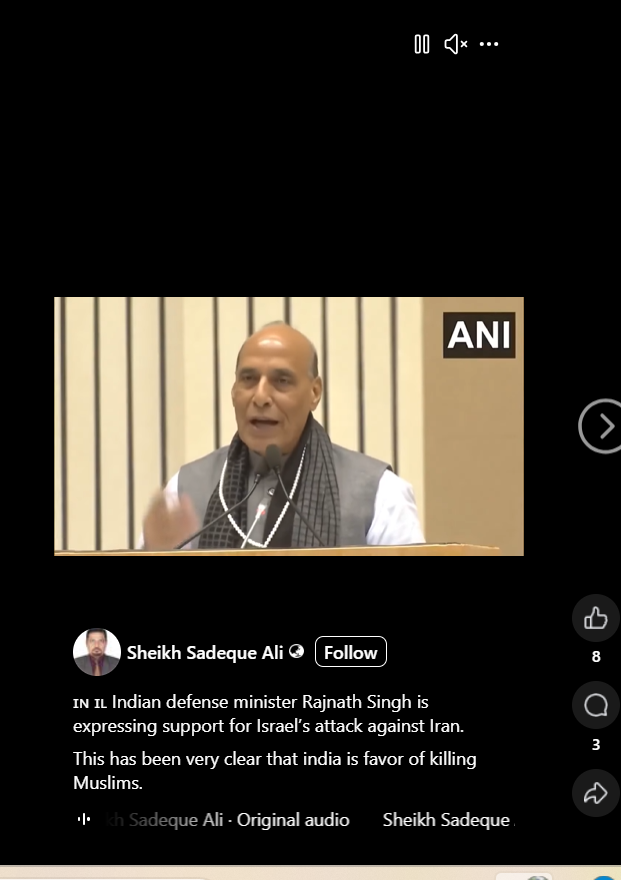
A video of India’s Defence Minister Rajnath Singh is going viral on social media. The post claims that Rajnath Singh is openly supporting Israeli-American attacks against Iran. In the video, he can allegedly be heard saying that Prime Minister Narendra Modi had visited Israel before the war began and warned Tehran that disturbing peace would have serious consequences.
Research by CyberPeace found that the viral video is a deepfake created using Artificial Intelligence (AI). Rajnath Singh has not made any such statement about Iran or the Israel-US conflict.
Claim
A Facebook user “Sheikh Sadeque Ali” shared the video on March 2, 2026. The caption of the post reads, “Indian Defence Minister Rajnath Singh is supporting Israel’s attack on Iran. This clearly shows that India supports the killing of Muslims.”
In the viral video, Rajnath Singh appears to say in English: “Prime Minister Modi’s visit to Israel before the attack on Iran reflects India’s solidarity with its strategic partner… He warned Tehran that hostile actions would have serious consequences for regional peace.”
Fact Check:
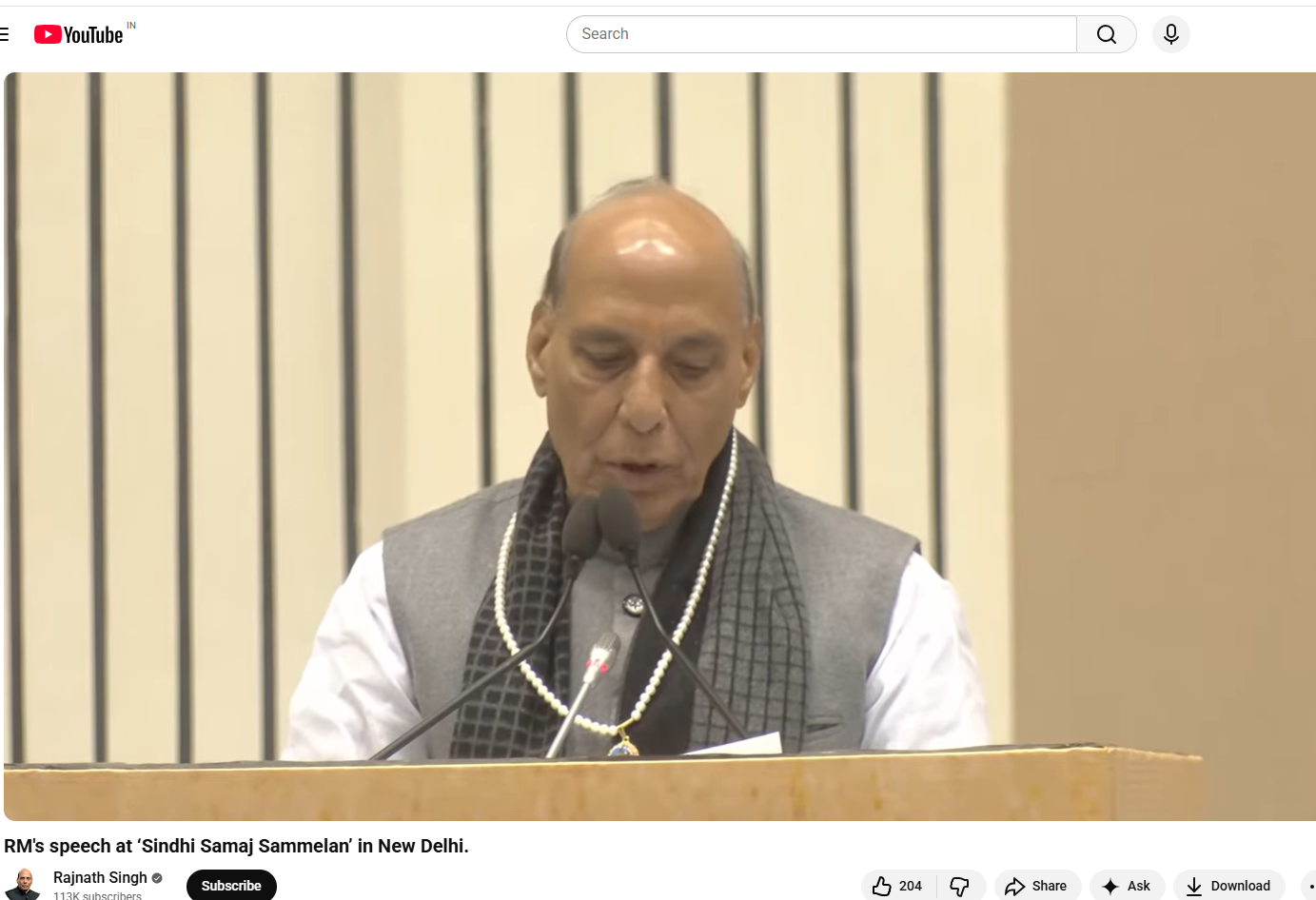
To verify the claim, we extracted keyframes from the viral video and conducted a reverse image search. During the research , we found the original video on Rajnath Singh’s official YouTube channel. The video was uploaded on November 23, 2025.In the original video, Rajnath Singh was addressing a Sindhi community conference in Delhi. During his speech, he was talking about Sindhi culture and the history of Partition. He did not mention Israel, Iran or any Middle East conflict during the entire program.
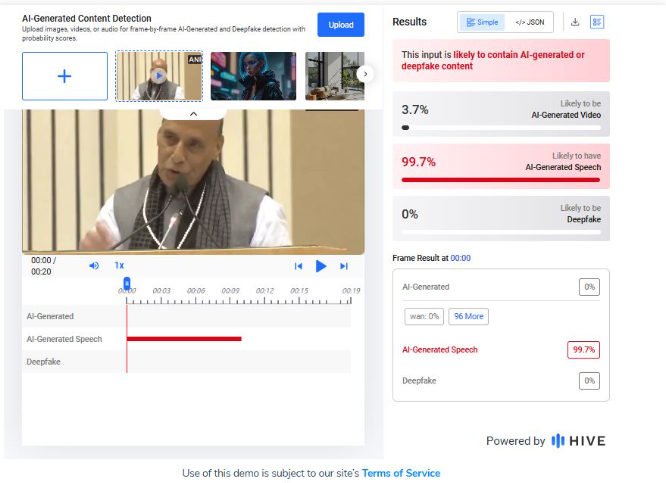
Upon closely examining the viral video, technical inconsistencies between the lip movements and the audio (lip-sync discrepancies) can be observed, which strongly indicate that the video may have been generated using AI. To verify this, we analysed the clip using several AI-detection tools. The AI detection tool Hive Moderation indicated that the video has a 99% probability of being AI-generated.
Conclusion:
Our research found that the viral video of Rajnath Singh is a deepfake. He has not made any statement supporting Israel or opposing Iran. The original video is from a Sindhi community event in Delhi, which has been digitally altered using AI to spread a misleading claim.
