
The Great Indian Gaming Paradox: Millions of Players, Very Few Creators
Introduction
One of the biggest gaming populations in the world today is found in India. Every day, hundreds of millions of young Indians engage with streaming services, immersive digital content, mobile games and e-sports ecosystems. Yet, despite this massive scale of participation, India remains largely absent from the global conversation on original gaming intellectual property. Although the nation produces very few globally significant gaming worlds of its own, it consumes games on an astonishing scale. This paradox highlights a more serious structural issue with the gaming discourse in India. Our national conversation around gaming often begins and ends with regulation i.e., online betting, taxation, fantasy gaming legality, addiction and compliance. Although these worries are valid they have inadvertently obscured a much more crucial query: is India creating a gaming industry or is it just regulating a gaming market? Various subject-matter experts have expressed their views on this issue, like Shailendra Vikram Singh Former Deputy Secretary (Cyber & Information Security), Ministry of Home Affairs who is of the opinion,
“I believe India’s gaming story presents a unique paradox. While we are one of the world’s largest gaming markets, we have yet to fully realize gaming’s potential as a strategic pillar of the AVGC vision. Much of the conversation remains focused on regulation and consumption, whereas the larger opportunity lies in creation, innovation, and global competitiveness.
In my view, gaming should be recognized as a strategic creative and digital industry. It has the potential to generate high-value employment, foster indigenous intellectual property, and strengthen capabilities in design, storytelling, animation, immersive technologies, and emerging digital skills. Beyond its economic value, gaming can also serve as a powerful platform for education, skilling, and public engagement.
I also see gaming as an important medium for bringing India’s rich cultural heritage, historical narratives, and diverse traditions to global audiences through interactive storytelling. As digital experiences increasingly shape how younger generations learn, engage, and understand the world, culturally rooted content can become a source of both creative expression and national soft power.
At the same time, sustainable growth must be built on trust. Strong safeguards for cybersecurity, child protection, user safety, responsible gaming, and data governance are essential to creating a resilient and trusted ecosystem.
To realize the full promise of the AVGC vision, I believe India must aspire to be more than a large gaming market. A nation of gamers must ultimately become a nation of game creators.”
The Misplaced Focus of Regulating Bodies
A country with one of the world’s oldest storytelling civilizations should not remain from the world’s most influential storytelling medium. Examining how other nations viewed gaming as a strategic cultural enterprise highlights the disparity even further. Japan turned gaming into a tool of soft power by exporting global icons like Mario, Pokémon and Zelda. Along with K-pop and digital culture, South Korea incorporated gaming into its larger cultural export sector. With businesses like Tencent and games like Genshin Impact and Black Myth: Wukong, China is now aggressively marketing gaming as a geopolitical and technological impact ecosystem.
Through The Witcher, Poland even showed how local folklore based storytelling may achieve cultural relevance on a worldwide scale. In contrast, India contributes very little to the global gaming imagination despite having one of the strongest civilisational storytelling traditions in human history, including the Mahabharata, Ramayana, Buddhist Narratives, tribal folklore, Indic mythology and regional legends.
Artificial Intelligence and Lore of Lost Opportunities
The arrival of artificial intelligence now changes this equation dramatically. AI is lowering the barriers to creativity in ways previously unimaginable. For character design, procedural storytelling, localisation, environment creation, NPC interactions, voice synthesis and animation pipelines, independent producers and small studios can now use generative AI. Agile creative ecosystems are increasingly able to accomplish what formerly required enormous infrastructure and production teams. This offers India a once-in-a-lifetime chance to overcome conventional developmental barriers in the gaming sector. India may become a global center for AI-assisted storytelling, culturally grounded gaming storylines and scalable independent game production instead of competing just through capital-intensive AAA ecosystems.
The AVGC Promotion Task Force for India’s Digital future explicitly highlighted the significance of intellectual property development, academic integration, skilling and incubation systems. However, India still views gaming more as a compliance industry than as a significant creative economy. Economists use revenue forecasts to discuss gaming. Taxation frameworks are used by policymakers to discuss it. However, narrative ownership, digital culture, creative sovereignty and gaming as a long-term civilisational export are not sufficiently discussed.
Playing Everyone Else’s Game
The actual danger does not lie in the fact India won’t grow into a sizable gaming industry. The change has already taken place. The bigger risk is that, in a global market that is becoming more and more controlled by foreign narratives, foreign engines and foreign platforms, India may permanently remain a consumer ecosystem. Processors and graphic engines won’t be the only factors influencing gaming in the future, cultures that can emotionally engage worlds will also play a significant role. India possesses the depth of civilisation, creative heritage, technical prowess and population size necessary to develop into such a creator economy. It does not, however, have a consistent institutional focus on supporting studios, storytellers, animators and original intellectual property ecosystems.
References
- AVGC Promotion Task Force Report, Government of India
- KPMG India Media & Entertainment Reports
- EY-FICCI Media & Entertainment Industry Reports
- Newzoo Global Games Market Reports
- Lumikai “State of India Gaming” Reports
- UNESCO Reports on Cultural & Creative Industries
- World Economic Forum reports on AI and Creative Economies

Related Blogs
.webp)
Executive Summary
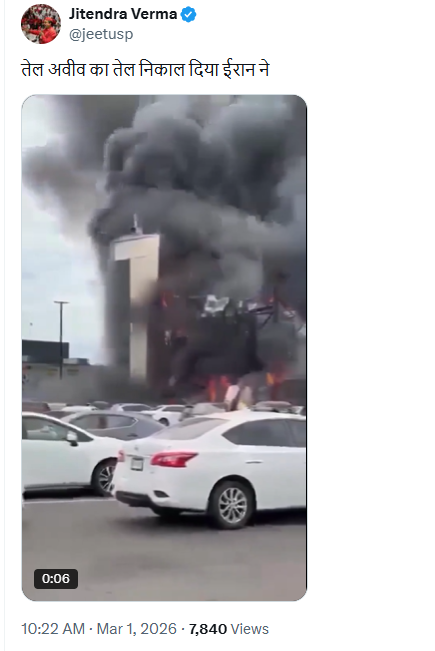
Amid heightened tensions following Israel and US actions against Iran, a video is being widely shared on social media. The footage shows thick black smoke rising into the sky from a location, suggesting a major explosion or attack. However, research conducted by the CyberPeace found the viral claim to be misleading. Our research revealed that the video is not recent and has no connection to the current Israel-Iran tensions. In fact, the footage is nearly a year old and shows a fire at a casino in Mexico, now being shared out of context.
Claim
Users circulating the video claim that it shows an attack on Tel Aviv, Israel. On March 1, 2026, a user on X shared the clip with the caption, “Iran has drained the oil out of Tel Aviv,” implying a devastating retaliatory strike. (Post and archive links provided above.)
Fact Check:
To verify the authenticity of the video, we extracted key frames and performed a reverse image search using Google Lens. During the search, we found the same visuals in a Spanish media report published on January 16, 2025. This confirmed that the video predates the ongoing geopolitical developments.

According to the report, the footage shows a fire at the Royal Park Casino located inside the Cinépolis plaza in Culiacán, Mexico. Local outlet Meganoticias Culiacán reported on X that the casino was “completely burned down.” The structure reportedly collapsed following the blaze, and emergency responders confirmed that several people were injured. Further keyword searches led us to the same footage on the official YouTube channel of Milenio, uploaded on January 17, 2025. The report clearly states that the fire occurred at the Royal Yacht Casino in Mexico and is unrelated to any recent military developments.

Conclusion
Evidence gathered during our research clearly establishes that the viral video is not related to any missile attack by Iran on Israel. The claim is false. The footage is from a fire incident at a casino in Mexico and is being misleadingly shared in the context of current international tensions, potentially creating unnecessary panic and confusion.
.webp)
Introduction
The recent events in Mira Road, a bustling suburb on the outskirts of Mumbai, India, unfold like a modern-day parable, cautioning us against the perils of unverified digital content. The Mira Road incident, a communal clash that erupted into the physical realm, has been mirrored and magnified through the prism of social media. The Maharashtra Police, in a concerted effort to quell the spread of discord, issued stern warnings against the dissemination of rumours and fake messages. These digital phantoms, they stressed, have the potential to ignite law and order conflagrations, threatening the delicate tapestry of peace.
The police's clarion call came in the wake of a video, mischievously edited, that falsely claimed anti-social elements had set the Mira Road railway station ablaze. This digital doppelgänger of reality swiftly went viral, its tendrils reaching into the ubiquitous realm of WhatsApp, ensnaring the unsuspecting in its web of deceit.
In this age of information overload, where the line between fact and fabrication blurs, the police urged citizens to exercise discernment. The note they issued was not merely an advisory but a plea for vigilance, a reminder that the act of sharing unauthenticated messages is not a passive one; it is an act that can disturb the peace and unravel the fabric of society.
The Massacre
The police's response to this crisis was multifaceted. Administrators and members of social media groups found to be the harbingers of such falsehoods would face legal repercussions. The Thane District, a mosaic of cultural and religious significance, has been marred by a series of violent incidents, casting a shadow over its storied history. The police, in their role as guardians of order, have detained individuals, scoured social media for inauthentic posts, and maintained a vigilant presence in the region.
The Maharashtra cyber cell, a digital sentinel, has unearthed approximately 15 posts laden with videos and messages designed to sow discord among the masses. These findings were shared with the Mira-Bhayandar, Vasai-Virar (MBVV) police, who stand ready to take appropriate action. Inspector General Yashasvi Yadav of the Maharashtra cyber cell issued an appeal to the public, urging them to refrain from circulating such unverified messages, reinforcing the notion that the propagation of inauthentic information is, in itself, a crime.
The MBVV police, in their zero-tolerance stance, have formed a team dedicated to scrutinizing social media posts. The message is clear: fake news will be met with strict action. The right to free speech on social media comes with the responsibility not to share information that could incite mischief. The Indian Penal Code and Information Technology Act serve as the bulwarks against such transgressions.
The Aftermath
In the aftermath of the clashes, the police have worked tirelessly to restore calm. A young man, whose video replete with harsh and obscene language went viral, was apprehended and has since apologised for his actions. The MBVV police have also taken to social media to reassure the public that the situation is under control, urging them to avoid circulating messages that could exacerbate tensions.
The Thane district has witnessed acts of vandalism targeting shops, further escalating tensions. In response, the police have apprehended individuals linked to these acts, hoping that such measures will expedite the return of peace. Advisories have been issued, warning against the dissemination of provocative messages and rumours.
In total, 19 individuals have been taken into custody in relation to numerous incidents of violence. The Mira-Bhayandar and Vasai-Virar police have underscored their commitment to legal action against those who spread rumours through fake messages. The authorities have also highlighted the importance of brotherhood and unity, reminding citizens that above all, they are Indians first.
Conclusion
In a world where old videos, stripped of context, can fuel tensions, the police have issued a note referring to the aforementioned fake video message. They urge citizens to exercise caution, to neither believe nor circulate such messages. Police Authorities have assured that no one involved in the violence will be spared, and peace committees are being convened to restore harmony. The Mira Road incident serves as a sign of the prowess of information and responsibility that comes with it. In the digital age, where the ephemeral and the eternal collide, we must navigate the waters of truth with care. Ultimately, it is not just the image of a locality that is at stake, but the essence of our collective humanity.
References
- https://youtu.be/gK2Ac1qP-nE?feature=shared
- https://www.mid-day.com/mumbai/mumbai-crime-news/article/mira-road-communal-clash-those-spreading-fake-messages-to-face-strict-action-say-mira-bhayandar-vasai-virar-cops-23331572
- https://www.mid-day.com/mumbai/mumbai-news/article/mira-road-communal-clash-cybercops-on-alert-for-fake-clips-23331653
- https://www.theweek.in/wire-updates/national/2024/01/24/bom43-mh-shops-3rdld-vandalism.html

Executive Summary
A video is being widely circulated on social media showing thousands of drones forming an image of Cristiano Ronaldo wearing his iconic Portugal jersey over what appears to be a water body. Moments later, the drones are seen creating his famous “SIUUU” celebration pose. The video is being shared with the claim that this spectacular aerial drone show was organised as a tribute to Ronaldo.
CyberPeace Research Wing’s research found the viral claim to be false. The research revealed that the video is not a real drone display but was created using Artificial Intelligence (AI) and is being circulated with a misleading claim.
Claim
The viral video is being shared on social media with the claim that the drone show was organised in honour of Cristiano Ronaldo.
https://www.instagram.com/reel/DamaeegILpU/?igsh=NmtjOTN4cWJzenJ1

Fact Check
To verify the claim, we extracted multiple keyframes from the viral video and conducted a reverse image search using Google Lens. During the research, we did not find any credible video, news report, or reliable source confirming that such a drone show was organised for Cristiano Ronaldo.
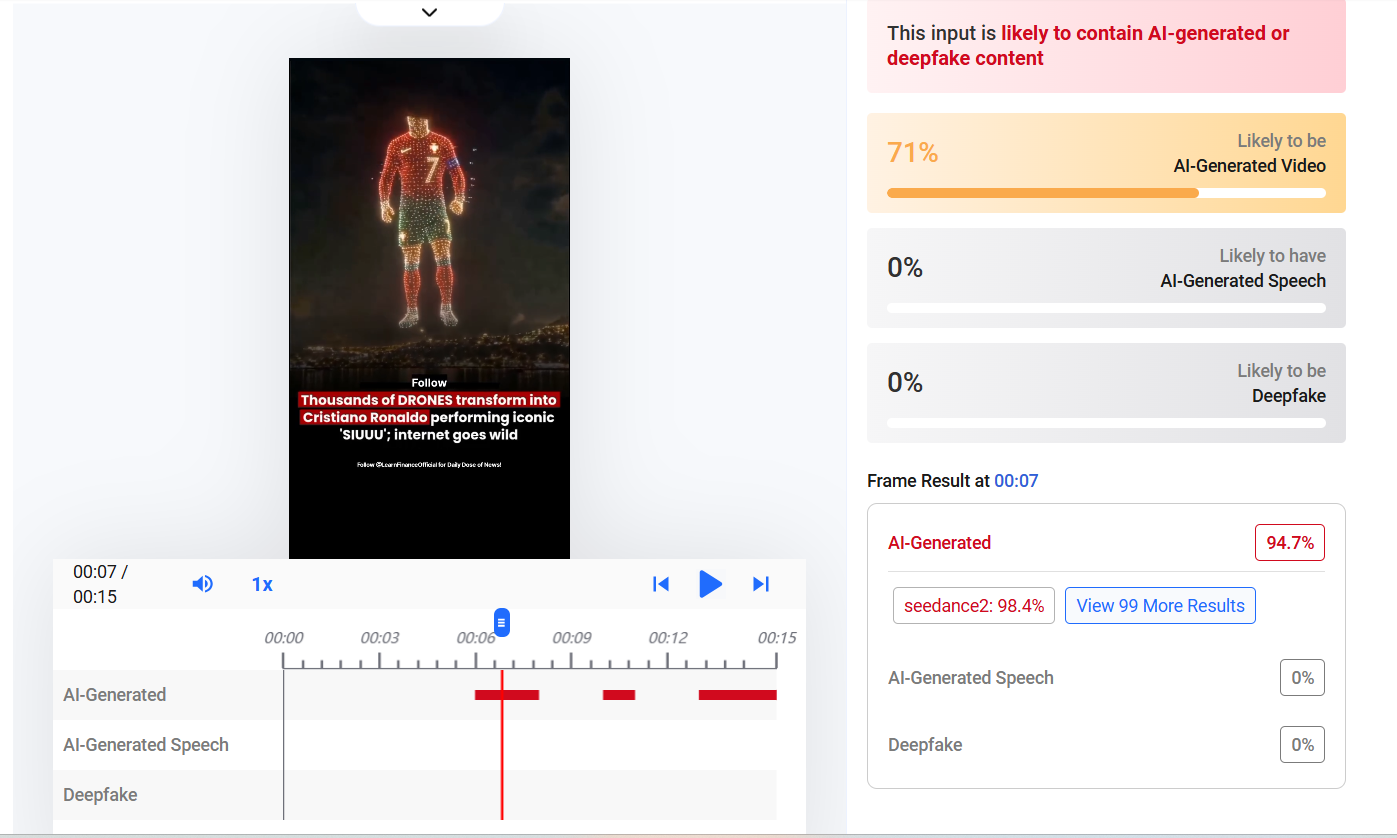
In the next stage of the research, we analysed the video using the AI detection tool Hive Moderation. The tool’s results indicated that the viral video had a 71% probability of being AI-generated.
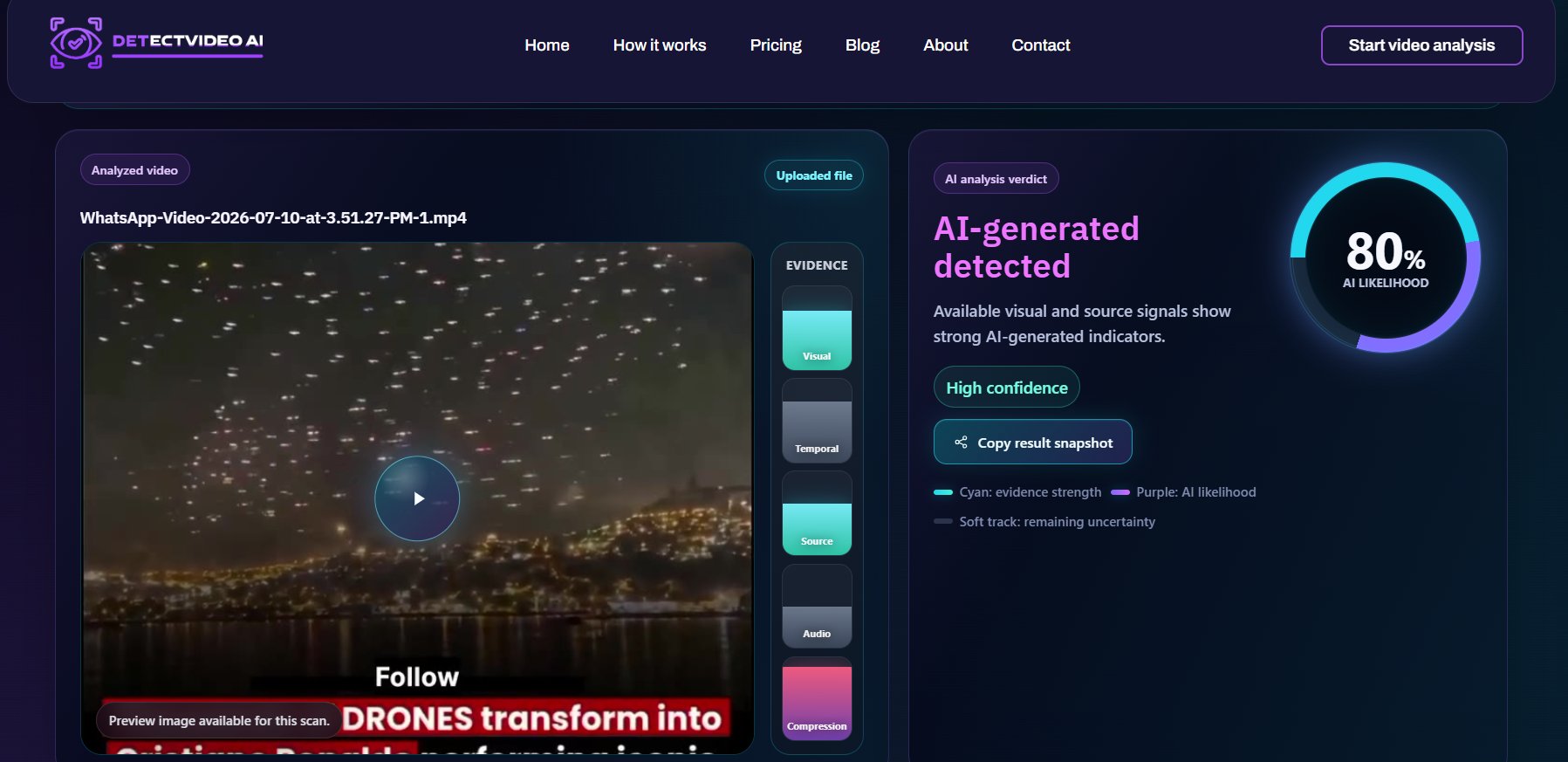
For further verification, we checked the video using another AI detection tool, DetectVideo AI. The analysis showed that the video had an 80% probability of being AI-generated.
At the final stage of the research, the video was also analysed using Deepfake-O-Meter. The tool indicated an almost 100% probability that the video was AI-generated.

Conclusion
Our research found that the viral claim is false. The video does not show a real drone show organised in honour of Cristiano Ronaldo. The footage was found to be AI-generated and is being circulated on social media with a false narrative.
