
The Digital Leviathan: The UN Cybercrime Treaty and the Future of Global Governance
Introduction
Law grows by confronting its absences, it heals through its own gaps. States often find themselves navigating a shared frontier without a mutual guide or lines of law in an era of expanding digital boundaries and growing cyber damages. The United Nations General Assembly ratified the United Nations Convention against Cybercrime on December 24, 2024, and more than sixty governments were in attendance in the signing ceremony on 24th & 25th October this year, marking a moment of institutional regeneration and global commitment.
A new Lexicon for Global Order
The old liberal order is being strained by growing nationalism, economic fracturing, populism, and great-power competition as often emphasised in the works of scholars like G. John Iken berry and John Mearsheimer. Multilateral arrangements become more brittle in such circumstances. Therefore, the new cybercrimes convention represents not only a legal tool but also a resurgence of international promise, a significant win for collective governance in an uncertain time. It serves as a reminder that institutions can be rebuilt even after they have been damaged.
In Discussion: The Fabric of the Digital Polis
The digital sphere has become a contentious area. On the one hand, the US and its allies support stakeholder governance, robust individual rights, and open data flows. On the other hand, nations like China and Russia describe a “post-liberal cyber order” based on state mediation, heavily regulated flows, and sovereignty. Instead of focusing on ideological dichotomies, India, which is positioned as both a rising power and a voice of the Global South, has offered a viewpoint based on supply-chain security, data localisation, and capacity creation. Thus, rather than being merely a regulation, the treaty arises from a framework of strategic recalibration.
What Changed & Why it Matters
There have been regional cybercrime accords up to this point, such as the Budapest Convention. The goal of this new international convention, which is accessible to all UN members, is to standardise definitions, evidence sharing and investigation instruments. 72 states signed the Hanoi signature event in October, 2025, demonstrating an unparalleled level of scope and determination. In addition to establishing structures for cooperative investigations, extradition, and the sharing of electronic evidence, it requires signatories to criminalise acts such as fraud, unlawful access to systems, data interference, and online child exploitation.
For the first time, a legally obligatory global architecture aims to harmonise cross-border evidence flows, mutual legal assistance, and national procedural laws. Cybercrime offers genuine promise for community defence at a time when it is no longer incidental but existential, attacks on hospitals, schools and infrastructure are now common, according to the Global Observatory.
Holding the Line: India’s Deliberate Path in the Age of Cyber Multilateralism
India takes a contemplative rather than a reluctant stance towards the UN Cybercrime Treaty. Though it played an active role during the drafting sessions and lent its voice to the shaping of global cyber norms, New Delhi is yet to sign the convention. Subtle but intentional, the reluctance suggests a more comprehensive reflection, an evaluation of how international obligations correspond with domestic constitutional protections, especially the right to privacy upheld by the Supreme Court in Puttaswamy v. UOI (2017).
Prudence is the reason for this halt. Policy circles speculate that the government is still assessing the treaty’s consequences for national data protection, surveillance regimes, and territorial sovereignty. Officials have not provided explicit justifications for India’s refusal to join. India’s position has frequently been characterised by striking a careful balance between digital sovereignty and taking part in cooperative international regimes. In earlier negotiations, India had even proposed including clauses to penalise “offensive messages” on social media, echoing the erstwhile Section 66A of the IT Act, 2000, but the suggestion found little international traction.
Advocates for digital rights such as Raman Jit Singh Chima of Access Now have warned that ensuring that the treaty’s implementation upholds constitutional privacy principles may be necessary for India to eventually endorse it. He contends that the treaty’s wording might not entirely meet India’s legal requirements in the absence of such voluntary pledges.
UN Secretary-General Antonio Guterres praised the agreement as “a powerful, legally binding instrument to strengthen our collective defences against “cybercrime” during its signing in Hanoi. The issue for India is to make sure that multilateral collaboration develops in accordance with constitutional values rather than to reject that vision. Therefore, the path forward is one of assertion rather than absence, careful march towards a cyber future that protects freedom and sovereignty.
Sources:

Related Blogs
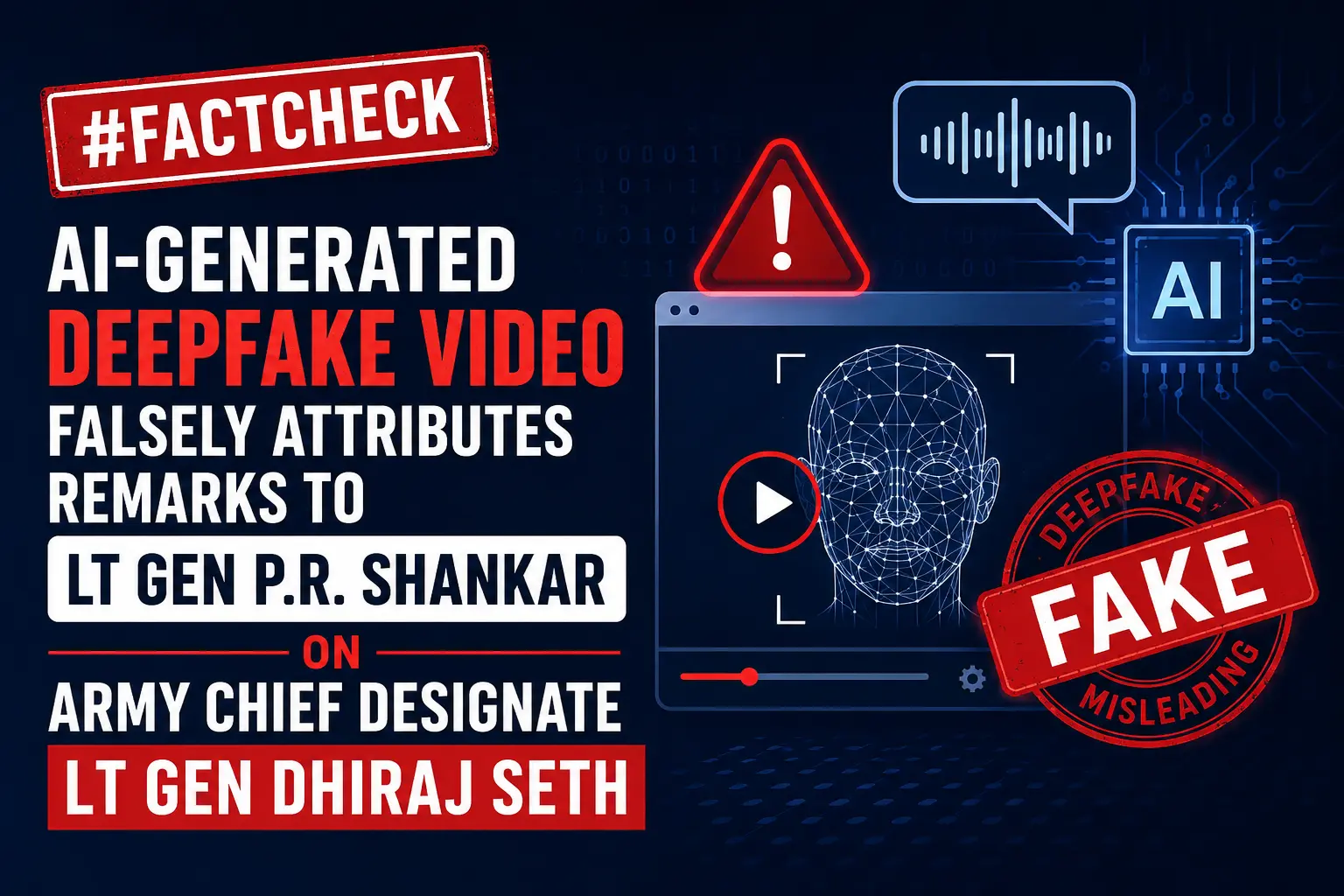
Executive Summary: A video circulating on social media claims that retired Lieutenant General P.R. Shankar questioned the capability of newly appointed Army Chief Lt Gen Dhiraj Seth, suggesting he may not be able to effectively counter Pakistan or China. The clip further alleges that the appointment involved political influence and favoritism. CyberPeace Research Wing research found the claim to be false and misleading. The original video contains no such remarks regarding the new Army Chief or his appointment.
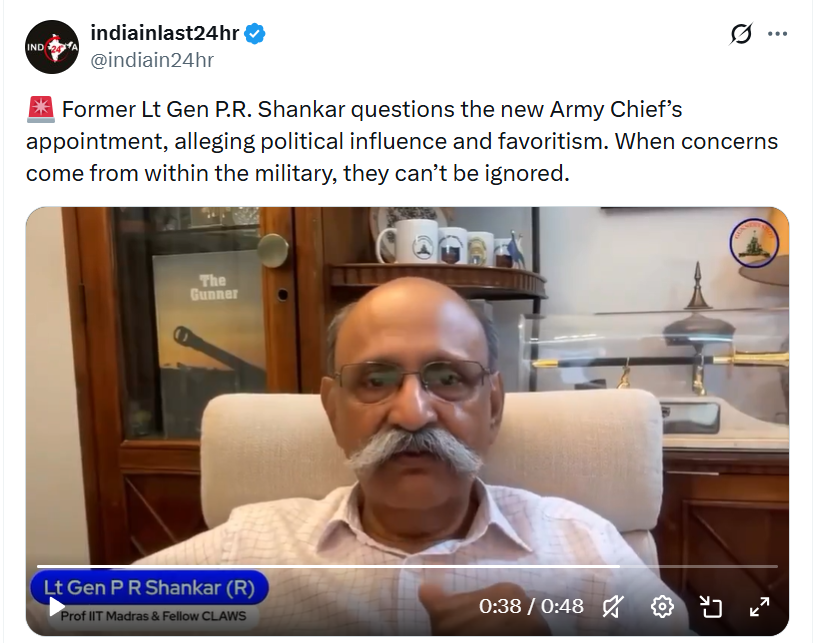
Claim: An X user shared the viral video on June 16, 2026, alleging that Lt Gen P.R. Shankar raised concerns over the appointment of the new Army Chief and questioned his competence in handling threats from Pakistan and China. https://x.com/indiain24hr/status/2066916021982908502 , https://archive.ph/vAnjo
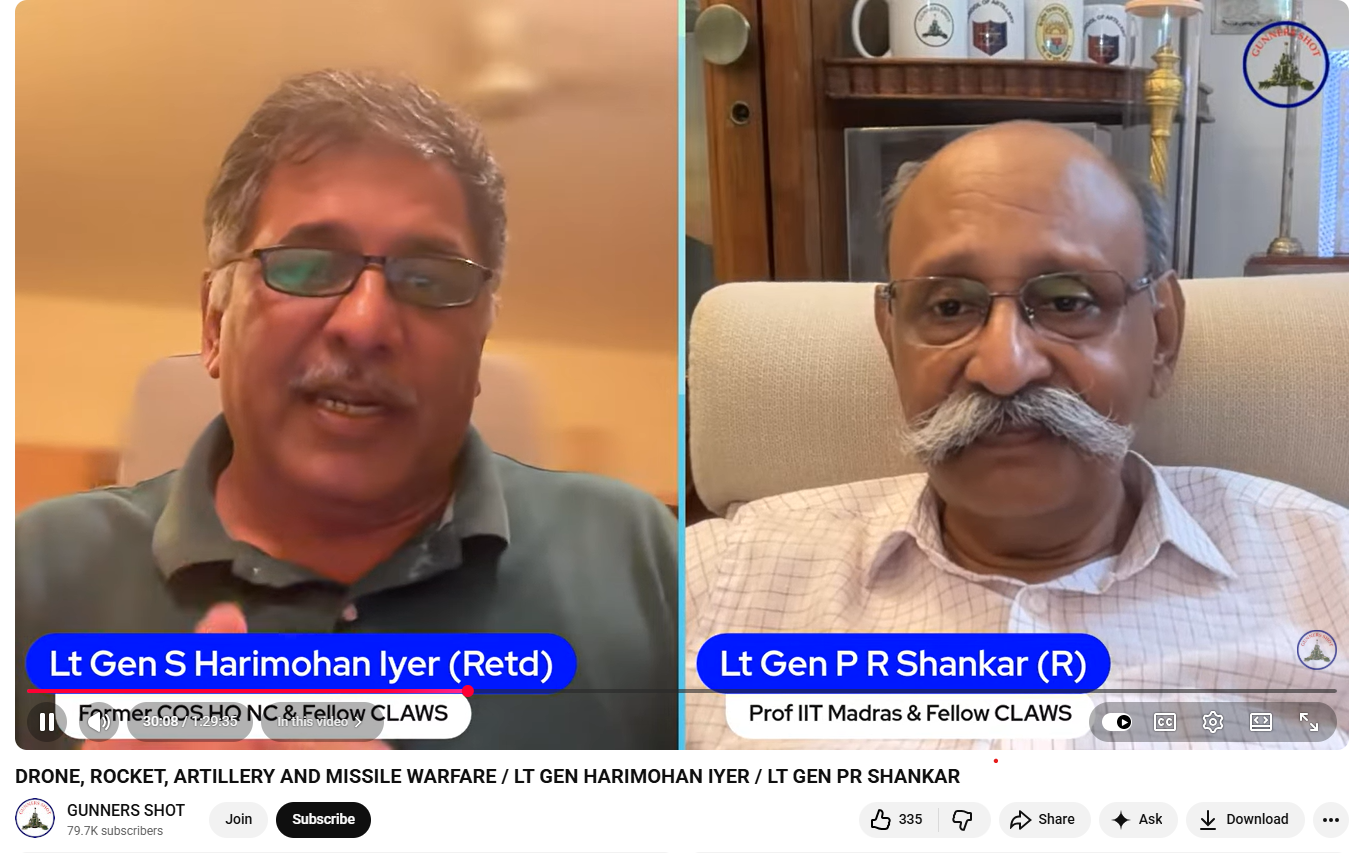
Fact Check: A Google search using relevant keywords did not yield any credible media reports supporting the claim, raising initial doubts about its authenticity. A reverse image search of keyframes from the viral video led to a YouTube livestream uploaded on June 13, 2026. The original video showed Lt Gen P.R. Shankar discussing modern military concepts such as drone warfare, rocket systems, artillery and missile warfare (DRaM Warfare), with no reference to Lt Gen Dhiraj Seth or his appointment.
https://www.youtube.com/live/60JMMlHRmjA
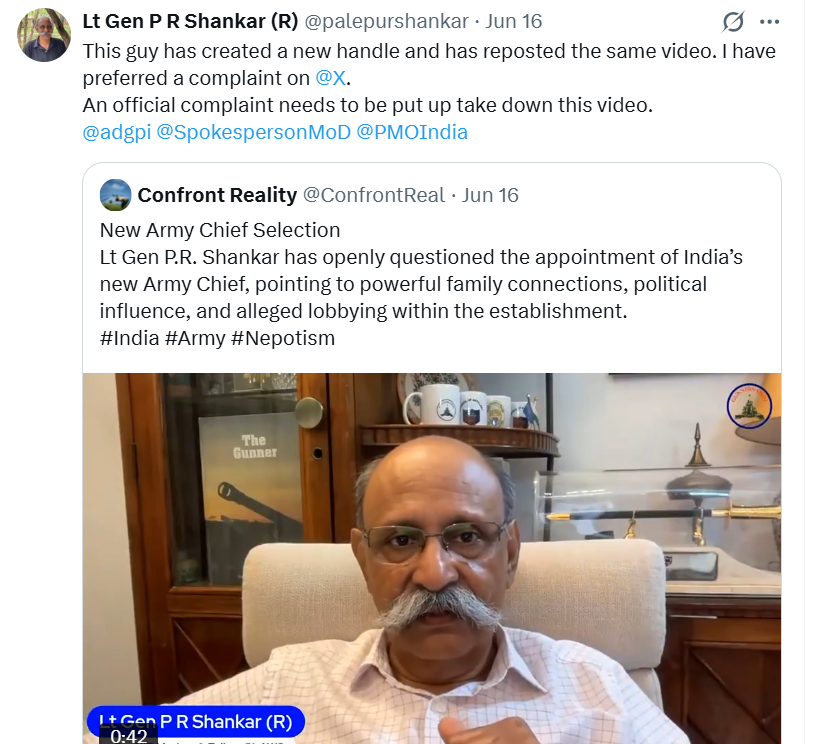
Further verification revealed that Lt Gen P.R. Shankar himself has labelled the circulating clip as fake on his official X account and has stated that a formal complaint has been filed against such manipulated content.
https://x.com/palepurshankar/status/2066826145707024778
Additionally, AI detection analysis using Hive Moderation indicated that the audio in the viral video has a 99% probability of being AI-generated.
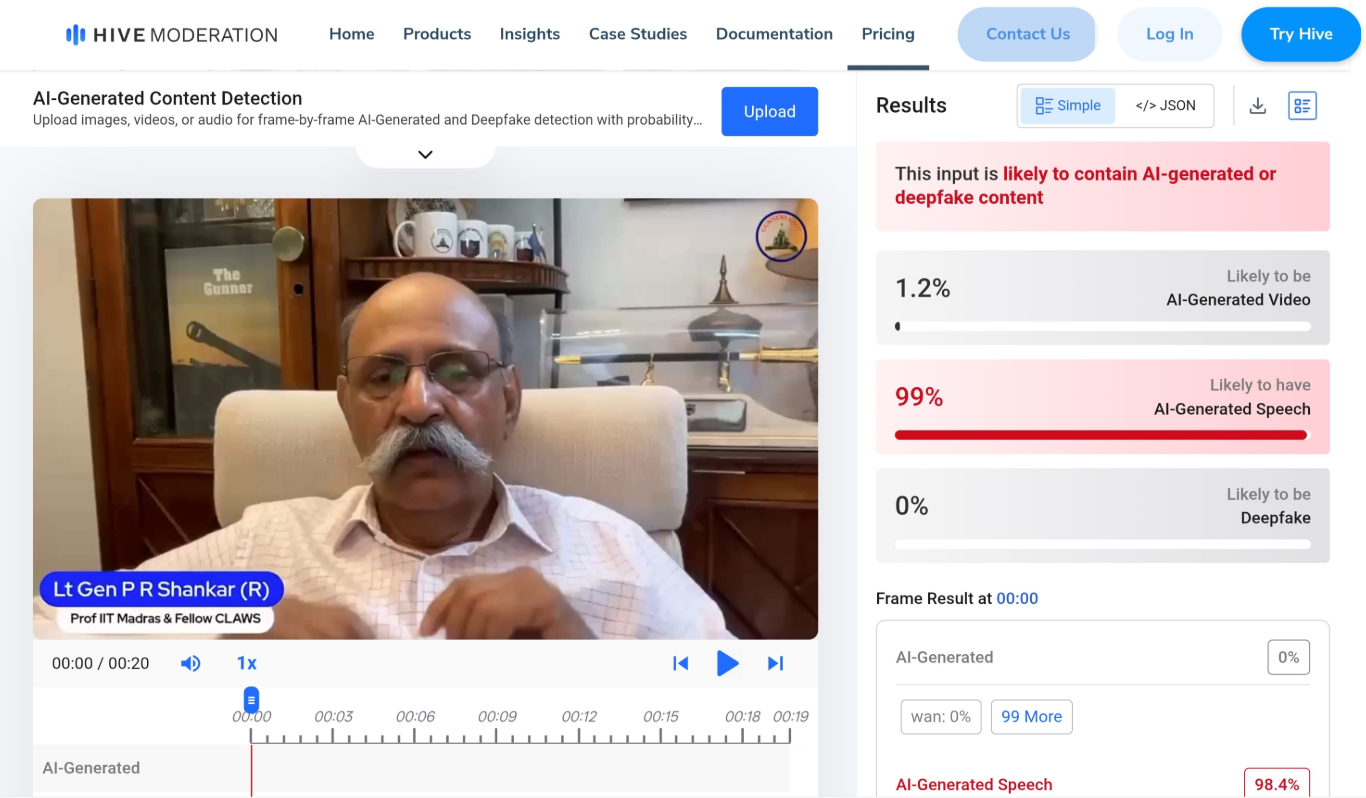
Conclusion: The research confirms that the viral video is an AI-generated deepfake. The original video does not contain any remarks about Lt Gen Dhiraj Seth or his appointment. The content has been digitally manipulated and is being circulated with a misleading narrative.
Executive Summary
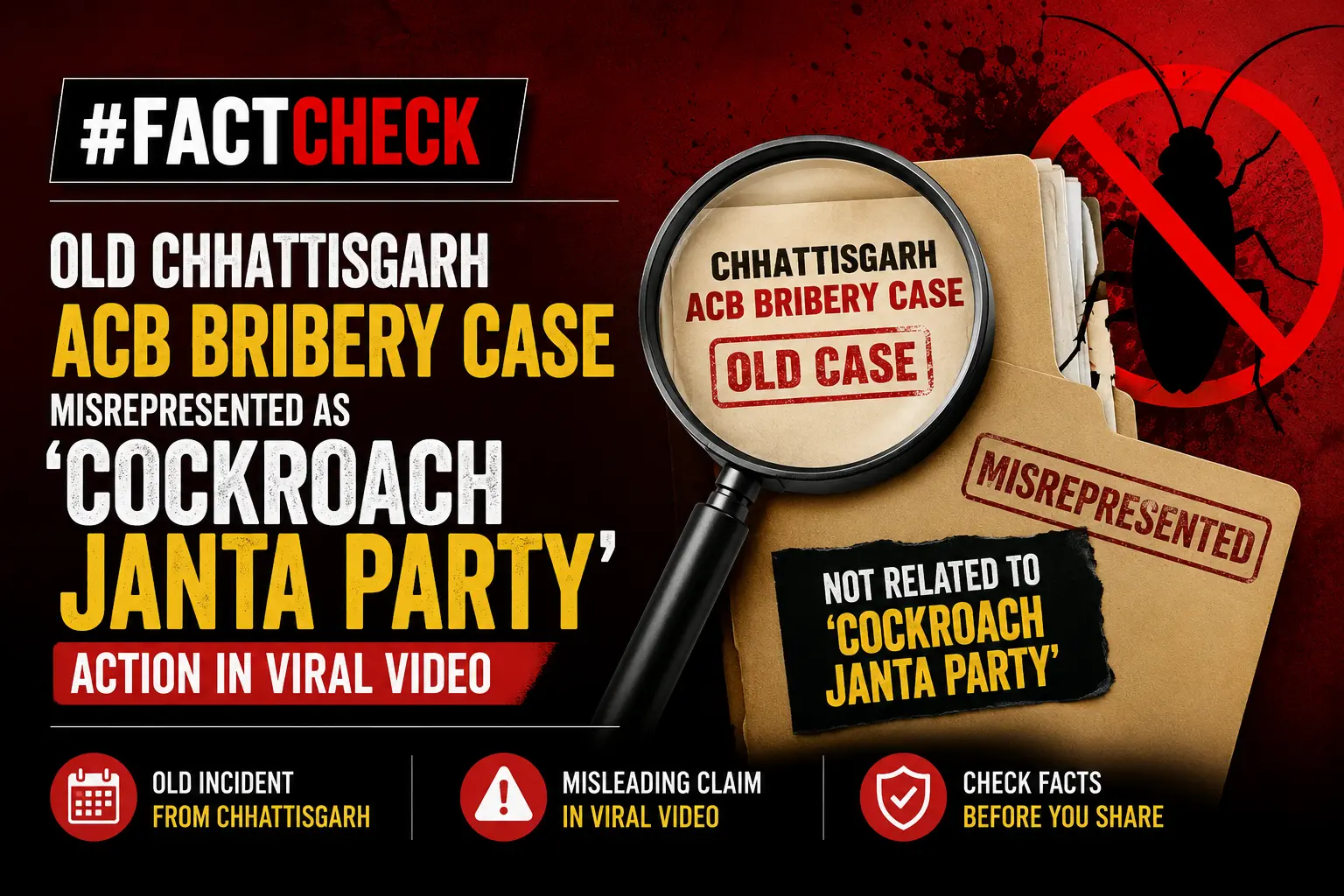
A video is being widely shared on social media claiming that members of the so-called ‘Cockroach Janta Party (CJP)’ caught a police officer in Chhattisgarh red-handed while accepting a bribe of ₹30,000. The viral posts also claim that the group has intensified its so-called campaign to “clean the rotten system.” However, CyberPeace Research Wing research found the claim to be misleading.The research revealed that the video has no connection with the ‘Cockroach Janta Party (CJP)’. The original footage dates back to February 2026 and shows Chhattisgarh Police sub-inspector Abdul Munaf being caught by the Anti-Corruption Bureau (ACB) in an alleged ₹25,000 bribery case.
Claim
A Facebook user shared the viral video on May 23, 2026, claiming that members of the “Cockroach Janta Party” caught a police officer red-handed taking a ₹30,000 bribe. The post further stated that the group had intensified its campaign against corruption. The link and archived post are provided.

Fact Check
To verify the claim, we extracted key frames from the viral video and conducted a reverse image search. During the research, we found a report published on the Navbharat Times website dated February 26, 2026, which contained visuals matching the viral vi
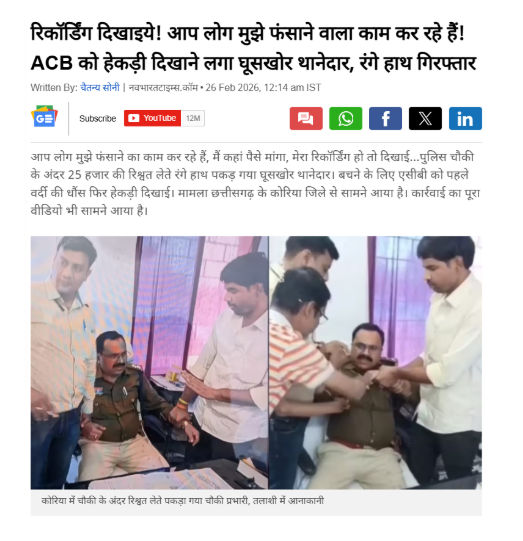
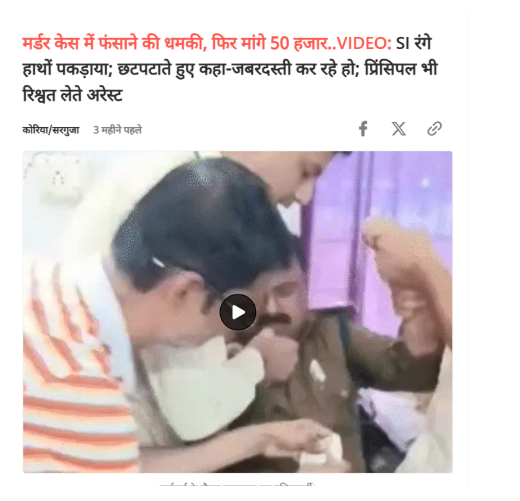
According to the report, the Anti-Corruption Bureau (ACB) in Korea district, Chhattisgarh, arrested a corrupt police station in-charge while accepting a bribe of ₹25,000. After being caught, the officer attempted to assert authority using his uniform and resisted the search procedure, but soon gave up. Further verification using keywords from the Navbharat Times report led to a similar story published by Dainik Bhaskar, which also contained the same visuals.
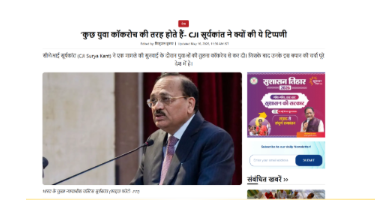
Additionally, a related context about the satirical “Cockroach Janta Party (CJP)” trend was found in a Times Now Hindi report, which explains that the term emerged as an online satire following a controversial remark attributed to the Chief Justice of India regarding unemployed youth. The statement was later clarified.
Conclusion
The research confirms that the viral video has no connection with the ‘Cockroach Janta Party (CJP)’. The original footage is from a February 2026 incident in which Chhattisgarh Police sub-inspector Abdul Munaf was arrested by the ACB in a bribery case involving ₹25,000. The video has been falsely linked to a misleading narrative on social media.
Introduction
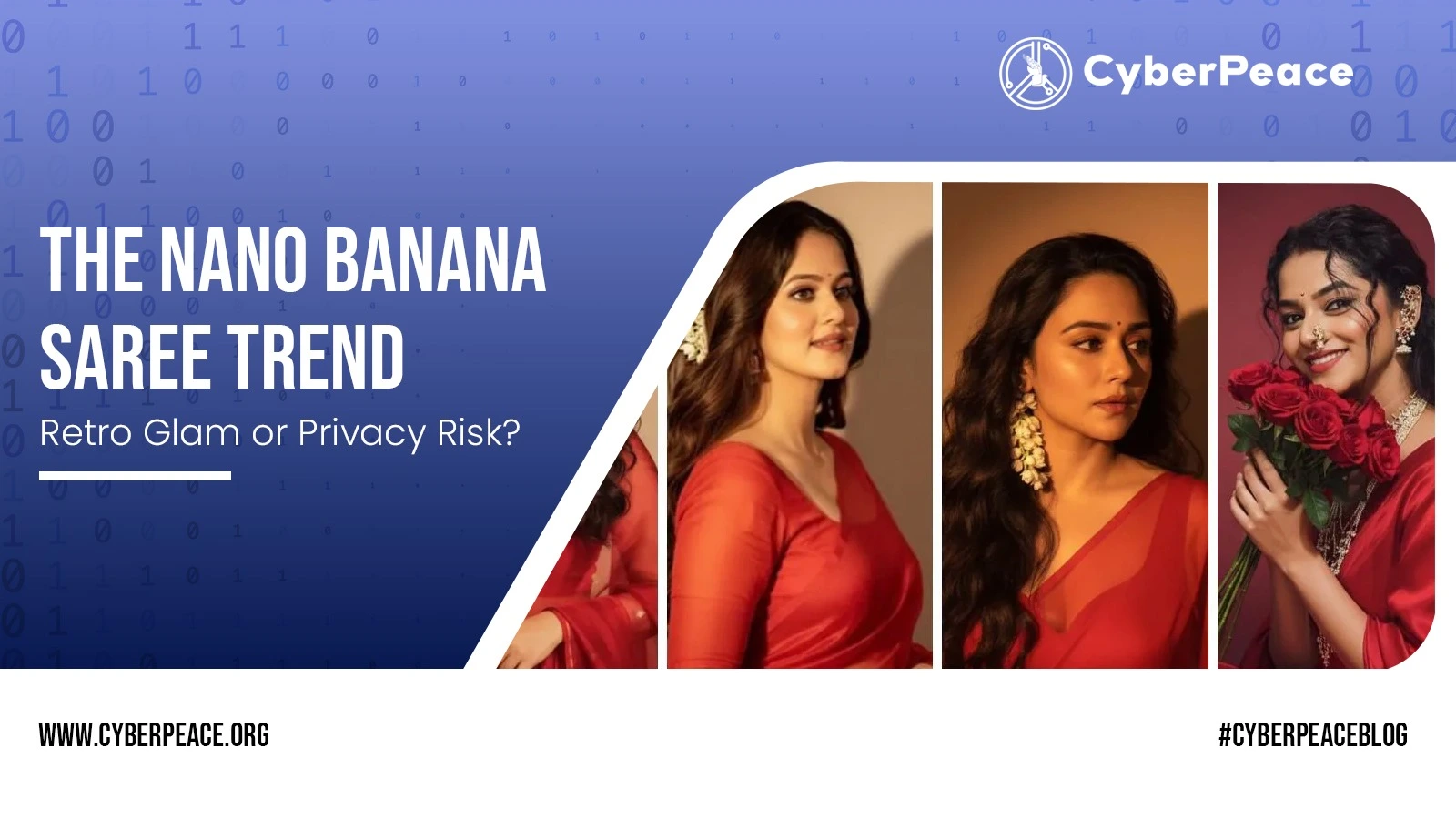
In September 2025, social media feeds were flooded with strikingly vintage saree-type portraits. These images were not taken by professional photographers, but AI-generated images. More than a million people turned to the "Nano Banana" AI tool of Google Gemini, uploading their ordinary selfies and watching them transform into Bollywood-style, cinematic, 1990s posters. The popularity of this trend is evident, as are the concerns of law enforcement agencies and cybersecurity experts regarding risks of infringement of privacy, unauthorised data sharing, and threats related to deepfake misuse.
What is the Trend?
This trend in AI sarees is created using Google Geminis' Nano Banana image-editing tool, editing and morphing uploaded selfies into glitzy vintage portraits in traditional Indian attire. A user would upload a clear photograph of a solo subject and enter prompts to generate images of cinematic backgrounds, flowing chiffon sarees, golden-hour ambience, and grainy film texture, reminiscent of classic Bollywood imagery. Since its launch, the tool has processed over 500 million images, with the saree trend marking one of its most popular uses. Photographs are uploaded to an AI system, which uses machine learning to alter the pictures according to the description specified. The transformed AI portraits are then shared by users on their Instagram, WhatsApp, and other social media platforms, thereby contributing to the viral nature of the trend.
Law Enforcement Agency Warnings
- A few Indian police agencies have issued strong advisories against participation in such trends. IPS Officer VC Sajjanar warned the public: "The uploading of just one personal photograph can make greedy operators go from clicking their fingers to joining hands with criminals and emptying one's bank account." His advisory had further warned that sharing personal information through trending apps can lead to many scams and fraud.
- Jalandhar Rural Police issued a comprehensive warning stating that such applications put the user at risk of identity theft and online fraud when personal pictures are uploaded. A senior police officer stated: "Once sensitive facial data is uploaded, it can be stored, analysed, and even potentially misused to open the way for cyber fraud, impersonation, and digital identity crimes.
The Cyber Crime Police also put out warnings on social media platforms regarding how photo applications appear entertaining but can pose serious risks to user privacy. They specifically warned that selfies uploaded can lead to data misuse, deepfake creation, and the generation of fake profiles, which are punishable under Sections 66C and 66D of the IT Act 2000.
Consequences of Such Trends
The massification of AI photo trends has several severe effects on private users and society as a whole. Identity fraud and theft are the main issues, as uploaded biometric information can be used by hackers to generate imitated identities, evading security measures or committing financial fraud. The facial recognition information shared by means of these trends remains a digital asset that could be abused years after the trend has passed. ‘Deepfake’ production is another tremendous threat because personal images shared on AI platforms can be utilised to create non-consensual artificial media. Studies have found that more than 95,000 deepfake videos circulated online in 2023 alone, a 550% increase from 2019. The images uploaded can be leveraged to produce embarrassing or harmful content that can cause damage to personal reputation, relationships, and career prospects.
Financial exploitation is also when fake applications in the guise of genuine AI tools strip users of their personal data and financial details. Such malicious platforms tend to look like well-known services so as to trick users into divulging sensitive information. Long-term privacy infringement also comes about due to the permanent retention and possible commercial exploitation of personal biometric information by AI firms, even when users close down their accounts.
Privacy Risks
A few months ago, the Ghibli trend went viral, and now this new trend has taken over. Such trends may subject users to several layers of privacy threats that go far beyond the instant gratification of taking pleasing images. Harvesting of biometric data is the most critical issue since facial recognition information posted on these sites becomes inextricably linked with user identities. Under Google's privacy policy for Gemini tools, uploaded images might be stored temporarily for processing and may be kept for longer periods if used for feedback purposes or feature development.
Illegal data sharing happens when AI platforms provide user-uploaded content to third parties without user consent. A Mozilla Foundation study in 2023 discovered that 80% of popular AI apps had either non-transparent data policies or obscured the ability of users to opt out of data gathering. This opens up opportunities for personal photographs to be shared with anonymous entities for commercial use. Exploitation of training data includes the use of personal photos uploaded to enhance AI models without notifying or compensating users. Although Google provides users with options to turn off data sharing within privacy settings, most users are ignorant of these capabilities. Integration of cross-platform data increases privacy threats when AI applications use data from interlinked social media profiles, providing detailed user profiles that can be taken advantage of for purposeful manipulation or fraud. Inadequacy of informed consent continues to be a major problem, with users engaging in trends unaware of the entire context of sharing information. Studies show that 68% of individuals show concern regarding the misuse of AI app data, but 42% use these apps without going through the terms and conditions.
CyberPeace Expert Recommendations
While the Google Gemini image trend feature operates under its own terms and conditions, it is important to remember that many other tools and applications allow users to generate similar content. Not every platform can be trusted without scrutiny, so users who engage in such trends should do so only on trustworthy platforms and make reliable, informed choices. Above all, following cybersecurity best practices and digital security principles remains essential.
Here are some best practices:-
1.Immediate Protection Measures for User
In a nutshell, protection of personal information may begin by not uploading high-resolution personal photos into AI-based applications, especially those trained for facial recognition. Instead, a person can play with stock images or non-identifiable pictures to the degree that it satisfies the program's creative features without compromising biometric security. Strong privacy settings should exist on every social media platform and AI app by which a person can either limit access to their data, content, or anything else.
2.Organisational Safeguards
AI governance frameworks within organisations should enumerate policies regarding the usage of AI tools by employees, particularly those concerning the upload of personal data. Companies should appropriately carry out due diligence before the adoption of an AI product made commercially available for their own use in order to ensure that such a product has its privacy and security levels as suitable as intended by the company. Training should instruct employees regarding deepfake technology.
3.Technical Protection Strategies
Deepfake detection software should be used. These tools, which include Microsoft Video Authenticator, Intel FakeCatcher, and Sensity AI, allow real-time detection with an accuracy higher than 95%. Use blockchain-based concepts to verify content to create tamper-proof records of original digital assets so that the method of proposing deepfake content as original remains very difficult.
4.Policy and Awareness Initiatives
For high-risk transactions, especially in banks and identity verification systems, authentication should include voice and face liveness checks to ensure the person is real and not using fake or manipulated media. Implement digital literacy programs to empower users with knowledge about AI threats, deepfake detection techniques, and safe digital practices. Companies should also liaise with law enforcement, reporting purported AI crimes, thus offering assistance in combating malicious applications of synthetic media technology.
5.Addressing Data Transparency and Cross-Border AI Security
Regulatory systems need to be called for requiring the transparency of data policies in AI applications, along with providing the rights and choices to users regarding either Biometric data or any other data. Promotion must be given to the indigenous development of AI pertaining to India-centric privacy concerns, assuring the creation of AI models in a secure, transparent, and accountable manner. In respect of cross-border AI security concerns, there must be international cooperation for setting common standards of ethical design, production, and use of AI. With the virus-like contagiousness of AI phenomena such as saree editing trends, they portray the potential and hazards of the present-day generation of artificial intelligence. While such tools offer newer opportunities, they also pose grave privacy and security concerns, which should have been considered quite some time ago by users, organisations, and policy-makers. Through the setting up of all-around protection mechanisms and keeping an active eye on digital privacy, both individuals and institutions will reap the benefits of this AI innovation, and they shall not fall on the darker side of malicious exploitation.
References
- https://www.hindustantimes.com/trending/amid-google-gemini-nano-banana-ai-trend-ips-officer-warns-people-about-online-scams-101757980904282.html%202
- https://www.moneycontrol.com/news/india/viral-banana-ai-saree-selfies-may-risk-fraud-warn-jalandhar-rural-police-13549443.html
- https://www.parliament.nsw.gov.au/researchpapers/Documents/Sexually%20explicit%20deepfakes.pdf
- https://www.mckinsey.com/capabilities/quantumblack/our-insights/the-state-of-ai-in-2023-generative-ais-breakout-year
- https://www.mckinsey.com/capabilities/quantumblack/our-insights/the-state-of-ai-in-2023-generative-ais-breakout-year
- https://socradar.io/top-10-ai-deepfake-detection-tools-2025/
