
The Data Behind India’s Digital Fraud Surge
India’s Rapid Digital Expansion
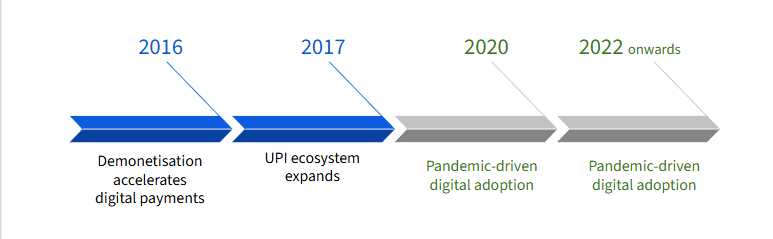
Over the past decade, India has experienced a rapid digitalisation process. The rise of digital financial services, affordable internet costs, and the penetration of smartphones have transformed the way people communicate, transact and do business online.
Online payment systems, including Unified Payments Interface (UPI), have enabled real-time transactions between banks and financial systems. As much as these systems have enhanced access to finance and efficiency, they have also created new opportunities for cybercriminals.
Cybercrime has evolved alongside the shift of financial and social interactions to digital platforms. The fraud attacks on online payments, online banking, and personal information have become common and increasingly costly.
To analyse the scale and trend of cybercrime in India, this analysis will use the datasets released by the National Crime Records Bureau (NCRB) and financial fraud data released by the Indian Cyber Crime Coordination Centre (I4C) under the Ministry of Home Affairs.
The Rise of Cybercrime in India
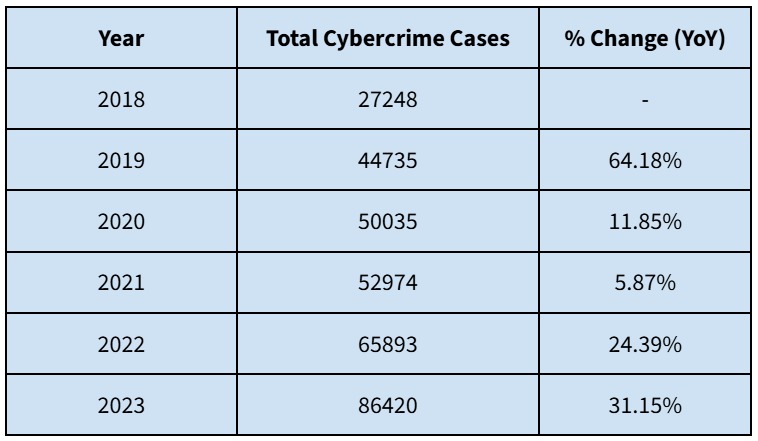
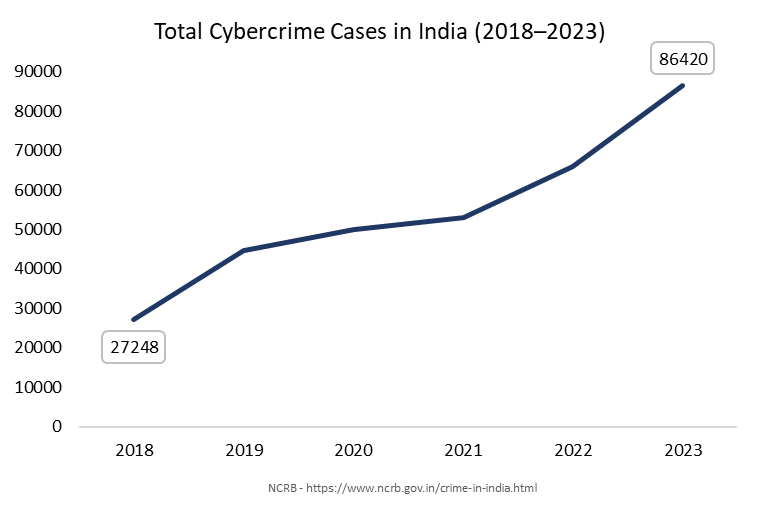
The Rise of Cybercrime in India
Source: National Crime Records Bureau – Crime in India Reports
The data released by the NCRB documents cybercrime incidents registered by the police at the national level under the Information Technology Act, 2000 (IT Act) and criminal provisions covering offences such as cheating, impersonation, and digital fraud. In the past, the offences were listed in the provisions of the Indian Penal Code (IPC). Following criminal law reforms in India, on 1 July 2024, the Bharatiya Nyaya Sanhita (BNS), which replaced the IPC, came into force. Section 419 (cheating by impersonation), IPC, would be related to BNS Section 319 and Section 420 (cheating and dishonestly inducing delivery of property), which would be related to BNS Section 318(4). Similarly, crimes involving forgery and use of forged documents or electronic documents, which were previously contained in the IPC Sections 465-471, are dealt with in BNS Sections 335-340.
The data published by the NCRB represent the number of crimes that reached the point of the First Information Report (FIR) registration, meaning they reflect only cybercrime cases that were formally presented to the law enforcement system to investigate, rather than all complaints reported. The data shows that cybercrime cases increased from 27,248 in 2018 to 86,420 in 2023, a 3.17-fold increase in 5 years.
Two structural shifts are visible: the post-pandemic jump and subsequent acceleration.
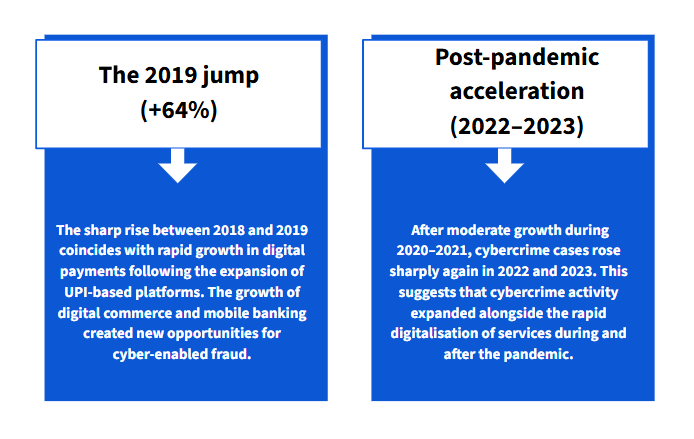
However, these figures likely underestimate the true scale of cybercrime because many incidents are reported only through online complaint portals and may not result in FIR registration.
The Financial Scale of Digital Fraud
The Financial Scale of Digital Fraud
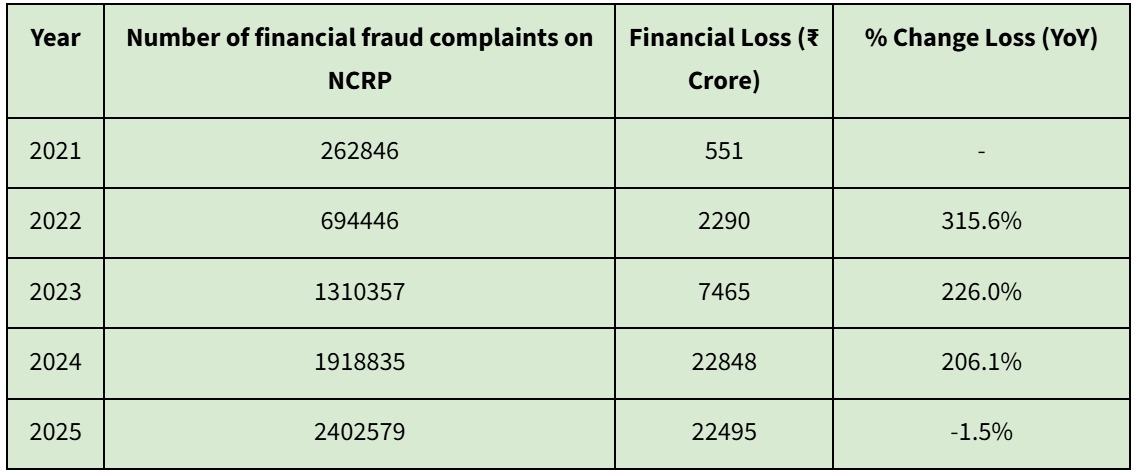
This dataset tracks financial fraud complaints reported through the National Cyber Crime Reporting Portal (NCRP) and the estimated financial losses associated with those complaints.
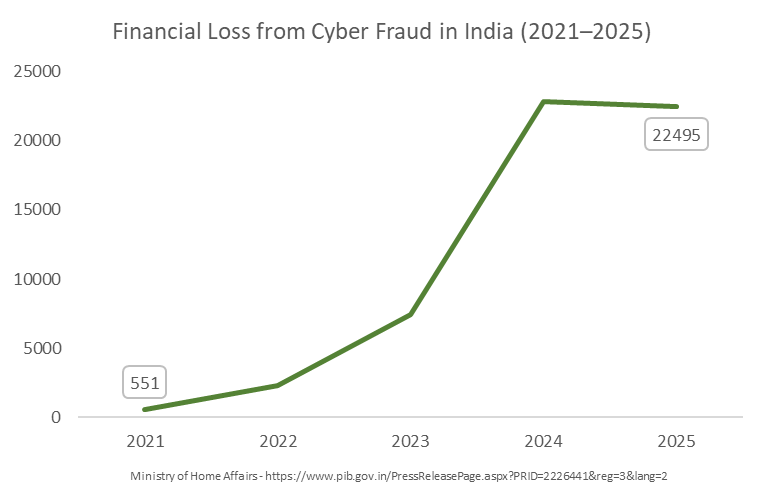
The financial losses reported between 2021 and 2024 increased by 41 times over four years, compared to 2021, from 551 crore to 22,848 crore. At the same time, the number of complaints rose from 262,846 to over 1.9 million, an increase of ~623%, indicating both rising victimisation and greater public awareness of reporting mechanisms.
The contrast between these two trends is striking:
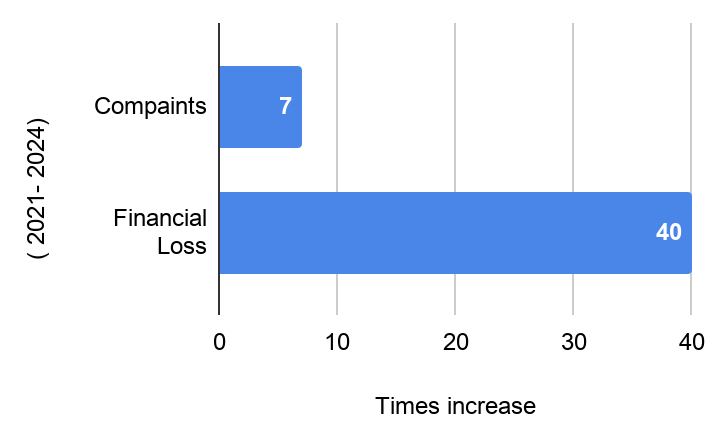
While complaints increased by around 7 times, financial losses increased by over 40 times.
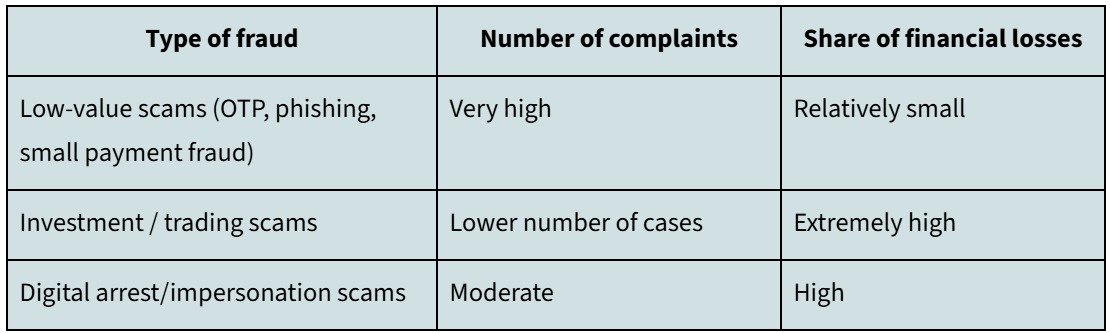
Distribution of Cyber-Fraud Complaints and Financial Losses by Fraud Type
This divergence implies an uneven relationship between the number of incidents and the financial damage that they inflict. Most cyber fraud incidents involve relatively small transaction values; however, a smaller group of fraud categories result in disproportionate numbers of financial losses.
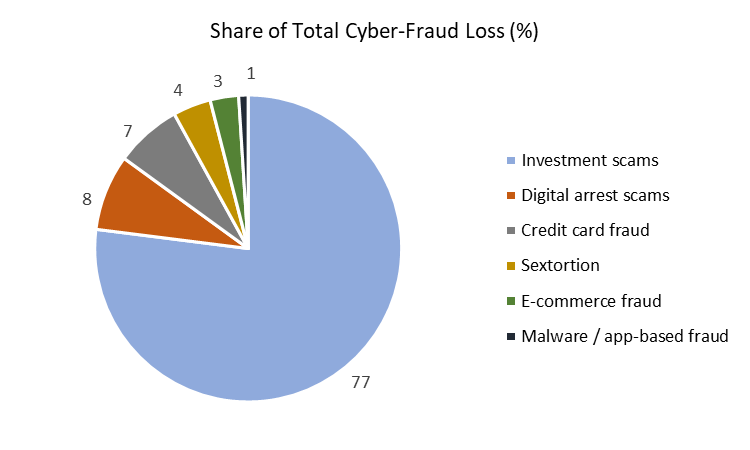
Distribution of Financial Losses Across Major Cyber-Fraud Categories in India
As reported by The Indian Express, based on the data compiled by the I4C, investment-related scams alone account for roughly 77% of reported cyber-fraud losses, followed by smaller shares from “digital arrest” scams (8%), credit card fraud (7%), sextortion (4%), e-commerce fraud (3%), and malware or app-based fraud (1%). This distribution means that even though scams with lower values, like phishing, OTP fraud, and small payment fraud, produce a high proportion of complaints, few categories of fraud produce most of the financial losses.
Analysis
1. Cybercrime is expanding faster than most traditional crimes: The fact that cybercrime cases have tripled in five years shows that cyber offences are presently becoming a significant element of Indian crime. Unlike conventional crimes that require physical proximity, cybercrime can be conducted remotely and at scale, enabling perpetrators to target large numbers of victims simultaneously.
2. Financial losses are concentrated in a small set of fraud categories: As cases of cybercrimes have been on the increase, the monetary losses of digital fraud cases have been increasing at a higher rate. The fact that the number of reported financial losses has increased 40 times in 4 years indicates that cybercrime has a very high economic impact.
3. Complaint volumes and financial damage follow different patterns: When comparing complaints and financial losses, it is evident that cyber fraud losses are unevenly distributed across types of incidents. Most of the prevalent scams reported, including phishing or OTP fraud, involve relatively small transaction values but yield a high portion of complaints. Conversely, fewer categories of fraud, especially investment-based schemes, contribute a significantly higher percentage of total financial losses.
4. Digital financial infrastructure has expanded the attack surface: India’s rapid adoption of digital payment systems, mobile banking and digital financial systems has dramatically increased the number of potential victims of cybercriminals. The scale of online transactions creates new vulnerabilities that organised cybercrime networks take advantage of.
5. Reporting improvements reveal previously hidden crime: The expansion of national reporting systems has enhanced the transparency in the trends of cybercrime. The increase in the number of complaints recorded is partially due to improved reporting systems and not necessarily to the increased criminal activity, meaning that previous data might have understated the magnitude of cyber fraud.
Recommendations
1. Move from reactive policing to proactive cyber-risk monitoring: The conventional models of policing focus on investigation of crimes that have already taken place. With such a magnitude and pace of cyber fraud, India should have systems that are designed to detect and prevent the fraud at its early stages, such as real-time observation of suspicious patterns in transactions by financial institutions.
2. Strengthen financial intelligence sharing across institutions: There are a lot of instances of cyber fraud that use more than one bank, payment system, and telecommunication provider. To detect new networks of fraud sooner, it can be suggested to establish more information-sharing measures between the financial institution and law enforcement agencies.
3. Target organised cyber fraud networks rather than individual incidents: Many digital scams operate through organised networks that coordinate phishing, mule accounts, and fake payment channels. The solution in regard to this involves dismantling these networks through investigative procedures instead of treating incidents on a case-by-case basis.
4. Improve recovery mechanisms for stolen funds: The recovery of the funds lost is one of the most difficult issues in cases of cyber fraud. Expanding systems such as the Citizen Financial Cyber Fraud Reporting and Management System (CFCFRMS) can improve the speed at which fraudulent transactions are frozen or reversed.
5. Strengthen digital financial literacy: A significant percentage of cyber frauds are based on social engineering methods that take advantage of user behaviour as opposed to technical weaknesses. Victimisation can be greatly reduced through specific public awareness efforts on typical scam schemes.
Conclusion
India’s experience illustrates a broader global trend: as economies digitise, crime increasingly follows the flow of digital money. While cybercrime incidents are rising steadily, the much faster growth in financial losses suggests that cybercriminals are becoming more organised, technologically sophisticated, and economically motivated.
References:
- https://indianexpress.com/article/india/indians-lost-rs-53000-crore-fraud-cheating-cases-six-years-maharashtra-2025-10452185/
- https://www.pib.gov.in/PressReleasePage.aspx?PRID=2226441®=3&lang=2 -
- https://www.ncrb.gov.in/crime-in-india.html
- https://i4c.mha.gov.in/index.aspx
- https://i4c.mha.gov.in/index.aspx

Related Blogs

Introduction
Summer vacations have always been one of the most anticipated times in a child’s life. In earlier times, it was something entirely different. The season was filled with outdoor games, muddy hands, mango-stained mouths, and stories shared with cousins under the stars. Children lived in the moment, playing in parks, riding bicycles, and inventing new adventures without a screen in sight. Today, those same summer days are shaped by glowing devices, virtual games, and hours spent online. While technology brings learning and entertainment, it also invites risks that parents cannot ignore. The Cyber Mom Toolkit is here to help you navigate this shift, offering simple and thoughtful ways to keep your children safe, balanced, and joyful during these screen filled holidays.
The Hidden Cyber Risks of Summer Break
With increased leisure time and less supervision, children are likely to venture into unknown reaches of the internet. I4C reports indicate that child-related cases, such as cyberbullying, sextortion, and viewing offensive content, surge during school vacations. Gaming applications, social networking applications, and YouTube can serve as entry points for cyber predators and spammers. That's why it is important that parents, particularly mothers know what digital spaces their children live in and how to intervene appropriately.
Your Action Plan for Being a Cyber Smart Mom
Moms Need to Get Digitally Engaged
You do not need to be a tech expert to become a cyber smart mom. With just a few simple digital skills, you can start protecting your child online with confidence and ease.
1. Know the Platforms Your Children Use
Spend some time investigating apps such as Instagram, Snapchat, Discord, YouTube, or computer games like Roblox and Minecraft. Familiarise yourself with the type of content, chat options, and privacy loopholes they may have.
2. Install Parental Controls
Make use of native features on devices (Android, iOS, Windows) to limit screen time, block mature content, and track downloads. Applications such as Google Family Link and Apple Screen Time enable parents to control apps and web browsing.
3. Develop a Family Cyber Agreement
- Establish common rules such as:
- No devices in bedrooms past 9 p.m.
- Add only safe connections on social media.
- Don't open suspicious messages or click on mysterious links.
- Always tell your mom if something makes you feel uncomfortable online.
Talk Openly and Often
Kids tend to hide things online because they don't want to get punished or embarrassed. Trust is built better than monitoring. Here's how:
- Have non-judgmental chats about what they do online.
- Use news reports or real-life cases as conversation starters: "Did you hear about that YouTuber's hacked account?
- Encourage them to question things if they're confused or frightened.
- Honour their online life as a legitimate aspect of their lives.
Look for the Signs of Online Trouble
Stay alert to subtle changes in your child’s behavior, as they can be early signs of trouble in their online world.
- Sudden secrecy or aggression when questioned about online activity.
- Overuse of screens, particularly in the evening.
- Deterioration in school work or interest in leisure activities.
- Mood swings, anxiety, or withdrawn behaviour.
If you notice these, speak to your child calmly. You can also report serious matters such as cyberbullying or blackmail on the Cybercrime Helpline 1930 or visit https://cybercrime.gov.in
Support Healthy Digital Behaviours
Teach your kids to be good netizens by leading them to:
- Reflect Before Posting: No address, school name, or family information should ever appear in public posts.
- Set Strong Passwords: Passwords must be long, complicated, and not disclosed to friends, even best friends.
- Enable Privacy Settings: Keep social media accounts privately. Disable location sharing. Restrict comments and messages from others.
- Vigilance: Encourage them to spot fake news, scams, and manipulative ads. Critical thinking is the ultimate defence.
Stay alert to subtle changes in your child’s behavior, as they can be early signs of trouble in their online world.
Where to Learn More and Get Support as a Cyber Mom
Cyber moms looking to deepen their understanding of online safety can explore a range of helpful resources offered by CyberPeace. Our blog features easy-to-understand articles on current cyber threats, safety tips, and parenting guidance for the digital age. You can also follow our social media pages for regular updates, quick tips, and awareness campaigns designed especially for families. If you ever feel concerned or need help, the CyberPeace Helpline is available to offer support and guidance. (+91 9570000066 or write to us at helpline@cyberpeace.net). For those who want to get more involved, joining the CyberPeace Corps allows you to become part of a larger community working to promote digital safety and cyber awareness across the country.
Empowering Mothers Empowers Society
We at CyberPeace feel that every mother, irrespective of her background and technological expertise, has the potential to be a Cyber Mom. The intention is not to control the child but to mentor towards safer decisions, identify issues early, and prepare them for a lifetime of online responsibility. Mothers are empowered when they know. And children are safe when they are protected.
Conclusion
The web isn't disappearing, and neither are its dangers. But when mothers are digital role models, they can make summer screen time a season of wise decisions. This summer, become a Cyber Mom: someone who learns, leads, and listens. Whether it's installing a parental control app, discussing openly about cyberbullying, or just asking your child, "What did you discover online today? " that engagement can make a difference. This summer break, help your child become digitally equipped with the skills and knowledge they need to navigate the online world safely and confidently.
Cyber safety starts at home, and there's no better point of departure than being alongside your child, rather than behind them.
References
- https://cybercrime.gov.in
- https://support.apple.com/en-in/HT208982
- https://beinternetawesome.withgoogle.com
- https://www.cyberpeace.org
- https://ncpcr.gov.in

Executive Summary:
Recently PAN-OS software of Palo Alto Networks was discovered with the critical vulnerability CVE-2024-3400. It is the software used to power all their networks in the next generation firewalls. This vulnerability is a common injection vulnerability which provides access to unauthenticated attackers to execute random code having root privileges on the attacked system. This has been exploited actively by threat actors, leaving many organizations at risk for severe cyberattacks. This report helps to understand the exploitation, detection, mitigations and recommendations for this vulnerability.

Understanding The CVE-2024-3400 Vulnerability:
CVE-2024-3400 impacts the particular version of PAN-OS and a certain configuration susceptible to this kind of a security issue. It is a command injection, which exists in the GlobalProtect module of the PAN-OS software. The vulnerability can be exploited by an unauthorized user to run any code on the firewall having root privileges. This targets Active Directory database (ntds.dit), important data (DPAPI), and Windows event logs (Microsoft-Windows-TerminalServices-LocalSessionManager%4Operational.evtx) and also login data, cookies, and local state data for Chrome and Microsoft Edge from specific targets leading attackers to capture the browser master key and steal sensitive information of the organization.
The CVE-2024-3400 has been provided with a critical severity rating of 10.0. The following two weaknesses make this CVE highly severe:
- CWE-77: Improper Neutralization of Special Elements used in a Command ('Command Injection')
- CWE-20: Improper Input Validation.
Impacted Products:
The affected version of PAN-OS by CVE-2024-3400 are-

Only the versions 10.2, 11.0, and 11.1, setup with GlobalProtect Gateway or GlobalProtect Portal are exploited by this vulnerability. Whereas the Cloud NGFW, Panorama appliances and Prisma Access are not affected.
Detecting Potential Exploitation:
Palo Alto Networks has confirmed that they are aware of the exploitation of this particular vulnerability by threat actors. In a recent publication they have given acknowledgement to Volexity for identifying the vulnerability. There is an increasing number of organizations that face severe and immediate risk by this exploitation. Third parties also have released the proof of concept for the vulnerability.
The suggestions were provided by Palo Alto Networks to detect this critical vulnerability. To detect this vulnerability, the following command shall be run on the command-line interface of PAN-OS device:
grep pattern "failed to unmarshal session(.\+.\/" mp-log gpsvc.log*
This command looks through device logs for specific entries related to vulnerability.
These log entries should contain a long, random-looking code called a GUID (Globally Unique Identifier) between the words "session(" and ")". If an attacker has tried to exploit the vulnerability, this section might contain a file path or malicious code instead of a GUID.
Presence of such entries in your logs, could be a sign of a potential attack to hack your device which may look like:
- failed to unmarshal session(../../some/path)
A normal, harmless log entry would look like this:
- failed to unmarshal session(01234567-89ab-cdef-1234-567890abcdef)
Further investigations and actions shall be needed to secure the system in case the GUID entries were not found and suspicious.
Mitigation and Recommendations:
Mitigation of the risks posed by the critical CVE-2024-3400 vulnerability, can be accomplished by the following recommended steps:
- Immediately update Software: This vulnerability is fixed in software releases namely PAN-OS 10.2.9-h1, PAN-OS 11.0.4-h1, PAN-OS 11.1.2-h3, and all higher versions. Updating software to these versions will protect your systems fully against potential exploitation.
- Leverage Hotfixes: Palo Alto Networks has released hotfixes for commonly deployed maintenance releases of PAN-OS 10.2, 11.0, and 11.1 for the users who cannot upgrade to the latest versions immediately. These hotfixes do provide a temporary solution while you prepare for the full upgrade.
- Enable Threat Prevention: Incase of available Threat Prevention subscription, enable Threat IDs 95187, 95189, and 95191 to block attacks targeting the CVE-2024-3400 vulnerability. These Threat IDs are available in Applications and Threats content version 8836-8695 and later.
- Apply Vulnerability Protection: Ensure that vulnerability protection has been applied in the GlobalProtect interface to prevent the exploitation on the device. It can be implemented using these instructions.
- Monitor Advisory Updates: Regularly checking for the updates to the official advisory of Palo Alto Networks. This helps to stay up to date of the new releases of the guidance and threat prevention IDs of CVE-2024-3400.
- Disable Device Telemetry – Optional: It is suggested to disable the device telemetry as an additional precautionary measure.
- Remediation: If there is an active exploitation observed, follow the steps mentioned in this Knowledge Base article by Palo Alto Networks.
Implementation of the above mitigation measures and recommendations would be in a position to greatly reduce the risk of exploitation you might face from a cyber attack targeting the CVE-2024-3400 vulnerability in Palo Alto Networks' PAN-OS software.
Conclusion:
The immediate response should be taken against the offensive use of the critical CVE-2024-3400 vulnerability found in the PAN-OS platform of Palo Alto Networks. Organizations should actively respond by implementing the suggested mitigation measures such as upgrading to the patched versions, enabling threat prevention and applying vulnerability protection to immediately protect from this vulnerability. Regular monitoring, implementing security defense mechanisms and security audits are the necessary measures that help to combat emerging threats and save critical resources.

Executive Summary
A video of Prime Minister Narendra Modi is being widely shared on social media, in which he appears to announce that all ration card holders will receive free mobile phones, provided no member of their family is a government employee. However, research by the CyberPeace has found this claim to be false. Our research reveals that the viral video is AI-generated and does not reflect any real announcement.
Claim:
An Instagram user shared the viral video with the caption, “If you have a ration card, you will get a free mobile phone.”
- Post link: https://www.instagram.com/reels/DWqDKWxy6lJ/
- Archived link: https://archive.ph/wip/dmpIf

Fact Check
To verify the claim, we first conducted a keyword-based search on Google. However, we did not find any credible media reports supporting such an announcement, raising doubts about the authenticity of the video. We then checked the official government welfare schemes portal, myscheme.gov.in, which provides verified information about central government schemes. No such scheme offering free mobile phones to ration card holders was found on the platform.

Conclusion
Our research confirms that the viral video is fake and AI-generated. There is no official announcement or credible report suggesting that ration card holders will receive free mobile phones under any government scheme. The video has been digitally manipulated using artificial intelligence and is being circulated with a misleading claim. This serves as another example of how AI-generated content can be used to spread misinformation.
