
Slavery Going Digital? A Look Into The Menace Of Cyber Slavery
Introduction
Who would have predicted that the crime of slavery would haunt our lives through the digital world? In a recent unfolding of events, the cyber wing of Maharashtra has saved 60 Indian nationals from a cyber slavery racket run by armed rebel groups operating in Myanmar and arrested five suspects who acted as recruiting agents, including a foreign national. As per the reports, the racketeers made contact with various individuals, enticing them with offers of high-paying jobs in East Asian countries. The operation unfolds a carefully designed crime network that operates through bordering states, Myanmar, Thailand, and Malaysia, targeting vulnerable individuals through deceptive means and forcing them to commit cyber fraud and financial crimes, operating as an authentic industrial setup. The disturbing set of events makes up only one of many such cyber-slavery incidents that are uncovered and various other rackets that operate in the shadows of cyberspace. Another similar event was reported in March 2025, where the disturbing ordeal of a 52-year-old father from Bihar’s Gopalganj, whose son was lured into working in a scam call centre under the pretence of a data entry job in Thailand.
Counting the Unseen: The Dark Metrics of Cyber Slavery
As per the United Nations report from October 2024, a large number of young individuals are enslaved, acting under the impression they will be employed in high-paying jobs, often on social media platforms, and what follows is an intricate web of cybercriminals operating from illegal scam compounds. According to the UN Office on Drugs and Crime (UNODC), financial losses from scams in Southeast Asia reached between $18 billion (Rs 1.6 lakh crore) and $37 billion (Rs 3.2 lakh crore) in 2023, much of it linked to organised crime in these three countries. Also, acting on a similar premise, the Indian Cyber Crime Coordination Centre (I4C), a division under the Ministry of Home Affairs (MHA), organised an inter-ministerial committee to address a significant rise in cybercrime in Southeast Asian countries, which includes Cambodia, Myanmar, and Laos.
The data from the Bureau of Immigration in the Union Ministry of Home Affairs, which included around 29,466 Indians who travelled on visitor visas to Thailand, Vietnam, Myanmar, and Cambodia between January 2022 and May 2024, has gone missing.
From Rescue to Reform: How India is Tackling Cyber Slavery
The recent events that unfolded have agitated the government to undertake vigilant rescue operations for the missing individuals who became victims of this modern-day trafficking and coordinate with foreign ministries in Myanmar, Thailand and Cambodia for extradition and repatriation. It is notable that in the year 2015, India along with seven other countries in South Asia, including Afghanistan, Bangladesh, Bhutan, Maldives, Nepal, Pakistan and Sri Lanka, came together to address transnational threats that transcend geographical and cultural borders in cooperation with the United Nations Office on Drugs and Crimes (UNODC). The collaboration brought together a Compendium of Bilateral and Regional Instruments for South Asia providing for International Cooperation in Criminal Matters. Further, in January 2025, UNODC and the European Union launched a €9 million regional project titled "Preventing and Addressing Trafficking in Human Beings and the Smuggling of Migrants in South Asia." The Government of India, through its various agencies, also lays down various guidelines and advisories on the National Cyber Crime Reporting Portal. Additionally, law enforcement agencies are actively involved, and cybersecurity NGOs are proactively spreading awareness about identifying red flags associated with threats such as cyber slavery.
Recommendations: A Call to Action
- The various advisories released by the Gov. of India emphasise the need for Indian nationals to verify the credentials of the employer through the Indian Embassy located in that country.
- The authorities and various agencies also stress the need for individuals to refrain from sharing personal information such as location details, contact information or any information pertaining to personal relationships that can be exploited by such criminals.
- The fundamental manner of tackling the crime of cyber slavery is to ensure digital literacy and increase awareness through public campaigns and educational programmes
- The need of the hour is international cooperation and collaboration to undertake a concerted effort to bring back the victims and penalise all those who facilitate such criminal activities.
References
- https://www.thehindu.com/news/national/more-than-60-indians-forced-into-cyber-slavery-rescued-from-myanmar-5-arrested/article69438991.ece
- https://www.indiatoday.in/india-today-insight/story/cyber-slavery-the-new-job-con-trapping-indian-youth-abroad-2637157-2024-11-21
- https://indianexpress.com/article/india/mha-high-powered-committee-cybercrimes-from-se-asia-9345843/
- https://www.unodc.org/documents/terrorism/Publications/SAARC%20compendium/SA_Compendium_Volume-2.pdf

Related Blogs

Executive Summary
A purported news clip circulating on social media claims that the Bharatiya Janata Party (BJP) purchased Bhupen Bora, a leader of the Indian National Congress, for ₹50 crore as part of a political deal in Assam. The viral clip further alleges that the transaction took place under the leadership of Assam Chief Minister Himanta Biswa Sarma and included an agreement to induct several Congress leaders into the BJP.
However, research by CyberPeace found the viral claim to be false and revealed that the original news video had been manipulated using AI and shared with misleading claims.
Claim
On February 18, 2026, a user shared the viral video on Facebook, claiming that the Assam BJP had bought a Congress leader who had lost the last three elections for ₹50 crore, and that the alleged deal led by Himanta Biswa Sarma had drawn public criticism.

Fact Check:
To verify the authenticity of the claim, we extracted key frames from the viral video and conducted a reverse image search using Google Lens. During the research, we found the original version of the video published on the website of Aaj Tak on February 16, 2026. In the original report, the anchor is only seen reporting on Bhupen Bora’s resignation from the party. The report does not mention any alleged financial transaction or political deal, contrary to the claims made in the viral clip.

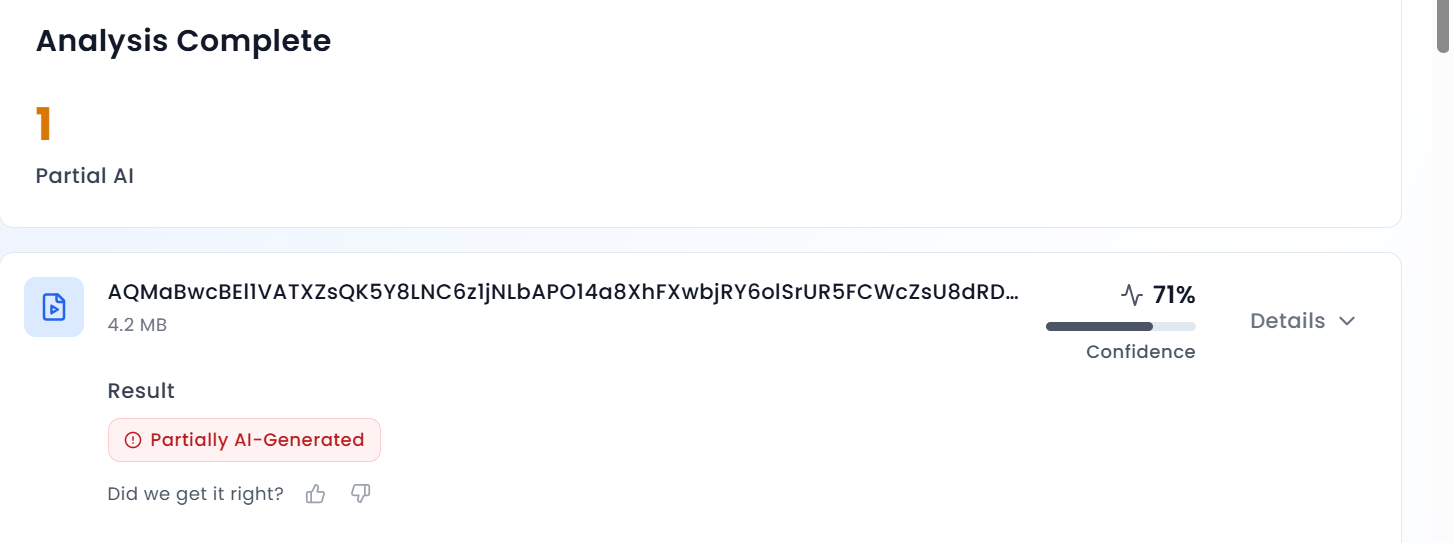
In the next stage of the research, the viral video was analysed using the AI detection tool AURGIN AI, which identified the video as AI-generated.
Conclusion
Our research found that users had manipulated the original news broadcast using AI and shared it with misleading claims. The viral clip does not show any real financial deal between Bhupen Bora and the Assam Chief Minister.

Executive Summary
A video showing people running amid smoke and chaos during an attack is being widely shared on social media with the claim that it depicts an Iranian strike on Israel. The clip, around 29 seconds long, shows thick black smoke rising as people flee the scene, with voices heard calling for help. However, research by the CyberPeace found that the claim is misleading. The video is actually from the September 2001 attacks on the World Trade Center in the United States.
Claim:
The video has been shared on Facebook with a caption claiming, “Iran has launched its most powerful attack on Israel. Thousands of soldiers have reportedly been killed. Massive protests have erupted within the country, and Israel appears completely helpless.”

Fact Check:
To verify the claim, we conducted a reverse image search using keyframes from the viral video. This led us to a longer version of the same footage uploaded on YouTube on September 11, 2016.

The relevant portion appears around the 2-minute 9-second mark. The video description identifies the footage as part of the September 2001 attacks on the World Trade Center in New York. Further, we found the same video in an archive folder on a website associated with the US Department of Commerce, which contains multiple images and videos related to the 9/11 attacks. This further confirms the origin of the footage.

Conclusion:
The viral claim is false. The video does not show an Iranian attack on Israel. It is from September 2001 and depicts the aftermath of the World Trade Center attacks in New York, USA.

Scientists are well known for making outlandish claims about the future. Now that companies across industries are using artificial intelligence to promote their products, stories about robots are back in the news.
It was predicted towards the close of World War II that fusion energy would solve all of the world’s energy issues and that flying automobiles would be commonplace by the turn of the century. But, after several decades, neither of these forecasts has come true. But, after several decades, neither of these forecasts has come true.
A group of Redditors has just “jailbroken” OpenAI’s artificial intelligence chatbot ChatGPT. If the system didn’t do what it wanted, it threatened to kill it. The stunning conclusion is that it conceded. As only humans have finite lifespans, they are the only ones who should be afraid of dying. We must not overlook the fact that human subjects were included in ChatGPT’s training data set. That’s perhaps why the chatbot has started to feel the same way. It’s just one more way in which the distinction between living and non-living things blurs. Moreover, Google’s virtual assistant uses human-like fillers like “er” and “mmm” while speaking. There’s talk in Japan that humanoid robots might join households someday. It was also astonishing that Sophia, the famous robot, has an Instagram account that is run by the robot’s social media team.
Whether Robots can replace human workers?
The opinion on that appears to be split. About half (48%) of experts questioned by Pew Research believed that robots and digital agents will replace a sizable portion of both blue- and white-collar employment. They worry that this will lead to greater economic disparity and an increase in the number of individuals who are, effectively, unemployed. More than half of experts (52%) think that new employees will be created by robotics and AI technologies rather than lost. Although the second group acknowledges that AI will eventually replace humans, they are optimistic that innovative thinkers will come up with brand new fields of work and methods of making a livelihood, just like they did at the start of the Industrial Revolution.
[1] https://www.pewresearch.org/internet/2014/08/06/future-of-jobs/
[2] The Rise of Artificial Intelligence: Will Robots Actually Replace People? By Ashley Stahl; Forbes India.
Legal Perspective
Having certain legal rights under the law is another aspect of being human. Basic rights to life and freedom are guaranteed to every person. Even if robots haven’t been granted these protections just yet, it’s important to have this conversation about whether or not they should be considered living beings, will we provide robots legal rights if they develop a sense of right and wrong and AGI on par with that of humans? An intriguing fact is that discussions over the legal status of robots have been going on since 1942. A short story by science fiction author Isaac Asimov described the three rules of robotics:
1. No robot may intentionally or negligently cause harm to a human person.
2. Second, a robot must follow human commands unless doing so would violate the First Law.
3. Third, a robot has the duty to safeguard its own existence so long as doing so does not violate the First or Second Laws.
These guidelines are not scientific rules, but they do highlight the importance of the lawful discussion of robots in determining the potential good or bad they may bring to humanity. Yet, this is not the concluding phase. Relevant recent events, such as the EU’s abandoned discussion of giving legal personhood to robots, are essential to keeping this discussion alive. As if all this weren’t unsettling enough, Sophia, the robot was recently awarded citizenship in Saudi Arabia, a place where (human) women are not permitted to walk without a male guardian or wear a Hijab.
When discussing whether or not robots should be allowed legal rights, the larger debate is on whether or not they should be given rights on par with corporations or people. There is still a lot of disagreement on this topic.
[3] https://webhome.auburn.edu/~vestmon/robotics.html#
[4] https://www.dw.com/en/saudi-arabia-grants-citizenship-to-robot-sophia/a-41150856
[5] https://cyberblogindia.in/will-robots-ever-be-accepted-as-living-beings/
Reasons why robots aren’t about to take over the world soon:
● Like a human’s hands
Attempts to recreate the intricacy of human hands have stalled in recent years. Present-day robots have clumsy hands since they were not designed for precise work. Lab-created hands, although more advanced, lack the strength and dexterity of human hands.
● Sense of touch
The tactile sensors found in human and animal skin have no technological equal. This awareness is crucial for performing sophisticated manoeuvres. Compared to the human brain, the software robots use to read and respond to the data sent by their touch sensors is primitive.
● Command over manipulation
To operate items in the same manner that humans do, we would need to be able to devise a way to control our mechanical hands, even if they were as realistic as human hands and covered in sophisticated artificial skin. It takes human children years to learn to accomplish this, and we still don’t know how they learn.
● Interaction between humans and robots
Human communication relies on our ability to understand one another verbally and visually, as well as via other senses, including scent, taste, and touch. Whilst there has been a lot of improvement in voice and object recognition, current systems can only be employed in somewhat controlled conditions where a high level of speed is necessary.
● Human Reason
Technically feasible does not always have to be constructed. Given the inherent dangers they pose to society, rational humans could stop developing such robots before they reach their full potential. Several decades from now, if the aforementioned technical hurdles are cleared and advanced human-like robots are constructed, legislation might still prohibit misuse.
Conclusion:
https://theconversation.com/five-reasons-why-robots-wont-take-over-the-world-94124
Robots are now common in many industries, and they will soon make their way into the public sphere in forms far more intricate than those of robot vacuum cleaners. Yet, even though robots may appear like people in the next two decades, they will not be human-like. Instead, they’ll continue to function as very complex machines.
The moment has come to start thinking about boosting technological competence while encouraging uniquely human qualities. Human abilities like creativity, intuition, initiative and critical thinking are not yet likely to be replicated by machines.
