
Process Over Substance: Inside the G20's Light-Touch AI Framework
Introduction
On September 1–2, 2026, the G20 Innovation Ministerial was held at the Carolina Inn in Chapel Hill, North Carolina. This gathering of ministers, senior officials, and high-profile technology executives marked the first sectoral ministerial of the G20 presidency held by the U.S. government this year. The two consensus documents that resulted from the meeting, the G20 Innovation Ministerial Statement and the Carolina Principles, are expected to dictate how the largest world economies regulate AI for many years. In this post, the content of the two documents will be discussed along with their role in the larger context of the U.S. G20 presidency that will culminate in the leaders’ summit in Miami scheduled for December and the response of the tech community, allied governments, and civil society to the framework.
The U.S. Presidency and the Road to Chapel Hill
The United States assumed the rotating G20 presidency on December 1, 2025, and immediately signalled a departure from the priorities pursued by South Africa, the previous chair, whose 2025 Johannesburg summit had emphasised climate finance and debt sustainability for developing economies, a summit the U.S. ultimately boycotted. In its opening statement, the State Department announced that the American presidency would organise the year around three themes: reducing regulatory burdens on economic growth, securing affordable and reliable energy supply chains, and "pioneering new technologies and innovations". The Innovation Ministerial in Chapel Hill was the clearest single expression of that third pillar, and it was scheduled ahead of the finance ministers' meetings in Asheville and the foreign ministers' meetings in Atlanta, with the full cycle set to close at the Leaders' Summit at Trump National Doral in Miami on December 14–15, 2026.
Symbolism was deliberately built into the choice of venue. White House science and technology advisor Michael Kratsios, who chaired the ministerial, argued that North Carolina's Research Triangle and its status as home to the nation's first public university made Chapel Hill an apt backdrop for a statement about translating research into commercial and public benefit. The venue also produced the framework's name: the Carolina Principles.
The Innovation Ministerial Statement: Six Pillars
The Innovation Ministerial Statement is organised around six pillars:
pro-innovation policy frameworks; technology for opportunity and prosperity (chiefly AI adoption in public services);
- skilled technical workforce development;
- intellectual property policy for AI;
- standards that support both AI-enabled standards development and standards for AI systems; and
- industrial innovation and supply-chain resilience.
All six ideas run together in one concept: "Old-fashioned or too rigid regulatory systems can limit innovation in an unintended way," and successful policymaking, short of restricting entrepreneurial initiatives, consists of creating the type of regulatory framework which is effective and flexible. The language is also marked by sensitivity to sovereignty, stating repeatedly that countries have the right "to formulate their policies and express their sovereignty on issues of emerging technology governance" and thus make it possible for twenty countries with different legislative customs to agree upon one text.
On IP, the statement treats the copyright-AI interface as unresolved by design, noting that questions about how doctrines such as prior consent and fair-use-style exceptions apply to AI training "remain appropriately resolved through each member's established legal processes" rather than through a harmonised international rule. On standards, it frames AI itself as a tool for regulatory efficiency for comparing safety and performance data across jurisdictions and reducing duplicative testing while affirming that market competition, not government selection, should determine which AI models succeed.
The Carolina Principles: Structuring the Technology Lifecycle
Where the Ministerial Statement sets out aspirations, the Carolina Principles operationalise them across the "science and technology development lifecycle". The document is structured in three parts. The first, Advancing Discovery and Strengthening Technology Development, calls for sustained public investment in foundational research, blended public-private financing across technology readiness levels, and streamlined administrative processes for R&D funding. The second, Accelerating Validation and Commercialisation, is the most operationally specific section, endorsing regulatory sandboxes, results-based funding mechanisms, and innovation-orientated public procurement to help technologies cross the gap from laboratory to market. The third, Enabling Technology Adoption, is the section that has drawn the most political attention: it commits members to apply existing sector-specific regulatory frameworks to AI wherever possible and to reserve new rulemaking only for "novel considerations that existing legal frameworks cannot adequately address" as defined in The Carolina Principles for Emerging Technologies, 2026, Section III.
That last commitment is the crux of what commentary has called the U.S.'s "light-touch" pitch to the world. Rather than proposing a new international AI regulator, the Carolina Principles ask governments to extend the jurisdiction of existing sector regulators and financial supervisors handling AI in finance and health authorities handling AI in medical devices and to treat novel, cross-cutting AI regulation as an exception rather than a default. Commerce Secretary Howard Lutnick announced that all twenty G20 members, including China, endorsed the framework, calling it a product of "an enormous amount of work" given the divergent starting positions in the room. The timing was pointed: the framework was finalised roughly a month after the European Union's AI Act reached its most consequential enforcement milestone, with binding obligations for high-risk AI systems taking effect on August 2, 2026, a contrast Elon Musk, participating in the ministerial, invoked directly in criticising EU-style regulation.
Reception: Consensus Inside, Scepticism Outside
Inside the Carolina Inn, the mood among industry leaders was buoyant. In a fireside conversation with Secretary Lutnick, OpenAI's Sam Altman described AI as "incredible magic of intelligence in a bottle" while warning that continued infrastructure build-out, more data centres, and more compute would be necessary to keep costs manageable. Nvidia's Jensen Huang and Palantir's Alex Karp offered similarly optimistic assessments, and Anthropic's participation in a voluntary model-testing arrangement with the U.S. government's safety and security institute was cited by OSTP Director Kratsios as evidence that industry-government cooperation, rather than statutory mandate, could deliver trustworthy AI.
Outside the security perimeter, several hundred demonstrators, like students, faculty, and local organisers, gathered to protest what they characterised as an unaccountable alliance between government and AI capital, chanting slogans against both the technology's labour-market effects and the data centre buildout it requires. The juxtaposition captured a tension that runs beneath the consensus text itself: a framework designed to secure the broadest possible international agreement necessarily says less about how risks Labour displacement, energy demand, and algorithmic harm will be managed than it does about how innovation will be accelerated.
Conclusion
The Carolina Principles represent a coherent and, by G20 standards, unusually specific attempt to answer a question that has vexed multilateral technology governance for a decade: how do twenty economies with incompatible regulatory philosophies agree on anything regarding AI? The answer Chapel Hill produced was to agree on process rather than on substantive limits. Whether that process-based consensus proves durable will depend on what happens between now and the Miami Leaders' Summit in December, when heads of state, rather than ministers, will decide whether to elevate the Carolina Principles into the G20's broader economic agenda or treat them as a single ministerial's contribution to a much longer conversation.
References
- https://assets.publishing.service.gov.uk/media/6a996786f5b35599aec19180/g20-innovation-ministerial
- https://www.commerce.gov/sites/default/files/2026-09/THE-CAROLINA-PRINCIPLES-FOR-EMERGING-TE
- https://www.commerce.gov/news/press-releases/2026/09/g20-innovation-ministerial-concludes-conseNSUS statement
- https://www.whitehouse.gov/releases/2026/09/g20-innovation-ministerial-concludes-with-consensus-sstatement/
- https://www.state.gov/policy-issues/g20/feed/
- https://g20.org/g20-united-states/
- https://dailytarheel.com/480187/university/university-g20-event-1/
- https://qz.com/g20-us-light-touch-ai-framework-chapel-hill-090326
- https://explainx.ai/blog/g20-carolina-principles-ai-regulation-chapel-hill-2026
- https://enterprisedna.co/resources/news/us-g20-carolina-principles-ai-regulation-enterprise-september-2026/
- https://www.cnbc.com/2026/09/02/g20-innovation-ministerial-live-updates.html
- https://fortune.com/2026/09/05/tech-ceos-ai-data-centers-g20-protests-sam-altman-nvidia-jensen-huang-palantir-alex-karp-chapel-hill-north-carolina-ai-backlash/
- https://www.wunc.org/education/2026-09-02/protest-chapel-hill-unc-g20-innovation-technology-sam-a
- https://www.cfr.org/articles/us-g20-presidency-narrow-agenda-2026

Related Blogs

A photograph showing a massive crowd on a road is being widely shared on social media. The image is being circulated with the claim that people in the United States are staging large-scale protests against President Donald Trump.
However, CyberPeace Foundation’s research has found this claim to be misleading. Our fact-check reveals that the viral photograph is nearly eight years old and has been falsely linked to recent political developments.
Claim:
Social media users are sharing a photograph and claiming that it shows people protesting against US President Donald Trump.An X (formerly Twitter) user, Salman Khan Gauri (@khansalman88177), shared the image with the caption:“Today, a massive protest is taking place in America against Donald Trump.”
The post can be viewed here, and its archived version is available here.
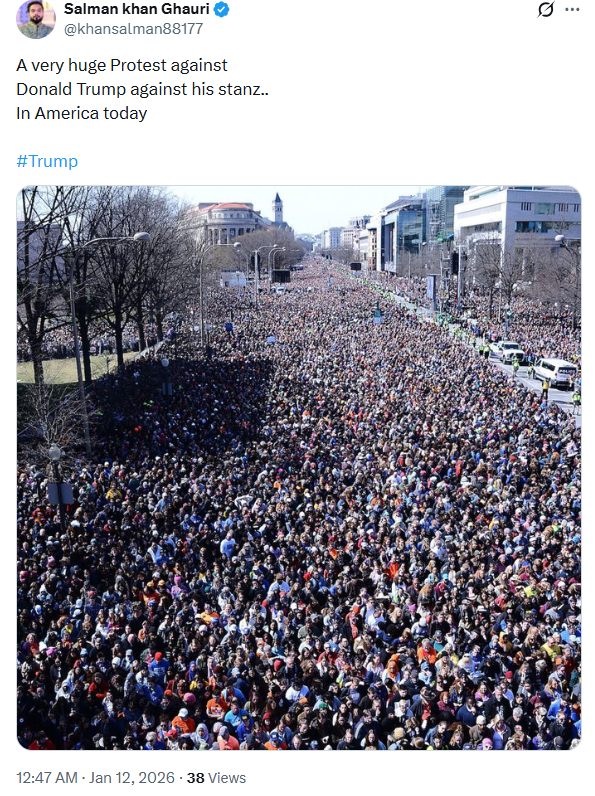
FactCheck:
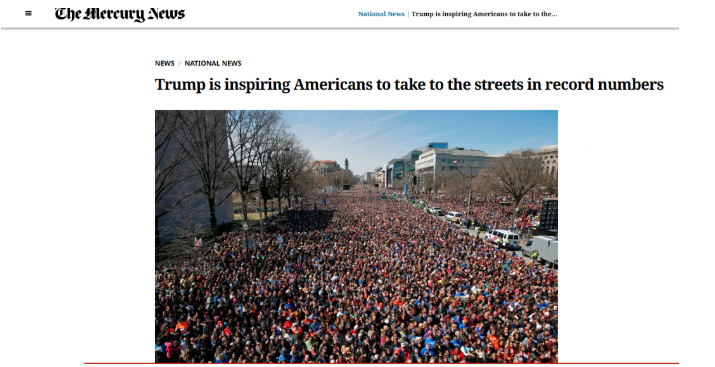
To verify the claim, we conducted a reverse image search of the viral photograph using Google. This led us to a report published by The Mercury News on April 6, 2018.
The report features the same image and states that the photograph was taken on March 24, 2018, during the ‘March for Our Lives’ rally in Washington, DC. The rally was organized to demand stricter gun control laws in the United States. The image shows a large crowd gathered on Pennsylvania Avenue in support of gun reform.
The report further notes that the Associated Press, on March 30, 2018, debunked false claims circulating online which alleged that liberal billionaire George Soros and his organizations had paid protesters $300 each to participate in the rally.
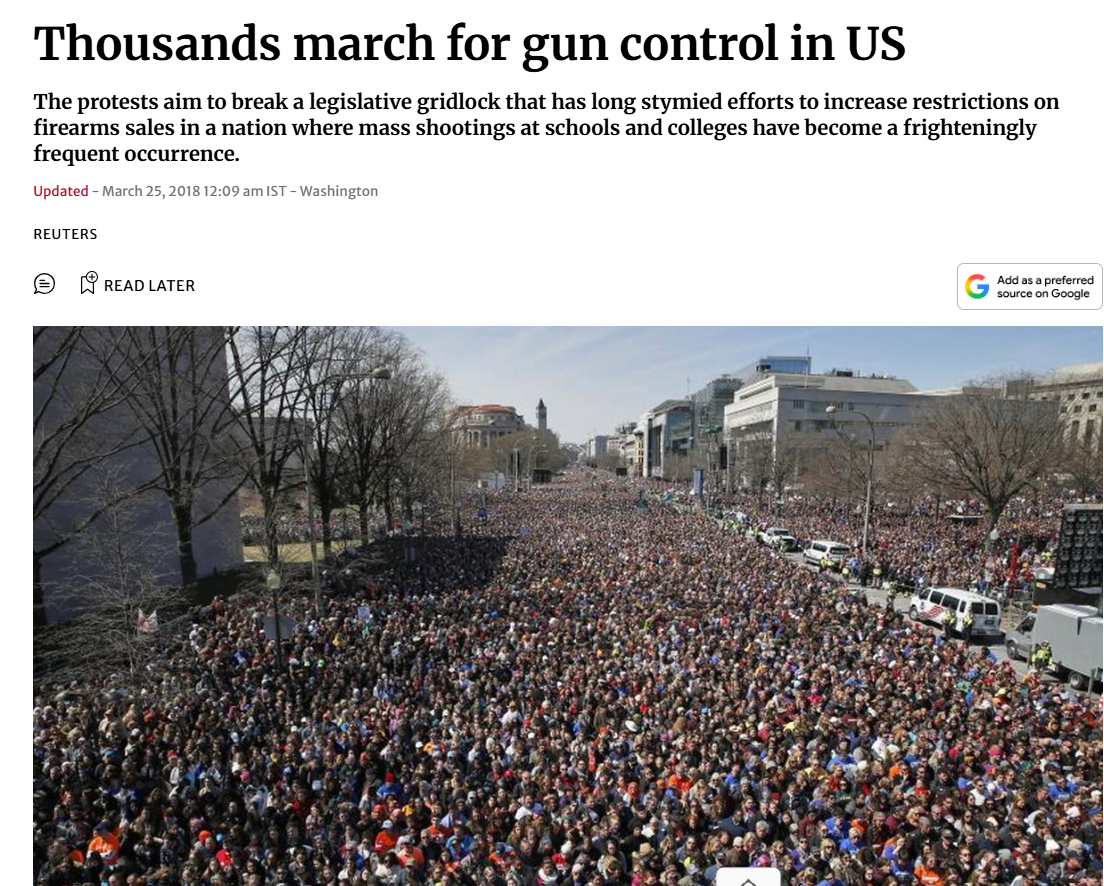
Further research led us to a report published by The Hindu on March 25, 2018, which also carries the same photograph. According to the report, thousands of Americans across the country participated in ‘March for Our Lives’ rallies following a mass shooting at a school in Florida. The protests were led by survivors and victims, demanding stronger gun laws.
The objective of these demonstrations was to break the legislative deadlock that has long hindered efforts to tighten firearm regulations in a country frequently rocked by mass shootings in schools and colleges.
Conclusion
The viral photograph is nearly eight years old and is unrelated to any recent protests against President Donald Trump.The image actually depicts a gun control protest held in 2018 and is being falsely shared with a misleading political claim.By circulating this outdated image with an incorrect context, social media users are spreading misinformation.

Executive Summary
As India concluded its 77th Republic Day celebrations on January 26, 2026, with grandeur and patriotic enthusiasm along the iconic Kartavya Path, a video began circulating on social media claiming to show Indian security personnel failing to perform motorcycle stunts during the ceremonial parade. The short clip allegedly depicts soldiers attempting high-risk, synchronised motorcycle manoeuvres, only to lose balance and fall off their bikes. The visuals were widely shared online with mocking captions, suggesting incompetence during a nationally televised event. However, an research by the CyberPeace found that the video is not authentic and was digitally generated using artificial intelligence.
Claim
A Pakistan-based X user, Sadaf Baloch (@sadafzbaloch), shared the video on January 27, claiming it showed Indian security personnel failing to execute motorcycle stunts during the Republic Day parade held on January 26, 2026. While sharing the clip, the user wrote:“Every time the Indian Army tries a tactical stunt, it looks less like combat training and more like a low-budget circus trailer filmed in one take.”The post was widely circulated with similar narratives questioning the professionalism of Indian forces.
Here is the link and archive link to the post, along with a screenshot.

To verify the authenticity of the viral video, the Desk conducted a detailed frame-by-frame analysis. During the examination, a watermark linked to ‘Sora’—an AI text-to-video generation model was detected at the 00:05 timestamp. The presence of this watermark strongly indicated that the video was artificially generated and not recorded during a real-world event.

Fact Check:
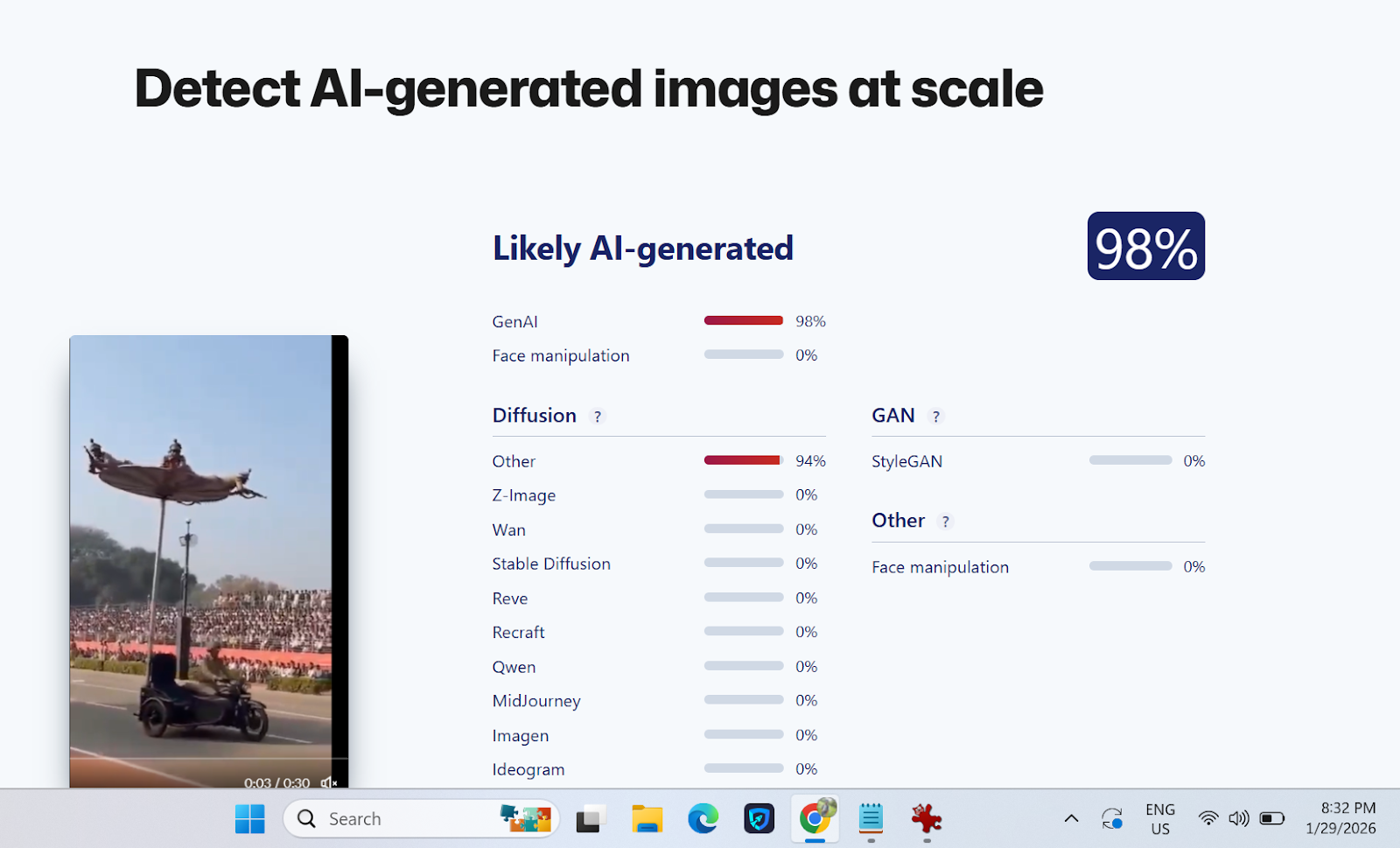
Further visual scrutiny revealed several inconsistencies commonly associated with AI-generated content. The background appeared unnatural and lacked realistic depth, while the movements and reactions of the security personnel looked mechanically exaggerated and inconsistent with real physics. Facial expressions and body motions during the alleged falls also appeared unrealistic. To strengthen the verification, the Desk analysed the clip using Sightengine, an AI-detection tool. The results showed a 98 per cent probability that the video contained AI-generated or deepfake elements.
Below is a screenshot of the result.
As part of the research , the Desk also conducted a customised keyword search and reviewed official coverage of the Republic Day parade. A full-length video broadcast by DD News on its official YouTube channel was examined. The footage showed joint CRPF and SSB motorcycle teams performing traditional daredevil stunts without any mishap. No incident resembling the viral claim was found in the official broadcast or in any credible media reports.
Here is the video link and a screenshot.

Conclusion
The CyberPeace research confirms that the viral video purportedly showing Indian security personnel failing to perform motorcycle stunts during the 77th Republic Day parade is AI-generated. The clip has been falsely circulated online as genuine content with the intent to mislead viewers and spread misinformation.
.jpeg)
As technological advancements continue to shape the future, the rise of artificial intelligence brings with it significant potential benefits, yet also raises concerns about the spread of misinformation. Recognising the need for accountability on both ends, on 5th May, during the three-day World News Media Congress 2025 in Kraków, Poland the European Broadcasting Union (EBU) and the World Association of News Publishers (WAN-IFRA) have announced to the public the five core principles for their joint initiative called News Integrity in the Age of AI. The initiative is aimed at fostering dialogue and cooperation between media organisations and technology platforms, and the principles announced are to be a code of practice to be followed by all those taking part. With thousands of public and private media outlets around the world joining the effort, the initiative highlights the shared responsibility of AI developers to ensure that AI systems are trustworthy, safe, and supportive of a reliable news ecosystem. It represents a global call to action to uphold the integrity of news in this age of major influx and curb the growing challenge of misinformation.
The five core principles released focus on:
1. Authorisation of content by the originators is a must prior to its usage in Generative AI tools and models
2. High-quality and up-to-date news content must be recognised by third parties that are benefiting from it
3. There must be a focus on accuracy and attribution, making the original sources of news apparent to the public, promoting transparency
4. Harnessing the plural nature of the news perspectives, which will help AI-driven tools perform better and
5. An invitation to tech companies for an open dialogue with news outlets, facilitating conversation to collaborate and develop standards of transparency, accuracy, and safety.
As this initiative provides a unified platform to address and deliberate on issues affecting the integrity of news, there are also some other technical ways in which misinformation in news caused by AI can be curbed:
1. Encourage the usage of Smaller Generative AI Models: The Large Language Models (LLMs) have to be trained on a range of topics. Businesses don’t require such an expanse of information but just a little that is relevant. A narrower context of information to be sourced from allows better content navigation and a reduced chance of mix-up.
2. Fighting AI hallucination: This is a phenomenon that causes generative AI (such as chatbots and computer vision tools) to present nonsensical and inaccurate outputs as the system perceives objects or patterns that are imperceptible or non-existent to human observers. This occurs as a result of the system trying to focus on both language fluency and stitching information from different sources together. In order to deal with this, one can deploy retrieval augmented generation (RAG). This enables connection with external sources of data that include academic journals, a company’s organisational data, among other things, that would help in providing more accurate, domain-specific content.
Conclusion
This global call to action marks an important step toward fostering unified efforts to combat misinformation. The set of principles introduced is designed to be adaptable, providing a flexible framework that can evolve to address emerging challenges (through dialogue and discussion), including issues like copyright infringement. While AI offers powerful tools to support the news industry, it is essential to emphasise that human oversight remains crucial. These technological advancements are meant to enhance and augment the work of journalists, not replace it, ensuring that the core values of journalism, such as accuracy and integrity, are preserved in the age of AI.
References
● https://www.techtarget.com/searchenterpriseai/tip/Generative-AI-ethics-8-biggest-concerns
● https://trilateralresearch.com/responsible-ai/using-responsible-ai-to-combat-misinformation
● https://www.omdena.com/blog/the-ethical-role-of-ai-in-media-combating-misformation
● https://2024.jou.ufl.edu/page/ai-and-misinformation
● https://techxplore.com/news/2025-05-ai-counter-misinformation-fact-based.html
● https://www.advanced-television.com/2025/05/06/media-outlets-call-for-ai-companies-news-integrity-protection/https://www.ibm.com/think/insights/ai-misinformation
