
From Social Media Ads to Fraud: The Rise of Fake Banking Apps - A Cybercrime investigation Case Study
Executive Summary:
Recently, CyberPeace faced a case involving a fraudulent Android application imitating the Punjab National Bank (PNB). The victim was tricked into downloading an APK file named "PNB.apk" via WhatsApp. After the victim installed the apk file, it resulted in unauthorized multiple transactions on multiple credit cards.
Case Study: The Attack: Social Engineering Meets Malware
The incident started when the victim clicked on a Facebook ad for a PNB credit card. After submitting basic personal information, the victim receives a WhatsApp call from a profile displaying the PNB logo. The attacker, posing as a bank representative, fakes the benefits and features of the Credit Card and convinces the victim to install an application named PNB.apk. The so called bank representative sent the app through WhatsApp, claiming it would expedite the credit card application. The application was installed in the mobile device as a customer care application. It asks for permissions such as to send or view SMS messages. The application opens only if the user provides this permission.

It extracts the credit card details from the user such as Full Name, Mobile Number, complain, on further pages irrespective of Refund, Pay or Other. On further processing, it asks for other information such as credit card number, expiry date and cvv number.


Now the scammer has access to all the details of the credit card information, access to read or view the sms to intercept OTPs.
The victim, thinking they were securely navigating the official PNB website, was unaware that the malware was granting the hacker remote access to their phone. This led to ₹4 lakhs worth of 11 unauthorized transactions across three credit cards.
The Investigation & Analysis:
Upon receiving the case through CyberPeace helpline, the CyberPeace Research Team acted swiftly to neutralize the threat and secure the victim’s device. Using a secure remote access tool, we gained control of the phone with the victim’s consent. Our first step was identifying and removing the malicious "PNB.apk" file, ensuring no residual malware was left behind.
Next, we implemented crucial cyber hygiene practices:
- Revoking unnecessary permissions – to prevent further unauthorized access.
- Running antivirus scans – to detect any remaining threats.
- Clearing sensitive data caches – to remove stored credentials and tokens.
The CyberPeace Helpline team assisted the victim to report the fraud to the National Cybercrime Portal and helpline (1930) and promptly blocked the compromised credit cards.
The technical analysis for the app was taken ahead and by using the md5 hash file id. This app was marked as malware in virustotal and it has all the permissions such as Send/Receive/Read SMS, System Alert Window.


In the similar way, we have found another application in the name of “Axis Bank” which is circulated through whatsapp which is having similar permission access and the details found in virus total are as follows:


Recommendations:
This case study implies the increasingly sophisticated methods used by cybercriminals, blending social engineering with advanced malware. Key lessons include:
- Be vigilant when downloading the applications, even if they appear to be from legitimate sources. It is advised to install any application after checking through an application store and not through any social media.
- Always review app permissions before granting access.
- Verify the identity of anyone claiming to represent financial institutions.
- Use remote access tools responsibly for effective intervention during a cyber incident.
By acting quickly and following the proper protocols, we successfully secured the victim’s device and prevented further financial loss.

Related Blogs

Introduction
The recent advisory issued by CERT, issued on April 26th, 2026, titled “Defending Against Frontier AI-Driven Cyber Risks”, on AI-driven cyber threats does not merely add to the list of routine cybersecurity warnings. Instead, it marks a shift in how cyber risk itself is understood. The concern, here, is not just that attacks are increasing, but also that their nature is changing. Artificial intelligence is no longer assisting cyber operations- whether legitimate or malicious, in fragments; it is beginning to organise and execute them at scale.
What is emerging is a situation where capability is no longer tied to human skill alone. Systems can now identify vulnerabilities, generate exploits, and carry out coordinated attacks with limited intervention. This alters the baseline assumption of cybersecurity, that attacks require effort, time, and expertise.
The Essence: Automation and Capability
At the core of the advisory lies the recognition that AI has introduced speed and autonomy into cyber operations. Tasks such as analysing code, identifying vulnerabilities, or crafting phishing content are no longer sequential processes. They can happen almost simultaneously and at scale.
This is not simply a matter of efficiency. It changes the structure of the threat itself. When attacks can be automated, they become repeatable and less dependent on specialised actors. The advisory also points to the ability of AI systems to conduct multi-stage attacks, moving across networks and adapting strategies in real time.
In a way, the threat is no longer just external. It is embedded within the logics of the technology being used.
Significance: Lower Barriers, Wider Exposure
One of the more important aspects of the advisory is its emphasis on ‘accessibility’. AI lowers the barrier of complexity in the commission of cybercrimes. Activities that once required coordinated teams can now be performed by individuals with access to advanced tools.
This has two consequences. First, the number of potential attackers increases. Second, the scale at which attacks can be carried out expands significantly. Systems that were previously considered low risk may become viable targets simply because automated tools can scan, test, and exploit them rapidly.
There is also a broader anxiety reflected in what is being described as “Mythos concerns”, a shorthand for uncertainty around frontier AI systems and their unpredictable capabilities. This signals that the risk is not fully mapped yet and that regulatory responses are still catching up.
Element of Continuous Risk
The advisory outlines impacts such as unauthorised access, data breaches, identity theft, and financial fraud. These are familiar categories. What is less explicit, but more important, is the shift in how these harms occur.
When AI enables rapid and repeated exploitation, risk becomes continuous. Systems are not attacked once and then secured. They are exposed to ongoing attempts. This creates pressure not only on technical infrastructure but also on legal frameworks that are designed around discrete incidents.
For instance, obligations under the Information Technology Act, 2000 or even emerging data protection frameworks often assume identifiable breaches and reportable events. Continuous probing complicates that model!
Response Framework: From Compliance to Vigilance
CERT-In’s recommendations reflect this change in threat perception. There is a clear emphasis on vigilance rather than mere compliance. Organisations are advised to adopt zero-trust approaches, reduce exposure surfaces, and treat vulnerabilities as immediately exploitable.
The insistence on rapid patching within short timeframes is particularly telling. It acknowledges that the window between vulnerability disclosure and exploitation is shrinking.
There is also a noticeable expansion of responsibility. The advisory does not limit itself to large organisations. It extends guidance to the MSMEs and individuals, recognising that cyber risk is now distributed across the entire digital ecosystem.
A Subtle Legal Shift
Although the advisory itself is not binding in law, it operates within the framework of Section 70B of the Information Technology Act, 2000, which empowers CERT-In to issue directions on cybersecurity best practices and guidelines.
So, while the advisory does not create liability directly, it influences what may later be considered ‘reasonable security practice’. In that sense, it serves as soft law, gradually informing standards of due diligence.
At the same time, there remains a gap. The advisory focuses on defensive measures, but it does not fully address attribution and accountability in AI driven attacks. When actions are automated and anonymised, identifying responsibility and imposing liability becomes more complex.
Conclusion
The CERT In advisory is not just a warning about new threats. It is an acknowledgement of a transition. Cyber risk is moving from being occasional and targeted to being constant and scalable. AI is not simply adding to existing threats; it is restructuring and advancing them.
For cyber vigilance frameworks, this suggests a need to rethink priorities. Static compliance measures are no longer sufficient. It has become necessary to adopt continuous monitoring, adaptive responses, and a clearer understanding of how technology is reshaping risk.
While the advisory does not resolve these questions, it does bring them into focus. And that, in itself, is significant.
References
- CERT-In issues advisory against AI driven cyber attacks for MSMEs, organisations and individuals, Moneycontrol (Apr. 27, 2026), https://www.moneycontrol.com/technology/cert-in-issues-advisory-against-ai-driven-cyber-attacks-for-msmes-organisations-and-individuals-article-13899942.html.
- CERT-In warns of rising AI driven cyber threats amid Mythos concerns, Ommcom News (2026), https://ommcomnews.com/science-tech/cert-in-warns-of-rising-ai-driven-cyber-threats-amid-mythos-concerns/.
- Indian Computer Emergency Response Team (CERT-In), Defending Against Frontier AI Driven Cyber Risks, Advisory No. CIAD-2026-0020 (Apr. 26, 2026)
- Information Technology Act, 2000, § 70B (India).

Executive Summary
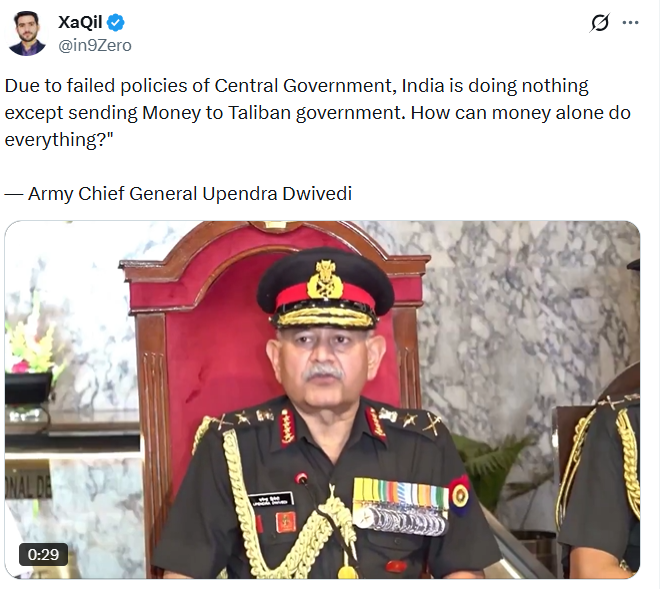
A video clip of Indian Army Chief Upendra Dwivedi is being widely shared across social media platforms with the claim that he criticised the Indian government's policy towards Taliban-ruled Afghanistan. In the viral clip, the Army Chief is allegedly heard saying that India is doing nothing except sending money to the Taliban government due to the Centre’s failed policies.
However, CyberPeace Research Wing research found the claim to be false. The viral video is a deepfake. In the original footage, General Upendra Dwivedi was speaking about Operation Sindoor and the preparedness of the Indian Armed Forces for a possible “Operation Sindoor 2.0.” He made no remarks regarding the Taliban or the government’s Afghanistan policy.
Claim
An X user named “XaQil” shared the viral video on May 31, 2026, with the caption:“Due to failed policies of the Central Government, India is doing nothing except sending Money to Taliban government. How can money alone do everything?” — Army Chief General Upendra Dwivedi.
Fact Check
In the viral video, General Dwivedi is purportedly heard making remarks about India’s Afghanistan policy, the Taliban, Pakistan, Iran, and India’s diplomatic position. To verify the claim, we searched for the original source of the video. A reverse image search of key frames led us to the authentic footage posted by news agency ANI on its official X account on May 30, 2026.
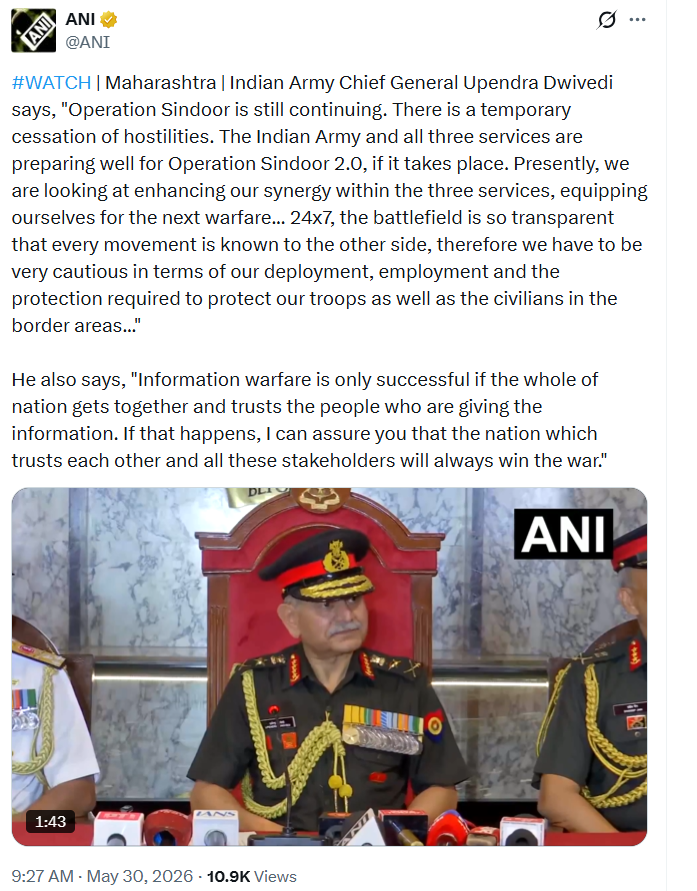
In the original video, General Dwivedi was responding to a question about Operation Sindoor. He stated that the operation was still ongoing, hostilities had only paused temporarily, and that the Indian Armed Forces were fully prepared if “Operation Sindoor 2.0” became necessary.
He also spoke about enhancing coordination among the three services and maintaining operational readiness.”
No part of his statement mentioned the Taliban, Afghanistan, Pakistan, Iran, or criticism of the Central Government.
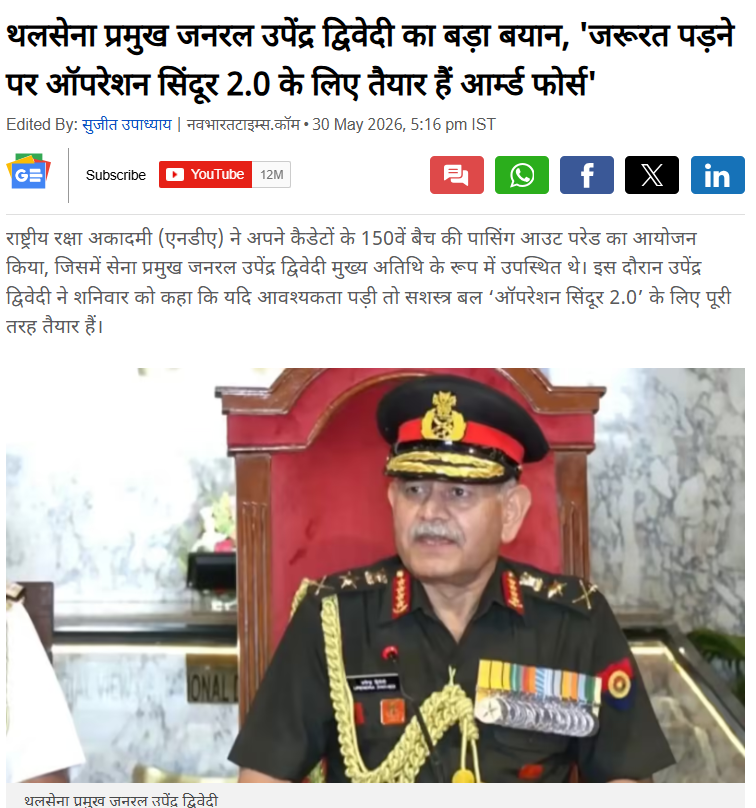
Further corroboration came from media reports covering the same event. According to a report published by Navbharat Times on May 30, 2026, General Dwivedi made the remarks during the passing-out parade of the 150th course of the National Defence Academy (NDA), where he attended as the chief guest. He reiterated that the armed forces were fully prepared for “Operation Sindoor 2.0” if required.
Since the content of the viral clip did not match the original statement, we examined it using InVID’s MeVer Deepfake Detector. The tool flagged signs of AI manipulation and indicated that the video had likely been altered.

Conclusion
Cyber Peace Foundation found that the viral video purportedly showing Army Chief General Upendra Dwivedi criticising the Indian government’s policy towards the Taliban is a deepfake. The Army Chief made no such remarks. The original video was recorded during an NDA event, where he spoke about Operation Sindoor and the preparedness of the Indian Armed Forces for a possible future operation. The viral clip has been manipulated using AI to spread a false narrative.

Executive Summary:
Social media has been overwhelmed by a viral post that claims Indian Railways is beginning to install solar panels directly on railway tracks all over the country for renewable energy purposes. The claim also purports that India will become the world's first country to undertake such a green effort in railway systems. Our research involved extensive reverse image searching, keyword analysis, government website searches, and global media verification. We found the claim to be completely false. The viral photos and information are all incorrectly credited to India. The images are actually from a pilot project by a Swiss start-up called Sun-Ways.

Claim:
According to a viral post on social media, Indian Railways has started an all-India initiative to install solar panels directly on railway tracks to generate renewable energy, limit power expenses, and make global history in environmentally sustainable rail operations.

Fact check:
We did a reverse image search of the viral image and were soon directed to international media and technology blogs referencing a project named Sun-Ways, based in Switzerland. The images circulated on Indian social media were the exact ones from the Sun-Ways pilot project, whereby a removable system of solar panels is being installed between railway tracks in Switzerland to evaluate the possibility of generating energy from rail infrastructure.

We also thoroughly searched all the official Indian Railways websites, the Ministry of Railways news article, and credible Indian media. At no point did we locate anything mentioning Indian Railways engaging or planning something similar by installing solar panels on railway tracks themselves.
Indian Railways has been engaged in green energy initiatives beyond just solar panel installation on program rooftops, and also on railway land alongside tracks and on train coach roofs. However, Indian Railways have never installed solar panels on railway tracks in India. Meanwhile, we found a report of solar panel installations on the train launched on 14th July 2025, first solar-powered DEMU (diesel electrical multiple unit) train from the Safdarjung railway station in Delhi. The train will run from Sarai Rohilla in Delhi to Farukh Nagar in Haryana. A total of 16 solar panels, each producing 300 Wp, are fitted in six coaches.


We also found multiple links to support our claim from various media links: Euro News, World Economy Forum, Institute of Mechanical Engineering, and NDTV.

Conclusion:
After extensive research conducted through several phases including examining facts and some technical facts, we can conclude that the claim that Indian Railways has installed solar panels on railway tracks is false. The concept and images originate from Sun-Ways, a Swiss company that was testing this concept in Switzerland, not India.
Indian Railways continues to use renewable energy in a number of forms but has not put any solar panels on railway tracks. We want to highlight how important it is to fact-check viral content and other unverified content.
- Claim: India’s solar track project will help Indian Railways run entirely on renewable energy.
- Claimed On: Social Media
- Fact Check: False and Misleading
