
#FactCheck-Video From Arunachal Pradesh Floods Falsely Shared as Nepal’s Rasuwa Floods
Executive Summary
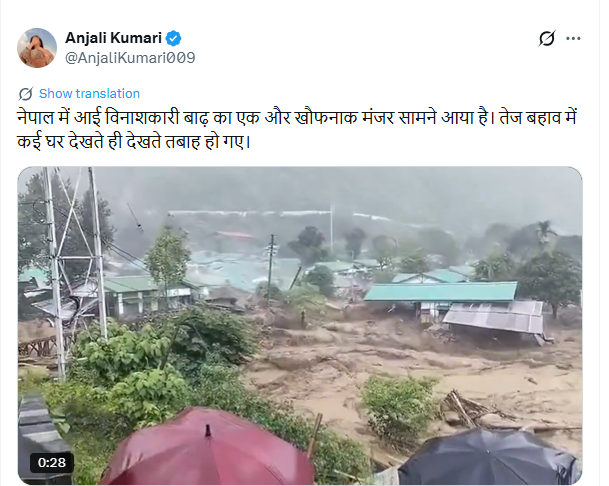
A video showing several houses being swept away by floodwaters is being shared on social media, claiming that it shows flooding in the Rasuwa area of Nepal. Research done by the CyberPeace research wing found that the video is not from Nepal, but is from the floods that occurred in Keyi Panyor district of Arunachal Pradesh in June.
Claim
The video was shared on X with the caption: “Another horrifying scene from the devastating floods in Nepal has emerged. Several houses were destroyed within moments by the strong current.”
https://x.com/anjalikumari009/status/2093257147094335652
FactCheck
During our research of the video being shared as footage of floods in Nepal’s Rasuwa area, we conducted a reverse image search using keyframes and found a longer version of the video posted on an X account on June 24, 2026. The caption accompanying the video identified it as footage of a flash flood and the resulting devastation in Nipko Colony, Possa, in Arunachal Pradesh’s Keyi Panyor district, on June 24.
https://x.com/NagaZapu/status/2069747140608331962

During the research, we also found videos of the flooding in Nipko Colony uploaded on several social media accounts from Arunachal Pradesh on June 24. These posts contained visuals matching those seen in the viral video.
https://www.facebook.com/reel/977442025167230

Additionally, we found a video report uploaded on June 24, 2026, on the Facebook account of a media outlet from Arunachal Pradesh. The report featured footage of the flooding in Nipko Colony. In the audio accompanying the video, the person recording the footage can also be heard describing the devastation caused by the floods.
https://www.facebook.com/reel/1571580381035813

Additionally, we found visuals matching those in the viral video in a 4-minute-35-second video posted on the Press Trust of India’s X account on June 24, 2026. According to media reports, around three people were killed in the floods in Nipko Colony, while approximately 18 houses were swept away.
https://x.com/PTI_News/status/2069747746525835341

Conclusion
The evidence gathered during our research clearly establishes that the video being shared as footage of the floods in Nepal’s Rasuwa area is actually from the floods that struck Keyi Panyor district in Arunachal Pradesh on June 24.

Related Blogs

Introduction
Established in the US, one of the world’s largest cab networks came into existence in 2010 and, since its inception, has expanded all over the globe with operations in 10,000 cities across 71 countries. It made a remarkable start in India in 2017 and, since then, has seen a rise in the customers and drivers for the company. India is among the largest markets for Uber, with 600,000 monthly drivers and 8.5 million monthly riders.
GeM
Government e-Marketplace (GeM) is a one-stop portal to facilitate online procurement of common-use Goods & Services required by various Government Departments / Organizations / PSUs. GeM aims to enhance transparency, efficiency and speed in public procurement. It provides the tools of e-bidding, reverses e-auction and demand aggregation to facilitate government users achieve the best value for their money. Government e-Marketplace owes its genesis to the recommendations of two Groups of Secretaries to the Prime Minister in January 2016. They recommended setting up a dedicated e-market for different goods & services procured or sold by Government/PSUs besides reforming DGS&D. Subsequently, the Finance Minister, in his Budget speech for FY 2016-17, announced setting up of a technology-driven platform to facilitate procurement of goods and services by various Ministries and agencies of the Government. The portal was launched on 9th August 2016 by the Commerce & Industry Minister.
Uber-GeM collaboration
The cab network giant has registered on the portal of the Government E-marketplace and has declared that it will offer its services to Government officials from Ministries and PSUs. The project is currently in its pilot phase and shall be executed systematically to cover all the ministries and PSUs in the nation. The officials can book cabs at a fixed price with no cancellation or surge fees on the rides. The authorised officials will be able to book a cab from the portal and select from the list of drivers available. It will be a cashless/cardless ride for the officials; additional vehicle categories for government riders have been added, namely, GeM Yatraa Hatch and GeM Yatraa Sedan, and there will be hourly rentals for multiple-stops, allowing the government officials to enjoy the flexible and easily accessible network of cabs in major cities.
Advantages
Such collaboration between Government institutions and corporates will go a long way to secure a stable equilibrium in the market. Uber, a US-based company, enjoys a vast user base in India and has created new job avenues. The advantages of the collaboration between GeM and Uber are as follows-
Easy accessibility
This will undoubtedly provide ease in accessibility in terms of being in a new place, and language barriers will no longer exist with such options for Government officials.
Increased jobs for drivers
With more cabs being engaged with ministries and PSUs, it is pertinent that the requirement for drivers will grow, thus increasing the employability rate in India and allowing the user to have an uninterrupted experience.
Ease of travel and commuting
This move will provide flexibility, thus leading to more ease in travel in cases of emergencies or places inaccessible by trains or other modes of transport.
Rise in travel and tourism
Coupled with the other factors, the opportunities for the users to visit different places will be an added advantage which will help boost the tourism industry, thus creating a balance in the market.
Sustainable Government corporate relationship

Such collaborations between the government and corporates will be substantial, signifying the ease of doing business in India. They will also act as a beacon of example for compliance with opportunities for the other companies and stakeholders.
Opportunities for collaboration with ingenious start-ups
With such major corporate joining hands with the government, the indigenous start-ups will have various opportunities to engage with companies and recreate similar businesses rooted in India, thus transforming the economy.
Conclusion
Transportation and communication play a vital role in our lives, thus, such collaboration will go a long way in creating a better and more uniform user experience in the country. This also goes a long way to showcase that the Governmental platforms also offer services of a global standard. Such portals exist in South Korea, Singapore, the US and Europe. The network of cabs can only be sustained using the locals as drivers, hence these collaborations are win-win for all as the market dynamics are improving, employability will increase, and improved user experience will be seen.

Executive Summary
After Donald Trump said that US Navy ships would soon begin escorting tankers through the Strait of Hormuz, several old images resurfaced on social media with claims that they show American sailors recently captured by Iran amid the ongoing Middle East tensions. Research by CyberPeace found that the viral posts are misleading. The images being circulated are nearly a decade old and have no connection to the ongoing situation in the Middle East.
Claim:
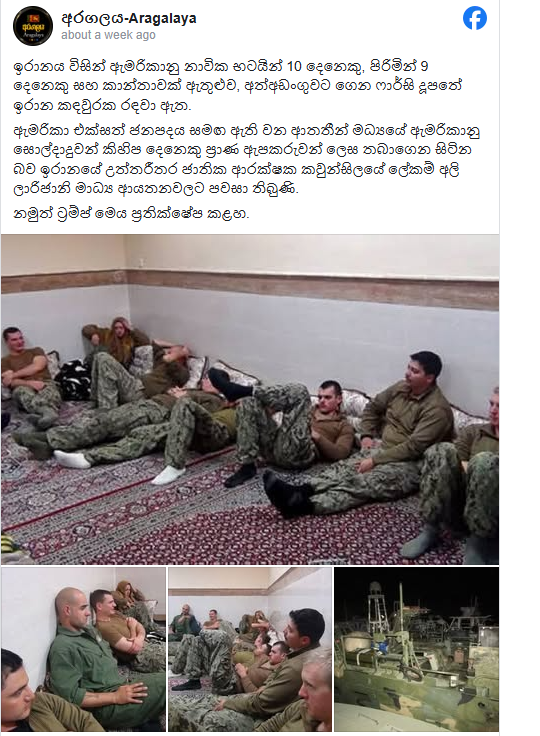
Posts circulating on Facebook alleged that Iran had captured 10 US Navy personnel — nine men and one woman — and detained them at a military base on Farsi Island. The caption further claimed that the incident was reported by Iranian official Ali Larijani and denied by Donald Trump.
https://www.facebook.com/photo/?fbid=1381610870661566&set=pcb.1381611363994850
Fact Check
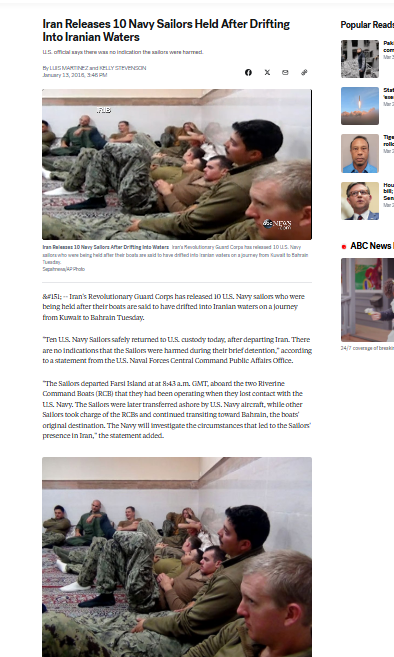
A reverse image search revealed that the viral images are not recent. They were published as early as January 13, 2016, by ABC News in a report titled “Iran Releases 10 Navy Sailors Held After Drifting Into Iranian Waters.”
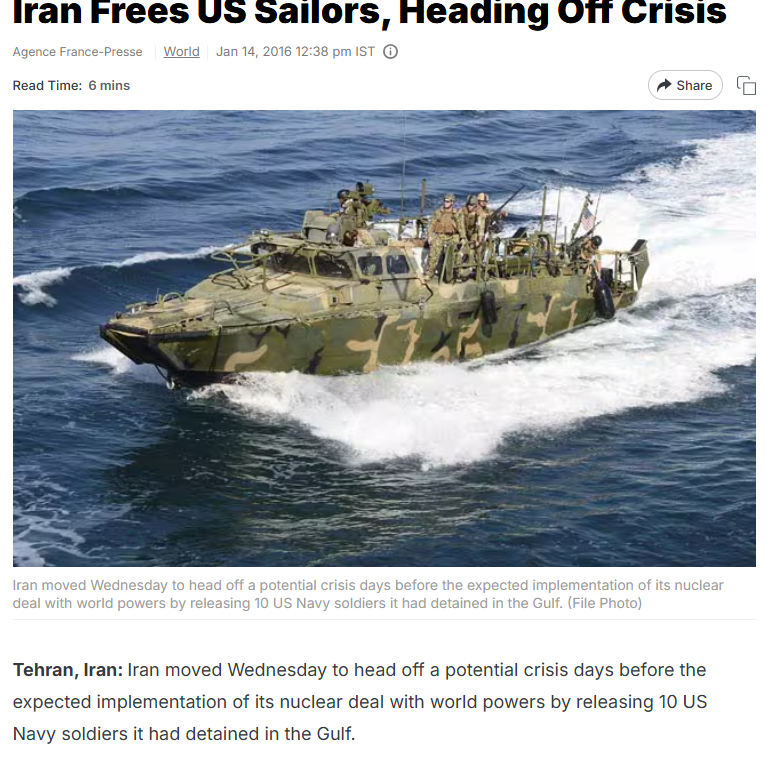
Further checks showed that the same images were distributed by AFP, with credits to Sepah News, the media wing of Iran’s Revolutionary Guards.
Context
The images relate to a 2016 incident in which two US Navy patrol boats accidentally entered Iranian waters. The crew was detained and taken to Farsi Island. Iran later released the sailors after determining that the intrusion was unintentional and that there was no hostile intent.
Conclusion
The viral posts are misleading. The images being shared are nearly a decade old and unrelated to the ongoing situation in the Middle East.

Introduction
Most people who lose money to an online scam do the same thing first. They stare at the bank message and try to work out whether it can still be undone. Sometimes it can, but only if the right people move within hours. In Delhi, once the amount crosses ₹50 lakh, those people sit in a unit most residents have never heard of: the Intelligence Fusion and Strategic Operations unit, known as IFSO.
The scale explains why it exists. Delhi residents lost close to ₹1,000 crore to cyber fraud in 2025, after roughly ₹1,100 crore in 2024, and police counted at least 376 cases in 2025 in which a single victim lost more than ₹50 lakh. Investment scams, boss impersonation and "digital arrest" calls, in which fraudsters pose as police, CBI or courier officials and convince a victim that they are under investigation, topped the list.
Where IFSO came from
IFSO's roots go back to February 2019, when the then Union Home Minister inaugurated the National Cyber Forensic Lab alongside a Delhi Police cybercrime unit called CyPAD. CyPAD was later renamed IFSO, and for years it worked inside the Special Cell, the force's counter-terror and organised crime wing. On 3 December 2025, an order approved by the Commissioner of Police made it a standalone unit, with all its personnel reporting directly to a Deputy Commissioner of Police (IFSO). By then the city also had dedicated cyber police stations in all 15 districts, which matters for what follows.
Who takes which case
Delhi Police sorts cyber fraud by the amount lost.

The split came with a change that matters to ordinary victims. From 1 November 2025, anyone who has lost ₹1 lakh or more can have an e-FIR registered at the Integrated Help Desk of any police station in the capital, down from a ₹10 lakh threshold earlier. Smaller losses still go through the 1930 helpline and the national portal. In practice, then, the amount decides who takes the case after you report, not which door you walk through.
What IFSO actually does
It chases the money, fast. Stolen funds rarely stay put. They hop through chains of "mule" accounts within minutes. When a victim reports and supplies transaction details, IFSO starts what police call lien marking, asking banks to put a hold on the money. According to the unit's DCP, Delhi Police managed to hold nearly 20 per cent of defrauded funds in 2025, almost double the share in 2024.
It works across state lines and borders. In October 2026, IFSO was reported to have broken a syndicate with handlers in Cambodia and other Southeast Asian countries, arresting 11 people. In the same operation, working with Andhra Pradesh Police, it helped secure ₹7.25 crore from the ₹10.25 crore taken from a 79-year-old man in Vijayawada, and put a hold on a further ₹1.96 crore. The network was linked to 78 complaints on the National Cyber Crime Reporting Portal, across several states, involving about ₹73 crore.
It tries to intervene before the money is gone. Reports describe a financial monitoring wing that identifies potential victims while a scam is still unfolding. In one round of interventions it reportedly helped prevent about ₹1.53 crore in losses across five states, including an elderly man held in fear by a "digital arrest" for 14 days.
It brings the forensic muscle. Reporting describes IFSO as home to a cybercrime lab whose services are available to police forces in other states, which is part of why complex, multi-state cases land with it.
If it happens to you or someone you know
Time is the one thing you cannot get back, so the order matters.
- Call the national cyber helpline, 1930, immediately, and tell your bank at the same time.
- File the complaint on cybercrime.gov.in. In Delhi, if the loss is ₹1 lakh or more, you can also have an e-FIR registered at any police station's help desk.
- Keep everything: transaction IDs, account numbers, the scammer's phone numbers, screenshots, chats, call logs. Do not delete the app or the conversation.
- Do not pay anyone who offers to recover your money for a fee. Delhi Police advice is blunt: do not join online investment groups, do not install unknown .apk files, and do not transfer money without verification.
Why the First Hour Counts
Picture the money after a scam. It rarely sits in one place. Within hours it is usually split across several “mule” accounts, then withdrawn or pushed onward, sometimes into crypto. That is the whole reason 1930 exists.
The helpline is run by the Indian Cyber Crime Coordination Centre under the Home Ministry, around the clock. When you call, the details go into a system called CFCFRMS, which alerts whichever bank or wallet is holding the money at that moment and asks it to freeze the amount before it moves again. Under a procedure issued on 2 January 2026, the call itself is handled by the police of your own state.
The numbers are large. By 30 June 2026, the Home Ministry told the Lok Sabha, more than ₹11,158 crore had been “saved” across over 32.80 lakh complaints. Read that word carefully, though: “saved” means held by banks, not handed back. Getting it back is a separate step, and a Money Restoration Module, live since April 2026, was built to speed that up.
A change to watch: D4C
On Tuesday, 25 August 2026, the Delhi Government approved a new body, the Delhi Cyber Crime Coordination Centre (D4C), meant to be the nodal agency for cyber fraud under the Commissioner of Police, with a command centre at Police Headquarters on Jai Singh Road working around the clock. Hindi reporting at the time said IFSO would be merged into it. IFSO's investigation wing, the digital investigation lab, the training and awareness centre, the 1930 helpline control room in Haiderpur and a Fraud Mitigation Centre, where bank representatives are to sit alongside police, would all come under D4C, and the 15 district cyber stations would work to its directions. English coverage noted that how the two bodies relate had not been fully explained.
For a victim the advice does not change: report first through 1930 or the portal, and let the system route the case. What may change is the name on the door.
The takeaway
Policing can claw money back only while it is still traceable, and that window is measured in hours. IFSO's record shows what a specialist unit can do inside it. The rest of the work belongs to the rest of us: verify before paying, report early, and never be embarrassed to call 1930.
References
- https://www.tribuneindia.com/news/delhi/delhi-police-lowers-e-fir-threshold-for-cyber-fraud-cases-to-1-lakh/
- https://www.tribuneindia.com/news/delhi/delhiites-lose-rs-1000-crore-to-cyber-frauds-in-2025/amp
- https://thepatriot.in/crime/over-7000-arrested-in-delhi-polices-biggest-cybercrime-crackdown-86937
- https://www.theweek.in/wire-updates/national/2025/12/04/des90-dl-ifso-separation.html
- https://www.thestatesman.com/cities/delhi/delhi-police-busts-digital-arrest-syndicate-with-foreign-links-11-arrested-rs-7-25-crore-saved-1503650650.html
- https://www.newshubonline.com/delhi-police-foil-cyber-fraud-attempts-worth-%E2%82%B91-53-crore-across-five-states-rescue-senior-citizens-from-digital-arrest-scams/
- https://www.bwpoliceworld.com/article/delhi-police-will-now-host-d4c-instead-of-ifso-to-tackle-cybercrime-621038
- https://www.saahassamachar.in/big-action-on-cyber-fraud-in-delhi-new-d4c-center-will-work-24-hours
- https://aninews.in/news/national/general-news/delhi-police-d4c-to-have-dedicated-unit-for-school-bomb-threat-emails-online-crimes-against-women-and-children20260831103631/
