
#FactCheck-Old Accident Involving Delhi Police Head Constable Falsely Linked to CJP Protest
Executive Summary
A social media post is being widely circulated claiming that Delhi Police personnel Amit died during the Cockroach Janata Party (CJP) ‘Sansad Chalo’ protest held on July 20, 2026. The post attempts to link his death to violence that allegedly took place during the demonstration. CyberPeace Research Wing’s research found the claim to be false. The research revealed that the death of Head Constable Amit was not related to the CJP protest held on July 20. He died on July 15 after being hit by a speeding vehicle while on duty at Singhu Border. An old accident has been falsely linked to the recent protest through a misleading claim.
Claim:
A Facebook user shared a post on July 23, 2026, claiming that a police personnel was martyred during the alleged protest carried out by “student goons and their supporters from Congress and Kejriwal’s party” on July 20. The user further claimed that the protest was responsible for the death of a police personnel and questioned criticism over alleged police action against protesters.
The post’s link, archive link and screenshot are provided below:
https://www.facebook.com/photo?fbid=3562630610568369&set=a.100838436747621
https://ghostarchive.org/archive/m8QM8

Fact Check:
To verify the authenticity of the viral claim, the Desk first examined the official social media accounts of Delhi Police. During the research, the Desk found a post shared on Delhi Police’s official Instagram account on July 16, 2026, which contained the same image being circulated in the viral post.
https://www.instagram.com/p/Da19BQxEmQv/?igsh=cnN1bXZhaHg5OWRs

In the next stage of the research, the Desk found an NDTV report published on July 16, 2026. According to the report, Delhi Police had arrested two accused in connection with the death of Head Constable Amit. The arrested individuals were identified as Kuldeep alias Karan and Neeraj. The report stated that police had also seized the vehicle bearing registration number DL11CG2268, which was involved in the accident. An FIR was registered at Alipur Police Station and further research was underway.
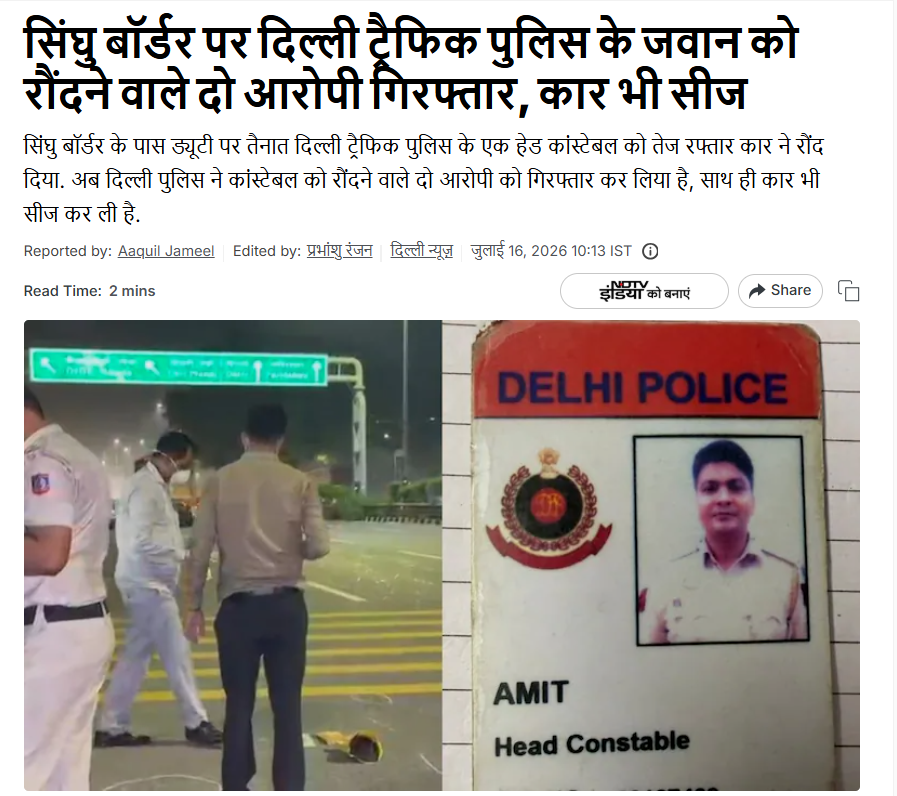
Further research led the Desk to a related post on the Facebook page of Delhi Samachar TV. According to the post, the hit-and-run case involving Head Constable Amit, who was hit while performing duty at Singhu Border (NH-44), was solved by Delhi Police within hours. The police team arrested two accused and recovered the vehicle used in the incident.
The post’s link and screenshot are provided below:
https://www.facebook.com/reel/1006635078843860

Conclusion:
The research established that the death of Delhi Police Head Constable Amit was not connected to the CJP ‘Sansad Chalo’ protest held on July 20, 2026. Amit died on July 15 after being hit by a speeding vehicle while on duty at Singhu Border. The old accident is being falsely linked to the recent protest with a misleading claim.

Related Blogs

Introduction
The two-day Apple’s Worldwide Developer Conference (WWDC) 2023, which was held on the 6th & 7th of June, has become an essential and highly anticipated part of our calendar as frequently as the trend. This year’s keynote announcements will include all of the usual enhancements for iOS, iPadOS, watchOS, macOS, and more. However, this year is also unique due to the unveiling of the Vision Pro headset, a brand-new Apple product.
In this blog, we will examine the exciting announcements made at Apple WWDC 2023, which was a ground-breaking event.
macOS Sonoma
macOS Sonoma, the new presentation of macOS disclosed at the WWDC full of exciting features. It comes with stunning video screensavers that show stunning scenes from all over the world. Gadgets can now be added genuinely to the work area and adjusted totally based on the client’s action. Also, it changes variety and blurring out of the spotlight while utilising applications. In addition, Death Stranding: Directors Cut for Mac announced that the Game Mode is added to make Macs more suitable for gaming. A presenter overlay enhances video presentations, and viewers can respond to them with interactive responses. Updated Safari is also included in the WebApp feature that turns frequently used websites into dedicated windows, a new Profile system for separating browsing history, and secure password sharing. Currently, the developer beta is available and the public beta will be available in July, and the final release is anticipated for the fall.
ios 16
Apple WWDC 2023 shows the following iOS, and iOS 16 replication, offering plenty of energising highlights for iPhone and iPad clients. Apple maintains its commitment to privacy with iOS 16, which introduces enhanced privacy settings that give users even more control over their data and online privacy. Users can also personalise their devices according to their preferences thanks to the new operating system’s refinement and customisable user interface.Improved multitasking capabilities like redesigned Files app and advanced note-taking features are just a few of the productivity enhancements included in the iOS 16. With iOS 16, Apple also improves its AR capabilities, allowing developers to develop even more immersive and interactive AR experiences.

WatchOS 9
Apple WWDC 2023 carried energising updates to the Apple Watch with the presentation of watchOS 9. The Apple Watch is an essential companion for sustaining a healthy lifestyle because the most recent version of the operating system includes cutting-edge health and fitness features. WatchOS 9 gives users unprecedented control over their health, offering personalised fitness recommendations and advanced sleep tracking.
Additionally, new watch faces were added, enhancing communication capabilities and improving app performance in watchOS 9, making the Apple Watch even easier to use daily.
ios 17
Rather than focusing on major features, Apple focused on quality-of-life enhancements when it announced iOS 17 at WWDC 2023. Live Voicemail with real-time transcripts of voicemails, personalised personal contact “posters,” and video voicemails for FaceTime are all part of the update. Search filters, a catch-up arrow, live location sharing, and a safety feature called Check-In are all available in Messages. AirDrop now supports NameDrop for transferring contact information; stickers have been expanded. The autocorrect and recording features on the keyboard have been improved for accuracy. Standby in the lock screen is an intelligent home display that shows the weather, upcoming appointments, and notifications. Siri works on Standby and adjusts itself for the night. The developer beta is currently available now, and a public beta will take place next month before the full release is in the fall.
Vision Pro VR Headset
Apple unveiled the Vision Pro AR headset, their first foray into virtual reality (VR), during the WWDC keynote. The Vision Pro is a virtual reality headset that competes with PlayStation VR2 and Meta Quest 3. This is in contrast to the long-awaited Apple smart glasses. Apple put a lot of effort into making a thin and light headset by using premium materials when needed. Voice, hand, and eye commands are all used to operate the Digital Crown-equipped device. The showcases offer extraordinary clarity, which is fueled by Apple’s M2 processor with a committed R1 chip. The Vision Pro combines virtual reality (VR) and augmented reality (AR), enabling users to interact with Apple apps and gain access to the company’s existing ecosystem. The expanded reality space created by the headset’s sensors and cameras allows users to place apps in real-world environments and adjust their level of concentration. Optic ID is a security and unlocking eye-tracking technology that is incorporated into the Vision Pro. It allows for a more immersive screen experience because it is compatible with Apple accessories like Magic Keyboard and Mac. At launch, the Vision Pro supports over a hundred Apple game galleries. Disney gave a hint that Apple and Disney might work together in the future by announcing support for the Vision Pro and making the Disney Plus app available immediately. The show highlighted the headset’s lightweight plan and recommended Apple clients wear it for extended periods. However, widespread adoption may be difficult due to the high price of $3,499 (₹289,093.01 approx). Apple is expected to release the Vision Pro for public use in 2024.

15-inch MacBook Air
At the WWDC event, Apple revealed a new MacBook Air with a larger 15-inch model instead of the standard 13-inch model. The 15-inch MacBook Air features a powerful Apple M2 processor, a thin, light, and long-lasting design, and a stunning 15.3-inch Retina display. It comes in four colours and has a headphone jack, two USB-C ports, and MagSafe charging. The display has six spatial speakers, a 1080p webcam, and 500 nits of brightness. Apple claims a battery life of up to 18 hours.
Conclusion
At Apple’s 2023 WWDC, the company demonstrated its commitment to developing technology that is user-friendly and accessible to all. Apple’s commitment to improving the user experience across all of its products is demonstrated in the updates to operating systems, improvements of Siri, breakthroughs in augmented reality, and enhancements to health and fitness.By making complex innovations more like-minded and easy to understand, Apple is enabling people to use the maximum capacity of their gadgets. Apple’s innovations at WWDC 2023 are expected to shape the future of technology, simplifying everyday tasks and revolutionising how we interact with the digital world.As we push ahead, it is exciting to guess what these advancements will proceed to develop and decidedly mean for our lives. The future holds even more incredible possibilities for all of us because of Apple’s focus on privacy, user-centric design, and pushing the boundaries of innovation. Thus, prepare to embrace a future where innovation flawlessly incorporates into our lives because of the endeavours displayed at Apple WWDC 2023.
.webp)
Data has become a critical asset for the advancement of a nation’s economic, social, and technological development. India’s emergence as a global digital economy hub makes it necessary to create a robust framework that addresses the challenges and opportunities of digital transformation. The Indian government introduced the Draft National Data Governance Framework Policy in 2022, aiming to create a comprehensive data handling and governance framework. This policy draft addresses key challenges in data management, privacy, and digital economy growth. As per the recent media reports, the Draft National Data Governance Policy so prepared is under the finalisation stage, the government specified in its implementation document for the Budget 2023-24 announcement. The policy also aims to address the country's AI adoption and the issue of lack of datasets by providing widespread access to anonymized data.
Background and Need for the Policy
India has a robust digital economy with its adoption of the Digital India Initiative, Aadhaar digital identification, UPI for seamless payments and many more. In India, 751.5 million people connect to the internet, and is home to 462.0 million social media users in January 2024, equivalent to 32.2% of its total population (Data Reportal 2024). This has brought challenges including data privacy concerns, cybersecurity threats, digital exclusion, and a need for better regulation frameworks. To overcome them, the Draft National Data Governance Policy has been designed to provide institutional frameworks for data rules, standards, guidelines, and protocols for the sharing of non-personal data sets in a manner that ensures privacy, security, and trust so that they remain secure, transparent, and accountable.
Objectives omphasizesf the Framework
The objective of the Framework Policy is to accelerate Digital Governance in India. The framework will standardize data management and security standards across the Government. It will promote transparency, accountability, and ownership in Non-Personal data and dataset access and build a platform to receive and process data requests. It will also set quality standards and promote the expansion of the datasets program and overall non-personal ecosystem. Further, it aims to build India’s digital government goals and capacity, knowledge, and competency in Government departments and entities. All this would be done while ensuring greater citizen awareness, participation, and engagement.
Key Provisions of the Draft Policy
The Draft Framework Policy aims to establish a cohesive digital governance ecosystem in India that balances the need for data utilization with protecting citizens' privacy rights. It sets up an institutional framework of the "India Data Management Office (IDMO) set up under the Digital India Corporation (DIC) which will be responsible for developing rules, standards, and guidelines under this Policy.
The key provisions of the framework policy include:
- Promoting interoperability among government digital platforms, ensuring data privacy through data anonymization and security, and enhancing citizen access to government services through digital means.
- The policy e the creation of unified digital IDs, a standardisation in digital processes, and data-sharing guidelines across ministries to improve efficiency.
- It also focuses on building digital infrastructure, such as cloud services and data centres in order to support e-governance initiatives.
- Furthermore, it encourages public-private partnerships and sets guidelines for accountability and transparency in digital governance.
Implications and Concerns of the Framework
- The policy potentially impacts data sharing in India as it mentions data anonymization. The scale of data that would need to be anonymised in India is at a very large scale and it could become a potential challenge to engage in.
- Data localization and cross-border transfers have raised concerns among global tech companies and trade partners. They argue that such requirements could increase operational costs and hinder cross-border data flows. Striking a balance between protecting national interests and facilitating business operations remains a critical challenge.
- Another challenge associated with the policy is over-data centralization under the IDMO and the potential risks of government overreach in data access.
Key Takeaways and Recommendations
The GDPR in the European Union and the Digital Personal Data Protection Act passed in 2023 in India and many others are the data privacy laws in force in different countries. The policy needs to be aligned with the DPDP Act, 2023 and be updated as per the recent developments. It further needs to maintain transparency over the sharing of data and a user’s control. The policy needs engagement with industry experts, privacy advocates, and civil society to ensure a balance of innovation with privacy and security.
Conclusion
The Draft National Data Governance Framework Policy of 2022 represents a significant stage in shaping India's digital future. It ensures the evolution of data governance evolves alongside technological advancements. The framework policy seeks to foster a robust digital ecosystem that benefits citizens, businesses, and the government alike by focusing on the essentials of data privacy, transparency, and security. However, achieving this vision requires addressing concerns like data centralisation, cross-border data flows, and maintaining alignment with global privacy standards. Continued engagement with stakeholders and necessary updates to the draft policy will be crucial to its success in balancing innovation with user rights and data integrity. The final version of the policy is expected to be released soon.
References
- https://meity.gov.in/writereaddata/files/National-Data-Governance-Framework-Policy.pdf
- https://datareportal.com/?utm_source=DataReportal&utm_medium=Country_Article_Hyperlink&utm_campaign=Digital_2024&utm_term=India&utm_content=Home_Page_Link
- https://www.imf.org/en/Publications/fandd/issues/2023/03/data-by-people-for-people-tiwari-packer-matthan
- https://inc42.com/buzz/draft-national-data-governance-policy-under-finalisation-centre/
- https://legal.economictimes.indiatimes.com/news/industry/government-unveiled-national-data-governance-policy-in-budget-2023/97680515

Transforming Misguided Knowledge into Social Strength
यत्र योगेश्वरः कृष्णो यत्र पार्थो धनुर्धरः । तत्र श्रीर्विजयो भूतिर्ध्रुवा नीतिर्मतिर्मम ॥ (Bhagavad Gita) translates as “Where there is divine guidance and righteous effort, there will always be prosperity, victory, and morality.” In the context of the idea of rehabilitation, this verse teaches us that if offenders receive proper guidance, their skills can be redirected. Instead of causing harm, the same abilities can be transformed into tools for protection and social good. Cyber offenders who misuse their skills can, through structured guidance, be redirected toward constructive purposes like cyber defence, digital literacy, and security innovation. This interpretation emphasises not discarding the “spoiled” but reforming and reintegrating them into society.
Introduction
Words and places are often associated with positive and negative aspects based on their history, stories, and the activities that might happen in that certain place. For example, the word “hacker” has a negative connotation, as does the place “Jamtara”, which is identified with its shady history as a cybercrime hotspot, but often people forget that there are lots of individuals who use their hacking skills to serve and protect their nation, also known as “white hat hackers”, a.k.a. ethical hackers, and places like Jamtara have a substantial number of talented individuals who have lost their way and are often victims of their circumstances. This presents the authorities with a fundamental issue of destigmatising cybercriminals and the need to act on their rehabilitation. The idea is to shift from punitive responses to rehabilitative and preventive approaches, especially in regions like Jamtara.
The Deeper Problem: Systemic Gaps and Social Context
Jamtara is not an isolated or a single case; there are many regions like Mewat, Bharatpur, Deoghar, Mathura, etc., that are facing a crisis, and various lives are uprooted because youth are entrapped in cybercrime rings, often to escape unemployment, poverty, and simply in the hope of a better life. In one such heart-wrenching story, a 24-year-old Shakil, belonging to Nuh, Haryana, was arrested for committing various cybercrimes, including sextortion and financial scams, and while his culpability is not in question here, his background reflects a deeper issue. He committed these crimes to pay for his diabetic father’s mounting bills and to see his sister, Shabana, married. This is the story of almost every other individual in the rural areas who is forced into committing these crimes, if not by a person, but by their circumstances. In a news report covered in 2024, an intervention was launched by various Meo leaders and social organisations in the Mewat region aimed at weaning the youth away from cybercrimes.
Not only poverty, but lack of education, social awareness, and digital literacy have acted as active agents for pushing the youth of India away from mainstream growth and towards the dark trenches of the cybercrime world. The local authorities have made active efforts to solve this problem; for instance, to dispel Jamtara’s unfavourable reputation for cybercrime and set the city firmly on the path to change, community libraries have been established in all 118 panchayats spread across six blocks of the district by IAS officer and DM Faiz Aq Ahmed Mumtaz.
The menace of cybercrimes is not limited to rural areas, as various reports surfaced during and post-COVID, where young children from urban areas became victims of various cybercrimes such as cyberbullying and stalking, and often perpetrators were someone from the same age group, adding to the dilemma. The issue has been noticed by various agencies, and the a need to deal with both victims and the accused in a sensitised manner. Recently, ex-CJI DY Chandrachud called for international collaboration to combat juvenile cybercrimes, as there are many who are ensnared and coerced into these criminal gangs, and swift resolution is the key to ensuring justice and rehabilitation.
CyberPeace Policy Outlook
Cybercrime is often a product of skill without purpose. The youth who are often pushed into these crimes either have an incomplete idea of the veracity of their actions or have no other resort. The legal system and the agencies will have to look beyond the nature of the crimes and adopt and undertake a reformative approach so that these people can make their way into society and harness their skills ethically. A good alternative would be to organise Cyber Bootcamps for Reform, i.e., structured training with placement support, and explain to them how ethical hacking and cybersecurity careers can be attractive alternatives. One way to make the process effective is to share real-world stories of reformed hackers. There are many who belong to small villages and districts who have written success stories on reform after participating in digital training programmes. The crime they commit doesn’t have to be the last thing they are able to do in life; it doesn’t have to be the ending. The digital programmes should be organised in a way and in a vernacular that the youth are well-versed in, so there are no language barriers. The programme may give training for coding, cyber hygiene, legal literacy, ethical hacking, psychological counselling, and financial literacy workshops.
It has become a matter of reclaiming the misdirected talent, as rehabilitation is not just humane; it is strategic in the fight against cybercrime. On 1st April 2025, IIT Madras Pravartak Technologies Foundation finished training its first batch of law enforcement officers in cybersecurity techniques. The initiative is commendable, and a similar initiative may prove effective for the youth accused of cybercrimes, and preferably, they can be involved in similar rehabilitation and empowerment programmes during the early stages of criminal proceedings. This will help prevent recidivism and convert digital deviance into digital responsibility. In order to successfully incorporate this into law enforcement, the police can effectively use it to identify first-time, non-habitual offenders involved in low-impact cybercrimes. Also, courts can exercise the authority to require participation in an approved cyber-reform programme as a condition of bail in addition to bail hearings.
Along with this, under the Juvenile Justice (Care and Protection of Children) Act, 2015, children in conflict with the law can be sent to observation homes where modules for digital literacy and skill development can be implemented. Other methods that may prove effective may include Restorative Justice Programmes, Court-monitored rehabilitation, etc.
Conlusion
A rehabilitative approach does not simply punish offenders, it transforms their knowledge into a force for good, ensuring that cybercrime is not just curtailed but converted into cyber defence and progress.
References
- Ismat Ara, How an impoverished district in Haryana became a breeding ground for cybercriminals, FRONTLINE (Jul 27, 2023, 11:00 IST), https://frontline.thehindu.com/the-nation/spotlight-how-nuh-district-in-haryana-became-a-breeding-ground-for-cybercriminals/article67098193.ece )
- Mohammed Iqbal, Counselling, skilling aim to wean Mewat youth away from cybercrimes, THE HINDU (Jul. 28, 2024, 01:39 AM), https://www.thehindu.com/news/cities/Delhi/counselling-skilling-aim-to-wean-mewat-youth-away-from-cybercrimes/article68454985.ece
- Prawin Kumar Tiwary,Jamtara’s journey from cybercrime to community libraries, 101 REPORTERS (Feb. 16, 2022), https://101reporters.com/article/development/Jamtaras_journey_from_cybercrime_to_community_libraries .
- IIT Madras Pravartak completes Training First Batch of Cyber Commandos, PRESS INFORMATION BUREAU (Apr. 1, 2025, 03:36 PM), https://www.pib.gov.in/PressReleasePage.aspx?PRID=2117256
