
#FactCheck - Edited Video Falsely Attributed to Arnab Goswami; Claim of Remarks Against Prime Minister Modi Is Misleading
A video has been going viral on social media in recent days in which Republic TV’s Editor-in-Chief and anchor Arnab Goswami can allegedly be heard using objectionable language against Prime Minister Narendra Modi. While sharing the video, users are claiming that Arnab Goswami publicly made controversial remarks about the Prime Minister.
An investigation by CyberPeace Foundation found this claim to be completely false. Our probe revealed that the viral video is edited and is being circulated on social media with a misleading narrative. In the original video, Arnab Goswami was not making any personal statement; rather, he was referring to an old statement made by Congress leader Rahul Gandhi.
Viral Claim
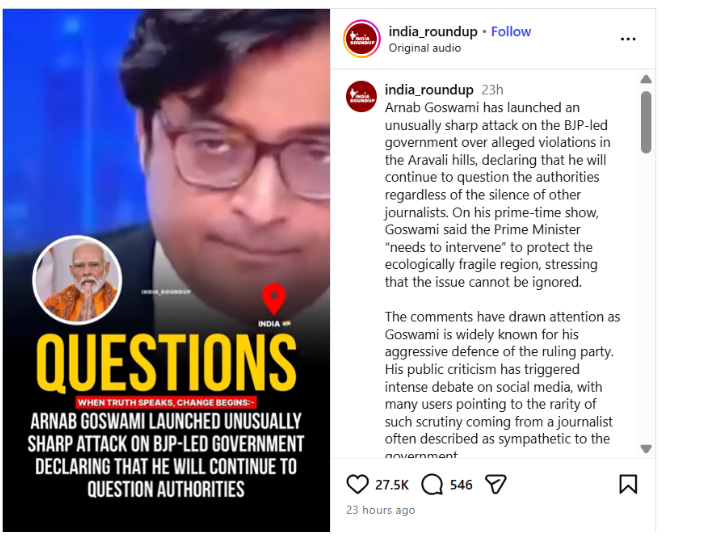
An Instagram user posted this video on 5 January 2026. In the video, a voice resembling Arnab Goswami is heard saying, “Ye jo Narendra Modi hain, ye chhe mahine baad ghar se nahi nikal paayenge aur Hindustan ke log inhein danda maarenge.”
(Translation: “This Narendra Modi will not be able to step out of his house after six months, and the people of India will beat him with sticks.”)
The post link, its archive link, and screenshots can be seen below:
- Instagram link: https://www.instagram.com/reel/DTHrO7bk7Rf/?igsh=MThzbzBlcm82eWN0ZA%3D%3D
- Archive link: https://archive.ph/oaYsf
Fact Check
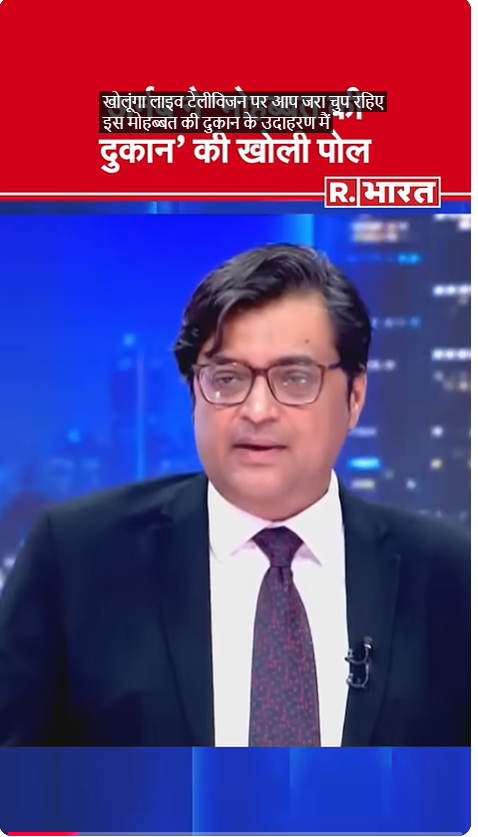
To verify the viral claim, we first examined the video using Google Lens search. During this process, we found a video published on 18 July 2024 on the official YouTube channel of Republic Bharat. The investigation revealed that this video is the longer (extended) version of the viral clip.
After carefully watching the full video, it became clear that Arnab Goswami was not making the statement himself. Instead, he was referring to a remark made by Congress leader Rahul Gandhi during the 2020 Delhi Assembly elections against Prime Minister Narendra Modi. This confirms that the viral video was clipped and presented out of context.
The related video link can be seen below: https://www.youtube.com/shorts/KlQV25-3l8s
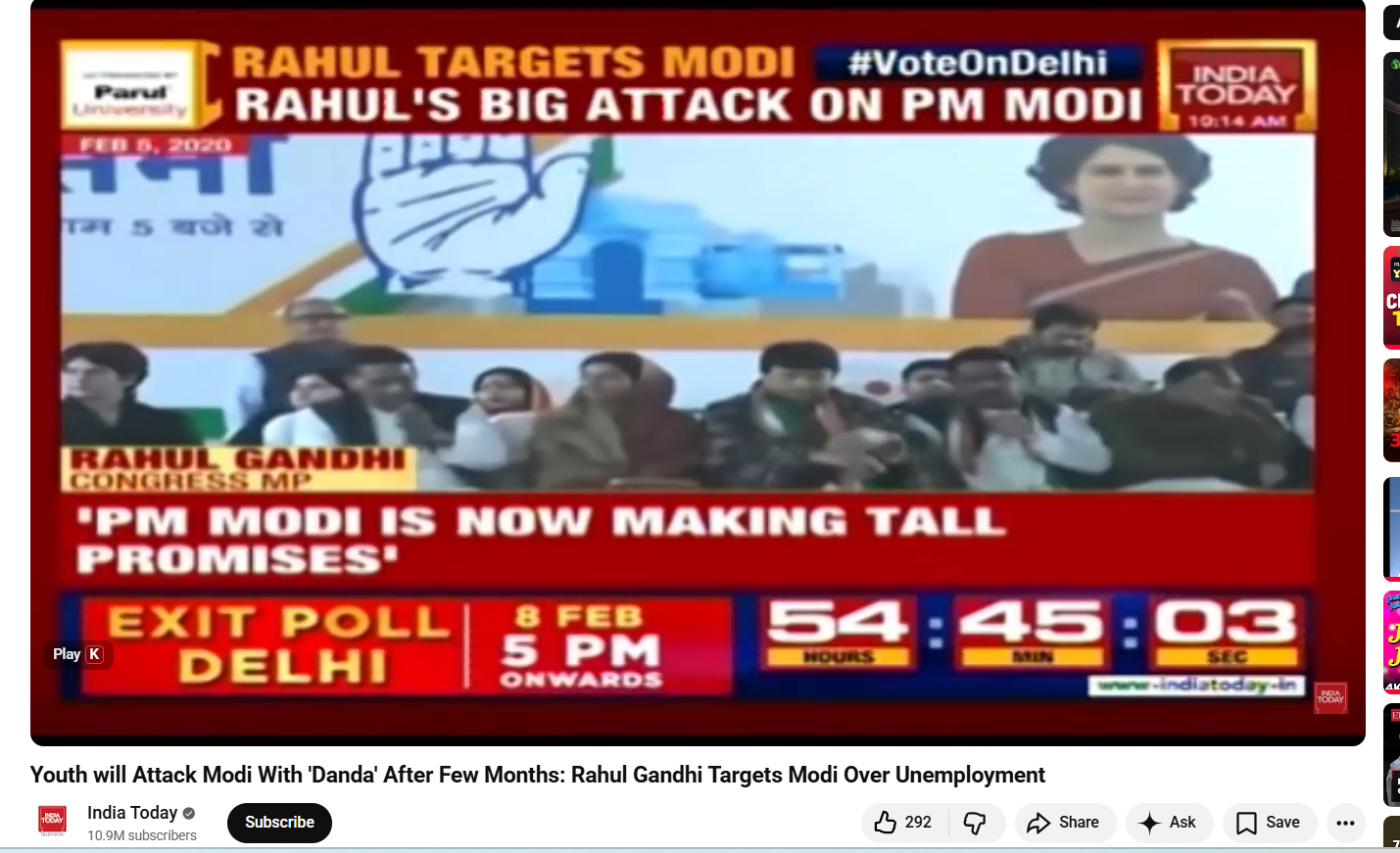
In the next step of the investigation, to verify whether Rahul Gandhi had indeed made such a statement, we conducted a customized keyword search on Google. During this, we found a video published on 6 February 2020 on the official YouTube channel of India Today.
In this video, recorded during a public event ahead of the 2020 Delhi Assembly elections, Rahul Gandhi is seen sharply attacking Prime Minister Narendra Modi, stating that if the Prime Minister fails to resolve the issue of unemployment in the country, the youth would beat him with sticks.
The video link is given below: https://www.youtube.com/watch?v=t5qCSA5nG9Y
Conclusion
The CyberPeace Foundation’s investigation found this claim to be completely fake. The viral video is edited and is being shared in a misleading context. In the original video, Arnab Goswami was referring to an old statement made by Rahul Gandhi, which was selectively clipped and presented in a way that falsely suggests Arnab Goswami himself made objectionable remarks against Prime Minister Narendra Modi.

Related Blogs
Executive Summary
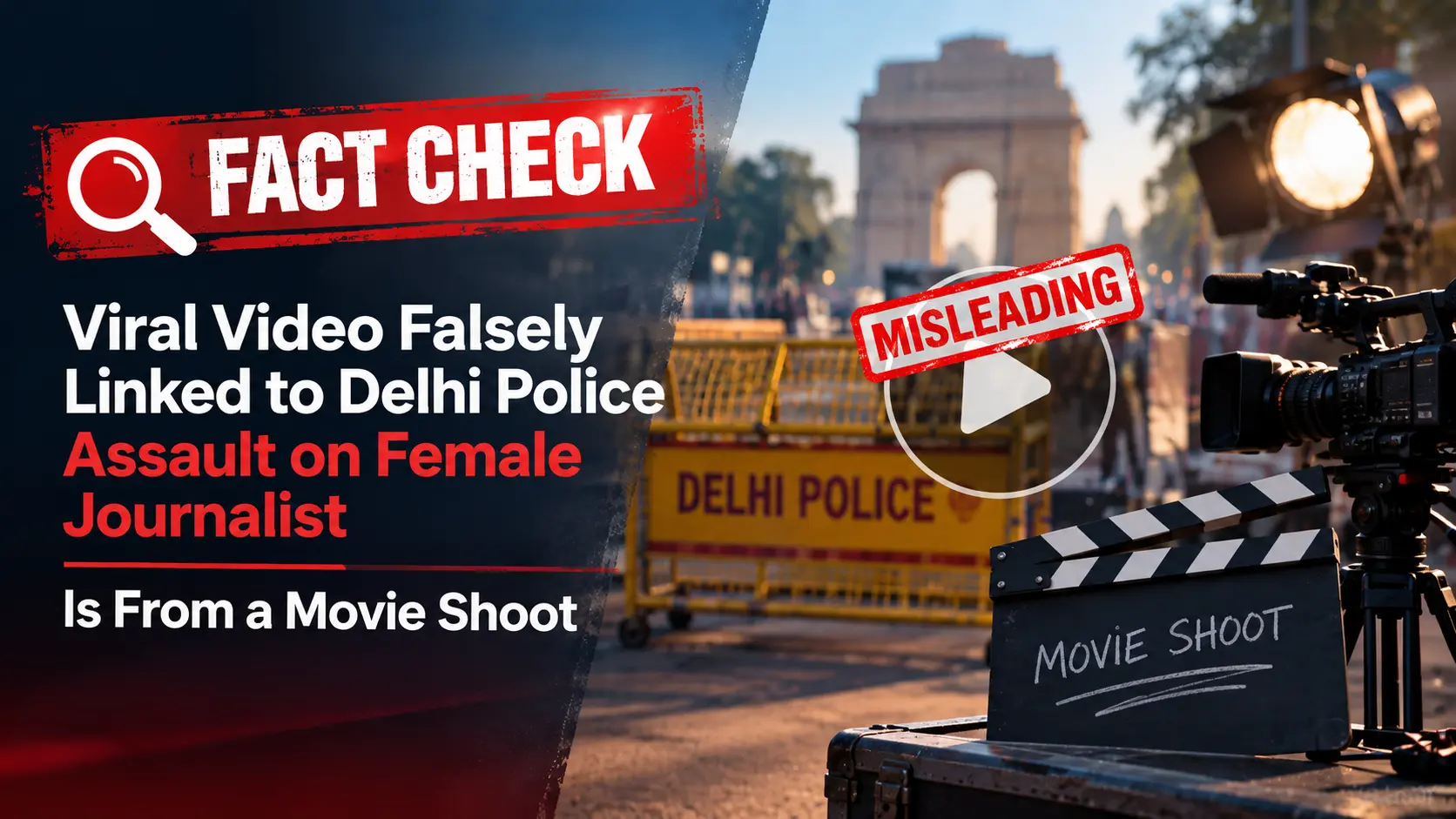
A video is being widely shared on social media with the claim that a female journalist was assaulted by the Delhi Police. The video is being shared with the claim that a female police officer from the Delhi Police is seen assaulting and misbehaving with a female journalist. In the video, a woman wearing a police uniform can be seen allegedly assaulting another woman. Research by the Research Wing of CyberPeace found that the video is actually from a movie shoot. Social media users are sharing it with a misleading claim.
Claim
Social media users shared the video with the caption: “A female journalist is being beaten up by the Delhi Police. What will happen to ordinary people?”
https://www.facebook.com/reel/1599067985010003
https://archive.ph/mgCqt

Fact Check
While investigating the video being shared with the claim that a female journalist was assaulted by the Delhi Police, we conducted a reverse image search of its keyframes. During the search, we found the same video on a Facebook page called ‘CineEdge Media-Behind the Scenes’. The video was uploaded on the page on June 26, 2026. The description and hashtags used with the video indicate that it is not footage of an actual police action, but is related to a film shoot.
https://www.facebook.com/reel/1542614027395118

In addition, the bio of the aforementioned Facebook page states that it posts videos featuring film acting sequences, action thrillers, and behind-the-scenes footage from movies
https://www.facebook.com/profile.php?id=61578948364025&sk=reels_tab

As part of the research, we also examined the CineEdge Media YouTube account. We found that the account has uploaded videos related to films and acting

Conclusion
The evidence gathered during our research makes it clear that the video being shared with the claim that a female journalist was assaulted by the Delhi Police is actually footage from a movie shoot. The video was found on a social media page that shares film-related content, including acting sequences, action scenes and behind-the-scenes footage. Therefore, the claim that the video shows a female journalist being assaulted by the Delhi Police is misleading.

Introduction
A photo circulating on social media depicting modified tractors is being misrepresented as part of the 'Delhi Chalo' farmers' protest narrative. In the recent swirl of misinformation surrounding the 'Delhi Chalo' farmers' protest. A photo, ostensibly showing a phalanx of modified tractors, has been making the rounds on social media platforms, falsely tethered to the ongoing protests. This image, accompanied by a headline suggesting a mechanical metamorphosis to resist police barricades, was allegedly published by a news agency. However, beneath the surface of this viral phenomenon lies a more complex and fabricated reality.
The Movement
The 'Delhi Chalo' movement, a clarion call that resonated with thousands of farmers from the fertile plains of Punjab, the verdant fields of Haryana, and the sprawling expanses of Uttar Pradesh, has been a testament to the agrarian community's demand for assured crop prices and legal guarantees for the Minimum Support Price (MSP). The protest, which has seen the fortification of borders and the chaos at the Punjab-Haryana border on February 13, 2024, has become a crucible for the farmers' unyielding spirit.
Yet, amidst this backdrop of civil demonstration and discourse, a nefarious narrative of misinformation has taken root. The viral image, which has been shared with the fervour of wildfire, was accompanied by a screenshot of an article allegedly published by the news agency. This article, dated February 11, 2024, quoted an anonymous official who claimed that intelligence agencies had alerted the police to the protesters' plans to outfit tractors with hydraulic tools. The implication was clear: these machines had been transformed into battering rams against the bulwark of law enforcement.
The Pursuit of Truth
However, the India TV Fact Check team, in their relentless pursuit of truth, unearthed that the viral photo of these so-called modified tractors is nothing but a chimerical creation, a figment of artificial intelligence. Visual discrepancies betrayed its AI-generated nature.
This is not the first time that the misinformation has loomed over the farmers' protest. Previous instances, including a viral video of a modified tractor, have been debunked by the same fact-checking team. These efforts are a bulwark against the tide of false narratives that seek to muddy the waters of public understanding.
The claim that the photo depicted modified tractors intended for use in the ‘Delhi Chalo’ farmers' protest rally in Delhi on February 13, 2024, was a mirage.
The Fact Check
OpIndia, in their article, clarified that the photo used was a representative image created by AI and not a real photograph. To further scrutinize this viral photo, the HIVE AI detector tool was employed, indicating a 99.4% likelihood of the image being AI-generated. Thus, the claim made in the post was misleading.
The viral photo claiming that farmers had modified their tractors to avoid tear gas shells and remove barricades put up by the police during the rally was a digital illusion. The internet has become a fertile ground for the rapid spread of misinformation, reaching millions in an instant. Social media, with its complex algorithms, amplifies this spread, as any interaction, even those intended to debunk false information, inadvertently increases its reach. This phenomenon is exacerbated by 'echo chambers,' where users are exposed to a homogenous stream of content that reinforces their pre-existing beliefs, making it difficult to encounter and consider alternative perspectives.
Conclusion
The viral image depicting modified tractors for the ‘Delhi Chalo’ farmers' protest rally was a digital fabrication, a testament to the power of AI in creating convincing yet false narratives. As we navigate the labyrinth of information in the digital era, it is imperative to remain vigilant, to question the veracity of what we see and hear, and to rely on the diligent work of fact-checkers in discerning the truth. The mirage of modified machines serves as a stark reminder of the potency of misinformation and the importance of critical thinking in the age of artificial intelligence.
References
- https://www.indiatvnews.com/fact-check/fact-check-ai-generated-tractor-photo-misrepresented-delhi-chalo-farmers-protest-narrative-msp-police-barricades-punjab-haryana-uttar-pradesh-2024-02-15-917010
- https://factly.in/this-viral-image-depicting-modified-tractors-for-the-delhi-chalo-farmers-protest-rally-is-created-using-ai/

Introduction
Misinformation is, to its basic meaning, incorrect or misleading information, it may or may not include specific malicious intent and includes inaccurate, incomplete, misleading, or false information and selective or half-truths. The main challenges in dealing with misinformation are defining and distinguishing misinformation from legitimate content. This complexity arises due to the rapid evolution and propagation which information undergoes on the digital platforms. Additionally, balancing the fundamental right of freedom of speech and expression with content regulation by state actors poses a significant challenge. It requires careful consideration to avoid censorship while effectively combating harmful misinformation.
Acknowledging the severe consequences of misinformation and the critical need to combat misinformation, Bharatiya Nyaya Sanhita (BNS), 2023 has implemented key measures to address misinformation in India. These new provisions introduced under the new criminal laws in India penalise the deliberate creation, distribution, or publication of inaccurate information. Previously missing from the IPC, these sections offer an additional legal resource to counter the proliferation of falsehoods, complementing existing laws targeting the same issue.
Section 353 of the BNS on Statements Conducing to Public Mischief criminalises making, publishing, or circulating statements, false information, rumours, or reports, including through electronic means, with the intent or likelihood of causing various harmful outcomes.
This section thus brings misinformation into its ambit, since misinformation has been traditionally used to induce public fear or alarm that may lead to offences against the State or public tranquillity or inciting one class or community to commit offences against another. The section also penalizes the promotion of enmity, hatred, or ill will among different religious, racial, linguistic, or regional groups.
BNS also prescribes punishment of imprisonment for up to three years, a fine, or both for offences under section 353. Interestingly, a longer imprisonment of up to 5 years along with a fine has been prescribed to curb such offences in places of worship or during religious ceremonies. The only exception that may be availed under this section is granted to unsuspecting individuals who, believing the misinformation to be true, spread misinformation without any ill intent. However, this exception may not be as effective in curbing misinformation, since at the outset, the offence is hard to trace and has multiple pockets for individuals to seek protection without any mechanism to verify their intent.
The BNS also aims to regulate misinformation through Section 197(1)(d) on Imputations, assertions prejudicial to national integration. Under this provision, anyone who makes or publishes false or misleading information, whether it is in the form of spoken words, written, by signs, in visible representations, or through electronic communication, therefore, results in jeopardising the sovereignty, unity, integrity, or security of India is liable to face punishment in the form of imprisonment for up to three years, a fine, or both and if it occurs in a place of worship or during religious ceremonies, the quantum of punishment is increased to imprisonment for up to five years and may include a fine. Additionally, Section 212 (a) & (b) provides against furnishing false information. If a person who is legally obligated to provide information to a public servant, knowingly or reasonably believes that the information is false, and still furnishes it, they now face a punishment of six months imprisonment or a fine up to five thousand rupees or both. However, if the false information pertains to the commission or prevention of an offence, or the apprehension of an offender, the punishment increases to imprisonment for up to two years, a fine, or both.
Enforcement Mechanisms: CyberPeace Policy Wing Outlook
To ensure the effective enforcement of these provisions, coordination between the key stakeholders, i.e., the law enforcement agencies, digital platforms, and judicial oversight is essential. Law enforcement agencies must utilize technology such as data analytics and digital forensics for tracking and identifying the origins of false information. This technological capability is crucial for pinpointing the sources and preventing the further spread of misinformation. Simultaneously, digital platforms associated with misinformation content are required to implement robust monitoring and reporting mechanisms to detect and address the generated misleading content proactively. A supporting oversight by judicial bodies plays a critical role in ensuring that enforcement actions are conducted fairly and in line with legal standards. It helps maintain a balance between addressing misinformation and upholding fundamental rights such as freedom of speech. The success of the BNS in addressing these challenges will depend on the effective integration of these mechanisms and ongoing adaptation to the evolving digital landscape.
Resources:
- Bharatiya Nyaya Sanhita, 2023 https://www.mha.gov.in/sites/default/files/250883_english_01042024.pdf
- https://www.foxmandal.in/changes-brought-forth-by-the-bharatiya-nyaya-sanhita-2023/
- https://economictimes.indiatimes.com/news/india/spreading-fake-news-could-land-people-in-jail-for-three-years-under-new-bharatiya-nyaya-sanhita-bill/articleshow/102669105.cms?from=mdr
