
Beyond the Utility Model: Magnifica Humanitas and the Moral Governance of AI
Introduction
Two of the most influential voices offered strikingly divergent visions of humanity’s technological future in May 2026. On one side of the equation was Sam Altman, the CEO of OpenAI, who spoke of a future in which intelligence would be a "service like electricity or water," available on a metered basis and powered by massive AI infrastructure. On the other side was Leo XIV, the Pope of the Catholic Church, whose encyclical, Magnifica Humanitas, presented the Church's most substantial response to AI, presenting the technology not simply as a technical innovation but also as a crucial moral, social, and civilizational challenge.
The differences in their views run much deeper than merely those regarding control and development. At issue is a conflict in understanding intelligence, the purpose of technology, and the dignity of man. While Altman saw intelligence as an abundant economic factor, one that could be produced, distributed, and consumed, Leo XIV emphasized that intelligence is indissociable from the person and that we should be wary of turning human potential into mere merchandise. Their clash of visions can essentially be understood as two different answers to the question: What is a human being, and to whose service should technology be devoted?
Intelligence as Infrastructure
Altman implies that artificial intelligence will follow the trajectory of electricity in industrial society, where the utility became available everywhere as part of the bedrock of society. The ultimate goal is to generate abundance. Cognitive ability will become cheaper and more readily available until it is so inexpensive that it is built into everything.
From the perspective of the business, this is compelling. In many ways modern AI already has infrastructure-like properties. Programmers, businesses, governments, and even individuals are using intelligence as a commodity delivered by a centralized platform and API in a way similar to how previous generations would have used the electricity grid. Altman is essentially predicting that this trend will reach its ultimate form, where intelligence becomes a utility.
There are several assumptions inherent in this utility metaphor; however, utilities are never neutral technologies; they are all forms of governance, ownership, and control. It is not merely the resource being delivered that makes electricity grids, telephone systems, and water infrastructure powerful but the institutions that mediate access to those resources. In Altman's statement "people will buy it from us," there is a political question inherent: Who does the infrastructure of cognition belong to?
Altman himself is also concerned with these issues, often reiterating that this technology could lead to an unprecedented concentration of power and wealth. Yet this concern is a paradox, as truly democratized artificial intelligence does not appear possible without immense capital investment, colossal data centers, proprietary models, and a monopolization of talent. The path to making intelligence universally available appears to lie through unprecedented centralization.
The Vatican's Response: Beyond Technology
Magnifica Humanitas approaches this from a different perspective. It is not, fundamentally, a document on AI policy but on social philosophy, rooted in the Catholic tradition of social teaching. Just as Rerum Novarum, published in 1891, had explored the social implications of industrial capitalism, Leo XIV views AI as a new juncture in humankind's engagement with technology and power.
Two biblical images are recurring throughout the encyclical: Babel and Jerusalem. Babel, the archetype of technical ambition without purpose or moral intent, is an effort to reorder and recenter human society based on conformity, centralization, and the delusion of self-sufficiency. Jerusalem, rebuilt under Nehemiah, is an image of collective reconstruction based on participation and responsibility.
The symbolic weight is critical. Leo XIV is not arguing that technology in itself is inherently dangerous. He is, rather, suggesting that the tools of technology will inherently contain and perpetuate whatever values, incentives, and priorities of the architects and wielders of these technologies. The question is not therefore whether AI should exist, but rather whether it increases human flourishing or enhances systems of control.
This provides what is likely the most significant realization within the encyclical that AI and human intelligence are categories distinct in kind, not in degree. AI can simulate, calculate, and compute, but it can never possess awareness, ethical responsibility, embodiment, or meaningful relationships. As such, decisions impacting human life can no longer be deferred to algorithms in a manner that negates the human good.
The Problem of Power
The most evident clash between Altman's vision and Magnifica Humanitas lies in power dynamics.
The utility model of Altman places the assumption that intelligence can be centrally controlled and widely disseminated. However, the Vatican perceives major political consequences from the concentration of cognitive ability. According to the encyclical, this kind of concentration can lead to major political problems because small groups are given immense power over the economy, public debate, and democracy by possessing the necessary control over data, computation, and the network.
This idea is becoming more prominent in recent research. Experts like Kate Crawford, for instance, have described AI as 'a registry of power' in which systems build up hierarchies of social, political, and economic power. Digital colonialism scholars also show that the control of the network of intelligence under a few transnational corporations may diminish power that would otherwise reside with local authorities and democratic institutions.
The problem, seen from this point of view, does not simply address technology but sovereignty itself. If intelligence is provided as a metered service within private platforms, the access to knowledge, reason, and decision-making tools might rest with entities outside the public sphere, unconcerned with democracy.
The Vatican's solution relies on the principle of subsidiarity; decisions should be taken at the lowest possible levels, respecting the autonomy of individuals, communities, and local institutions. This principle directly contradicts the proposals that see cognitive infrastructure located within a few multinational organizations.
The Hidden Labour Behind AI
A particularly important segment of Magnifica Humanitas addresses the invisible labor of the AI economy.
While discourse on AI frequently conceptualizes it as an intangible or ethereal technology residing within "the cloud," the opposite is in fact the case. AI relies on the unseen labors of data annotators, content moderators, miners harvesting rare earth metals, construction workers creating data centers, and technicians repairing digital infrastructure. In many cases, these workers exist in marginal situations; investigations have revealed poor wages, minimal rights, and psychologically damaging working conditions, especially for content moderators and data annotators in the Global South. Critics contend that the AI of today exists on the backbone of an unacknowledged global workforce that is shielded from consumers of AI technology. In the encyclical, this idea of the AI economy is framed in terms of human dignity, the standard by which all progress, technological or otherwise, must be measured. Progress cannot be defined solely in terms of efficiency and productivity but must be defined by its consequences for workers, society, and human relationships. While the technology of AI may confer tremendous value to a few, it must not do so at the expense of the humanity of others. It gives a key critique of Altman’s utility model that the appeal of abundant intelligence often focuses on products while neglecting the social and material conditions in which it is produced.
A Clash of Anthropologies
The deepest philosophical disagreement of Altman's and Leo XIV's is over anthropology, i.e., who human beings actually are.
Altman’s view presumes an ability to quantify and allocate the human capacity for intelligence. The more intelligent the society, the better the society; and intelligence becomes the prime causal factor whose production must be maximized by the machine.
The Vatican rejects this fundamental principle. According to the argument of Magnifica Humanitas, human value is not located in intelligent productivity or efficiency or economic productivity. Dignity is non-conditional and cannot be reduced to measures of performance. One has dignity not because one can compute, produce, and optimize, but because one is a person.
The implications of this difference are vast. If intelligence is principally treated as an economic asset, then humans will constantly have to deal with being judged as being of greater or lesser use compared to the machine. If dignity is intrinsic, machines must remain instruments of the flourishing of the human, irrespective of machine efficiency. In sum, this is not a debate over machines. It is a debate over whether society is going to be defined according to an ideology of optimization or an ideology of humanity.
Conclusion
The juxtaposition of Sam Altman’s model of utility and Leo XIV’s idea of Magnifica Humanitas defines one of the key intellectual arguments of our times. Altman presents a vision of abundance, efficiency, and humanly impossible intellectual capacity. Leo XIV represents what happens when intelligence is divorced from the demands of ethics, democracy, and human dignity; when the demands they represent only contribute to its ultimate capacity to wound the needs it serves.
It is not whether we will build machines more and more intelligent; it is what politics and values will govern these machines. When intelligence becomes a service, whose interests will govern the machine, who will write the rules, and who will be the direct beneficiaries? When dignity is the source from which man and machine alike emerge, the service must not be judged on what the machine does best but on what it can do for man. The ultimate question is whether we will be able to maintain a view of ourselves that is larger than just our capacity to engineer.
References:
- Atlas of AI, Crawford, Kate. Atlas of AI: Power, Politics, and the Planetary Costs of Artificial Intelligence. New Haven: Yale University Press, 2021.
- Pope Leo XIV. Magnifica Humanitas: On Safeguarding the Human Person in the Time of Artificial Intelligence. Vatican City: Holy See, 2026.
- Pope Leo XIII. Rerum Novarum. Vatican City: Holy See, 1891.
- Pope John Paul II. Laborem Exercens. Vatican City: Holy See, 1981.
- Dicastery for the Doctrine of the Faith. Dignitas Infinita. Vatican City: Holy See, 2024.
- International Theological Commission. Quo Vadis, Humanitas? Thinking About Christian Anthropology in the Face of Some Scenarios on the Future of Humanity. Vatican City, 2026.
- Nick Lichtenberg. "Sam Altman Admits AI Is Killing the Labor-Capital Balance—and Says Nobody Knows What to Do About It." Fortune, 12 March 2026.

Related Blogs

Executive Summary
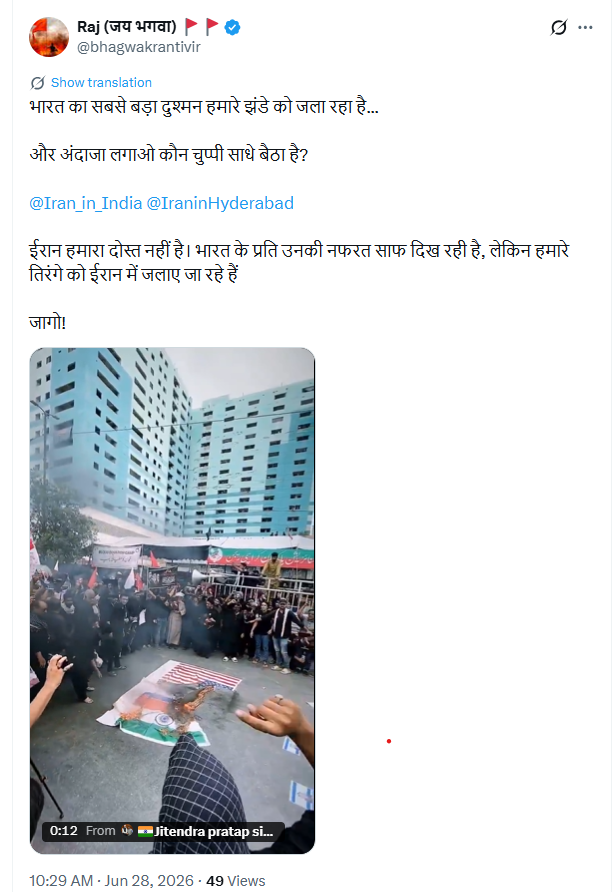
A video showing a large crowd disrespecting the Indian tricolor along with American and Israeli flags is being widely shared on social media. Users sharing the video claim that the incident recently took place in Iran's capital, Tehran, showcasing "Iran's hatred towards India." However, a fact-check done by the CyberPeace Research Wing has revealed that this claim is misleading. The viral video was not filmed in Iran, but rather during a procession in Karachi, Pakistan.
The Claim
A user on the social media platform X (formerly Twitter) shared the video with the caption: "India’s biggest enemy is burning our flag and guess who is sitting silently? Iran is not our friend. Their hatred towards India is clearly visible, but our tricolor is being burnt in Iran." https://x.com/bhagwakrantivir/status/2071096021183246667 , https://archive.ph/6mGE8
Factcheck
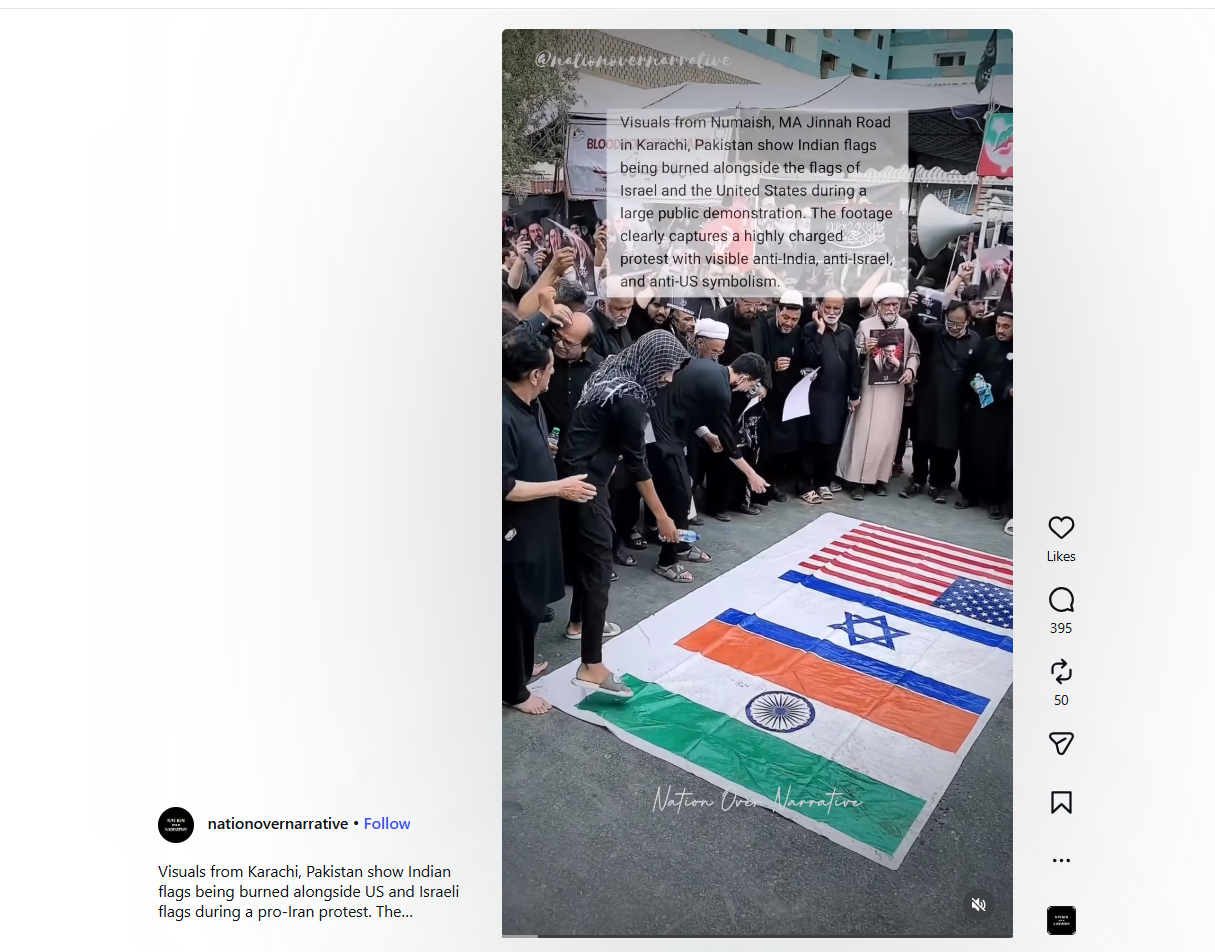
Keyframes extracted from the viral video were searched using Google Lens. This led to an Instagram post containing the exact same footage. The caption of this post identified the location as Karachi, Pakistan, noting that the demonstration was held in support of Iran, during which flags of India, the US, and Israel were burnt.
https://www.instagram.com/reels/DaDLQO6obcK/
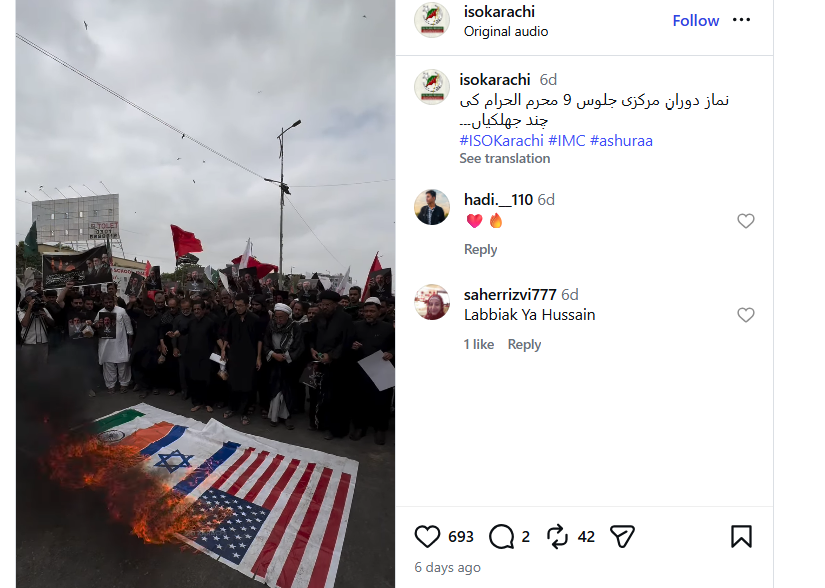
Further keyword searches led to the official Instagram account of the 'Imamia Students Organization Karachi'. A video uploaded on June 25, 2026, showed the same event captured from a different camera angle. According to the caption, the footage is from a '9th Muharram' procession in Karachi.
https://www.instagram.com/p/DaApSBfIpNQ/
To conclusively establish the location, Google Maps Street View was used to cross-reference the physical landmarks seen in the video.The visual elements perfectly match Mohammad Ali Jinnah Road in Karachi, Pakistan.A distinct blue building named 'Mid Town', visible in the viral video, matches the Google Street View imagery of the location.

Conclusion
The research confirms that the video showing the burning and desecration of the Indian national flag is from Karachi, Pakistan, and not Tehran, Iran. The social media claims linking this incident to Iran are false and contextually misleading.

Executive Summary
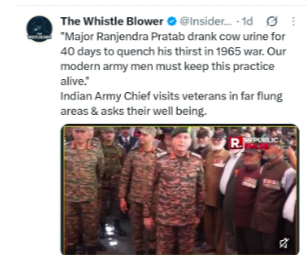
A video of Indian Army Chief General Dhiraj Seth is being shared on social media, allegedly showing him referring to an incident in which Major Rajendra Pratap Singh survived for 40 days by drinking cow urine during the 1965 India-Pakistan war and saying that Indian Army personnel should keep such a practice alive. The video is being shared with the claim that General Dhiraj Seth said that Major Rajendra Pratap Singh had consumed cow urine for 40 days to quench his thirst during the 1965 war and that serving Army personnel should also continue the practice. However, CyberPeace Research Wing found the claim to be false. The viral video has been digitally manipulated, with fabricated audio/remarks added to it. In the original video, General Dhiraj Seth did not make any such statement.
Claim:
Indian Army Chief General Dhiraj Seth allegedly referred to an incident in which Major Rajendra Pratap Singh survived for 40 days by drinking cow urine during the 1965 India-Pakistan war and urged serving Army personnel to keep the practice alive.
https://x.com/InsiderWB/status/2104242428647727428
Fact Check
To verify the truth behind the viral claim, we conducted a Google search using relevant keywords. During the search, we did not find any credible media reports supporting the claim. As part of the next step in our research, we extracted keyframes from the video and conducted a reverse image search. During the research, we found the original video on Gulistan News, which was published on September 25, 2026.
https://x.com/GulistanNewsTV/status/2103461004374061389
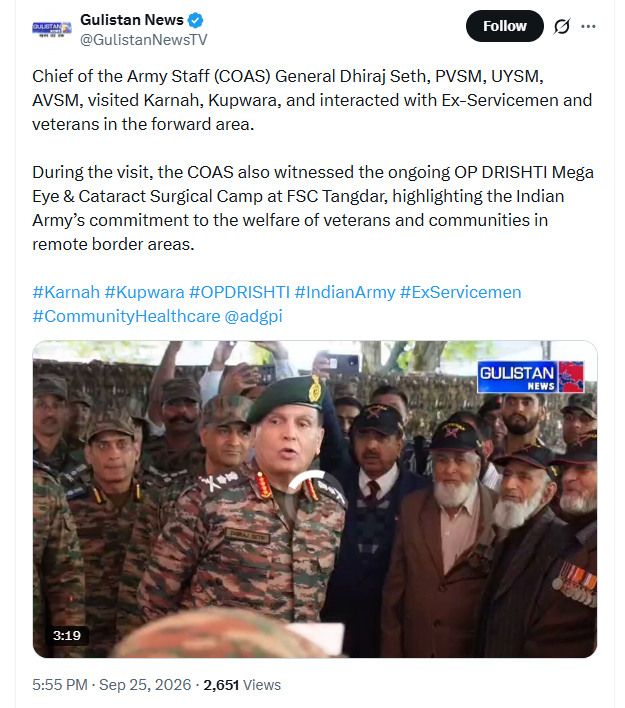
According to Gulistan News, Chief of the Army Staff (COAS) General Dhiraj Seth, PVSM, UYSM, AVSM, visited Karnah in Kupwara and interacted with ex-servicemen and veterans in the forward area. During the visit, the Army Chief also took stock of the ongoing ‘Operation Drishti’ Mega Eye and Cataract Surgical Camp at FSC Tangdhar. The initiative highlights the Indian Army’s commitment to the welfare of veterans and local communities in remote border areas. Further research led us to a video posted by the Press Trust of India (PTI) on X. According to its caption, Army Chief (COAS) General Dhiraj Seth visited the mega cataract surgery camp organised by the Indian Army at Tangdhar in Kupwara district and interacted with patients and army veterans.
https://x.com/PTI_News/status/2103404022279598579?s=20

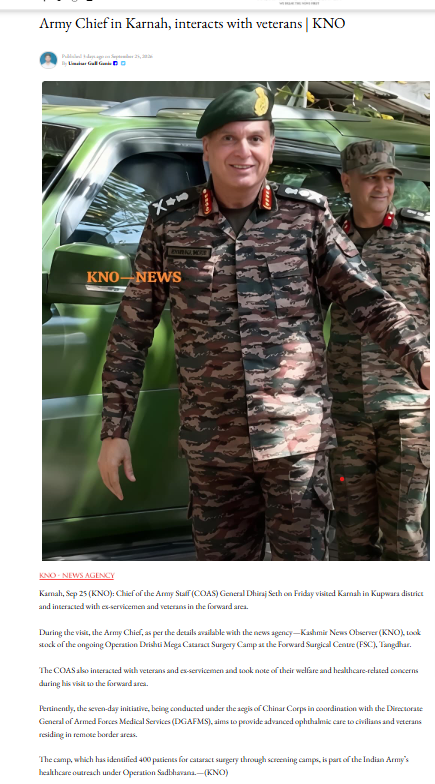
After verifying the viral video, we conducted a Google search using relevant keywords. During the search, we found a report by the news agency Kashmir News Observer (KNO). According to the report, Chief of the Army Staff (COAS) General Dhiraj Seth visited Karnah in Kupwara district on Friday and interacted with ex-servicemen and veterans in the forward area. During the visit, the Army Chief took stock of the ongoing ‘Operation Drishti’ Mega Cataract Surgery Camp at the Forward Surgical Centre (FSC), Tangdhar.The COAS also interacted with veterans and ex-servicemen and took note of their welfare and healthcare-related concerns.The seven-day initiative, being conducted under the aegis of Chinar Corps in coordination with the Directorate General of Armed Forces Medical Services (DGAFMS), aims to provide advanced ophthalmic care to civilians and veterans residing in remote border areas.
We scanned the video using the AI detection tool Detect Video AI. According to the results, the viral video is 75 per cent AI-generated.

At the end of our research, we also scanned the video using HumanMeter. According to the results, the viral video is 80 per cent AI-generated.

Conclusion:
The video being circulated on social media in the name of Indian Army Chief General Dhiraj Seth is misleading. The viral video purportedly shows him referring to an incident in which Major Rajendra Pratap Singh allegedly survived for 40 days by drinking cow urine during the 1965 India-Pakistan war and saying that Army personnel should keep the practice alive. However, the original video available does not contain any such statement by General Dhiraj Seth. The viral video has been digitally manipulated, with fabricated remarks attributed to him.

Executive Summary
A dispute over water balloons on the day of Holi in the Uttam Nagar area of Delhi reportedly turned violent, resulting in the brutal murder of a young man named Tarun Khatik. Following the incident, a video is being widely shared on social media and linked to the murder case. In the viral video, Yogi Adityanath, Chief Minister of Uttar Pradesh, can be seen walking alongside Ravi Kishan, Member of Parliament from Gorakhpur. People standing along the route are seen showering flowers on them. Several users claim that the video shows the chief minister visiting the house of Tarun Khatik to meet his family.
However, research by CyberPeace found the viral claim to be misleading. Our research revealed that the video has no connection to the Tarun Khatik murder case. In fact, the video is from a Holika Dahan celebration held in Gorakhpur, which is now being shared on social media with a misleading claim.
Claim Post:
An Instagram user shared the viral video on March 10, 2026, writing: “Tarun bhai ko insaaf dilane ke liye aage aaye maananiya mukhyamantri Shri Yogi Adityanath ji.”

Fact Check:
To verify the claim, we extracted several key frames from the viral video and conducted a reverse image search using Google Lens. During the search, we found the same video posted on a Facebook account on March 2, 2026.
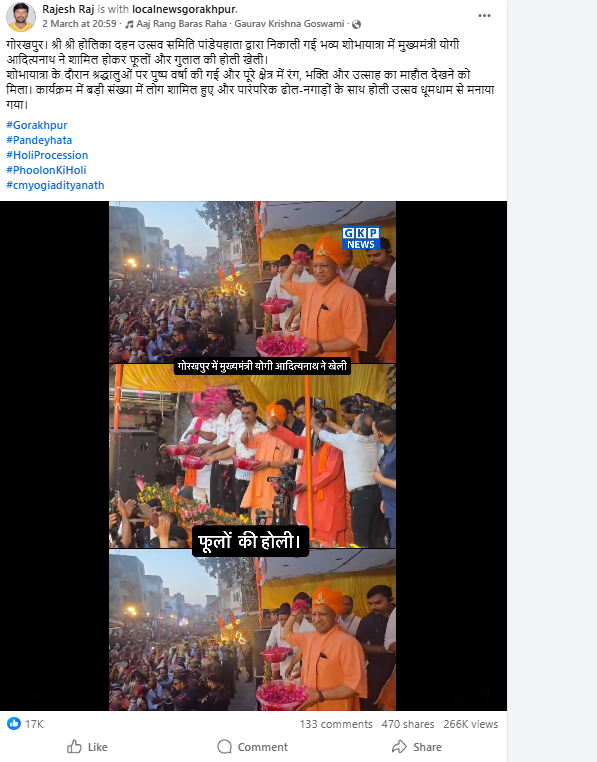
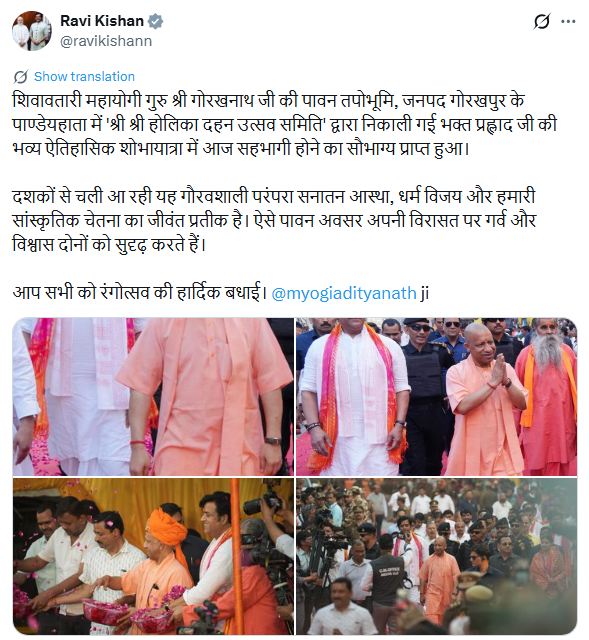
According to the caption of the Facebook post, the video shows a grand procession organised by the Shri Shri Holika Dahan Utsav Samiti, Pandeyhata in Gorakhpur. Yogi Adityanath attended the procession and was seen celebrating Holi with people by playing with flowers and coloured powder. During the procession, flower petals were showered on devotees, and the entire area witnessed a festive atmosphere filled with colours, devotion, and enthusiasm. A large number of people participated in the celebration, and the festival was celebrated with traditional drums and music. During further research, we also found images related to the viral video on the official X (formerly Twitter) account of Ravi Kishan. These images were shared on March 2, 2026, and the caption confirmed that they were taken during the Holika Dahan celebration in Gorakhpur.
At the end of the research, we also found the same video uploaded on March 3, 2026 on the Instagram page Local News Gorakhpur. According to the information in the post, Yogi Adityanath and several other leaders participated in the grand procession organised by the Shri Shri Holika Dahan Utsav Samiti, Pandeyhata. People celebrated Holi with flowers and coloured powder during the event.

Conclusion:
Our research found that the viral video has no connection with the Tarun Khatik murder case in Uttam Nagar, Delhi. The video actually shows Yogi Adityanath participating in a Holika Dahan celebration in Gorakhpur. Therefore, the video is being shared on social media with a misleading claim.
