
Beyond the Game: Policy Priorities for Responsible Esports Betting
Introduction
Betting has long been associated with sporting activities and has found a growing presence in online gaming and esports globally. As the esports industry continues to expand, Statista has projected that it will reach a market value of $5.9 billion by 2029. As such, associated markets have also seen significant growth. In 2024, this segment accounted for an estimated $2.5 billion globally. While such engagement avenues are popular among international audiences, they also bring attention to concerns around regulation, integrity, and user protection. As esports builds its credibility and reach, especially among younger demographics, these aspects become increasingly important to address in policy and practice.
What Does Esports Betting Involve?
Much like traditional sports, esports engagement in some regions includes the practice of wagering on teams, players, or match outcomes. But it is inherently more complex. The accurate valuation of odds in online gaming and esports can be complicated by frequently updated game titles, changing teams, and shifting updates to game mechanics (called metas- most effective strategies). Bets can be placed using real money, virtual items like skins (digital avatars), or increasingly, cryptocurrency.
Esports and Wagering: Emerging Issues and Implications
- Legal Grey Areas: While countries like South Korea and some USA states have dedicated regulations for esports betting and licensed bookmaking, most do not. This creates legal grey areas for betting service providers to access unregulated markets, increasing the risk of fraud, money laundering, and exploitation of bettors in those regions.
- The Skill v/s Chance Dilemma: Most gambling laws across the world regulate betting based on the distinction between ‘games of skill’ and ‘games of chance’. Betting on the latter is typically illegal, since winning depends on chance. But the definitions of ‘skill’ and ‘chance’ may vary by jurisdiction. Also, esports betting often blurs into gambling. Outcomes may depend on player skill, but in-game economies like skin betting and unpredictable gameplay introduce elements of chance, complicating regulation and making enforcement difficult.
- Underage Gambling and Addiction Risks: Players are often minors and are exposed to the gambling ecosystem due to gamified betting through reward systems like loot boxes. These often mimic the mechanics of betting, normalising gambling behaviours among young users before they fully understand the risks. This can lead to the development of addictive behaviours.
- Match-Fixing and Loss of Integrity: Esports are particularly susceptible to match-fixing because of weak regulation, financial pressures, and the anonymity of online betting. Instances like the Dota 2 Southeast Asia Scandals (2023) and Valorant match-fixing in North America (2021) can jeopardise audience trust and sponsorships. This affects the trustworthiness of minor tournaments, where talent is discovered.
- Cybersecurity and Data Risks: Esports betting apps collect sensitive user data, making them an attractive target for cybercrime. Bettors are susceptible to identity theft, financial fraud, and data breaches, especially on unlicensed platforms.
Way Forward
To strengthen trust, ensure user safety, and protect privacy within the esports ecosystem, responsible management of betting practices can be achieved through targeted interventions focused on:
- National-Level Regulations: Countries like India have a large online gaming and esports market. It will need to create a regulatory authority along the lines of the UK’s Gambling Commission and update its gambling laws to protect consumers.
- Protection of Minors: Setting guardrails such as age verification, responsible advertising, anti-fraud mechanisms, self-exclusion tools, and spending caps can help to keep a check on gambling by minors.
- Harmonizing Global Standards: Since esports is inherently global, aligning core regulatory principles across jurisdictions (such as through multi-country agreements or voluntary industry codes of conduct) can help create consistency while avoiding overregulation.
- Co-Regulation: Governments, esports organisers, betting platforms, and player associations should work closely to design effective, well-informed policies. This can help uphold the interests of all stakeholders in the industry.
Conclusion
Betting in esports is inevitable. But the industry faces a double dilemma- overregulating on the one hand, or letting gambling go unchecked, on the other. Both can be detrimental to its growth. This is why there is a need for industry actors like policymakers, platforms and organisers to work together to harmonise legal inconsistencies, protect vulnerable users and invest in forming data security. Forming industry-wide ethics boards, promoting regional regulatory dialogue, and instating transparency measures for betting operators can be a step in this direction to ensure that esports evolves into a mature, trusted global industry.
Sources

Related Blogs
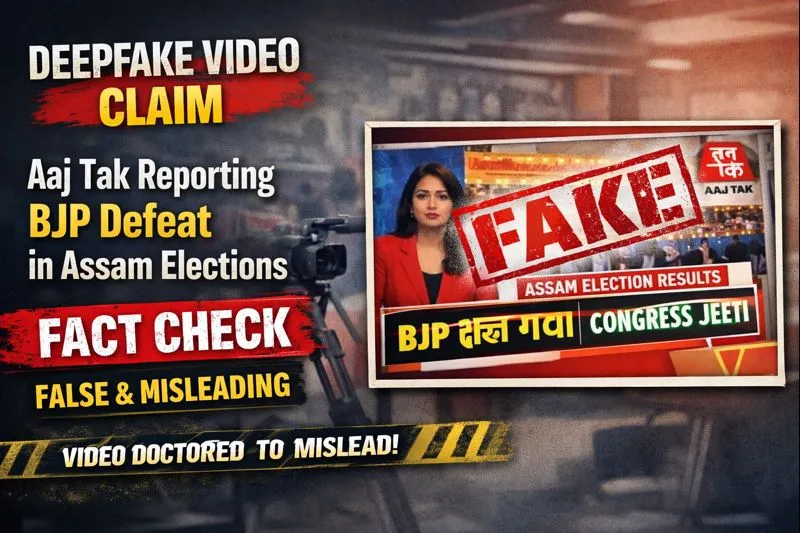
Assembly elections are due to be held in Assam later this year, with polling likely in April or May. Ahead of the elections, a video claiming to be an Aaj Tak news bulletin is being widely circulated on social media.
In the viral video, Aaj Tak anchor Rajiv Dhoundiyal is allegedly seen stating that a leaked intelligence report has issued a warning for the ruling Bharatiya Janata Party (BJP) in Assam. The clip claims that according to this purported report, the BJP may suffer significant losses in the upcoming Assembly elections. Several social media users sharing the video have also claimed that the alleged intelligence report signals the possible removal of Assam Chief Minister Himanta Biswa Sarma from office.
However, an investigation by the Cyber Peace Foundation found the viral claim to be false. Our probe clearly established that no leaked intelligence report related to the Assam Assembly elections exists.
Further, Aaj Tak has neither published nor broadcast any such report on its official television channel, website, or social media platforms. The investigation also revealed that the viral video itself is not authentic and has been created using deepfake technology.
Claim
On social media platform Facebook, a user shared the viral video claiming that the BJP has been pushed on the back foot following organisational changes in the Congress—appointing Priyanka Gandhi Vadra as chairperson of the election screening committee and Gaurav Gogoi as the Assam Pradesh Congress Committee president. The post further claims that an Intelligence Bureau report predicts that the current Assam government will not return to power.
(Link to the post, archive link, and screenshots are available.)
FactCheck:
To verify the claim, we first searched for reports related to any alleged leaked intelligence assessment concerning the Assam Assembly elections using relevant keywords. However, no credible or reliable reports supporting the claim were found. We then reviewed Aaj Tak’s official website, social media pages, and YouTube channel. Our examination confirmed that no such news bulletin has been published or broadcast by the network on any of its official platforms.
- https://www.facebook.com/aajtak/?locale=hi_IN
- https://www.instagram.com/aajtak/
- https://x.com/aajtak
- https://www.youtube.com/channel/UCt4t-jeY85JegMlZ-E5UWtA
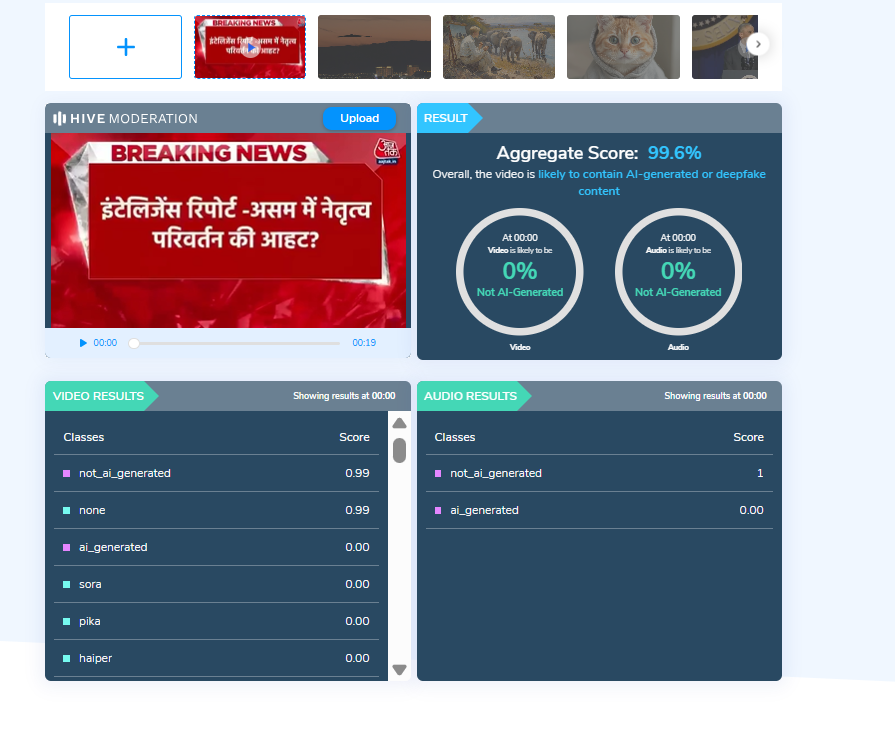
To further verify the authenticity of the video, its audio was scanned using the deepfake voice detection tool HIVE Moderation.
The analysis revealed that the voice heard in the video is 99 per cent AI-generated, clearly indicating that the audio is not genuine and has been artificially created using artificial intelligence.
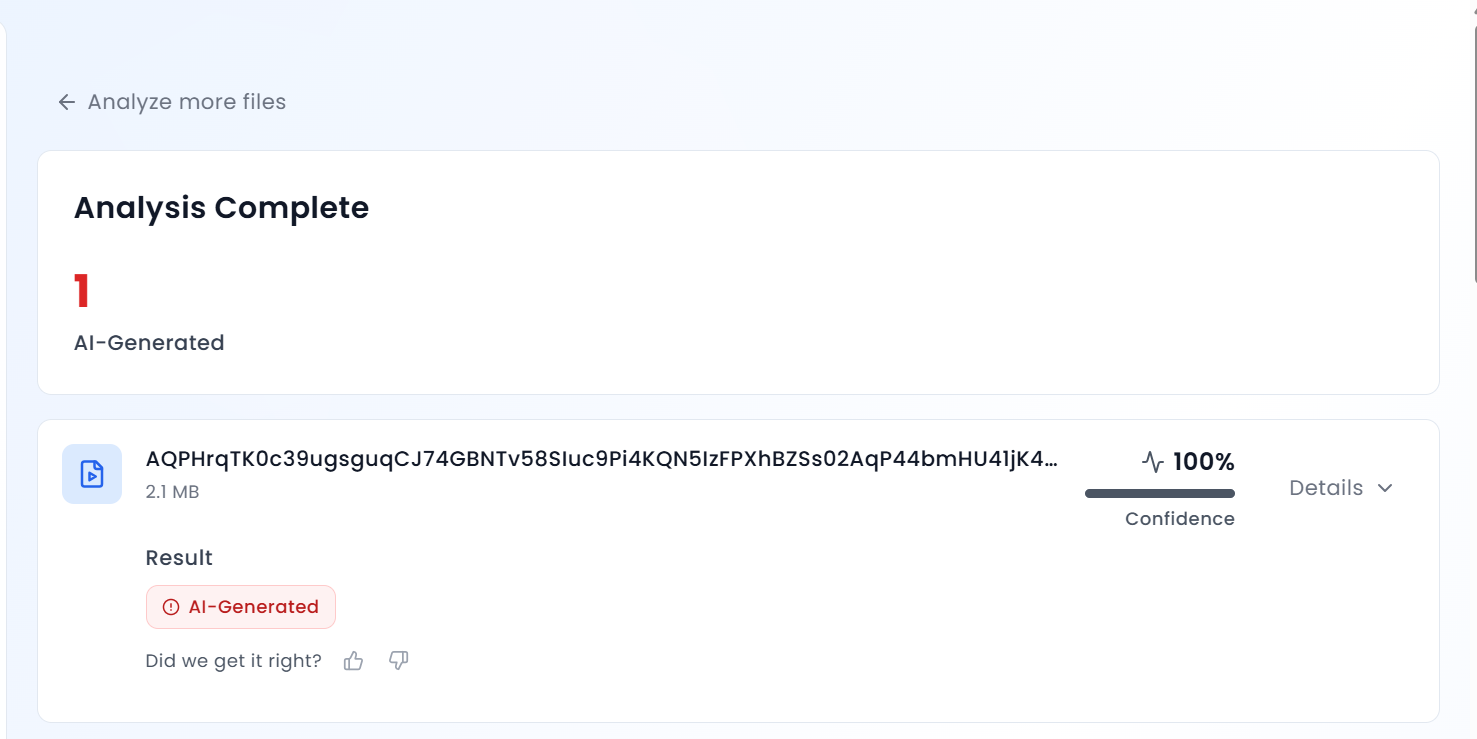
Additionally, the video was analysed using another AI detection tool, Aurigin AI, which also identified the viral clip as AI-generated.
Conclusion:
The investigation clearly establishes that there is no leaked intelligence report predicting BJP’s defeat in the Assam Assembly elections. Aaj Tak has not published or broadcast any such content on its official platforms. The video circulating on social media is not authentic and has been created using deepfake technology to mislead viewers.
Executive Summary:
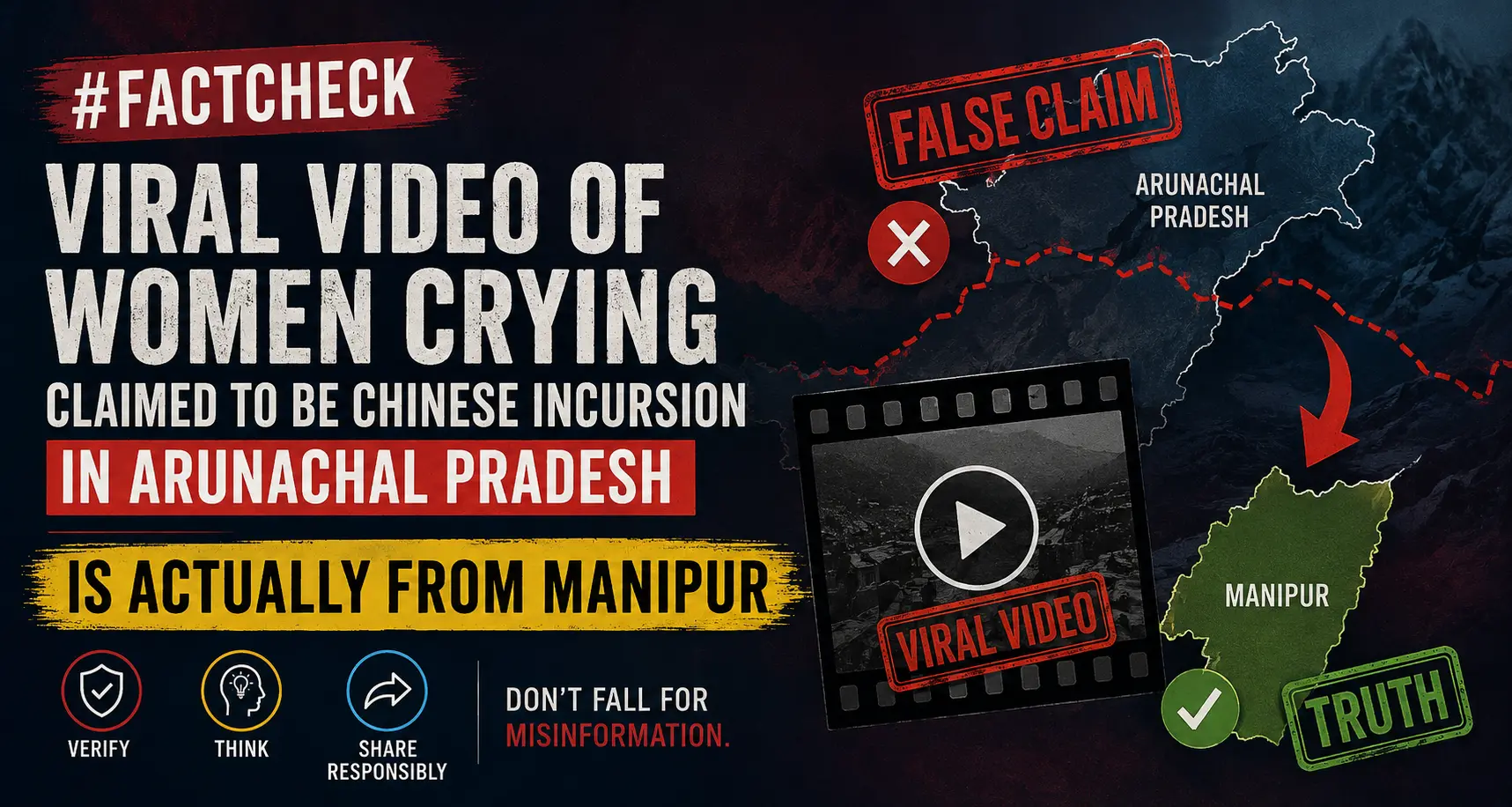
On August 13, 2026, Leader of Opposition in the Lok Sabha and MP Rahul Gandhi, speaking at a Rashtriya Congress program, alleged that in several places in Arunachal Pradesh, China has stopped our army from patrolling. Following this, a video went viral on social media showing weeping women standing behind uniformed personnel in a vehicle. Some users shared this video targeting the central government with claims of Chinese army infiltration in Arunachal Pradesh. The research by the CyberPeace's research wing revealed that the viral video is actually from Manipur. The video was captured when the United National Liberation Front (UNLF) was vacating its 'Nongshum Camp' in the Nongshum area of Manipur.
Claim:
On August 15, 2026, Facebook user ‘Adv Raman Yadav’ posted a video (archive link) writing, "Arunachal_Pradesh.. in China's grip, citizens will hoist the Tiranga at home themselves, but who will hoist it on the country's border? Neither the lion's courage is working, nor is the strategy of the so-called Chanakya working... The creator of the dialogue 'if Pakistan raises an eye, the world will see the consequences' and 'strongly condemn' is unable to say anything! And those famous for absurd statements... Giriraj Singh, Nishikant Dubey, Manoj Tiwari, someone named Negi, or any other BJP leader's conscience is not awakening. Today Arunachal Pradesh is slipping into China's grip, the people there are constantly pleading to save them from becoming slaves, but Narendra Damodardas Modi is busy making reels and giving instructions to his MPs..."
https://www.facebook.com/reel/2081742402422160

Fact Check:
To investigate the viral claim, we first extracted keyframes from the video and searched them using Google Lens. The Facebook user 'Manipur Assam' had posted this video on June 30, 2026.
https://www.facebook.com/reel/2565715717192123

According to a report published on the 'Manipur Update' website on June 30, 2026, "People from villages near the Nongshum area willingly bid a tearful farewell to UNLF's 'Nongshum Camp'. This step was taken after lengthy negotiations and the assurance that personnel from the 10th India Reserve Battalion (IRB) would immediately assume security responsibilities for the camp. Following their departure, 10th IRB personnel reached the Nongshum camp and replaced them."
https://manipur-update.com/people-in-nongshum-unwillingly-bid-tearful-adieus-to-unlfs-nongshum-camp/

According to information provided on the 'India Today NE' website on June 27, 2026, "The Pambei-led faction of the UNLF signed a tripartite peace agreement with the Central Government and the Manipur Government in November 2023. Recently, on June 19, talks took place in New Delhi between representatives of the Government of India and UNLF leaders. During this, the proposal to relocate the camp under a designated administrative and security framework was also discussed."

Conclusion:
Our research revealed that a video from Nongshum village in Manipur is being shared with false claims of Chinese military infiltration in Arunachal Pradesh
.webp)
Introduction
India has always been celebrated as the land of abundance, once known as the ‘golden bird’ that attracted the world with its prosperity and wisdom. In the current century, as the world moves deeper into the age where every nation is redefining its strength through advancements in every sector, including technology, India is preparing for a powerful transformation. “Viksit Bharat 2047” is an initiative aimed at achieving India's aspiration of becoming a developed nation by its centennial year of independence. India’s growth story is shifting as it takes a step towards development in every field and advances progress both in terms of generating economic growth and breakthroughs in technologies across industries.
Today, when technology touches every aspect of our lives, ‘Cyber Security’ becomes a key area that will significantly drive progress and hold strong importance under the Viksit Bharat vision, especially with the rise of emerging technologies such as AI, quantum computing, cryptography, 5G & 6G, robotics and automation, Internet of Things (IoT), augmented reality (AR) & virtual reality (VR) etc.
Key Initiatives Taken by the Centre
Indian Cyber Crime Coordination Centre:
The Indian Cybercrime Coordination Centre (I4C) was established by the Ministry of Home Affairs (MHA) to provide a framework for law enforcement agencies (LEAs) to deal with cybercrime in a coordinated and comprehensive manner. I4C is actively working on initiatives to combat emerging threats in cyberspace, and it has become a strong pillar of India’s cybersecurity and cybercrime prevention. The ‘National Cyber Crime Reporting Portal’, equipped with a 24x7 cybercrime helpline number 1930, is one of the key components of the I4C.
Recently under I4C, key initiatives were launched to strengthen cybersecurity. The Cyber Fraud Mitigation Centre (CFMC) has been incorporated to bring together banks, financial institutions, telecom companies, Internet Service Providers, and law enforcement agencies on a single platform to tackle online financial crimes efficiently. The Cyber Commandos Program will establish a specialised wing of trained Cyber Commandos in states, Union Territories, and Central Police Organisations to counter rising cyber threats. The Samanvay platform, a web-based Joint Cybercrime Investigation Facility System, has been introduced as a one-stop data repository for cybercrime to foster data sharing and collaboration. The Suspect Registry Portal, connected to the National Cybercrime Reporting Portal (NCRP), has been designed to track cybercriminals and strengthen fraud risk management.
India’s AI Mission:-
The Indian Cabinet has approved a comprehensive national-level IndiaAI Mission. The mission aims to strengthen the Indian AI innovation ecosystem by democratizing computing access, improving data quality, developing indigenous AI capabilities, attracting top AI talent, enabling industry collaboration, providing startup risk capital, ensuring socially impactful AI projects, and bolstering ethical AI. Through India AI Mission, the government is facilitating the development of India’s own foundational models, including Large Language Models (LLMs) and problem-specific AI solutions tailored to Indian needs.
The mission is implemented by the 'IndiaAI' Independent Business Division (IBD) under the Digital India Corporation (DIC) and consists of several components, such as IndiaAI Compute Capacity, IndiaAI Innovation Centre (IAIC), IndiaAI Datasets Platform, IndiaAI Application Development Initiative, IndiaAI Future Skills, IndiaAI Startup Financing, and Safe & Trusted AI. The main objective is to create and nurture an ecosystem for India’s AI innovation.
Startup India:-
With more than 1.59 lakh startups recognised by the Department for Promotion of Industry and Internal Trade (DPIIT) as of January 15, 2025, India has firmly established itself as the third-largest startup ecosystem in the world. Startup India is a flagship initiative launched by the Government of India on 16th January 2016 to build a strong ecosystem for nurturing innovation and startups in the country, which will drive economic growth and generate large-scale employment opportunities.
Key Regulations:-
The Centre, in order to better regulate the cyber domain, has come up with significant regulations. To protect the personal data of citizens, the Digital Personal Data Protection Act, 2023 has been enacted. The Intermediary Guidelines 2021 lay down obligations on social media platforms and intermediaries to ensure accountability and user safety. The Telecommunications Act 2023 has also been enacted. Further, the Promotion and Regulation of Online Gaming Bill 2025, passed by Parliament on 21st August 2025, aims to address related concerns. In addition, Cert-In issues guidelines & advisories from time to time, in order to strengthen cybersecurity.
CyberPeace Outlook
CyberPeace has been at the forefront in transforming policy, technology, and ethical growth in the cyber landscape through its key initiatives. In 2023, CyberPeace hosted the Global CyberPeace Summit in collaboration with Civil 20 and G20 India, with knowledge support from the United Service Institution of India and participation from MeitY, NCIIPC, CERT-In, Zoom, Meta, InMobi, ICANN, Internet Society, MANRS, APNIC, and leading universities, which helped shape critical global conversations on trust, safety, and collaboration in cyberspace.
Viksit Bharat 2047 is more than just a vision for economic success; it is a pledge to create a nation that is technologically secure, resilient, and globally competitive. In this journey, cybersecurity will be at the heart of India's digital reboot, securing its innovation, empowering its citizens, and ensuring its future.
References
- https://www.cyberpeace.org/resources/blogs/i4c-foundation-day-celebration-shri-amit-shah-launches-key-initiatives-to-tackle-cybercrime
- https://www.cyberpeace.org/resources/blogs/indiaai-mission
- https://bharatarticles.com/viksit-bharat-2047-vision-challenges-and-roadmap-to-a-developed-india/
- https://www.pib.gov.in/PressReleasePage.aspx?PRID=2012355
- https://www.pib.gov.in/PressReleasePage.aspx?PRID=2093125
