
#FactCheck - Viral Video of Sachin Tendulkar Commenting on Joe Root Is AI-Generated
A video circulating on social media claims to show former Indian cricketer Sachin Tendulkar commenting on England batter Joe Root’s batting feats. In the clip, Tendulkar is allegedly heard saying that if Joe Root continues scoring centuries, even his (Tendulkar’s) record would be broken. The video further claims that Tendulkar says if Root scores another century, he would give up the bat’s grip, after which the clip abruptly ends.
Users sharing the video are claiming that Sachin Tendulkar has taken a dig at Joe Root through this remark.
Cyber Peace Foundation’s research found the claim to be misleading. Our research clearly establishes that the viral video is not authentic but has been created using Artificial Intelligence (AI) tools and is being shared online with a false narrative.
CLAIM
On January 5, 2025, several users shared the viral video on Instagram, claiming it shows Sachin Tendulkar making remarks about Joe Root’s century-scoring spree.
(Post link and archive link available.)

FACT CHECK
To verify the claim, we extracted keyframes from the viral video and conducted a Google Reverse Image Search. This led us to an interview of Sachin Tendulkar published on the official BBC News YouTube channel on November 18, 2013. The visuals from that interview match exactly with those seen in the viral clip.
This establishes that the visuals used in the viral video are old and have been repurposed with manipulated audio to create a misleading narrative.
Further, Joe Root made his Test debut in 2012. At that time, he had not scored multiple Test centuries and was nowhere close to Sachin Tendulkar’s record tally of hundreds. This timeline itself makes the viral claim factually incorrect.
(Link to the original BBC interview available.)
https://www.youtube.com/watch?v=v6Rz4pgR9UQ
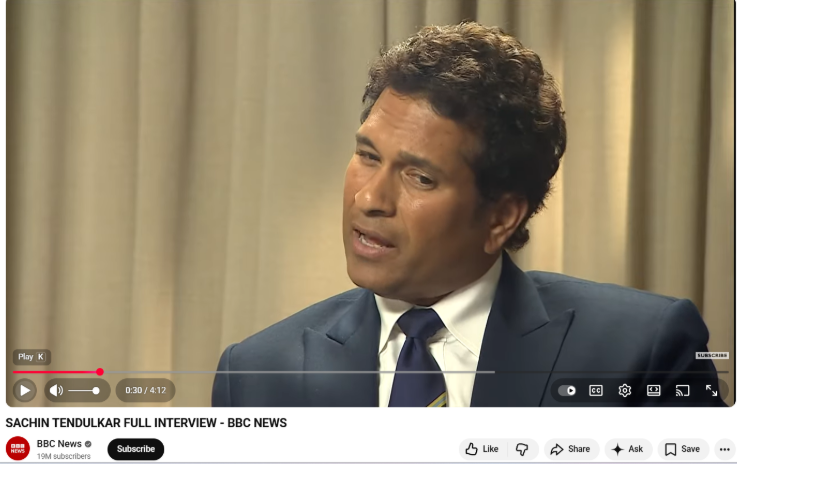
Upon closely examining the viral clip, we noticed that Sachin Tendulkar’s voice sounded unnatural and inconsistent. This raised suspicion of audio manipulation.
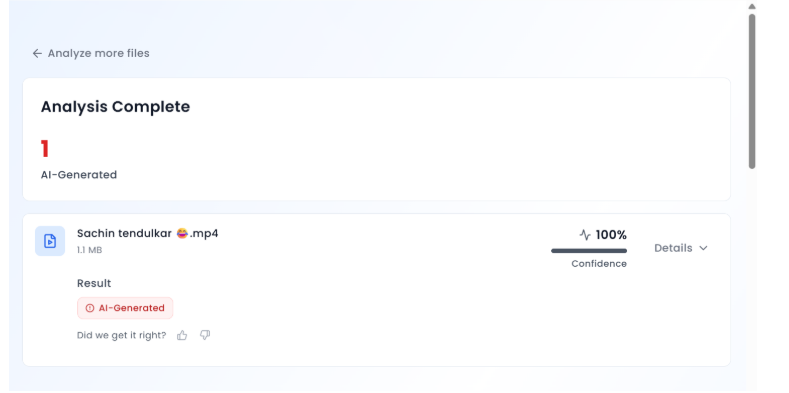
We then ran the viral video through an AI detection tool, Aurigin AI. According to the results, the audio in the video was found to be 100 percent AI-generated, confirming that Tendulkar never made the statements attributed to him in the clip.
Conclusion
Our research confirms that the viral video claiming Sachin Tendulkar commented on Joe Root’s centuries is fake. The video has been created using AI-generated audio and misleadingly combined with visuals from a 2013 interview. Users are sharing this manipulated clip on social media with a false claim.

Related Blogs
Executive Summary
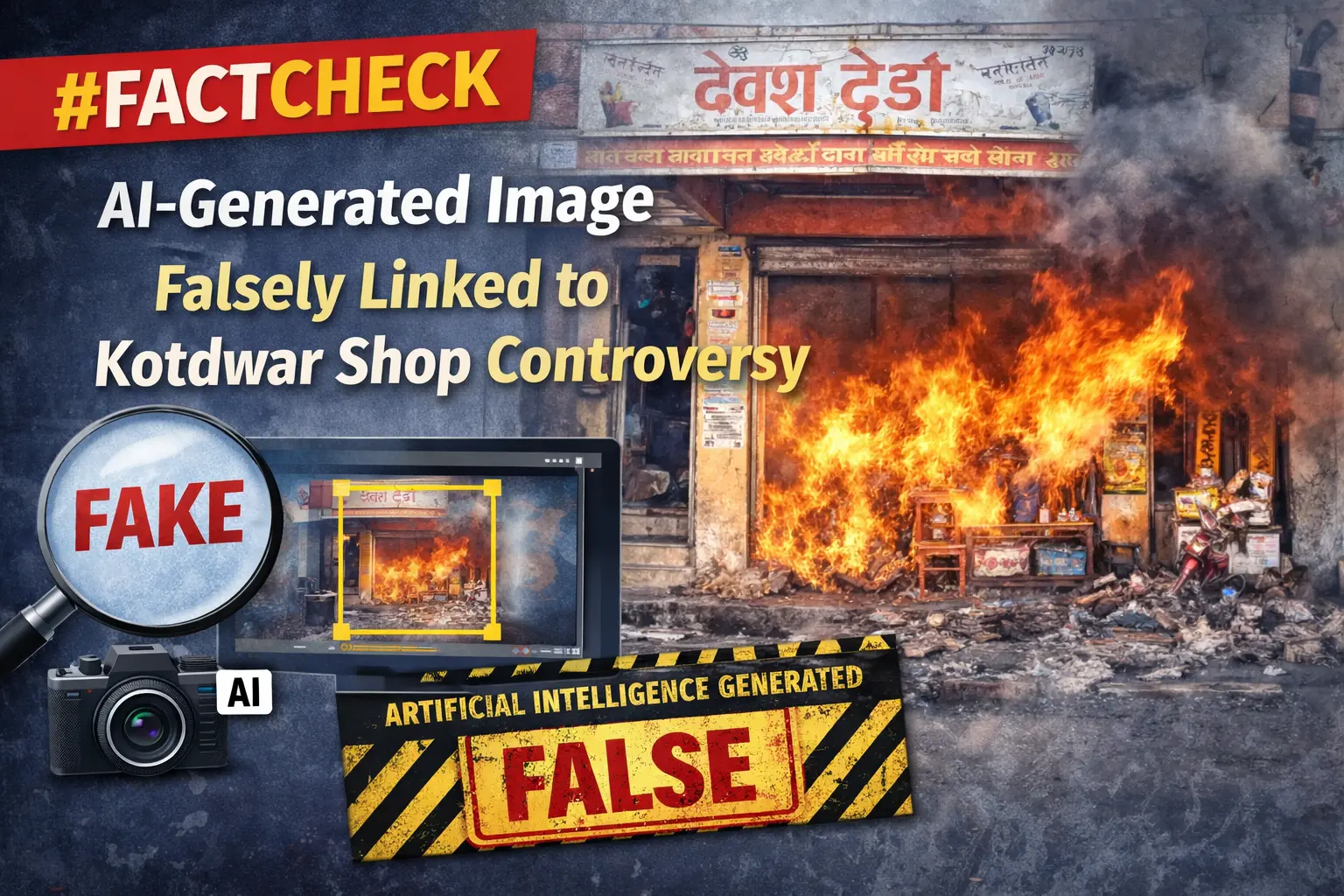
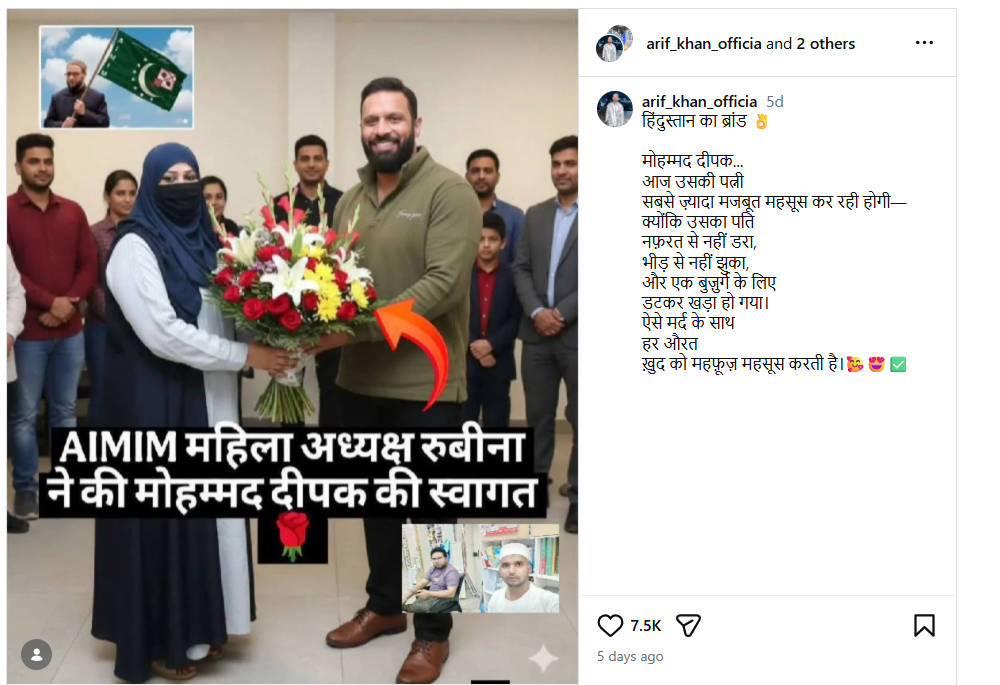
A dispute had recently emerged in Kotdwar, Uttarakhand, over the name of a shop. During the controversy, a local youth, Deepak Kumar, came forward in support of the shopkeeper. The incident subsequently became a subject of discussion on social media, with users expressing varied reactions. Meanwhile, a photo began circulating on social media showing a burqa-clad woman presenting a bouquet to Deepak Kumar. The image is being shared with the claim that All India Majlis-e-Ittehadul Muslimeen (AIMIM)’s women’s president, Rubina, welcomed “Mohammad Deepak Kumar” by presenting him with a bouquet. However, research conducted by the CyberPeace found the viral claim to be false. The research revealed that users are sharing an AI-generated image with a misleading claim.
Claim:
On social media platform Instagram, a user shared the viral image claiming that AIMIM’s women’s president Rubina welcomed “Mohammad Deepak Kumar” by presenting him with a bouquet. The link to the post, its archived version, and a screenshot are provided below.
Fact Check:
Upon closely examining the viral image, certain inconsistencies raised suspicion that it could be AI-generated. To verify its authenticity, the image was analysed using the AI detection tool Hive Moderation, which indicated a 96 percent probability that the image was AI-generated.

In the next stage of the research , the image was also analysed using another AI detection tool, Wasit AI, which likewise identified the image as AI-generated.

Conclusion
The research establishes that users are circulating an AI-generated image with a misleading claim linking it to the Kotdwar controversy.
Executive Summary
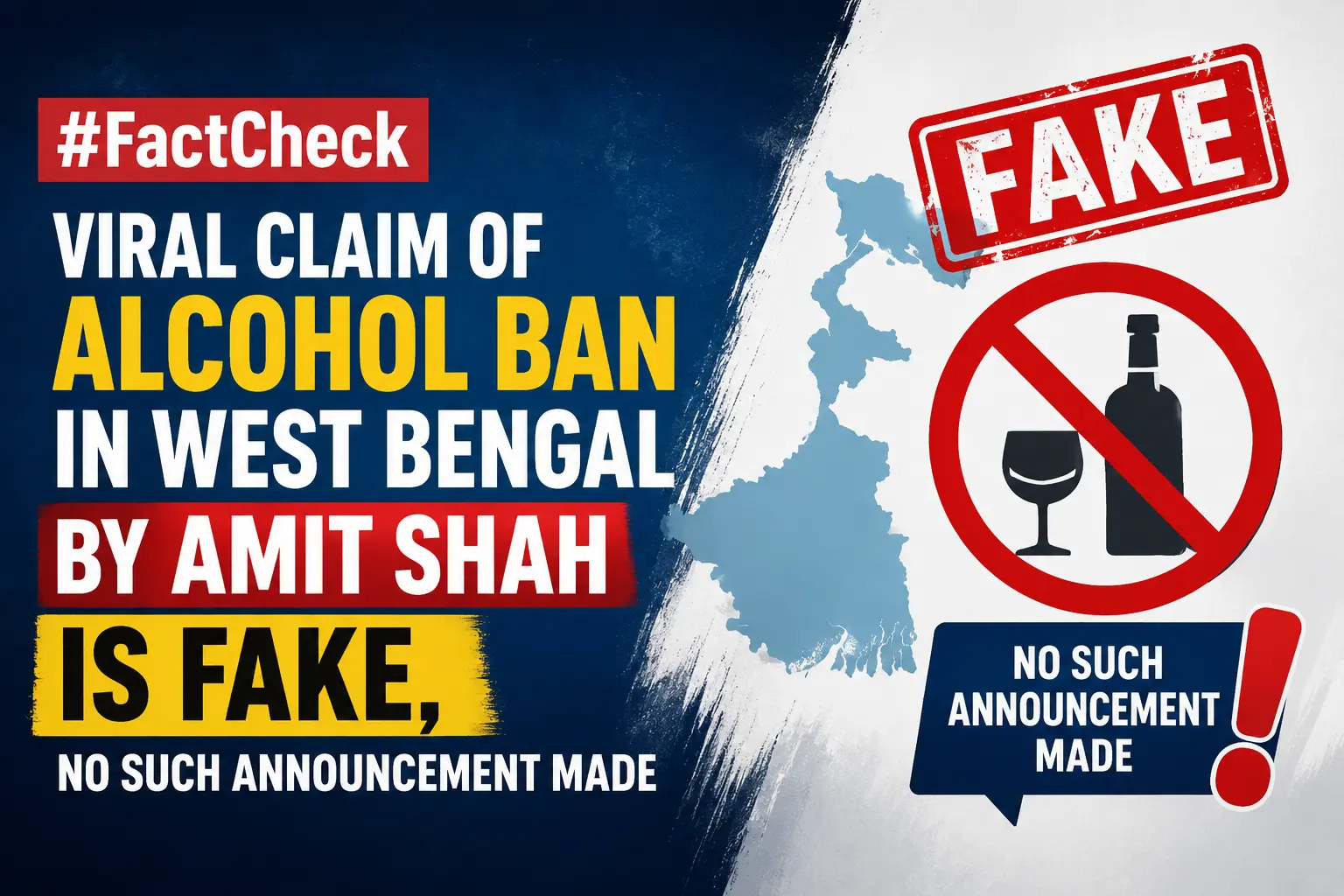
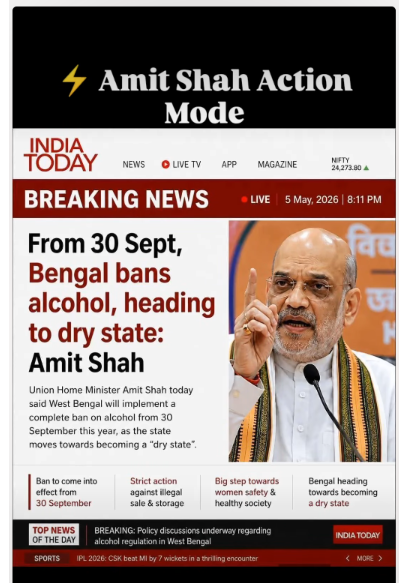
A graphic featuring Union Home Minister Amit Shah is being widely shared on social media, claiming that he has announced a complete ban on alcohol in West Bengal from September 30. The post further suggests that the state will move towards becoming a dry state. Notably, this claim surfaced soon after the BJP’s victory in the West Bengal Assembly elections. CyberPeace Research Wing research has found the viral claim to be false. Our research confirms that Home Minister Amit Shah has not made any such announcement.
Claim:
On Instagram, a user shared a viral graphic on May 8, 2026, alleging that Amit Shah announced a complete ban on alcohol in West Bengal starting September 30. The post link and archived version are provided below:
- https://www.instagram.com/reel/DYDy13zINV5/
- https://archive.ph/mYpZS
Fact Check
To verify the claim, we conducted a keyword-based search on Google. However, we did not find any credible media reports supporting the viral claim. Since the graphic carried the logo of India Today, we also checked the official website, YouTube channel, and social media handles of India Today. However, no matching report or graphic was found.
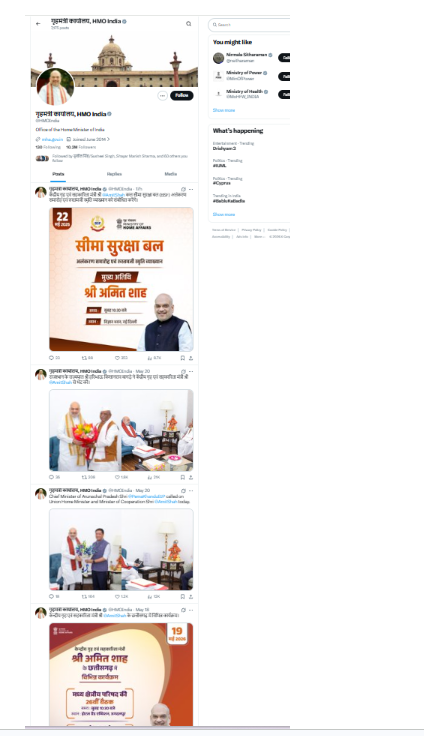
In the final step, we reviewed the official X account of the Ministry of Home Affairs. Even there, no statement or report confirming the viral claim was found. The relevant link is provided below:
- https://x.com/HMOIndia
Conclusion:
Our research confirms that Home Minister Amit Shah has made no such announcement regarding a complete alcohol ban in West Bengal.

Introduction
In September 2024, the Australian government announced the Communications Legislation Amendment (Combatting Misinformation and Disinformation) Bill 2024 ( CLA Bill 2024 hereon), to provide new powers to the Australian Communications and Media Authority (ACMA), the statutory regulatory body for Australia's communications and media infrastructure, to combat online misinformation and disinformation. It proposed allowing the ACMA to hold digital platforms accountable for the “seriously harmful mis- and disinformation” being spread on their platforms and their response to it, while also balancing freedom of expression. However, the Bill was subsequently withdrawn, primarily over concerns regarding the possibility of censorship by the government. This development is reflective of the global contention on the balance between misinformation regulation and freedom of speech.
Background and Key Features of the Bill
According to the BBC’s Global Minds Survey of 2023, nearly 73% of Australians struggled to identify fake news and AI-generated misinformation. There has been a substantial rise in misinformation on platforms like Facebook, Twitter, and TikTok since the COVID-19 pandemic, especially during major events like the bushfires of 2020 and the 2022 federal elections. The government’s campaign against misinformation was launched against this background, with the launch of The Australian Code of Practice on Disinformation and Misinformation in 2021. The main provisions of the CLA Bill, 2024 were:
- Core Transparency Obligations of Digital Media Platforms: Publishing current media literacy plans, risk assessment reports, and policies or information on their approach to addressing mis- and disinformation. The ACMA would also be allowed to make additional rules regarding complaints and dispute-handling processes.
- Information Gathering and Record-Keeping Powers: The ACMA would form rules allowing it to gather consistent information across platforms and publish it. However, it would not have been empowered to gather and publish user information except in limited circumstances.
- Approving Codes and Making Standards: The ACMA would have powers to approve codes developed by the industry and make standards regarding reporting tools, links to authoritative information, support for fact-checking, and demonetisation of disinformation. This would make compliance mandatory for relevant sections of the industry.
- Parliamentary Oversight: The transparency obligations, codes approved and standards set by ACMA under the Bill would be subject to parliamentary scrutiny and disallowance. ACMA would be required to report to the Parliament annually.
- Freedom of Speech Protections: End-users would not be required to produce information for ACMA unless they are a person providing services to the platform, such as its employees or fact-checkers. Further, it would not be allowed to call for removing content from platforms unless it involved inauthentic behavior such as bots.
- Penalties for Non-Compliance: ACMA would be required to employ a “graduated, proportionate and risk-based approach” to non-compliance and enforcement in the form of formal warnings, remedial directions, injunctions, or significant civil penalties as decided by the courts, subject to review by the Administrative Review Tribunal (ART). No criminal penalties would be imposed.
Key Concerns
- Inadequacy of Freedom of Speech Protections: The biggest contention on this Bill has been regarding the issue of possible censorship, particularly of alternative opinions that are crucial to the health of a democratic system. To protect the freedom of speech, the Bill defined mis- and disinformation, what constitutes “serious harm” (election interference, harming public health, etc.), and what would be excluded from its scope. However, reservations among the Opposition persisted due to the lack of a clear mechanism to protect divergent opinions from the purview of this Bill.
- Efficacy of Regulatory Measures: Many argue that by allowing the digital platform industry to make its codes, this law lets it self-police. Big Tech companies have no incentive to curb misinformation effectively since their business models allow them to reap financial benefits from the rampant spread of misinformation. Unless there are financial non- or dis- incentives to curb misinformation, Big Tech is not likely to address the situation at war footing. Thus, this law would run the risk of being toothless. Secondly, the Bill did not require platforms to report on the “prevalence of” false content which, along with other metrics, is crucial for researchers and legislators to track the efficacy of the current misinformation-curbing practices employed by platforms.
- Threat of Government Overreach: The Bill sought to expand the ACMA’s compliance and enforcement powers concerning misinformation and disinformation on online communication platforms by giving it powers to form rules on information gathering, code registration, standard-making powers, and core transparency obligations. However, even though the ACMA as a regulatory authority is answerable to the Parliament, the Bill was unclear in defining limits to these powers. This raised concerns from civil society about potential government overreach in a domain filled with contextual ambiguities regarding information.
Conclusion
While the Communications Legislation Amendment (Combatting Misinformation and Disinformation) Bill sought to equip the ACMA with tools to hold digital platforms accountable and mitigate the harm caused by false information, its critique highlights the complexities of regulating such content without infringing on freedom of speech. Legislations and proposals regarding the matter all over the world are having to contend with this challenge. Globally, legislation and proposals addressing this issue face similar challenges, emphasizing the need for a continuous discourse at the intersection of platform accountability, regulatory restraint, and the protection of diverse viewpoints.
To regulate Big Tech effectively, governments can benefit from adopting a consultative, incremental, and cooperative approach, as exemplified by the European Union’s Digital Services Act 2023. Such a framework provides for a balanced response, fostering accountability while safeguarding democratic freedoms.
Resources
- https://www.infrastructure.gov.au/sites/default/files/documents/factsheet-misinformation-disinformation-bill.pdf
- https://www.infrastructure.gov.au/have-your-say/new-acma-powers-combat-misinformation-and-disinformation
- https://www.mi-3.com.au/07-02-2024/over-80-australians-feel-they-may-have-fallen-fake-news-says-bbc
- https://www.hrlc.org.au/news/misinformation-inquiry
- https://humanrights.gov.au/our-work/legal/submission/combatting-misinformation-and-disinformation-bill-2024
- https://www.sbs.com.au/news/article/what-is-the-misinformation-bill-and-why-has-it-triggered-worries-about-freedom-of-speech/4n3ijebde
- https://www.hrw.org/report/2023/06/14/no-internet-means-no-work-no-pay-no-food/internet-shutdowns-deny-access-basic#:~:text=The%20Telegraph%20Act%20allows%20authorities,preventing%20incitement%20to%20the%20commission
- https://www.hrlc.org.au/submissions/2024/11/8/submission-combatting-misinformation?utm_medium=email&utm_campaign=Media%20Release%20Senate%20Committee%20to%20hear%20evidence%20calling%20for%20Albanese%20Government%20to%20regulate%20and%20hold%20big%20tech%20accountable%20for%20misinformation&utm_content=Media%20Release%20Senate%20Committee%20to%20hear%20evidence%20calling%20for%20Albanese%20Government%20to%20regulate%20and%20hold%20big%20tech%20accountable%20for%20misinformation+Preview+CID_31c6d7200ed9bd2f7f6f596ba2a8b1fb&utm_source=Email%20campaign&utm_term=Read%20the%20Human%20Rights%20Law%20Centres%20submission%20to%20the%20inquiry
