
#FactCheck - Viral Video Claiming Snowfall Near Ambience Mall in Gurugram Is Misleading
A video circulating widely on social media claims to show snowfall near Ambience Mall in Gurugram, Haryana. The clip is being shared alongside assertions that Gurugram witnessed snowfall for the first time in its history amid a severe cold wave in January 2026. However, an research by Cyber Peace Foundation has found the claim to be misleading. Our verification reveals that the viral video is not recent and has been available online since March 2023.
The Claim
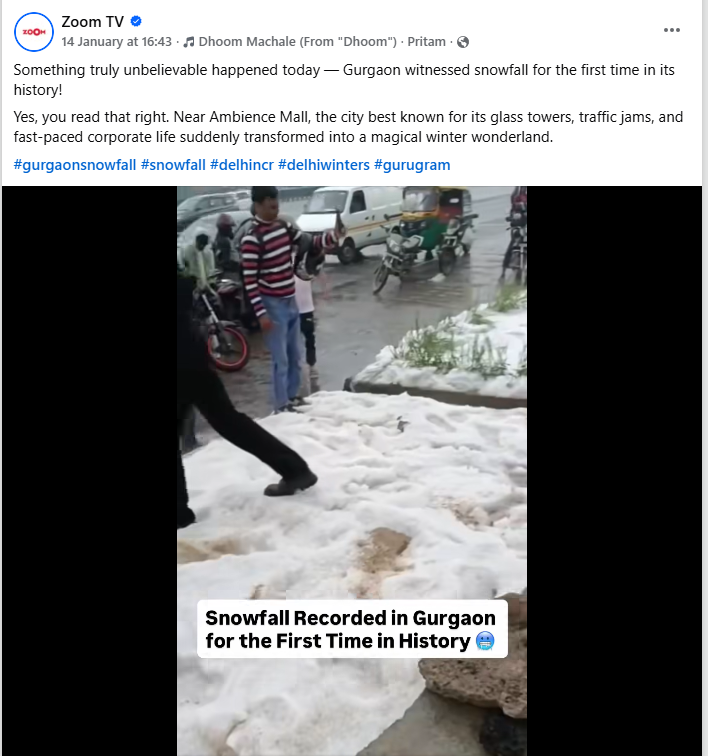
On 14 January 2026, a Facebook user shared the video with the caption,“Something truly unbelievable happened today — Gurgaon witnessed snowfall for the first time in its history!”Through this post, the user implied that the visuals showed snowfall near Ambience Mall during the ongoing cold wave.link and screeshot
- https://www.instagram.com/reel/DTfS9X9DyBo/?utm_source=ig_embed&ig_rid=239ddaf7-ec53-4b1d-8f3b-a5e39540b3ee
- https://archive.ph/JVjHf
Fact Check:
To verify the claim, we conducted a detailed search using relevant keywords but found no credible media reports or official statements to support it. Although Gurugram’s temperature dropped to 0.6 degrees Celsius amid an IMD-issued cold wave warning, there is no evidence to suggest that the city experienced snowfall or hail. As of January 16, 2026, weather records and official sources confirm that no such weather event occurred in Gurugram.
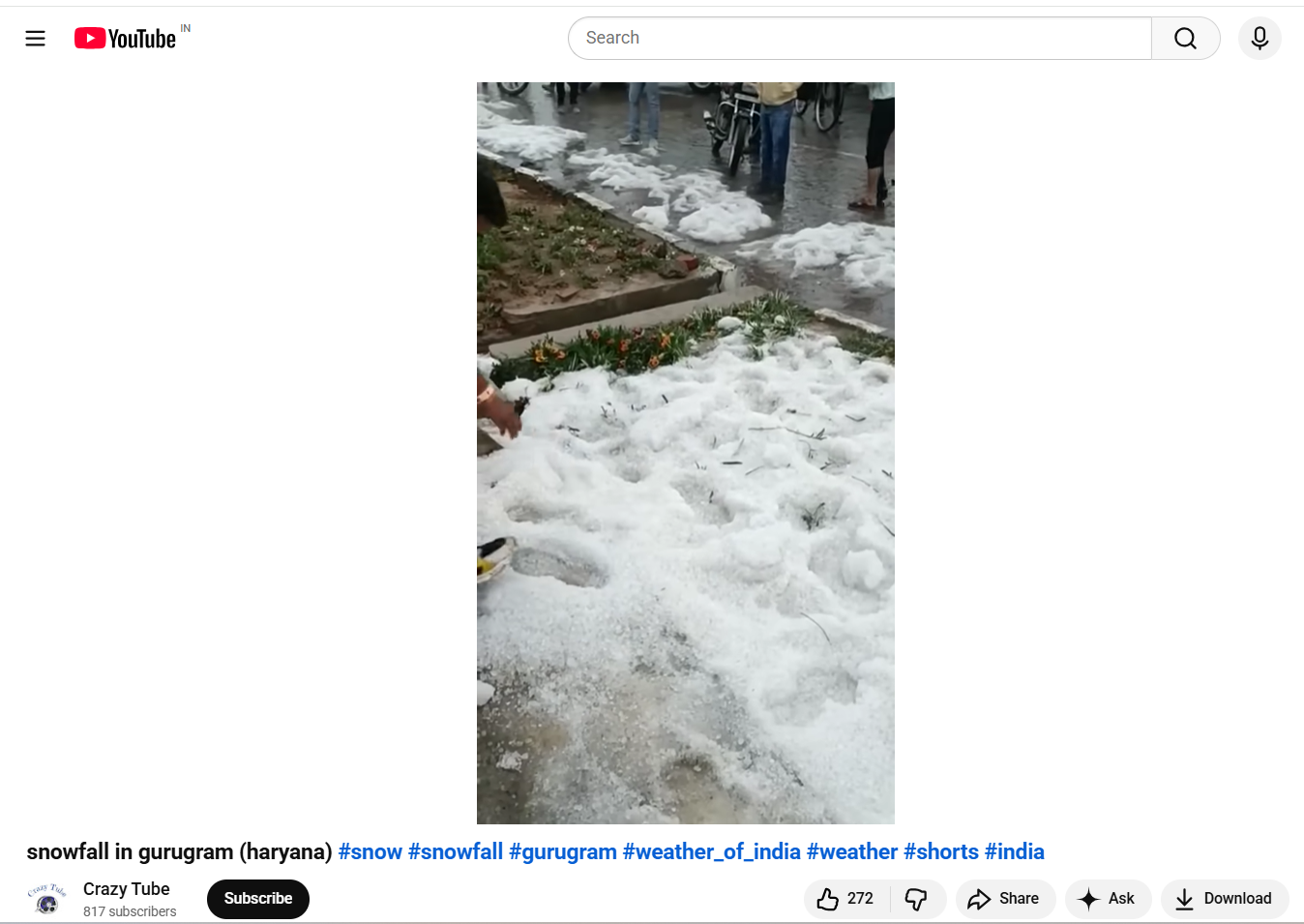
A reverse image search of keyframes extracted from the viral clip traced the same footage to a video uploaded on the YouTube channel Crazy Tube on March 21, 2023. This establishes that the video has been in circulation for nearly three years. In the original upload, the person filming clearly mentions that the visuals were recorded near a toll plaza, further indicating that the clip is unrelated to the recent weather conditions in Gurugram. Link and Screen Shot
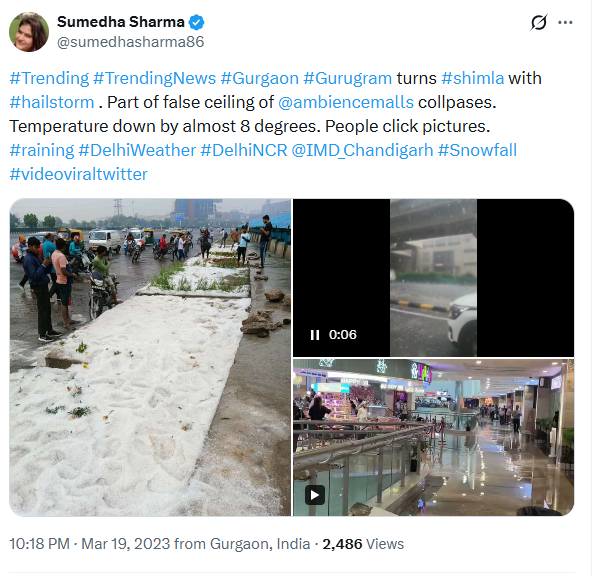
We also came across an X (formerly Twitter) post from March 19, 2023, which featured images similar to those seen in the viral video. The post described the visuals as being from a hailstorm in Gurugram, indicating that the content predates the current weather conditions and is unrelated to the recent cold wave.
Conclusion:
The video is old and predates January 2026, and has been on the internet at least since March 2023. While Gurugram recorded a low of 0.6 degrees Celsius amid an IMD cold wave warning, the city did not experience snowfall or hail as of 16 January 2026. News reports from March 2023 confirm heavy rain and hail in Delhi and adjoining areas, including parts of Gurugram, but there is no evidence of snowfall in January 2026. Hence, the claim made in the post is MISLEADING.

Related Blogs

Introduction
In recent years, India has witnessed a significant rise in the popularity and recognition of esports, which refers to online gaming. Esports has emerged as a mainstream phenomenon, influencing players and youngsters worldwide. In India, with the penetration of the internet at 52%, the youth has got its attracted to Esports. In this blog post, we will look at how the government is booting the players, establishing professional leagues, and supporting gaming companies and sponsors in the best possible manner. As the ecosystem continues to rise in prominence and establish itself as a mainstream sporting phenomenon in India.
Factors Shaping Esports in India: A few factors are shaping and growing the love for esports in India here. Let’s have a look.
Technological Advances: The availability and affordability of high-speed internet connections and smart gaming equipment have played an important part in making esports more accessible to a broader audience in India. With the development of smartphones and low-cost gaming PCs, many people may now easily participate in and watch esports tournaments.
Youth Demographic: India has a large population of young people who are enthusiastic gamers and tech-savvy. The youth demographic’s enthusiasm for gaming has spurred the expansion of esports in the country, as they actively participate in competitive gaming and watch major esports competitions.
Increase in the Gaming community: Gaming has been deeply established in Indian society, with many people using it for enjoyment and social contact. As the competitive component of gaming, esports has naturally gained popularity among gamers looking for a more competitive and immersive experience.
Esports Infrastructure and Events: The creation of specialised esports infrastructure, such as esports arenas, gaming cafés, and tournament venues, has considerably aided esports growth in India. Major national and international esports competitions and leagues have also been staged in India, offering exposure and possibilities for prospective esports players. Also supports various platforms such as YouTube, Twitch, and Facebook gaming, which has played a vital role in showcasing and popularising Esports in India.
Government support: Corporate and government sectors in India have recognised the potential of esports and are actively supporting its growth. Major corporate investments, sponsorships, and collaborations with esports organisations have supplied the financial backing and resources required for the country’s esports development. Government attempts to promote esports have also been initiated, such as forming esports governing organisations and including esports in official sporting events.
Growing Popularity and Recognition: Esports in India has witnessed a significant surge in viewership and fanbase, all thanks to online streaming platforms such as Twitch, YouTube which have provided a convenient way for fans to watch live esports events at home and at high-definition quality social media platforms let the fans to interact with their favourite players and stay updated on the latest esports news and events.

Esports Leagues in India
The organisation of esports tournaments and leagues in India has increased, with the IGL being one of the largest and most popular. The ESL India Premiership is a major esports event the Electronic Sports League organised in collaboration with NODWIN Gaming. Viacom18, a well-known Indian media business, established UCypher, an esports league. It focuses on a range of gaming games such as CS: GO, Dota 2, and Tekken in order to promote esports as a professional sport in India. All of these platforms provide professional players with a venue to compete and establish their profile in the esports industry.
India’s Performance in Esports to Date
Indian esports players have achieved remarkable global success, including outstanding results in prominent events and leagues. Individual Indian esports players’ success stories illustrate their talent, determination, and India’s ability to flourish in the esports sphere. These accomplishments contribute to the worldwide esports landscape’s awareness and growth of Indian esports. To add the name of the players and their success stories that have bought pride to India, they are Tirth Metha, Known as “Ritr”, a CS:GO player, Abhijeet “Ghatak”, Ankit “V3nom”, Saloni “Meow16K”.Apart from this Indian women’s team has also done exceptionally well in CS:GO and has made it to the finale.
Government and Corporate Sectors support: The Indian esports business has received backing from the government and corporate sectors, contributing to its growth and acceptance as a genuine sport.
Government Initiatives: The Indian government has expressed increased support for esports through different initiatives. This involves recognising esports as an official sport, establishing esports regulating organisations, and incorporating esports into national sports federations. The government has also announced steps to give financial assistance, subsidies, and infrastructure development for esports, therefore providing a favourable environment for the industry’s growth. Recently, Kalyan Chaubey, joint secretary and acting CEO of the IOA, personally gave the athletes cutting-edge training gear during this occasion, providing kits to the players. The kit includes the following:
Advanced gaming mouse.
Keyboard built for quick responses.
A smooth mousepad
A headphone for crystal-clear communication
An eSports bag to carry the equipment.
Corporate Sponsorship and Partnerships
Indian corporations have recognised esports’ promise and actively sponsored and collaborated with esports organisations, tournaments, and individual players. Companies from various industries, including technology, telecommunications, and entertainment, have invested in esports to capitalise on its success and connect with the esports community. These sponsorships and collaborations give financial support, resources, and visibility to esports in India. The leagues and championships provide opportunities for young players to showcase their talent.
Challenges and future
While esports provides great job opportunities, several obstacles must be overcome in order for the industry to expand and gain recognition:
Infrastructure & Training Facilities: Ensuring the availability of high-quality training facilities and infrastructure is critical for developing talent and allowing players to realise their maximum potential. Continued investment in esports venues, training facilities, and academies is critical for the industry’s long-term success.
Fostering a culture of skill development and giving outlets for formal education in esports would improve the professionalism and competitiveness of Indian esports players. Collaborations between educational institutions and esports organisations can result in the development of specialised programs in areas such as game analysis, team management, and sports psychology.
Establishing a thorough legal framework and governance structure for esports will help it gain legitimacy as a professional sport. Clear standards on player contracts, player rights, anti-doping procedures, and fair competition policies are all part of this.
Conclusion
Esports in India provide massive professional opportunities and growth possibilities for aspiring esports athletes. The sector’s prospects are based on overcoming infrastructure, perception, talent development, and regulatory barriers. Esports may establish itself as a viable and acceptable career alternative in India with continued support, investment, and stakeholder collaboration

Introduction
The Indian Computer Emergency Response Team, CERT-In, is the national statutory agency that responds to Cybersecurity Incidents under the Ministry of Electronics and Information Technology (MeitY) of the Government of India. CERT-In and Information Sharing and Analysis Center (ISAC) have joined hands to develop a focused pool of Cybersecurity Leaders through the National Cyber Security Scholar Program (NCSSP). This National Cyber Security Scholar Program is to create a pool of credible and ethical cybersecurity leaders in the country who prioritise national cyber security in their professional endeavours. This program allows both organisations to jointly issue joint certifications for Cohort 6 of the National Cyber Security Scholar Program (NCSSP). This certification is provided to cybersecurity professionals who complete one of the world’s leading cybersecurity management programs.
About the Program
The National Cybersecurity Scholar (NCSS) is a comprehensive 18-week, 160-hour Instructor-led program for emerging cybersecurity leaders. The ISAC will conduct the program with CERT-IN and KDEM as knowledge partners. This Cyber Security Scholar program aims to provide an extraordinary opportunity, for scholars, to gain hands-on experience in real-world scenarios through activities such as war games. It will allow scholars to acquaint themselves with roles such as that of stakeholders, including attackers, Security Operations Centre (SOC) teams, Forensicators, Chief Information Security Officers (CISOs), and CEOs, and engage in tabletop exercises that simulate a cyber crisis. This program would allow scholars to understand how responses to cyber crises impact the financial performance of an organisation, including, stock prices and sales. It offers a treasure trove of insights into the economic impact of cybersecurity decisions and the importance of proactive risk management.
The program invites applications from various scholars including Mid to senior-level leaders, diplomats and diplomatic corps officers, mid to senior-level government officials involved in homeland and cybersecurity operations, experienced executives from Managed Security Services Providers (MSSPs), faculty members who specialise in new and emerging technologies, cybersecurity professionals in CII sectors and post-doctoral or research scholars in cybersecurity.
CyberPeace Outlook
The National Cyber Security Scholar Program subsumes several key dimensions working towards building a resilient cybersecurity ecosystem for India.
- The program focuses on skill development and enhancing scholars’ knowledge in domains of network security, ethical hacking, cyber forensics, incident response, malware analysis, and threat intelligence.
- The partnership between CERT-In and ISAC, government and Industry entities, ensures that scholars are exposed to different policy-level frameworks and technical expertise, offering a unique blend of perspectives that cater to the country's national security goals and industry best practices.
- The scholar program encourages the development of new methodologies, tools, and frameworks that could be instrumental in tackling future cyber challenges and advancing India's position as a global leader in cybersecurity research and development. Research and innovation in cybersecurity are critical to the program.
- It plays a significant role in providing opportunities for career development by further providing networking platforms with professionals, researchers, and thought leaders in the cybersecurity field, giving them exposure to internships, job placements, and further academic pursuits.
This program aims to support upskilling India’s broader cyber defence strategy through the creation of highly skilled professionals. The scholars are expected to contribute actively to national cybersecurity efforts, whether through roles in government, private sector, or academia, helping to create a more secure and resilient cyberspace. The National Cyber Security Scholar Program is a major advancement in strengthening cybersecurity resilience in India. In a digital world where cyber threats crossing boundaries, such programs are essential for maintaining our national security and economic stability.
References
- https://theprint.in/ani-press-releases/cert-in-and-isac-collaborate-to-develop-focussed-pool-of-cybersecurity-leaders-through-the-national-cyber-security-scholar-program-ncssp/2318021/
- https://isacfoundation.org/national-cyber-security-scholar/
- https://cyberversefoundation.org/national-cyber-security-scholar/
Introduction
In the contemporary information environment, misinformation has emerged as a subtle yet powerful force capable of shaping public perception, influencing behavior, and undermining institutional credibility. Unlike overt falsehoods, misinformation often gains traction because it appears authentic, familiar, and authoritative. The rapid circulation of content through digital platforms has intensified this challenge, allowing altered or misleading material to reach wide audiences before verification mechanisms can respond. When misinformation mimics official communication, its impact becomes especially concerning, as citizens tend to place implicit trust in documents that carry the appearance of state authority. This growing vulnerability of public information systems was illustrated by the calendar incident in Himachal Pradesh in January 2026.
The calendar incident of Himachal Pradesh in January 2026 shows how a small lie can lead to large social and governance problems. A person whose identity is still unknown posted a modified version of the Government Calendar 2026, changing the official dates and resulting in public confusion and reputational damage to the Printing and Stationery Department. The incident may not appear very serious at first sight, but it indicates a deeper systemic issue. Misinformation is posing increasing dangers to public information ecosystems, especially when official documents are misrepresented and disseminated through digital platforms.
Misinformation as a Governance Challenge
Government calendars and official documents are necessary for public awareness and administrative coordination, and their manipulation impedes the credibility of institutions and the trustworthiness of governance. In Himachal Pradesh, modified dates might have led to confusion regarding public holidays, interference in school and administrative planning, and misinformation among the people. Such misinformation is a direct interference in the social contract that exists between the citizens and the State, where accurate information is the foundation of trust, compliance, and participation.
Impact on Citizens: Confusion, Distrust, and Digital Fatigue
For the general public, the dissemination of fake government information leads to a situation where people are confused and, at the same time, lose their trust in the government communication channels. If someone continuously gets to see the changed or misleading information misrepresented as credible, that person will find it hard to differentiate the truth from lies in the end.
This results in:
- Decision paralysis occurs when the public cannot make up their minds and either postpones or refrains from action due to the doubts they have
- Erosion of trust, not only in one department but also in the whole government communications department
- Digital fatigue occurs when people stop following public information completely, since they think that all content can be unreliable
Misinformation in a digital society is not limited to one platform only. It spreads quickly through direct messaging apps, community groups, and social networks, thus creating greater confusion among people before the official clarifications can reach the same audience.
Institutional Harm and Reputational Damage
The intentional tampering with official documents is not only a violation of ethics but also a crime and an immoral act from a governance perspective. The Printing and Stationery Department noted that such practices tarnish the public image of government bodies, which are based on accuracy, neutrality, and trust.
When untrue material gets to be known as official content:
- Departments have to communicate reactively.
- Money and manpower that could have been used for the normal administrative work are now spent on the control of the situation.
The registration of a First Information Report (FIR) in this matter is an indication of the gradual shift in the perception of law enforcement agencies that misinformation is not a playful act but rather a technology-assisted crime with serious consequences.
The Role of Verifiable Information and Trusted Sources
Such occurrences stress the need for trustworthy information as well as confirmed sources to be at the centre of the digital era. It should be the responsibility of the authorities to lead the citizens to practice and ENABLING to depend on official websites, verified social media accounts, government portals, and press releases for authentication.
Platform Responsibility and Digital Literacy
The spread of misinformation poses a significant challenge for social media platforms, which frequently amplify highly engaging content. There are some ways that the social media networks can try to limit the damage, and these are: tagging of non-verified material, limiting the sharing and working with authorities in the area of fact-checking support. However, one more thing which is crucial here is ‘public knowledge’ about digital platforms, as even unintentional dissemination of fake “official” materials can lead to legal and social repercussions. The advice of the Himachal state government is a good thing, but constantly informing the public is still a requirement.
Legal Accountability as a Deterrent
The active participation of the Cyber Crime Cells unequivocally indicates that digital misinformation, especially involving government documents, will face severe consequences. The establishment of legal responsibility acts as a preventive measure and reiterates the notion that the right to speak one's mind does not cover the right to lie or undermine public institutions. Nonetheless, to have an effective enforcement, it has to be accompanied by preventive actions such as good communication, strong governance, and public trust-building. Consistent enforcement against digital misinformation can contribute to greater accountability within society. Digital Literacy programs should be conducted periodically for netizens and institutions.
Conclusion
The incident of the creation of fake calendars in Himachal Pradesh served as a signal for the authorities to adopt accurate communication strategies. The ratification of misinformation can be achieved only if there is shared participation of governments, digital platforms, citizens and civil societies. The main goal of all this is to maintain public trust and the dissemination of information in democratic processes.
