
Valentine’s Day - Online Scams to Watch Out For
Introduction
Valentine’s Day celebrates the bond between people, their romantic love, and their deep relationships with others. The increasing use of digital platforms in modern relationships has created a situation where cybercriminals use this time of year to exploit human emotions for money-making schemes. The period around 14 February often sees a rise in online romance scams, phishing attacks, and fake shopping websites that specifically target people who are emotionally vulnerable and active online. People need to be aware of these scams because this awareness helps them protect their personal information and their financial resources.
The Rise of Romance Scams
Modern romance scams have evolved from their original form because criminals now execute their schemes through more advanced methods. Fraudsters create authentic-looking fake identities, which they use to deceive victims through dating applications, social media platforms and networking websites. The profiles use stolen images and fake job histories, together with convincing emotional stories, which help them establish trust with potential victims.
Scammers usually begin their deception after they have built an emotional connection with their targets. Once trust is established, they introduce a crisis or an opportunity that pressures the victim to act quickly. This is often presented as a problem that needs urgent help or a chance that should not be missed, such as:
- A sudden medical emergency that requires money for treatment
- Requests for travel expenses to finally come and meet in person
- Fake investment opportunities that promise quick or guaranteed returns
- Demands for customs, courier, or clearance fees to release a supposed package or gift
They make the victim give money to them and buy gift cards and handle personal banking details. The scam takes place for several weeks or months until the victim starts to show doubt about what is happening. The psychological manipulation that occurs in romance scams causes severe harm to their victims. Victims experience two types of damage because criminals steal their money, and they suffer emotional pain, and their social standing gets damaged.
Fake E-Commerce and “Valentine’s Deals”
Valentine's Day marks the beginning of a shopping rush, which leads people to buy various gifts, including flowers, jewellery and customised products, as well as making reservations for events. Cybercriminals create fake websites to exploit this demand by providing fake discounts and temporary promotional offers.
Common warning signs include:
- Newly registered domains that lack valid user reviews
- Websites that contain multiple spelling mistakes and display poor design
- Payment requests through methods that cannot be tracked
- Online platforms that lack secure payment processing systems
Consumers who make purchases on such sites face the risk of losing money while their card information is stolen for future fraudulent activities.
Phishing in the Name of Love
During the holiday season, phishing campaigns increase their focus on particular targets. Users may receive:
- Valentine's Day discount emails
- Messages that claim to show secret admirer intentions
- Links that lead to supposed romantic surprises
- Delivery notifications that inform about unreceived gifts
Malicious links result in credential theft, malware installation and unauthorised financial transactions. At first glance, these attacks show resemblance to authentic brands and logistics companies, which makes them hard to identify.
Investment and Crypto Romance Fraud
A rising type of romance scams now uses cryptocurrency and online trading platforms as their new approach. Scammers who establish trust with their victims will convince them to invest in digital assets that appear to generate high returns. The fake dashboards display excellent investment results to convince investors to commit more funds. The process stops when they block all withdrawal requests and stop all contact with the user. The combination of emotional manipulation with financial fraud shows how cybercrime develops according to technological advancements.
Why Seasonal Scams Work
Seasonal scams succeed because they match the predictable behaviour patterns that people exhibit during specific times of the year. During Valentine’s season:
- People experience their highest emotional vulnerability
- People shop more frequently through online platforms
- People use digital platforms at increased rates
- Users will decrease their level of scepticism while trying to establish connections with others
Cybercriminals use urgent situations together with emotional ties and social norms as their primary attack methods. The combination of psychological triggers and digital convenience creates fertile ground for deception.
CyberPeace Recommendations for Staying Safe This Valentine’s Season
The digital platforms provide people who search for connections with valuable opportunities to connect with others, yet users must remain careful about their online activities. People can protect themselves from online fraud by following these steps:
- They should confirm identity details before they give away their private data.
- They should not send money to people whom they met only through internet platforms.
- They should verify website ownership and examine customer feedback before making online purchases.
- They should activate multi-factor authentication for their social media accounts and financial accounts.
- People should treat unexpected links with great care, especially those links that create a sense of urgency.
- The Cybercrime reporting portal www.cybercrime.gov.in with 24x7 helpline 1930 is an effective tool at the disposal of victims of cybercrimes to report their complaints.
- In case of any cyber threat, issue or discrepancy, you can also seek assistance from the CyberPeace Helpline at +91 9570000066 or write to us at helpline@cyberpeace.net. Immediate reporting protects victims and helps to combat cybercrime.
Conlusion
Online safety during festive seasons requires shared responsibility among multiple parties. Digital resilience is strengthened through the combined efforts of platforms, financial institutions, regulators, and civil society organisations. The digital ecosystem becomes safer through three essential elements, which include awareness campaigns, stronger verification systems, and timely reporting mechanisms.
Valentine’s Day centres on the building of trust between people who want to connect with each other. To maintain trust in digital environments, users need to practice digital literacy skills, which should be shared by everyone. People who stay updated about cybersecurity threats can celebrate Valentine’s Day more safely, because their expressions of love remain protected from online scams.
References
- https://www.cloudsek.com/blog/valentines-day-cyber-attack-landscape-exploiting-love-through-digital-deception
- https://about.fb.com/news/2025/02/how-avoid-romance-scams-this-valentines-day/
- https://www.fbi.gov/contact-us/field-offices/sanfrancisco/fbi-san-francisco-warns-romance-scams-increasing-across-the-bay-area-this-valentines-day
- https://abc11.com/post/romance-scams-surge-ahead-valentines-day/18581079/
- https://www.moneycontrol.com/technology/5-common-online-scams-you-should-avoid-this-valentine-s-day-article-13820108.html

Related Blogs

Introduction
The Indian Ministry of Information and Broadcasting has proposed a new legislation. On the 10th of November, 2023, a draft bill emerged, a parchment of governance seeking to sculpt the contours of the nation's broadcasting landscape. The Broadcasting Services (Regulation) Bill, 2023, is not merely a legislative doctrine; it is a harbinger of change, an attestation to the storm of technology and the diversification of media in the age of the internet.
The bill, slated to replace the Cable Television Networks (Regulation) Act of 1995, acknowledges the paradigm shifts that have occurred in the media ecosystem. The emergence of Internet Protocol Television (IPTV), over-the-top (OTT) platforms and other digital broadcasting services has rendered the previous legislation a relic, ill-suited to the dynamism of the current milieu. The draft bill, therefore, stands at the precipice of the future, inviting stakeholders and the vox populi to weigh in on its provisions, to shape the edifice of regulation that will govern the airwaves and the digital streams.
Defining the certain Clauses of the bill
Clause 1 (dd) - The Programme
In the intricate tapestry of the bill's clauses, certain threads stand out, demanding scrutiny and careful consideration. Clause 1(dd), for instance, grapples with the definition of 'Programme,' a term that, in its current breadth, could ensnare the vast expanse of audio, visual, and written content transmitted through broadcasting networks. The implications are profound: content disseminated via YouTube or any website could fall within the ambit of this regulation, a prospect that raises questions about the scope of governmental oversight in the digital realm.
Clause 2(v) - The news and current affairs
Clause 2(v) delves into the murky waters of 'news and current affairs programmes,' a definition that, as it stands, is a maelstrom of ambiguity. The phrases 'newly-received or noteworthy audio, visual or audio-visual programmes' and 'about recent events primarily of socio-political, economic or cultural nature' are a siren's call, luring the unwary into a vortex of subjective interpretation. The threat of potential abuse looms larger, threatening the right to freedom of expression enshrined in Article 19 of the Indian Constitution. It is a clarion call for stakeholders to forge a definition that is objective and clear, one that is in accordance with the Supreme Court's decision in Shreya Singhal v. Union of India, which upheld the sanctity of digital expression while advocating for responsible content creation.
Clause 2(y) Over the Top Broadcasting Services
Clause 2(y) casts its gaze upon OTT broadcasting services, entities that operate in a realm distinct from traditional broadcasting. The one-to-many paradigm of broadcast media justifies a degree of governmental control, but OTT streaming is a more intimate affair, a one-on-one engagement with content on personal devices. The draft bill's attempt to umbrella OTT services under the broadcasting moniker is a conflation that could stifle the diversity and personalised nature of these platforms. It is a conundrum that other nations, such as Australia and Singapore, have approached with nuanced regulatory frameworks that recognise the unique characteristics of OTT services.
Clause 4(4) - Requirements for Broadcasters and Network Operators
The bill's journey through the labyrinth of regulation is fraught with other challenges. The definition of 'Person' in Clause 2(z), the registration exemptions in Clause 4(4), the prohibition on state governments and political parties from engaging in broadcasting in Clause 6, and the powers of inspection and seizure in Clauses 30(2) and 31, all present a complex puzzle. Each clause, each sub-section, is a cog in the machinery of governance that must be calibrated with precision to balance the imperatives of regulation with the freedoms of expression and innovation.
Clause 27 - Advisory Council
The Broadcast Advisory Council, envisioned in Clause 27, is yet another crucible where the principles of impartiality and independence must be tempered. The composition of this council, the public consultations that inform its establishment, and the alignment with constitutional principles are all vital to its legitimacy and efficacy.
A Way Forward
It is up to us, as participants in the democratic process and citizens, to interact with the bill's provisions as it makes its way through the halls of public discourse and legislative examination. To guarantee that the ultimate version of the Broadcasting Services (Regulation) Bill, 2023, is a symbol of advancement and a charter that upholds our most valued liberties while welcoming the opportunities presented by the digital era, we must employ the instruments of study and discussion.
The draft bill is more than just a document in this turbulent time of transition; it is a story of India's dreams, a testament to its dedication to democracy, and a roadmap for its digital future. Therefore, let us take this duty with the seriousness it merits, as the choices we make today will have a lasting impact on the history of our country and the media environment for future generations.
References
- https://scroll.in/article/1059881/why-indias-new-draft-broadcast-bill-has-raised-fears-of-censorship-and-press-suppression#:~:text=The%20bill%20extends%20the%20regulatory,regulation%20through%20content%20evaluation%20committees.
- https://pib.gov.in/PressReleasePage.aspx?PRID=1976200
- https://www.hindustantimes.com/india-news/new-broadcast-bill-may-also-cover-those-who-put-up-news-content-online-101701023054502.html

Executive Summary
A video has recently gone viral on social media, with claims that it shows Iranian air defence systems intercepting attacks by US fighter jets. The video is being widely shared across various social media platforms, linking it to the ongoing military tensions between Iran and the United States. CyberPeace’s research found the viral claim to be misleading. The research revealed that the video is old and has no connection with the ongoing war between Iran and the US or any recent military action.
Claim:
A video shared on the social media platform X claims that Iranian air defence systems are responding to an attack by US aircraft.
https://x.com/tvir_X/status/2095185048567968013?s=20

Factcheck
As part of our research, we conducted a reverse image search of the keyframes from the viral video. During the search, we found the same video on The Sun’s YouTube channel, where it was published on November 16, 2024. According to the video’s description, the incident took place in Odesa, Ukraine, where Ukrainian air defence systems engaged in a heavy confrontation with Russian drones. The descr
https://www.youtube.com/watch?v=TxECQr27wng

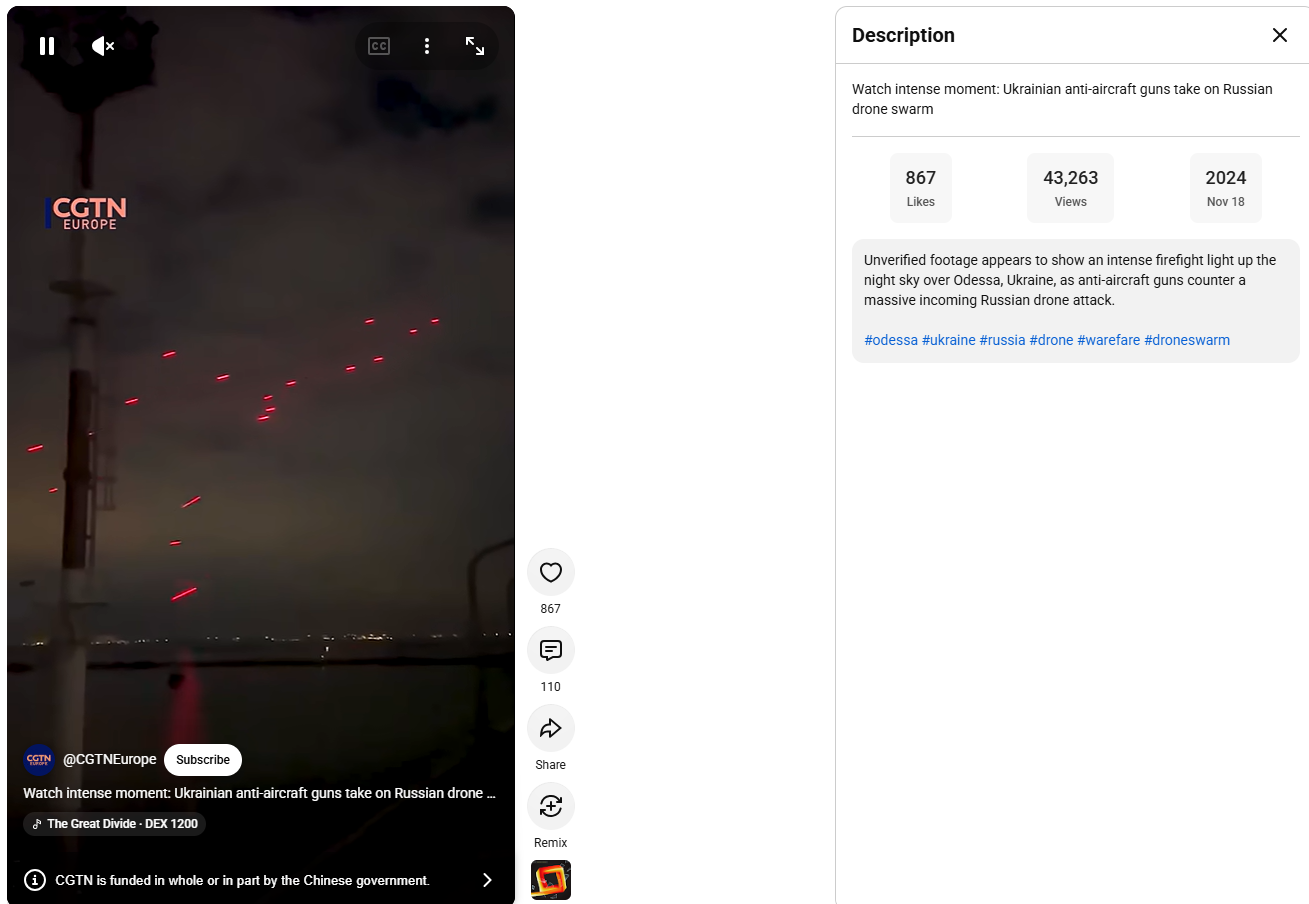
As part of our research, we found the video on the CGTN Europe YouTube channel, where it was published on November 18, 2024.The unverified footage appears to show heavy gunfire lighting up the night sky over Odesa, Ukraine. It is claimed that anti-aircraft guns were fired in response to a Russian drone attack.
https://www.youtube.com/shorts/Hq5P-UoPNHc
Conclusion:
The evidence gathered during our research makes it clear that the video circulating on social media is not related to the ongoing military tensions or any recent military action between Iran and the United States. A reverse image search revealed that the same video was published in November 2024. According to the video’s description, it shows Ukrainian air defence systems responding to a Russian drone attack in Odesa, Ukraine. Therefore, the claim that the viral video shows Iranian air defence systems intercepting attacks by US fighter jets is misleading.

Introduction
In an age where the lines between truth and fiction blur with an alarming regularity, we stand at the precipice of a new and dangerous era. Amidst the wealth of information that characterizes the digital age, deep fakes and disinformation rise like ghosts, haunting our shared reality. These manifestations of a technological revolution that promised enlightenment instead threaten the foundations upon which our societies are built: trust, truth, and collective understanding.
These digital doppelgängers, enabled by advanced artificial intelligence, and their deceitful companion—disinformation—are not mere ghosts in the machine. They are active agents of chaos, capable of undermining the core of democratic values, human rights, and even the safety of individuals who dare to question the status quo.
The Perils of False Narratives in the Digital Age
As a society, we often throw around terms such as 'fake news' with a mixture of disdain and a weary acceptance of their omnipresence. However, we must not understate their gravity. Misinformation and disinformation represent the vanguard of the digital duplicitous tide, a phenomenon growing more complex and dire each day. Misinformation, often spread without malicious intent but with no less damage, can be likened to a digital 'slip of the tongue' — an error in dissemination or interpretation. Disinformation, its darker counterpart, is born of deliberate intent to deceive, a calculated move in the chess game of information warfare.
Their arsenal is varied and ever-evolving: from misleading memes and misattributed quotations to wholesale fabrications in the form of bogus news sites and carefully crafted narratives. Among these weapons of deceit, deepfakes stand out for their audacity and the striking challenge they pose to the concept of seeing to believe. Through the unwelcome alchemy of algorithms, these video and audio forgeries place public figures, celebrities, and even everyday individuals into scenarios they never experienced, uttering words they never said.
The Human Cost: Threats to Rights and Liberties
The impact of this disinformation campaign transcends inconvenience or mere confusion; it strikes at the heart of human rights and civil liberties. It particularly festers at the crossroads of major democratic exercises, such as elections, where the right to a truthful, unmanipulated narrative is not just a political nicety but a fundamental human right, enshrined in Article 25 of the International Convention on Civil and Political Rights (ICCPR).
In moments of political change, whether during elections or pivotal referenda, the deliberate seeding of false narratives is a direct assault on the electorate's ability to make informed decisions. This subversion of truth infects the electoral process, rendering hollow the promise of democratic choice.
This era of computational propaganda has especially chilling implications for those at the frontline of accountability—journalists and human rights defenders. They find themselves targets of character assassinations and smear campaigns that not only put their safety at risk but also threaten to silence the crucial voices of dissent.
It should not be overlooked that the term 'fake news' has, paradoxically, been weaponized by governments and political entities against their detractors. In a perverse twist, this label becomes a tool to shut down legitimate debate and shield human rights violations from scrutiny, allowing for censorship and the suppression of opposition under the guise of combatting disinformation.
Deepening the societal schisms, a significant portion of this digital deceit traffic in hate speech. Its contents are laden with xenophobia, racism, and calls to violence, all given a megaphone through the anonymity and reach the internet so readily provides, feeding a cycle of intolerance and violence vastly disproportionate to that seen in traditional media.
Legislative and Technological Countermeasures: The Ongoing Struggle
The fight against this pervasive threat, as illustrated by recent actions and statements by the Indian government, is multifaceted. Notably, Union Minister Rajeev Chandrasekhar's commitment to safeguarding the Indian populace from the dangers of AI-generated misinformation signals an important step in the legislative and policy framework necessary to combat deepfakes.
Likewise, Prime Minister Narendra Modi's personal experience with a deepfake video accentuates the urgency with which policymakers, technologists, and citizens alike must view this evolving threat. The disconcerting experience of actor Rashmika Mandanna serves as a sobering reminder of the individual harm these false narratives can inflict and reinforces the necessity of a robust response.
In their pursuit to negate these virtual apparitions, policymakers have explored various avenues ranging from legislative action to penalizing offenders and advancing digital watermarks. However, it is not merely in the realm of technology that solutions must be sought. Rather, the confrontation with deepfakes and disinformation is also a battle for the collective soul of societies across the globe.
As technological advancements continue to reshape the battleground, figures like Kris Gopalakrishnan and Manish Gangwar posit that only a mix of rigorous regulatory frameworks and savvy technological innovation can hold the front line against this rising tidal wave of digital distrust.
This narrative is not a dystopian vision of a distant future - it is the stark reality of our present. And as we navigate this new terrain, our best defenses are not just technological safeguards, but also the nurturing of an informed and critical citizenry. It is essential to foster media literacy, to temper the human inclination to accept narratives at face value and to embolden the values that encourage transparency and the robust exchange of ideas.
As we peer into the shadowy recesses of our increasingly digital existence, may we hold fast to our dedication to the truth, and in doing so, preserve the essence of our democratic societies. For at stake is not just a technological arms race, but the very quality of our democratic discourse and the universal human rights that give it credibility and strength.
Conclusion
In this age of digital deceit, it is crucial to remember that the battle against deep fakes and disinformation is not just a technological one. It is also a battle for our collective consciousness, a battle to preserve the sanctity of truth in an era of falsehoods. As we navigate the labyrinthine corridors of the digital world, let us arm ourselves with the weapons of awareness, critical thinking, and a steadfast commitment to truth. In the end, it is not just about winning the battle against deep fakes and disinformation, but about preserving the very essence of our democratic societies and the human rights that underpin them.
