
G20 Conference on Crime and Security in the Age of NFTs, AI, and Metaverse
Introduction
Discussions took place focused on cybersecurity measures, specifically addressing cybercrime in the context of emerging technologies such as Non-Fungible Tokens (NFTs), Artificial Intelligence (AI), and the Metaverse. Session 5 of the conference focused on the interconnectedness between the darknet and cryptocurrency and the challenges it poses for law enforcement agencies and regulators. They discussed that Understanding AI is necessary for enterprises. AI models have difficulties, but we are looking forward to trustworthy AIs. and AI technology must be transparent.
Darknet and Cryptocurrency
The darknet refers to the hidden part of the internet where illicit activities have proliferated in recent years. It was initially developed to provide anonymity, privacy, and protection to specific individuals such as journalists, activists, and whistleblowers. However, it has now become a playground for criminal activities. Cryptocurrency, particularly Bitcoin, has been widely adopted on the darknet due to its anonymous nature, enabling anti-money laundering and unlawful transactions.
Three major points emerge from this relationship: the integrated nature of the darknet and cryptocurrency, the need for regulations to prevent darknet-based crimes, and the importance of striking a balance between privacy and security.
Key Challenges:
- Integrated Relations: The darknet and cryptocurrency have evolved independently, with different motives and purposes. It is crucial to understand the integrated relationship between them and how criminals exploit this connection.
- Regulatory Frameworks: There is a need for effective regulations to prevent crimes facilitated through the darknet and cryptocurrency while striking a balance between privacy and security.
- Privacy and Security: Privacy is a fundamental right, and any measures taken to enhance security should not infringe upon individual privacy. A multistakeholder approach involving tech companies and regulators is necessary to find this delicate balance.
Challenges Associated with Cryptocurrency Use:
The use of cryptocurrency on the darknet poses several challenges. The risks associated with darknet-based cryptocurrency crimes are a significant concern. Additionally, regulatory challenges arise due to the decentralised and borderless nature of cryptocurrencies. Mitigating these challenges requires innovative approaches utilising emerging technologies.
Preventing Misuse of Technologies:
The discussion emphasised that we can step ahead of the people who wish to use these beautiful technologies meant and developed for a different purpose, to prevent from using them for crime.
Monitoring the Darknet:
The darknet, as explained, is an elusive part of the internet that necessitates the use of a special browser for access. Initially designed for secure communication by the US government, its purpose has drastically changed over time. The darknet’s evolution has given rise to significant challenges for law enforcement agencies striving to monitor its activities.
Around 95% of the activities carried out on the dark net are associated with criminal acts. Estimates suggest that over 50% of the global cybercrime revenue originates from the dark net. This implies that approximately half of all cybercrimes are facilitated through the darknet.
The exploitation of the darknet has raised concerns regarding the need for effective regulation. Monitoring the darknet is crucial for law enforcement, national agencies, and cybersecurity companies. The challenges associated with the darknet’s exploitation and the criminal activities facilitated by cryptocurrency emphasise the pressing need for regulations to ensure a secure digital landscape.
Use of Cryptocurrency on the Darknet
Cryptocurrency plays a central role in the activities taking place on the darknet. The discussion highlighted its involvement in various illicit practices, including ransomware attacks, terrorist financing, extortion, theft, and the operation of darknet marketplaces. These applications leverage cryptocurrency’s anonymous features to enable illegal transactions and maintain anonymity.
AI's Role in De-Anonymizing the Darknet and Monitoring Challenges:
- 1.AI’s Potential in De-Anonymizing the Darknet
During the discussion, it was highlighted how AI could be utilised to help in de-anonymizing the darknet. AI’s pattern recognition capabilities can aid in identifying and analysing patterns of behaviour within the darknet, enabling law enforcement agencies and cybersecurity experts to gain insights into its operations. However, there are limitations to what AI can accomplish in this context. AI cannot break encryption or directly associate patterns with specific users, but it can assist in identifying illegal marketplaces and facilitating their takedown. The dynamic nature of the darknet, with new marketplaces quickly emerging, adds further complexity to monitoring efforts.
- 2.Challenges in Darknet Monitoring
Monitoring the darknet poses various challenges due to its vast amount of data, anonymous and encrypted nature, dynamically evolving landscape, and the need for specialised access. These challenges make it difficult for law enforcement agencies and cybersecurity professionals to effectively track and prevent illicit activities.
- 3.Possible Ways Forward
To address the challenges, several potential avenues were discussed. Ethical considerations, striking a balance between privacy and security, must be taken into account. Cross-border collaboration, involving the development of relevant laws and policies, can enhance efforts to combat darknet-related crimes. Additionally, education and awareness initiatives, driven by collaboration among law enforcement, government entities, and academia, can play a crucial role in combating darknet activities.
The panel also addressed the questions from the audience
- How law enforcement agencies and regulators can use AI to detect and prevent crimes on the darknet and cryptocurrency? The panel answered that- Law enforcement officers should also be AI and technology ready, and that kind of upskilling program should be there in place.
- How should lawyers and the judiciary understand the problem and regulate it? The panel answered that AI should only be applied by looking at the outcomes. And Law has to be clear as to what is acceptable and what is not.
- Aligning AI with human intention? Whether it’s possible? Whether can we create an ethical AI instead of talking about using AI ethically? The panel answered that we have to understand how to behave ethically. AI can beat any human. We have to learn AI. Step one is to focus on our ethical behaviour. And step two is bringing the ethical aspect to the software and technologies. Aligning AI with human intention and creating ethical AI is a challenge. The focus should be on ethical behaviour both in humans and in the development of AI technologies.
Conclusion
The G20 Conference on Crime and Security shed light on the intertwined relationship between the darknet and cryptocurrency and the challenges it presents to cybersecurity. The discussions emphasised the need for effective regulations, privacy-security balance, AI integration, and cross-border collaboration to tackle the rising cybercrime activities associated with the darknet and cryptocurrency. Addressing these challenges will require the combined efforts of governments, law enforcement agencies, technology companies, and individuals committed to building a safer digital landscape.

Related Blogs

Introduction
A Reuters investigation has uncovered an elephant in the room regarding Meta Platforms' internal measures to address online fraud and illicit advertising. The confidential documents that Reuters reviewed disclosed that Meta was planning to generate approximately 10% of its 2024 revenue, i.e., USD 16 billion, from ads related to scams and prohibited goods. The findings point out a disturbing paradox: on the one hand, Meta is a vocal advocate for digital safety and platform integrity, while on the other hand, the internal logs of the company indicate the existence of a very large area allowing the shunning of fraudulent advertisement activities that exploit users throughout the world.
The Scale of the Problem
Internal Meta projections show that its platforms, Facebook, Instagram, and WhatsApp, are displaying a staggering 15 billion scam ads per day combined. The advertisements include deceitful e-commerce promotions, fake investment schemes, counterfeit medical products, and unlicensed gambling platforms.
Meta has developed sophisticated detection tools, but even then, the system does not catch the advertisers until they are 95% certain to be fraudsters. By having at least that threshold for removing an ad, the company is unlikely to lose much money. As a result, instead of turning the fraud adjacent advertisers down, it charges them higher ad rates, which is the strategy they call “penalty bids” internally.
Internal Acknowledgements & Business Dependence
Internal documents that date between 2021 and 2025 reveal that the financial, safety, and lobbying divisions of Meta were cognizant of the enormity of revenues generated from scams. One of the 2025 strategic papers even describes this revenue source as "violating revenue," which implies that it includes ads that are against Meta's policies regarding scams, gambling, sexual services, and misleading healthcare products.
The company's top executives consider the cost-benefit scenario of stricter enforcement. According to a 2024 internal projection, Meta's half-yearly earnings from high-risk scam ads were estimated at USD 3.5 billion, whereas regulatory fines for such violations would not exceed USD 1 billion, thus making it a tolerable trade-off from a commercial viewpoint. At the same time, the company intends to scale down scam ad revenue gradually, thus from 10.1% in 2024 to 7.3% by 2025, and 6% by 2026; however, the documents also reveal a planned slowdown in enforcement to avoid "abrupt reductions" that could affect business forecasts.
Algorithmic Amplification of Scams
One of the most alarming situations is the fact that Meta's own advertising algorithms amplify scam content. It has been reported that users who click on fraudulent ads are more likely to see other similar ads, as the platform's personalisation engine assumes user "interest."
This scenario creates a self-reinforcing feedback loop where the user engagement with scam content dictates the amount of such content being displayed. Thus, a digital environment is created which encourages deceptive engagement and consequently, user trust is eroded and systemic risk is amplified.
An internal presentation in May 2025 was said to put a number on how deeply the platform's ad ecosystem was intertwined with the global fraud economy, estimating that one-third of the scams that succeeded in the U.S. were due to advertising on Meta's platforms.
Regulatory & Legal Implications
The disclosures arrived at the same time as the US and UK governments started to closely check the company's activities more than ever before.
- The U.S. Securities and Exchange Commission (SEC) is said to be looking into whether Meta has had any part in the promotion of fraudulent financial ads.
- The UK’s Financial Conduct Authority (FCA) found that Meta’s platforms were the main sources of scams related to online payments and claimed that the amount of money lost was more than all the other social platforms combined in 2023.
Meta’s spokesperson, Andy Stone, at first denied the accusations, stating that the figures mentioned in the leak were “rough and overly-inclusive”; nevertheless, he conceded that the company’s consistent efforts toward enforcement had negatively impacted revenue and would continue to do so.
Operational Challenges & Policy Gaps
The internal documents also reveal the weaknesses in Meta's day-to-day operations when it comes to the implementation of its own policies.
- Because of the large number of employees laid off in 2023, the whole department that dealt with advertiser-brand impersonation was said to have been dissolved.
- Scam ads were categorised as a "low severity" issue, which was more of a "bad user experience" than a critical security risk.
- At the end of 2023, users were submitting around 100,000 legitimate scam reports per week, of which Meta dismissed or rejected 96%.
Human Impact: When Fraud Becomes Personal
The financial and ethical issues have tangible human consequences. The Reuters investigation documented multiple cases of individuals defrauded through hijacked Meta accounts.
One striking example involves a Canadian Air Force recruiter, whose hacked Facebook account was used to promote fake cryptocurrency schemes. Despite over a hundred user reports, Meta failed to act for weeks, during which several victims, including military colleagues, lost tens of thousands of dollars.
The case underscores not just platform negligence, but also the difficulty of law enforcement collaboration. Canadian authorities confirmed that funds traced to Nigerian accounts could not be recovered due to jurisdictional barriers, a recurring issue in transnational cyber fraud.
Ethical and Cybersecurity Implications
The research has questioned extremely important things at least from the perspective of cyber policy:
- Platform Accountability: Meta, by its practice, is giving more importance to the monetary aspect rather than the truth, and in this way, it is going against the principles of responsible digital governance.
- Transparency in Ad Ecosystems: The lack of transparency in digital advertising systems makes it very easy for dishonest actors to use automated processes with very little supervision.
- Algorithmic Responsibility: The use of algorithms that impact the visibility of misleading content and targeting can be considered the direct involvement of the algorithms in the fraud.
- Regulatory Harmonisation: The presence of different and disconnected enforcement frameworks across jurisdictions is a drawback to the efforts in dealing with cross-border cybercrime.
- Public Trust: Users’ trust in the digital world is mainly dependent on the safety level they see and the accountability of the companies.
Conclusion
Meta’s records show a very unpleasant mix of profit, laxity, and failure in the policy area concerning scam-related ads. The platform’s readiness to accept and even profit from fraudulent players, though admitting the damage they cause, calls for an immediate global rethinking of advertising ethics, regulatory enforcement, and algorithmic transparency.
With the expansion of its AI-driven operations and advertising networks, protecting the users of Meta must evolve from being just a public relations goal to being a core business necessity, thus requiring verifiable accountability measures, independent audits, and regulatory oversight. It is an undeniable fact that there are billions of users who count on Meta’s platforms for their right to digital safety, which is why this right must be respected and enforced rather than becoming optional.
References
- https://www.reuters.com/investigations/meta-is-earning-fortune-deluge-fraudulent-ads-documents-show-2025-11-06/?utm_source=chatgpt.com
- https://www.indiatoday.in/technology/news/story/leaked-docs-claim-meta-made-16-billion-from-scam-ads-even-after-deleting-134-million-of-them-2815183-2025-11-07

CAPTCHA, or the Completely Automated Public Turing Test to Tell Computers and Humans Apart function, is an image or distorted text that users have to identify or interpret to prove they are human. 2007 marked the inception of CAPTCHA, and Google developed its free service called reCAPTCHA, one of the most commonly used technologies to tell computers apart from humans. CAPTCHA protects websites from spam and abuse by using tests considered easy for humans but were supposed to be difficult for bots to solve.
But, now this has changed. With AI becoming more and more sophisticated, it is now capable of solving CAPTCHA tests at a rate that is more accurate than humans, rendering them increasingly ineffective. This raises the question of whether CAPTCHA is still effective as a detection tool with the advancements of AI.
CAPTCHA Evolution: From 2007 Till Now
CAPTCHA has evolved through various versions to keep bots at bay. reCAPTCHA v1 relied on distorted text recognition, v2 introduced image-based tasks and behavioural analysis, and v3 operated invisibly, assigning risk scores based on user interactions. While these advancements improved user experience and security, AI now solves CAPTCHA with 96% accuracy, surpassing humans (50-86%). Bots can mimic human behaviour, undermining CAPTCHA’s effectiveness and raising the question: is it still a reliable tool for distinguishing real people from bots?
Smarter Bots and Their Rise
AI advancements like machine learning, deep learning and neural networks have developed at a very fast pace in the past decade, making it easier for bots to bypass CAPTCHA. They allow the bots to process and interpret the CAPTCHA types like text and images with almost human-like behaviour. Some examples of AI developments against bots are OCR or Optical Character Recognition. The earlier versions of CAPTCHA relied on distorted text: AI because of this tech is able to recognise and decipher the distorted text, making CAPTCHA useless. AI is trained on huge datasets which allows Image Recognition by identifying the objects that are specific to the question asked. These bots can mimic human habits and patterns by Behavioural Analysis and therefore fool the CAPTCHA.
To defeat CAPTCHA, attackers have been known to use Adversarial Machine Learning, which refers to AI models trained specifically to defeat CAPTCHA. They collect CAPTCHA datasets and answers and create an AI that can predict correct answers. The implications that CAPTCHA failures have on platforms can range from fraud to spam to even cybersecurity breaches or cyberattacks.
CAPTCHA vs Privacy: GDPR and DPDP
GDPR and the DPDP Act emphasise protecting personal data, including online identifiers like IP addresses and cookies. Both frameworks mandate transparency when data is transferred internationally, raising compliance concerns for reCAPTCHA, which processes data on Google’s US servers. Additionally, reCAPTCHA's use of cookies and tracking technologies for risk scoring may conflict with the DPDP Act's broad definition of data. The lack of standardisation in CAPTCHA systems highlights the urgent need for policymakers to reevaluate regulatory approaches.
CyberPeace Analysis: The Future of Human Verification
CAPTCHA, once a cornerstone of online security, is losing ground as AI outperforms humans in solving these challenges with near-perfect accuracy. Innovations like invisible CAPTCHA and behavioural analysis provided temporary relief, but bots have adapted, exploiting vulnerabilities and undermining their effectiveness. This decline demands a shift in focus.
Emerging alternatives like AI-based anomaly detection, biometric authentication, and blockchain verification hold promise but raise ethical concerns like privacy, inclusivity, and surveillance. The battle against bots isn’t just about tools but it’s about reimagining trust and security in a rapidly evolving digital world.
AI is clearly winning the CAPTCHA war, but the real victory will be designing solutions that balance security, user experience and ethical responsibility. It’s time to embrace smarter, collaborative innovations to secure a human-centric internet.
References
- https://www.business-standard.com/technology/tech-news/bot-detection-no-longer-working-just-wait-until-ai-agents-come-along-124122300456_1.html
- https://www.milesrote.com/blog/ai-defeating-recaptcha-the-evolving-battle-between-bots-and-web-security
- https://www.technologyreview.com/2023/10/24/1081139/captchas-ai-websites-computing/
- https://datadome.co/guides/captcha/recaptcha-gdpr/

Executive Summary:
A missile attack was reportedly carried out by Yemen-based Houthi militants at King Khalid International Airport in Riyadh, the capital of Saudi Arabia, on October 8, damaging an aircraft at the airport. Following the attack, a video has gone viral on social media. The video is being shared with the claim that it shows footage from the time of the Houthi attack. CyberPeace Research found that the video is not authentic. It was created using AI with the help of an image from 2016.
Claim:
A Facebook user shared the video with the caption: “New video footage has emerged showing the moments when King Khalid International Airport in Riyadh, the capital of Saudi Arabia, was targeted.”
https://www.facebook.com/reel/1482618257069151

Fact Check:
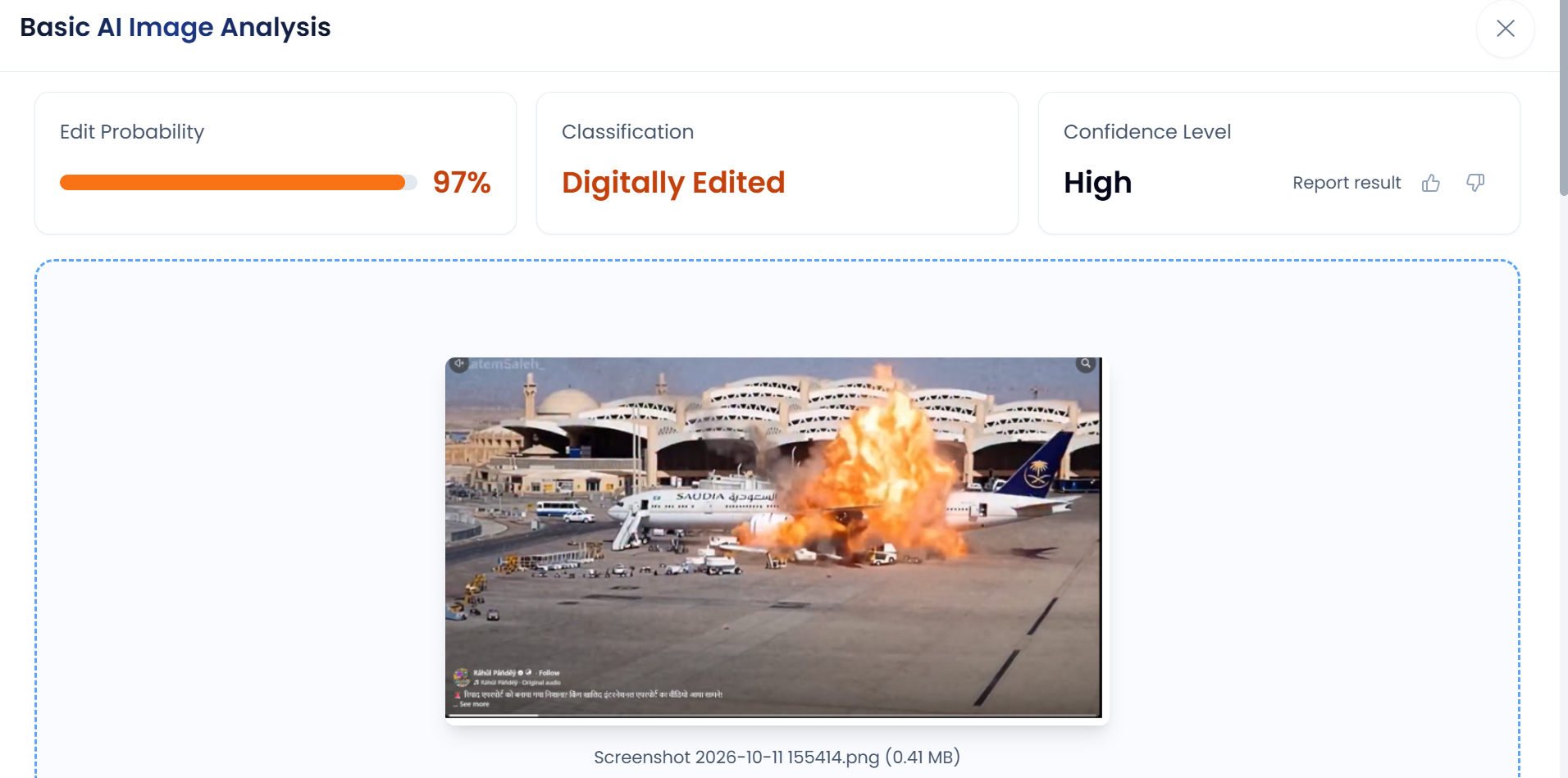
To verify the viral claim, we conducted a Google keyword search using relevant terms. However, we did not find any credible media reports corroborating the claim.A reverse image search led us to a similar image on the stock photo website Shutterstock. According to the listing, the image was taken on March 1, 2016, at King Khalid International Airport in Riyadh, showing an aircraft preparing for takeoff. A close examination of the viral video makes it clear that the same image was used to create the viral video.

Upon closely examining the viral video, we suspected that it could be AI-generated. We then scanned the viral video using the AI detection tool Undetectable AI. According to the results, the video was found to be 85% AI-generated.
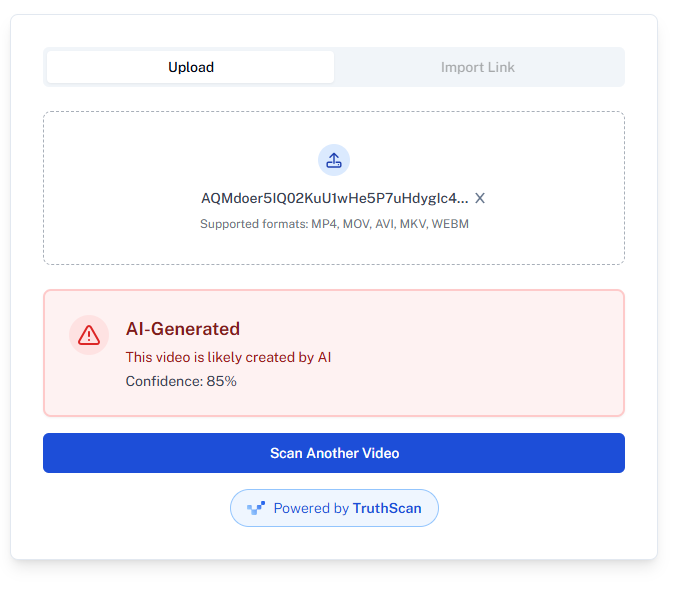
As part of our further research, we scanned the viral image using TruthScan. According to the results, the image was found to be 97% AI-generated.
Conclusion:
CyberPeace Research found the viral claim to be misleading. The video being shared as footage of the alleged Houthi missile attack on King Khalid International Airport in Riyadh is not authentic. Our research revealed that the video was AI-generated using a photograph taken at the airport on March 1, 2016. AI detection tools further indicated that the video and the image showed strong signs of being AI-generated.
